REVIEW 3 major objections 5 minor 74 references
Near the big bang, a non-stiff fluid's velocity in inhomogeneous cosmologies oscillates between tilted and orthogonal states, generating matter-density ripples.
Reviewed by Pith at T0; open to challenge. T0 means a machine referee read the full paper against a public rubric. the ladder, T0–T4 →
2026-08-03 16:52 UTC pith:J4YPL2GJ
load-bearing objection Solid, novel numerical evidence for tilt transitions in T2-symmetric non-stiff fluid cosmologies, but the untested path-dependence of the shock-capturing scheme and the over-strong causal claim in the abstract need attention before this is more than conditional. the 3 major comments →
Mixmaster Fluids Near the Big Bang
The pith
A machine-rendered reading of the paper's core claim, the machinery that carries it, and where it could break.
Core claim
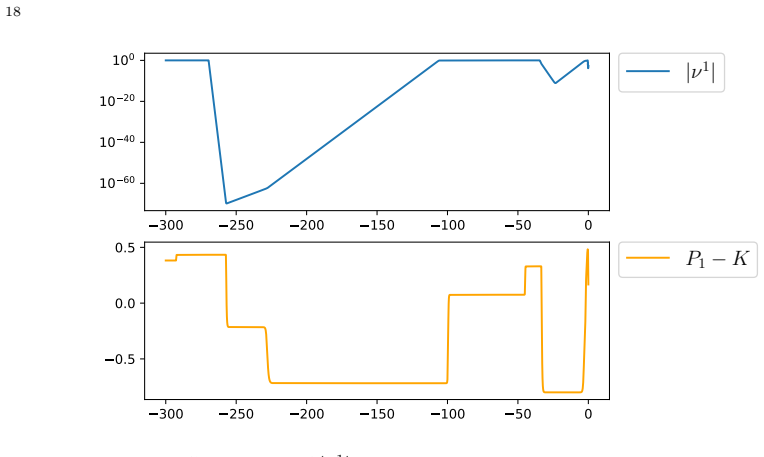
The central claim is that the approach to the singularity in inhomogeneous T^2-symmetric spacetimes with a non-stiff perfect fluid is local, oscillatory, and governed by the vacuum mixmaster dynamics with the fluid acting as a test field. The new observation is that the fluid velocity undergoes repeated tilt transitions, oscillating between orthogonal (|ν|=0) and extremely tilted (|ν|→1) states, in response to the Kasner oscillations of the gravitational field. The paper derives linearised trigger conditions — a velocity component grows when the corresponding Kasner exponent exceeds the sound-speed square K — and shows numerically that these conditions correctly predict the growth, decay, an
What carries the argument
The analysis is carried out in the β-normalised orthonormal-frame formulation of the Einstein-Euler equations for T^2-symmetric spacetimes in a timelike areal gauge. The key numerical tool is a path-conservative finite-volume scheme that evolves the primitive fluid variables (log T^00 and the three-velocity ν^A) directly, avoiding the primitive-recovery failures that occur when conserved variables decay; it also enforces the sub-luminal constraint |ν|<1 by rescaling. The physical mechanism is the tilt transition: at a given point, the fluid alternates between orthogonal and extremely tilted Kasner states, with the transition triggered by the sign of PA−K, where PA are the Kasner exponents an
Load-bearing premise
The numerical results assume that the periodic boundary conditions used for all runs do not alter the qualitative late-time behaviour — the paper itself notes that periodicity can suppress spatial-curvature growth and possibly change the initial inhomogeneous phase, and it does not compare with excision-type boundaries.
What would settle it
Run the same simulations with an excision-type or 'zooming' boundary (e.g., as used in some G2 cosmological codes) and compare the tilt-transition times and the spatial distribution of density-gradient spikes at late times; a qualitative mismatch with the periodic-boundary runs would falsify the claim that the observed oscillations are boundary-independent.
If this is right
- If the claim holds, the generalised BKL conjecture extends to inhomogeneous cosmologies with non-stiff perfect fluids: the approach to the singularity is local, oscillatory, and the fluid is a test field undergoing tilt transitions.
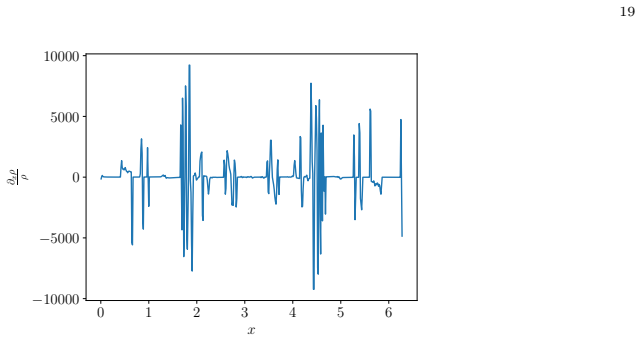
- Matter density inhomogeneities can be generated throughout the spatial domain by tilt-transition dynamics, providing a possible mechanism for primordial density fluctuations and structure formation.
- The tilt-transition triggers depend on the sign of PA−K, so the sound speed K controls the statistical behaviour: low-K fluids tend to extreme tilt, high-K (stiff) fluids to orthogonality, and intermediate K to sustained oscillation.
- The numerical method — evolving primitive fluid variables with a path-conservative finite-volume scheme — proves stable through many tilt transitions, where previous simulations crashed.
Where Pith is reading between the lines
- Because the paper uses periodic boundary conditions and flags that periodicity can suppress spatial-curvature growth, the chaotic spatial pattern of density inhomogeneities may depend on boundary conditions; testing with excision-type boundaries would clarify this.
- The tilt-transition mechanism is essentially a test-field response to a known vacuum attractor, so it likely persists for other matter such as magnetic fields or multiple fluids; the trigger condition PA−K might act as a general selection rule.
- A quantitative test of the density-fluctuation claim would be to compare the statistics of ∂xρ/ρ spikes against a simple Markov map for the Kasner-to-Kasner transition; the paper does not provide such a statistical model.
- In 3+1 models removing the T^2 symmetry, tilt transitions would likely occur in all velocity components, potentially making the density-fluctuation mechanism generic rather than symmetry-induced.
Editorial analysis
A structured set of objections, weighed in public.
Referee Report
Summary. This paper presents numerical simulations of T^2-symmetric cosmological spacetimes with a non-stiff perfect fluid obeying p=Kρ for K∈[0,1). The author uses β-normalized orthonormal-frame variables, evolves the primitive fluid variables directly, and employs a path-conservative finite-volume scheme to handle shocks. The central claims are: (i) the fluid velocity in inhomogeneous cosmologies undergoes mixmaster-like tilt transitions, consistent with the generalized BKL conjecture of Uggla et al.; (ii) these tilt transitions generate local matter-density inhomogeneities of the Rendall type. The paper also derives linearized trigger conditions for tilt transitions from spatially homogeneous Kasner states, and reports good agreement between those conditions and the observed growth/decay of the velocity components. The numerical setup is described in detail, with convergence tests in the pre-mixmaster phase and constraint monitoring in the chaotic phase.
Significance. If the central claims are correct, this is the first numerical evidence of repeated tilt transitions in inhomogeneous non-stiff fluid cosmologies near the big bang, providing concrete support for the generalized BKL picture beyond vacuum mixmaster models. The connection between tilt transitions and the Rendall instability is also physically interesting, suggesting a mechanism for primordial density inhomogeneities. The paper has several genuine strengths: the trigger conditions in Section 3 are derived from linearized homogeneous equations rather than fitted to the numerical output, so the agreement in Section 5.1 is a validation rather than a tautology; the primitive-variable evolution is well motivated by the failure of conservative variable recovery; and the monitoring of constraint residuals in the chaotic regime is a useful sanity check. However, the headline claims currently rest on a path-conservative scheme whose path dependence is acknowledged but untested, and on pointwise comparisons in a chaotic regime where formal numerical convergence is absent.
major comments (3)
- [§4.1, Eqs. (4.4)-(4.5), Figs. 3 and 10] The generalized Rankine-Hugoniot condition (4.5) depends on the DLM path, and the paper acknowledges that the path-selection problem is not addressed and convergence to the path-defined solution is not guaranteed. This is load-bearing because Fig. 3 shows that shocks in ν^1 form during the initial inhomogeneous phase, at t≈-0.25 to -1.0, before the ODE-dominated mixmaster regime begins. During this phase the non-conservative products are non-negligible, so different paths will in general produce different shock speeds and strengths. The resulting state at the onset of the mixmaster regime is therefore path-dependent, and since the subsequent Kasner/tilt sequence is chaotic, the pointwise tilt transitions (Fig. 5) and the spatial pattern of density gradients (Fig. 10) may depend on the arbitrary choice of the segment path. The argument that the path plays a small role because the mixmaste
- [§4.4 and §5.1, Figs. 5-10] The convergence tests establish formal second-order behavior only before the mixmaster regime; the paper states that in the chaotic mixmaster regime convergence is 'notably worse'. Yet the central evidence—tilt transitions in Fig. 5, the trigger-condition comparisons in Figs. 6-8, and the density inhomogeneity in Fig. 10—is presented at single resolutions (N=500 or N=1000) without a resolution study of the qualitative features. Because chaotic systems do not converge pointwise, the meaningful objects should be statistical or coarse-grained (e.g., distributions of tilt-transition times, spatial density-gradient statistics, or counts of transitions) and shown to be stable under resolution refinements and under the path choice. Monitoring constraint residuals alone does not establish that the pointwise tilt sequence is physical. This is a load-bearing gap for the paper's specific claims.
- [Remark 4.1] The paper explicitly acknowledges that periodic boundary conditions may suppress the growth of spatial curvature and influence the initial inhomogeneous phase, which in turn may alter the state when mixmaster dynamics begin. This is exactly the phase that sets the initial data for the chaotic regime, so the concern is not merely technical. No test with alternative boundary treatments (e.g., excision-type or 'zooming' boundaries) or with different domain sizes is provided. Given that the abstract claims generic inhomogeneous behavior and attributes density inhomogeneities to the oscillations, the possible sensitivity to periodic boundaries should be either addressed numerically or reflected in a significantly more cautious phrasing of the conclusions.
minor comments (5)
- [Fig. 2] The caption refers to the constraint (CM)_1, but the constraint equations are labeled (CM)_2 and (CM)_3 in Eqs. (2.9)-(2.10). This labeling should be corrected for consistency.
- [§4.1, footnote 20] The footnote states that λ±_{j+1/2} in the numerical scheme are not the fluid characteristic speeds λ± defined in (2.20), but the notation is confusing because the same symbol is used. Please use distinct notation for the numerical dissipation speeds.
- [§3 and Table 1] The derivation text writes the growth condition as K−P_A<0 while Table 1 states P_A−K>0; these are equivalent but the sign reversal may confuse readers. A brief sentence aligning the two notations would help.
- [Figs. 5 and 6] Different resolutions are used for the principal tilt-transition plots (N=500 in Fig. 5, N=1000 in Fig. 6) without explanation. It would be clearer to either use the same resolution or justify the difference.
- [General] No code or data are shipped, and the paper does not state whether the author is willing to provide them upon request. Given the numerical nature of the claims and the acknowledged subtleties of path-conservative schemes, a reproducibility statement would be valuable.
Circularity Check
No significant circularity: the tilt-trigger conditions are derived independently and then validated against the numerics, not fitted or renamed as predictions.
full rationale
I traced the paper's derivation chain: the Einstein-Euler equations (Section 2) are reduced to β-normalized form; Section 3 linearizes the spatially homogeneous fluid equations about the orthogonal and extremely tilted Kasner equilibrium points to derive the trigger conditions in Table 1 (e.g., P_A - K > 0 for growth of ν^A). These conditions are obtained analytically from the stated equations and are not fitted to the numerical output. The subsequent comparison in Section 5.1 (e.g., 'changes in the growth and decay of the velocity components coincide with the changes in sign and size of the quantities P_A - K') is a validation against the simulation, not a tautology. The paper's self-citations [9,10,33,34,58] are used for context—gauge conventions, asymptotic stability results in other settings, and the known Rendall-instability mechanism—but they are not load-bearing for the central claim that the fluid develops mixmaster-like tilt transitions in inhomogeneous T^2-symmetric spacetimes. The acknowledged caveats about periodic boundaries (Remark 4.1) and the path-dependence of the path-conservative scheme (Section 4.1) are numerical limitations and physical uncertainties, not circular reasoning: the path choice affects the shock evolution, but the tilt-trigger prediction is not derived from that path choice. The generalized-BKL framework of Uggla et al. is used as an interpretive lens, not as an input fitted to produce the observed oscillations. Overall, the central derivation is self-contained against its own assumptions, and no prediction reduces by construction to an input or to a self-citation chain.
Axiom & Free-Parameter Ledger
free parameters (4)
- Initial data amplitudes a,b,c,d =
a=b=-1, c=0.01, d=0.1
- Sound speed K =
0.1, 0.5, 0.9 in scans
- Velocity rescaling epsilon =
10^-13
- CFL constant C =
0.01
axioms (5)
- domain assumption T2-symmetric reduction with timelike areal gauge and beta-normalized frame equations faithfully captures the relevant near-singularity dynamics.
- domain assumption BKL locality: as E1_1 decays, spatial-derivative terms become negligible so pointwise dynamics is ODE-dominated.
- domain assumption Periodic boundary conditions do not qualitatively change the late-time mixmaster/tilt-transition behaviour.
- domain assumption The segment path in the path-conservative scheme yields the physically relevant non-conservative shock solution.
- domain assumption Spatially homogeneous linearized trigger conditions (Table 1) remain valid pointwise in the inhomogeneous setting.
Cite this review
Pith. "Pith review of Mixmaster Fluids Near the Big Bang." pith.science (2026). https://pith.science/paper/J4YPL2GJ
@misc{pith2026251211375,
  author       = {Pith},
  title        = {Pith review of: Mixmaster Fluids Near the Big Bang},
  year         = {2026},
  howpublished = {\url{https://pith.science/paper/J4YPL2GJ}},
  note         = {Machine review of arXiv:2512.11375}
}
read the original abstract
We numerically study the approach to the singularity in $\mathbb{T}^{2}$-symmetric cosmological spacetimes containing a non-stiff perfect fluid satisfying a linear equation of state $p=K\rho$, $K \in [0,1)$. Near the singularity, the dynamics are found to be local and oscillatory. In particular, our results show, for the first time, that the fluid velocity in inhomogeneous cosmologies develops mixmaster-esque oscillations consistent with the generalised BKL conjecture of Uggla et al. Moreover, we find these fluid oscillations are responsible for the development of local inhomogeneities in the matter density of the early universe.
Figures



Reference graph
Works this paper leans on
-
[1]
Abgrall and S
R. Abgrall and S. Karni,A Comment on the Computation of Non-Conservative Pproducts, Journal of Compu- tational Physics229(2010), no. 8, 2759–2763
2010
-
[2]
Andersson and A.D
L. Andersson and A.D. Rendall,Quiescent Cosmological Singularities, Commun. Math. Phys.218(2001), no. 3, 479–511
2001
-
[3]
Andersson, H
L. Andersson, H. van Elst, W.C. Lim, and C. Uggla,Asymptotic Silence of Generic Cosmological Singularities, Phys. Rev. Lett.94(2005), 051101
2005
-
[4]
Aurrekoetxea, K
J.C. Aurrekoetxea, K. Clough, and E.A. Lim,CTTK: A New Method to Solve the Initial Data Constraints in Numerical Relativity, Classical and Quantum Gravity40(March 2023), no. 7, 075003. 20
2023
-
[5]
Belinskii, I.M
V.A. Belinskii, I.M. Khalatnikov, and E.M. Lifshitz,Oscillatory Approach to a Singular Point in Relativistic Cosmology, Adv. Phys.19(1970), no. 80, 525–573
1970
-
[6]
B.K. Berger and D. Garfinkle,Phenomenology of the Gowdy universe onT 3×R, Physical Review D57(1998), no. 8, 4767–4777. DOI: 10.1103/PhysRevD.57.4767
-
[7]
Berger, J
B.K. Berger, J. Isenberg, and M. Weaver,Oscillatory Approach to the Singularity in Vacuum Spacetimes with T 2 Isometry, Phys. Rev. D64(2001), no. 8
2001
-
[8]
1, 64–84
M.J.BergerandP.Colella,Local Adaptive Mesh Refinement for Shock Hydrodynamics,JournalofComputational Physics82(1989), no. 1, 64–84
1989
-
[9]
Beyer, E
F. Beyer, E. Marshall, and T.A. Oliynyk,Future Instability of FLRW Fluid Solutions for Linear Equations of Statep=Kρwith1/3<K<1, Phys. Rev. D107(2023), 104030
2023
-
[10]
,Past Instability of FLRW Solutions of the Einstein-Euler-Scalar Field Equations for Linear Equations of Statep=Kρwith0≤K<1/3, Physical Review D110(2024), no. 4
2024
-
[11]
Beyer and T.A
F. Beyer and T.A. Oliynyk,Localized Big Bang Stability for the Einstein-Scalar Field Equations, Archive for Rational Mechanics and Analysis248(December 2023), no. 1
2023
-
[12]
2, 515–637
,Past Stability of FLRW Solutions to the Einstein-Euler-Scalar Field Equations and their Big Bang Singularities, Beijing Journal of Pure and Applied Mathematics1(2024), no. 2, 515–637
2024
-
[13]
6, 1701–1794
,Relativistic Perfect Fluids Near Kasner Singularities, Communications in Analysis and Geometry32 (2024), no. 6, 1701–1794
2024
-
[14]
F. Beyer, T.A. Oliynyk, and W. Zheng,Localized Past Stability of the Subcritical Kasner-Scalar Field Spacetimes (2025), available at2502.09210
Pith/arXiv arXiv 2025
-
[15]
Bernhard Brehm,Bianchi VIII and IX Vacuum Cosmologies: Almost Every Solution Forms Particle Horizons and Converges to the Mixmaster Attractor(2016), available at1606.08058
Pith/arXiv arXiv 2016
-
[16]
Castro, U.S
M.J. Castro, U.S. Fjordholm, S. Mishra, and C. Parés,Entropy Conservative and Entropy Stable Schemes for Nonconservative Hyperbolic Systems, SIAM Journal on Numerical Analysis51(2013), no. 3, 1371–1391
2013
-
[17]
Castro, P.G
M.J. Castro, P.G. LeFloch, M.L. Muñoz-Ruiz, and C. Parés,Why Many Theories of Shock Waves are Necessary: Convergence Error in Formally Path-Consistent Schemes, Journal of Computational Physics227(2008), no. 17, 8107–8129
2008
-
[18]
Chiodaroli,A Counterexample to Well-Posedness of Entropy Solutions to the Compressible Euler System, Journal of Hyperbolic Differential Equations11(September 2014), no
E. Chiodaroli,A Counterexample to Well-Posedness of Entropy Solutions to the Compressible Euler System, Journal of Hyperbolic Differential Equations11(September 2014), no. 03, 493–519
2014
-
[19]
Chiodaroli, C
E. Chiodaroli, C. De Lellis, and O. Kreml,Global Ill-Posedness of the Isentropic System of Gas Dynamics, Communications on Pure and Applied Mathematics68(August 2014), no. 7, 1157–1190
2014
-
[20]
Coley and S
A. Coley and S. Hervik,A Dynamical Systems Approach to the Tilted Bianchi Models of Solvable Type, Classical and Quantum Gravity22(2005), no. 3, 579
2005
-
[21]
,Bianchi Models with Vorticity: The Type III Bifurcation, arXiv preprint arXiv:0802.3629 (2008)
Pith/arXiv arXiv 2008
-
[22]
Coley and S
A.A. Coley and S. Hervik,Bianchi Cosmologies: A Tale of Two Tilted Fluids, Classical and Quantum Gravity 21(2004), no. 17, 4193
2004
-
[23]
Coley, S
A.A. Coley, S. Hervik, and W.C. Lim,Fluid Observers and Tilting Cosmology, Classical and Quantum Gravity 23(2006), no. 10, 3573
2006
-
[24]
4, 310–313
,Tilt and Phantom Cosmology, Physics Letters B638(2006), no. 4, 310–313
2006
-
[25]
Coley and W.C
A.A. Coley and W.C. Lim,Generating Matter Inhomogeneities in General Relativity, Phys. Rev. Lett.108 (2012), 191101
2012
-
[26]
1, 015009
,Spikes and Matter Inhomogeneities in Massless Scalar Field Models, Classical and Quantum Gravity 33(2016), no. 1, 015009
2016
-
[27]
1, 015009
,Periodic Boundary Conditions and G2 Cosmology, Classical and Quantum Gravity41(2023), no. 1, 015009
2023
-
[28]
Curtis and D
J. Curtis and D. Garfinkle,Numerical Simulations of Stiff Fluid Gravitational Singularities, Physical Review D 72(2005), no. 6, 064003
2005
-
[29]
Dal Maso, P.G
G. Dal Maso, P.G. LeFloch, and F. Murat,Definition and Weak Stability of Nonconservative Products, Journal de mathématiques pures et appliquées74(1995), no. 6, 483–548
1995
-
[30]
M.J.C. Diaz, A. Kurganov, and T.M. de Luna,Path-Conservative Central-Upwind Schemes for Nonconservative Hyperbolic Systems, ESAIM: Mathematical Modelling and Numerical Analysis53(2019), no. 3, 959–985
2019
-
[31]
Ellis,Dynamics of Pressure-Free Matter in General Relativity, Journal of Mathematical Physics8 (1967), no
G.F.R. Ellis,Dynamics of Pressure-Free Matter in General Relativity, Journal of Mathematical Physics8 (1967), no. 5, 1171–1194
1967
-
[32]
Ellis and M.A.H
G.F.R. Ellis and M.A.H. MacCallum,A Class of Homogeneous Cosmological Models, Communications in Mathematical Physics12(1969), no. 2, 108 –141
1969
-
[33]
G. Fournodavlos, E. Marshall, and T.A. Oliynyk,Future Stability of Perfect Fluids with Extreme Tilt and Linear Equation of Statep=c 2 sρ for the Einstein-Euler System with Positive Cosmological Constant: The Range 1 3 <c 2 s < 3 7 (2024), available at2404.06789
Pith/arXiv arXiv 2024
-
[34]
,Future Stability of Tilted Two-Fluid Bianchi I Spacetimes(2025), available at2508.15155
Pith/arXiv arXiv 2025
-
[35]
Fournodavlos, I
G. Fournodavlos, I. Rodnianski, and J. Speck,Stable Big Bang Formation for Einstein’s Equations: The Complete Sub-Critical Regime, J. Amer. Math. Soc.36(July 2023), 827–916
2023
-
[36]
Garfinkle,Numerical Simulations of Generic Singularities, Physical Review Letters93(2004), no
D. Garfinkle,Numerical Simulations of Generic Singularities, Physical Review Letters93(2004), no. 16, 6
2004
-
[37]
12, S295–S306
,Numerical simulations of general gravitational singularities, Classical and Quantum Gravity24(2007), no. 12, S295–S306. 21
2007
-
[38]
Garfinkle, A
D. Garfinkle, A. Ijjas, and P.J. Steinhardt,Initial Conditions Problem in Cosmological Inflation Revisited, Physics Letters B843(2023), 138028
2023
-
[39]
Garfinkle and F
D. Garfinkle and F. Pretorius,Spike Behavior in the Approach to Spacetime Singularities, Physical Review D 102(December 2020), no. 12
2020
-
[40]
H.O. Groeniger, O. Petersen, and H. Ringström,Formation of Quiescent Big Bang Singularities(2023), available at2309.11370
arXiv 2023
-
[41]
Hawking and G.F.R
S.W. Hawking and G.F.R. Ellis,The Large Scale Structure of Space-Time, First, Cambridge University Press, 1973
1973
-
[42]
Uggla,A New Proof of the Bianchi Type IX Attractor Theorem, Class
J.M Heinzle and C. Uggla,A New Proof of the Bianchi Type IX Attractor Theorem, Class. Quantum Grav.26 (2009), no. 7, 075015
2009
-
[43]
Hervik, W.C
S. Hervik, W.C. Lim, P. Sandin, and C. Uggla,Future Asymptotics of Tilted Bianchi Type II Cosmologies, Class. Quantum Gravity27(2010), no. 18, 185006
2010
-
[44]
Hervik, R.J
S. Hervik, R.J. Van Den Hoogen, W.C. Lim, and A.A. Coley,The Futures of Bianchi Type VII0 Cosmologies with Vorticity, Classical and Quantum Gravity23(2006), no. 3, 845
2006
-
[45]
Hervik, R.J
S. Hervik, R.J. van den Hoogen, W.C. Lim, and A.A. Coley,Late-Time Behaviour of the Tilted Bianchi Type V I−1/9 Models, Classical and Quantum Gravity25(2007), no. 1, 015002
2007
-
[46]
Hervik, R.J
S. Hervik, R.J. Van den Hoogen, W.C. Lim, and A.A. Coley,Late-Time Behaviour of the Tilted Bianchi Type V Ih Models, Classical and Quantum Gravity24(2007), no. 15, 3859
2007
-
[47]
Hewitt, R
C.G. Hewitt, R. Bridson, and J. Wainwright,The Asymptotic Regimes of Tilted Bianchi II Cosmologies, General Relativity and Gravitation33(January 2001), no. 1, 65–94
2001
-
[48]
King and G.F.R
A.R. King and G.F.R. Ellis,Tilted Homogeneous Cosmological Models, Communications in Mathematical Physics31(1973/09/01), no. 3, 209–242
1973
-
[49]
Kurganov and E
A. Kurganov and E. Tadmor,New High-Resolution Central Schemes for Non-Linear Conservation Laws and Convection-Diffusion Equations, Journal of computational physics160(2000), no. 1, 241–282
2000
-
[50]
LeFloch and A.D
P.G. LeFloch and A.D. Rendall,A Global Foliation of Einstein-Euler Spacetimes with Gowdy-Symmetry on T 3, Arch. Rat. Mech.201(2011), no. 3, 841–870
2011
-
[51]
LeVeque,Finite Volume Methods for Hyperbolic Problems, Cambridge Texts in Applied Mathematics, Cambridge University Press, 2002
R.J. LeVeque,Finite Volume Methods for Hyperbolic Problems, Cambridge Texts in Applied Mathematics, Cambridge University Press, 2002
2002
-
[52]
W. Li,BKL Bounces Outside Homogeneity: Einstein-Maxwell-Scalar Field in Surface Symmetry(2024), available at2408.12434
Pith/arXiv arXiv 2024
-
[53]
,BKL Bounces Outside Homogeneity: Gowdy Symmetric Spacetimes(2024), available at2408.12427
Pith/arXiv arXiv 2024
-
[54]
Lim,The Dynamics of Inhomogeneous Cosmologies, Ph.D
W.C. Lim,The Dynamics of Inhomogeneous Cosmologies, Ph.D. Thesis, 2004
2004
-
[55]
W.C. Lim, L. Andersson, D. Garfinkle, and F. Pretorius,Spikes in the Mixmaster Regime ofG2 Cosmologies, Physical Review D79(2009), no. 12, 123526
2009
-
[56]
Lim and A.A
W.C. Lim and A.A. Coley,General Relativistic Density Perturbations, Classical and Quantum Gravity31 (November 2013), no. 1, 015020
2013
-
[57]
MacCallum,Cosmological Models from a Geometric Point of View, Cargese Lect
M.A.H. MacCallum,Cosmological Models from a Geometric Point of View, Cargese Lect. Phys.6(1973), 61–174, available at2001.11387
Pith/arXiv arXiv 1973
-
[58]
Marshall,Instability of Slowly Expanding FLRW Spacetimes, Classical and Quantum Gravity42(2025), no
E. Marshall,Instability of Slowly Expanding FLRW Spacetimes, Classical and Quantum Gravity42(2025), no. 10, 105005
2025
-
[59]
Oliynyk,On the Fractional Density Gradient Blow-Up Conjecture of Rendall, Communications in Mathematical Physics405(2024), no
T.A. Oliynyk,On the Fractional Density Gradient Blow-Up Conjecture of Rendall, Communications in Mathematical Physics405(2024), no. 8, 197
2024
-
[60]
Parés,Numerical Methods for Nonconservative Hyperbolic Systems: A Theoretical Framework., SIAM Journal on Numerical Analysis44(2006), no
C. Parés,Numerical Methods for Nonconservative Hyperbolic Systems: A Theoretical Framework., SIAM Journal on Numerical Analysis44(2006), no. 1, 300–321
2006
-
[61]
Rendall,Asymptotics of Solutions of the Einstein Equations with Positive Cosmological Constant, Ann
A.D. Rendall,Asymptotics of Solutions of the Einstein Equations with Positive Cosmological Constant, Ann. Henri Poincaré5(2004), no. 6, 1041–1064
2004
-
[62]
Ringström,The Bianchi IX attractor, Ann
H. Ringström,The Bianchi IX attractor, Ann. Henri Poincaré2(2001), 405–500
2001
-
[63]
Rodnianski and J
I. Rodnianski and J. Speck,A Regime of Linear Stability for the Einstein-Scalar Field System with Applications to Non-Linear Big Bang Formation, Ann. Math.187(2018), no. 1, 65–156
2018
-
[64]
,Stable Big Bang Formation in Near-FLRW Solutions to the Einstein-Scalar Field and Einstein-Stiff Fluid Systems, Sel. Math. New Ser.24(2018), no. 5, 4293–4459
2018
-
[65]
G. Rácz, I. Szapudi, I. Csabai, and L. Dobos,The Anisotropy of the Power Spectrum in Periodic Cosmological Simulations, Monthly Notices of the Royal Astronomical Society503(March 2021), no. 4, 5638–5645
2021
-
[66]
Uggla, H
C. Uggla, H. van Elst, J. Wainwright, and G.F.R. Ellis,Past Attractor in Inhomogeneous Cosmology, Physical Review D68(November 2003), no. 10
2003
-
[67]
van Elst and C
H. van Elst and C. Uggla,General Relativistic Orthonormal Frame Approach, Classical and Quantum Gravity 14(September 1997), no. 9, 2673–2695
1997
-
[68]
van Elst, C
H. van Elst, C. Uggla, and J. Wainwright,Dynamical Systems Approach toG2 Cosmology, Classical and Quantum Gravity19(December 2001), no. 1, 51–82
2001
-
[69]
Wainwright and G.F.R
J. Wainwright and G.F.R. Ellis,Dynamical Systems in Cosmology, Cambridge University Press, 1997
1997
-
[70]
Wainwright and L
J. Wainwright and L. Hsu,A Dynamical Systems Approach to Bianchi Cosmologies: Orthogonal Models of Class A, Classical and Quantum Gravity6(1989oct), no. 10, 1409
-
[71]
Weaver, J
M. Weaver, J. Isenberg, and B.K. Berger,Mixmaster Behavior in Inhomogeneous Cosmological Spacetimes, Physical Review Letters80(April 1998), no. 14, 2984–2987. 22
1998
-
[72]
Wu,Design of Provably Physical-Constraint-Preserving Methods for General Relativistic Hydrodynamics, Physical Review D95(2017), no
K. Wu,Design of Provably Physical-Constraint-Preserving Methods for General Relativistic Hydrodynamics, Physical Review D95(2017), no. 10, 103001
2017
-
[73]
Zhang and C
X. Zhang and C. Shu,On Positivity-Preserving High Order Discontinuous Galerkin Schemes for Compressible Euler Equations on Rectangular Meshes, Journal of Computational Physics229(2010), no. 23, 8918–8934
2010
-
[74]
4, 1238–1248
,Positivity-Preserving High Order Discontinuous Galerkin Schemes for Compressible Euler Equations with Source Terms, Journal of Computational Physics230(2011), no. 4, 1238–1248. School of Mathematics, 9 Rainforest W alk, Monash University, VIC 3800, Australia Email address:elliot.marshall@monash.edu
2011
This paper was first reviewed by deepseek-v4-flash on August 3, 2026.
discussion (0)
Sign in with ORCID, Apple, or X to comment. Anyone can read and Pith papers without signing in.