REVIEW 3 major objections 5 minor 44 references
Multiple-Nanowire Superconducting Quantum Interference Devices: Critical Currents, Symmetries, and Vorticity Stability Regions
T0 review · 3 major / 5 minor · reviewed 2026-08-07 · deepseek-v4-flash
Pith's one-line read This paper shows that an n-nanowire SQUID with linear current-phase relations has a multi-valued critical current organized into classified polygon stability regions, with exact symmetries and a perfect diode branch.
desk verdict Solid n-wire generalization of the two-wire nanowire SQUID model with a useful VSR taxonomy and correct symmetry theorems; the one load-bearing prediction (the disjointness threshold) is asserted rather than derived and needs proof or qualification. read the letter →
The pith
A machine-rendered reading of the paper's core claim, the machinery that carries it, and where it could break.
The reading
What carries the argument
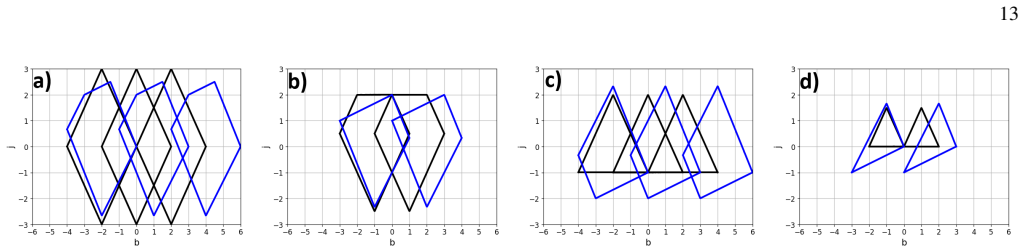
The engine is the Meissner phase equation $\varphi_{i+1} = \varphi_i + 2\pi(x_{i+1}-x_i)b - 2\pi v_{i,i+1}$, which ties the phase bias of every wire to the phase of the first wire, the normalized field $b$, and the integer vorticity in each loop, together with the linear current-phase relation $I_i = I_{c,i}\varphi_i/\varphi_{c,i}$. Because each wire's superconducting condition is just $|\varphi_i| \leq \varphi_{c,i}$, every VSR is the intersection of $n$ strips in the $(b, j)$ plane, hence a polygon; the paper classifies these polygons by the vorticity-difference vector between neighboring cells and uses the same equations to prove the IBV and IB symmetries, the Little-Parks periodicity, and the generalized period for incommensurate cell sizes.
What would settle it
Fabricate a three-nanowire SQUID with nominally equal wires, measure $I_c(B)$ at millikelvin temperatures, and check three signatures: the VSR boundaries should be straight lines; the small-triangle vortex configuration such as $[0,-3]$ should give exactly zero negative critical current at a finite field; and at $\varphi_c \approx 2\pi/3$ the stability regions should just touch, becoming disjoint for lower critical phases. Any rounding of the boundary lines, a nonzero $I_{c,-}$ inside the predicted diode triangle, or overlapping VSRs below the threshold would falsify the linear-CPR polygon model.
Extended reading notes
Core claim
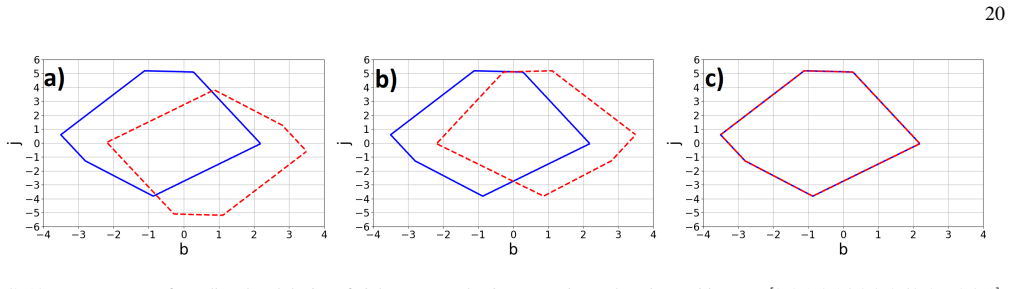
For an n-nanowire SQUID with linear current-phase relations $I_i = I_{c,i}(\varphi_i/\varphi_{c,i})$, the paper's central claim is that the full $I$–$B$ response is governed by stability polygons: each integer vorticity configuration $(v_{1,2}, v_{2,3}, \ldots)$ owns a polygonal VSR whose boundaries are the critical-current lines, and the envelope of all such polygons is the multi-valued $I_c(B)$. The shape of each VSR is fixed by the absolute differences of neighboring-cell vorticities: equal vorticity gives diamonds, differences of 1, 2, 3 give flat-top diamonds, large triangles, and small triangles (for three wires), and four-wire devices add glider, trapezoidal, tilted triangular, and kite shapes. Every VSR is IBV-symmetric, meaning it is unchanged when current, magnetic field, and all vortex polarities are inverted together, while the upper and lower critical-current envelopes are IB-symmetric. If the largest critical phase obeys $\max_i \varphi_{c,i} < \pi(n-1)/n$, the VSR sequence becomes disjoint, giving field regions with zero supercurrent and quantum superconductor-normal transitions, and specific three-wire vortex configurations give a perfect diode with zero critical current in one polarity.
Load-bearing premise
The whole polygon construction rests on assuming each nanowire's current is exactly proportional to its phase difference up to a hard critical phase; if real nanowires have a curved current-phase relation near that cutoff, the predicted shapes, symmetries, and disjointness threshold are not exact.
Editorial extensions
If this is right
- The multi-valued $I_c(B)$ branches give a finite set of metastable vortex states at fixed field, so an n-wire SQUID can act as an n-state memory element without extra inductors.
- Because every VSR is IBV-symmetric and the envelope is IB-symmetric even in completely disordered arrays, a measured violation of IB symmetry signals vortices trapped in the electrodes.
- For $\max_i \varphi_{c,i} < \pi(n-1)/n$, the device has field windows with zero supercurrent, enabling 100% critical-current modulation and quantum superconductor-normal transitions at zero temperature.
- Specific vorticity configurations in three-wire devices produce a perfect superconducting diode, i.e., one bias polarity carries zero supercurrent while the other carries a finite current.
- Position disorder changes the Little-Parks period to a commensurability-determined value $c$, and irrational cell-size ratios make the device aperiodic.
Reading between the lines
- The polygon picture suggests that the VSR shape taxonomy for arbitrary $n$ is the normal fan of a zonotope generated by the wire positions and critical phases, so the diamond/glider/kite naming could be unified by a single hyperplane-arrangement formula.
- The perfect diode relies on the vorticity being frozen; at higher temperatures or under strong bias noise, vortex escape would wash out the exactly-zero polarity, so the effect should be tested in short, low-noise current pulses.
- The disjointness threshold doubles as a design rule: choosing critical phases below $\pi(n-1)/n$ turns the device into a field-switchable kinetic-inductance element, which could serve as a tunable coupler or switch in superconducting circuits.
- One could test the linear-CPR assumption directly by measuring the current-phase relation of a single wire, since the model predicts that any curvature would first appear as a systematic deviation of VSR boundary slopes from the constant values $\varphi_c/\pi$ per unit wire spacing.
Editorial analysis
A structured set of objections, weighed in public.
Referee Report
Summary. The paper develops a linear current-phase-relation (CPR) model for superconducting quantum interference devices made from n parallel nanowires. For fixed integer vorticity vectors, it defines vorticity stability regions (VSRs) in the normalized current-field plane and predicts that the critical current is a multi-valued function of the magnetic field. The VSRs are polygons whose shapes are classified for n=2, 3, and 4 wires and for various disorder types. The paper also proves IBV symmetry for every VSR and IB symmetry for the maximum and minimum critical-current envelopes, predicts a perfect diode effect for certain fixed vorticity configurations, and gives a generalized Little-Parks period formula for position-disordered arrays. A central quantitative prediction is that the VSR sequence becomes disjoint when max_i(phi_c,i) < pi(n-1)/n, leading to 100% supercurrent modulation and quantum phase transitions at zero temperature.
Significance. If taken at face value, the paper provides a clean, parameter-explicit framework for an experimentally relevant class of devices: multi-nanowire SQUIDs with approximately linear CPRs. Its main strengths are that the model has no fitted parameters, the symmetry arguments (IBV and IB) are proven analytically in the text, the VSR boundaries are defined by elementary linear inequalities, and the predictions are falsifiable in principle. The shape taxonomy for three- and four-wire devices, the perfect-diode condition, and the generalized Little-Parks period formula are concrete and interesting. The main weakness is that the disjointness threshold, which underlies the 100% modulation and quantum-transition claims, is asserted on the basis of an unspecified computer model rather than derived or fully documented. The paper is therefore a useful theoretical contribution provided that threshold is supplied with a proof or a reproducible numerical verification.
major comments (3)
- [Sec. IX and Conclusions] The disjointness condition max_i(phi_c,i) < pi(n-1)/n is a central, load-bearing prediction, but it is not derived. The text states 'Our computer model of multiple-nanowire SQUIDs confirms this formula' (Sec. IX) without giving the derivation, the numerical procedure, or the code version. Figure 7 shows only the marginal touching cases phi_c = 2pi/3 (n=3) and phi_c = 3pi/4 (n=4); it does not demonstrate disjointness for slightly lower values of phi_c. Since the claims of 100% modulation and quantum transitions depend on this threshold, the manuscript should provide an analytic argument, for example a circular-covering argument on the phase biases modulo 2pi, or a complete enumerable verification that no non-principal vorticity state can cover the gap.
- [Sec. VIII] The right-vertex calculation for the zero-vorticity diamond gives b_right = phi_c/pi, so the principal diamond alone has width 2phi_c/pi. A reader might therefore expect a disjointness threshold of order phi_c < pi(n-1)/2, not pi(n-1)/n. The more restrictive threshold must arise from the way all other VSR shapes fill the inter-diamond gaps. This is exactly the missing part of the argument. The paper should prove that, for phi_c < pi(n-1)/n, there exists a range of b for which no vorticity vector yields |phi_i| <= phi_c,i for all i, and that for phi_c >= pi(n-1)/n the union of VSRs is connected. Without this proof, the threshold remains an unsupported numerical observation.
- [Sec. IV and Abstract] The 'perfect diode effect' is presented in the abstract and conclusions as a property of the MW-SQUID, but the detailed discussion in Sec. IV makes clear that it is a property of specific fixed vorticity states such as [−1,−4] or [0,−3]. The paper should state explicitly whether this diode effect survives maximization over all vorticity states when computing the physical critical currents Ic,+ and Ic,- as defined in Sec. II. If it is a metastable-state effect, that limitation should appear wherever the diode effect is summarized.
minor comments (5)
- [Sec. IX] There is a typo in 'the top and the bottom vertices of the VSR co not shift' which should read 'do not shift'.
- [Sec. II and Eq. (3)] The statement that the critical phase of a nanowire 'cannot be less than pi/2' is used to justify parameter ranges but is not derived or referenced in the linear-CPR context; please clarify the origin of this bound.
- [Code availability] The GitHub repository is cited without a version, commit hash, or archive identifier. Since the disjointness threshold is attributed to a computer model, please pin the exact code version used to generate Figures 7 and the threshold claim.
- [Figure captions] Several figure captions contain spacing artifacts such as 'V orticity' and 'V orticity stability regions'; these should be corrected.
- [Sec. VI] In the flat-top derivation, the example assumes identical critical currents; the text later states the 'flat top' effect for general critical phases [phi_c, phi_c2, phi_c] without discussing whether critical-current disorder modifies the condition. A brief qualification would be helpful.
Circularity Check
No significant circularity: the VSR shapes, symmetries, and diode effects are derived consequences of the stated linear-CPR model; the disjointness threshold is under-justified but not circular.
full rationale
The paper's derivation chain is self-contained: the model is specified by the Meissner phase equation (Eq. 1) and the linear current-phase relation (Eq. 3), and each vorticity stability region is the feasible region defined by the inequalities |φ_i| ≤ φ_c,i for fixed vorticities. The critical current is then defined as the envelope of these VSR boundaries, so the multi-valuedness, polygonal shapes, and the IBV/IB symmetries are mathematical consequences of the stated inequalities rather than imported conclusions. The in-text derivations in Sections III, V, VI, VIII, and IX compute vertex positions, boundary slopes, and symmetry transformations directly from Eqs. (1)–(3), so these central predictions do not reduce to their inputs by construction. The self-citations (e.g., Murphy and Bezryadin 2017, Murphy et al. 2017, Hopkins et al. 2005) supply the linear-CPR premise and the two-wire Meissner phase relation as background inputs, but the n-wire generalization, the VSR shape classification, and the perfect-diode examples are derived in the present text rather than loaded from those citations. No data are fitted and no parameters are tuned to force the predicted curves. The one notable gap is the disjointness threshold, max_i(φc,i) < π(n−1)/n, stated in Sections V, VII, IX, and the Conclusions and justified only by 'Our computer model confirms this formula' rather than by a closed-form derivation. This is a missing proof or correctness risk, not circularity: the formula is not an input to the model and is not obtained by fitting measured data, so the claim does not reduce to its own assumptions. The related 100%-modulation and quantum-transition statements are conditional consequences of the VSR definitions, again not circular. Overall, no load-bearing step exhibits the quoted reduction required for a circularity finding, so the paper receives a low score reflecting only minor, non-load-bearing self-citation.
Assumptions & free parameters
free parameters (1)
- Example device parameters (φc,i, Ic,i, xi) =
φc,i=2π, Ic,i=1, xi equally spaced in symmetric cases
assumptions (5)
- domain assumption Phase winding around any closed superconducting loop is an integer multiple of 2π, so vorticity v is an integer.
- domain assumption Each nanowire obeys I_i = I_{c,i} φ_i / φ_{c,i} for |φ_i| ≤ φ_{c,i}.
- domain assumption Device switches to normal (or a phase slip occurs) as soon as any |φ_i| reaches φ_{c,i}; critical currents are set by this criterion.
- domain assumption The electrodes impose φ_{i+1} = φ_i + 2π b (x_{i+1}-x_i) - 2π v_{i,i+1} independently of wire currents; persistent currents do not feed back on electrode phase gradients.
- domain assumption There are no vortices inside the electrodes or inside the nanowires; only coreless inter-wire vortices are considered.
Cite this review
Pith. "Pith review of Multiple-Nanowire Superconducting Quantum Interference Devices: Critical Currents, Symmetries, and Vorticity Stability Regions." pith.science (2026). https://pith.science/paper/J5GKDSK3
@misc{pith2026250523095,
  author       = {Pith},
  title        = {Pith review of: Multiple-Nanowire Superconducting Quantum Interference Devices: Critical Currents, Symmetries, and Vorticity Stability Regions},
  year         = {2026},
  howpublished = {\url{https://pith.science/paper/J5GKDSK3}},
  note         = {Machine review of arXiv:2505.23095}
}
abstract
An ordinary superconducting quantum interference device (SQUID) contains two weak links connected in parallel. We model a multiple-wire SQUID (MW-SQUID), generalized in two ways. First, the number of weak links, which are provided by parallel superconducting nanowires, is larger than two. Second, the current-phase relationship of each nanowire is assumed linear, which is typical for a homogeneous superconducting thin wire. For such MW-SQUIDs, our model predicts that the critical current ($I_c$) is a multi-valued function of the magnetic field. We also calculate vorticity stability regions (VSR), i.e., regions in the current-magnetic field plane in which, for a given distribution of vortices, the currents in all wires are below their critical values, so the vortices do not move between the cells. The VSRs have rhombic shapes in the case of two-wire SQUIDS and have more complicated shapes in the case of many nanowires. We present a classification of such VSRs and determine conditions under which VSR is disjoint, leading to 100\% supercurrent modulation and quantum phase transitions. According to the model, the maximum critical current curves obey $IB$ symmetry, while each VSR obeys $IBV$ symmetry. The model predicts conditions at which MW-SQUID exhibits a perfect diode effect in which the critical current of one polarity is zero while it is not zero for the opposite polarity of the bias current. We also provide a classification of the stability regions produced by (1) completely symmetric, (2) phase disordered, (3) position disordered, (4) critical current disordered, and (5) completely disordered multi-wire SQUIDs.
Figures


Figures from the paper (17 more)





Reference graph
Works this paper leans on
-
[1]
merlin.mbs aapmrev4-1.bst 2010-07-25 4.21a (PWD, AO, DPC) hacked
FUNCTION id.bst "merlin.mbs aapmrev4-1.bst 2010-07-25 4.21a (PWD, AO, DPC) hacked" ENTRY address archive archivePrefix author bookaddress booktitle chapter collaboration doi edition editor eid eprint howpublished institution isbn issn journal key language month note number organization pages primaryClass publisher school SLACcitation series title translat...
2010
-
[2]
merlin.mbs aipauth4-1.bst 2010-07-25 4.21a (PWD, AO, DPC) hacked
FUNCTION id.bst "merlin.mbs aipauth4-1.bst 2010-07-25 4.21a (PWD, AO, DPC) hacked" ENTRY address archive archivePrefix author bookaddress booktitle chapter collaboration doi edition editor eid eprint howpublished institution isbn issn journal key language month note number organization pages primaryClass publisher school SLACcitation series title translat...
2010
-
[3]
merlin.mbs aipnum4-1.bst 2010-07-25 4.21a (PWD, AO, DPC) hacked
FUNCTION id.bst "merlin.mbs aipnum4-1.bst 2010-07-25 4.21a (PWD, AO, DPC) hacked" ENTRY address archive archivePrefix author bookaddress booktitle chapter collaboration doi edition editor eid eprint howpublished institution isbn issn journal key language month note number organization pages primaryClass publisher school SLACcitation series title translati...
2010
-
[4]
merlin.mbs apsrev4-1.bst 2010-07-25 4.21a (PWD, AO, DPC) hacked
FUNCTION id.bst "merlin.mbs apsrev4-1.bst 2010-07-25 4.21a (PWD, AO, DPC) hacked" ENTRY address archive archivePrefix author bookaddress booktitle chapter collaboration doi edition editor eid eprint howpublished institution isbn issn journal key language month note number organization pages primaryClass publisher school SLACcitation series title translati...
2010
-
[5]
merlin.mbs apsrmp4-1.bst 2010-07-25 4.21a (PWD, AO, DPC) hacked
FUNCTION id.bst "merlin.mbs apsrmp4-1.bst 2010-07-25 4.21a (PWD, AO, DPC) hacked" ENTRY address archive archivePrefix author bookaddress booktitle chapter collaboration doi edition editor eid eprint howpublished institution isbn issn journal key language month note number organization pages primaryClass publisher school SLACcitation series title translati...
2010
-
[6]
author author M. Tinkham ,\ @noop title Introduction to superconductivity \ ( publisher Courier Corporation ,\ year 2004 ) NoStop
work page 2004
-
[7]
author author A. Murphy \ and\ author A. Bezryadin ,\ title title Asymmetric nanowire squid: Linear current-phase relation, stochastic switching, and symmetries , \ @noop journal journal Phys. Rev. B \ volume 96 ,\ pages 094507 ( year 2017 ) NoStop
work page 2017
-
[8]
author author A. Murphy , author D. V. \ Averin , \ and\ author A. Bezryadin ,\ title title Nanoscale superconducting memory based on the kinetic inductance of asymmetric nanowire loops , \ @noop journal journal New Journal of Physics \ volume 19 ,\ pages 063015 ( year 2017 ) NoStop
work page 2017
Show all 44 references
-
[9]
author author W. A. \ Little ,\ title title Decay of persistent currents in small superconductors , \ @noop journal journal Phys. Rev. \ volume 156 ,\ pages 396--403 ( year 1967 ) NoStop
1967
-
[10]
author author J. S. \ Langer \ and\ author V. Ambegaokar ,\ title title Intrinsic resistive transition in narrow superconducting channels , \ @noop journal journal Physical Review \ volume 164 ,\ pages 498--510 ( year 1967 ) NoStop
1967
-
[11]
author author R. S. \ Newbower , author M. R. \ Beasley , \ and\ author M. Tinkham ,\ title title Fluctuation Effects on the Superconducting Transition of Tin Whisker Crystals , \ @noop journal journal Phys. Rev. B \ volume 5 ,\ pages 864--868 ( year 1972 ) NoStop
1972
-
[12]
Giordano ,\ title title Evidence for Macroscopic Quantum Tunneling in One-Dimensional Superconductors , \ @noop journal journal Phys
author author N. Giordano ,\ title title Evidence for Macroscopic Quantum Tunneling in One-Dimensional Superconductors , \ @noop journal journal Phys. Rev. Lett. \ volume 61 ,\ pages 2137--2140 ( year 1988 ) NoStop
1988
-
[13]
Bezryadin , author C
author author A. Bezryadin , author C. N. \ Lau , \ and\ author M. Tinkham ,\ title title Quantum suppression of superconductivity in ultrathin nanowires , \ @noop journal journal Nature \ volume 404 ,\ pages 971--974 ( year 2000 ) NoStop
2000
-
[14]
author author C. N. \ Lau , author N. Markovic , author M. Bockrath , author A. Bezryadin , \ and\ author M. Tinkham ,\ title title Quantum Phase Slips in Superconducting Nanowires , \ @noop journal journal Phys. Rev. Lett. \ volume 87 ,\ pages 217003 ( year 2001 ) NoStop
2001
-
[15]
author author A. Bezryadin ,\ title title Quantum suppression of superconductivity in nanowires , \ @noop journal journal Journal of Physics Condensed Matter \ volume 20 ,\ pages 043202 ( year 2008 ) NoStop
2008
-
[16]
Arutyunov , author D
author author K. Arutyunov , author D. Golubev , \ and\ author A. Zaikin ,\ title title Superconductivity in one dimension , \ @noop journal journal Physics Reports \ volume 464 ,\ pages 1--70 ( year 2008 ) NoStop
2008
-
[17]
Sahu , author M.-H
author author M. Sahu , author M.-H. \ Bae , author A. Rogachev , author D. Pekker , author T.-C. \ Wei , author N. Shah , author P. M. \ Goldbart , \ and\ author A. Bezryadin ,\ title title Individual topological tunnelling events of a quantum field probed through their macro...
2009
-
[18]
Bezryadin ,\ @noop title Superconductivity in nanowires: fabrication and quantum transport \ ( publisher Vch Pub ,\ year 2012 ) NoStop
author author A. Bezryadin ,\ @noop title Superconductivity in nanowires: fabrication and quantum transport \ ( publisher Vch Pub ,\ year 2012 ) NoStop
2012
-
[19]
author author K. Y. \ Arutyunov , author T. T. \ Hongisto , author J. S. \ Lehtinen , author L. I. \ Leino , \ and\ author A. L. \ Vasiliev ,\ title title Quantum phase slip phenomenon in ultra-narrow superconducting nanorings , \ @noop journal journal Scientific Reports \ vol...
2012
-
[20]
author author J. E. \ Mooij \ and\ author Y. V. \ Nazarov ,\ title title Superconducting nanowires as quantum phase-slip junctions , \ @noop journal journal Nature Physics \ volume 2 ,\ pages 169--172 ( year 2006 ) NoStop
2006
-
[21]
author author R. S. \ Shaikhaidarov , author K. H. \ Kim , author J. W. \ Dunstan , author I. V. \ Antonov , author S. Linzen , author M. Ziegler , author D. S. \ Golubev , author V. N. \ Antonov , author E. V. \ Il’ichev , \ and\ author O. V. \ Astafiev ,\ title title Quantiz...
2022
-
[22]
Altomare , author A
author author F. Altomare , author A. M. \ Chang , author M. R. \ Melloch , author Y. Hong , \ and\ author C. W. \ Tu ,\ title title Evidence for Macroscopic Quantum Tunneling of Phase Slips in Long One-Dimensional Superconducting Al Wires , \ @noop journal journal Phys. Rev. ...
2006
-
[23]
Li , author P
author author P. Li , author P. M. \ Wu , author Y. Bomze , author I. V. \ Borzenets , author G. Finkelstein , \ and\ author A. M. \ Chang ,\ title title Switching Currents Limited by Single Phase Slips in One-Dimensional Superconducting Al Nanowires , \ @noop journal journal ...
2011
-
[24]
Belkin , author M
author author A. Belkin , author M. Brenner , author T. Aref , author J. Ku , \ and\ author A. Bezryadin ,\ title title Little--Parks oscillations at low temperatures: Gigahertz resonator method , \ @noop journal journal Applied Physics Letters \ volume 98 ( year 2011 ) NoStop
2011
-
[25]
Friedrich , author P
author author F. Friedrich , author P. Winkel , author K. Borisov , author H. Seeger , author C. Sürgers , author I. M. \ Pop , \ and\ author W. Wernsdorfer ,\ title title Onset of phase diffusion in high kinetic inductance granular aluminum micro-SQUIDs , \ @noop journal jour...
2019
-
[26]
Ilin , author X
author author E. Ilin , author X. Song , author I. Burkova , author A. Silge , author Z. Guo , author K. Ilin , \ and\ author A. Bezryadin ,\ title title Supercurrent-controlled kinetic inductance superconducting memory element , \ @noop journal journal Applied Physics Letters...
2021
-
[27]
\ Zhao , author E
author author Q.-Y. \ Zhao , author E. A. \ Toomey , author B. A. \ Butters , author A. N. \ McCaughan , author A. E. \ Dane , author S.-W. \ Nam , \ and\ author K. K. \ Berggren ,\ title title A compact superconducting nanowire memory element operated by Nanowire cryotrons , ...
2018
-
[28]
Chen , author L
author author L. Chen , author L. Wu , author Y. Wang , author Y. Pan , author D. Zhang , author J. Zeng , author X. Liu , author L. Ma , author W. Peng , author Y. Wang , author J. Ren , \ and\ author Z. Wang ,\ title title Miniaturization of the superconducting memory cell v...
2020
-
[29]
author author M. Manheimer ,\ title title Cryogenic Computing complexity (C3) , \ https://rebootingcomputing.ieee.org/images/files/pdf/RCS4ManheimerThu1015.pdf journal journal IARPA \ ( year 2015 ) ,\ note Accessed: 2025-05-12 NoStop
2015
-
[30]
author author I. V. \ Vernik , author V. V. \ Bol'ginov , author S. V. \ Bakurskiy , author A. A. \ Golubov , author M. Y. \ Kupriyanov , author V. V. \ Ryazanov , \ and\ author O. A. \ Mukhanov ,\ title title Magnetic Josephson Junctions With Superconducting Interlayer for Cr...
2013
-
[31]
Guarcello , author P
author author C. Guarcello , author P. Solinas , author M. Di Ventra , \ and\ author F. Giazotto ,\ title title Solitonic Josephson-based meminductive systems , \ @noop journal journal Scientific Reports \ volume 7 ( year 2017 ) NoStop
2017
-
[32]
Goldobin , author H
author author E. Goldobin , author H. Sickinger , author M. Weides , author N. Ruppelt , author H. Kohlstedt , author R. Kleiner , \ and\ author D. Koelle ,\ title title Memory cell based on a Josephson junction , \ @noop journal journal Applied Physics Letters \ volume 102 ( ...
2013
-
[33]
author author B. M. \ Niedzielski , author E. C. \ Gingrich , author R. Loloee , author W. P. \ Pratt , \ and\ author N. O. \ Birge ,\ title title S/F/S Josephson junctions with single-domain ferromagnets for memory applications , \ @noop journal journal Superconductor Science...
2015
-
[34]
Ku , author V
author author J. Ku , author V. Manucharyan , \ and\ author A. Bezryadin ,\ title title Superconducting nanowires as nonlinear inductive elements for qubits , \ @noop journal journal Phys. Rev. B \ volume 82 ,\ pages 134518 ( year 2010 ) NoStop
2010
-
[35]
Faramarzi , author P
author author F. Faramarzi , author P. Day , author J. Glasby , author S. Sypkens , author M. Colangelo , author R. Chamberlin , author M. Mirhosseini , author K. Schmidt , author K. K. \ Berggren , \ and\ author P. Mauskopf ,\ title title Initial design of a W-Band Supercondu...
2021
-
[36]
author author I. E. \ Zadeh , author J. Chang , author J. W. N. \ Los , author S. Gyger , author A. W. \ Elshaari , author S. Steinhauer , author S. N. \ Dorenbos , \ and\ author V. Zwiller ,\ title title Superconducting nanowire single-photon detectors: A perspective on evolu...
2021
-
[37]
author author D. S. \ Hopkins , author D. Pekker , author P. M. \ Goldbart , \ and\ author A. Bezryadin ,\ title title Quantum interference device made by DNA templating of superconducting nanowires , \ @noop journal journal Science \ volume 308 ,\ pages 1762--1765 ( year 2005...
2005
-
[38]
author author V. L. \ Gurtovoi , author A. A. \ Burlakov , author A. V. \ Nikulov , author V. A. \ Tulin , author A. A. \ Firsov , author V. N. \ Antonov , author R. Davis , \ and\ author S. Pelling ,\ title title Multiple current states of two phase-coupled superconducting ri...
2011
-
[39]
Arpaia , author M
author author R. Arpaia , author M. Arzeo , author S. Nawaz , author S. Charpentier , author F. Lombardi , \ and\ author T. Bauc h ,\ title title Ultra low noise YBa _2 Cu _3 O _ 7- nano superconducting quantum interference devices implementing nanowires , \ @noop journal jour...
2014
-
[40]
Pekker , author A
author author D. Pekker , author A. Bezryadin , author D. S. \ Hopkins , \ and\ author P. M. \ Goldbart ,\ title title Operation of a superconducting nanowire quantum interference device with mesoscopic leads , \ @noop journal journal Physical Review B \ volume 72 ,\ pages 104...
2005
-
[41]
author author W. A. \ Little \ and\ author R. D. \ Parks ,\ title title Observation of Quantum Periodicity in the Transition Temperature of a Superconducting Cylinder , \ @noop journal journal Phys. Rev. Lett. \ volume 9 ,\ pages 9--12 ( year 1962 ) NoStop
1962
-
[42]
Song , author S
author author X. Song , author S. S. \ Babu , author Y. Bai , author D. S. \ Golubev , author I. Burkova , author A. Romanov , author E. Ilin , author J. N. \ Eckstein , \ and\ author A. Bezryadin ,\ title title Interference, diffraction, and diode effects in superconducting a...
2023
-
[43]
Golod \ and\ author V
author author T. Golod \ and\ author V. M. \ Krasnov ,\ title title Demonstration of a superconducting diode-with-memory, operational at zero magnetic field with switchable nonreciprocity , \ @noop journal journal Nature Communications \ volume 13 ( year 2022 ) NoStop
2022
-
[44]
author author M. E. \ Peskin \ and\ author D. V. \ Schroeder ,\ @noop title An Introduction to Quantum Field Theory \ ( publisher Westview Press ,\ year 1995 )\ note reading, USA: Addison-Wesley (1995) 842 p NoStop
1995
Reviewed August 7, 2026 · model on record in the stance chip above.
Discussion (0). Sign in to comment.