REVIEW 4 major objections 6 minor 8 references
Phonon and Thermal Properties of Quasi-Two-Dimensional FePS3 and MnPS3 Antiferromagnetic Semiconductor Materials
T0 review · 4 major / 6 minor · reviewed 2026-08-14 · deepseek-v4-flash
Pith's one-line read First measurements of heat conduction in the antiferromagnetic semiconductors FePS3 and MnPS3 show heat flows 3 to 6 times faster along the layers than across them.
desk verdict First thermal conductivity data for FePS3/MnPS3 with real new UV-Raman features, but the TR-MOKE anisotropy fit needs a sensitivity analysis before the headline numbers can be fully trusted. read the letter →
The pith
A machine-rendered reading of the paper's core claim, the machinery that carries it, and where it could break.
The reading
What carries the argument
The thermal claim rests on two measurement techniques. Time-resolved magneto-optical Kerr effect (TR-MOKE) is a pump-probe method: a thin Co/Pt multilayer on the crystal surface is heated by a modulated laser train, and the polar Kerr rotation of a reflected probe beam tracks the surface temperature decay; the authors fit an analytical cylindrical heat-diffusion model to data taken at 1 and 10 MHz modulation to extract the interface conductance $G$, the through-plane conductivity $k_{\perp}$, and the in-plane conductivity $k_{\parallel}$. The steady-state optothermal Raman method uses the Raman peak position as a thermometer: separate calibrations of peak shift versus stage temperature and versus laser power give the coefficients that map laser heating into a thermal conductivity through finite-element solution of the steady heat equation. The phonon assignment uses density functional theory with Hubbard corrections on differently sized supercells and two spin textures, producing candidate modes in the 417–526 cm−1 range that bracket the observed 431 and 467 cm−1 features.
What would settle it
Repeat the TR-MOKE measurement on the same flakes with a series of pump spot sizes at fixed modulation frequencies; if the model's best-fit in-plane conductivity shifts by more than the quoted uncertainty when the spot size changes, the two-frequency decomposition is not unique. A stronger check is to measure the in-plane conductivity of a suspended exfoliated flake by a contact method such as a microbridge and compare the result with the 2.7 and 6.3 W m−1 K−1 values.
Extended reading notes
Core claim
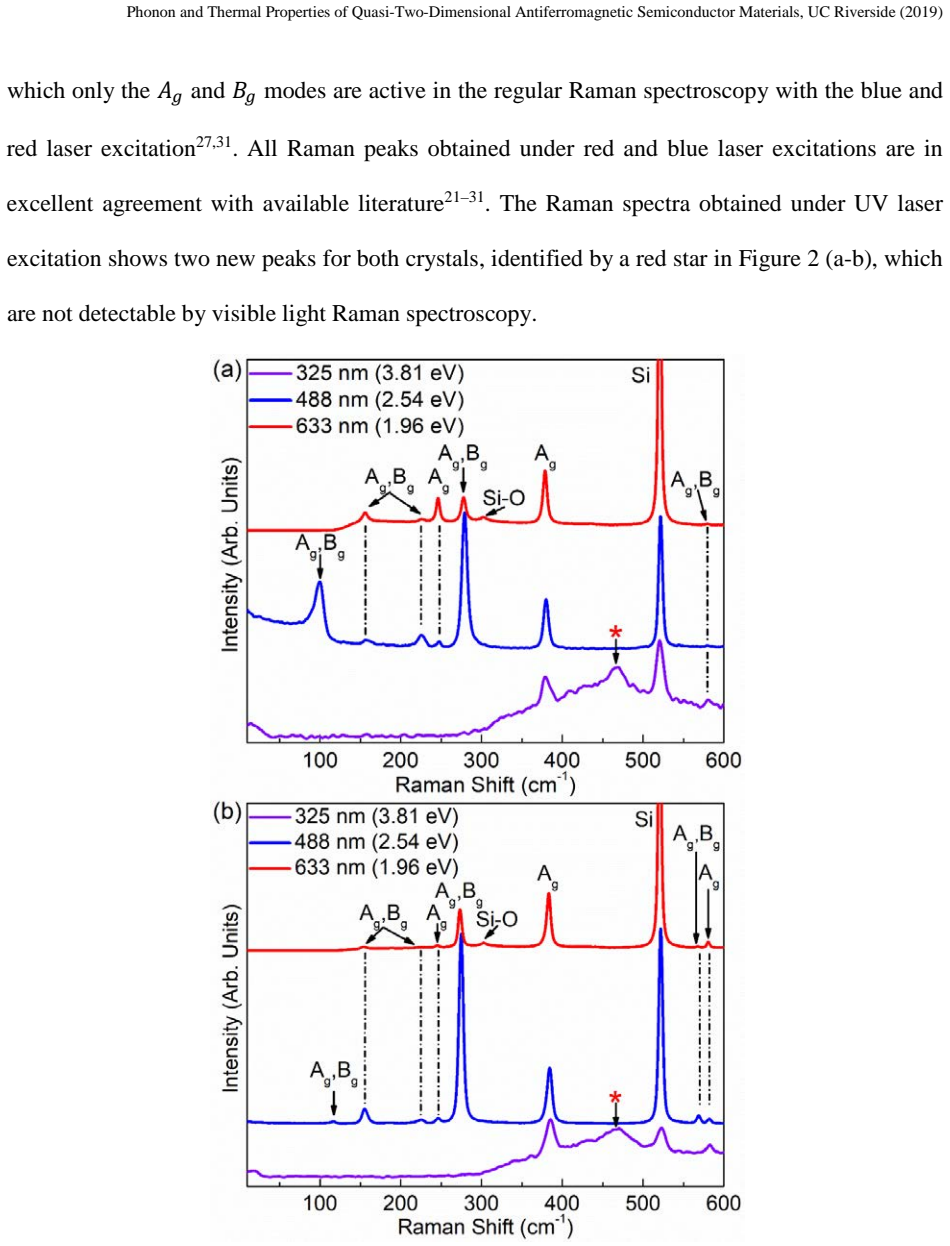
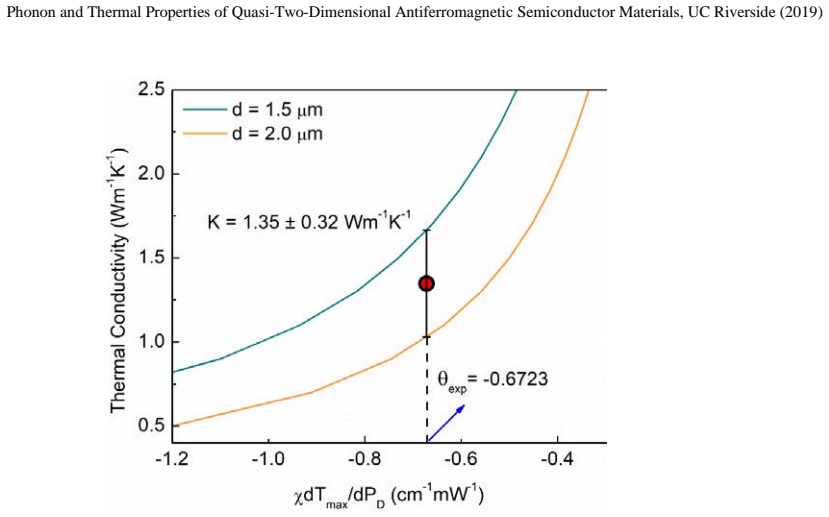
The central discovery is that quasi-two-dimensional FePS3 and MnPS3 are strongly anisotropic and phonon-dominated heat conductors at room temperature, with through-plane conductivities of $0.85 \pm 0.15$ and $1.1 \pm 0.2$ W m−1 K−1 and in-plane conductivities of $2.7 \pm 0.3$ and $6.3 \pm 1.7$ W m−1 K−1, respectively. The authors state these are the first experimental values for these antiferromagnetic semiconductors and the first decomposition into in-plane and through-plane components. The anisotropy follows the expected bond picture: weak van der Waals interlayer bonds resist cross-plane transport while covalent intralayer bonds carry heat in-plane. The independent Raman optothermal measurement on FePS3 gave $1.35 \pm 0.32$ W m−1 K−1, which matches the TR-MOKE components combined as $k = \alpha k_{\perp} + \beta k_{\parallel}$ with $\alpha = 0.73$ and $\beta = 0.27$. A second result is the appearance of a UV-only Raman peak near 467 cm−1 and a shoulder near 430 cm−1, which the calculations associate with modes of $B_u$ and $B_g$ symmetry whose frequencies shift with the magnetic order used in the supercell.
Load-bearing premise
The whole separation of in-plane from through-plane heat flow rests on the assumption that measurements at just two pump modulation frequencies, 1 and 10 MHz, can uniquely determine three unknowns: the interface conductance, the cross-plane conductivity, and the in-plane conductivity; the paper presents no sensitivity or identifiability analysis for that split.
Editorial extensions
If this is right
- A spin-Seebeck device using FePS3 or MnPS3 will develop larger temperature gradients for a given heating power than one built on higher-conductivity materials, directly changing the device's voltage output.
- The through-plane values near 1 W m−1 K−1 place this material family among the most thermally insulating crystalline semiconductors, suggesting use as a heat barrier in nanoscale stacks.
- The measured tensor gives a benchmark against which first-principles phonon calculations for the MPX3 family can be tested.
- The consistency between the Raman optothermal average and the TR-MOKE components ($\alpha = 0.73$, $\beta = 0.27$) implies the two methods produce compatible values when the flake is much larger than the laser spot.
- Because the metal transducer used in TR-MOKE is thin, the measured in-plane values are attributed to the crystal itself rather than to heat shunting through the metal film.
Reading between the lines
- Because the extraction uses two modulation frequencies to fix three unknowns, a natural check is to repeat the fits with several pump spot sizes; if the fitted in-plane conductivity moves with spot size beyond the quoted uncertainty, the split between in-plane and through-plane terms would be suspect.
- The computed dependence of the 467 cm−1 mode on the iron spin texture raises the possibility of using UV-Raman as a local, non-contact probe of antiferromagnetic order in thin flakes, though the paper does not claim this application.
- The reported interface conductance of about 24 MW m−2 K−1, equivalent to tens of nanometers of glass, implies that in real devices the metal–MPX3 contact will dominate total through-plane thermal resistance; thermal design would need to focus on interfaces rather than only the crystal.
- Extending the same TR-MOKE protocol to other MPX3 members such as NiPS3 and to monolayer flakes would map how the anisotropy and conductivity evolve with magnetic ion and thickness, testing whether phonon-boundary scattering suppresses the in-plane value at the monolayer limit.
Signed reviews
Editorial analysis
A structured set of objections, weighed in public.
Referee Report
Summary. The paper reports phonon and thermal property measurements on exfoliated films of the antiferromagnetic semiconductors FePS3 and MnPS3. Raman spectroscopy was performed with 325 nm (UV), 488 nm (blue), and 633 nm (red) excitation, revealing new UV-only spectral features near 430 and 467 cm-1. Density functional theory calculations for FePS3 were used to propose assignments for these modes. Thermal conductivity was measured by two techniques: steady-state Raman optothermal analysis, yielding an orientation-average value of 1.35 ± 0.32 W/mK for a 400-nm FePS3 film, and time-resolved magneto-optical Kerr effect (TR-MOKE), which is claimed to separately determine through-plane and in-plane conductivities. Reported values are k⊥ = 0.85 ± 0.15 W/mK and k∥ = 2.7 ± 0.3 W/mK for FePS3, and k⊥ = 1.1 ± 0.2 W/mK and k∥ = 6.3 ± 1.7 W/mK for MnPS3. The conclusion emphasizes strong thermal anisotropy and phonon-dominated heat conduction.
Significance. If the reported anisotropic thermal conductivities are correct, they constitute the first experimental thermal transport data for FePS3 and MnPS3, two materials of active interest for antiferromagnetic spintronics. The UV-Raman features, if properly assigned, would also add to the understanding of the vibrational spectra of metal phosphorus trichalcogenides. The paper is honest in reporting the parameter sensitivity of the DFT results, which is a strength, and the thermal conductivity values are direct measurements rather than derived from fitted parameters. However, the central anisotropy claim rests on a TR-MOKE analysis whose identifiability is not demonstrated, and the DFT support for the UV peaks is weakened by the absence of a unique calculation matching both observed modes. The significance of the work is therefore conditional on strengthening the uniqueness and sensitivity analysis of the thermal extraction.
major comments (4)
- [TR-MOKE measurements, paragraph beginning 'By performing measurements at multiple pump modulation frequencies'] The claim that measurements at two modulation frequencies, 1 MHz and 10 MHz, can independently determine three unknowns (G, k⊥, and k∥) is not supported by any identifiability or sensitivity analysis. With three free parameters in the cylindrical heat-diffusion model, two modulation frequencies do not, by themselves, guarantee a unique fit; the time-varying surface temperature signal at each frequency may be sensitive to only a combination of parameters. In particular, the in-plane conductivity k∥ enters through radial heat spreading, which at the used spot sizes could be largely degenerate with the interface conductance G and the through-plane conductivity k⊥. The paper reports no sensitivity matrix, no parameter correlation contours, and no joint confidence regions. The quoted uncertainties appear to reflect propagated input errors rather than fit degeneracy. Without showing that the data can distinguish k∥ from the other parameters, the reported in-plane values (2.7 W/mK for FePS3 and 6.3 W/mK for MnPS3) and the headline anisotropy claim are not demonstrated to be unique. The authors should provide a sensitivity analysis (e.g., ∂(signal)/∂ln(k∥) at both frequencies) or fit all three parameters simultaneously with reported confidence regions.
- [Conclusions, paragraph computing α and β] The consistency check between the optothermal average (1.35 W/mK) and the TR-MOKE values (0.85 and 2.7 W/mK) is achieved by choosing weight coefficients α = 0.73 and β = 0.27 after the fact. The optothermal Raman measurement alone yields only a weighted average k = αk⊥ + βk∥; the weights are not independently measured but are inferred from the TR-MOKE values. Therefore, this agreement does not provide an independent validation of the anisotropy. The abstract's statement that 'the data obtained by both techniques reveal strong thermal anisotropy' overstates the joint evidence; the anisotropy claim rests solely on the TR-MOKE decomposition, which is itself the subject of the identifiability concern above. To support the claim, an independent measurement of the in-plane conductivity, or a quantitative estimate of α and β from the optothermal experiment's geometry (rather than from the TR-MOKE results), is needed.
- [Density functional theory calculations, Table 2 and surrounding text] The DFT assignment of the UV-Raman peaks is not conclusive. The three calculations give lower-mode frequencies of 417, 431, and 417 cm-1 and upper-mode frequencies of 483, 521, and 526 cm-1; no single calculation reproduces both experimental features at 431 and 467 cm-1 simultaneously. The upper-mode frequency varies by about 8% depending on supercell size and the U-J parameter, which the paper acknowledges. The conclusion that these modes 'appear to be the possible candidates' is too strong given this sensitivity. Moreover, the calculations are performed for bulk FePS3 only, whereas the UV-Raman peaks are observed in both FePS3 and MnPS3; no DFT evidence is presented for MnPS3 to support a similar assignment. The authors should either provide a systematic convergence study (e.g., a U-J sweep and phonon dispersion at relevant wavevectors) or substantially hedge the conclusion, noting that the 467 cm-1 feature currently lacks a robust theoretical assignment.
- [Density functional theory calculations and Raman temperature dependence] The DFT calculations assume the zigzag antiferromagnetic (z-AFM) spin texture, which is the low-temperature ground state, to interpret Raman spectra taken at room temperature, well above the Néel temperature of FePS3 (about 118 K). The paper does not justify why a low-temperature magnetic configuration is appropriate for phonon modes measured in the paramagnetic phase. Table 2 shows that the calculated mode frequencies depend strongly on spin texture (the nonmagnetic calculation gives 417/526 cm-1 versus the z-AFM values), so the choice of magnetic state is not a negligible detail. The nonmagnetic calculation does not match the observed 431/467 cm-1 pair either. Since the material is paramagnetic at the measurement temperature, a paramagnetic or disordered-spin calculation would be a more relevant comparator, or the authors should explicitly argue why the z-AFM frequencies should persist above the magnetic transition. As it stands, the phonon assignment is built on an unexamined assumption.
minor comments (6)
- [Experimental section, Materials and characterization] The sentence 'In order to avoid self-heating effects, we used law laser excitation power in order to avoid self-heating effects' contains a typo ('law' for 'low') and a redundant phrase; it should be revised.
- [Results and Discussion, paragraph on optothermal thermal conductivity] The statement that α > β 'based on the lateral dimensions of the flake size (>10 µm) and the laser spot size (~1.5 µm)' is qualitative. A quantitative estimate of the weight coefficients from the COMSOL model would be more compelling and would avoid the appearance that the weights are chosen post hoc.
- [Table 3] The column headers in Table 3 are ambiguous: the first column labeled 'k' appears to be used for both the orientation-average value (FePS3 row) and for isotropic or unknown-direction values in the comparison rows. Please clarify the column meaning, e.g., by labeling the columns 'k (average)', 'k⊥', and 'k∥' and explaining in the caption how values for the literature materials were categorized.
- [Figure 7 caption] The text states that error bars in Figure 7 represent uncertainty in thermal conductivity due to laser spot size uncertainty, but the figure as displayed does not show visible error bars. Please ensure the error bars are drawn and described in the caption.
- [Methods, TR-MOKE description] The paper refers to an analytical solution of the heat-diffusion equation in cylindrical coordinates from references [42-44] but does not state the specific equations, assumptions (e.g., uniform in-plane conductivity, boundary conditions, heat capacity values, film thicknesses used in the fit), or the exact values of modulation frequencies and spot sizes. Including this information would substantially improve reproducibility and would also help the reader assess the identifiability concern raised in the major comments.
- [Supplementary Information] The text states that 'Full details of the calculations are provided in the Supplementary Materials,' but the supplementary files as provided contain only figures (XRD, optical, AFM, Raman) and no computational parameters such as pseudopotentials, energy cutoff, k-point sampling, or the phonon calculation method. This is an explicit promise that is not fulfilled. Please either add the missing computational details to the SI or correct the statement in the main text.
Circularity Check
No significant circularity: the thermal-conductivity values are direct inverse measurements, the Raman optothermal and TR-MOKE analyses have independent inputs, and the DFT mode matching is presented as tentative assignment, not a prediction.
full rationale
The paper's central quantitative claims are extracted thermal conductivities, produced by fitting a heat-diffusion model to measured TR-MOKE signals (Fig. 8) and by the Raman optothermal calibration (Figs. 5-7). These are measurement inversions rather than predictions from fitted parameters; the fit parameters (G, k-perp, k-par) are the reported quantities. The two-frequency identifiability concern raised in the reader's take is a sensitivity and correctness issue, not a circularity: nothing in the text defines k-par as the fit target of k-perp or derives it from the same single datum by construction. The FePS3 average k = alpha*k-perp + beta*k-par with alpha = 0.73 and beta = 0.27 is a post hoc consistency check using independently measured components, not an input to their determination. The DFT section explicitly varies U-J and supercell and notes frequencies depend on parameters; it is a tentative assignment of the 431/467 cm-1 peaks and does not bear on the thermal claims. Citations to prior TDTR/MOKE work [42-46] are standard method references, not self-citation of an unverified uniqueness result. No circular step can be quoted or exhibited. The paper is self-contained as a measurement report.
Assumptions & free parameters
free parameters (2)
- U-J Hubbard correction in DFT =
5.91 eV (2x2x2 z-AFM); 3.5 eV (4x4x1 z-AFM and non-magnetic)
- DFT supercell size =
2x2x2 and 4x4x1
assumptions (4)
- standard math Fourier's law with a Gaussian laser heat source describes the temperature field in the optothermal Raman experiment.
- domain assumption The analytical solution to the heat diffusion equation in cylindrical coordinates (from Ref. 42) applies to the TR-MOKE multilayer stack and adequately separates through-plane and in-plane heat flow.
- domain assumption A 400 nm exfoliated FePS3 flake is thick enough that phonon-boundary scattering is negligible, so the extracted optothermal value equals the average bulk thermal conductivity.
- ad hoc to paper The z-AFM spin texture (low-temperature ground state) is a relevant reference for phonon modes observed at room temperature, well above the Néel temperature.
Cite this review
Pith. "Pith review of Phonon and Thermal Properties of Quasi-Two-Dimensional FePS3 and MnPS3 Antiferromagnetic Semiconductor Materials." pith.science (2026). https://pith.science/paper/J5QHUXE3
@misc{pith2026190805186,
  author       = {Pith},
  title        = {Pith review of: Phonon and Thermal Properties of Quasi-Two-Dimensional FePS3 and MnPS3 Antiferromagnetic Semiconductor Materials},
  year         = {2026},
  howpublished = {\url{https://pith.science/paper/J5QHUXE3}},
  note         = {Machine review of arXiv:1908.05186}
}
read the original abstract
We report results of investigation of the phonon and thermal properties of the exfoliated films of layered single crystals of antiferromagnetic FePS3 and MnPS3 semiconductors. The Raman spectroscopy was conducted using three different excitation lasers with the wavelengths of 325 nm (UV), 488 nm (blue), and 633 nm (red). The resonant UV-Raman spectroscopy reveals new spectral features, which are not detectable via visible Raman light scattering. The thermal conductivity of FePS3 and MnPS3 thin films was measured by two different techniques: the steady-state Raman optothermal and transient time-resolved magneto-optical Kerr effect. The Raman optothermal measurements provided the orientation-average thermal conductivity of FePS3 to be 1.35 W/mK at room temperature. The transient measurements revealed that the through-plane and in-plane thermal conductivity of FePS3 is 0.85 W/mK and 2.7 W/mK, respectively. The films of MnPS3 have higher thermal conductivity of 1.1 W/mK through-plane and 6.3 W/mK in-plane. The data obtained by both techniques reveal strong thermal anisotropy of the films and the dominant contribution of phonons to heat conduction. Our results are important for the proposed applications of the antiferromagnetic semiconductor thin films in spintronic devices.
Figures


Figures from the paper (5 more)



Reference graph
Works this paper leans on
-
[1]
L.; Park, Y.; Lee, D.; Han, M.; Macdonald, A
(1) Chittari, B. L.; Park, Y.; Lee, D.; Han, M.; Macdonald, A. H.; Hwang, E.; Jung, J. Electronic and Magnet ic Properties of Single -Layer M PX3 Metal Phosphorous Trichalcogenides. Phys. Rev. B 2016, 94 (18), 184428. (2) Brec, R.; Schleich, D. M.; Ouvrard, G.; Louisy, A.; Rouxel, J. Physical Properties of Lithium Intercalation Compounds of the Layered Tr...
work page 2019
-
[46]
(53) Sahoo, S.; Gaur, A. P. S.; Ahmadi, M.; Guinel, J.-F.; Katiyar, R. S. Temperature-Dependent Raman Studies and Thermal Conductivity of Few-Layer MoS2. J. Phys. Chem. C 2013, 117,
work page 2013
-
[50]
Ab Initio Molecular Dynamics for Open- Shell Transition Metals
(35) Kresse, G.; Hafner, J. Ab Initio Molecular Dynamics for Open- Shell Transition Metals. Phys. Rev. B 1993, 48 (17), 13115–13118. (36) Perdew, J. P.; Burke, K.; Ernzerhof, M. Generalized Gradient Approximation Made Simple. Phys. Rev. Lett. 1996, 77 (18), 3865–3868. (37) Grimme, S. Semiempirical GGA-Type Density Functional Constructed with a Long-Range ...
work page 2019
-
[292]
(22) Wang, X.; Song, Z.; Wen, W.; Liu, H.; Wu, J.; Dang, C.; Hossain, M.; Iqbal, M. A.; Xie, L. Potential 2D Materials with Phase Transitions: Structure, Synthesis, and Device Phonon and Thermal Properties of Quasi-Two-Dimensional Antiferromagnetic Semiconductor Materials, UC Riverside (2019) 31 | Page Applications. Advanced Materials. John Wiley & Sons, ...
work page 2019
-
[345]
Spin Dependent Phonon Ra man Scattering in Antiferromagnetic FePS3 Layer-Type Compound
(25) Scagliotti, M.; Jouanne, M.; Balkanski, M.; Ouvrard, G. Spin Dependent Phonon Ra man Scattering in Antiferromagnetic FePS3 Layer-Type Compound. Solid State Commun. 1985, 54 (3), 291–294. (26) Scagliotti, M.; Jouanne, M.; Balkanski, M.; Ouvrard, G.; Benedek, G. Raman Scattering in Antiferromagnetic FePS3 and FePSe3 Crystals. Phys. Rev. B 1987, 35 (13)...
work page 2019
-
[827]
Thermal Conductivity Determination of Suspended Mono- and Bilayer WS2 by Raman Spectroscopy
(41) Peimyoo, N.; Shang, J.; Yang, W.; Wang, Y.; Cong, C.; Yu, T. Thermal Conductivity Determination of Suspended Mono- and Bilayer WS2 by Raman Spectroscopy. Nano Res. 2015, 8 (4), 1210–1221. (42) Cahill, D. G.; Braun, P. V; Chen, G.; Clarke, D. R.; Fan, S.; Goodson, K. E.; Keblinski, P.; King, W. P.; Mahan, G. D.; Majumdar, A.; Phillpot, S. R.; Pop, E.;...
work page 2019
-
[2015]
-Y.; Choi, S.- M.; Seo, W.- S.; Cho, W.- S
(55) Kim, J. -Y.; Choi, S.- M.; Seo, W.- S.; Cho, W.- S. Thermal and Electronic Properties of Exfoliated Metal Chalcogenides. Bull. Korean Chem. Soc. 2010, 31 (11), 3225–3227. (56) Brill, J. W.; Tzou, C. P.; Verma, G.; Ong, N. P. Thermal Conductivity of NbSe3. Solid State Commun. 1981, 39 (2), 233–237. (57) Zhang, Q.; Liu, C.; Liu, X.; Liu, J.; Cui, Z.; Z...
work page 2019
-
[2809]
(67) Towns, J.; Cockerill, T.; Dahan, M.; Foster, I.; Gaither, K.; Grimshaw, A.; Hazlewood, V.; Lathrop, S.; Lifka, D.; Peterson, G. D.; et al. XSEDE: Accelerating Scientific Discovery. Comput. Sci. Eng. 2014, 16 (5), 62–74. Phonon and Thermal Properties of Quasi-Two-Dimensional Antiferromagnetic Semiconductor Materials, UC Riverside (2019) 37 | Page Supp...
work page 2019
Reviewed August 14, 2026 · model on record in the stance chip above.
Discussion (0). Continue with ORCID to comment.