REVIEW 3 major objections 6 minor 62 references
GP2C: Geometric Projection Parameter Consensus for Joint 3D Pose and Focal Length Estimation in the Wild
T0 review · 3 major / 6 minor · reviewed 2026-08-14 · deepseek-v4-flash
Pith's one-line read This paper claims that jointly optimizing 3D pose together with camera focal length, instead of predicting them separately, cuts translation error by about 20 percent and sharply improves 2D-3D alignment.
desk verdict A solid, honest category-level pose+focal length paper whose headline translation gain depends on the Stage-1 focal estimate more than the paper quantifies; worth refereeing with a request for the missing control. read the letter →
The pith
A machine-rendered reading of the paper's core claim, the machinery that carries it, and where it could break.
The reading
What carries the argument
Key machinery here is the PnPf optimization itself: a nonlinear least-squares / robust-loss refinement in which rotation $R$, translation $t$, and focal length $f$ are updated together to minimize reprojection error, with four 2D-3D correspondences as the theoretical minimum. The initial rotation and translation come from EPnP using the network's predicted focal length, and the refinement uses Levenberg-Marquardt for the squared loss or a Subspace Trust-Region Interior-Reflective method for the Cauchy loss. This shared minimization is what creates the paper's 'geometric consensus' between projection parameters; a constant focal length or independent per-parameter prediction cannot enforce that coupling, which is why the paper attributes the translation and alignment improvements to it.
What would settle it
On a held-out test set with ground-truth focal lengths, run the full pipeline with three initializations — the network's predicted focal length, the ground-truth focal length, and the training-set median — and compare median relative translation error after joint refinement. The central claim is falsified if the predicted-focal-length and median initializations give the same translation accuracy, or if joint refinement does not reduce the gap between the predicted and ground-truth initializations.
Extended reading notes
Core claim
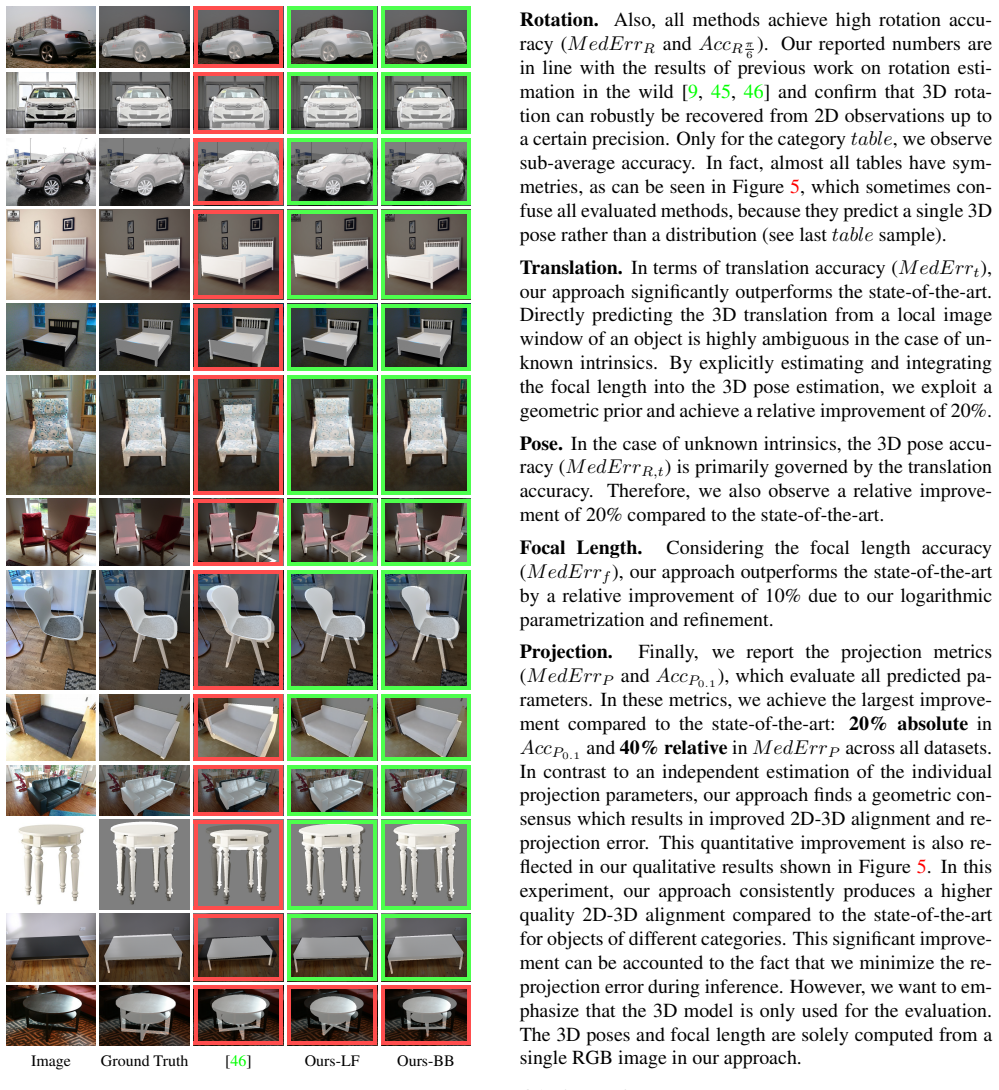
On the paper's own terms, the central discovery is that the translation-zoom ambiguity for objects in the wild can be broken by coupling pose and focal length in one optimization rather than treating focal length as a constant or as a separate prediction. The network outputs a logarithmic focal length $y_f=\ln(f)$ and either a dense location field of per-pixel 3D coordinates or the 2D projections of 3D bounding-box corners; the geometric stage then solves the PnPf problem by minimizing $e_{\text{reproj}}=\frac{1}{N}\sum_i L(\|\mathrm{Proj}_{R,t,f}(X_i)-x_i\|_2)$ with respect to rotation, translation, and focal length, initialized by EPnP with the predicted focal length and refined with a Newton-step method. Across the Pix3D, Comp, and Stanford datasets, the paper reports that this joint refinement improves median translation error, pose error, focal length error, and reprojection accuracy compared with the independent-estimation baseline, and an ablation shows that even the initial solution already outperforms the baseline while joint refinement adds a further gain.
Load-bearing premise
The method depends on the network's initial focal length estimate being accurate enough that the subsequent joint optimization recovers the true object-to-camera distance rather than merely a self-consistent projection; if the predicted focal lengths were no better than the training-set median, the claimed translation gains would largely disappear.
Editorial extensions
If this is right
- Translation accuracy from a single image is limited by the focal-length ambiguity, so any pose estimator that fixes or ignores intrinsics will hit a ceiling that explicit joint estimation can raise.
- The same geometric consensus step works with either dense location-field correspondences or sparse bounding-box-corner correspondences, so the correspondence representation can be chosen to match available training data.
- Projection-based alignment improves more than any other metric, which directly benefits augmented reality and any application that overlays a 3D model onto the image.
- Because translation error and pose error both drop by about twenty percent relative when focal length is integrated, focal-length accuracy becomes a lever on 3D pose quality rather than a separate output.
- The formulation extends to multiple objects in one image and to more complex camera models, although the evaluated datasets only support one annotated object per image with a simple pinhole model.
Reading between the lines
- The gap the paper shows between predicted-focal-length and ground-truth-focal-length initialization suggests that adding an uncertainty estimate or multiple focal-length hypotheses to the network could close much of the remaining translation error; the paper itself does not explore this.
- If the principle transfers to instance-level 6D pose with unknown intrinsics, the same PnPf refinement could remove the need for per-camera calibration in robotics and augmented reality, assuming correspondences are accurate enough.
- The paper notes joint multi-object refinement is straightforward but leaves it unevaluated; a natural test is whether optimizing several objects' poses and a shared focal length together improves accuracy on images with multiple annotated objects.
Signed reviews
Editorial analysis
A structured set of objections, weighed in public.
Referee Report
Summary. The paper proposes GP2C, a two-stage approach to joint 3D object pose and focal length estimation from a single RGB image. In Stage 1, a Mask R-CNN-style network predicts an initial focal length (via a logarithmic parametrization) and 2D-3D correspondences, using either dense location fields (LF) or projections of 3D bounding box corners (BB). In Stage 2, the rotation, translation, and focal length are refined by minimizing the reprojection error of the predicted correspondences (PnPf). Experiments on Pix3D, Comp, and Stanford report consistent improvements over a reimplemented baseline [46] across several metrics, including translation, pose, focal length, and 2D-3D projection accuracy.
Significance. If the results hold, the paper addresses a real and underappreciated problem: the translation-zoom ambiguity that arises when estimating 3D pose from images with unknown focal length. The two-stage design is clean, the optimization is standard, and the ablations (initial vs. refined; standard vs. RANSAC vs. Cauchy PnP; different focal initializations) help isolate the mechanism. The comparison of two correspondence representations (LF and BB) is also useful. However, the central quantitative claim is weakened by two issues: (1) the headline translation/pose improvements appear to depend substantially on the quality of the Stage-1 focal length estimate, and the paper does not report the final translation/pose metrics for the different focal initializations it uses in Fig. 6; and (2) the projection metrics, for which the largest absolute gains are reported, are improved partly by construction since Stage 2 explicitly minimizes reprojection error. These issues do not invalidate the method, but they must be addressed before the claimed benefits can be fully credited.
major comments (3)
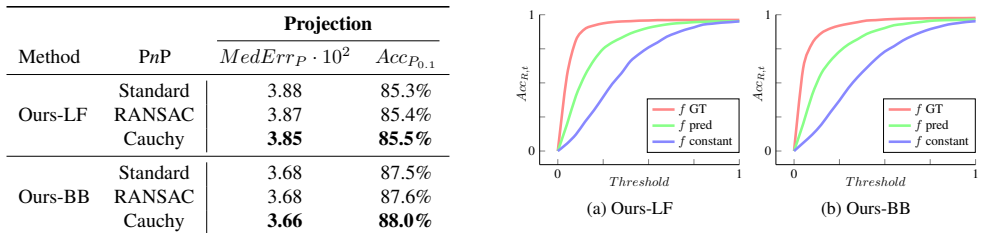
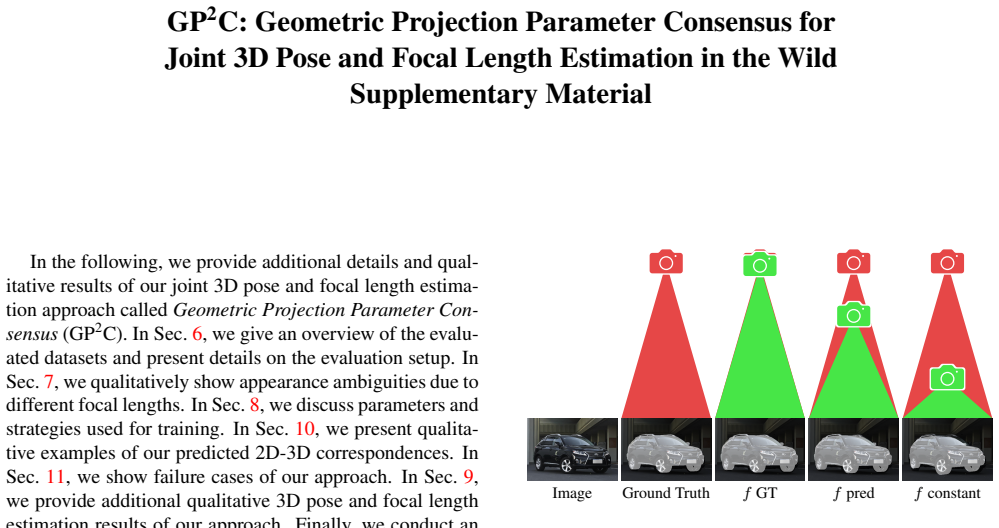
- [§3.2, §4.2, Fig. 6] The paper's own Sec. 3.2 states that for noisy category-level correspondences, "a low reprojection error is achieved by finding the correct ratio between the object-to-camera distance and the focal length," and that PnPf cannot recover the absolute focal length from scratch. Figure 6 confirms that pose accuracy degrades when the optimization is initialized with the training-set median focal length (f_constant). Yet the manuscript reports only cumulative accuracy curves for the different focal initializations; it does not report the numeric MedErrt, MedErrR,t, or MedErrf values that would allow the reader to quantify how much of the headline translation improvement over [46] is due to the Stage-1 focal branch rather than the joint geometric refinement. Since the central claim is that joint estimation yields "significantly improved 3D translation and 3D pose accuracy," the authors should provide a table with these metrics for f_pred, f_constant, and f_GT initializations (at least for the Pix3D mean, and ideally per category and dataset). Without this, the load-bearing premise that the predicted focal length is accurate enough to make the refinement meaningful cannot be assessed.
- [§4.1, Table 1] The baseline comparison is described in Sec. 4.1 as follows: "we reimplemented the approach of [46] and achieve comparable results, even outperforming their reported MedErrP and AccP0.1 scores due to our improved backbone architecture and initialization." This means the numbers attributed to [46] in Table 1 are not necessarily the original published numbers but a reimplementation with modifications. The paper should state explicitly which rows are from the original paper and which are from the reimplementation, and describe the reimplementation's architecture and training details. If the reimplementation improves on the original [46], the claim of outperforming the state-of-the-art should be qualified, and the original reported numbers should be included for reference so that readers can judge the comparison.
- [§4, Eq. (7), Table 1] The projection metrics MedErrP and AccP0.1 are computed from the reprojection error that Stage 2 explicitly minimizes in Eq. (2). Improvements in these metrics are therefore partly by construction and do not, by themselves, demonstrate better 3D pose or focal length estimation. The paper acknowledges this in Sec. 4.1 ("This significant improvement can be accounted to the fact that we minimize the reprojection error during inference"), but still lists projection accuracy as a headline contribution. The independent evidence for the method's benefit rests on translation and pose metrics, which makes the missing analysis described in the first major comment more critical: without those numbers, the reader cannot separate the contribution of the geometric consensus from the contribution of the improved Stage-1 predictions.
minor comments (6)
- [§4.1, Table 1] The text states a "relative improvement of 20%" for translation and pose, but from Table 1 the Pix3D-mean MedErrt improves from 2.52 to 1.85 (≈27%) and MedErrR,t from 1.76 to 1.30 (≈26%). Please reconcile the stated percentage with the table, or specify the aggregation used.
- [§4.1, Table 1] Add a table note or footnote specifying that the [46] rows are the authors' reimplementation and which components (backbone, initialization) differ from the original method, to avoid ambiguity in the baseline comparison.
- [§3.2] The statement "A minimum of four 2D-3D correspondences is needed to find a unique solution" is correct for a 7-parameter PnPf problem, but the wording could be clarified: four correspondences provide eight equations, and uniqueness holds only under non-degenerate configurations. A brief reference to degeneracy conditions in [49] would help.
- [Figure 6] The x-axis label "Threshold" and y-axis "AccR,t" are vague. Please specify that the curve is the cumulative pose accuracy for the metric in Eq. (5), and define the threshold range.
- [§4.2 / Supplementary Table 3] Supplementary Table 3 (ablation of joint refinement) is not referenced in the main text. Please cite it in Sec. 4.2 when discussing the initial vs. refined results.
- [Abstract / §4.1] The abstract's "up to 20% absolute in multiple different metrics" is vague. Specify which metric achieves 20% absolute (AccP0.1) and which achieves 20% relative (translation/pose), and ensure the numbers match the tables.
Circularity Check
No significant circularity: empirical gains are externally evaluated, and the focal-initialization dependence is disclosed.
full rationale
The paper's derivation chain is short: Stage 1 regresses a focal length and 2D-3D correspondences; Stage 2 minimizes Eq. (2) over rotation, translation, and focal length. No claim reduces to an input by construction. The projection metrics (Eq. 7) are computed against ground-truth projections Proj_gt, while the inference objective Eq. (2) uses predicted correspondences x_i, so minimizing the objective does not by itself force a low MedErrP or high AccP0.1; it only helps when the predicted correspondences are accurate. The paper itself discloses and quantifies this dependence: Section 3.2 states that a low reprojection error can arise from finding the correct ratio between object-to-camera distance and focal length, Figure 6 shows the gap between predicted and ground-truth focal-length initialization, and Supplementary Figure 7 explicitly shows that a visually precise 2D-3D alignment can still have a wrong object-to-camera distance. Thus the paper does not confuse reprojection consistency with absolute pose accuracy. The claimed translation and pose gains are empirical comparisons against a reimplemented baseline [46], and they depend on the Stage-1 focal estimate in a way the paper acknowledges, but dependence on an input is not circularity. Self-citations [9] and [23] provide component methods (bounding-box corner prediction and EPnP initialization), not the central joint-optimization claim, and they are standard published results; no load-bearing uniqueness theorem is imported from the authors, and no fitted parameter is renamed as a prediction. Therefore no circular step is established.
Assumptions & free parameters
free parameters (4)
- Loss weight for focal length branch =
0.1
- Loss weight for 2D-3D correspondences branch =
10.0
- Location field spatial resolution =
28 x 28
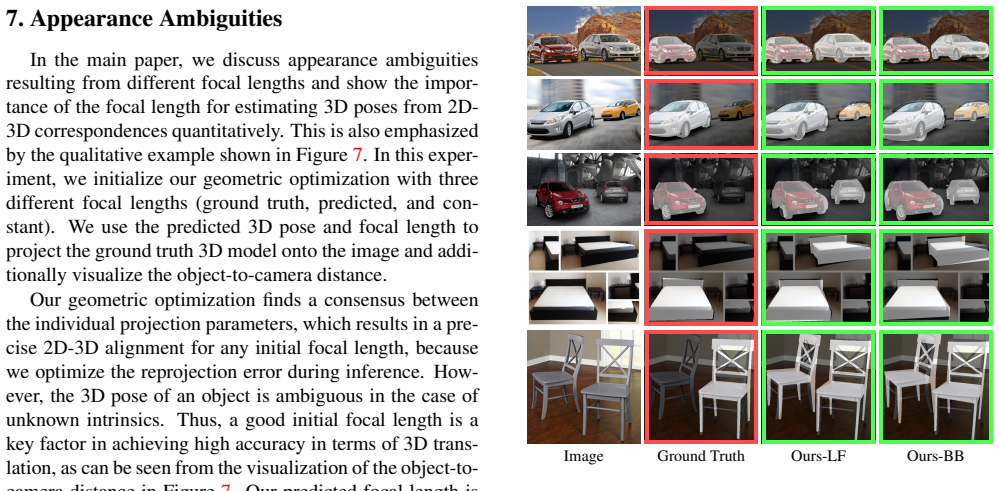
- Train/test split for Pix3D =
50% / 50%
assumptions (6)
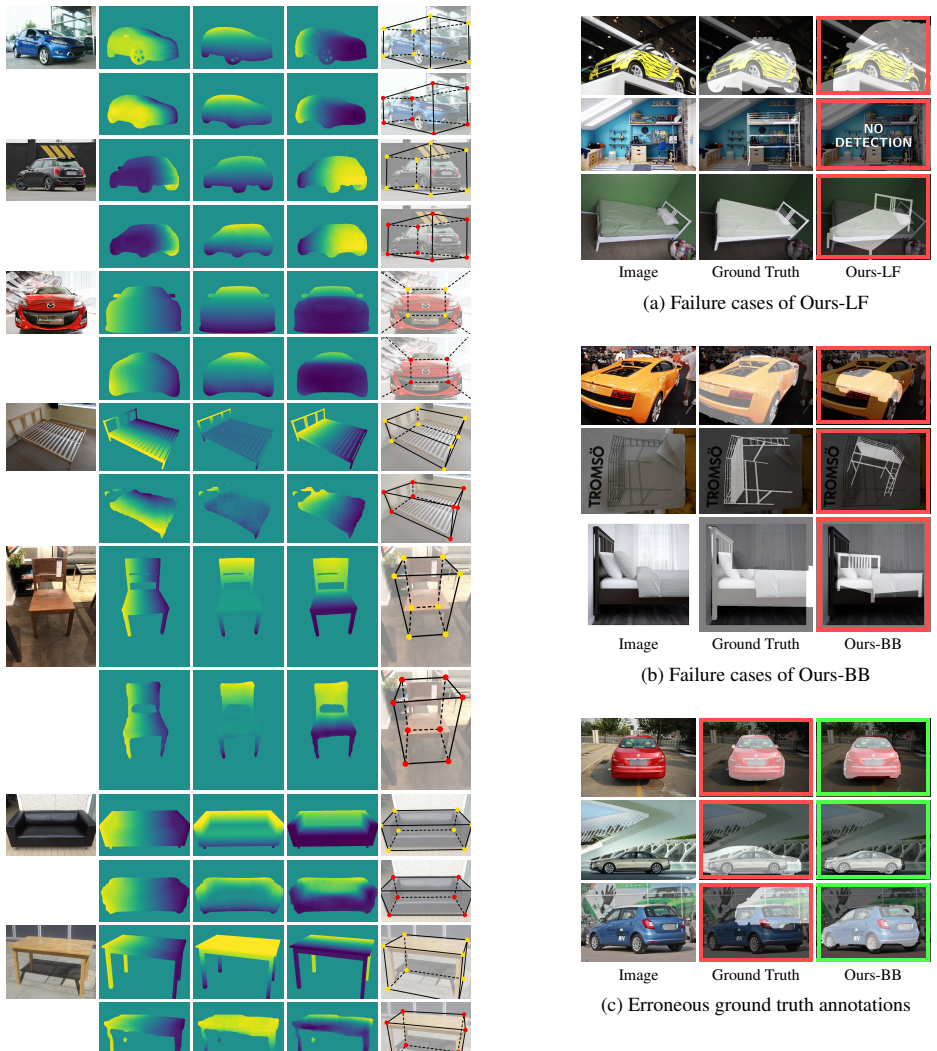
- domain assumption Pinhole camera model with principal point at image center, zero skew, and no distortion
- domain assumption Object appearance in the image determines only the ratio of object-to-camera distance to focal length, not the absolute values
- domain assumption The CNN can learn to predict useful 2D-3D correspondences and focal length from the training data
- domain assumption Ground truth pose and focal length annotations in Pix3D, Comp, and Stanford are sufficiently accurate for evaluation
- domain assumption EPnP with the predicted focal length provides a sufficiently good initial solution for the joint optimization
- standard math The PnPf problem has a unique solution with at least four 2D-3D correspondences
Cite this review
Pith. "Pith review of GP2C: Geometric Projection Parameter Consensus for Joint 3D Pose and Focal Length Estimation in the Wild." pith.science (2026). https://pith.science/paper/J6BMJKJ5
@misc{pith2026190802809,
  author       = {Pith},
  title        = {Pith review of: GP2C: Geometric Projection Parameter Consensus for Joint 3D Pose and Focal Length Estimation in the Wild},
  year         = {2026},
  howpublished = {\url{https://pith.science/paper/J6BMJKJ5}},
  note         = {Machine review of arXiv:1908.02809}
}
read the original abstract
We present a joint 3D pose and focal length estimation approach for object categories in the wild. In contrast to previous methods that predict 3D poses independently of the focal length or assume a constant focal length, we explicitly estimate and integrate the focal length into the 3D pose estimation. For this purpose, we combine deep learning techniques and geometric algorithms in a two-stage approach: First, we estimate an initial focal length and establish 2D-3D correspondences from a single RGB image using a deep network. Second, we recover 3D poses and refine the focal length by minimizing the reprojection error of the predicted correspondences. In this way, we exploit the geometric prior given by the focal length for 3D pose estimation. This results in two advantages: First, we achieve significantly improved 3D translation and 3D pose accuracy compared to existing methods. Second, our approach finds a geometric consensus between the individual projection parameters, which is required for precise 2D-3D alignment. We evaluate our proposed approach on three challenging real-world datasets (Pix3D, Comp, and Stanford) with different object categories and significantly outperform the state-of-the-art by up to 20% absolute in multiple different metrics.
Figures



Figures from the paper (5 more)
Reference graph
Works this paper leans on
-
[46]
Y . Wang, X. Tan, Y . Yang, X. Liu, E. Ding, F. Zhou, and L. S. Davis. 3D Pose Estimation for Fine-Grained Object Categories. In European Conference on Computer Vision Workshops, 2018
work page 2018
-
[1]
E. Brachmann, A. Krull, F. Michel, S. Gumhold, J. Shotton, and C. Rother. Learning 6D Object Pose Estimation using 3D Object Coordinates. In European Conference on Com- puter Vision, pages 536–551, 2014
work page 2014
-
[2]
E. Brachmann, F. Michel, A. Krull, M. Ying Yang, S. Gumhold, and C. Rother. Uncertainty-Driven 6D Pose Estimation of Objects and Scenes from a Single RGB Image. In Conference on Computer Vision and Pattern Recognition, pages 3364–3372, 2016
work page 2016
-
[3]
M. A. Branch, T. F. Coleman, and Y . Li. A Subspace, Interior, and Conjugate Gradient Method for Large-Scale Bound-Constrained Minimization Problems. SIAM Journal on Scientific Computing, 21(1):1–23, 1999
work page 1999
- [4]
-
[5]
Q. Chen, H. Wu, and T. Wada. Camera Calibration with Two Arbitrary Coplanar Circles. In European Conference on Computer Vision, pages 521–532, 2004
work page 2004
-
[6]
A. R. Conn, N. I. Gould, and P. L. Toint. Trust Region Meth- ods. SIAM, 2000
work page 2000
-
[7]
M. Dubsk ´a, A. Herout, R. Jur ´anek, and J. Sochor. Fully Automatic Roadside Camera Calibration for Traffic Surveil- lance. IEEE Transactions on Intelligent Transportation Sys- tems, 16(3):1162–1171, 2015
work page 2015
Show all 62 references
-
[8]
Faugeras
O. Faugeras. Three-Dimensional Computer Vision: A Geo- metric Viewpoint. MIT Press, 1993
1993
-
[9]
Grabner, P
A. Grabner, P. M. Roth, and V . Lepetit. 3D Pose Estimation and 3D Model Retrieval for Objects in the Wild. In Con- ference on Computer Vision and Pattern Recognition, pages 3022–3031, 2018
2018
-
[10]
Hartley and A
R. Hartley and A. Zisserman. Multiple View Geometry in Computer Vision. Cambridge University Press, 2003
2003
-
[11]
K. He, G. Gkioxari, P. Doll ´ar, and R. Girshick. Mask R- CNN. In International Conference on Computer Vision , pages 2980–2988, 2017
2017
-
[12]
K. He, X. Zhang, S. Ren, and J. Sun. Deep Residual Learning for Image Recognition. In Conference on Computer Vision and Pattern Recognition, pages 770–778, 2016
2016
-
[13]
K. He, X. Zhang, S. Ren, and J. Sun. Identity Mappings in Deep Residual Networks. In European Conference on Com- puter Vision, pages 630–645, 2016
2016
-
[14]
J. A. Hesch and S. I. Roumeliotis. A Direct Least-Squares (DLS) Method for P nP. In International Conference on Computer Vision, pages 383–390, 2011
2011
-
[15]
Hinterstoisser, C
S. Hinterstoisser, C. Cagniart, S. Ilic, P. Sturm, N. Navab, P. Fua, and V . Lepetit. Gradient Response Maps for Real- Time Detection of Textureless Objects. IEEE Transactions on Pattern Analysis and Machine Intelligence , 34(5):876– 888, 2011
2011
-
[16]
Hinterstoisser, V
S. Hinterstoisser, V . Lepetit, S. Ilic, S. Holzer, G. Bradski, K. Konolige, and N. Navab. Model Based Training, De- tection and Pose Estimation of Texture-Less 3D Objects in Heavily Cluttered Scenes. In Asian Conference on Computer Vision, pages 548–562, 2012
2012
-
[17]
Hodan, P
T. Hodan, P. Haluza, ˇS. Obdr ˇz´alek, J. Matas, M. Lourakis, and X. Zabulis. T-LESS: An RGB-D Dataset for 6D Pose Estimation of Texture-Less Objects. In IEEE Winter Con- ference on Applications of Computer Vision, pages 880–888, 2017
2017
-
[18]
Hoda ˇn, J
T. Hoda ˇn, J. Matas, and ˇS. Obdrˇz´alek. On Evaluation of 6D Object Pose Estimation. In European Conference on Com- puter Vision, pages 606–619, 2016
2016
-
[19]
P. Huber. Robust Estimation of a Location Parameter. The Annals of Mathematical Statistics, 35(1):73–101, 1964
1964
-
[20]
O. H. Jafari, S. K. Mustikovela, K. Pertsch, E. Brachmann, and C. Rother. iPose: Instance-Aware 6D Pose Estimation of Partly Occluded Objects. In Asian Conference on Computer Vision, 2018
2018
-
[21]
W. Kehl, F. Manhardt, F. Tombari, S. Ilic, and N. Navab. SSD-6D: Making RGB-Based 3D Detection and 6D Pose Estimation Great Again. In International Conference on Computer Vision, pages 1530–1538, 2017
2017
-
[22]
Kundu, Y
A. Kundu, Y . Li, and J. M. Rehg. 3D-RCNN: Instance-Level 3D Object Reconstruction via Render-and-Compare. InCon- ference on Computer Vision and Pattern Recognition, pages 3559–3568, 2018
2018
-
[23]
Lepetit, F
V . Lepetit, F. Moreno-Noguer, and P. Fua. EPnP: An Accu- rate O(n) Solution to the PnP Problem. International Jour- nal of Computer Vision, 81(2):155, 2009
2009
-
[24]
C. Li, J. Bai, and G. D. Hager. A Unified Framework for Multi-View Multi-Class Object Pose Estimation. In Euro- pean Conference on Computer Vision, pages 1–16, 2018
2018
-
[25]
T.-Y . Lin, P. Doll ´ar, R. B. Girshick, K. He, B. Hariharan, and S. J. Belongie. Feature Pyramid Networks for Object Detection. In Conference on Computer Vision and Pattern Recognition, pages 2117–2125, 2017
2017
-
[26]
T.-Y . Lin, M. Maire, S. Belongie, J. Hays, P. Perona, D. Ra- manan, P. Doll´ar, and C. L. Zitnick. Microsoft COCO: Com- mon Objects in Context. In European Conference on Com- puter Vision, pages 740–755, 2014
2014
-
[27]
Mahendran, H
S. Mahendran, H. Ali, and R. Vidal. A Mixed Classification- Regression Framework for 3D Pose Estimation from 2D Im- ages. In British Machine Vision Conference , pages 238.1– 238.12, 2018
2018
-
[28]
Massa, R
F. Massa, R. Marlet, and M. Aubry. Crafting a Multi-Task CNN for Viewpoint Estimation. In British Machine Vision Conference, pages 91.1–91.12, 2016
2016
-
[29]
J. J. Mor ´e. The Levenberg-Marquardt Algorithm: Implemen- tation and Theory. In Numerical Analysis, pages 105–116, 1978
1978
-
[30]
Mottaghi, Y
R. Mottaghi, Y . Xiang, and S. Savarese. A Coarse-To-Fine Model for 3D Pose Estimation and Sub-Category Recogni- tion. In Conference on Computer Vision and Pattern Recog- nition, pages 418–426, 2015
2015
-
[31]
Mousavian, D
A. Mousavian, D. Anguelov, J. Flynn, and J. Kosecka. 3D Bounding Box Estimation Using Deep Learning and Geom- etry. In Conference on Computer Vision and Pattern Recog- nition, pages 7074–7082, 2017
2017
-
[32]
G. Nakano. A Versatile Approach for Solving P nP, PnPf, and PnPfr Problems. In European Conference on Computer Vision, pages 338–352, 2016
2016
-
[33]
Pavlakos, X
G. Pavlakos, X. Zhou, A. Chan, K. Derpanis, and K. Dani- ilidis. 6-DoF Object Pose from Semantic Keypoints. In In- ternational Conference on Robotics and Automation , pages 2011–2018, 2017. 9
2011
-
[34]
Penate-Sanchez, J
A. Penate-Sanchez, J. Andrade-Cetto, and F. Moreno- Noguer. Exhaustive Linearization for Robust Camera Pose and Focal Length Estimation. IEEE Transactions on Pat- tern Analysis and Machine Intelligence , 35(10):2387–2400, 2013
2013
-
[35]
Pepik, M
B. Pepik, M. Stark, P. Gehler, T. Ritschel, and B. Schiele. 3D Object Class Detection in the Wild. In Conference on Computer Vision and Pattern Recognition Workshops, pages 1–10, 2015
2015
-
[36]
Rad and V
M. Rad and V . Lepetit. BB8: A Scalable, Accurate, Robust to Partial Occlusion Method for Predicting the 3D Poses of Challenging Objects Without Using Depth. In International Conference on Computer Vision, pages 3828–3836, 2017
2017
-
[37]
S. Ren, K. He, R. Girshick, and J. Sun. Faster R-CNN: Towards Real-Time Object Detection with Region Proposal Networks. In Advances in Neural Information Processing Systems, pages 91–99, 2015
2015
-
[38]
X. Sun, J. Wu, X. Zhang, Z. Zhang, C. Zhang, T. Xue, J. Tenenbaum, and W. Freeman. Pix3D: Dataset and Meth- ods for Single-Image 3D Shape Modeling. In Conference on Computer Vision and Pattern Recognition , pages 2974– 2983, 2018
2018
-
[39]
Sundermeyer et.al
M. Sundermeyer et.al. Implicit 3D Orientation Learning for 6D Object Detection from RGB Images. In European Con- ference on Computer Vision, 2018
2018
-
[40]
Szeliski
R. Szeliski. Computer Vision: Algorithms and Applications. Springer Science & Business Media, 2010
2010
-
[41]
Tekin, S
B. Tekin, S. N. Sinha, and P. Fua. Real-Time Seamless Single Shot 6D Object Pose Prediction. InConference on Computer Vision and Pattern Recognition, pages 292–301, 2018
2018
-
[42]
Triggs, P
B. Triggs, P. F. McLauchlan, R. I. Hartley, and A. W. Fitzgib- bon. Bundle Adjustment – A Modern Synthesis. In In- ternational Workshop on Vision Algorithms, pages 298–372, 1999
1999
-
[43]
R. Tsai. A Versatile Camera Calibration Technique for High- Accuracy 3D Machine Vision Metrology Using Off-The- Shelf TV Cameras and Lenses. Journal of Robotics and Au- tomation, 3(4):323–344, 1987
1987
-
[44]
Tulsiani, J
S. Tulsiani, J. Carreira, and J. Malik. Pose Induction for Novel Object Categories. In International Conference on Computer Vision, pages 64–72, 2015
2015
-
[45]
Tulsiani and J
S. Tulsiani and J. Malik. Viewpoints and Keypoints. In Con- ference on Computer Vision and Pattern Recognition, pages 1510–1519, 2015
2015
-
[47]
Workman, C
S. Workman, C. Greenwell, M. Zhai, R. Baltenberger, and N. Jacobs. DEEPFOCAL: A Method for Direct Focal Length Estimation. In International Conference on Image Process- ing, pages 1369–1373, 2015
2015
-
[48]
C. Wu. P3.5P: Pose Estimation with Unknown Focal Length. In Conference on Computer Vision and Pattern Recognition, pages 2440–2448, 2015
2015
-
[49]
Wu and Z
Y . Wu and Z. Hu. PnP Problem Revisited. Journal of Math- ematical Imaging and Vision, 24(1):131–141, 2006
2006
-
[50]
Xiang, W
Y . Xiang, W. Kim, W. Chen, J. Ji, C. Choy, H. Su, R. Mot- taghi, L. Guibas, and S. Savarese. ObjectNet3D: A Large Scale Database for 3D Object Recognition. In European Conference on Computer Vision, pages 160–176, 2016
2016
-
[51]
Xiang, R
Y . Xiang, R. Mottaghi, and S. Savarese. Beyond Pascal: A Benchmark for 3D Object Detection in the Wild. In IEEE Winter Conference on Applications of Computer Vi- sion, pages 75–82, 2014
2014
-
[52]
Xiang, T
Y . Xiang, T. Schmidt, V . Narayanan, and D. Fox. PoseCNN: A Convolutional Neural Network for 6D Object Pose Esti- mation in Cluttered Scenes. In Robotics: Science and Sys- tems Conference, pages 1–10, 2018
2018
-
[53]
Z. Zhang. A Flexible New Technique for Camera Calibra- tion. IEEE Transactions on Pattern Analysis and Machine Intelligence, 22(11):1330–1334, 2000
2000
-
[54]
Zheng and L
Y . Zheng and L. Kneip. A Direct Least-Squares Solution to the P nP Problem with Unknown Focal Length. In Con- ference on Computer Vision and Pattern Recognition, pages 1790–1798, 2016
2016
-
[55]
Zheng, S
Y . Zheng, S. Sugimoto, I. Sato, and M. Okutomi. A General and Simple Method for Camera Pose and Focal Length De- termination. In Conference on Computer Vision and Pattern Recognition, pages 430–437, 2014. 10 GP2C: Geometric Projection Parameter Consensus for Joint 3D Pose and...
2014
-
[56]
These datasets provide category-level 3D pose and focal length annotations for RGB images taken in the wild and have only been available recently
Datasets and Evaluation Setup We evaluate our proposed approach for joint 3D pose and focal length estimation in the wild on three challenging real- world dataset with different object categories: Pix3D [38] (bed, chair, sofa, table), Comp [46] (car), and Stanford [46] (car). ...
-
[57]
This is also emphasized by the qualitative example shown in Figure 7
Appearance Ambiguities In the main paper, we discuss appearance ambiguities resulting from different focal lengths and show the impor- tance of the focal length for estimating 3D poses from 2D- 3D correspondences quantitatively. This is also emphasized by the qualitative examp...
-
[58]
In this way, we are able to use a batch size of 6 on a 12GB GPU
Training Details For our implementation, we resize and pad images to a spatial resolution of 512× 512 maintaining the aspect ra- tio. In this way, we are able to use a batch size of 6 on a 12GB GPU. We train our networks for 200 epochs and employ a staged training strategy for...
-
[59]
We predict 3D poses for multiple objects, however, all evaluated datasets only provide 3D pose annotations for one instance per image
Qualitative Results Figure 8 shows additional qualitative 3D pose and focal length estimation results for multiple objects in a single im- age. We predict 3D poses for multiple objects, however, all evaluated datasets only provide 3D pose annotations for one instance per image...
-
[60]
The predicted correspon- dences do not contain single extreme outliers, because they are computed from a low dimensional feature embedding which produces consistent predictions
Qualitative Predictions Qualitative examples of our predicted 2D-3D correspon- dences are presented in Figure 9. The predicted correspon- dences do not contain single extreme outliers, because they are computed from a low dimensional feature embedding which produces consistent...
-
[61]
Most failure cases relate to strong truncations, heavy occlusions, or poses which are far from the poses seen during training
Failure Cases Figure 10 shows failure cases of our approach using our two different methods for establishing 2D-3D correspon- dences (Ours-LF and Ours-BB). Most failure cases relate to strong truncations, heavy occlusions, or poses which are far from the poses seen during trai...
-
[62]
Ablation Study Finally, Table 3 presents quantitative results of our ap- proach with and without joint 3D pose and focal length re- finement. For this purpose, we compare our initial solution obtained by EP nP [23] with our predicted focal length to the final solution computed b...
Reviewed August 14, 2026 · model on record in the stance chip above.
Discussion (0). Continue with ORCID to comment.