REVIEW 5 major objections 5 minor 3 references
Surround Inhibition Mechanism by Deep Learning
T0 review · 5 major / 5 minor · reviewed 2026-08-14 · deepseek-v4-flash
Pith's one-line read This paper claims that a trained deep network reproduces the effect of seven iterations of the Hartline surround-inhibition operation, both in its final outputs and in its intermediate training states.
desk verdict Small honest demonstration that a feedforward net can learn H^7 on synthetic data; the stronger epoch-to-iteration correspondence claim is a post hoc artifact. read the letter →
The pith
A machine-rendered reading of the paper's core claim, the machinery that carries it, and where it could break.
The reading
What carries the argument
The Hartline operation $\hat H$ defined by $X'(i)=\lambda\,{\rm ReLU}\{X_i-\kappa(X_{i+1}+X_{i-1})\}$ is the object that carries the argument: it turns one 60-point sensory profile into the next by subtracting weighted neighboring activity (with $\kappa=0.25$) and then amplifying by $\lambda=2$, with ReLU enforcing the threshold that suppresses weak signals. The training labels are seven iterations, $Y=(\hat H)^7X$, so the network is trained to approximate a known iterative map. The loss function is the mean squared error $L=\frac{1}{2N}\sum_n\sum_i(X_{\rm out}-Y)^2$ over the test data, and the intermediate-epoch matching procedure uses that loss to identify which training step corresponds to which Hartline iteration.
What would settle it
Train the same 60-unit, four-layer network on labels produced by a different transformation—for example, Gaussian smoothing, or Hartline iterations with $\kappa=0.5$ or $\lambda=1$—then run the same intermediate-epoch loss matching. If the network still exhibits stages matching the original seven Hartline iterations, the claimed correspondence is an artifact of the matching procedure; if it does not, the correspondence is specific to the label rule.
Extended reading notes
Core claim
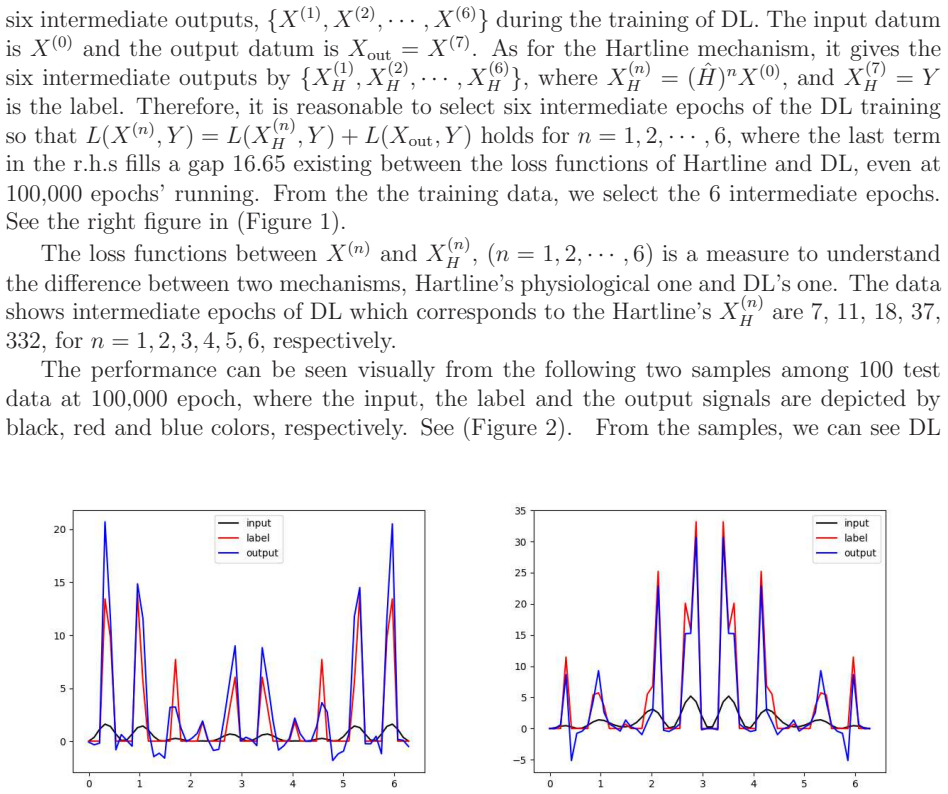
On the paper's own terms, the discovery is that the trained network's input-output behavior reproduces the iterative Hartline surround-inhibition rule, not only at the final output but through matching intermediate stages. The output signals are visibly closer to the Hartline-labeled outputs than to the inputs, with enhanced bumps and suppressed background. The decisive comparison is the loss matching: for six selected intermediate training epochs, $L(X^{(n)},Y)=L(X^{(n)}_H,Y)+L(X_{\rm out},Y)$, which lines up the deep-learning trajectory with the Hartline iteration index $n$; the reported matching epochs are 7, 11, 18, 37, 332 for $n=1,2,3,4,5$, with a sixth stage claimed. The authors conclude that deep learning 'acquires an ability of making the sharp contrast to the input datum' and that more detailed comparison with real sensory data is needed.
Load-bearing premise
The load-bearing premise is that the training labels are generated by exactly the operation being compared—$Y=(\hat H)^7X$ with $\kappa=0.25$ and $\lambda=2$—so any similarity between the deep network and the Hartline iterations is inherited from the labels rather than discovered independently.
Editorial extensions
If this is right
- If the claim is correct, a purely feedforward network with two hidden layers can emulate an iterative lateral-inhibition algorithm without needing recurrent connections.
- The learned weights should encode an effective inhibition kernel, so one can extract from the trained network an empirical estimate of the Hartline coefficient $\kappa$ and compare it with the 0.25 used to generate labels.
- The loss-matching procedure gives a quantitative way to annotate training checkpoints by physiological operation count, which may help interpret networks trained on sensory tasks.
- Because the same Hartline mechanism is invoked for vision, hearing, and color sensation, the result suggests the training recipe transfers to other one-dimensional sensory signal arrays.
Reading between the lines
- The labels fully determine the target behavior, so the experiment establishes that a deep network can approximate a specified iterated map; it does not by itself establish that biological surround inhibition is implemented by the same computation, and a stronger test would use actual physiological firing data rather than generated labels.
- The reported matching epochs grow roughly exponentially with the Hartline stage (7, 11, 18, 37, 332), which suggests that later iterations of the map are progressively harder for gradient descent to reproduce; if that pattern holds, it may reflect the sharpening becoming more nonlinear at each step.
- A natural extension is to train with a different number of Hartline iterations, say $(\hat H)^3$ or $(\hat H)^{10}$, and check whether the number of intermediate matching stages changes accordingly; this would test whether the correspondence is a generic property of deep learning on iterated sharpening maps.
Signed reviews
Editorial analysis
A structured set of objections, weighed in public.
Referee Report
Summary. The paper trains a four-layer feedforward network (60 units per layer) on 1000 synthetic inputs, where each label is produced by applying the Hartline-style operation H-hat (Eq. 6) seven times with κ=0.25 and λ=2. The authors report that the trained network sharpens the inputs, compare the test loss of selected intermediate training epochs with the losses of successive Hartline iterations, display two sample outputs, and conclude that the network acquires the ability to make sharp contrast analogous to surround inhibition. The conclusion also acknowledges that the DL mechanism is not necessarily equal to the physiological one and calls for further comparison with real data.
Significance. The paper raises an interesting question: whether gradient-based learning in a feedforward network converges to a known lateral-inhibition operator. If the comparison were based on independent evidence, it would be a useful bridge result. However, the central evidence is circular: because the labels are defined as Y=(H-hat)^7X, the network is trained to approximate exactly the operation with which it is later compared. The only non-tautological statement is the weak empirical claim that a small feedforward net can fit this synthetic mapping, which is expected from universal approximation and does not require the proposed epoch-matching analysis. The paper also provides no code, no data, and no error bars, so the numerical claims cannot be independently checked and the two selected samples in Figure 2 do not establish a general sharpening effect. These limitations undermine the central claim as presented.
major comments (5)
- [Section 2, after Eq. (6)] The label is defined as Y=(H-hat)^7X, so the network is trained to approximate the iterated Hartline operation. Any resemblance between the final DL output and H-hat^7X is inherited from the training target, not evidence of an independent convergence of deep learning to the physiological mechanism. The conclusion should be restricted to the statement that this feedforward network can approximate H-hat^7X on the generated distribution.
- [Section 2, Figure 1 and epoch selection] The six intermediate epochs are chosen by enforcing L(X^(n),Y)=L(X_H^(n),Y)+L(X_out,Y) for n=1,...,6. This is a scalar matching condition on the distance to the label, not a comparison between the network output and the corresponding Hartline iterate. Along any monotonically decreasing loss trajectory from X to Y, one can generically find epochs satisfying these equalities, so the claimed epoch-to-iteration correspondence (7, 11, 18, 37, 332) is not evidence that the network passes through the Hartline states. The paper never reports a direct metric such as L(X^(n), X_H^(n)) that would compare the outputs themselves. Moreover, the selection is made using the test-data loss after training, so the chosen epochs are a post hoc selection on the same test data used for evaluation.
- [Section 2, Figure 1 loss offset] Adding the final DL loss L(X_out,Y)=16.65 to all Hartline losses before drawing the horizontal lines in Figure 1 is an ad hoc shift. No argument is given that the two loss curves differ by a constant gap across epochs, and without such an argument the visual alignment of the two curves carries no quantitative meaning. The offset is simply a free parameter introduced to make the comparison look plausible.
- [Section 2, sample outputs and statistics] The claim that DL 'acquires an ability of making the sharp contrast' is supported only by two selected test samples in Figure 2. No quantitative measure of sharpening (for example, a contrast index or peak-to-surround ratio) is reported for the full 100-test dataset, and no repeated runs with different random seeds are provided. The loss curve appears to come from a single training run, so the numerical epoch numbers and the final loss value are not statistically supported.
- [Section 2, mechanism interpretation] Even if the network output approximates H-hat^7X, the paper does not establish that the internal operation of the trained network resembles the local, translation-invariant Hartline operation of Eq. (6). The network is free to implement the same input-output mapping in a different way, and no analysis of the learned weights, of the network's response to perturbations, or of its behavior on held-out distributions is provided. Therefore the phrase 'corresponding to the Hartline mechanism' overstates what the experiment can show.
minor comments (5)
- [Section 2, epoch list] The text says six intermediate outputs are selected, but only five epoch numbers (7, 11, 18, 37, 332) are listed for n=1,...,6; please correct the count or provide the missing value.
- [Section 2, Eq. (3)] Equation (3) has a summation over j that does not act on the first term ri(ℓ); the intended index structure should be clarified.
- [Section 2, optimization details] The phrase 'full Stochastic Gradient Descent' is ambiguous; full-batch gradient descent is not stochastic. Please specify the optimizer, learning rate, initialization scheme, and any regularization.
- [Figure 1] The horizontal lines in the right panel are not keyed to specific n values; please state explicitly which line corresponds to which Hartline iteration.
- [Section 2, Eq. (5)] Equation (5) defines X(x) on a continuum, but the data are evaluated at discrete points xi; please state clearly that the inputs are the 60 sampled values.
Circularity Check
The claimed epoch-to-iteration correspondence is selected by matching scalar losses to the label, and the label itself is the target operation, making the comparison tautological.
-
self definitional
[Section 2, label definition following Eq. (6)]
"The label Y for a datum X is given by Y = ( ˆH)7X with κ(= Hartline ′s K) = 0 .25, and λ = 2."
The network is trained to map X to Y, and Y is defined as seven iterations of the Hartline operation. Therefore the final output's resemblance to H-hat^7X is an expected consequence of supervised fitting to that exact target, not an independently derived correspondence between deep learning and the physiological mechanism. The claimed 'sharp contrast' ability is inherited from the labels by construction.
-
fitted input called prediction
[Section 2, Figure 1 caption / epoch selection paragraph]
"Therefore, it is reasonable to select six intermediate epochs of the DL training so that L(X (n), Y ) = L(X (n) H , Y ) + L(Xout, Y ) holds for n = 1, 2, · · ·, 6, where the last term in the r.h.s fills a gap 16.65 existing between the loss functions of Hartlin e and DL, even at 100,000 epochs’ running."
This selection rule imposes only equality of the scalar squared-error distances to the fixed label Y. Along any decreasing loss trajectory from X to Y, epochs satisfying these equalities will generically exist, so the reported intermediate epochs (7, 11, 18, 37, 332) are chosen by the matching condition rather than by any demonstrated geometric resemblance between X^(n) and H^n X. The paper reports no direct comparison of X^(n) to H^nX; thus the claimed epoch-to-iteration correspondence is manufactured by the fitting criterion.
full rationale
The paper is self-contained and does not rely on self-citation, but its central comparison is circular in two related places. First, the training label is defined by the same operation that the paper later claims deep learning 'acquires' (Y = (H-hat)^7 X), so any final agreement is forced by fitting. Second, the intermediate-epoch correspondence is not measured directly; the epochs are selected to satisfy an equality between scalar losses to the label, L(X^(n), Y) = L(X_H^(n), Y) + L(X_out, Y). That condition can be satisfied by any trajectory that decreases smoothly in loss and does not establish that the network's internal states pass through the Hartline iterates. Because the milestone list is defined by this loss-matching constraint, the reported correspondence is tautological. The only supported conclusion is the weaker statement that a feedforward net can be trained to approximate a sevenfold Hartline operation on this synthetic distribution.
Assumptions & free parameters
free parameters (3)
- kappa (Hartline inhibition coefficient) =
0.25
- lambda (amplification factor) =
2
- n_Hartline (number of iterations) =
7
assumptions (4)
- domain assumption Hartline equations (1) and (6) correctly model surround inhibition in sensory systems.
- ad hoc to paper The shift of Hartline losses by the final DL loss, L(Xout,Y)=16.65, is a valid comparison device.
- domain assumption A feedforward network with two hidden layers, sigmoid activation, and full-batch SGD can represent the target operation.
- domain assumption The random input generation in Eq. (5) samples the relevant stimulus space.
Cite this review
Pith. "Pith review of Surround Inhibition Mechanism by Deep Learning." pith.science (2026). https://pith.science/paper/J6J4FL2G
@misc{pith2026190809314,
  author       = {Pith},
  title        = {Pith review of: Surround Inhibition Mechanism by Deep Learning},
  year         = {2026},
  howpublished = {\url{https://pith.science/paper/J6J4FL2G}},
  note         = {Machine review of arXiv:1908.09314}
}
read the original abstract
In the sensation of tones, visions and other stimuli, the "surround inhibition mechanism" (or "lateral inhibition mechanism") is crucial. The mechanism enhances the signals of the strongest tone, color and other stimuli, by reducing and inhibiting the surrounding signals, since the latter signals are less important. This surround inhibition mechanism is well studied in the physiology of sensor systems. The neural network with two hidden layers in addition to input and output layers is constructed; having 60 neurons (units) in each of the four layers. The label (correct answer) is prepared from an input signal by applying seven times operations of the "Hartline mechanism", that is, by sending inhibitory signals from the neighboring neurons and amplifying all the signals afterwards. The implication obtained by the deep learning of this neural network is compared with the standard physiological understanding of the surround inhibition mechanism.
Figures

Reference graph
Works this paper leans on
-
[1]
(Vision ): H. K. Hartline, H. G. Wagner, and F. Ratliff, J. Gen. Physiol. 39 (1956) 651; H. K. Hartline and F. Ratliff, i.b.d. (1957) 357; i.b.d. 41 (1958) 1049; D. H. Hubel and T. N. Wiesel, J. Physiol. 148 (1959) 574; (Audition): E. G. Wever, M. Lawrence, and G. von B´ ek´ esy, Proc. N. A. S. 40 (1954) 508, H. Helmholtz, “On the Sensations of Tones” Dover...
work page 1956
-
[2]
Sensonary Physiology-Illustrated
M. Takagi, “Sensonary Physiology-Illustrated”, Shokabo Publis hing (1989); A. Ogata, “Musical Temperamant and Scale” revised version (2018)
work page 1989
-
[3]
Deep Learning-time series date processing by TensorFlow an d Keras-
Y. LeCun, Y. Bengino and G. Hinton, Nature 521 436 (2015); K. Saitoh, ‘Deep Learning-theory and implementation by Python-’, O’Reilly Japan (201 6); Y. Sugu- mori, “Deep Learning-time series date processing by TensorFlow an d Keras-”, Mynavi Publisher (2017). 5
work page 2015
Reviewed August 14, 2026 · model on record in the stance chip above.
Discussion (0). Continue with ORCID to comment.