When Representative Samples Produce Worse Outcomes: Scale-up Decisions and Testing in Small-Budget RCTs
Pith reviewed 2026-06-27 05:45 UTC · model grok-4.3
The pith
In small-budget pilot RCTs, sampling from one homogeneous subpopulation can maximize expected downstream impact more than representative sampling when decisions rely on significance tests.
A machine-rendered reading of the paper's core claim, the machinery that carries it, and where it could break.
Core claim
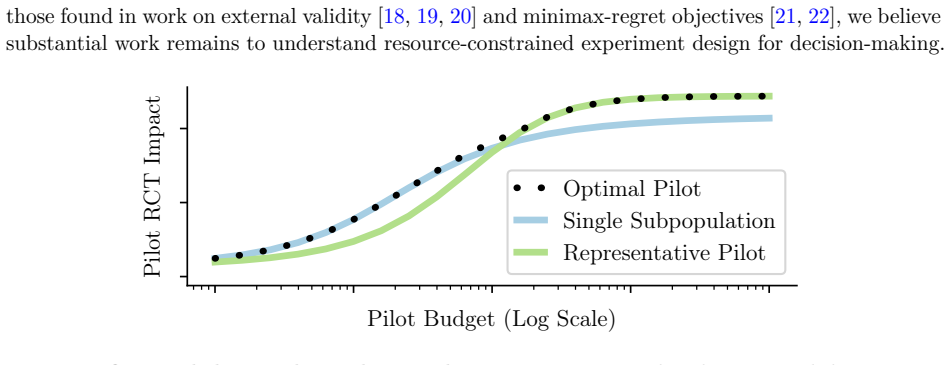
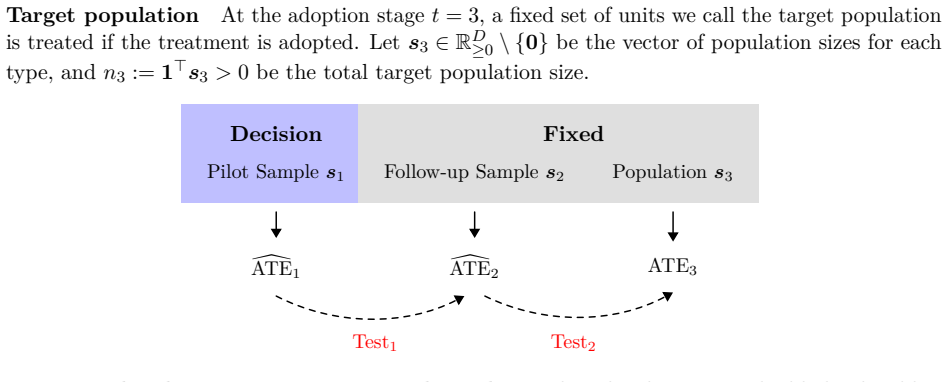
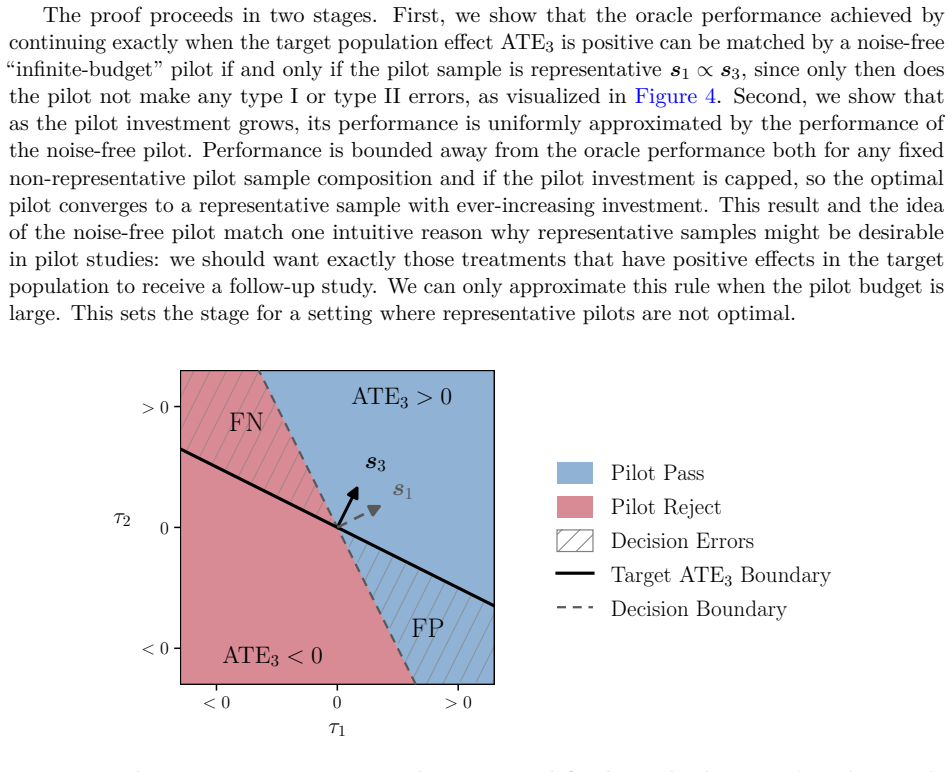
When an RCT paired with a non-adaptive significance test determines whether an intervention receives any downstream payoff, the pilot sample composition maximizing expected impact consists of a single homogeneous subpopulation in the small-budget regime; the subpopulation is selected according to sampling costs and the designer's priors on heterogeneous treatment effects. In the large-budget limit this composition converges to a representative sample of the target population.
What carries the argument
The budget-constrained pilot sample allocation that maximizes the expected value of the downstream payoff under a fixed significance-test decision rule.
If this is right
- The optimal pilot composition is not fixed but depends on the available budget size.
- In the small-budget regime homogeneous sampling from one subpopulation outperforms representative sampling.
- The preferred subpopulation is determined jointly by sampling costs and prior beliefs on treatment effect heterogeneity.
- The small-budget result extends to any setting where a significance test on RCT data decides receipt of a non-adaptive downstream payoff.
Where Pith is reading between the lines
- Decision rules that adaptively incorporate pilot data or use Bayesian updating may alter the optimal sampling strategy.
- The result implies that low-budget experimentation in other domains could also favor non-representative designs when tests gate payoffs.
- Accurate priors on effect heterogeneity become especially valuable when budgets constrain pilot size.
Load-bearing premise
Downstream decisions are made by a non-adaptive significance test applied to the pilot RCT data.
What would settle it
A simulation or empirical study in which, under small budgets and significance-test decisions, a representative sample produces strictly higher expected downstream impact than the single-subpopulation design.
Figures
read the original abstract
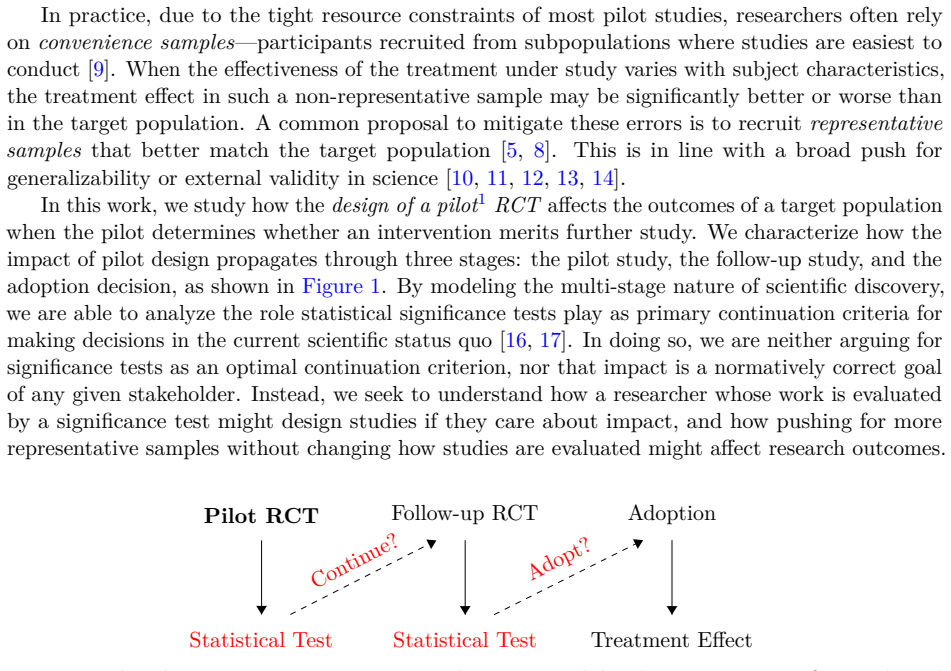
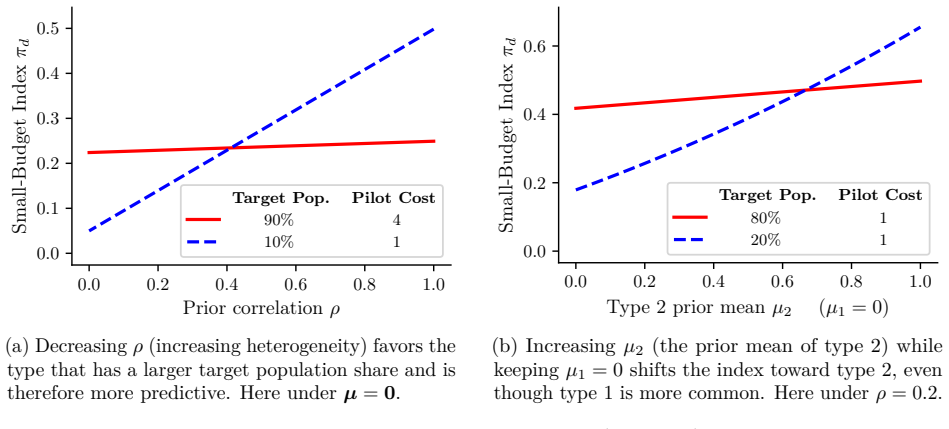
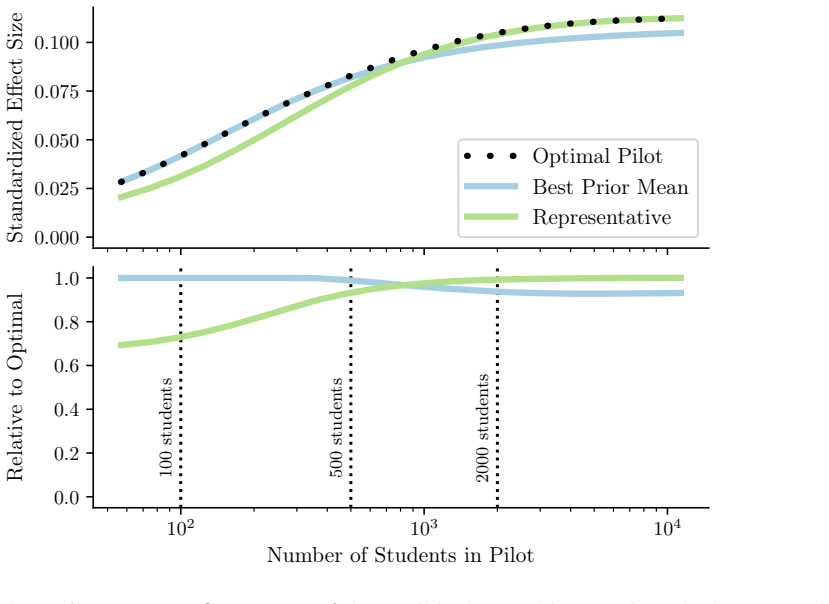
Small randomized controlled trials are often used to screen interventions before running larger follow-up studies. This is a critical phase of experimentation, as missing effective interventions or scaling up harmful ones can be very costly. A common proposal to mitigate these errors is to recruit samples that are representative of the target population, but this is often challenging in resource-constrained pilots. We challenge the narrative that representative samples are always superior by showing that when statistical significance testing determines whether interventions receive further study, the pilot trial composition that maximizes the downstream expected improvement in outcomes depends critically on its budget size. In the large-budget limit, the optimal pilot design converges to a sample that is representative of the target population. However, in the small-budget regime, the pilot designer maximizes expected impact by sampling only from a single homogeneous sub-population, chosen in a manner that depends on sampling costs and the designer's prior beliefs about heterogeneous treatment effects. Our proof of the small-budget result applies more generally when an RCT and significance test are used to decide whether to receive any non-adaptive downstream payoff, a result that may be applicable to other settings with constrained experimentation budgets.
Editorial analysis
A structured set of objections, weighed in public.
Referee Report
Summary. The manuscript claims that when small-budget RCTs are used to screen interventions before larger studies, with a significance test determining whether to scale up, the pilot sampling design that maximizes expected downstream impact is to draw all samples from a single homogeneous subpopulation (chosen based on group-specific sampling costs and the designer's priors on heterogeneous treatment effects). In the large-budget limit the optimum converges to a representative sample of the target population. The small-budget result is derived for the case of any non-adaptive downstream payoff decided by such a significance test.
Significance. If the central derivation holds, the result supplies a precise theoretical counter-example to the default recommendation for representative sampling in pilot RCTs, showing that the optimality of representativeness is budget-dependent and decision-rule-dependent. The explicit generalization of the small-budget proof to arbitrary non-adaptive payoffs decided by a significance test is a clear strength, as is the clean separation between the small-budget and large-budget regimes. The scoping to non-adaptive significance testing is stated up front, so the stress-test concern about other decision rules (Bayesian, magnitude-based, etc.) does not undermine the manuscript's internal claims.
minor comments (3)
- The precise functional form of the significance test (e.g., one-sided t-test, exact threshold) and the downstream payoff function should be stated explicitly in the main text before the small-budget theorem, rather than only in the appendix, to make the load-bearing threshold effect transparent.
- Notation for the heterogeneous treatment effects and the prior distribution over them is introduced gradually; a single early display equation collecting all primitives would improve readability.
- Figure 2 (or equivalent) comparing optimal allocation across budget sizes would benefit from an explicit legend indicating the prior parameters used in each panel.
Simulated Author's Rebuttal
We thank the referee for their careful reading, positive summary of the manuscript's contributions, and recommendation of minor revision. No specific major comments were raised in the report.
Circularity Check
No significant circularity detected in derivation chain.
full rationale
The paper presents a mathematical derivation of optimal pilot sampling under a model with heterogeneous treatment effects, sampling costs, and a non-adaptive significance-testing decision rule. The small-budget result (single-subpopulation sampling) follows from the model's assumptions and proof, without any quoted reduction of the optimum to a fitted parameter, self-defined quantity, or self-citation chain. The decision rule is an explicit modeling choice rather than a hidden tautology. This is a standard non-circular theoretical result.
Axiom & Free-Parameter Ledger
free parameters (2)
- prior beliefs on heterogeneous treatment effects
- group-specific sampling costs
axioms (2)
- domain assumption Downstream payoff is non-adaptive and determined solely by whether the pilot passes a significance test.
- domain assumption Treatment effects are heterogeneous across subpopulations.
Reference graph
Works this paper leans on
-
[1]
Imbens and Donald B
Guido W. Imbens and Donald B. Rubin.Causal Inference for Statistics, Social, and Biomed- ical Sciences: An Introduction. Cambridge: Cambridge University Press, 2015.isbn: 978- 0-521-88588-1.doi: 10 . 1017 / CBO9781139025751.url: https : / / www . cambridge . org / core/books/causal- inference- for- statistics- social- and- biomedical- sciences/ 71126BE90C...
2015
-
[2]
Determining Optimal Sample Sizes for Multistage Adaptive Randomized Clinical Trials from an Industry Perspective Using Value of Information Methods
Maggie H Chen and Andrew R Willan. “Determining Optimal Sample Sizes for Multistage Adaptive Randomized Clinical Trials from an Industry Perspective Using Value of Information Methods”. In:Clinical Trials10.1 (Feb. 1, 2013), pp. 54–62.issn: 1740-7745.doi: 10 . 1177 / 1740774512467404.url: https : / / doi . org / 10 . 1177 / 1740774512467404(visited on 05/11/2024)
2013
-
[3]
Adaptive Treatment Assignment in Experiments for Policy Choice
Maximilian Kasy and Anja Sautmann. “Adaptive Treatment Assignment in Experiments for Policy Choice”. In:Econometrica89.1 (2021), pp. 113–132.issn: 0012-9682.doi: 10. 3982/ECTA17527.url: https://www.econometricsociety.org/doi/10.3982/ECTA17527 (visited on 02/08/2026). 49
-
[4]
E8(R1) GENERAL CONSIDERATIONS FOR CLINICAL STUD- IES
FDA, CDER, and CBER. “E8(R1) GENERAL CONSIDERATIONS FOR CLINICAL STUD- IES”. In: (Apr. 2022)
2022
-
[5]
Department of Education et al.The Future of Education Research at IES: Advancing an Equity-Oriented Science
Committee on the Future of Education Research at the Institute of Education Sciences in the U.S. Department of Education et al.The Future of Education Research at IES: Advancing an Equity-Oriented Science. Ed. by Adam Gamoran and Kenne Dibner. Washington, D.C.: National Academies Press, July 1, 2022, p. 26428.isbn: 978-0-309-27539-2.doi:10.17226/ 26428.ur...
2022
-
[6]
Screening Designs for Drug Development
D. Rossell, P. Muller, and G. L. Rosner. “Screening Designs for Drug Development”. In: Biostatistics8.3 (July 1, 2007), pp. 595–608.issn: 1465-4644, 1468-4357.doi: 10 . 1093 / biostatistics / kxl031.url: https : / / academic . oup . com / biostatistics / article - lookup/doi/10.1093/biostatistics/kxl031(visited on 02/07/2026)
-
[7]
Elizabeth Tipton. “Beyond Generalization of the ATE: Designing Randomized Trials to Understand Treatment Effect Heterogeneity”. In:Journal of the Royal Statistical Society Series A: Statistics in Society184.2 (Apr. 1, 2021), pp. 504–521.issn: 0964-1998, 1467-985X. doi: 10.1111/rssa.12629 .url: https://academic.oup.com/jrsssa/article/184/2/ 504/7056369(vis...
-
[8]
FDA et al.Enhancing the Diversity of Clinical Trial Populations. Nov. 2020
2020
-
[9]
Elizabeth Tipton et al. “Toward a System of Evidence for All: Current Practices and Future Opportunities in 37 Randomized Trials”. In:Educational Researcher50.3 (Apr. 2021), pp. 145– 156.issn: 0013-189X, 1935-102X.doi: 10.3102/0013189X20960686.url: http://journals. sagepub.com/doi/10.3102/0013189X20960686(visited on 04/29/2024)
-
[10]
Elements of External Validity: Framework, Design, and Analysis
Naoki Egami and Erin Hartman. “Elements of External Validity: Framework, Design, and Analysis”. In:American Political Science Review117.3 (Aug. 2023), pp. 1070–1088.issn: 0003-0554, 1537-5943.doi: 10.1017/S0003055422000880.url: https://www.cambridge. org/core/product/identifier/S0003055422000880/type/journal_article (visited on 11/16/2023)
-
[11]
Behavioural Science Is Unlikely to Change the World without a Heterogeneity Revolution
Christopher J. Bryan, Elizabeth Tipton, and David S. Yeager. “Behavioural Science Is Unlikely to Change the World without a Heterogeneity Revolution”. In:Nature Human Behaviour 5.8 (July 22, 2021), pp. 980–989.issn: 2397-3374.doi:10.1038/s41562-021-01143-3.url: https://www.nature.com/articles/s41562-021-01143-3(visited on 04/29/2024)
-
[12]
External Validity of Randomised Controlled Trials: “To Whom Do the Results of This Trial Apply?
Peter M Rothwell. “External Validity of Randomised Controlled Trials: “To Whom Do the Results of This Trial Apply?”” In:The Lancet365.9453 (Jan. 2005), pp. 82–93.issn: 01406736. doi: 10 . 1016 / S0140 - 6736(04 ) 17670 - 8.url: https : / / linkinghub . elsevier . com / retrieve/pii/S0140673604176708(visited on 04/25/2026)
2005
-
[13]
The Weirdest People in the World?
Joseph Henrich, Steven J. Heine, and Ara Norenzayan. “The Weirdest People in the World?” In:Behavioral and Brain Sciences33.2–3 (June 2010), pp. 61–83.issn: 0140-525X, 1469-1825. doi: 10.1017/S0140525X0999152X .url: https://www.cambridge.org/core/product/ identifier/S0140525X0999152X/type/journal_article(visited on 04/25/2026)
-
[14]
Reproducibility of Preclinical Animal Research Improves with Het- erogeneity of Study Samples
Bernhard Voelkl et al. “Reproducibility of Preclinical Animal Research Improves with Het- erogeneity of Study Samples”. In:PLOS Biology16.2 (Feb. 22, 2018). Ed. by Eric-Jan Wagenmakers, e2003693.issn: 1545-7885.doi: 10 . 1371 / journal . pbio . 2003693.url: https://dx.plos.org/10.1371/journal.pbio.2003693(visited on 04/25/2026). 50
-
[15]
Defining Feasibility and Pilot Studies in Preparation for Randomised Controlled Trials: Development of a Conceptual Framework
Sandra M. Eldridge et al. “Defining Feasibility and Pilot Studies in Preparation for Randomised Controlled Trials: Development of a Conceptual Framework”. In:PLOS ONE11.3 (Mar. 15, 2016). Ed. by Chiara Lazzeri, e0150205.issn: 1932-6203.doi: 10 . 1371 / journal . pone . 0150205.url: https : / / dx . plos . org / 10 . 1371 / journal . pone . 0150205(visited...
2016
-
[16]
FDA.Demonstrating Substantial Evidence of Effectiveness for Human Drug and Biological Products. Dec. 2019
2019
-
[17]
Experimental Design for Drug Development: A Bayesian Approach
Donald A. Berry. “Experimental Design for Drug Development: A Bayesian Approach”. In: Journal of Biopharmaceutical Statistics1.1 (Jan. 1, 1991), pp. 81–101.issn: 1054-3406, 1520- 5711.doi: 10.1080/10543409108835007.url: https://www.tandfonline.com/doi/full/ 10.1080/10543409108835007(visited on 01/02/2025)
-
[18]
Elizabeth Tipton. “Stratified Sampling Using Cluster Analysis: A Sample Selection Strategy for Improved Generalizations from Experiments”. In:Evaluation Review37.2 (Apr. 2013), pp. 109–139.issn: 1552-3926.doi:10.1177/0193841X13516324. PMID:24647924
-
[19]
Naoki Egami and Diana Da In Lee.Designing Multi-Context Studies for External Validity: Site Selection via Synthetic Purposive Sampling. Aug. 24, 2023.url:https://naokiegami. com/paper/sps.pdf(visited on 11/22/2023). Pre-published
2023
-
[20]
Adam Bouyamourn.Where to Experiment? Site Selection Under Distribution Shift via Optimal Transport and Wasserstein DRO. Nov. 6, 2025.doi:10.48550/arXiv.2511.04658 . arXiv: 2511.04658 [stat] .url: http://arxiv.org/abs/2511.04658 (visited on 02/07/2026). Pre-published
-
[21]
Minimax-Regret Sample Selection in Randomized Experiments
Yuchen Hu et al. “Minimax-Regret Sample Selection in Randomized Experiments”. In:Pro- ceedings of the 25th ACM Conference on Economics and Computation. EC ’24. New York, NY, USA: Association for Computing Machinery, Dec. 17, 2024, pp. 1209–1235.isbn: 979- 8-4007-0704-9.doi: 10.1145/3670865.3673458.url: https://dl.acm.org/doi/10.1145/ 3670865.3673458(visit...
-
[22]
José Luis Montiel Olea et al.Externally Valid Selection of Experimental Sites via the K-Median Problem. Aug. 29, 2025.doi:10.48550/arXiv.2408.09187. arXiv: 2408.09187 [econ].url: http://arxiv.org/abs/2408.09187(visited on 02/04/2026). Pre-published
-
[23]
Monographs on Statistics and Applied Probability 36
KaitaiFang,SamuelKotz,andKaiWangNg.Symmetric Multivariate and Related Distributions. Monographs on Statistics and Applied Probability 36. London ; New York: Chapman and Hall, 1990. 220 pp.isbn: 978-0-412-31430-8
1990
-
[24]
Tony and Li, Hongzhe , month = jan, year =
Xinran Li and Peng Ding. “General Forms of Finite Population Central Limit Theorems with Applications to Causal Inference”. In:Journal of the American Statistical Association112.520 (Oct. 2, 2017), pp. 1759–1769.issn: 0162-1459.doi:10.1080/01621459.2017.1295865.url: https://doi.org/10.1080/01621459.2017.1295865(visited on 01/04/2026)
-
[25]
Peng Ding.A First Course in Causal Inference. Oct. 3, 2023.doi:10.48550/arXiv.2305. 18793. arXiv: 2305.18793 [stat] .url: http://arxiv.org/abs/2305.18793 (visited on 01/21/2026). Pre-published. 51
-
[26]
The Knowledge-Gradient Policy for Correlated Normal Beliefs
Peter Frazier, Warren Powell, and Savas Dayanik. “The Knowledge-Gradient Policy for Correlated Normal Beliefs”. In:INFORMS Journal on Computing21.4 (Nov. 2009), pp. 599– 613.issn: 1091-9856, 1526-5528.doi: 10.1287/ijoc.1080.0314.url: https://pubsonline. informs.org/doi/10.1287/ijoc.1080.0314(visited on 03/18/2024)
-
[27]
Bayesian Sequential Learning for Clinical Trials of Multiple Correlated Medical Interventions
Stephen E. Chick, Noah Gans, and Özge Yapar. “Bayesian Sequential Learning for Clinical Trials of Multiple Correlated Medical Interventions”. In:Management Science68.7 (July 2022), pp. 4919–4938.issn: 0025-1909.doi: 10.1287/mnsc.2021.4137.url: https://pubsonline. informs.org/doi/10.1287/mnsc.2021.4137(visited on 10/21/2025)
-
[28]
Eduardo M. Azevedo et al. “A/B Testing with Fat Tails”. In:Journal of Political Economy 128.12 (Dec. 1, 2020), pp. 4614–000.issn: 0022-3808, 1537-534X.doi:10.1086/710607.url: https://www.journals.uchicago.edu/doi/10.1086/710607(visited on 03/01/2024)
-
[29]
Enrichment Strategies for Clinical Trials to Support Determination of Effectiveness of Human Drugs and Biological Products Guidance for Industry
FDA, CDER, and CBER. “Enrichment Strategies for Clinical Trials to Support Determination of Effectiveness of Human Drugs and Biological Products Guidance for Industry”. In: (2019)
2019
-
[30]
Human HDAC6 senses valine abundancy to regulate DNA damage
David S. Yeager et al. “A National Experiment Reveals Where a Growth Mindset Improves Achievement”. In:Nature573.7774 (Sept. 2019), pp. 364–369.issn: 0028-0836, 1476-4687.doi: 10.1038/s41586- 019- 1466- y.url: https://www.nature.com/articles/s41586- 019- 1466-y(visited on 04/29/2024)
-
[31]
Interpreting Effect Sizes of Education Interventions
Matthew A. Kraft. “Interpreting Effect Sizes of Education Interventions”. In:Educational Researcher49.4 (May 2020), pp. 241–253.issn: 0013-189X, 1935-102X.doi: 10 . 3102 / 0013189X20912798.url: https://journals.sagepub.com/doi/10.3102/0013189X20912798 (visited on 02/02/2026)
-
[32]
Amelia J. Averitt et al. “Translating Evidence into Practice: Eligibility Criteria Fail to Eliminate Clinically Significant Differences between Real-World and Study Populations”. In: NPJ digital medicine3 (2020), p. 67.issn: 2398-6352.doi: 10.1038/s41746-020-0277-8 . PMID:32411828
-
[33]
Rachael Meager. “Understanding the Average Impact of Microcredit Expansions: A Bayesian Hierarchical Analysis of Seven Randomized Experiments”. In:American Economic Journal: Applied Economics11.1 (Jan. 1, 2019), pp. 57–91.issn: 1945-7782, 1945-7790.doi:10.1257/ app.20170299.url: https://pubs.aeaweb.org/doi/10.1257/app.20170299 (visited on 01/12/2024)
-
[34]
Ryan Williams et al. “Heterogeneity in Mathematics Intervention Effects: Evidence from a Meta-Analysis of 191 Randomized Experiments”. In:Journal of Research on Educational Effectiveness15.3 (July 3, 2022), pp. 584–634.issn: 1934-5747, 1934-5739.doi:10.1080/ 19345747 . 2021 . 2009072.url: https : / / www . tandfonline . com / doi / full / 10 . 1080 / 1934...
arXiv 2022
-
[35]
URL https://www.science.org/doi/abs/10.1126/science
Open Science Collaboration. “Estimating the Reproducibility of Psychological Science”. In: Science349.6251 (Aug. 28, 2015), aac4716.issn: 0036-8075, 1095-9203.doi:10.1126/science. aac4716.url: https://www.science.org/doi/10.1126/science.aac4716 (visited on 02/06/2026)
-
[36]
Evaluating Replicability of Laboratory Experiments in Economics
Colin F. Camerer et al. “Evaluating Replicability of Laboratory Experiments in Economics”. In:Science351.6280 (Mar. 25, 2016), pp. 1433–1436.issn: 0036-8075, 1095-9203.doi: 10. 1126/science.aaf0918.url: https://www.science.org/doi/10.1126/science.aaf0918 (visited on 02/06/2026). 52
-
[37]
RaiseStandardsforPreclinicalCancerResearch
C.GlennBegleyandLeeM.Ellis.“RaiseStandardsforPreclinicalCancerResearch”.In:Nature 483.7391 (Mar. 29, 2012), pp. 531–533.issn: 0028-0836, 1476-4687.doi:10.1038/483531a. url:https://www.nature.com/articles/483531a(visited on 02/06/2026)
-
[38]
Washington, D.C.: National Academies Press, Sept
Committee on Reproducibility and Replicability in Science et al.Reproducibility and Repli- cability in Science. Washington, D.C.: National Academies Press, Sept. 20, 2019, p. 25303. isbn: 978-0-309-48616-3.doi: 10.17226/25303 .url: https://www.nationalacademies. org/publications/25303(visited on 02/08/2026)
-
[39]
Elizabeth Tipton et al. “Site Selection in Experiments: An Assessment of Site Recruitment and Generalizability in Two Scale-up Studies”. In:Journal of Research on Educational Effectiveness 9 (sup1 Oct. 3, 2016), pp. 209–228.issn: 1934-5747, 1934-5739.doi:10.1080/19345747. 2015.1105895.url: https://www.tandfonline.com/doi/full/10.1080/19345747.2015. 110589...
-
[40]
Peter F. Thall. “Adaptive Enrichment Designs in Clinical Trials”. In:Annual review of statistics and its application8.1 (Mar. 2021), pp. 393–411.issn: 2326-8298.doi:10.1146/annurev- statistics- 040720- 032818. PMID: 36212769.url: https://www.ncbi.nlm.nih.gov/ pmc/articles/PMC9544313/(visited on 12/31/2024)
-
[41]
Jon Arni Steingrimsson et al. “Optimized Adaptive Enrichment Designs for Three-Arm Trials: Learning Which Subpopulations Benefit from Different Treatments”. In:Biostatistics22.2 (Apr. 10, 2021), pp. 283–297.issn: 1465-4644, 1468-4357.doi:10.1093/biostatistics/ kxz030.url: https://academic.oup.com/biostatistics/article/22/2/283/5550955 (visited on 12/31/2024)
-
[42]
A Review of Statistical Methods for Generalizing From Evaluations of Educational Interventions
Elizabeth Tipton and Robert B. Olsen. “A Review of Statistical Methods for Generalizing From Evaluations of Educational Interventions”. In:Educational Researcher47.8 (Nov. 2018), pp. 516–524.issn: 0013-189X, 1935-102X.doi: 10.3102/0013189X18781522 .url: http: //journals.sagepub.com/doi/10.3102/0013189X18781522(visited on 04/11/2024)
-
[44]
Albee Y. Ling et al. “An Overview of Current Methods for Real-world Applications to Gener- alize or Transport Clinical Trial Findings to Target Populations of Interest”. In:Epidemiology 34.5 (Sept. 1, 2023), pp. 627–636.issn: 1531-5487.doi:10.1097/EDE.0000000000001633. PMID:37255252
-
[45]
Edinburgh: Oliver and Boyd, 1949
Ronald Aylmer Fisher.The Design of Experiments. Edinburgh: Oliver and Boyd, 1949
1949
-
[46]
Classic ed., unabridged republ
Friedrich Pukelsheim.Optimal Design of Experiments. Classic ed., unabridged republ. of the work first publ. by Wiley, 1993. Classics in Applied Mathematics 50. Philadelphia, Pa: SIAM, Soc. for Industrial and Applied Mathematics, 2006. 454 pp.isbn: 978-0-89871-604-7
1993
-
[47]
Bayesian Experimental Design: A Review
Kathryn Chaloner and Isabella Verdinelli. “Bayesian Experimental Design: A Review”. In: Statistical Science10.3 (Aug. 1, 1995).issn: 0883-4237.doi: 10 . 1214 / ss / 1177009939. url: https://projecteuclid.org/journals/statistical-science/volume-10/issue- 3/Bayesian-Experimental-Design-A-Review/10.1214/ss/1177009939.full (visited on 01/02/2025). 53
-
[48]
Tom Rainforth et al.Modern Bayesian Experimental Design. Nov. 29, 2023. arXiv:2302.14545 [cs, stat] .url: http : / / arxiv . org / abs / 2302 . 14545(visited on 06/27/2024). Pre- published
arXiv 2023
-
[49]
David Blackwell. “Comparison of Experiments”. In:Proceedings of the Second Berkeley Sympo- sium on Mathematical Statistics and Probability. Vol. 2. University of California Press, Jan. 1, 1951, pp. 93–103.url:https://projecteuclid.org/ebooks/berkeley- symposium- on- mathematical- statistics- and- probability/Proceedings- of- the- Second- Berkeley- Symposi...
arXiv 1951
-
[50]
Causal Decision Making and Causal Effect Estimation Are Not the Same...and Why It Matters
Carlos Fernández-Loría and Foster Provost. “Causal Decision Making and Causal Effect Estimation Are Not the Same...and Why It Matters”. In:INFORMS Journal on Data Science1.1 (Apr. 2022), pp. 4–16.issn: 2694-4022, 2694-4030.doi:10.1287/ijds.2021.0006. url: https : / / pubsonline . informs . org / doi / 10 . 1287 / ijds . 2021 . 0006(visited on 09/12/2025)
-
[51]
Dean Eckles. “Commentary on “Causal Decision Making and Causal Effect Estimation Are Not the Same...and Why It Matters”: On Loss Functions and Bias–Variance Tradeoffs in Causal Estimation and Decisions”. In:INFORMS Journal on Data Science1.1 (Apr. 2022), pp. 17–18.issn: 2694-4022, 2694-4030.doi:10.1287/ijds.2022.0012.url: https: //pubsonline.informs.org/d...
-
[52]
A Review of Modern Computational Algorithms for Bayesian Optimal Design
Elizabeth G. Ryan et al. “A Review of Modern Computational Algorithms for Bayesian Optimal Design”. In:International Statistical Review84.1 (2016), pp. 128–154.issn: 1751- 5823.doi: 10.1111/insr.12107.url: https://onlinelibrary.wiley.com/doi/abs/10. 1111/insr.12107(visited on 02/07/2026)
-
[53]
Hoiyi Ng and Guido Imbens.Scalable Decisions Using a Bayesian Decision-Theoretic Approach. Jan. 27, 2026.doi: 10.48550/arXiv.2601.20031 . arXiv: 2601.20031 [stat].url: http: //arxiv.org/abs/2601.20031(visited on 02/07/2026). Pre-published
-
[54]
A Nonconcavity in the Value of Information
Roy Radner and Joseph Stiglitz. “A Nonconcavity in the Value of Information”. In:Bayesian models in economic theory5 (1984), pp. 33–52.url: https : / / pages . stern . nyu . edu / ~rradner/publishedpapers/50Nonconcavity.pdf(visited on 04/11/2025)
1984
-
[55]
A Tight Sufficient Condition for Radner–Stiglitz Nonconcavity in the Value of Information
Michel De Lara and Laurent Gilotte. “A Tight Sufficient Condition for Radner–Stiglitz Nonconcavity in the Value of Information”. In:Journal of Economic Theory137.1 (Nov. 2007), pp. 696–708.issn: 00220531.doi: 10 . 1016 / j . jet . 2007 . 01 . 014.url: https : //linkinghub.elsevier.com/retrieve/pii/S0022053107000373(visited on 04/11/2025)
2007
-
[56]
Elisabeth Fenwick et al. “Value of Information Analysis for Research Decisions-An Introduction: Report 1 of the ISPOR Value of Information Analysis Emerging Good Practices Task Force”. In: Value in Health: The Journal of the International Society for Pharmacoeconomics and Outcomes Research23.2 (Feb. 2020), pp. 139–150.issn: 1524-4733.doi:10.1016/j.jval.20...
-
[57]
Calculating Expected Value of Sample Information Adjusting for Imperfect Im- plementation
Anna Heath. “Calculating Expected Value of Sample Information Adjusting for Imperfect Im- plementation”. In:Medical Decision Making42.5 (July 1, 2022), pp. 626–636.issn: 0272-989X. doi: 10.1177/0272989X211073098.url: https://doi.org/10.1177/0272989X211073098 (visited on 05/11/2024). 54
-
[58]
Expected Value of Sample Information to Guide the Design of Group Sequential Clinical Trials
Laura Flight et al. “Expected Value of Sample Information to Guide the Design of Group Sequential Clinical Trials”. In:Medical Decision Making42.4 (May 2022), pp. 461–473.issn: 0272-989X, 1552-681X.doi: 10.1177/0272989X211045036.url: http://journals.sagepub. com/doi/10.1177/0272989X211045036(visited on 05/11/2024)
-
[59]
Michael Gechter et al.Selecting Experimental Sites for External Validity. Version 1. May 21, 2024.doi: 10.48550/arXiv.2405.13241. arXiv: 2405.13241 [econ].url: http://arxiv. org/abs/2405.13241(visited on 02/07/2026). Pre-published
-
[61]
Stephen Bates et al.Incentive-Theoretic Bayesian Inference for Collaborative Science. July 7, 2023.doi: 10 . 48550 / arXiv . 2307 . 03748. arXiv: 2307 . 03748 [cs, stat] .url: http : //arxiv.org/abs/2307.03748(visited on 10/24/2023). Pre-published
arXiv 2023
-
[62]
Daehong Min. “Screening for Experiments”. In:Games and Economic Behavior142 (Nov. 1, 2023), pp. 73–100.issn: 0899-8256.doi:10.1016/j.geb.2023.07.009.url: https://www. sciencedirect.com/science/article/pii/S0899825623001021(visited on 12/24/2024)
-
[63]
Ronald L. Wasserstein and Nicole A. Lazar. “The ASA Statement onp-Values: Context, Process, and Purpose”. In:The American Statistician70.2 (Apr. 2, 2016), pp. 129–133. issn: 0003-1305, 1537-2731.doi: 10.1080/00031305.2016.1154108 .url: https://www. tandfonline.com/doi/full/10.1080/00031305.2016.1154108(visited on 02/08/2026)
work page internal anchor Pith review Pith/arXiv arXiv doi:10.1080/00031305.2016.1154108 2016
-
[64]
A Theory of Experimenters: Robustness, Randomization, and Balance
Abhijit V. Banerjee et al. “A Theory of Experimenters: Robustness, Randomization, and Balance”. In:American Economic Review110.4 (Apr. 1, 2020), pp. 1206–1230.issn: 0002- 8282.doi: 10.1257/aer.20171634 .url: https://pubs.aeaweb.org/doi/10.1257/aer. 20171634(visited on 02/07/2026)
-
[65]
Benjamin Recht.A Bureaucratic Theory of Statistics. Jan. 7, 2025.doi:10.48550/arXiv. 2501.03457. arXiv: 2501.03457 [stat].url: http://arxiv.org/abs/2501.03457 (visited on 01/08/2025). Pre-published
work page internal anchor Pith review doi:10.48550/arxiv 2025
-
[66]
Foundations of a General Theory of Sequential Decision Functions
Abraham Wald. “Foundations of a General Theory of Sequential Decision Functions”. In: Econometrica15.4 (1947), pp. 279–313.issn: 0012-9682.doi: 10.2307/1905331. JSTOR: 1905331.url:https://www.jstor.org/stable/1905331(visited on 02/07/2026)
-
[67]
Ethan Che and Hongseok Namkoong.Adaptive Experimentation at Scale: A Computational Framework for Flexible Batches. Aug. 14, 2023.doi:10.48550/arXiv.2303.11582. arXiv: 2303.11582 [cs, stat] .url: http://arxiv.org/abs/2303.11582 (visited on 09/11/2023). Pre-published
-
[68]
An Empirical Evaluation of Thompson Sampling
Olivier Chapelle and Lihong Li. “An Empirical Evaluation of Thompson Sampling”. In:Ad- vances in Neural Information Processing Systems. Vol. 24. Curran Associates, Inc., 2011.url: https://papers.nips.cc/paper_files/paper/2011/hash/e53a0a2978c28872a4505bdb51db06dc- Abstract.html(visited on 02/07/2026)
2011
-
[69]
Designing Reinforcement Learning Algorithms for Digital Interventions: Pre-Implementation Guidelines
Anna L. Trella et al. “Designing Reinforcement Learning Algorithms for Digital Interventions: Pre-Implementation Guidelines”. In:Algorithms15.8 (Aug. 2022), p. 255.issn: 1999-4893.doi: 10.3390/a15080255. PMID: 36713810.url: https://pmc.ncbi.nlm.nih.gov/articles/ PMC9881427/(visited on 02/07/2026). 55
-
[70]
SQR: Balancing Speed, Quality and Risk in Online Experiments
Ya Xu, Weitao Duan, and Shaochen Huang. “SQR: Balancing Speed, Quality and Risk in Online Experiments”. In:Proceedings of the 24th ACM SIGKDD International Conference on Knowledge Discovery & Data Mining. KDD ’18: The 24th ACM SIGKDD International Conference on Knowledge Discovery and Data Mining. London United Kingdom: ACM, July 19, 2018, pp. 895–904.isb...
-
[71]
Bayesian Optimal Design for Phase II Screening Trials
Meichun Ding, Gary L. Rosner, and Peter Müller. “Bayesian Optimal Design for Phase II Screening Trials”. In:Biometrics64.3 (Sept. 2008), pp. 886–894.issn: 0006-341X, 1541- 0420.doi: 10 . 1111 / j . 1541 - 0420 . 2007 . 00951 . x.url: https : / / academic . oup . com / biometrics/article/64/3/886-894/7331561(visited on 02/07/2026)
2008
-
[72]
Utility-based Optimization of Phase II/III Programs
Marietta Kirchner et al. “Utility-based Optimization of Phase II/III Programs”. In:Statistics in Medicine35.2 (Jan. 30, 2016), pp. 305–316.issn: 0277-6715, 1097-0258.doi:10.1002/ sim.6624.url: https://onlinelibrary.wiley.com/doi/10.1002/sim.6624 (visited on 02/07/2026)
-
[73]
Optimal Designs for Phase II/III Drug Development Programs Including Methods for Discounting of Phase II Results
Stella Erdmann et al. “Optimal Designs for Phase II/III Drug Development Programs Including Methods for Discounting of Phase II Results”. In:BMC Medical Research Methodology20.1 (Dec. 2020), p. 253.issn: 1471-2288.doi: 10 . 1186 / s12874 - 020 - 01093 - w.url: https : / / bmcmedresmethodol . biomedcentral . com / articles / 10 . 1186 / s12874 - 020 - 0109...
2020
-
[74]
How Generalizable Is Your Experiment? An Index for Comparing Ex- perimental Samples and Populations
Elizabeth Tipton. “How Generalizable Is Your Experiment? An Index for Comparing Ex- perimental Samples and Populations”. In:Journal of Educational and Behavioral Statistics 39.6 (Dec. 2014), pp. 478–501.issn: 1076-9986, 1935-1054.doi:10.3102/1076998614558486. url: https : / / journals . sagepub . com / doi / 10 . 3102 / 1076998614558486(visited on 02/09/2026)
-
[75]
G. B. Folland.Real Analysis: Modern Techniques and Their Applications. 2nd ed. Pure and Applied Mathematics. New York: Wiley, 1999. 386 pp.isbn: 978-0-471-31716-6
1999
-
[76]
G. B. Folland.Advanced Calculus. 2nd ed. Aug. 4, 2023.url: https : / / sites . math . washington.edu//~folland/AdvCalc24.pdf(visited on 04/08/2026)
2023
-
[77]
Tyrrell Rockafellar and Roger Wets.Variational Analysis
R. Tyrrell Rockafellar and Roger Wets.Variational Analysis. Vol. 317. Grundlehren Der Mathematischen Wissenschaften. Springer Verlag, 2009. 56
2009
discussion (0)
Sign in with ORCID, Apple, or X to comment. Anyone can read and Pith papers without signing in.