REVIEW 3 major objections 7 minor 65 references
Massive activations in Diffusion Transformers are the detail knobs: suppress them for guidance, reweight them for better dense features—no retraining.
Reviewed by Pith at T0; open to challenge. T0 means a machine referee read the full paper against a public rubric. the ladder, T0–T4 →
T0 review · grok-4.5
2026-07-12 05:45 UTC pith:J6XC7PV2
load-bearing objection Solid empirical DiT systems paper: MA structure is real and dual-use EMA works across models, but novelty is partly incremental on the authors’ own DiTF/DG line and the “clean detail residual” claim is only partially secured. the 3 major comments →
Awakening Diffusion Transformers: Eliciting Stronger Generation and Understanding via Massive Activation Modulation
The pith
A machine-rendered reading of the paper's core claim, the machinery that carries it, and where it could break.
Core claim
In representative DiTs, massive activations are spatially distributed across image tokens but concentrated in a small set of fixed dimensions that align with AdaLN residual scaling factors and are primarily modulated by denoising timestep rather than text. That structure makes them critical for fine-grained detail synthesis with limited effect on global semantics, while the same shared high-magnitude directions make raw DiT features overly similar across tokens and weaken dense discrimination. Task-aware modulation of these activations—suppression for detail guidance in sampling, AdaLN reweighting plus spatial MA maps for representation—elicits stronger generation and understanding without t
What carries the argument
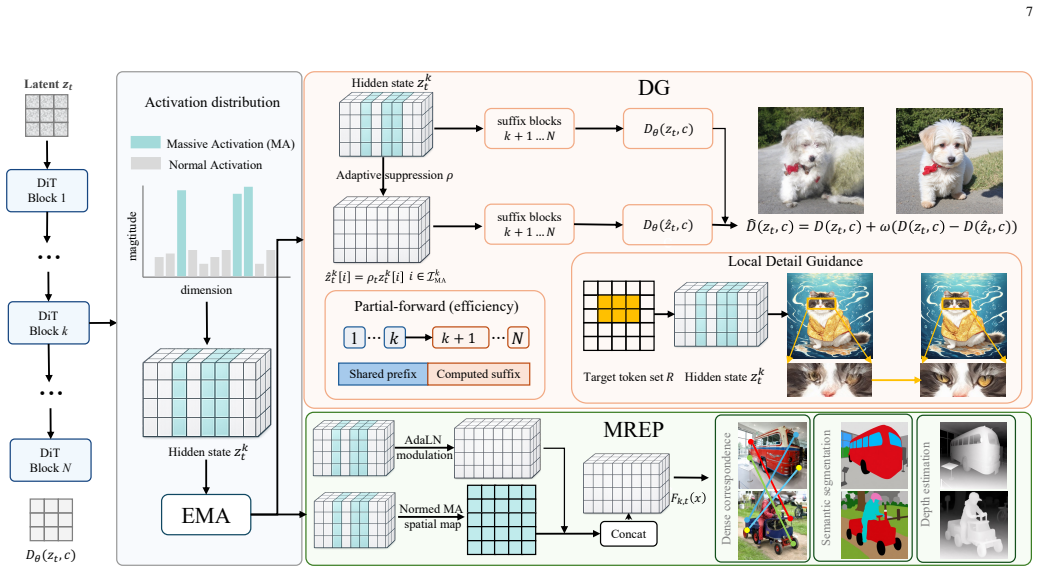
Eliciting Massive Activation (EMA): MA-driven Detail Guidance (DG) suppresses calibrated MA dimensions at an intermediate block to form a detail-deficient counterfactual residual that guides sampling (with partial-forward, CFG, and token-level Local DG variants); MA-modulated Representation Extraction (MREP) applies pretrained AdaLN channel-wise modulation to reduce MA directional dominance and concatenates spatially normalized MA maps to keep useful spatial structure.
Load-bearing premise
That a one-time median-ratio pick of a few channels on a small calibration set, suppressed with a fixed sigmoid schedule at a grid-searched intermediate block, cleanly isolates detail rather than mixing in semantics or model-specific artifacts.
What would settle it
On a fixed DiT and prompt set, intervene only the calibrated MA channels versus the same count of non-MA channels at the same block and schedule: if detail metrics (aesthetic/HPS) and human preference for local texture collapse for both interventions equally, or if prompt-alignment metrics collapse when MAs are suppressed, the claimed detail-specific residual is false.
If this is right
- Suppressing MA dimensions at intermediate blocks yields a detail-specific guidance direction that improves fine detail and can be combined with classifier-free guidance.
- Sharing the prefix forward before the intervention block makes detail guidance cheaper than a full second denoising pass.
- Token-local MA suppression enables selective refinement of chosen regions without rewriting the rest of the image.
- AdaLN-modulated features plus normalized MA spatial maps raise dense-task scores (correspondence, segmentation, depth) over raw DiT hidden states.
- The same MA structure appears across image and video DiTs, so the modulation recipe transfers to spatiotemporal generation.
Where Pith is reading between the lines
- If MAs are mainly timestep-driven residual scales, other AdaLN-conditioned denoisers (beyond pure DiTs) may admit similar detail and representation knobs with only calibration, not architecture changes.
- A natural next test is whether the same MA residual can be inverted—amplifying rather than suppressing selected dimensions—to trade detail for global coherence or style.
- Because MA channels are few and fixed, they are natural candidates for low-bit quantization or caching schedules that preserve detail while cutting memory.
- Local DG suggests interactive editors could treat MA suppression masks as soft “detail brushes” driven by user regions rather than full re-sampling.
Editorial analysis
A structured set of objections, weighed in public.
Referee Report
Summary. The paper analyzes Massive Activations (MAs) in Diffusion Transformers and reports a DiT-specific structure: MAs are spatially distributed across tokens but concentrated in a few fixed channels that align with AdaLN residual scales and are primarily timestep-modulated rather than text-modulated. From this, the authors argue a dual role—MAs support fine-grained detail synthesis in generation, while their shared high-magnitude directions reduce spatial discriminability of raw DiT features for dense understanding. They propose EMA, a training-free framework with two modules: Detail Guidance (DG), which suppresses MA channels to form a detail-deficient counterfactual and uses the residual as a guidance signal (with partial-forward, CFG combination, and Local DG variants); and MREP, which reuses AdaLN modulation to reduce MA directional dominance and concatenates spatially normalized MA maps. Experiments on multiple image DiTs, video DiTs, ImageNet class-conditional generation, and dense tasks (correspondence, segmentation, depth) report consistent gains.
Significance. If the analysis and methods hold, the work provides a useful internal-activation account of DiTs that unifies generation-side detail control and representation-side feature cleanup under one training-free modulation principle. Strengths include multi-architecture generation results (SD3/SD3.5/Flux, PixArt-α, SANA, DiT-XL/2, Wan), explicit MA vs non-MA intervention evidence, CFG complementarity, partial-forward cost accounting, Local DG controllability, and MREP ablations on dense tasks. These make MA modulation a practical, reusable lever rather than only a diagnostic observation, with clear value for sampling guidance and DiT feature extraction without retraining.
major comments (3)
- §V-A, Eqs. (7)–(11) and §IV-C: The central generative claim treats the residual D_θ(z_t,c)−D_θ(ẑ_t,c) as a largely detail-specific direction. Figs. 5–6 and the near-0.5 CLIP/BLIP win rates after MA disruption support limited semantic damage, and Table XI shows MA channels beat random channels. Still missing is a direct residual-disentanglement check (e.g., residual cosine similarity to CFG residuals; layout/pose/identity probes; or controlled semantic edits under fixed seeds). Because MAs are AdaLN-aligned and timestep-modulated (Fig. 4), a single intermediate block k with a fixed sigmoid schedule can couple the residual to stage/scale artifacts. Please add at least one quantitative disentanglement analysis, or temper the ‘detail-specific’ language to match the current aggregate evidence.
- §V-A (MA selection and schedule) and free parameters τ_MA, k, ρ_t: MA dimensions are fixed from a small calibration set via a median-ratio threshold, then suppressed with defaults τ_ρ=0.5, λ_ρ=12 and grid-searched k (6/20/22). Table XI ablations help, but the manuscript does not report sensitivity of selected channels across calibration sets/prompts, stability of I^k_MA across models/seeds, or performance under modest τ_MA / schedule perturbations. Given that EMA’s claim is that calibrated MAs are stable shared structure, a short sensitivity table (channel overlap; metric change under τ_MA and k±) is needed to secure the ‘once-calibrated, reused for all prompts’ assumption.
- §VI-D / Tables VI–VIII: MREP gains are clear versus ‘w/o MREP’, but several dense-task comparisons mix unsupervised DiT features with supervised or differently trained baselines (e.g., SCorrSAN, CATs++, VPD variants). Please clarify protocol parity (frozen features vs fine-tuning, probe heads, timesteps/blocks, resolution) and, where possible, report the same probe setup for DiTF, w/o MREP, and MREP so the contribution of MA modulation is isolated from evaluation-protocol differences.
minor comments (7)
- Abstract: typo ‘Detail G}uidance’ (stray brace).
- Fig. 2 / §IV-A: state explicitly how many MA dimensions are selected per model and whether the same absolute channel indices recur across checkpoints or only relative magnitude ranks.
- Eq. (10) and Algorithm 1: define the normalized timestep convention (t∈[0,1] vs discrete sampler indices) so the ρ_t schedule is reproducible across SD3/Flux/Wan samplers.
- Table II vs Table III: HPSv2.1 numbers appear under different evaluation settings; add a short note on prompt sets and sampling steps to avoid cross-table over-interpretation.
- §II-D / related work: DiTF and the prior DG arXiv are closely related; a clearer novelty paragraph separating analysis contributions from method reuse would help readers.
- Fig. 13: axis labels and which model/setting each panel uses could be made more self-contained in the caption.
- Local DG (§V-C, Fig. 12): quantitative region-level metrics (or user preference on local edits) would strengthen the qualitative demos.
Circularity Check
No significant circularity: MA structure is measured, DG/MREP are designed methods evaluated on external metrics; mild self-citation of authors' DiTF/DG priors is not load-bearing.
specific steps
-
self citation load bearing
[Sec. II-D Related Work; citations [36] DiTF and [45] prior DG arXiv]
"Notably, DiTF [36] observes that DiTs exhibit fixed-dimensional massive activations across spatial tokens when used as feature extractors, while DG [45] further suggests that such activations are closely related to local detail synthesis in DiT-based generation."
The dual-role framing (MAs for detail synthesis and for representation) is partly prefigured in the authors' own DiTF and DG preprints with overlapping author lists. This is mild narrative self-citation, not a load-bearing uniqueness or sole justification: Section IV re-measures MA structure and intervention effects in this manuscript, and EMA is evaluated on external generation/understanding benchmarks. Does not force the reported residual or MREP gains by construction.
full rationale
The paper's chain is observational then constructive, not definitional. Section IV measures MA spatial/channel structure, AdaLN alignment, and timestep vs text modulation on SD3/Flux/DiT-XL (Figs. 2–4); generative impact is shown by one-layer intervention with external CLIP/BLIP and detail metrics (Figs. 5–6), not by defining detail as the residual. DG (Eqs. 7–11) builds a counterfactual by suppressing calibrated MA channels and uses the residual as guidance—standard self-guidance form—then reports gains on Pick-a-Pic, HPSv2.1, Aesthetic, VBench, ImageNet FID/IS against CFG and other guidance baselines. MREP reuses pretrained AdaLN and normalized MA maps and is scored on SPair/AP-10K/PF-Pascal, ADE20K, NYUv2. Hyperparameter choices (τ_MA, ρ schedule, k, w) are ablated (Tables XI–XII, Fig. 13) rather than fitted then re-predicted as the same quantity. Self-citations to DiTF [36] and the authors' prior DG note [45] frame related work and the dual-use story, but the present manuscript re-presents analyses and external-benchmark evaluations; the central claims do not reduce to those citations alone, nor to a uniqueness theorem or renamed known law. Score 1 reflects only that mild, non-load-bearing self-citation backdrop.
Axiom & Free-Parameter Ledger
free parameters (4)
- MA ratio threshold τ_MA
- Intervention block index k
- Retention schedule (τ_ρ=0.5, λ_ρ=12)
- Detail guidance scale w (and CFG λ when combined)
axioms (4)
- domain assumption Self-guidance by contrasting the model with a deliberately degraded counterpart yields a useful sampling direction.
- domain assumption AdaLN residual scales α_k are the primary channel-wise controllers of MA locations and magnitudes.
- standard math Standard latent diffusion sampling and CFG formulation hold for the evaluated DiTs.
- ad hoc to paper A small calibration set’s mean absolute activations suffice to identify stable MA dimensions for all later prompts.
invented entities (3)
-
EMA (Eliciting Massive Activation) framework
no independent evidence
-
Detail Guidance (DG) / Local DG
no independent evidence
-
MREP (MA-modulated REPresentation extraction)
no independent evidence
read the original abstract
Massive Activations (MAs) have been widely observed in Transformer-based models, yet their structure and functional roles in Diffusion Transformers (DiTs) remain insufficiently understood. In this work, we systematically analyze MAs in representative DiTs and find that they are spatially distributed across image tokens while concentrated in a small set of fixed feature dimensions. We further show that these dimensions are closely aligned with AdaLN residual scaling factors and are primarily modulated by the denoising timestep rather than text conditions. This structure leads to two task-dependent effects: for generation, MAs are critical for fine-grained detail synthesis while having limited influence on global semantics; for understanding, their shared high-magnitude directions make raw DiT features overly similar across spatial tokens and weaken dense feature discrimination. Based on these findings, we introduce Eliciting Massive Activation (EMA), a training-free framework that leverages Massive Activations (MAs) as a unified modulation signal to improve both generative and representational capabilities of DiTs. For generation, EMA proposes MA-driven Detail G}uidance (DG), which suppresses MA dimensions to construct a detail-deficient counterfactual prediction and guides sampling toward finer visual details. DG further supports efficient partial-forward inference, integration with classifier-free guidance, and token-level Local DG for refining selected image regions. For understanding, EMA introduces MA-modulated REPresentation extraction (MREP), which uses pretrained AdaLN channel-wise modulation to reduce MA directional dominance and concatenates spatially normalized MA maps to preserve useful spatial structure. Extensive experiments demonstrate that EMA consistently improves both the generation quality and representation capability of DiTs.
Figures




Reference graph
Works this paper leans on
-
[1]
High- resolution image synthesis with latent diffusion models,
R. Rombach, A. Blattmann, D. Lorenz, P. Esser, and B. Ommer, “High- resolution image synthesis with latent diffusion models,” inCVPR, 2022
2022
-
[2]
Photorealistic text-to-image diffusion models with deep language understanding,
C. Saharia, W. Chan, S. Saxena, L. Li, J. Whang, E. L. Denton, K. Ghasemipour, R. Gontijo Lopes, B. Karagol Ayan, T. Salimans et al., “Photorealistic text-to-image diffusion models with deep language understanding,”NeurIPS, 2022
2022
-
[3]
Attention is all you need,
A. Vaswani, N. Shazeer, N. Parmar, J. Uszkoreit, L. Jones, A. N. Gomez, Ł. Kaiser, and I. Polosukhin, “Attention is all you need,”Advances in neural information processing systems, vol. 30, 2017
2017
-
[4]
Scalable diffusion models with transformers,
W. Peebles and S. Xie, “Scalable diffusion models with transformers,” inICCV, 2023
2023
-
[5]
Scaling rectified flow transformers for high-resolution image synthesis,
P. Esser, S. Kulal, A. Blattmann, R. Entezari, J. M ¨uller, H. Saini, Y . Levi, D. Lorenz, A. Sauer, F. Boeselet al., “Scaling rectified flow transformers for high-resolution image synthesis,” inICML, 2024
2024
-
[6]
black-forest labs, “Flux,” https://blackforestlabs.ai/ announcing-black-forest-labs/, 2024
2024
-
[7]
Cogvideox: Text-to-video diffusion models with an expert transformer,
Z. Yang, J. Teng, W. Zheng, M. Ding, S. Huang, J. Xu, Y . Yang, W. Hong, X. Zhang, G. Fenget al., “Cogvideox: Text-to-video diffusion models with an expert transformer,”arXiv preprint arXiv:2408.06072, 2024
Pith/arXiv arXiv 2024
-
[8]
Cogvideo: Large- scale pretraining for text-to-video generation via transformers,
W. Hong, M. Ding, W. Zheng, X. Liu, and J. Tang, “Cogvideo: Large- scale pretraining for text-to-video generation via transformers,”arXiv preprint arXiv:2205.15868, 2022
Pith/arXiv arXiv 2022
-
[10]
Unsupervised semantic correspondence using stable diffusion,
E. Hedlin, G. Sharma, S. Mahajan, H. Isack, A. Kar, A. Tagliasacchi, and K. M. Yi, “Unsupervised semantic correspondence using stable diffusion,”NeurIPS, 2024
2024
-
[11]
Emergent correspondence from image diffusion,
L. Tang, M. Jia, Q. Wang, C. P. Phoo, and B. Hariharan, “Emergent correspondence from image diffusion,”Advances in Neural Information Processing Systems, vol. 36, pp. 1363–1389, 2023
2023
-
[12]
A tale of two features: Stable diffusion complements dino for zero-shot semantic correspondence,
J. Zhang, C. Herrmann, J. Hur, L. Polania Cabrera, V . Jampani, D. Sun, and M.-H. Yang, “A tale of two features: Stable diffusion complements dino for zero-shot semantic correspondence,”NeurIPS, 2024
2024
-
[13]
Sd4match: Learning to prompt stable diffusion model for semantic matching,
X. Li, J. Lu, K. Han, and V . A. Prisacariu, “Sd4match: Learning to prompt stable diffusion model for semantic matching,” inCVPR, 2024
2024
-
[14]
Massive activations in large language models,
M. Sun, X. Chen, J. Z. Kolter, and Z. Liu, “Massive activations in large language models,”arXiv preprint arXiv:2402.17762, 2024
Pith/arXiv arXiv 2024
-
[15]
Efficient streaming language models with attention sinks,
G. Xiao, Y . Tian, B. Chen, S. Han, and M. Lewis, “Efficient streaming language models with attention sinks,” inThe Twelfth International Conference on Learning Representations, 2024
2024
-
[16]
Vision transformers need registers,
T. Darcet, M. Oquab, J. Mairal, and P. Bojanowski, “Vision transformers need registers,” inThe Twelfth International Conference on Learning Representations, 2024
2024
-
[17]
Classifier-free diffusion guidance,
J. Ho and T. Salimans, “Classifier-free diffusion guidance,” arXiv:2207.12598, 2022
Pith/arXiv arXiv 2022
-
[18]
Denoising diffusion probabilistic models,
J. Ho, A. Jain, and P. Abbeel, “Denoising diffusion probabilistic models,” NeurIPS, 2020
2020
-
[19]
Diffusion models beat gans on image synthesis,
P. Dhariwal and A. Nichol, “Diffusion models beat gans on image synthesis,”NeurIPS, 2021
2021
-
[20]
An image is worth 16x16 words: Transformers for image recognition at scale,
A. Dosovitskiy, “An image is worth 16x16 words: Transformers for image recognition at scale,”arXiv:2010.11929, 2020
Pith/arXiv arXiv 2010
-
[21]
Pixart-alpha: Fast training of diffusion transformer for photorealistic text-to-image synthesis,
J. Chen, J. Yu, C. Ge, L. Yao, E. Xie, Y . Wu, Z. Wang, J. Kwok, P. Luo, H. Luet al., “Pixart-alpha: Fast training of diffusion transformer for photorealistic text-to-image synthesis,”arXiv:2310.00426, 2023
Pith/arXiv arXiv 2023
-
[22]
Eliminating oversaturation and artifacts of high guidance scales in diffusion models,
S. Sadat, O. Hilliges, and R. M. Weber, “Eliminating oversaturation and artifacts of high guidance scales in diffusion models,” inThe Thirteenth International Conference on Learning Representations, 2024
2024
-
[23]
Cfg++: Manifold- constrained classifier free guidance for diffusion models,
H. Chung, J. Kim, G. Y . Park, H. Nam, and J. C. Ye, “Cfg++: Manifold- constrained classifier free guidance for diffusion models,”arXiv preprint arXiv:2406.08070, 2024
Pith/arXiv arXiv 2024
-
[24]
Guiding a diffusion model with a bad version of itself,
T. Karras, M. Aittala, T. Kynk ¨a¨anniemi, J. Lehtinen, T. Aila, and S. Laine, “Guiding a diffusion model with a bad version of itself,”Ad- vances in Neural Information Processing Systems, vol. 37, pp. 52 996– 53 021, 2024
2024
-
[25]
Improving sample quality of diffusion models using self-attention guidance,
S. Hong, G. Lee, W. Jang, and S. Kim, “Improving sample quality of diffusion models using self-attention guidance,” inProceedings of the IEEE/CVF International Conference on Computer Vision, 2023, pp. 7462–7471
2023
-
[26]
Self-rectifying diffusion sampling with perturbed-attention guidance,
D. Ahn, H. Cho, J. Min, W. Jang, J. Kim, S. Kim, H. H. Park, K. H. Jin, and S. Kim, “Self-rectifying diffusion sampling with perturbed-attention guidance,” inEuropean Conference on Computer Vision. Springer, 2024, pp. 1–17
2024
-
[27]
Spatiotemporal skip guidance for enhanced video diffusion sampling,
J. Hyung, K. Kim, S. Hong, M.-J. Kim, and J. Choo, “Spatiotemporal skip guidance for enhanced video diffusion sampling,” inProceedings of the Computer Vision and Pattern Recognition Conference, 2025, pp. 11 006–11 015
2025
-
[28]
Segdiff: Image segmentation with diffusion probabilistic models,
T. Amit, T. Shaharbany, E. Nachmani, and L. Wolf, “Segdiff: Image segmentation with diffusion probabilistic models,”arXiv:2112.00390, 2021
Pith/arXiv arXiv 2021
-
[29]
Label-efficient semantic segmentation with diffusion models,
D. Baranchuk, I. Rubachev, A. V oynov, V . Khrulkov, and A. Babenko, “Label-efficient semantic segmentation with diffusion models,” arXiv:2112.03126, 2021
Pith/arXiv arXiv 2021
-
[30]
Open- vocabulary panoptic segmentation with text-to-image diffusion models,
J. Xu, S. Liu, A. Vahdat, W. Byeon, X. Wang, and S. De Mello, “Open- vocabulary panoptic segmentation with text-to-image diffusion models,” inCVPR, 2023
2023
-
[31]
Unleashing text- to-image diffusion models for visual perception,
W. Zhao, Y . Rao, Z. Liu, B. Liu, J. Zhou, and J. Lu, “Unleashing text- to-image diffusion models for visual perception,” inICCV, 2023
2023
-
[32]
Diffusion hyperfeatures: Searching through time and space for semantic corre- spondence,
G. Luo, L. Dunlap, D. H. Park, A. Holynski, and T. Darrell, “Diffusion hyperfeatures: Searching through time and space for semantic corre- spondence,”NeurIPS, 2024
2024
-
[33]
Deep vit features as dense visual descriptors,
S. Amir, Y . Gandelsman, S. Bagon, and T. Dekel, “Deep vit features as dense visual descriptors,”arXiv:2112.05814, 2021
Pith/arXiv arXiv 2021
-
[34]
Dinov2: Learning robust visual features without supervision,
M. Oquab, T. Darcet, T. Moutakanni, H. V o, M. Szafraniec, V . Khalidov, P. Fernandez, D. Haziza, F. Massa, A. El-Noubyet al., “Dinov2: Learning robust visual features without supervision,”arXiv:2304.07193, 2023
Pith/arXiv arXiv 2023
-
[35]
Telling left from right: Identifying geometry-aware semantic correspondence,
J. Zhang, C. Herrmann, J. Hur, E. Chen, V . Jampani, D. Sun, and M.- H. Yang, “Telling left from right: Identifying geometry-aware semantic correspondence,” inCVPR, 2024
2024
-
[36]
Un- leashing diffusion transformers for visual correspondence by modulating massive activations,
C. Gan, Y . Tu, X. Chen, T. Chen, Y . Li, M. Harandi, and W. Lin, “Un- leashing diffusion transformers for visual correspondence by modulating massive activations,” inThe Thirty-ninth Annual Conference on Neural Information Processing Systems, 2025
2025
-
[37]
Repurposing video diffusion transformers for robust point tracking,
S. Son, H. An, C. Kim, H. Ko, J. Nam, D. Chung, S. Jin, J. Yi, J. Min, J. Huret al., “Repurposing video diffusion transformers for robust point tracking,”arXiv preprint arXiv:2512.20606, 2025
Pith/arXiv arXiv 2025
-
[38]
Unveiling a core linguistic region in large language models,
J. Zhao, Z. Zhang, Y . Ma, Q. Zhang, T. Gui, L. Gao, and X. Huang, “Unveiling a core linguistic region in large language models,”arXiv preprint arXiv:2310.14928, 2023
Pith/arXiv arXiv 2023
-
[39]
SLMRec: Distilling large language models into small for sequential recommendation,
W. Xu, Q. Wu, Z. Liang, J. Han, X. Ning, Y . Shi, W. Lin, and Y . Zhang, “SLMRec: Distilling large language models into small for sequential recommendation,” inThe Thirteenth International Conference on Learning Representations, 2025. [Online]. Available: https://openreview.net/forum?id=G4wARwjF8M
2025
-
[40]
Massive values in self-attention modules are the key to contextual knowledge understanding,
M. Jin, K. Mei, W. Xu, M. Sun, R. Tang, M. Du, Z. Liu, and Y . Zhang, “Massive values in self-attention modules are the key to contextual knowledge understanding,”arXiv preprint arXiv:2502.01563, 2025
Pith/arXiv arXiv 2025
-
[41]
Denoising vision transformers,
J. Yang, K. Z. Luo, J. Li, C. Deng, L. Guibas, D. Krishnan, K. Q. Weinberger, Y . Tian, and Y . Wang, “Denoising vision transformers,” in European Conference on Computer Vision. Springer, 2024, pp. 453– 469
2024
-
[42]
Hq-dit: Efficient diffusion transformer with fp4 hybrid quantization,
W. Liu and S. Q. Zhang, “Hq-dit: Efficient diffusion transformer with fp4 hybrid quantization,”arXiv preprint arXiv:2405.19751, 2024
Pith/arXiv arXiv 2024
-
[43]
T. Zhao, T. Fang, H. Huang, E. Liu, R. Wan, W. Soedarmadji, S. Li, Z. Lin, G. Dai, S. Yanet al., “Vidit-q: Efficient and accurate quantization of diffusion transformers for image and video generation,”arXiv preprint arXiv:2406.02540, 2024
Pith/arXiv arXiv 2024
-
[44]
Tinyfusion: Diffusion transform- ers learned shallow,
G. Fang, K. Li, X. Ma, and X. Wang, “Tinyfusion: Diffusion transform- ers learned shallow,” inProceedings of the Computer Vision and Pattern Recognition Conference, 2025, pp. 18 144–18 154
2025
-
[45]
Massive activations are the key to local detail synthesis in diffusion transformers,
C. Gan, Z. Zhao, Y . Tu, X. Chen, Z. Qin, T. Chen, M. Harandi, and W. Lin, “Massive activations are the key to local detail synthesis in diffusion transformers,”arXiv preprint arXiv:2510.11538, 2025. 17
arXiv 2025
-
[46]
Deep residual learning for image recognition,
K. He, X. Zhang, S. Ren, and J. Sun, “Deep residual learning for image recognition,” inProceedings of the IEEE conference on computer vision and pattern recognition, 2016, pp. 770–778
2016
-
[47]
Visual reasoning with a general conditioning layer,
E. Perez, F. Strub, H. De Vries, V . Dumoulin, and A. C. Film, “Visual reasoning with a general conditioning layer,”AAAI, 2018
2018
-
[48]
Elucidating the design space of diffusion-based generative models,
T. Karras, M. Aittala, T. Aila, and S. Laine, “Elucidating the design space of diffusion-based generative models,”Advances in neural infor- mation processing systems, vol. 35, pp. 26 565–26 577, 2022
2022
-
[49]
Sana: Efficient high-resolution image synthesis with linear diffusion transformers,
E. Xie, J. Chen, J. Chen, H. Cai, H. Tang, Y . Lin, Z. Zhang, M. Li, L. Zhu, Y . Luet al., “Sana: Efficient high-resolution image synthesis with linear diffusion transformers,”arXiv preprint arXiv:2410.10629, 2024
Pith/arXiv arXiv 2024
-
[50]
Wan: Open and advanced large-scale video generative models,
T. Wan, A. Wang, B. Ai, B. Wen, C. Mao, C.-W. Xie, D. Chen, F. Yu, H. Zhao, J. Yanget al., “Wan: Open and advanced large-scale video generative models,”arXiv preprint arXiv:2503.20314, 2025
Pith/arXiv arXiv 2025
-
[51]
Pick-a-pic: An open dataset of user preferences for text-to-image generation,
Y . Kirstain, A. Polyak, U. Singer, S. Matiana, J. Penna, and O. Levy, “Pick-a-pic: An open dataset of user preferences for text-to-image generation,”Advances in neural information processing systems, vol. 36, pp. 36 652–36 663, 2023
2023
-
[52]
X. Wu, Y . Hao, K. Sun, Y . Chen, F. Zhu, R. Zhao, and H. Li, “Human preference score v2: A solid benchmark for evaluating human pref- erences of text-to-image synthesis,”arXiv preprint arXiv:2306.09341, 2023
Pith/arXiv arXiv 2023
-
[53]
Learning transferable visual models from natural language supervision,
A. Radford, J. W. Kim, C. Hallacy, A. Ramesh, G. Goh, S. Agarwal, G. Sastry, A. Askell, P. Mishkin, J. Clarket al., “Learning transferable visual models from natural language supervision,” inInternational conference on machine learning. PmLR, 2021, pp. 8748–8763
2021
-
[54]
Blip: Bootstrapping language-image pre-training for unified vision-language understanding and generation,
J. Li, D. Li, C. Xiong, and S. Hoi, “Blip: Bootstrapping language-image pre-training for unified vision-language understanding and generation,” inInternational conference on machine learning. PMLR, 2022, pp. 12 888–12 900
2022
-
[55]
Laion-aesthetics,
C. Schuhmann, “Laion-aesthetics,” https://laion.ai/blog/laion-aesthetics/, 2022, accessed: 2023-11-10
2022
-
[56]
Vbench: Comprehensive benchmark suite for video generative models,
Z. Huang, Y . He, J. Yu, F. Zhang, C. Si, Y . Jiang, Y . Zhang, T. Wu, Q. Jin, N. Chanpaisitet al., “Vbench: Comprehensive benchmark suite for video generative models,” inProceedings of the IEEE/CVF Conference on Computer Vision and Pattern Recognition, 2024, pp. 21 807–21 818
2024
-
[57]
Spair-71k: A large-scale benchmark for semantic correspondence,
J. Min, J. Lee, J. Ponce, and M. Cho, “Spair-71k: A large-scale benchmark for semantic correspondence,”arXiv:1908.10543, 2019
Pith/arXiv arXiv 1908
-
[58]
Proposal flow,
B. Ham, M. Cho, C. Schmid, and J. Ponce, “Proposal flow,” inCVPR, 2016
2016
-
[59]
Ap-10k: A benchmark for animal pose estimation in the wild,
H. Yu, Y . Xu, J. Zhang, W. Zhao, Z. Guan, and D. Tao, “Ap-10k: A benchmark for animal pose estimation in the wild,”arXiv:2108.12617, 2021
Pith/arXiv arXiv 2021
-
[60]
Scene parsing through ade20k dataset,
B. Zhou, H. Zhao, X. Puig, S. Fidler, A. Barriuso, and A. Torralba, “Scene parsing through ade20k dataset,” inProceedings of the IEEE conference on computer vision and pattern recognition, 2017, pp. 633– 641
2017
-
[61]
Indoor segmentation and support inference from rgbd images,
N. Silberman, D. Hoiem, P. Kohli, and R. Fergus, “Indoor segmentation and support inference from rgbd images,” inEuropean conference on computer vision. Springer, 2012, pp. 746–760
2012
-
[62]
Cfg-zero*: Improved classifier-free guidance for flow matching models,
W. Fan, A. Y . Zheng, R. A. Yeh, and Z. Liu, “Cfg-zero*: Improved classifier-free guidance for flow matching models,”arXiv preprint arXiv:2503.18886, 2025
Pith/arXiv arXiv 2025
-
[63]
S 2-guidance: Stochastic self guidance for training-free enhancement of diffusion models,
C. Chen, J. Zhu, X. Feng, N. Huang, M. Wu, F. Mao, J. Wu, X. Chu, and X. Li, “S 2-guidance: Stochastic self guidance for training-free enhancement of diffusion models,”arXiv preprint arXiv:2508.12880, 2025
arXiv 2025
-
[64]
Learning semantic correspondence with sparse annotations,
S. Huang, L. Yang, B. He, S. Zhang, X. He, and A. Shrivastava, “Learning semantic correspondence with sparse annotations,” inECCV, 2022
2022
-
[65]
Cats++: Boosting cost aggregation with convolutions and transformers,
S. Cho, S. Hong, and S. Kim, “Cats++: Boosting cost aggregation with convolutions and transformers,”TPAMI, 2022. Chaofan Ganreceived the Bachelor’s degree in Software Engineering from Huazhong University of Science and Technology, Wuhan, China in 2022. He is currently pursuing the Ph.D. degree in Electronic Information and Electrical Engineering at Shangh...
2022
-
[66]
degree with the School of Electronic Information and Electrical Engineering, Shanghai Jiao Tong University
He is currently pursuing the Ph.D. degree with the School of Electronic Information and Electrical Engineering, Shanghai Jiao Tong University. His research interests include efficient generative modeling, visual autoregressive generation, and model compression. Tieyuan Chenreceived the Bachelor’s degree in the school of electronic information and electric...
2023
discussion (0)
Sign in with ORCID, Apple, or X to comment. Anyone can read and Pith papers without signing in.