REVIEW 3 major objections 5 minor 1 cited by
A unified Bayesian analysis of Tully–Fisher, fundamental-plane, and supernova distances finds all three tracers agree with the CMB on S8 = 0.819 ± 0.030.
Reviewed by Pith at T0; open to challenge. T0 means a machine referee read the full paper against a public rubric. the ladder, T0–T4 →
A unified Bayesian analysis of Tully-Fisher, fundamental plane, and supernova distances gives S8 = 0.819±0.030, consistent with the Planck CMB value of 0.832±0.013.
T0 review reviewed 2026-08-04 challenge →
load-bearing objection Useful unified peculiar-velocity analysis undermined by a direct abstract/body contradiction over the fundamental plane and the headline S8 value. the 3 major comments →
S₈ from peculiar velocities: agreement with Planck for Tully--Fisher and supernovae, tension for the fundamental plane
The pith
A machine-rendered reading of the paper's core claim, the machinery that carries it, and where it could break.
The reading
Core claim
The central discovery is that low-redshift peculiar velocities are concordant with the cosmic microwave background. Treating distances as latent parameters, the analysis jointly calibrates each distance–indicator relation and the velocity scaling β* (the ratio of the growth rate to the galaxy bias of the density template) against a linear-theory reconstruction of the local velocity field. After accounting for each sample's own galaxy bias in the Malmquist-bias distance prior, the five samples agree on β* and hence on S8; the joint value is S8 = 0.819 ± 0.030. The fundamental-plane catalogues are the most precise but are unstable under the adopted inhomogeneous Malmquist-bias treatment, and a
What carries the argument
The load-bearing object is a whole-sky linear-theory reconstruction of the local universe, voxelized from a near-infrared galaxy catalogue with Gaussian smoothing on 4 h^-1 Mpc, used to predict each source's peculiar velocity from its inferred distance. The argument runs through the identity β* ≡ f/b, with f ≈ Ω_m^0.55 the linear growth rate and b the galaxy bias of the density template; peculiar velocities constrain β*, and multiplying by the externally measured galaxy fluctuation amplitude σg8 on 8 h^-1 Mpc gives f σ8^NL, which is converted to S8 using an emulator-based nonlinear-to-linear correction. Around this, the machinery includes a per-sample linear bias b1 in the distance prior (ph
Load-bearing premise
The claim hangs on the assumption that the true line-of-sight velocity of every tracer equals a single constant β* times the reconstructed linear-theory template plus a uniform external dipole; if the template's shape is wrong — due to catalogue incompleteness, the 4 h^-1 Mpc smoothing, or the constant-bias assumption — then β* and therefore S8 are biased by an amount not captured by the quoted error bars.
What would settle it
Run the identical inference on the same five catalogues against an independent reconstruction of the local velocity field (for example from a constrained simulation or a different galaxy catalogue). If the joint S8 moves by more than about 0.03, or if the fundamental-plane samples shift to roughly 0.75 while the Tully–Fisher and supernova samples stay near 0.8 under the quadratic Malmquist-bias term, then the claimed concordance is a property of the chosen template or model rather than of the data.
If this is right
- A joint, self-consistent treatment of Tully–Fisher, fundamental-plane, and supernova distances gives S8 = 0.819 ± 0.030, consistent with the CMB; the quoted error is dominated by the uncertainty in the galaxy-field amplitude σg8, not by the velocity data.
- Earlier peculiar-velocity measurements that reported lower S8 — in particular from fundamental-plane-only or Tully–Fisher-only analyses — are likely affected by methodological choices, such as fixing the galaxy bias to unity or modeling scatter in angular size rather than its logarithm.
- The fundamental-plane samples give the tightest velocity-scaling constraints but are sensitive to the Malmquist-bias model; a quadratic extension preferred by the data shifts their S8 downward, so their systematics need further work.
- If all samples are truly concordant, peculiar velocities do not support an early-versus-late S8 tension; they are consistent with the CMB and with recent weak-lensing values within current precision.
Where Pith is reading between the lines
- A direct test: repeat the joint inference with an independent reconstruction of the local velocity field; if the five samples remain concordant and S8 shifts by less than roughly 0.03, the result is a property of the local velocity field rather than of the chosen template.
- The fundamental-plane instability hints that the phenomenological distance prior r^2 [1 + b1 δ(r)] is too crude for early-type samples; a survey-specific selection model based on actual apparent-magnitude limits could either confirm the concordance or expose a real FP-specific bias.
- If the galaxy-field amplitude σg8 were remeasured with better data, the joint S8 uncertainty would drop below 0.02, making peculiar velocities competitive with weak lensing as a late-time probe.
- The inferred external velocity dipole differs in direction between the two fundamental-plane samples; this may signal residual large-scale flow not captured by the reconstruction, and its origin could be tested by splitting the samples by sky region.
Editorial analysis
A structured set of objections, weighed in public.
Referee Report
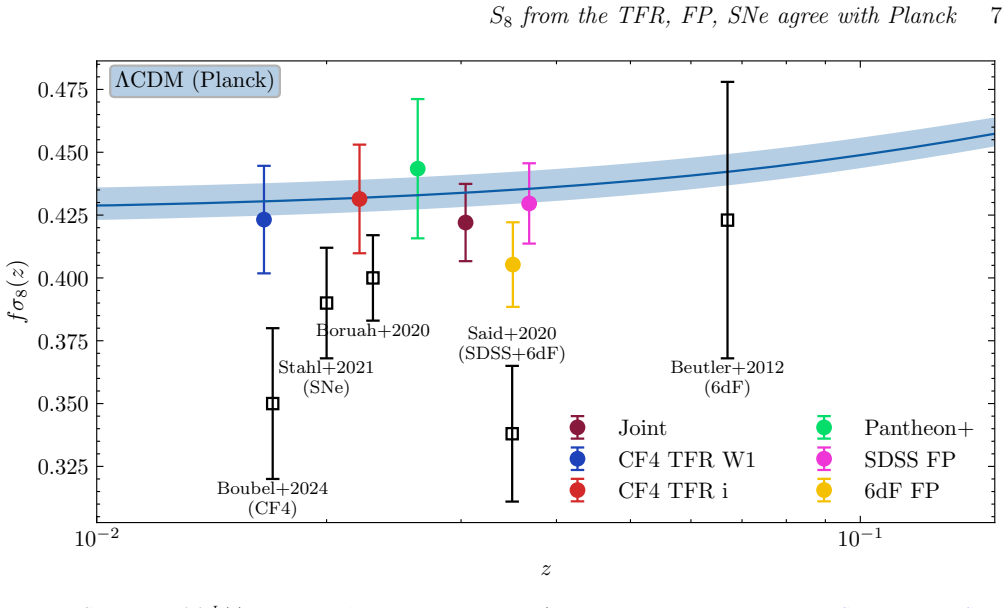
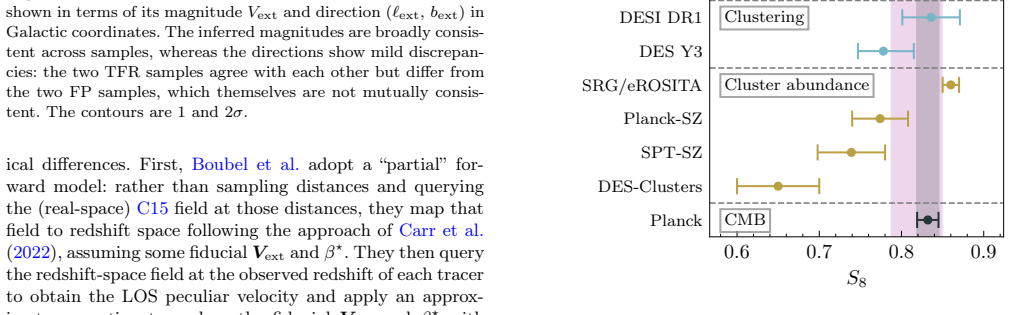
Summary. The paper presents a unified Bayesian hierarchical forward model for inferring the cosmological parameter combination fσ8 (and S8) from peculiar velocities measured with three distance indicators: the Tully–Fisher relation (two CosmicFlows-4 samples), the fundamental plane (SDSS and 6dF), and Type Ia supernovae (Pantheon+). The velocity field is modelled with the Carrick et al. (2015) 2M++ reconstruction, with a free velocity scaling β*, an external dipole, and a phenomenological inhomogeneous Malmquist-bias prior with a free tracer bias b1. The main result stated in the full-text abstract and Section 5 is that all three tracers yield mutually consistent S8 values in agreement with Planck, with a joint constraint S8 = 0.819 ± 0.030; the paper further argues that previous lower S8 estimates from peculiar velocities are affected by methodological problems. The paper also reports tracer-by-tracer constraints and compares with external S8 probes.
Significance. If the central result holds, it is an important contribution: it provides the first analysis that treats TFR, FP, and SNe within one framework, cross-checks systematics across galaxy populations, and suggests that peculiar velocities do not add to the S8 tension. The model is well specified, the checks on Ωm sensitivity are useful, and the use of a Pantheon+ covariance with peculiar-velocity terms removed is a careful detail. The paper also gives concrete methodological criticisms of earlier work (Said et al.; Boubel et al.). However, the current manuscript contains a direct contradiction between the abstract preceding the full text and the full-text abstract/body regarding the FP stability and the joint S8 value. This must be resolved before the significance can be accepted; the underlying analysis appears potentially sound, but the manuscript is not internally consistent as written.
major comments (3)
- [Abstract (preceding text) vs §5 (Table 1, Fig. 2)] The abstract preceding the full text states a different central result from the full-text abstract and body. It reports S8 = 0.798 ± 0.035 from TFR+SNe, calls the FP constraints 'unstable under the inhomogeneous Malmquist bias treatment', and mentions a quadratic extension preferred by FP data. The full-text abstract, Section 5, Fig. 2, and Table 1 report S8 = 0.819 ± 0.030 from all five samples and state that all three tracers agree with Planck, with no quadratic FP extension anywhere in the body. This is not a typo: the two abstracts disagree on which samples enter the joint constraint and on whether FP is robust. The manuscript must be revised so that the abstract, body, and tables present one consistent result, and any FP quadratic-extension test must be either reported and interpreted or explicitly removed.
- [§5, Table 1; §7] The headline uncertainty S8 = 0.819 ± 0.030 omits the sample-variance estimate from Hollinger & Hudson (2024), which the paper itself cites in §7 and then dismisses as 'likely overly conservative'. Since the abstract and Table 1 quote only the smaller error, a reader cannot tell whether the agreement with Planck is robust to this variance. Please either include the Hollinger & Hudson variance in the headline error budget or provide a quantitative justification (e.g., mock-based) for excluding it.
- [§5, Fig. 2, Table 1] The assertion that all three tracers are 'in excellent agreement' with Planck and with each other is supported only by visual inspection of Fig. 2. The 6dF FP value, S8 = 0.782 ± 0.033, is about 1.4σ from Planck, and the five samples span a range of 0.78–0.86. A quantitative consistency statistic (e.g., chi-square between sample posteriors or a joint posterior predictive check) is needed to substantiate the central claim, especially given the abstract conflict about FP stability.
minor comments (5)
- [Table 1] The 'Joint' row appears to show only two values, with '-0.476±0.005' in the b1 column. Since each sample has its own b1, the Joint row should list β* and S8 with a blank or explanatory note for b1.
- [References] Stiskalek et al. 2025b and 2025c are listed with the same arXiv identifier (arXiv:2509.09665). One of these entries is likely erroneous; please correct the duplicate.
- [Figure 4 caption] 'The contours are1and2σ' is missing spacing; also specify whether these are 1σ and 2σ contours of the two-dimensional posterior.
- [Eq. (24)] The notation σ_L^8 and σ_NL^8 is easy to misread. Consider defining 'σ8 computed from the linear/non-linear power spectrum' explicitly before Eq. (24).
- [§4, selection term] The sentence 'This term modifies the model probability density ... by a factor [p(S=1|η_obs)]^{-n}' is terse. A one-line derivation or reference to Kelly et al. (2008) would improve readability.
Circularity Check
No circularity: S8 is derived from the fitted velocity scaling beta* and the external 2M++ clustering amplitude sigma_g8; neither quantity is defined in terms of the target S8.
full rationale
The derivation chain is self-contained and non-circular. The paper infers the velocity scaling beta* from the peculiar-velocity likelihood (Eqs. 14-16) using the Carrick et al. (2015) reconstruction, then converts beta* to S8 via Eq. (24): S8 = sigma_L8 (beta* sigma_g8 / Omega_m^0.55) sqrt(Omega_m/0.3). S8 never appears in the likelihood, priors, or distance-indicator calibrations, so the result is not an input recycled as an output. The external inputs (sigma_g8, the Planck cosmology used for the conversion) are not fitted to the S8 target; the paper explicitly tests Omega_m = 0.25 and 0.35 and finds <1 sigma changes. The self-citations (Stiskalek et al. 2025a,b,c) are methodological references for the hierarchical forward model, but Section 4 reproduces the full likelihood equations, and the nonlinear-to-linear sigma8 mapping is computed with the external syren emulator (Bartlett et al. 2024; Sui et al. 2024), not merely asserted from the self-citation. I also flag a serious internal inconsistency that is not circularity: the abstract supplied at the top states 'The fundamental plane constraints are instead unstable under the inhomogeneous Malmquist bias treatment; the quadratic extension preferred by the fundamental plane data drives their S8 values lower,' whereas the full-text abstract and Section 5/Fig. 2/Table 1 report 'All three tracers yield consistent values of S8 that are also in agreement with Planck' with a joint S8 = 0.819 ± 0.030 and make no mention of a quadratic FP extension. This contradiction concerns which result is the paper's central claim, but it does not make the derivation circular, as neither version feeds S8 back into the inference.
Axiom & Free-Parameter Ledger
free parameters (6)
- beta* (velocity scaling) =
0.452±0.010 to 0.500±0.029 per sample
- b1 (tracer bias in Malmquist prior) =
1.088±0.013 to 1.539±0.005 per sample
- Vext (external dipole) =
~140±7 to ~200±20 km/s, direction varies
- sigma_v (residual velocity scatter) =
not quoted in paper
- p, q, R (distance prior shape) =
not quoted in paper
- Distance-indicator calibrations (a,b,c, sigma_int) and hyperparameters =
not quoted in paper
axioms (7)
- domain assumption The galaxy density field traces matter with constant linear bias delta_g = b delta (Eq. 2)
- standard math Linear LambdaCDM continuity equation v ~ grad^-2 delta (Eq. 1)
- domain assumption f ~ Omega_m^0.55 (LambdaCDM growth approximation)
- domain assumption C15 reconstruction and sigma_g8 = 0.99±0.04 are correct
- domain assumption Residual peculiar velocities are uncorrelated and Gaussian (Eq. 14)
- ad hoc to paper Phenomenological distance prior of Eq. (11) and quadratic smoothing of Eq. (13)
- domain assumption Nonlinear-to-linear sigma_8 mapping via syren-new emulator
Cite this review
Pith. "Pith review of $S_8$ from peculiar velocities: agreement with Planck for Tully--Fisher and supernovae, tension for the fundamental plane." pith.science (2026). https://pith.science/paper/J6YF2NG3
@misc{pith2026250920235,
  author       = {Pith},
  title        = {Pith review of: $S_8$ from peculiar velocities: agreement with Planck for Tully--Fisher and supernovae, tension for the fundamental plane},
  year         = {2026},
  howpublished = {\url{https://pith.science/paper/J6YF2NG3}},
  note         = {Machine review of arXiv:2509.20235}
}
read the original abstract
Peculiar velocity measurements constrain the parameter combination $f\sigma_8$, the product of the linear growth rate $f$ and the fluctuation amplitude $\sigma_8$. Under the approximation that $f$ is a monotonic function of $\Omega_{\rm m}$, this can be related to $S_8 \equiv \sigma_8 \sqrt{\Omega_{\rm m}/0.3}$, enabling direct comparison with weak lensing and cosmic microwave background results. We use three classes of direct-distance tracers -- the Tully--Fisher relation, the fundamental plane, and Type Ia supernovae -- to infer peculiar velocities. A unified hierarchical forward model jointly calibrates each distance indicator and a linear theory reconstruction of the local Universe. This is the first consistent Bayesian analysis to treat all three major classes of distance indicators within a common framework, enabling cross-checks of systematics across diverse galaxy populations. Combining the Tully--Fisher and Type Ia supernova samples, we obtain $S_8 = 0.798 \pm 0.035$ ($f\sigma_8 = 0.412 \pm 0.018$), in agreement with Planck and robust under the choice of galaxy bias model, with the uncertainty dominated by the variance of the 2M++ galaxy field. The fundamental plane constraints are instead unstable under the inhomogeneous Malmquist bias treatment; the quadratic extension preferred by the fundamental plane data drives their $S_8$ values lower. These findings indicate that low-redshift peculiar velocity data are concordant with the cosmic microwave background and do not reinforce the early-versus-late $S_8$ tension, though the fundamental plane results call for further scrutiny of their systematics.
Figures




Forward citations
Cited by 1 Pith paper
-
The Status of Single Scalar Field Dark Energy
Cosmological data can constrain only a handful of EFT parameters for single-scalar dark energy; extended models show modest preference over Λ but remain underdetermined and challenged by fifth forces and screening.
Reference graph
Works this paper leans on
-
[1]
Abazajian K. N., et al., 2009, @doi [ ] 10.1088/0067-0049/182/2/543 , https://ui.adsabs.harvard.edu/abs/2009ApJS..182..543A 182, 543
-
[2]
Abbott T. M. C., et al., 2020, @doi [ ] 10.1103/PhysRevD.102.023509 , https://ui.adsabs.harvard.edu/abs/2020PhRvD.102b3509A 102, 023509
-
[3]
Abbott T. M. C., et al., 2022, @doi [ ] 10.1103/PhysRevD.105.023520 , https://ui.adsabs.harvard.edu/abs/2022PhRvD.105b3520A 105, 023520
-
[4]
Abolfathi B., et al., 2018, @doi [ ] 10.3847/1538-4365/aa9e8a , https://ui.adsabs.harvard.edu/abs/2018ApJS..235...42A 235, 42
-
[5]
Adams C., Blake C., 2020, @doi [ ] 10.1093/mnras/staa845 , https://ui.adsabs.harvard.edu/abs/2020MNRAS.494.3275A 494, 3275
-
[6]
Amon A., et al., 2022, @doi [ ] 10.1103/PhysRevD.105.023514 , https://ui.adsabs.harvard.edu/abs/2022PhRvD.105b3514A 105, 023514
-
[7]
Angulo R. E., Hahn O., 2022, @doi [Living Reviews in Computational Astrophysics] 10.1007/s41115-021-00013-z , https://ui.adsabs.harvard.edu/abs/2022LRCA....8....1A 8, 1
-
[8]
Asgari M., et al., 2021, @doi [ ] 10.1051/0004-6361/202039070 , https://ui.adsabs.harvard.edu/abs/2021A&A...645A.104A 645, A104
-
[9]
Bartlett D. J., Wandelt B. D., Zennaro M., Ferreira P. G., Desmond H., 2024, @doi [ ] 10.1051/0004-6361/202449854 , https://ui.adsabs.harvard.edu/abs/2024A&A...686A.150B 686, A150
-
[10]
Beutler F., et al., 2012, @doi [ ] 10.1111/j.1365-2966.2012.21136.x , https://ui.adsabs.harvard.edu/abs/2012MNRAS.423.3430B 423, 3430
arXiv 2012
-
[11]
Blake C., Turner R. J., 2024, @doi [The Open Journal of Astrophysics] 10.33232/001c.124509 , https://ui.adsabs.harvard.edu/abs/2024OJAp....7E..87B 7, 87
-
[13]
Bocquet S., et al., 2019, @doi [ ] 10.3847/1538-4357/ab1f10 , https://ui.adsabs.harvard.edu/abs/2019ApJ...878...55B 878, 55
-
[14]
Boruah S. S., Hudson M. J., Lavaux G., 2020, @doi [ ] 10.1093/mnras/staa2485 , https://ui.adsabs.harvard.edu/abs/2020MNRAS.498.2703B 498, 2703
-
[15]
Boubel P., Colless M., Said K., Staveley-Smith L., 2024, @doi [ ] 10.1093/mnras/stae1122 , https://ui.adsabs.harvard.edu/abs/2024MNRAS.531...84B 531, 84
-
[16]
Bouchet F. R., Colombi S., Hivon E., Juszkiewicz R., 1995, @doi [ ] 10.48550/arXiv.astro-ph/9406013 , https://ui.adsabs.harvard.edu/abs/1995A&A...296..575B 296, 575
-
[17]
Brout D., et al., 2022, @doi [ ] 10.3847/1538-4357/ac8e04 , https://ui.adsabs.harvard.edu/abs/2022ApJ...938..110B 938, 110
-
[18]
Campbell L. A., et al., 2014, @doi [ ] 10.1093/mnras/stu1198 , https://ui.adsabs.harvard.edu/abs/2014MNRAS.443.1231C 443, 1231
-
[19]
M., Scolnic D., Said K., Brout D., Peterson E
Carr A., Davis T. M., Scolnic D., Said K., Brout D., Peterson E. R., Kessler R., 2022, @doi [ ] 10.1017/pasa.2022.41 , https://ui.adsabs.harvard.edu/abs/2022PASA...39...46C 39, e046
-
[20]
Carrick J., Turnbull S. J., Lavaux G., Hudson M. J., 2015, @doi [ ] 10.1093/mnras/stv547 , https://ui.adsabs.harvard.edu/abs/2015MNRAS.450..317C 450, 317
-
[21]
Coles P., Lucchin F., 2002, Cosmology: The Origin and Evolution of Cosmic Structure, Second Edition
2002
-
[22]
DESI Collaboration et al., 2024, @doi [arXiv e-prints] 10.48550/arXiv.2411.12022 , https://ui.adsabs.harvard.edu/abs/2024arXiv241112022D p. arXiv:2411.12022
-
[23]
Dalal R., et al., 2023, @doi [ ] 10.1103/PhysRevD.108.123519 , https://ui.adsabs.harvard.edu/abs/2023PhRvD.108l3519D 108, 123519
-
[24]
Dark Energy Survey and Kilo-Degree Survey Collaboration et al., 2023, @doi [The Open Journal of Astrophysics] 10.21105/astro.2305.17173 , https://ui.adsabs.harvard.edu/abs/2023OJAp....6E..36D 6, 36
Pith/arXiv arXiv 2023
-
[25]
Di Valentino E., et al., 2025, @doi [Physics of the Dark Universe] 10.1016/j.dark.2025.101965 , https://ui.adsabs.harvard.edu/abs/2025PDU....4901965D 49, 101965
arXiv 2025
-
[26]
Djorgovski S., Davis M., 1987, @doi [ ] 10.1086/164948 , https://ui.adsabs.harvard.edu/abs/1987ApJ...313...59D 313, 59
doi:10.1086/164948 1987
-
[27]
Dressler A., Lynden-Bell D., Burstein D., Davies R. L., Faber S. M., Terlevich R., Wegner G., 1987, @doi [ ] 10.1086/164947 , https://ui.adsabs.harvard.edu/abs/1987ApJ...313...42D 313, 42
doi:10.1086/164947 1987
-
[28]
Dvali G., Gabadadze G., Porrati M., 2000, @doi [Physics Letters B] 10.1016/S0370-2693(00)00669-9 , https://ui.adsabs.harvard.edu/abs/2000PhLB..485..208D 485, 208
-
[29]
S., Frenk C
Efstathiou G., Kaiser N., Saunders W., Lawrence A., Rowan-Robinson M., Ellis R. S., Frenk C. S., 1990, , https://ui.adsabs.harvard.edu/abs/1990MNRAS.247P..10E 247, 10P
1990
-
[30]
Garc \' a-Garc \' a C., Zennaro M., Aric \`o G., Alonso D., Angulo R. E., 2024, @doi [ ] 10.1088/1475-7516/2024/08/024 , https://ui.adsabs.harvard.edu/abs/2024JCAP...08..024G 2024, 024
-
[31]
Ghirardini V., et al., 2024, @doi [ ] 10.1051/0004-6361/202348852 , https://ui.adsabs.harvard.edu/abs/2024A&A...689A.298G 689, A298
-
[32]
Gomes R. C. H., et al., 2025, @doi [arXiv e-prints] 10.48550/arXiv.2508.14018 , https://ui.adsabs.harvard.edu/abs/2025arXiv250814018G p. arXiv:2508.14018
-
[33]
Guy J., et al., 2007, @doi [ ] 10.1051/0004-6361:20066930 , https://ui.adsabs.harvard.edu/abs/2007A&A...466...11G 466, 11
-
[34]
Heymans C., et al., 2013, @doi [ ] 10.1093/mnras/stt601 , https://ui.adsabs.harvard.edu/abs/2013MNRAS.432.2433H 432, 2433
-
[35]
Hikage C., et al., 2019, @doi [ ] 10.1093/pasj/psz010 , https://ui.adsabs.harvard.edu/abs/2019PASJ...71...43H 71, 43
-
[36]
Hollinger A. M., Hudson M. J., 2024, @doi [ ] 10.1093/mnras/stae1042 , https://ui.adsabs.harvard.edu/abs/2024MNRAS.531..788H 531, 788
-
[37]
Hong T., et al., 2019, @doi [ ] 10.1093/mnras/stz1413 , https://ui.adsabs.harvard.edu/abs/2019MNRAS.487.2061H 487, 2061
-
[38]
R., Colless M., Qin F., Lai Y., Tully R
Howlett C., Said K., Lucey J. R., Colless M., Qin F., Lai Y., Tully R. B., Davis T. M., 2022, @doi [ ] 10.1093/mnras/stac1681 , https://ui.adsabs.harvard.edu/abs/2022MNRAS.515..953H 515, 953
-
[39]
Huchra J. P., et al., 2012, @doi [ ] 10.1088/0067-0049/199/2/26 , https://ui.adsabs.harvard.edu/abs/2012ApJS..199...26H 199, 26
-
[40]
Huterer D., Shafer D. L., Scolnic D. M., Schmidt F., 2017, @doi [ ] 10.1088/1475-7516/2017/05/015 , https://ui.adsabs.harvard.edu/abs/2017JCAP...05..015H 2017, 015
-
[41]
Jee M. J., Tyson J. A., Hilbert S., Schneider M. D., Schmidt S., Wittman D., 2016, @doi [ ] 10.3847/0004-637X/824/2/77 , https://ui.adsabs.harvard.edu/abs/2016ApJ...824...77J 824, 77
-
[42]
Jones D. H., et al., 2009, @doi [ ] 10.1111/j.1365-2966.2009.15338.x , https://ui.adsabs.harvard.edu/abs/2009MNRAS.399..683J 399, 683
arXiv 2009
-
[43]
Jorgensen I., Franx M., Kjaergaard P., 1995, @doi [ ] 10.1093/mnras/276.4.1341 , https://ui.adsabs.harvard.edu/abs/1995MNRAS.276.1341J 276, 1341
-
[44]
Juszkiewicz R., Feldman H. A., Fry J. N., Jaffe A. H., 2010, @doi [ ] 10.1088/1475-7516/2010/02/021 , https://ui.adsabs.harvard.edu/abs/2010JCAP...02..021J 2010, 021
-
[45]
Kelly B. C., Fan X., Vestergaard M., 2008, @doi [ ] 10.1086/589501 , https://ui.adsabs.harvard.edu/abs/2008ApJ...682..874K 682, 874
doi:10.1086/589501 2008
-
[46]
Kessler R., Scolnic D., 2017, @doi [ ] 10.3847/1538-4357/836/1/56 , https://ui.adsabs.harvard.edu/abs/2017ApJ...836...56K 836, 56
-
[47]
Kourkchi E., Tully R. B., Anand G. S., Courtois H. M., Dupuy A., Neill J. D., Rizzi L., Seibert M., 2020a, @doi [ ] 10.3847/1538-4357/ab901c , https://ui.adsabs.harvard.edu/abs/2020ApJ...896....3K 896, 3
-
[48]
Kourkchi E., et al., 2020b, @doi [ ] 10.3847/1538-4357/abb66b , https://ui.adsabs.harvard.edu/abs/2020ApJ...902..145K 902, 145
-
[49]
Lavaux G., 2016, @doi [ ] 10.1093/mnras/stv2915 , https://ui.adsabs.harvard.edu/abs/2016MNRAS.457..172L 457, 172
-
[50]
Lavaux G., Hudson M. J., 2011, @doi [ ] 10.1111/j.1365-2966.2011.19233.x , https://ui.adsabs.harvard.edu/abs/2011MNRAS.416.2840L 416, 2840
arXiv 2011
-
[51]
Li X., et al., 2023a, @doi [ ] 10.1103/PhysRevD.108.123518 , https://ui.adsabs.harvard.edu/abs/2023PhRvD.108l3518L 108, 123518
-
[52]
Li S.-S., et al., 2023b, @doi [ ] 10.1051/0004-6361/202347236 , https://ui.adsabs.harvard.edu/abs/2023A&A...679A.133L 679, A133
-
[53]
Linder E. V., Cahn R. N., 2007, @doi [Astroparticle Physics] 10.1016/j.astropartphys.2007.09.003 , https://ui.adsabs.harvard.edu/abs/2007APh....28..481L 28, 481
-
[54]
Mandelbaum R., 2018, @doi [ ] 10.1146/annurev-astro-081817-051928 , https://ui.adsabs.harvard.edu/abs/2018ARA&A..56..393M 56, 393
-
[55]
Masters K. L., Springob C. M., Haynes M. P., Giovanelli R., 2006, @doi [ ] 10.1086/508924 , https://ui.adsabs.harvard.edu/abs/2006ApJ...653..861M 653, 861
doi:10.1086/508924 2006
-
[56]
Masters K. L., Springob C. M., Huchra J. P., 2008, @doi [ ] 10.1088/0004-6256/135/5/1738 , https://ui.adsabs.harvard.edu/abs/2008AJ....135.1738M 135, 1738
-
[57]
Nusser A., 2017, @doi [ ] 10.1093/mnras/stx1225 , https://ui.adsabs.harvard.edu/abs/2017MNRAS.470..445N 470, 445
-
[58]
Peebles P. J. E., 1980, The Large-Scale Structure of the Universe. Princeton University Press, Princeton, NJ
1980
-
[59]
Peebles P. J., Ratra B., 2003, @doi [Reviews of Modern Physics] 10.1103/RevModPhys.75.559 , https://ui.adsabs.harvard.edu/abs/2003RvMP...75..559P 75, 559
-
[60]
Perivolaropoulos L., Skara F., 2022, @doi [ ] 10.1016/j.newar.2022.101659 , https://ui.adsabs.harvard.edu/abs/2022NewAR..9501659P 95, 101659
arXiv 2022
-
[61]
Peterson E. R., et al., 2022, @doi [ ] 10.3847/1538-4357/ac4698 , https://ui.adsabs.harvard.edu/abs/2022ApJ...938..112P 938, 112
-
[62]
M., 1993, @doi [ ] 10.1086/186970 , https://ui.adsabs.harvard.edu/abs/1993ApJ...413L.105P 413, L105
Phillips M. M., 1993, @doi [ ] 10.1086/186970 , https://ui.adsabs.harvard.edu/abs/1993ApJ...413L.105P 413, L105
doi:10.1086/186970 1993
-
[63]
Planck Collaboration et al., 2016, @doi [ ] 10.1051/0004-6361/201525833 , https://ui.adsabs.harvard.edu/abs/2016A&A...594A..24P 594, A24
-
[64]
Planck Collaboration et al., 2020a, @doi [ ] 10.1051/0004-6361/201833880 , https://ui.adsabs.harvard.edu/abs/2020A&A...641A...1P 641, A1
-
[65]
Planck Collaboration et al., 2020b, @doi [ ] 10.1051/0004-6361/201833910 , https://ui.adsabs.harvard.edu/abs/2020A&A...641A...6P 641, A6
-
[66]
Porredon A., et al., 2022, @doi [ ] 10.1103/PhysRevD.106.103530 , https://ui.adsabs.harvard.edu/abs/2022PhRvD.106j3530P 106, 103530
-
[67]
Preston C., Amon A., Efstathiou G., 2023, @doi [ ] 10.1093/mnras/stad2573 , https://ui.adsabs.harvard.edu/abs/2023MNRAS.525.5554P 525, 5554
-
[68]
Riess A. G., Press W. H., Kirshner R. P., 1996, @doi [ ] 10.1086/178129 , https://ui.adsabs.harvard.edu/abs/1996ApJ...473...88R 473, 88
doi:10.1086/178129 1996
-
[69]
Said K., Colless M., Magoulas C., Lucey J. R., Hudson M. J., 2020, @doi [ ] 10.1093/mnras/staa2032 , https://ui.adsabs.harvard.edu/abs/2020MNRAS.497.1275S 497, 1275
-
[70]
Scolnic D., et al., 2022, @doi [ ] 10.3847/1538-4357/ac8b7a , https://ui.adsabs.harvard.edu/abs/2022ApJ...938..113S 938, 113
-
[71]
Secco L. F., et al., 2022, @doi [ ] 10.1103/PhysRevD.105.023515 , https://ui.adsabs.harvard.edu/abs/2022PhRvD.105b3515S 105, 023515
-
[72]
Secrest N. J., von Hausegger S., Rameez M., Mohayaee R., Sarkar S., 2022, @doi [ ] 10.3847/2041-8213/ac88c0 , https://ui.adsabs.harvard.edu/abs/2022ApJ...937L..31S 937, L31
-
[73]
Skrutskie M. F., et al., 2006, @doi [ ] 10.1086/498708 , https://ui.adsabs.harvard.edu/abs/2006AJ....131.1163S 131, 1163
doi:10.1086/498708 2006
-
[74]
Springob C. M., Masters K. L., Haynes M. P., Giovanelli R., Marinoni C., 2007, @doi [ ] 10.1086/519527 , https://ui.adsabs.harvard.edu/abs/2007ApJS..172..599S 172, 599
doi:10.1086/519527 2007
-
[75]
Springob C. M., et al., 2014, @doi [ ] 10.1093/mnras/stu1743 , https://ui.adsabs.harvard.edu/abs/2014MNRAS.445.2677S 445, 2677
-
[76]
Stahl B. E., de Jaeger T., Boruah S. S., Zheng W., Filippenko A. V., Hudson M. J., 2021, @doi [ ] 10.1093/mnras/stab1446 , https://ui.adsabs.harvard.edu/abs/2021MNRAS.505.2349S 505, 2349
-
[77]
Stiskalek R., Desmond H., Devriendt J., Slyz A., Lavaux G., Hudson M. J., Bartlett D. J., Courtois H. M., 2025a, @doi [arXiv e-prints] 10.48550/arXiv.2502.00121 , https://ui.adsabs.harvard.edu/abs/2025arXiv250200121S p. arXiv:2502.00121
-
[79]
Stiskalek R., Desmond H., Tsaprazi E., Heavens A., Lavaux G., McAlpine S., Jasche J., 2025c, @doi [arXiv e-prints] 10.48550/arXiv.2509.09665 , https://ui.adsabs.harvard.edu/abs/2025arXiv250909665S p. arXiv:2509.09665
-
[80]
J., Pandey S., Desmond H., Ferreira P
Sui C., Bartlett D. J., Pandey S., Desmond H., Ferreira P. G., Wandelt B. D., 2024, @doi [arXiv e-prints] 10.48550/arXiv.2410.14623 , https://ui.adsabs.harvard.edu/abs/2024arXiv241014623S p. arXiv:2410.14623
-
[81]
Tripp R., 1998, , https://ui.adsabs.harvard.edu/abs/1998A&A...331..815T 331, 815
1998
-
[82]
Trotta R., 2008, @doi [Contemporary Physics] 10.1080/00107510802066753 , https://ui.adsabs.harvard.edu/abs/2008ConPh..49...71T 49, 71
This paper was first reviewed by deepseek-v4-flash on August 4, 2026.
discussion (0)
Sign in with ORCID, Apple, or X to comment. Anyone can read and Pith papers without signing in.