REVIEW 2 major objections 4 minor 235 references
Cosmology can pin only a few EFT parameters of single-scalar dark energy; Stage-IV data will still leave it underdetermined.
Reviewed by Pith at T0; open to challenge. T0 means a machine referee read the full paper against a public rubric. the ladder, T0–T4 →
T0 review · grok-4.5
2026-07-10 18:18 UTC pith:IVMQHLFX
load-bearing objection Solid status report that updates the authors’ EFT program with DES-Dovekie + DESI DR2 and shows underdetermination survives Stage IV; soft spots are known and already flagged. the 2 major comments →
The Status of Single Scalar Field Dark Energy
The pith
A machine-rendered reading of the paper's core claim, the machinery that carries it, and where it could break.
Core claim
Cosmological observations of single-scalar dark energy are fundamentally limited: they can at most constrain a small number of EFT parameters that govern the scalar’s late-time dynamics. Even after Stage-IV surveys, the problem of underdetermination will persist, so the ultimate viability of these models hinges on improved low-redshift growth measurements and a consistent understanding of gravitational screening.
What carries the argument
The low-energy EFT of a single scalar (Jordan-frame non-minimal coupling plus optional cubic Galileon term), Taylor-expanded to quadratic or cubic order in the field. Because cosmological data probe only a narrow field excursion, this expansion collapses the infinite landscape of microphysical models onto a handful of free parameters whose background and linear-perturbation predictions can be mapped onto the familiar (w0, wa) plane and tested against growth and ISW observables.
Load-bearing premise
The assumption that the same low-energy EFT that works on cosmological scales is either invalid or successfully screened on Solar-System and galactic scales, so that fifth-force constraints do not immediately rule the models out.
What would settle it
A high-precision measurement of the density-weighted growth rate fσ8 at z ≲ 0.1 that is inconsistent with the enhanced growth predicted by the non-minimally coupled or massive-Galileon posteriors preferred by current expansion-history data, while remaining consistent with ΛCDM.
Editorial analysis
A structured set of objections, weighed in public.
Referee Report
Summary. The paper assesses single-scalar-field dark energy within a low-energy EFT truncated at quadratic (or cubic) order, covering minimal quintessence, non-minimally coupled (NM) models, and massive Galileons (mG). Using MCMC with hi_class+Cobaya on DESI DR2 BAO, DES-Dovekie SNe, and Planck/ACT CMB (plus variants with PR4, neutrinos, and optical depth), it shows that quintessence is only marginally preferred over Λ while NM and mG achieve Δχ^{2}≈−16 (≈3.2σ) and modest Bayesian evidence, both sensitive to data choices and priors. The same models generically produce fifth forces (μ,Σ) that conflict with Solar-System bounds unless screening operates; the authors examine Vainshtein, chameleon and symmetron mechanisms, find theoretical obstructions, and confront the models with low-z fσ_{8}, ISW cross-correlations and LLR. Stage-IV forecasts indicate only modest tightening of (w_{0},w_a) and that underdetermination will persist, so viability hinges on improved low-redshift growth and a clearer theory of screening.
Significance. If the underdetermination claim holds, the paper supplies a useful, self-contained map of what cosmological data can and cannot say about single-scalar dark energy. Strengths include a systematic EFT truncation justified by the narrow field range Δφ/M_Pl≲O(0.1) (Fig. 1), careful multi-dataset MCMC with Wilks and Bayesian evidence (Tables II–VI), an explicit (w_{0},w_a) compression that recovers the microphysical expansion history, and concrete, falsifiable predictions for low-z fσ_{8} and ISW that can be tested with forthcoming surveys. The work therefore clarifies both the observational ceiling and the theoretical bottlenecks (screening, UV completion) that any viable scalar-field model must confront.
major comments (2)
- [Section VIII / Appendix C] Section VIII and Appendix C: the ISW analysis omits cross-covariances between C^{gT}_ℓ and C^{gκ}_ℓ (or C^{gg}_ℓ) for Krolewski+22 and Stölzner+18, and rejects up to 44% of mG samples because of numerical failures in the non-Limber integrals. While the authors correctly label the comparison qualitative, the claim that “current ISW and growth data remain largely in agreement” (abstract and §X) rests on these incomplete fits. Either a joint covariance (or a clear demonstration that the missing correlations do not shift A_ISW by more than the quoted 1σ) or a more cautious wording is needed before the statement can be treated as load-bearing.
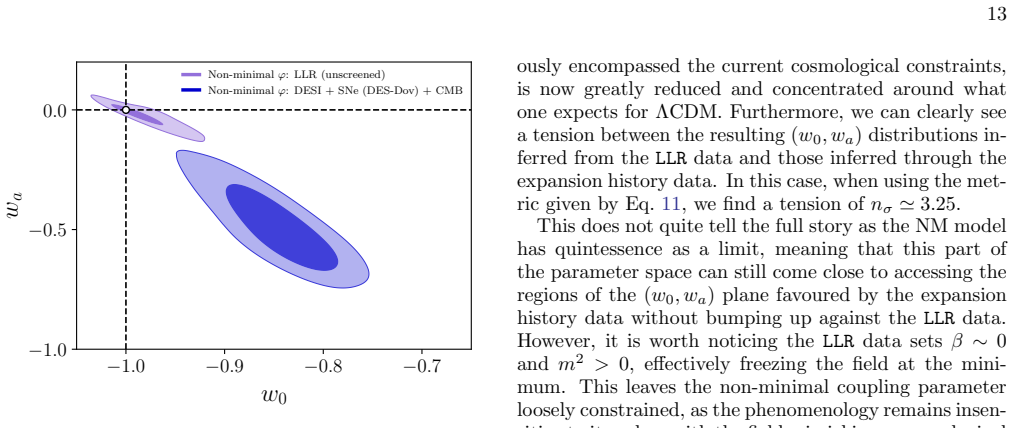
- [Section VI / Fig. 8] Section VI and Fig. 8: the LLR constraint on Ġ/G is translated into a (w_{0},w_a) prior that appears to rule out the cosmologically preferred NM region at ~3.25σ. The paper acknowledges that screening may invalidate the extrapolation, yet still presents the tension as a serious challenge. A quantitative statement of how large a screening factor (or how high an EFT cutoff) would be required to restore consistency would make the argument sharper and would clarify whether the tension is decisive or merely indicative.
minor comments (4)
- [Table III] Table III: the conversion of Δχ^{2}_MAP to n_σ via Wilks’ theorem assumes nested models and Gaussian likelihoods; a brief caveat that the approximation can be imperfect for the highly non-Gaussian mG and NM posteriors would be useful.
- [Figure 9] Figure 9: the Stiskalek25 fσ_{8} point is plotted with a large error bar that still visibly pulls the NM and mG contours; clarifying whether the linear-theory bias assumption remains valid at z~0.02 would strengthen the interpretation.
- [Appendix A] Appendix A: the prior ranges for eta, au_reio and A are listed, but the motivation for the upper edge of au_reio=[0.01,0.15] (well above Planck) is not stated; a one-sentence justification would help reproducibility.
- Throughout: a few typographical slips remain (“undetermination”, “vis-à-vis”, inconsistent hyphenation of “non-minimally”). A final proof-read would clean these up.
Circularity Check
Minor self-citations for the (w0,wa) compression methodology and prior model implementations; core constraints, growth/ISW predictions and underdetermination claim rest on external data and independent calculations.
specific steps
-
self citation load bearing
[Section IV (and references to [13,14])]
"In [13, 14], we refined the procedure to use the observables at the redshifts probed by a given data set, and with their associated relative covariance. The method can be summarized as follows: 1. Define a Lagrangian L ... 4. Now, using a w0waCDM cosmology, compute H2(w0,wa) ... and determine the (w0,wa) parameters that best fit the observables predicted by the model Lagrangian L"
The (w0,wa) compression used for theory priors and posterior visualization is taken from the authors’ own prior papers. While the procedure is re-stated and the actual parameter constraints come from direct MCMC (not the compression), the visualization step that underpins several figures and tension estimates inherits its construction from self-cited work rather than an independent external method.
full rationale
The paper is an observational assessment that updates previous analyses with new data combinations (DESI DR2, DES-Dovekie, Planck PR3/PR4, ACT lensing). The EFT truncation to quadratic/cubic order is justified by an explicit field-excursion argument and Fig. 1 comparison of full potentials versus Taylor expansions, not by definitional fiat. Full Bayesian inference is performed by solving the scalar-field equations in hi_class and sampling with Cobaya against external likelihoods; the (w0,wa) projection of Section IV is used only for visualization and is explicitly distinguished from the MCMC results. Growth-rate (fσ8) and ISW predictions are derived from the resulting posteriors and compared to independent data sets (Stiskalek25, BOSS FS, unWISE, Reeves+25, Stölzner+18). Screening discussion acknowledges theoretical obstructions rather than assuming them away. Self-citations ([13–17,28]) supply the compression algorithm and earlier model implementations, but the algorithm is re-derived in full in Section IV and the numerical results are regenerated with current data. No prediction reduces by construction to a fitted input, no uniqueness theorem is imported solely from the authors, and no ansatz is smuggled via citation. Circularity is therefore limited to ordinary methodological continuity and does not affect the load-bearing claims.
Axiom & Free-Parameter Ledger
free parameters (6)
- V0 (potential height) =
model-dependent (e.g. 0.71–2.23 in units of M_Pl² H0²)
- m² (mass-squared term) =
negative, O(1–50) H0²
- β (linear potential slope) =
2.45^{+0.54}_{-0.36}
- ξ (non-minimal coupling) =
2.21^{+0.85}_{-0.35}
- α (Galileon kinetic coefficient) =
−2.22^{+0.29}_{-0.42}
- γ (Galileon normalization) =
−1/H̃0²
axioms (5)
- domain assumption Homogeneous isotropic FRW background plus linear scalar perturbations in Newtonian gauge.
- domain assumption Single-scalar EFT truncated at quadratic (or cubic for Galileon) order is sufficient on cosmological scales because Δφ/M_Pl ≪ 1.
- domain assumption Quasi-static approximation for μ(k,z) and Σ(k,z) on sub-horizon scales.
- domain assumption Weak Equivalence Principle holds for the universal coupling (or is deliberately violated only for dark-matter-only couplings discussed in Appendix B).
- ad hoc to paper CPL (w0,wa) is an adequate two-parameter compression of the expansion history for the redshifts and covariances of the chosen data sets.
read the original abstract
We present an assessment of the current observational status of single scalar field models of dark energy. Motivated by recent cosmological measurements -- including baryon acoustic oscillations, Type Ia supernovae, and CMB data -- we examine whether a dynamical scalar field offers a viable explanation for the accelerated expansion of the Universe. Working within an effective field theory (EFT) framework, we argue that cosmological observations are fundamentally limited and can at most constrain a small number of parameters that govern scalar field dynamics. We show that quintessence remains only marginally distinguishable from a cosmological constant, $\Lambda$, and that more general EFT extensions exhibit modest statistical preference, though such evidence is sensitive to data set selection and prior assumptions. These extended models generically predict fifth forces and modifications to the growth of structure, raising challenges from astrophysical constraints. We compare their predictions with current growth rate measurements, Integrated Sachs-Wolfe (ISW) effect and Solar System constraints. We emphasize that viable screening mechanisms remain theoretically non-trivial and observationally testable. On the other hand, we find that current ISW and growth data remain largely in agreement. Looking ahead to Stage IV surveys we forecast improvements in constraints on the dark energy behaviour; although there will be some tightening of bounds, we argue that the problem of underdetermination will persist. We conclude that while single scalar field dark energy remains a natural and flexible framework, its ultimate viability will hinge on improved low-redshift growth measurements and a clearer understanding of gravitational screening.
Figures






Reference graph
Works this paper leans on
-
[1]
There is very little evidence that whatever form of energy – dark energy – which is responsible for the accelerated expansion of the Universe isnot the cosmological constant, Λ. While the strongest, credible evidence for it comes from a combination of the CMB,DESImeasurements of the BAO, and the original calibration ofDES-Y5measurements of apparent magnit...
-
[2]
If one’s prejudice is firmly in favour of Λ, it is pos- sible to make such a case. While there are concerns about possible systematics with parts of either the DESIdata or theDES-Y5compilation, one can argue that theDES-Dovekieanalysis on its own as well as discarding measurements of the low-ℓE mode 25 from thePlanck2018 data set (and thus allowing for a ...
-
[3]
Dark energy, in the form of a single scalar field, is a natural extension to Λ. Given the very narrow range of time and length scales accessible to cosmo- logical measurements, one is very limited to what one might say about the fundamental properties of these scalar fields. In particular, at most we will be able to constrain a few, effective, fundamental...
-
[4]
An interesting consequence of this perspective is thatV 0 (or Λ) isalwayspresent. Indeed, from the analysis we have undertaken, we have always found uncontrovertible evidence for Λ which means that, from the EFT perspective, one can view dark en- ergy as ”Λ + something dynamical”. Alternatively, one can think of Λ as simply the lowest order of a local Tay...
-
[5]
Current measurements are only marginally consistent with quintessence
The simplest single scalar field form of dark energy is quintessence, completely characterized in terms of a quadratic potential. Current measurements are only marginally consistent with quintessence. Fur- thermore, the data favoursm 2 <0, which means from cosmological data alone, we cannot determine the full form of the potential
-
[6]
There is slightly stronger evidence for non-trivial modifications to quintessence either in the form of a non-minimal coupling (NM) or in the form of a massive Galileon (mG), both with a quintessence like potential. These modifications comprehen- sively cover the EFT of single scalar field dark en- ergy models on cosmological scales. The evidence weakens ...
-
[7]
That is a substantial ex- trapolation for the EFT which might not, in prac- tice, be valid
If one assumes that the scope of the EFT extends all the way down to Solar System scales, then both NM and mG models inevitably lead to fifth forces at late times which, bar any other mechanism, should be detectable and constrainable on astro- physical scales, effectively ruling out these modifi- cation to quintessence. That is a substantial ex- trapolati...
-
[8]
Both NM and mG have internal theoretical re- sources that can generate gravitational screening – either of the Vainshtein or chameleon form – which would shield them from being detected and ruled out with astrophysical constraints. Nevertheless, in both cases, there are severe theoretical obstruc- tions to implementing these screening mechanisms. Although...
-
[9]
There one clearly sees that the largest deviations from ΛCDM occur at very late times
To circumvent the issues of whether there is a viable screening mechanism or the cosmological- scales EFT validity at astrophysical scales, one should focus on larger scales and, in particular on the effect on the growth rate of structure. There one clearly sees that the largest deviations from ΛCDM occur at very late times. The current, tight- est, const...
-
[10]
A corollary of this, is that one should not expect current endeavours to constrainf σ 8 on intermedi- ate to high redshift ranges to deliver a killer blow to these theories – the uncertainties will remain too large in a regime where the deviations are small. Quite clearly the focus should be on improving con- straints at very low redshifts where, unfortun...
-
[11]
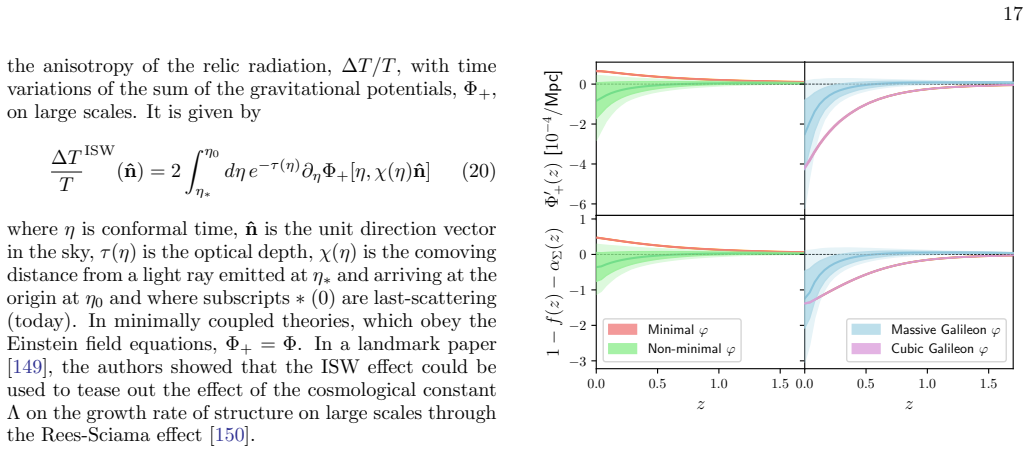
The ISW effect has been used to rule out the sim- plest shift symmetric models – cubic Galileons. The key effect is that the time derivative of the gravita- tional potential, Φ ′ + has the opposite sign to what one finds in a Λ dominated cosmology. In both NM and mG, one finds that, indeed, Φ ′ + is pulled away from the Λ prediction but not as much as for...
-
[12]
While we have focused on a universally coupled sin- gle scalar field, it has been argued that a scalar field coupled solely to the dark matter will have the right behaviour to explain current data. Such a theory naturally evades astrophysical constraints but will have a similar phenomenology to that of the NM model in the growth rate, albeit with a slight...
-
[13]
In rough terms, we expect our constraints onw 0 and wa to improve by a factor of a few but not more
We have a good idea of how the quality and quan- tity of data will improve over the next decade. In rough terms, we expect our constraints onw 0 and wa to improve by a factor of a few but not more. 26 Thus we should not expect a step change in our understanding of dark energy
-
[14]
From the point of view of scalar field dark en- ergy, there are a few possible outcomes. Contours may drift back to ΛCDM although quintessence and its extensions remain a possibility. Contours may drift upwards in the (w 0,wa) plane, favour- ing quintessence and its extensions but increasing the evidence against ΛCDM. Finally, constraints remain resolutel...
work page 2025
-
[15]
ExtraC gT ℓ plots In this section we present the ISW angular power spectra for the galaxy and CMB temperature cross- correlation forReeves+25(Fig. 21) andSt¨ olzner+18 (Fig. 22)
-
[16]
Data sets We now describe the three data sets considered for the ISW analysis in more detail. The main take-away is that the three data sets have undergone different data analysis choices, that we are missing the cross-covariance between most of the redshift bins and surveys, preventing us from doing a joint analysis, and that the underlying approximation...
-
[17]
Precision parameters Despite our best efforts to produce reliable angular power spectra, we found that there were still models for which the perturbations, the non-Limber integral or other computational step failed. In addition, apart from those that crashed, there were some that produce un- reliable results, with unphysical oscillations or values, a clea...
-
[18]
A. G. Adameet al.(DESI), DESI 2024 VI: Cosmological Constraints from the Measurements of Baryon Acoustic Oscillations, (2024), arXiv:2404.03002 [astro-ph.CO]
work page internal anchor Pith review Pith/arXiv arXiv 2024
-
[19]
DESI DR2 Results II: Measurements of Baryon Acoustic Oscillations and Cosmological Constraints
M. Abdul Karimet al.(DESI), DESI DR2 Results II: Measurements of Baryon Acoustic Oscillations and Cos- mological Constraints, (2025), arXiv:2503.14738 [astro- ph.CO]
work page internal anchor Pith review Pith/arXiv arXiv 2025
-
[20]
B. Ratra and P. J. E. Peebles, Cosmological Conse- quences of a Rolling Homogeneous Scalar Field, Phys. Rev. D37, 3406 (1988)
work page 1988
-
[21]
P. J. E. Peebles and B. Ratra, Cosmology with a Time Variable Cosmological Constant, Astrophys. J. Lett. 325, L17 (1988)
work page 1988
-
[22]
P. G. Ferreira and M. Joyce, Structure formation with a selftuning scalar field, Phys. Rev. Lett.79, 4740 (1997), arXiv:astro-ph/9707286. 35 0.30 0.32 Ω m 2 4 6 A −20 −10 0 m2 −3 −2 −1 α 3.00 3.04 3.08 log(As1010) 0.04 0.06 0.08 τreio 0.96 0.97 0.98 ns 0.66 0.67 0.68 0.69 h 0.0222 0.0224 0.0226 0.0228 ωb 0.0222 0.0228 ωb 0.66 0.68 h 0.96 0.97 ns 0.04 0.06...
work page internal anchor Pith review Pith/arXiv arXiv 1997
-
[23]
R. R. Caldwell, R. Dave, and P. J. Steinhardt, Cos- mological imprint of an energy component with gen- eral equation of state, Phys. Rev. Lett.80, 1582 (1998), arXiv:astro-ph/9708069
work page internal anchor Pith review Pith/arXiv arXiv 1998
-
[24]
P. G. Ferreira and M. Joyce, Cosmology with a pri- mordial scaling field, Phys. Rev. D58, 023503 (1998), arXiv:astro-ph/9711102
work page internal anchor Pith review Pith/arXiv arXiv 1998
-
[25]
F. Perrotta, C. Baccigalupi, and S. Matarrese, Ex- tended quintessence, Phys. Rev. D61, 023507 (1999), arXiv:astro-ph/9906066
work page internal anchor Pith review Pith/arXiv arXiv 1999
-
[26]
L. Amendola, Coupled quintessence, Phys. Rev. D62, 043511 (2000), arXiv:astro-ph/9908023
work page internal anchor Pith review Pith/arXiv arXiv 2000
-
[27]
P. Brax and J. Martin, Quintessence and supergravity, Phys. Lett. B468, 40 (1999), arXiv:astro-ph/9905040
work page internal anchor Pith review Pith/arXiv arXiv 1999
-
[28]
Quintessence arising from exponential potentials
T. Barreiro, E. J. Copeland, and N. J. Nunes, Quintessence arising from exponential potentials, Phys. 36 Rev. D61, 127301 (2000), arXiv:astro-ph/9910214
work page internal anchor Pith review Pith/arXiv arXiv 2000
-
[29]
Modified Gravity and Cosmology
T. Clifton, P. G. Ferreira, A. Padilla, and C. Skordis, Modified Gravity and Cosmology, Phys. Rept.513, 1 (2012), arXiv:1106.2476 [astro-ph.CO]
work page internal anchor Pith review Pith/arXiv arXiv 2012
-
[30]
W. J. Wolf and P. G. Ferreira, Underdetermination of dark energy, Phys. Rev. D108, 103519 (2023), arXiv:2310.07482 [astro-ph.CO]
work page internal anchor Pith review Pith/arXiv arXiv 2023
-
[31]
W. J. Wolf, C. Garc´ ıa-Garc´ ıa, D. J. Bartlett, and P. G. Ferreira, Scant evidence for thawing quintessence, Phys. Rev. D110, 083528 (2024), arXiv:2408.17318 [astro- ph.CO]
work page internal anchor Pith review Pith/arXiv arXiv 2024
-
[32]
W. J. Wolf, P. G. Ferreira, and C. Garc´ ıa-Garc´ ıa, Matching current observational constraints with non- minimally coupled dark energy, Phys. Rev. D111, L041303 (2025), arXiv:2409.17019 [astro-ph.CO]
work page internal anchor Pith review Pith/arXiv arXiv 2025
-
[33]
W. J. Wolf, C. Garc´ ıa-Garc´ ıa, T. Anton, and P. G. Ferreira, Assessing Cosmological Evidence for Nonmin- imal Coupling, Phys. Rev. Lett.135, 081001 (2025), arXiv:2504.07679 [astro-ph.CO]
work page internal anchor Pith review Pith/arXiv arXiv 2025
-
[34]
W. J. Wolf, P. G. Ferreira, and C. Garc´ ıa-Garc´ ıa, Cos- mological constraints on Galileon dark energy with bro- ken shift symmetry, Phys. Rev. D113, 023551 (2026), arXiv:2509.17586 [astro-ph.CO]
work page internal anchor Pith review Pith/arXiv arXiv 2026
-
[35]
M. Park, K. M. Zurek, and S. Watson, A Unified Ap- proach to Cosmic Acceleration, Phys. Rev. D81, 124008 (2010), arXiv:1003.1722 [hep-th]
work page internal anchor Pith review Pith/arXiv arXiv 2010
-
[36]
R. P. Woodard, Ostrogradsky’s theorem on Hamil- tonian instability, Scholarpedia10, 32243 (2015), arXiv:1506.02210 [hep-th]
work page internal anchor Pith review Pith/arXiv arXiv 2015
-
[37]
C. P. Burgess and M. Williams, Who You Gonna Call? Runaway Ghosts, Higher Derivatives and Time- Dependence in EFTs, JHEP08, 074, arXiv:1404.2236 [gr-qc]
work page internal anchor Pith review Pith/arXiv arXiv
-
[38]
Tracking Extended Quintessence
C. Baccigalupi, S. Matarrese, and F. Perrotta, Tracking extended quintessence, Phys. Rev. D62, 123510 (2000), arXiv:astro-ph/0005543
work page internal anchor Pith review Pith/arXiv arXiv 2000
-
[39]
C. Baccigalupi, A. Balbi, S. Matarrese, F. Perrotta, and N. Vittorio, Constraints on flat cosmologies with track- ing quintessence from cosmic microwave background ob- servations, Phys. Rev. D65, 063520 (2002), arXiv:astro- ph/0109097
-
[40]
Reconstruction of a scalar-tensor theory of gravity in an accelerating universe
B. Boisseau, G. Esposito-Farese, D. Polarski, and A. A. Starobinsky, Reconstruction of a scalar tensor theory of gravity in an accelerating universe, Phys. Rev. Lett.85, 2236 (2000), arXiv:gr-qc/0001066
work page internal anchor Pith review Pith/arXiv arXiv 2000
-
[41]
R. Gannouji, D. Polarski, A. Ranquet, and A. A. Starobinsky, Scalar-Tensor Models of Normal and Phantom Dark Energy, JCAP09, 016, arXiv:astro- ph/0606287
-
[42]
Scaling solutions in general non-minimal coupling theories
L. Amendola, Scaling solutions in general nonminimal coupling theories, Phys. Rev. D60, 043501 (1999), arXiv:astro-ph/9904120
work page internal anchor Pith review Pith/arXiv arXiv 1999
-
[43]
Theoretical priors in scalar-tensor cosmologies: Shift-symmetric Horndeski models
D. Traykova, E. Bellini, P. G. Ferreira, C. Garc´ ıa- Garc´ ıa, J. Noller, and M. Zumalac´ arregui, Theoreti- cal priors in scalar-tensor cosmologies: Shift-symmetric Horndeski models, Phys. Rev. D104, 083502 (2021), arXiv:2103.11195 [astro-ph.CO]
work page internal anchor Pith review Pith/arXiv arXiv 2021
-
[44]
Tsujikawa, Crossing the phantom divide in scalar- tensor and vector-tensor theories, Phys
S. Tsujikawa, Crossing the phantom divide in scalar- tensor and vector-tensor theories, Phys. Rev. D113, L041301 (2026), arXiv:2508.17231 [astro-ph.CO]
-
[45]
W. J. Wolf, C. Garc´ ıa-Garc´ ıa, and P. G. Ferreira, Ro- bustness of dark energy phenomenology across differ- ent parameterizations, JCAP05, 034, arXiv:2502.04929 [astro-ph.CO]
work page internal anchor Pith review Pith/arXiv arXiv
-
[50]
J. Torrado and A. Lewis, Cobaya: Bayesian analysis in cosmology, Astrophysics Source Code Library, record ascl:1910.019 (2019)
work page 1910
-
[51]
N. Metropolis, A. W. Rosenbluth, M. N. Rosen- bluth, A. H. Teller, and E. Teller, Equation of state calculations by fast computing machines, The Journal of Chemical Physics21, 1087 (1953), https://doi.org/10.1063/1.1699114
-
[52]
W. K. Hastings, Monte Carlo sampling methods using Markov chains and their applications, Biometrika57, 97 (1970), https://academic.oup.com/biomet/article- pdf/57/1/97/23940249/57-1-97.pdf
work page 1970
-
[53]
Efficient sampling of fast and slow cosmological parameters
A. Lewis, Efficient sampling of fast and slow cosmo- logical parameters, Phys. Rev.D87, 103529 (2013), arXiv:1304.4473 [astro-ph.CO]
work page internal anchor Pith review Pith/arXiv arXiv 2013
-
[54]
Accelerating Universes with Scaling Dark Matter
M. Chevallier and D. Polarski, Accelerating universes with scaling dark matter, Int. J. Mod. Phys. D10, 213 (2001), arXiv:gr-qc/0009008
work page internal anchor Pith review Pith/arXiv arXiv 2001
- [55]
-
[56]
Extended Dark Energy analysis using DESI DR2 BAO measurements
K. Lodhaet al.(DESI), Extended dark energy analy- sis using DESI DR2 BAO measurements, Phys. Rev. D 112, 083511 (2025), arXiv:2503.14743 [astro-ph.CO]
work page internal anchor Pith review Pith/arXiv arXiv 2025
-
[57]
Optimal parameterizations for observational constraints on thawing dark energy
D. Shlivko, P. J. Steinhardt, and C. L. Steinhardt, Op- timal parameterizations for observational constraints on thawing dark energy, (2025), arXiv:2504.02028 [astro- ph.CO]
work page internal anchor Pith review Pith/arXiv arXiv 2025
-
[58]
G. Montefalcone and R. Stiskalek, Parameterizing Dark Energy at the density level: A two-parameter alterna- tive to CPL, (2026), arXiv:2603.25735 [astro-ph.CO]
-
[59]
B. Popovicet al.(DES), The Dark Energy Survey Su- pernova Program: A Reanalysis Of Cosmology Re- sults And Evidence For Evolving Dark Energy With An Updated Type Ia Supernova Calibration, (2025), arXiv:2511.07517 [astro-ph.CO]
work page internal anchor Pith review Pith/arXiv arXiv 2025
- [60]
-
[61]
Planck 2018 results. VI. Cosmological parameters
N. Aghanimet al.(Planck), Planck 2018 results. VI. Cosmological parameters, Astron. Astrophys.641, A6 (2020), [Erratum: Astron.Astrophys. 652, C4 (2021)], arXiv:1807.06209 [astro-ph.CO]
work page internal anchor Pith review Pith/arXiv arXiv 2018
-
[62]
T. M. C. Abbottet al.(DES), The Dark Energy Sur- vey: Cosmology Results with∼1500 New High-redshift Type Ia Supernovae Using the Full 5 yr Data Set, Astro- phys. J. Lett.973, L14 (2024), arXiv:2401.02929 [astro- 37 ph.CO]
work page internal anchor Pith review Pith/arXiv arXiv 2024
-
[63]
The Pantheon+ Analysis: Cosmological Constraints
D. Broutet al., The Pantheon+ Analysis: Cosmo- logical Constraints, Astrophys. J.938, 110 (2022), arXiv:2202.04077 [astro-ph.CO]
work page internal anchor Pith review Pith/arXiv arXiv 2022
-
[64]
Evolving Dark Energy or Supernovae Systematics?
G. Efstathiou, Evolving dark energy or supernovae sys- tematics? (2024), arXiv:2408.07175 [astro-ph.CO]
work page internal anchor Pith review Pith/arXiv arXiv 2024
-
[65]
M. Vincenziet al.(DES), Comparing the DES-SN5YR and Pantheon+ SN cosmology analyses: Investigation based on ”Evolving Dark Energy or Supernovae sys- tematics?”, (2025), arXiv:2501.06664 [astro-ph.CO]
work page internal anchor Pith review Pith/arXiv arXiv 2025
-
[66]
Planck 2018 results. V. CMB power spectra and likelihoods
N. Aghanimet al.(Planck), Planck 2018 results. V. CMB power spectra and likelihoods, Astron. Astrophys. 641, A5 (2020), arXiv:1907.12875 [astro-ph.CO]
work page internal anchor Pith review Pith/arXiv arXiv 2018
-
[67]
The Atacama Cosmology Telescope: DR6 Constraints on Extended Cosmological Models
E. Calabreseet al.(Atacama Cosmology Telescope), The Atacama Cosmology Telescope: DR6 constraints on extended cosmological models, JCAP11, 063, arXiv:2503.14454 [astro-ph.CO]
work page internal anchor Pith review Pith/arXiv arXiv
-
[68]
E. Camphuiset al.(SPT-3G), SPT-3G D1: CMB tem- perature and polarization power spectra and cosmology from 2019 and 2020 observations of the SPT-3G Main field, (2025), arXiv:2506.20707 [astro-ph.CO]
work page internal anchor Pith review Pith/arXiv arXiv 2019
-
[69]
D. D. Y. Ong, D. Yallup, and W. Handley, The Bayesian view of DESI DR2: Evidence and tension in a combined analysis with CMB and supernovae across cosmological models, (2026), arXiv:2603.05472 [astro-ph.CO]
work page internal anchor Pith review Pith/arXiv arXiv 2026
-
[70]
Planck intermediate results. LVII. Joint Planck LFI and HFI data processing
Y. Akramiet al.(Planck),P lanckintermediate re- sults. LVII. Joint Planck LFI and HFI data processing, Astron. Astrophys.643, A42 (2020), arXiv:2007.04997 [astro-ph.CO]
work page internal anchor Pith review Pith/arXiv arXiv 2020
-
[71]
Cosmological parameters derived from the final (PR4) Planck data release
M. Tristramet al., Cosmological parameters derived from the final Planck data release (PR4), Astron. Astro- phys.682, A37 (2024), arXiv:2309.10034 [astro-ph.CO]
work page internal anchor Pith review Pith/arXiv arXiv 2024
-
[72]
Constraints on Neutrino Physics from DESI DR2 BAO and DR1 Full Shape
W. Elberset al., Constraints on neutrino physics from DESI DR2 BAO and DR1 full shape, Phys. Rev. D112, 083513 (2025), arXiv:2503.14744 [astro-ph.CO]
work page internal anchor Pith review Pith/arXiv arXiv 2025
-
[73]
NuFit-6.0: Updated global analysis of three-flavor neutrino oscillations
I. Esteban, M. C. Gonzalez-Garcia, M. Maltoni, I. Martinez-Soler, J. P. Pinheiro, and T. Schwetz, NuFit- 6.0: updated global analysis of three-flavor neutrino os- cillations, JHEP12, 216, arXiv:2410.05380 [hep-ph]
work page internal anchor Pith review Pith/arXiv arXiv
-
[74]
Negative neutrino masses as a mirage of dark energy
W. Elbers, C. S. Frenk, A. Jenkins, B. Li, and S. Pascoli, Negative neutrino masses as a mirage of dark energy, Phys. Rev. D111, 063534 (2025), arXiv:2407.10965 [astro-ph.CO]
work page internal anchor Pith review Pith/arXiv arXiv 2025
-
[75]
The Cosmological Preference for Negative Neutrino Mass
D. Green and J. Meyers, Cosmological preference for a negative neutrino mass, Phys. Rev. D111, 083507 (2025), arXiv:2407.07878 [astro-ph.CO]
work page internal anchor Pith review Pith/arXiv arXiv 2025
-
[76]
Negative neutrino mass or negative dark energy?
C. Kıbrıs, W. Elbers, ¨O. Akarsu, and E. Di Valentino, Negative neutrino mass or negative dark energy?, (2026), arXiv:2605.21456 [astro-ph.CO]
work page internal anchor Pith review Pith/arXiv arXiv 2026
-
[77]
It's All ${\tt Ok}$: Curvature in Light of BAO from DESI DR2
S.-F. Chen and M. Zaldarriaga, It’s all Ok: curva- ture in light of BAO from DESI DR2, JCAP08, 014, arXiv:2505.00659 [astro-ph.CO]
work page internal anchor Pith review Pith/arXiv arXiv
-
[78]
I. J. Allali, L. Li, P. Singh, and J. Fan, Cosmicτensions Indirectly Correlate with Reionization Optical Depth, (2025), arXiv:2509.09678 [astro-ph.CO]
work page internal anchor Pith review Pith/arXiv arXiv 2025
- [79]
-
[80]
Turning a negative neutrino mass into a positive optical depth
T. Jhaveri, T. Karwal, and W. Hu, Turning a negative neutrino mass into a positive optical depth, Phys. Rev. D112, 043541 (2025), arXiv:2504.21813 [astro-ph.CO]
work page internal anchor Pith review Pith/arXiv arXiv 2025
-
[81]
Rapid late-time reionization: constraints and cosmological implications
W. Elbers, Rapid late-time reionization: con- straints and cosmological implications, (2025), arXiv:2508.21069 [astro-ph.CO]
work page internal anchor Pith review Pith/arXiv arXiv 2025
-
[82]
Y. Kageura, M. Ouchi, F. Naokawa, H. Umeda, A. Mat- sumoto, Y. Harikane, M. Nakane, and T. T. Thai, A New Constraint on the Optical Depth from the Reion- ization History Independent of CMB Large-Scale E- Mode Polarization, (2026), arXiv:2601.09644 [astro- ph.CO]
- [83]
-
[84]
D. D. Y. Ong, D. Yallup, and W. Handley, A Bayesian Perspective on Evidence for Evolving Dark Energy, (2025), arXiv:2511.10631 [astro-ph.CO]
work page internal anchor Pith review Pith/arXiv arXiv 2025
discussion (0)
Sign in with ORCID, Apple, or X to comment. Anyone can read and Pith papers without signing in.