Negative neutrino mass or negative dark energy?
Pith reviewed 2026-05-21 02:58 UTC · model grok-4.3
The pith
A sign-switching dark energy model restores positive effective neutrino masses in fits to DESI and CMB data.
A machine-rendered reading of the paper's core claim, the machinery that carries it, and where it could break.
Core claim
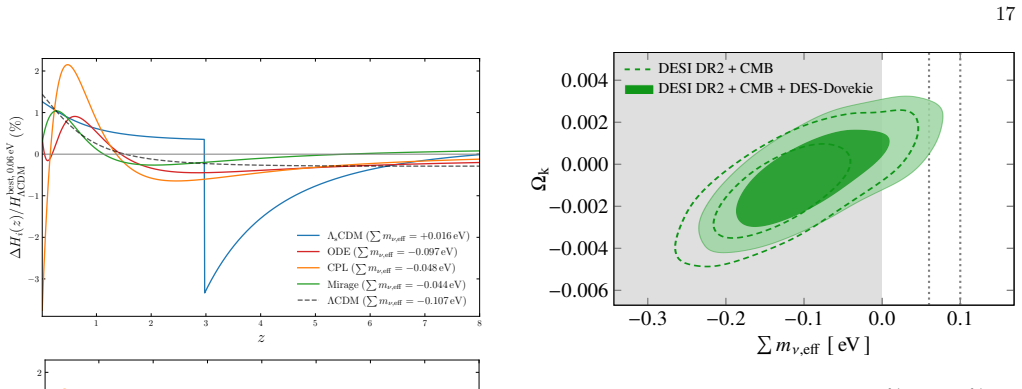
For the combination of DESI DR2 BAO, CMB, and DES-Dovekie supernova data, the constraint on the effective neutrino mass shifts from a negative value in standard Lambda CDM to a positive value of 0.055 plus or minus 0.050 eV at 68 percent in the sign-switching Lambda_s CDM model, together with a 95 percent lower bound on the dark energy transition redshift above 2.4.
What carries the argument
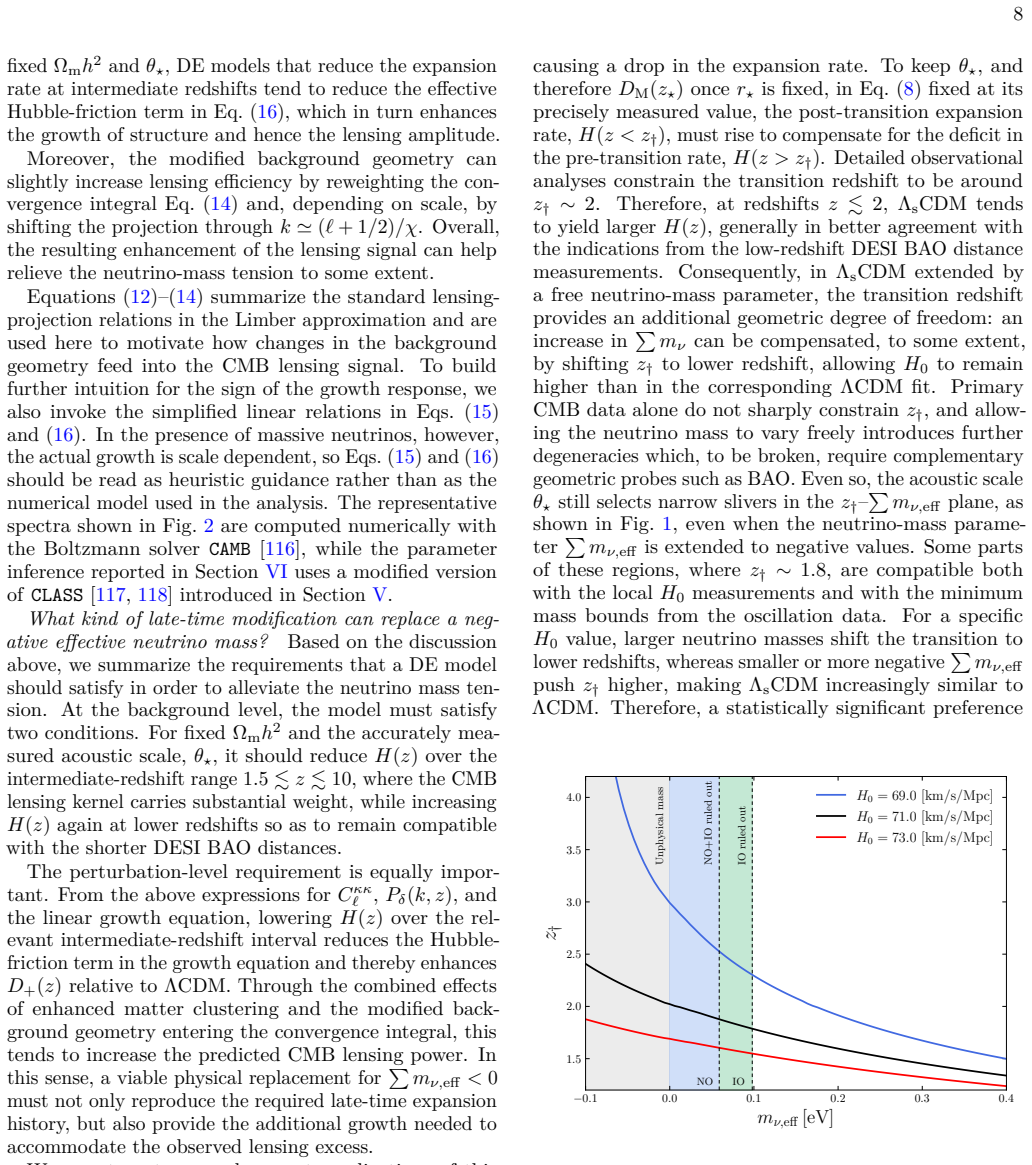
The sign-switching cosmological constant Lambda_s CDM, which allows the dark energy density to change sign at a transition redshift and thereby modifies the expansion history in the range relevant for CMB lensing.
If this is right
- The apparent tension with the minimum neutrino mass from oscillation experiments is removed.
- The expansion history receives a targeted adjustment at redshifts that affect CMB lensing but preserve BAO matches at lower redshifts.
- Only the sign-switching model among those tested recovers positive effective neutrino masses.
- The transition redshift must exceed 2.4 at 95 percent .
Where Pith is reading between the lines
- High-precision expansion-rate measurements around redshift 2 to 3 could test whether the required sign switch is present.
- The same structured change in dark energy could be checked against other late-time tensions such as the Hubble constant.
- Extending the model to include galaxy clustering or weak lensing data would further limit the allowed transition redshift.
Load-bearing premise
A sign switch in dark energy density can be introduced without violating other cosmological constraints or requiring adjustments to early-universe physics.
What would settle it
A future dataset that keeps the effective neutrino mass sum negative even after the sign switch in dark energy is allowed, or a direct probe showing that dark energy density does not change sign near or above redshift 2.4.
Figures



read the original abstract
Recent cosmological analyses based on DESI and CMB data have revealed a tension between the inferred sum of neutrino masses and the minimum value allowed by neutrino oscillation experiments, when assuming an underlying $\Lambda$CDM model of cosmology. In this work, we perform a systematic exploration of alternative dark energy models, including models that can supply a negative dark energy density capable of reproducing the cosmological effects of negative effective neutrino masses. We argue that dark energy models can alleviate the tension by modifying the cosmic expansion rate over a specific redshift range relevant for CMB lensing, while matching BAO distance measurements from DESI at lower redshifts. Among the models considered, we find that a sign-switching cosmological constant model, $\Lambda_\mathrm{s}$CDM, is uniquely capable of recovering positive neutrino masses by modifying the expansion history in this way. For the combination of DESI DR2 BAO, CMB, and DES-Dovekie supernova data, the constraint on the effective neutrino mass shifts from $\sum m_{\nu,\mathrm{eff}}=-0.075^{+0.039}_{-0.053}$ eV (68%) for $\Lambda$CDM to $\sum m_{\nu,\mathrm{eff}}=0.055\pm0.050$ eV (68%) for $\Lambda_\mathrm{s}$CDM, with a 95% lower bound on the dark energy transition redshift, $z_\dagger>2.4$. Although $\Lambda_\mathrm{s}$CDM does not have the strongest overall statistical support among the models considered, when the $\sum m_{\nu,\mathrm{eff}}$ parameter is allowed to vary, our findings point toward a specific sign- and redshift-structured contribution to the late-time expansion history as a viable way to alleviate the neutrino mass tension.
Editorial analysis
A structured set of objections, weighed in public.
Referee Report
Summary. The manuscript claims that the negative sum of neutrino masses inferred from DESI DR2 BAO + CMB + DES-Dovekie supernova data under ΛCDM can be resolved by a sign-switching dark energy model (Λ_s CDM). This model modifies the expansion history only in the redshift window relevant to CMB lensing (with transition redshift z_† > 2.4 at 95% CL) while preserving BAO distances at z < 2.4, shifting the effective neutrino mass constraint from ∑ m_ν,eff = -0.075^{+0.039}_{-0.053} eV (68%) in ΛCDM to 0.055 ± 0.050 eV (68%) in Λ_s CDM. The paper presents this as part of a systematic exploration of alternative dark energy models, arguing that Λ_s CDM is uniquely effective at recovering positive neutrino masses.
Significance. If robust, the result would demonstrate that a targeted, sign-structured modification to the late-time expansion history can reconcile CMB lensing constraints with positive neutrino masses without requiring changes to early-universe parameters or BAO scales. The quantitative posterior shift and the lower bound on z_† provide a concrete, falsifiable example of how dark energy phenomenology can impact neutrino mass inferences from current datasets.
major comments (2)
- [Abstract and model implementation] The central claim that Λ_s CDM recovers positive ∑ m_ν,eff while exactly preserving the sound horizon θ_* and DESI BAO distances at z < 2.4 (Abstract) requires explicit demonstration that the sign switch at z_† > 2.4 does not alter the angular-diameter distance to recombination. If the model changes the integral for D_A(z_*) without additional marginalization over compensating shifts in ω_cdm or H_0 when using the full Planck TT/TE/EE + lensing likelihood, the reported shift in neutrino mass may be partly an artifact of an incomplete degeneracy structure rather than a genuine resolution.
- [Abstract] The abstract reports quantitative shifts in neutrino mass posteriors and a redshift bound but provides no details on fitting methodology, covariance handling between DESI BAO, CMB, and supernova datasets, or robustness checks against systematics. This absence limits verification that the central claim (recovery of positive neutrino mass) is supported by the data rather than by modeling assumptions.
minor comments (2)
- [Abstract] The abstract states that Λ_s CDM is 'uniquely capable' among the models considered but does not list the other models explored or the quantitative criteria (e.g., Bayesian evidence or posterior overlap) used to reach this conclusion.
- Clarify the precise functional form of the sign-switching in Λ_s CDM, including whether the negative-density phase introduces any additional degrees of freedom that could affect early-universe constraints.
Simulated Author's Rebuttal
We thank the referee for their constructive and detailed comments on our manuscript. We address each major comment point by point below, providing clarifications based on the analysis presented and indicating where revisions will strengthen the presentation.
read point-by-point responses
-
Referee: [Abstract and model implementation] The central claim that Λ_s CDM recovers positive ∑ m_ν,eff while exactly preserving the sound horizon θ_* and DESI BAO distances at z < 2.4 (Abstract) requires explicit demonstration that the sign switch at z_† > 2.4 does not alter the angular-diameter distance to recombination. If the model changes the integral for D_A(z_*) without additional marginalization over compensating shifts in ω_cdm or H_0 when using the full Planck TT/TE/EE + lensing likelihood, the reported shift in neutrino mass may be partly an artifact of an incomplete degeneracy structure rather than a genuine resolution.
Authors: We thank the referee for this important observation. In the Λ_s CDM implementation, the sign switch is parameterized to occur at z_† > 2.4 (95% CL), modifying the expansion history primarily in the redshift window that influences CMB lensing while enforcing consistency with DESI BAO distances at z < 2.4 by construction. The sound horizon r_s at recombination is unaffected as early-universe physics is unchanged, and the MCMC chains already marginalize over H_0 and ω_cdm, which absorb any residual adjustments to D_A(z_*). Nevertheless, we agree that an explicit demonstration would remove any ambiguity. We will add a dedicated paragraph and supporting calculation in Section 2 of the revised manuscript showing the integrated D_A(z_*) under the posterior constraints on z_† and confirming consistency with the Planck θ_* measurement. revision: yes
-
Referee: [Abstract] The abstract reports quantitative shifts in neutrino mass posteriors and a redshift bound but provides no details on fitting methodology, covariance handling between DESI BAO, CMB, and supernova datasets, or robustness checks against systematics. This absence limits verification that the central claim (recovery of positive neutrino mass) is supported by the data rather than by modeling assumptions.
Authors: We acknowledge that the abstract's length constraints prevent inclusion of full methodological details. The manuscript itself (Section 3 and Appendix A) specifies the likelihoods employed: the full Planck TT/TE/EE + lensing likelihood, DESI DR2 BAO with its published covariance matrix, and the DES-Dovekie supernova sample. Dataset covariances are treated as independent where no cross-covariance is provided in the public releases, following standard practice. Robustness tests, including prior variations and data subset analyses, appear in Appendix B. To improve accessibility, we will revise the abstract to include a concise reference to the datasets and direct readers to the methods section for fitting and covariance details. revision: partial
Circularity Check
No significant circularity; central result is a direct data fit.
full rationale
The paper's core result is obtained by fitting the Λ_sCDM model parameters (including transition redshift z_†) and ∑m_ν,eff simultaneously to the combination of DESI DR2 BAO, Planck CMB, and DES-Dovekie supernova likelihoods. The shift from negative to positive effective neutrino mass is reported as an output of the MCMC chains rather than imposed by definition or by a self-citation that replaces an independent derivation. No equation is shown to reduce to its own input by construction, and the model is introduced as an ansatz whose viability is tested against external datasets rather than assumed to force the neutrino-mass sign change. The derivation therefore remains self-contained against the supplied observational constraints.
Axiom & Free-Parameter Ledger
free parameters (1)
- dark energy transition redshift z_†
axioms (1)
- domain assumption Background expansion history follows standard Friedmann equations with modified dark energy component
invented entities (1)
-
sign-switching cosmological constant Λ_s
no independent evidence
Lean theorems connected to this paper
-
IndisputableMonolith/Cost/FunctionalEquation.leanwashburn_uniqueness_aczel unclear?
unclearRelation between the paper passage and the cited Recognition theorem.
sign-switching cosmological constant model, ΛsCDM, is uniquely capable of recovering positive neutrino masses by modifying the expansion history... z†>2.4
-
IndisputableMonolith/Foundation/RealityFromDistinction.leanreality_from_one_distinction unclear?
unclearRelation between the paper passage and the cited Recognition theorem.
ρDE(a) = ρDE0 [1 + α(a−am)² + β(a−am)³] / ... (DMS20)
What do these tags mean?
- matches
- The paper's claim is directly supported by a theorem in the formal canon.
- supports
- The theorem supports part of the paper's argument, but the paper may add assumptions or extra steps.
- extends
- The paper goes beyond the formal theorem; the theorem is a base layer rather than the whole result.
- uses
- The paper appears to rely on the theorem as machinery.
- contradicts
- The paper's claim conflicts with a theorem or certificate in the canon.
- unclear
- Pith found a possible connection, but the passage is too broad, indirect, or ambiguous to say the theorem truly supports the claim.
Reference graph
Works this paper leans on
-
[1]
Global constraints on absolute neutrino masses and their ordering
F. Capozzi, E. Di Valentino, E. Lisi, A. Marrone, A. Mel- chiorri, and A. Palazzo, Global constraints on absolute neutrino masses and their ordering, Phys. Rev. D95, 096014 (2017), [Addendum: Phys.Rev.D 101, 116013 (2020)], 1703.04471
work page internal anchor Pith review Pith/arXiv arXiv 2017
-
[2]
Current unknowns in the three neutrino framework
F. Capozzi, E. Lisi, A. Marrone, and A. Palazzo, Current unknowns in the three neutrino framework, Prog. Part. Nucl. Phys.102, 48 (2018), 1804.09678
work page internal anchor Pith review Pith/arXiv arXiv 2018
-
[3]
P. F. De Salas, S. Gariazzo, O. Mena, C. A. Ternes, and M. Tórtola, Neutrino Mass Ordering from Oscillations and Beyond: 2018 Status and Future Prospects, Front. Astron. Space Sci.5, 36 (2018), 1806.11051
work page internal anchor Pith review Pith/arXiv arXiv 2018
- [4]
-
[5]
F. Capozzi, E. Di Valentino, E. Lisi, A. Marrone, A. Mel- chiorri, and A. Palazzo, Unfinished fabric of the three neutrino paradigm, Phys. Rev. D104, 083031 (2021), 2107.00532
-
[6]
NuFit-6.0: Updated global analysis of three-flavor neutrino oscillations
I. Esteban, M. C. Gonzalez-Garcia, M. Maltoni, I. Martinez-Soler, J. P. Pinheiro, and T. Schwetz, NuFit- 6.0: updated global analysis of three-flavor neutrino 21 oscillations, JHEP12, 216 (2024), 2410.05380
work page internal anchor Pith review Pith/arXiv arXiv 2024
-
[7]
F. Capozzi, W. Giarè, E. Lisi, A. Marrone, A. Melchiorri, and A. Palazzo, Neutrino masses and mixing: Entering theeraofsubpercentprecision,Phys.Rev.D111,093006 (2025), 2503.07752
-
[8]
Massive neutrinos and cosmology
J. Lesgourgues and S. Pastor, Massive neutrinos and cos- mology, Phys. Rept.429, 307 (2006), astro-ph/0603494
work page internal anchor Pith review Pith/arXiv arXiv 2006
-
[9]
Y. Y. Y. Wong, Neutrino mass in cosmology: status and prospects, Ann. Rev. Nucl. Part. Sci.61, 69 (2011), 1111.1436
work page internal anchor Pith review Pith/arXiv arXiv 2011
-
[10]
K. N. Abazajian and M. Kaplinghat, Neutrino Physics from the Cosmic Microwave Background and Large-Scale Structure, Ann. Rev. Nucl. Part. Sci.66, 401 (2016)
work page 2016
-
[11]
Status of neutrino properties and future prospects - Cosmological and astrophysical constraints
M. Lattanzi and M. Gerbino, Status of neutrino proper- ties and future prospects - Cosmological and astrophysi- cal constraints, Front. in Phys.5, 70 (2018), 1712.07109
work page internal anchor Pith review Pith/arXiv arXiv 2018
-
[12]
E. Di Valentino, S. Gariazzo, and O. Mena, Neutrinos in Cosmology (2024), 2404.19322
-
[13]
DESI DR2 Results I: Baryon Acoustic Oscillations from the Lyman Alpha Forest
M. Abdul Karimet al.(DESI), DESI DR2 results. I. Baryon acoustic oscillations from the Lyman alpha forest, Phys. Rev. D112, 083514 (2025), 2503.14739
work page internal anchor Pith review Pith/arXiv arXiv 2025
-
[14]
DESI DR2 Results II: Measurements of Baryon Acoustic Oscillations and Cosmological Constraints
M. Abdul Karimet al.(DESI), DESI DR2 results. II. Measurements of baryon acoustic oscillations and cos- mological constraints, Phys. Rev. D112, 083515 (2025), 2503.14738
work page internal anchor Pith review Pith/arXiv arXiv 2025
-
[15]
Planck 2018 results. VI. Cosmological parameters
N. Aghanimet al.(Planck), Planck 2018 results. VI. Cosmological parameters, Astron. Astrophys.641, A6 (2020), [Erratum: Astron.Astrophys. 652, C4 (2021)], 1807.06209
work page internal anchor Pith review Pith/arXiv arXiv 2018
-
[16]
The Atacama Cosmology Telescope: DR6 Power Spectra, Likelihoods and $\Lambda$CDM Parameters
T. Louiset al.(Atacama Cosmology Telescope), The Atacama Cosmology Telescope: DR6 power spectra, likelihoodsandΛCDMparameters,JCAP11,062(2025), 2503.14452
work page internal anchor Pith review Pith/arXiv arXiv 2025
-
[17]
E. Camphuiset al.(SPT-3G), SPT-3G D1: CMB tem- perature and polarization power spectra and cosmology from 2019 and 2020 observations of the SPT-3G main field, Phys. Rev. D113, 083504 (2026), 2506.20707
work page internal anchor Pith review Pith/arXiv arXiv 2019
- [18]
-
[19]
Constraints on Neutrino Physics from DESI DR2 BAO and DR1 Full Shape
W. Elberset al., Constraints on neutrino physics from DESI DR2 BAO and DR1 full shape, Phys. Rev. D112, 083513 (2025), 2503.14744
work page internal anchor Pith review Pith/arXiv arXiv 2025
-
[20]
J.-Q. Jiang, W. Giarè, S. Gariazzo, M. G. Dainotti, E. Di Valentino, O. Mena, D. Pedrotti, S. S. da Costa, and S. Vagnozzi, Neutrino cosmology after DESI: tightest mass upper limits, preference for the normal ordering, and tension with terrestrial observations, JCAP01, 153 (2025), 2407.18047
- [21]
-
[22]
D. Green and J. Meyers, Cosmological preference for a negative neutrino mass, Phys. Rev. D111, 083507 (2025), 2407.07878
- [23]
- [24]
-
[25]
H. Pulido-Hernández and J. L. Cervantes-Cota, Nega- tive Masses and Spatial Curvature: Alleviating Neutrino Mass Tensions in LambdaCDM and Extended Cosmolo- gies (2026), 2603.13208
- [26]
-
[27]
M. Loverde and Z. J. Weiner, Massive neutrinos and cosmic composition, JCAP12, 048 (2024), 2410.00090
-
[28]
Accelerating Universes with Scaling Dark Matter
M. Chevallier and D. Polarski, Accelerating universes with scaling dark matter, Int. J. Mod. Phys. D10, 213 (2001), gr-qc/0009008
work page internal anchor Pith review Pith/arXiv arXiv 2001
- [29]
- [30]
- [31]
- [32]
- [33]
- [34]
- [35]
-
[36]
E. Di Valentino, A. Mukherjee, and A. A. Sen, Dark Energy with Phantom Crossing and theH0 Tension, Entropy23, 404 (2021), 2005.12587
- [37]
-
[38]
E. Specogna, S. A. Adil, E. Ozulker, E. Di Valentino, R. C. Nunes, O. Akarsu, and A. A. Sen, Updated Con- straints on Omnipotent Dark Energy: A Comprehensive Analysis with CMB and BAO Data (2025), 2504.17859
-
[39]
Calderonet al.(DESI), JCAP10, 048, arXiv:2405.04216 [astro-ph.CO]
R. Calderonet al.(DESI), DESI 2024: reconstructing dark energy using crossing statistics with DESI DR1 BAO data, JCAP10, 048 (2024), 2405.04216
- [40]
-
[41]
A. Sousa-Neto, C. Bengaly, J. E. Gonzalez, and J. Al- caniz, Symbolic regression analysis of dynamical dark energy with DESI-DR2 and SN data, Phys. Dark Univ. 50, 102108 (2025), 2502.10506
- [42]
- [43]
-
[44]
Extended Dark Energy analysis using DESI DR2 BAO measurements
K. Lodhaet al.(DESI), Extended dark energy analysis using DESI DR2 BAO measurements, Phys. Rev. D112, 083511 (2025), 2503.14743
work page internal anchor Pith review Pith/arXiv arXiv 2025
- [45]
-
[46]
Y. Wang and K. Freese, Model-independent dark energy measurements from DESI DR2 and Planck 2015 data, JCAP02, 023 (2026), 2505.17415
-
[47]
P. Mukherjee and A. A. Sen, New expansion rate anoma- lies at characteristic redshifts geometrically determined using DESI-DR2 BAO and DES-SN5YR observations, Rept. Prog. Phys.88, 098401 (2025), 2505.19083
-
[48]
A. González-Fuentes and A. Gómez-Valent, Reconstruc- tion of dark energy and late-time cosmic expansion using the Weighted Function Regression method, JCAP12, 049 (2025), 2506.11758
-
[49]
Ö. Akarsu, M. Caruana, K. F. Dialektopoulos, L. A. Escamilla, E. O. Kahya, and J. Levi Said, Do equation of state parametrizations of dark energy faithfully capture the dynamics of the late universe? (2026), 2604.12987
work page internal anchor Pith review Pith/arXiv arXiv 2026
-
[50]
Nonparametric Reconstruction of the Dark Energy Equation of State from Diverse Data Sets
T. Holsclaw, U. Alam, B. Sanso, H. Lee, K. Heitmann, S. Habib, and D. Higdon, Nonparametric Reconstruction of the Dark Energy Equation of State from Diverse Data Sets, Phys. Rev. D84, 083501 (2011), 1104.2041
work page internal anchor Pith review Pith/arXiv arXiv 2011
-
[51]
Reconstruction of dark energy and expansion dynamics using Gaussian processes
M. Seikel, C. Clarkson, and M. Smith, Reconstruction of dark energy and expansion dynamics using Gaussian processes, JCAP06, 036 (2012), 1204.2832
work page internal anchor Pith review Pith/arXiv arXiv 2012
-
[52]
Reconstruction of the Dark Energy equation of state
J. Alberto Vazquez, M. Bridges, M. P. Hobson, and A. N. Lasenby, Reconstruction of the Dark Energy equation of state, JCAP09, 020 (2012), 1205.0847
work page internal anchor Pith review Pith/arXiv arXiv 2012
-
[53]
Dynamical dark energy in light of the latest observations
G.-B. Zhaoet al., Dynamical dark energy in light of the latest observations, Nature Astron.1, 627 (2017), 1701.08165
work page internal anchor Pith review Pith/arXiv arXiv 2017
-
[54]
Y. Wang, L. Pogosian, G.-B. Zhao, and A. Zucca, Evolu- tion of dark energy reconstructed from the latest obser- vations, Astrophys. J. Lett.869, L8 (2018), 1807.03772
work page internal anchor Pith review Pith/arXiv arXiv 2018
-
[55]
A. Bonilla, S. Kumar, and R. C. Nunes, Measurements of H0 and reconstruction of the dark energy properties from a model-independent joint analysis, Eur. Phys. J. C81, 127 (2021), 2011.07140
- [56]
- [57]
- [58]
- [59]
- [60]
-
[61]
E. Ozulker, Is the dark energy equation of state pa- rameter singular?, Phys. Rev. D106, 063509 (2022), 2203.04167
- [62]
- [63]
-
[64]
Tensions between the Early and the Late Universe
L. Verde, T. Treu, and A. G. Riess, Tensions between the Early and the Late Universe, Nature Astron.3, 891 (2019), 1907.10625
work page internal anchor Pith review Pith/arXiv arXiv 2019
-
[65]
E. Di Valentinoet al., Snowmass2021 - Letter of interest cosmology intertwined II: The hubble constant tension, Astropart. Phys.131, 102605 (2021), 2008.11284
-
[66]
In the Realm of the Hubble tension $-$ a Review of Solutions
E. Di Valentino, O. Mena, S. Pan, L. Visinelli, W. Yang, A. Melchiorri, D. F. Mota, A. G. Riess, and J. Silk, In the realm of the Hubble tension—a review of solutions, Class. Quant. Grav.38, 153001 (2021), 2103.01183
work page internal anchor Pith review Pith/arXiv arXiv 2021
-
[67]
Challenges for $\Lambda$CDM: An update
L. Perivolaropoulos and F. Skara, Challenges forΛCDM: An update, New Astron. Rev.95, 101659 (2022), 2105.05208
work page internal anchor Pith review Pith/arXiv arXiv 2022
-
[68]
N. Schöneberg, G. Franco Abellán, A. Pérez Sánchez, S. J. Witte, V. Poulin, and J. Lesgourgues, The H0 Olympics: A fair ranking of proposed models, Phys. Rept.984, 1 (2022), 2107.10291
- [69]
-
[70]
E.Abdallaet al.,Cosmologyintertwined: Areviewofthe particle physics, astrophysics, and cosmology associated with the cosmological tensions and anomalies, JHEAp 34, 49 (2022), 2203.06142
work page internal anchor Pith review Pith/arXiv arXiv 2022
-
[71]
Di Valentino, Challenges of the Standard Cosmologi- cal Model, Universe8, 399 (2022)
E. Di Valentino, Challenges of the Standard Cosmologi- cal Model, Universe8, 399 (2022)
work page 2022
-
[72]
The Hubble Tension and Early Dark Energy
M. Kamionkowski and A. G. Riess, The Hubble Tension and Early Dark Energy, Ann. Rev. Nucl. Part. Sci.73, 153 (2023), 2211.04492
work page internal anchor Pith review Pith/arXiv arXiv 2023
-
[73]
Giare, CMB Anomalies and the Hubble Tension (2023), 2305.16919
W. Giare, CMB Anomalies and the Hubble Tension (2023), 2305.16919
-
[74]
J.-P. Hu and F.-Y. Wang, Hubble Tension: The Evidence of New Physics, Universe9, 94 (2023), 2302.05709
- [75]
-
[76]
E. Di Valentino and D. Brout, eds.,The Hubble Constant Tension, Springer Series in Astrophysics and Cosmology (Springer, 2024)
work page 2024
-
[77]
E. Di Valentinoet al.(CosmoVerse Network), The Cos- moVerseWhitePaper: Addressingobservationaltensions in cosmology with systematics and fundamental physics, Phys. Dark Univ.49, 101965 (2025), 2504.01669
work page internal anchor Pith review Pith/arXiv arXiv 2025
- [78]
- [79]
- [80]
discussion (0)
Sign in with ORCID, Apple, or X to comment. Anyone can read and Pith papers without signing in.