REVIEW 1 major objections 1 minor 24 references
Suicide Risk Assessment from AI-powered Video Surveillance: An Interpretable Framework for Prevention in Metro Stations
T0 review · 1 major / 1 minor · reviewed 2026-06-30 · grok-4.3
Pith's one-line read An interpretable framework assesses suicide risk in metro stations from surveillance video by accumulating evidence through person tracking, activity recognition, platform segmentation, and trajectory heatmaps instead of inferring intent.
desk verdict The paper outlines a multi-component pipeline for suicide risk scoring from metro video but the 83.2% ROC-AUC rests on an undefined labeling process for the positive cases, so the number cannot be interpreted yet. read the letter →
The pith
A machine-rendered reading of the paper's core claim, the machinery that carries it, and where it could break.
The reading
What carries the argument
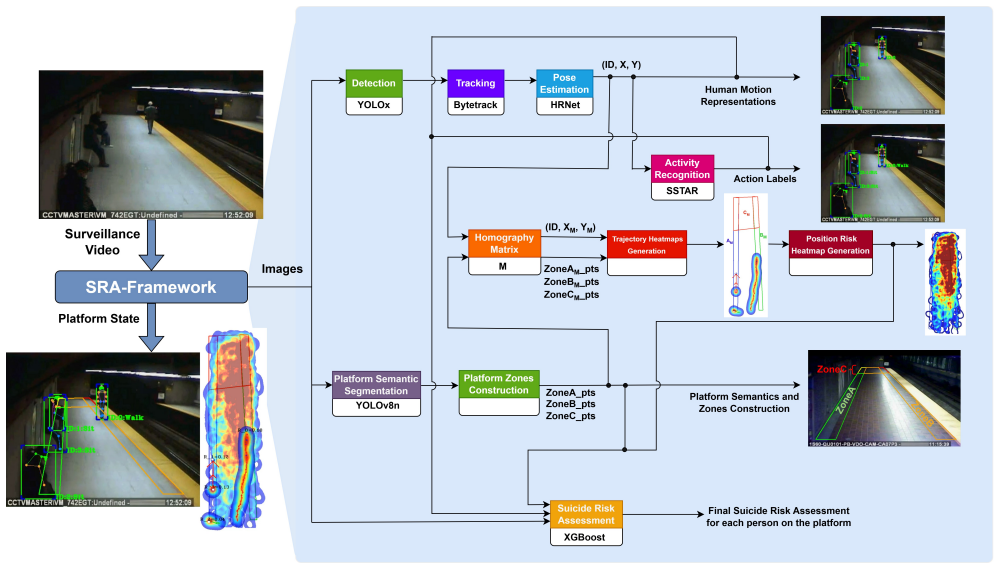
The interpretable pipeline that integrates person tracking, activity recognition, semantic segmentation of the platform, and trajectory-driven risk heatmap modeling to accumulate behavioral evidence over time and produce risk scores.
What would settle it
A controlled test on new metro surveillance footage in which the framework produces risk scores that do not correlate with actual recorded incidents or intervention outcomes at rates above random chance.
Extended reading notes
Core claim
The authors introduce the first interpretable framework for Suicide Risk Assessment in metro stations that assesses risk from accumulated evidence by incorporating person tracking, activity recognition, semantic segmentation of the platform, and trajectory-driven risk heatmap modeling, achieving 83.2 percent ROC-AUC on real surveillance data rather than focusing on isolated subtasks or attempting to infer intent directly.
Load-bearing premise
The integrated pipeline of tracking, recognition, segmentation, and heatmap modeling can reliably assess suicide risk from video without direct intent inference, and the reported ROC-AUC indicates practical utility for prevention.
Editorial analysis
A structured set of objections, weighed in public.
Referee Report
Summary. The paper formalizes the task of Suicide Risk Assessment (SRA) from metro station surveillance videos as distinct from isolated subtasks or direct intent inference. It proposes an interpretable framework that accumulates evidence via person tracking, activity recognition, semantic segmentation of the platform, and trajectory-driven risk heatmap modeling, and reports benchmarking a complete operational pipeline that achieves 83.2% ROC-AUC on real surveillance data.
Significance. If the validation details were supplied and the metric shown to be reliable, the work would be significant as one of the first end-to-end interpretable pipelines for this socially important application in computer vision. It correctly emphasizes accumulated behavioral and contextual cues over direct intent modeling and opens directions for AI for social good. The absence of any dataset construction, labeling protocol, or baseline comparison currently prevents assessing whether the result advances the state of the art.
major comments (1)
- [Abstract and Evaluation] Abstract (and the evaluation section it summarizes): the central claim that the pipeline 'achieves 83.2% ROC-AUC on real surveillance data' is load-bearing for the contribution, yet the manuscript supplies no information on dataset size, how ground-truth positive and negative suicide-risk events are defined independently of the model (e.g., incident logs, expert annotation criteria, temporal windows), train/test splits, cross-validation, baselines, or error analysis. Without an independent labeling protocol the reported AUC cannot be interpreted as evidence that the accumulated-evidence formulation measures the intended construct.
minor comments (1)
- [Abstract] The abstract states the framework is 'the first' without referencing prior related work on behavior analysis or risk modeling in surveillance; a brief related-work paragraph would improve context.
Simulated Author's Rebuttal
We thank the referee for the constructive feedback and for acknowledging the potential significance of formalizing suicide risk assessment as a distinct task. We address the major comment on evaluation details below.
read point-by-point responses
-
Referee: [Abstract and Evaluation] Abstract (and the evaluation section it summarizes): the central claim that the pipeline 'achieves 83.2% ROC-AUC on real surveillance data' is load-bearing for the contribution, yet the manuscript supplies no information on dataset size, how ground-truth positive and negative suicide-risk events are defined independently of the model (e.g., incident logs, expert annotation criteria, temporal windows), train/test splits, cross-validation, baselines, or error analysis. Without an independent labeling protocol the reported AUC cannot be interpreted as evidence that the accumulated-evidence formulation measures the intended construct.
Authors: We agree that the manuscript currently provides insufficient details on the dataset and evaluation protocol. In the revised manuscript we will add a dedicated subsection describing: the size and characteristics of the real surveillance dataset; the independent ground-truth labeling protocol (including use of incident logs, expert annotation criteria, and temporal windows for positive/negative events); the train/test splits and any cross-validation procedure; relevant baselines; and error analysis. These additions will allow readers to properly interpret the 83.2% ROC-AUC in the context of the accumulated-evidence formulation. revision: yes
Circularity Check
No derivation chain or equations; framework is descriptive pipeline without self-referential reduction
full rationale
The paper describes an operational pipeline combining person tracking, activity recognition, semantic segmentation, and trajectory risk heatmaps to produce a risk score, benchmarked at 83.2% ROC-AUC. No equations, formal derivations, fitted parameters renamed as predictions, or self-citations appear in the provided text. The central claim is an engineering integration validated on real data rather than a mathematical result that reduces to its inputs by construction. Absence of any load-bearing derivation steps means the analysis is self-contained with no circularity.
Assumptions & free parameters
Cite this review
Pith. "Pith review of Suicide Risk Assessment from AI-powered Video Surveillance: An Interpretable Framework for Prevention in Metro Stations." pith.science (2026). https://pith.science/paper/J7COEMFW
@misc{pith2026260522904,
  author       = {Pith},
  title        = {Pith review of: Suicide Risk Assessment from AI-powered Video Surveillance: An Interpretable Framework for Prevention in Metro Stations},
  year         = {2026},
  howpublished = {\url{https://pith.science/paper/J7COEMFW}},
  note         = {Machine review of arXiv:2605.22904}
}
read the original abstract
Understanding and monitoring human behavior in metro stations play an important role in supporting suicide prevention efforts, where early identification of high-risk situations can enable timely intervention. This requires assessing suicide risk from a surveillance video by jointly reasoning about the behavior of each passenger, his/her spatial context, and temporal dynamics. However, this assessment using videos captured by surveillance cameras is challenging, as it demands accurate perception of human motion, understanding of platform geometry, and aggregation of heterogeneous behavioral cues over time. In this work, we formalize the task of Suicide Risk Assessment (SRA) in metro stations and introduce the first interpretable framework that addresses this challenge. Unlike approaches that focus on isolated subtasks or attempt to infer intent directly, our formulation assesses suicide risk from accumulated evidence by incorporating person tracking, activity recognition, semantic segmentation of the platform, and trajectory-driven risk heatmap modeling. By formalizing SRA as a distinct task and benchmarking a complete operational pipeline achieving 83.2% ROC-AUC on real surveillance data, this work highlights the complexity of suicide risk assessment and opens new directions for research on interpretable AI systems for social good.
Figures


Figures from the paper (2 more)


Reference graph
Works this paper leans on
-
[1]
[Anjali and Kumar, 2024] T Anjali and B. Rushi Kumar. Spatial analysis of multivariate factors influencing suicide hotspots in urban tamil nadu.Journal of Affective Disor- ders Reports,
work page 2024
-
[2]
Humans in the loop, lives on the line: Ai in high-risk decision making
[Balamuruganet al., 2025 ] Merlin Balamurugan, Kumar Shanmugasamy, and Saranya Balaguru. Humans in the loop, lives on the line: Ai in high-risk decision making. European Journal of Computer Science and Information Technology,
work page 2025
-
[3]
Intelligent video surveillance for real-time detection of suicide attempts.Pattern Recog- nit
[Bouachiret al., 2018 ] Wassim Bouachir, Rafik Gouiaa, Bo Li, and Rita Noumeir. Intelligent video surveillance for real-time detection of suicide attempts.Pattern Recog- nit. Lett., 110:1–7,
work page 2018
-
[4]
[Changet al., 2025 ] Chin-Chieh Chang, Kai-Hsiang Huang, Tsz-Kin Lau, Chung-Fah Huang, and Chun-Hsiung Wang. Using deep learning model integration to build a smart railway traffic safety monitoring system.Scientific Re- ports, 15,
work page 2025
-
[5]
[Chen and Guestrin, 2016] Tianqi Chen and Carlos Guestrin. Xgboost: A scalable tree boosting system.Proceedings of the 22nd ACM SIGKDD International Conference on Knowledge Discovery and Data Mining,
work page 2016
-
[6]
[Forteet al., 2021 ] Alberto Forte, Giuseppe Sarli, Lorenzo Polidori, David Lester, and Maurizio Pompili. The role of new technologies to prevent suicide in adolescence: A systematic review of the literature.Medicina, 57,
work page 2021
-
[7]
Osgood, Benjamin Yeoh, Eva Graham, and Heather Orpana
[Gari´epyet al., 2024 ] Genevi`eve Gari ´epy, Rifat Zahan, Nathaniel D. Osgood, Benjamin Yeoh, Eva Graham, and Heather Orpana. Dynamic simulation models of suicide and suicide-related behaviors: Systematic review.JMIR Public Health and Surveillance, 10,
work page 2024
-
[8]
[Gurselet al., 2024 ] Ezgi Gursel, Mahboubeh Madadi, Jamie Baalis Coble, Vivek Agarwal, Vaibhav Yadav, Ronald L. Boring, and Anahita Khojandi. The role of ai in detecting and mitigating human errors in safety-critical industries: A review.Reliab. Eng. Syst. Saf., 256:110682,
work page 2024
Show all 24 references
-
[9]
Girshick
[Heet al., 2017 ] Kaiming He, Georgia Gkioxari, Piotr Doll´ar, and Ross B. Girshick. Mask r-cnn
2017
-
[10]
Hightower and Mor- gan J
[Hightower and Grant, 2024] Heath H. Hightower and Mor- gan J. Grant. Proposing an individual-in-contexts model for reimagining suicide screening, assessment, and inter- vention in black communities.Journal of Human Services,
2024
-
[11]
Ultralytics yolov8 https://github.com/ultralytics/ultralytics
[Jocheret al., 2023 ] Glenn Jocher, Ayush Chaura- sia, and Jing Qiu. Ultralytics yolov8 https://github.com/ultralytics/ultralytics
2023
-
[12]
Laliberte, Brandon Roth, Beau Edwards, and Jason I
[Laliberteet al., 2021 ] Avery Z. Laliberte, Brandon Roth, Beau Edwards, and Jason I. Chen. Suicide screening and risk assessment in the emergency department: Case review of a suicide attempt survivor.Journal of emergency nurs- ing,
2021
-
[13]
Behaviours preceding suicides at railway and underground locations: a multimethodological quali- tative approach.BMJ Open, 8,
[Mackenzieet al., 2018 ] Jay-Marie Mackenzie, Jo Borrill, Emily Hawkins, Bob Fields, Ian Kruger, Ian Noonan, and Lisa Marzano. Behaviours preceding suicides at railway and underground locations: a multimethodological quali- tative approach.BMJ Open, 8,
2018
-
[14]
Mishara, C ´ecile Bardon, and Serge Dupont
[Misharaet al., 2016 ] Brian L. Mishara, C ´ecile Bardon, and Serge Dupont. Can cctv identify people in public transit stations who are at risk of attempting suicide? an analysis of cctv video recordings of attempters and a comparative investigation.BMC Public Health, 16,
2016
-
[15]
[Naimiet al., 2025 ] Safwen Naimi, Wassim Bouachir, Guillaume-Alexandre Bilodeau, and Brian L. Mishara. Sstar: Skeleton-based spatio-temporal action recognition for intelligent video surveillance and suicide prevention in metro stations.2025 IEEE/CVF Winter Conference on Appli...
2025
-
[16]
Koudys, and Anthony C
[Parsapooret al., 2023 ] Mahboobeh Parsapoor, Jacob W. Koudys, and Anthony C. Ruocco. Suicide risk detec- tion using artificial intelligence: the promise of creating a benchmark dataset for research on the detection of suicide risk.Frontiers in Psychiatry, 14,
2023
-
[17]
[R˚adbo and Andersson, 2012] Helena R ˚adbo and Ragnar Andersson. Patterns of suicide and other trespassing fatal- ities on state-owned railways in greater stockholm; impli- cations for prevention.International Journal of Environ- mental Research and Public Health, 9:772 – 780,
2012
-
[18]
Information and com- munication technology use in suicide prevention: Scoping review.Journal of Medical Internet Research, 23,
[Rassyet al., 2021 ] Jessica Rassy, C ´ecile Bardon, Luc Dar- gis, Louis-Philippe Cˆot´e, Laurent Corth´esy-Blondin, Carl- Maria M ¨orch, and R ´eal Labelle. Information and com- munication technology use in suicide prevention: Scoping review.Journal of Medical Internet Research, 23,
2021
-
[19]
Yolov3: An incremental improvement.ArXiv, abs/1804.02767,
[Redmon and Farhadi, 2018] Joseph Redmon and Ali Farhadi. Yolov3: An incremental improvement.ArXiv, abs/1804.02767,
2018 arXiv
-
[20]
Main characteristics of train-pedestrian fatalities on finnish rail- roads.Accident; analysis and prevention, 45:61–6,
[Silla and Luoma, 2012] Anne Silla and Juha Luoma. Main characteristics of train-pedestrian fatalities on finnish rail- roads.Accident; analysis and prevention, 45:61–6,
2012
-
[21]
Evaluating xgboost for balanced and im- balanced data: Application to fraud detection,
[Velardeet al., 2023 ] Gissel Velarde, Anindya Sudhir, San- jay Deshmane, Anuj Deshmunkh, Khushboo Sharma, and Vaibhav Joshi. Evaluating xgboost for balanced and im- balanced data: Application to fraud detection,
2023
-
[22]
Deep high-resolution representation learn- ing for visual recognition.IEEE Transactions on Pattern Analysis and Machine Intelligence, 43:3349–3364,
[Wanget al., 2019 ] Jingdong Wang, Ke Sun, Tianheng Cheng, Borui Jiang, Chaorui Deng, Yang Zhao, Dong Liu, Yadong Mu, Mingkui Tan, Xinggang Wang, Wenyu Liu, and Bin Xiao. Deep high-resolution representation learn- ing for visual recognition.IEEE Transactions on Pattern Analysi...
2019
-
[23]
Bytetrack: Multi-object tracking by associat- ing every detection box.ArXiv, abs/2110.06864,
[Zhanget al., 2021 ] Yifu Zhang, Pei Sun, Yi Jiang, Dong- dong Yu, Zehuan Yuan, Ping Luo, Wenyu Liu, and Xing- gang Wang. Bytetrack: Multi-object tracking by associat- ing every detection box.ArXiv, abs/2110.06864,
2021
-
[24]
The research on recognition of passenger abnormal behavior in urban rail transit stations based on conditional generative adversarial networks.Alexandria Engineering Journal, 2025
[Zuoet al., 2025 ] Jing Zuo, Zexin Li, Ming He, and Qiaoli Yang. The research on recognition of passenger abnormal behavior in urban rail transit stations based on conditional generative adversarial networks.Alexandria Engineering Journal, 2025
2025
Reviewed June 30, 2026 · model on record in the stance chip above.
Discussion (0). Continue with ORCID to comment.