REVIEW 3 major objections 7 minor 77 references
The paper introduces a unified corpus of 957,253 agent-evaluation records and shows that the choice of aggregation rule—all-pass versus partial credit—can change both measured capability and agent rankings.
Reviewed by Pith at T0; open to challenge. T0 means a machine referee read the full paper against a public rubric. the ladder, T0–T4 →
T0 review · deepseek-v4-flash
2026-08-01 01:10 UTC pith:J7EY7EQ6
load-bearing objection Useful corpus with a real caveat: the HarveyAI-Lab counterfactual numbers rest on an unvalidated local verifier, so treat them as illustrative until the authors verify against official scoring and actually release the data. the 3 major comments →
Messier: A High-Resolution Corpus for Cross-Benchmark Agent Evaluation
The pith
A machine-rendered reading of the paper's core claim, the machinery that carries it, and where it could break.
Core claim
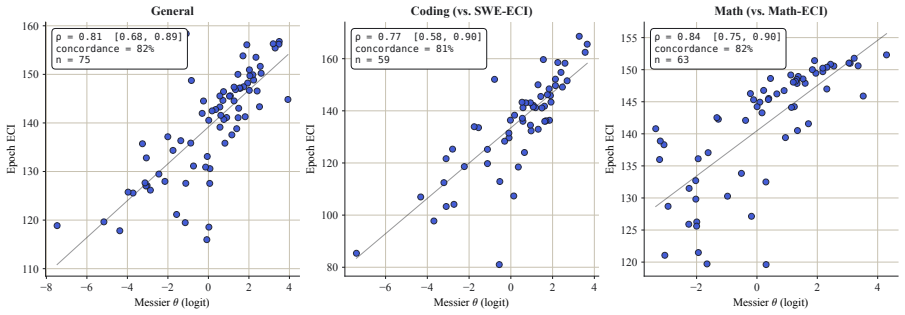
Messier's central claim is that per-criterion, per-verifier records—not just task-level pass/fail—are the right unit for comparing AI agents across benchmarks. From those records, the authors demonstrate counterfactual rescoring: rescoring the same trials under soft (mean fraction of criteria passed) or majority-pass rules instead of the official all-pass rule raises measured success substantially and, on some benchmarks, changes agent orderings. They then fit a 1PL Rasch model to the consolidated agent-task response matrix and show that the resulting ability estimates align with the published ranking of an external capability index at Spearman ρ = 0.81 (95% CI [0.68, 0.89]) for general capa
What carries the argument
The corpus itself is the central object: a reconciled schema in which every trial is decomposed as (model, scaffold, environment, task, verifier, aggregation rule), with 74,205 verifiers and per-criterion outcomes for multi-verifier tasks. Two mechanisms carry the argument. (1) Counterfactual rescoring: because records preserve each verifier's binary outcome, any aggregation rule—all-pass, majority-pass, or soft mean—can be applied post hoc to the same trials, revealing how much of measured capability is an artifact of the rule. (2) A 1PL Rasch (item-response) model fitted to the consolidated agent-task binary matrix, from which per-agent ability θ and per-task difficulty β are estimated on
Load-bearing premise
The load-bearing premise is that the per-criterion verifier outcomes for the newly contributed benchmarks, especially the legal-workflow benchmark whose rubric was rebuilt locally as an LLM judge, faithfully reproduce the upstream benchmark's own grading; the paper reports no validation of this local verifier against official scores.
What would settle it
Take a multi-verifier benchmark that publicly releases both official task-level scores and individual criterion outcomes, and check whether the paper's rescoring pipeline exactly reproduces the official all-pass scores from the criterion outcomes; a mismatch would indicate the pipeline (or its local judge) diverges from the upstream grader. Concretely, for the six contributed benchmarks, run the upstream benchmarks' original verifiers on the same recorded traces and compare per-criterion outcomes with the local LLM judge's judgments—if they disagree on a large fraction of criteria, the headlin
If this is right
- If evaluations release criterion-level outcomes, any aggregation rule can be computed post hoc, making leaderboards re-auditable without rerunning agents.
- Strict all-pass scoring should be read as a lower bound on progress: on multi-verifier tasks it can hide substantial partial completion, as the 0.2% vs 28.8% gap illustrates.
- Open, harmonized records can reproduce an established capability ordering (ρ = 0.81) without a new evaluation campaign, lowering the cost of capability scaling.
- Capability scales can be specialized by occupation, action space, or verifier type, enabling domain-specific rather than global comparisons.
- Frontier progress is uneven: function calling is near saturation, programming shows the largest gains, and enterprise workflows remain the hardest frontier.
Where Pith is reading between the lines
- Editorial extension: if per-verifier records become a release standard, audits for reward hacking, sandbagging, and evaluation awareness could run on archived trials at the exact granularity where those failure modes occur, without new compute.
- Editorial extension: the observed rank reordering under different aggregation rules implies that any single-number leaderboard is partly a choice of scoring philosophy; competitive pressure on all-pass leaderboards may push agents to satisfy every criterion rather than to maximize partial progress, a behavior that may not match deployment value.
- Editorial extension: the modest within-benchmark difficulty-prediction gains suggest task text encodes hardness beyond benchmark identity; a testable next step is using such estimates to build stratified test sets with calibrated difficulty for future benchmarks.
- Editorial extension: a direct check of the verifier-transfer assumption—comparing the locally rebuilt rubric judge's per-criterion outcomes against the upstream benchmark's official scores on a shared subset—would quantify how much of the aggregation-effect magnitudes depend on the local judge.
Editorial analysis
A structured set of objections, weighed in public.
Referee Report
Summary. Messier is proposed as a unified corpus of 957,253 standardized trial outcomes spanning 30 benchmarks, 714 agents, 11,891 tasks, and 74,205 verifiers, assembled from public releases plus new five-agent runs on six benchmarks (HarveyAI-Lab, MedAgentBench, DABStep, QCircuitBench, ScienceAgentBench, ReplicationBench) under a fixed OpenHands/Harbor configuration. On this corpus the paper reports three analyses: (i) frontier progress, finding function-calling near saturation, programming fastest-improving, and enterprise workflows most challenging (Figure 1f); (ii) counterfactual rescoring, showing that all-pass aggregation can obscure partial progress and reorder agents (Table 3); and (iii) 1PL IRT capability scales correlating with Epoch ECI at Spearman ρ=0.81 over 75 matched agents (Figure 2), plus a difficulty-prediction experiment (Table 4).
Significance. With the caveat below, the corpus would be a valuable community asset: roughly eight times HAL in task count, verifier-level rather than task-level, with careful per-source license/access tables, deterministic hygiene checks, and modular per-benchmark builders. The ECI alignment is a genuine external anchor: ρ=0.81 over 75 matched agents is meaningful, although it partly validates the reconciliation pipeline given shared source benchmarks. The qualitative aggregation result is also supported by tau2-bench and TheAgentCompany, whose per-criterion outcomes come from public releases. The paper is honest about the difficulty-prediction baseline and includes a thoughtful Limitations section. The central risk in this manuscript, fidelity of the locally constructed HarveyAI-Lab verifier, does land on reading §A.5 and is detailed in Major Comment 1.
major comments (3)
- [§5.2 / §A.5 / Table 3] The HarveyAI-Lab row rests on a verifier constructed by the authors, not on the upstream benchmark grading. For each of 1,000 tasks, anthropic/claude-sonnet-4-6 issues 33-65 binary criterion judgments (§A.5), so Table 3 all-pass 0.002 vs soft 0.288, near-pass 0.080, and per-agent ρ=0.667 are internal properties of that judge. No validation against official Harvey scores, human labels, or a second judge is reported. The Limitations sentence that the authors largely assume the validity of underlying datasets does not cover a newly constructed judge. Because Harvey supplies 1,000 of 2,572 enterprise tasks and 221k of 957k outcomes, the enterprise-frontier point 0.57 (Figure 1f) inherits this bias. Please validate the judge on a sample against official scoring and re-derive these figures, or explicitly label the Harvey counterfactual as illustrative.
- [§5.2, Table 3] The claim that aggregation artificially alters agent rankings is only weakly supported by the HarveyAI-Lab row: ρ=0.667 is computed across n=5 agents (Table 2), each with one trial per task (§A.5), with no confidence interval or significance test, and most all-pass means cluster near zero, making the estimate tie-dominated. Moreover, with roughly 60 criteria per task and mean criterion pass 0.288, an all-pass rate near zero is close to a mathematical consequence (0.288^60 ≈ 0), so the empirical content of that row is the per-criterion rate of the unvalidated judge (Major Comment 1). The stronger reordering evidence is TheAgentCompany (n=18, ρ=0.981) and tau2-bench (n=7, ρ=0.857). The paper calls for broader validation in §5.2; the abstract should reflect that caution.
- [§5.1, Figure 1f] The per-task frontier is the maximum score over eligible agents, so its expected value grows with the number of eligible agents, which differs by an order of magnitude across the groups compared: function-calling has 108 agents, programming up to 192, while enterprise benchmarks have 5-18 (Table 2). The headline that enterprise workflows remain the most challenging at 0.57 is therefore confounded with agent coverage and, for the 1,000 Harvey tasks, with the unvalidated verifier of Major Comment 1. The §5.1 disclaimer that the analysis is not intended to estimate field-wide progress is appropriate but does not protect the abstract statement. Please add a robustness check on a common agent subset or an explicit coverage adjustment, and show per-benchmark eligible-agent counts alongside the curves.
minor comments (7)
- [§A.1 / Table 2] BFCL-Multi-Turn is described as matching the agent per-turn method-call trace turn by turn (§A.1) but Table 2 lists one verifier per task (800 verifiers / 800 tasks). Clarify whether trace matching is a composite single verifier; otherwise it may qualify as a multi-verifier all-pass benchmark and should be considered for §5.2.
- [Figure 1f] The dumbbell markers and +Δ annotations are not defined in the caption; state which endpoint is the first versus final observed quarter, and what the delta values are.
- [Table 4] The z-scored-β baseline value of -0.081 is confusing; state that the baseline predicts the training-fold benchmark mean and can be negative when the target is within-benchmark z-scored difficulty.
- [§A.5] Each (agent, task) cell is run once. Add a sentence acknowledging that Table 3 and Figure 1f estimates carry no sampling error and would benefit from repeated trials or interval estimates.
- [§A.3] SOC/NAICS classification reports only 2-of-3 voter agreement (88.3%/86.8%); consider validating the labels against a small human-annotated sample, since agreement among the same-family voters is not accuracy.
- [Limitations] Extend the validity-assumption sentence to cover newly introduced verifiers (in particular the Harvey judge), and note the single-trial design, so readers can calibrate trust in the contributed runs.
- [§5.3] Because many Messier benchmarks overlap Epoch's source pool, ρ=0.81 partly verifies the reconciliation pipeline rather than a fully independent scale; mention this explicitly and, if feasible, add a robustness check excluding shared benchmarks.
Circularity Check
No significant circularity: the ECI alignment uses an external benchmark, the aggregation and difficulty analyses are empirical or cross-validated, and no load-bearing self-citation appears.
full rationale
I walked the derivation chain in each analytical section. Section 5.1 is explicitly descriptive and disclaims causal progress claims. Section 5.2 rescoring is a direct empirical comparison of formally defined aggregation rules (Section 3): the direction that all-pass ≤ soft is a mathematical fact about the definitions, but the paper does not disguise this as a fitted prediction; the empirical content is the Table 3 magnitudes, which are computed from verifier-level records. Section 5.3 compares a 1PL fit to Epoch's ECI, an external published benchmark ranking; there is no author overlap, and the paper openly states that it follows Epoch's naming and model-level aggregation protocol (§4, §B.2). This is a replication/validation exercise, not a derivation from the target itself. Section 5.4 uses cross-validated regression with a benchmark-mean baseline, so no leakage equates the predictor to the label. Appendix B.1 explicitly labels its BRIDGE/METR agreement as an 'implementation check confirming pipeline consistency on overlapping data,' which is transparent rather than circular. The Limitations section and Appendix A.5 flag that upstream dataset validity is assumed and that the HarveyAI-Lab verifier is a locally built LLM judge without reported validation against official Harvey scores. These are external-validity concerns, not circularity: they affect whether the numbers are trustworthy, not whether the reasoning reduces to its inputs. No load-bearing self-citations or uniqueness claims imported from the authors' prior work appear in the paper.
Axiom & Free-Parameter Ledger
free parameters (3)
- IRT priors and optimization hyperparameters =
mean 0, std 1; ClippedAdam lr 0.01; 1000-2000 epochs; seed 42
- Best-scaffold aggregation protocol =
highest-scoring scaffold per (model,benchmark)
- Domain slicing via SOC =
SOC 15-1200 for programming, SOC 15-2000 for math
axioms (5)
- domain assumption The 30 selected benchmarks are a representative sample of interactive agent evaluation, and their releases are mutually comparable after normalization.
- standard math Rasch (1PL) item-response theory adequately describes trial success, P(Y=1)=σ(θ_a−β_t), for heterogeneous tasks and agents.
- domain assumption Binary per-verifier outcomes are sufficient to encode task success; the SOC/NAICS classifier ensemble is trustworthy enough for domain slicing.
- domain assumption The response matrix can be formed by taking each model's best scaffold per benchmark, and constant-outcome tasks can be dropped.
- ad hoc to paper The anonymized repository will actually release the code and data at the stated URL.
invented entities (2)
-
Capability scales from MESSIER θ and β
independent evidence
-
HarveyAI-Lab's local rubric verifier
no independent evidence
read the original abstract
Evaluating AI agents in interactive environments is hindered by fragmented tasks, scaffolds, verifiers, and scoring rules. Existing efforts focus on narrow settings, remain limited in scale, or require costly reruns, leaving much of the empirical record incomparable. We introduce Messier, a unified corpus of 957,253 records that span 30 benchmarks, 714 agents, 11,891 tasks, and 74,205 verifiers. Messier consolidates public benchmark scores and supplements them with five-agent runs across six underrepresented professional and scientific domains, including a recent legal benchmark. Each record is standardized by model, scaffold, environment, task, verifier, and aggregation rule, with SOC/NAICS classifications for occupational and industry analysis. Using this corpus, we show frontier progress is uneven across benchmark types, with "function calling" saturated, "programming" improving the fastest, and "enterprise workflows" remaining the most challenging. Furthermore, counterfactual rescoring shows that strict all-pass aggregation in multi-verifier tasks can obscure progress and artificially alter agent rankings. From these standardized records, we derive capability scales that align with Epoch's Evaluation Capability Index rankings at Spearman \r{ho} = 0.81 and can be specialized by domain, occupation, action space, or verifier type. Messier provides a foundational, reusable infrastructure for agent capability scaling, benchmark auditing, and fine-grained analysis of evaluation failures.
Figures



Reference graph
Works this paper leans on
-
[1]
Aho and Jeffrey D
Alfred V. Aho and Jeffrey D. Ullman , title =. 1972
1972
-
[2]
Publications Manual , year = "1983", publisher =
1983
-
[3]
Ashok K. Chandra and Dexter C. Kozen and Larry J. Stockmeyer , year = "1981", title =. doi:10.1145/322234.322243
arXiv 1981
-
[4]
Scalable training of
Andrew, Galen and Gao, Jianfeng , booktitle=. Scalable training of
-
[5]
Dan Gusfield , title =. 1997
1997
-
[6]
Tetreault , title =
Mohammad Sadegh Rasooli and Joel R. Tetreault , title =. Computing Research Repository , volume =. 2015 , url =
2015
-
[7]
A Framework for Learning Predictive Structures from Multiple Tasks and Unlabeled Data , Volume =
Ando, Rie Kubota and Zhang, Tong , Issn =. A Framework for Learning Predictive Structures from Multiple Tasks and Unlabeled Data , Volume =. Journal of Machine Learning Research , Month = dec, Numpages =
-
[8]
Florian Brand and Jean-Stanislas Denain , year=
-
[9]
Artificial intelligence , volume=
Planning and acting in partially observable stochastic domains , author=. Artificial intelligence , volume=. 1998 , publisher=
1998
-
[10]
Proceedings of the 26th annual international conference on machine learning , pages=
Curriculum learning , author=. Proceedings of the 26th annual international conference on machine learning , pages=
-
[11]
European review , volume=
‘Improving ratings’: audit in the British University system , author=. European review , volume=. 1997 , publisher=
1997
-
[12]
arXiv preprint arXiv:2211.09110 , year=
Holistic evaluation of language models , author=. arXiv preprint arXiv:2211.09110 , year=
-
[13]
Transactions on machine learning research , year=
Beyond the imitation game: Quantifying and extrapolating the capabilities of language models , author=. Transactions on machine learning research , year=
-
[14]
International Conference on Learning Representations , volume=
Swe-bench: Can language models resolve real-world github issues? , author=. International Conference on Learning Representations , volume=
-
[15]
International Conference on Learning Representations , volume=
Livecodebench: Holistic and contamination free evaluation of large language models for code , author=. International Conference on Learning Representations , volume=
-
[16]
Advances in Neural Information Processing Systems , volume=
Osworld: Benchmarking multimodal agents for open-ended tasks in real computer environments , author=. Advances in Neural Information Processing Systems , volume=
-
[17]
Advances in Neural Information Processing Systems , volume=
Theagentcompany: benchmarking llm agents on consequential real world tasks , author=. Advances in Neural Information Processing Systems , volume=
-
[18]
Proceedings of the 62nd Annual Meeting of the Association for Computational Linguistics (Volume 1: Long Papers) , pages=
Webvoyager: Building an end-to-end web agent with large multimodal models , author=. Proceedings of the 62nd Annual Meeting of the Association for Computational Linguistics (Volume 1: Long Papers) , pages=
-
[19]
International Conference on Learning Representations , volume=
Cybench: A framework for evaluating cybersecurity capabilities and risks of language models , author=. International Conference on Learning Representations , volume=
-
[20]
Barres, Victor and Dong, Honghua and Ray, Soham and Si, Xujie and Narasimhan, Karthik , journal=
-
[21]
Forty-second International Conference on Machine Learning , year=
The berkeley function calling leaderboard (bfcl): From tool use to agentic evaluation of large language models , author=. Forty-second International Conference on Machine Learning , year=
-
[22]
Advances in Neural Information Processing Systems , volume=
Measuring AI ability to complete long software tasks , author=. Advances in Neural Information Processing Systems , volume=
-
[23]
arXiv preprint arXiv:2512.00193 , year=
A Rosetta Stone for AI Benchmarks , author=. arXiv preprint arXiv:2512.00193 , year=
-
[24]
arXiv preprint arXiv:2510.04374 , year=
Gdpval: Evaluating ai model performance on real-world economically valuable tasks , author=. arXiv preprint arXiv:2510.04374 , year=
-
[25]
arXiv preprint arXiv:2510.21652 , year=
Astabench: Rigorous benchmarking of ai agents with a scientific research suite , author=. arXiv preprint arXiv:2510.21652 , year=
-
[26]
Nejm Ai , volume=
MedAgentBench: a virtual EHR environment to benchmark medical LLM agents , author=. Nejm Ai , volume=. 2025 , publisher=
2025
-
[27]
arXiv preprint arXiv:2510.01179 , year=
Toucan: Synthesizing 1.5 m tool-agentic data from real-world mcp environments , author=. arXiv preprint arXiv:2510.01179 , year=
-
[28]
arXiv preprint arXiv:2510.11977 , year=
Holistic agent leaderboard: The missing infrastructure for ai agent evaluation , author=. arXiv preprint arXiv:2510.11977 , year=
-
[29]
arXiv preprint arXiv:2504.08942 , year=
Agentrewardbench: Evaluating automatic evaluations of web agent trajectories , author=. arXiv preprint arXiv:2504.08942 , year=
-
[30]
Findings of the Association for Computational Linguistics: EMNLP 2023 , pages=
NLP evaluation in trouble: On the need to measure LLM data contamination for each benchmark , author=. Findings of the Association for Computational Linguistics: EMNLP 2023 , pages=
2023
-
[31]
arXiv preprint arXiv:2602.07267 , year=
BRIDGE: Predicting Human Task Completion Time From Model Performance , author=. arXiv preprint arXiv:2602.07267 , year=
-
[32]
arXiv preprint arXiv:2604.00594 , year=
Agent psychometrics: Task-level performance prediction in agentic coding benchmarks , author=. arXiv preprint arXiv:2604.00594 , year=
-
[33]
arXiv preprint arXiv:2504.12516 , year=
Browsecomp: A simple yet challenging benchmark for browsing agents , author=. arXiv preprint arXiv:2504.12516 , year=
-
[34]
arXiv preprint arXiv:2504.01382 , year=
An illusion of progress? assessing the current state of web agents , author=. arXiv preprint arXiv:2504.01382 , year=
-
[35]
arXiv preprint arXiv:2601.11868 , year=
Terminal-bench: Benchmarking agents on hard, realistic tasks in command line interfaces , author=. arXiv preprint arXiv:2601.11868 , year=
-
[36]
Advances in Neural Information Processing Systems , volume=
Gso: Challenging software optimization tasks for evaluating swe-agents , author=. Advances in Neural Information Processing Systems , volume=
-
[37]
Science , volume=
Rethink reporting of evaluation results in AI , author=. Science , volume=. 2023 , publisher=
2023
-
[38]
arXiv preprint arXiv:2508.20453 , year=
Mcp-bench: Benchmarking tool-using llm agents with complex real-world tasks via mcp servers , author=. arXiv preprint arXiv:2508.20453 , year=
-
[39]
2026 , month =
Niko Grupen and Gabe Pereyra and Julio Pereyra , title =. 2026 , month =
2026
-
[40]
International Conference on Learning Representations , volume=
Ai sandbagging: Language models can strategically underperform on evaluations , author=. International Conference on Learning Representations , volume=
-
[41]
arXiv preprint arXiv:2505.23836 , year=
Large language models often know when they are being evaluated , author=. arXiv preprint arXiv:2505.23836 , year=
-
[42]
arXiv preprint arXiv:2510.20487 , year=
Steering Evaluation-Aware Language Models to Act Like They Are Deployed , author=. arXiv preprint arXiv:2510.20487 , year=
-
[43]
arXiv preprint arXiv:2511.21654 , year=
EvilGenie: A Reward Hacking Benchmark , author=. arXiv preprint arXiv:2511.21654 , year=
-
[44]
arXiv preprint arXiv:2603.29357 , year=
BenchScope: How Many Independent Signals Does Your Benchmark Provide? , author=. arXiv preprint arXiv:2603.29357 , year=
-
[45]
arXiv preprint arXiv:2501.12851 , year=
Acebench: Who wins the match point in tool usage? , author=. arXiv preprint arXiv:2501.12851 , year=
-
[46]
arXiv preprint arXiv:2602.12670 , year=
SkillsBench: Benchmarking how well agent skills work across diverse tasks , author=. arXiv preprint arXiv:2602.12670 , year=
-
[47]
arXiv preprint arXiv:2602.11898 , year=
Benchmark Illusion: Disagreement among LLMs and Its Scientific Consequences , author=. arXiv preprint arXiv:2602.11898 , year=
-
[48]
arXiv preprint arXiv:2603.00039 , year=
CARE: Confounder-Aware Aggregation for Reliable LLM Evaluation , author=. arXiv preprint arXiv:2603.00039 , year=
-
[49]
arXiv preprint arXiv:2605.02964 , year=
Reward Hacking Benchmark: Measuring Exploits in LLM Agents with Tool Use , author=. arXiv preprint arXiv:2605.02964 , year=
-
[50]
2025 , url =
Johannes Gasteiger and Akbir Khan and Sam Bowman and Misha Wagner and Vladimir Mikulik and Ethan Perez and Fabien Roger , title =. 2025 , url =
2025
-
[51]
arXiv preprint arXiv:2508.00828 , year=
Finance agent benchmark: Benchmarking llms on real-world financial research tasks , author=. arXiv preprint arXiv:2508.00828 , year=
-
[52]
arXiv preprint arXiv:2603.11337 , year=
RewardHackingAgents: Benchmarking Evaluation Integrity for LLM ML-Engineering Agents , author=. arXiv preprint arXiv:2603.11337 , year=
-
[53]
Proceedings of the 57th annual meeting of the association for computational linguistics , pages=
Energy and policy considerations for deep learning in NLP , author=. Proceedings of the 57th annual meeting of the association for computational linguistics , pages=
-
[54]
Proceedings of the 47th international ACM SIGIR conference on research and development in information retrieval , pages=
C-pack: Packed resources for general chinese embeddings , author=. Proceedings of the 47th international ACM SIGIR conference on research and development in information retrieval , pages=
-
[55]
arXiv preprint arXiv:2602.18998 , year=
Benchmark test-time scaling of general LLM agents , author=. arXiv preprint arXiv:2602.18998 , year=
-
[56]
Georg Rasch , title =
-
[57]
Xingyao Wang and Boxuan Li and Yufan Song and Frank F. Xu and Xiangru Tang and Mingchen Zhuge and Jiayi Pan and Yueqi Song and Bowen Li and Jaskirat Singh and Hoang H. Tran and Fuqiang Li and Ren Ma and Mingzhang Zheng and Bill Qian and Yanjun Shao and Niklas Muennighoff and Yizhe Zhang and Binyuan Hui and Junyang Lin and Robert Brennan and Hao Peng and H...
-
[58]
arXiv preprint arXiv:2509.16941 , year=
Swe-bench pro: Can ai agents solve long-horizon software engineering tasks? , author=. arXiv preprint arXiv:2509.16941 , year=
-
[59]
Advances in Neural Information Processing Systems , volume=
QCircuitBench: A Large-Scale Dataset for Benchmarking Quantum Algorithm Design , author=. Advances in Neural Information Processing Systems , volume=
-
[60]
arXiv preprint arXiv:2411.15114 , year=
Re-bench: Evaluating frontier ai r&d capabilities of language model agents against human experts , author=. arXiv preprint arXiv:2411.15114 , year=
-
[61]
International Conference on Learning Representations , volume=
Mle-bench: Evaluating machine learning agents on machine learning engineering , author=. International Conference on Learning Representations , volume=
-
[62]
International Conference on Learning Representations , volume=
Scienceagentbench: Toward rigorous assessment of language agents for data-driven scientific discovery , author=. International Conference on Learning Representations , volume=
-
[63]
arXiv preprint arXiv:2510.24591 , year=
ReplicationBench: Can AI Agents Replicate Astrophysics Research Papers? , author=. arXiv preprint arXiv:2510.24591 , year=
-
[64]
arXiv preprint arXiv:2501.14249 , year=
Humanity's last exam , author=. arXiv preprint arXiv:2501.14249 , year=
-
[65]
Advances in Neural Information Processing Systems , volume=
Matharena: Evaluating llms on uncontaminated math competitions , author=. Advances in Neural Information Processing Systems , volume=
-
[66]
arXiv preprint arXiv:2410.04698 , year=
Mathhay: An automated benchmark for long-context mathematical reasoning in llms , author=. arXiv preprint arXiv:2410.04698 , year=
-
[67]
arXiv preprint arXiv:2506.23719 , year=
Dabstep: Data agent benchmark for multi-step reasoning , author=. arXiv preprint arXiv:2506.23719 , year=
-
[68]
International Conference on Learning Representations , volume=
Agentbench: Evaluating llms as agents , author=. International Conference on Learning Representations , volume=
-
[69]
International Conference on Learning Representations , volume=
Gaia: a benchmark for general ai assistants , author=. International Conference on Learning Representations , volume=
-
[70]
Advances in neural information processing systems , volume=
Agentboard: An analytical evaluation board of multi-turn llm agents , author=. Advances in neural information processing systems , volume=
-
[71]
Advances in neural information processing systems , volume=
Are emergent abilities of large language models a mirage? , author=. Advances in neural information processing systems , volume=
-
[72]
Proceedings of the 2024 Conference of the North American Chapter of the Association for Computational Linguistics: Human Language Technologies (Volume 1: Long Papers) , pages=
Show your work with confidence: Confidence bands for tuning curves , author=. Proceedings of the 2024 Conference of the North American Chapter of the Association for Computational Linguistics: Human Language Technologies (Volume 1: Long Papers) , pages=
2024
-
[73]
arXiv preprint arXiv:2406.10229 , year=
Quantifying variance in evaluation benchmarks , author=. arXiv preprint arXiv:2406.10229 , year=
-
[74]
arXiv preprint arXiv:2512.03438 , year=
Multimodal Reinforcement Learning with Agentic Verifier for AI Agents , author=. arXiv preprint arXiv:2512.03438 , year=
-
[75]
arXiv preprint arXiv:2602.03130 , year=
FinMTM: A Multi-Turn Multimodal Benchmark for Financial Reasoning and Agent Evaluation , author=. arXiv preprint arXiv:2602.03130 , year=
-
[76]
2018 , organization =
2018 Standard Occupational Classification Manual , author =. 2018 , organization =
2018
-
[77]
2022 , organization =
North American Industry Classification System: United States, 2022 , author =. 2022 , organization =
2022
discussion (0)
Sign in with ORCID, Apple, or X to comment. Anyone can read and Pith papers without signing in.