REVIEW 2 major objections 4 minor 25 references
TabDPT-Turbo: Efficient In-Context Learning for Tabular Prediction
T0 review · 2 major / 4 minor · reviewed 2026-08-06 · deepseek-v4-flash
Pith's one-line read TabDPT-Turbo matches prior accuracy, orders of magnitude faster
desk verdict A solid efficiency-focused result for tabular ICL that mostly delivers on speed, but the accuracy comparison relies on a deduplication step that is asserted, not demonstrated. read the letter →
The pith
A machine-rendered reading of the paper's core claim, the machinery that carries it, and where it could break.
The reading
What carries the argument
The central mechanism is row-based self-attention in which each table row is encoded as a single token (zero-padded to 128 dimensions), avoiding the sequence-length blow-up of cell-based tokenization. To this backbone the authors add 64 learned 'thinking rows' that participate in attention without representing input features, per-layer routing of context targets through value projections, per-head normalized queries and keys with a learned sigmoid gate, and attention temperature scaling that grows with context length. Inference uses a single shared sequence of context and query rows, removing per-query retrieval entirely.
What would settle it
Compute the minimum row/column-order-invariant distance between each benchmark table and every pre-training table; if any benchmark table is a near-duplicate of a training table within the paper's own duplication tolerance, the benchmark comparison is invalid.
Extended reading notes
Core claim
The paper presents TabDPT-Turbo, a row-based tabular foundation model that achieves default predictive performance comparable to TabDPT v1.1 on TabArena-Lite, CC18, and CTR23 while being orders of magnitude faster at inference. The speedup comes from eliminating retrieval: instead of building a kNN index and passing a query-specific context for every test point, the model uses a single shared context of up to 100k rows and evaluates all queries in one batched forward pass. This is enabled by long-context pre-training on a corpus roughly 13 times larger than TabDPT v1.1's, plus architectural changes including learned thinking rows, per-layer conditioning of context targets through value proje
Load-bearing premise
The pre-training corpus is effectively free of near-duplicates of the benchmark tables, so the reported gains come from the method rather than from data leakage.
Editorial extensions
If this is right
- TabDPT-Turbo's default inference is orders of magnitude faster than TabDPT v1.1, making neural tabular prediction feasible in low-latency or compute-limited deployments.
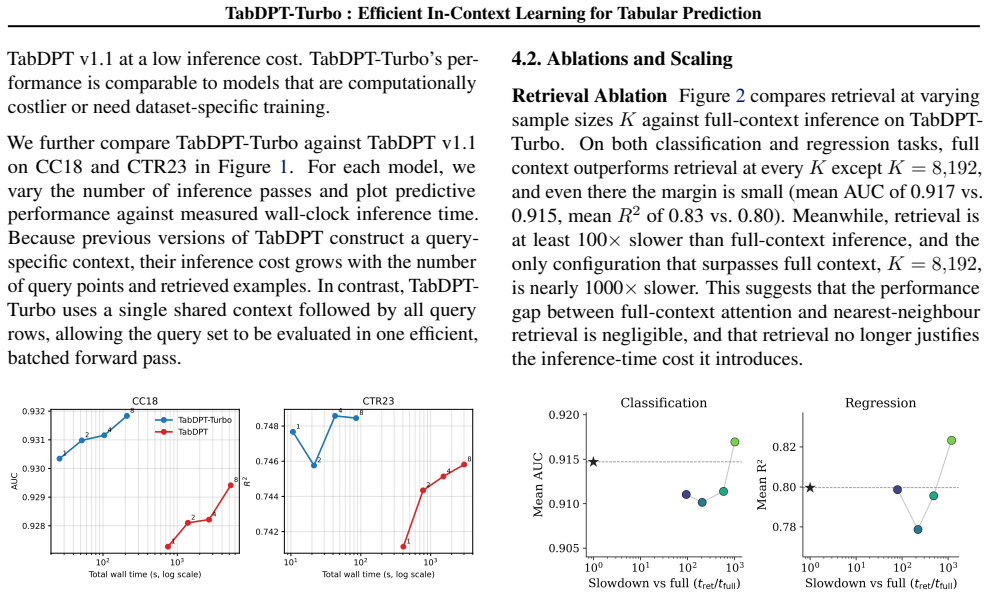
- Retrieval can be removed without sacrificing accuracy, since full-context attention matches or exceeds retrieval at every tested context size.
- Scaling the pre-training corpus from 112 to 1,445 datasets, and increasing both context length and model size, each yields measurable performance gains.
- On TabArena-Lite, TabDPT-Turbo ranks fourth among leading foundation models and outperforms TabDPT v1.1 while being the fastest model on the same hardware.
Reading between the lines
- If the internal nearest-neighbour behaviour of in-context learners is general, other retrieval-heavy tabular foundation models could likely drop retrieval in favour of longer contexts and gain similar speedups without losing accuracy.
- The paper does not report a quantitative leakage test between its new 1,445-dataset pre-training corpus and the benchmark suites; running such a test would either strengthen or undermine the performance comparison.
- The same retrieval-free long-context recipe could be applied to data regimes the paper leaves open, such as very high-dimensional tables (via PCA or column subsampling) and non-standard prediction tasks like survival analysis.
Editorial analysis
A structured set of objections, weighed in public.
Referee Report
Summary. The paper introduces TabDPT-Turbo, a row-based, retrieval-free tabular foundation model that extends the TabDPT family. The main claim is that TabDPT-Turbo achieves predictive performance comparable to TabDPT v1.1 on TabArena-Lite, CC18, and CTR23, while being orders of magnitude faster at inference. The model uses a longer context (up to 32k rows during training, 100k at inference), a larger OpenML-derived pre-training corpus (1,445 datasets), and several architectural changes such as attention temperature scaling, per-layer target conditioning, learned thinking rows, regression-as-classification with CRPS, and an auxiliary context prediction loss. Experiments report accuracy versus wall-time trade-offs (Figure 1), same-hardware speed comparisons (Table 1), an Elo ranking on TabArena-Lite (Figure 4), and ablations on retrieval and scaling. The model is released as TabDPT v1.2.
Significance. If the claims hold, this is a practically valuable contribution: it shows that a row-based architecture with long-context training can match or exceed a previously leading row-based TFM while removing the retrieval bottleneck, and it provides an open-source model that is substantially faster than current state-of-the-art TFMs. The paper includes several strengths: release of the model, a new larger pre-training corpus, same-hardware speed comparisons for leading models, and ablations isolating retrieval and scaling effects. However, the central accuracy claim depends on two points that are not fully demonstrated: (1) the pre-training corpus is effectively disjoint from the evaluation benchmarks, and (2) the reported accuracy differences are statistically reliable. Both are addressable with additional analysis.
major comments (2)
- [§3.1 (Data)] The central accuracy claim — 'comparable default performance to TabDPT v1.1' — depends on the pre-training corpus being effectively disjoint from the evaluation benchmarks, but the paper only asserts the deduplication pipeline and gives no quantitative leakage test. The described heuristic (equal row/column counts plus a permuted-table tolerance) can miss near-duplicates that differ by renaming, added/deleted columns, or row resampling. Please add a concrete leakage analysis between the 1,445 OpenML training tables and CC18, CTR23, and TabArena-Lite: for example, nearest-neighbor feature correlation or canonicalized table hashing, reporting the worst-case similarity. Without this, the reported accuracy numbers in Figure 1 and Figure 4 could be optimistically biased.
- [§4, Figure 1 and Table 1] The paper reports no uncertainty quantification on its main comparisons. Figure 1 plots a single point per pass count with no error bars or per-dataset spread; Table 1 gives single averages on one hardware setup. Since the contribution is 'comparable performance at lower cost,' the accuracy equivalence needs statistical support: for instance, paired bootstrap confidence intervals across datasets on mean AUC/R2, or a signed-rank test for TabDPT-Turbo versus TabDPT v1.1 and versus the other TFMs. The speed differences are large enough to be robust, but the accuracy comparison is not supported without such analysis.
minor comments (4)
- [Abstract and §4.1] The phrase 'orders of magnitude faster' is not consistently quantified. Table 1 gives TabDPT-Turbo 0.63 s/1k rows versus TabPFN-3 1.51 s (about 2.4×) and TabICLv2 8.16 s (about 13×). The claim is plausibly true for TabDPT v1.1 in Figure 1, but the paper should state exact speed ratios on the reported hardware, especially when referring to 'leading foundation models' in general.
- [§4.1] The TabArena-Lite comparison mentions that 'hardware configurations differed' between the paper's runs and the reported TabArena-Lite results. This limits the comparability of those speed statements; please clarify which numbers were produced on which hardware and restrict cross-hardware comparisons to the same harder tests or add a caveat.
- [Figure 1] The x-axis label 'Total wall time (s, log scale)' is clear, but the legend labels 'T abDPT-T urbo' and 'T abDPT' are inconsistent with the text. Please use 'TabDPT-Turbo' and 'TabDPT v1.1' throughout for clarity.
- [§3.1] The filtering criterion 'fewer than 10 columns' is a notable design choice, since many tabular benchmarks contain low-dimensional datasets. A sentence justifying this cutoff (e.g., an ablation) would help readers assess the model's applicability to small- and medium-feature regimes.
Circularity Check
No significant circularity; evaluation is external and the self-citations are motivational rather than load-bearing.
full rationale
The paper's central claim—comparable default predictive performance to TabDPT v1.1 on TabArena-Lite, CC18, and CTR23 at much higher speed—is evaluated against external benchmark suites. The model is pre-trained on a filtered and deduplicated OpenML corpus with an SSL objective, and the reported accuracy numbers are measured outcomes of that trained model, not values of fitted parameters recycled into an evaluation target. No equation or fitted constant is shown to reduce to an input by construction. The self-citations (TabDPT by Ma et al., Shaheen et al., Thomas et al., Ma et al.) are used to motivate design choices, but the paper supplies its own evidence for those choices: e.g., the retrieval-free design is supported by the retrieval ablation in Figure 2, and scaling benefits are shown in the paper's own scaling experiments. The citing of the authors' forthcoming Shaheen et al. work to argue that ICL TFMs learn nearest-neighbour behaviour internally is not load-bearing because the paper's own full-context-vs-retrieval comparison provides the actual empirical justification. A caveat worth noting as a data-quality risk, not circularity, is that the deduplication against TabArena/CC18/CTR23 is asserted without a quantitative leakage test; if near-duplicates remained in the 1,445 OpenML datasets, the benchmark numbers could be optimistic. But this would be data contamination, not a derivation that is circular by definition. The ablations in Section 4.2 also use CC18/CTR23, which is a benchmarking-practice concern (repeated evaluation on the test suites during development), but again does not amount to a circular reduction in the paper's reasoning. Overall, the derivation chain is self-contained with respect to its inputs.
Assumptions & free parameters
free parameters (4)
- attention temperature scaling coefficient =
not stated
- maximum context length =
32,768 rows
- deduplication tolerance for table reordering =
not stated
- pre-training data filters =
>=10 columns, <=200 columns, categorical cardinality <=100
assumptions (3)
- domain assumption Pre-training on OpenML tables with the SSL objective transfers to benchmark datasets (CC18, CTR23, TabArena-Lite).
- domain assumption The deduplication process successfully removes all near-duplicates of CC18, CTR23, and TabArena from the pre-training corpus.
- standard math Tensor operations and attention (softmax, scaled dot-product, SwiGLU) are standard mathematics; no exotic lemmas.
Cite this review
Pith. "Pith review of TabDPT-Turbo: Efficient In-Context Learning for Tabular Prediction." pith.science (2026). https://pith.science/paper/J7U3EJVH
@misc{pith2026260801400,
  author       = {Pith},
  title        = {Pith review of: TabDPT-Turbo: Efficient In-Context Learning for Tabular Prediction},
  year         = {2026},
  howpublished = {\url{https://pith.science/paper/J7U3EJVH}},
  note         = {Machine review of arXiv:2608.01400}
}
read the original abstract
Tabular foundation models, driven by in-context learning, have rapidly grown in quality and popularity. However, recent approaches with either cell-based architectures or retrieval have sacrificed efficiency for raw performance, restricting their utility in situations where compute is limited or inference speed is crucial. We adopt an alternate approach, sticking with row-based attention while incorporating long context pre-training to eliminate the need for retrieval. By combining this with architectural improvements and SSL pre-training on a newly-sourced, larger corpus of real data results, we present TabDPT-Turbo, a model that provides comparable default performance to TabDPT v1.1 on TabArena-Lite, CC18, and CTR23, at orders of magnitude faster. In our experiments, TabDPT-Turbo is the fastest model overall among leading foundation models. We have released the new model as TabDPT v1.2 at https://github.com/layer6ai-labs/TabDPT-inference.
Figures


Figures from the paper (2 more)


Reference graph
Works this paper leans on
-
[1]
CausalPFN : Amortized causal effect estimation via in-context learning
Balazadeh Meresht, V., Kamkari, H., Thomas, V., Ma, J., Li, B., Cresswell, J., and Krishnan, R. CausalPFN : Amortized causal effect estimation via in-context learning. In Advances in Neural Information Processing Systems, 2025
work page 2025
-
[2]
Bischl, B., Casalicchio, G., Feurer, M., Gijsbers, P., Hutter, F., Lang, M., Gomes Mantovani, R., van Rijn, J., and Vanschoren, J. OpenML benchmarking suites. In Proceedings of the Neural Information Processing Systems Track on Datasets and Benchmarks, volume 1, 2021
work page 2021
-
[3]
C., Németh, L., Oala, L., Purucker, L., Ravi, S., van Rijn, J
Bischl, B., Casalicchio, G., Das, T., Feurer, M., Fischer, S., Gijsbers, P., Mukherjee, S., Müller, A. C., Németh, L., Oala, L., Purucker, L., Ravi, S., van Rijn, J. N., Singh, P., Vanschoren, J., van der Velde, J., and Wever, M. OpenML : Insights from 10 years and more than a thousand papers. Patterns, 6 0 (7), 2025
work page 2025
-
[4]
Bouadi, M., Seth, P., Tanna, A., and Sankarapu, V. K. Orion-MSP : Multi-scale sparse attention for tabular in-context learning. arXiv:2511.02818, 2025
arXiv 2025
-
[5]
Random forests
Breiman, L. Random forests. Machine learning, 45: 0 5--32, 2001
2001
-
[6]
M., Salinas, D., and Hutter, F
Erickson, N., Purucker, L., Tschalzev, A., Holzm \"u ller, D., Desai, P. M., Salinas, D., and Hutter, F. TabArena : A living benchmark for machine learning on tabular data. In Advances in Neural Information Processing Systems, 2025
work page 2025
-
[7]
Fischer, S. F., Feurer, M., and Bischl, B. OpenML-CTR23 -- A curated tabular regression benchmarking suite. In AutoML Conference (Workshop), 2023
work page 2023
-
[8]
TabM: Advancing tabular deep learning with parameter-efficient ensembling
Gorishniy, Y., Kotelnikov, A., and Babenko, A. TabM: Advancing tabular deep learning with parameter-efficient ensembling . In International Conference on Learning Representations, 2025
work page 2025
Show all 25 references
-
[9]
o ge, K., Key, O., Birkel, F., Jund, P., Roof, B., J \
Grinsztajn, L., Fl \"o ge, K., Key, O., Birkel, F., Jund, P., Roof, B., J \"a ger, B., Safaric, D., Alessi, S., Hayler, A., Manium, M., Yu, R., Jablonski, F., Hoo, S. B., Garg, A., Robertson, J., B \"u hler, M., Moroshan, V., Purucker, L., Cornu, C., Wehrhahn, L. C., Bonetto, ...
2025 arXiv
-
[10]
TabPFN : A transformer that solves small tabular classification problems in a second
Hollmann, N., M \"u ller, S., Eggensperger, K., and Hutter, F. TabPFN : A transformer that solves small tabular classification problems in a second. In International Conference on Learning Representations, 2023
2023
-
[11]
B., Schirrmeister, R
Hollmann, N., Müller, S., Purucker, L., Krishnakumar, A., Körfer, M., Hoo, S. B., Schirrmeister, R. T., and Hutter, F. Accurate predictions on small data with a tabular foundation model. Nature, 637 0 (8045): 0 319--326, 2025
2025
-
[12]
and Knoll, P
Landsgesell, J. and Knoll, P. ScoringBench : A benchmark for evaluating tabular foundation models with proper scoring rules. arXiv:2603.29928, 2026
2026 arXiv
-
[13]
Accurate intelligible models with pairwise interactions
Lou, Y., Caruana, R., Gehrke, J., and Hooker, G. Accurate intelligible models with pairwise interactions. In Proceedings of the 19th ACM SIGKDD international conference on Knowledge discovery and data mining, pp.\ 623--631, 2013
2013
-
[14]
Ma, J., Thomas, V., Yu, G., and Caterini, A. L. In-context data distillation with TabPFN . In ICLR Workshop on Understanding of Foundation Models (ME-FoMo), 2024
2024
-
[15]
C., Golestan, K., Yu, G., Caterini, A
Ma, J., Thomas, V., Hosseinzadeh, R., Kamkari, H., Labach, A., Cresswell, J. C., Golestan, K., Yu, G., Caterini, A. L., and Volkovs, M. TabDPT : Scaling tabular foundation models on real data. In Advances in Neural Information Processing Systems, 2025
2025
-
[16]
V., and Gulin, A
Prokhorenkova, L., Gusev, G., Vorobev, A., Dorogush, A. V., and Gulin, A. CatBoost : Unbiased boosting with categorical features. In Advances in Neural Information Processing Systems, 2018
2018
-
[17]
Qu, J., Holzm \"u ller, D., Varoquaux, G., and Morvan, M. L. TabICL : A tabular foundation model for in-context learning on large data. In International Conference on Machine Learning, 2025
2025
-
[18]
Qu, J., Holzm \"u ller, D., Varoquaux, G., and Morvan, M. L. TabICLv2 : A better, faster, scalable, and open tabular foundation model. In International Conference on Machine Learning, 2026
2026
-
[19]
L., and Thomas, V
Shaheen, N., Ma, J., Labach, A., Hutter, F., Caterini, A. L., and Thomas, V. Understanding the surprising generalization properties of tabular foundation models. arXiv:2511.09665, 2026
2026
-
[20]
Thomas, V., Ma, J., Hosseinzadeh, R., Golestan, K., Yu, G., Volkovs, M., and Caterini, A. L. Retrieval & fine-tuning for in-context tabular models. In Advances in Neural Information Processing Systems, 2024
2024
-
[21]
and van der Schaar, M
van Breugel, B. and van der Schaar, M. Why tabular foundation models should be a research priority. In International Conference on Machine Learning, 2024
2024
-
[22]
N., Bischl, B., and Torgo, L
Vanschoren, J., Van Rijn, J. N., Bischl, B., and Torgo, L. OpenML : Networked science in machine learning. ACM SIGKDD Explorations Newsletter, 15 0 (2): 0 49--60, 2014
2014
-
[23]
Softmax is not enough (for sharp size generalisation)
Veli c kovi \'c , P., Perivolaropoulos, C., Barbero, F., and Pascanu, R. Softmax is not enough (for sharp size generalisation). In International Conference on Machine Learning, 2025
2025
-
[24]
F., Han, B., Zhang, S., Akoglu, L., Faloutsos, C., Mahoney, M., Hu, T., Rangwala, H., Karypis, G., and Wang, Y
Zhang, X., Maddix Robinson, D., Yin, J., Erickson, N., Ansari, A. F., Han, B., Zhang, S., Akoglu, L., Faloutsos, C., Mahoney, M., Hu, T., Rangwala, H., Karypis, G., and Wang, Y. B. Mitra: Mixed synthetic priors for enhancing tabular foundation models. In Advances in Neural Inf...
2025
-
[25]
LimiX : Unleashing structured-data modeling capability for generalist intelligence
Zhang, X., Ren, G., Yu, H., Yuan, H., Wang, H., Li, J., Wu, J., Mo, L., Mao, L., Hao, M., et al. LimiX : Unleashing structured-data modeling capability for generalist intelligence. arXiv:2509.03505, 2025 b
2025
Reviewed August 6, 2026 · model on record in the stance chip above.
Discussion (0). Continue with ORCID to comment.