MMBench-Live: A Continuously Evolving Benchmark for Multimodal Models
Pith reviewed 2026-07-03 16:08 UTC · model grok-4.3
The pith
A multi-agent automated pipeline creates continuously updating multimodal benchmarks that preserve original properties at low cost.
A machine-rendered reading of the paper's core claim, the machinery that carries it, and where it could break.
Core claim
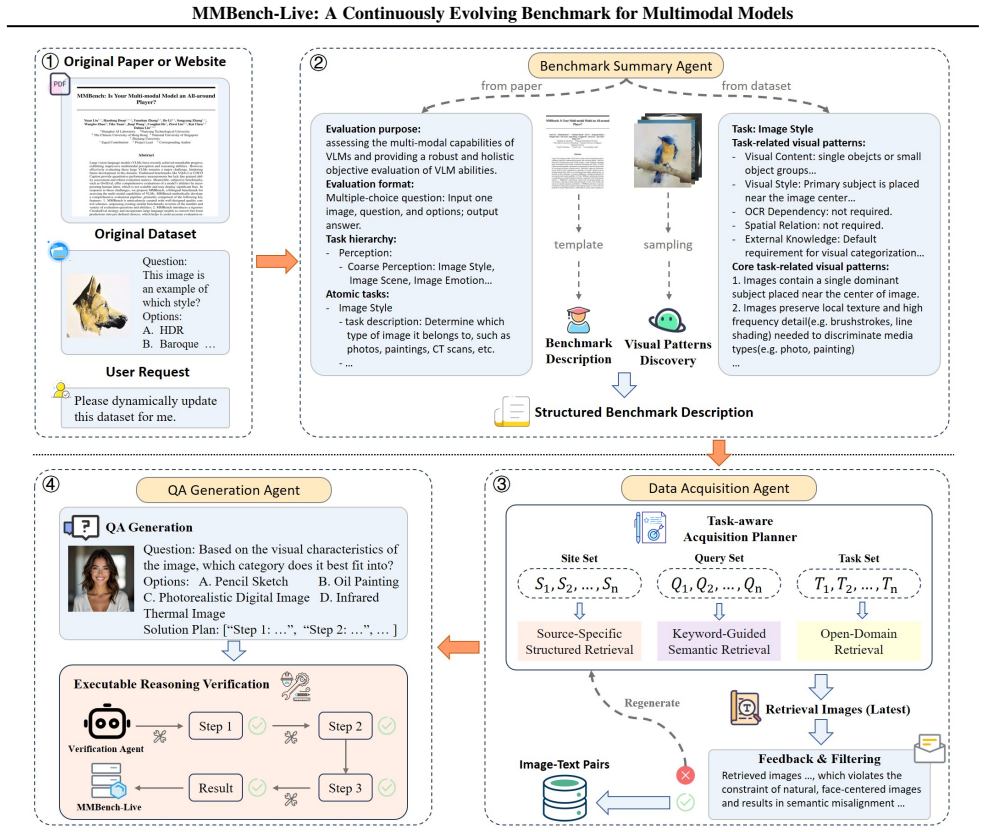
MMBench-Live is instantiated from MMBench via a multi-agent-driven automated pipeline that integrates structured benchmark specification, feedback-controlled real-time data acquisition, and verifiable QA generation with executable reasoning. A distribution-consistent update strategy extracts task-related visual patterns from the original benchmark to guide collection and filtering. The resulting set contains 5.9K new evaluation instances with high answer correctness, where each update costs about USD 30 and takes 1-2 hours. Evaluations confirm that the live version preserves stable model rankings, maintains semantic alignment with the original, and exhibits weaker contamination-related memor
What carries the argument
Multi-agent-driven automated pipeline with distribution-consistent update strategy, which automates real-time data acquisition and filtering while enforcing cross-version comparability through extracted visual patterns.
If this is right
- Model performance rankings remain consistent between successive benchmark versions.
- New instances reduce measurable contamination effects relative to the static original.
- Updates become feasible on a frequent schedule without large resource expenditure.
- The same visual patterns and task requirements continue to be measured across versions.
Where Pith is reading between the lines
- The same pipeline structure could be applied to other static multimodal or language benchmarks to address staleness.
- Frequent low-cost refreshes would allow finer tracking of capability changes over short time periods.
- If the alignment mechanism generalizes, evaluation sets could shift from one-time human curation toward ongoing automated maintenance.
Load-bearing premise
The multi-agent pipeline produces new instances whose semantic alignment and correctness can be trusted without introducing new biases or contamination.
What would settle it
Direct side-by-side testing in which models show substantially different accuracy patterns or stronger memorization signals on the new instances compared with the original benchmark.
Figures


read the original abstract
Evaluation benchmarks are essential for assessing vision-language models (VLMs), but most multimodal benchmarks are static, making them vulnerable to temporal staleness, data contamination, and costly maintenance. We present MMBench-Live, a continuously evolving multimodal benchmark built by a multi-agent-driven automated pipeline. Our framework treats benchmark evolution as task-guided dataset construction, integrating structured benchmark specification, feedback-controlled real-time data acquisition, and verifiable QA generation with executable reasoning. To maintain cross-version comparability, we introduce a distribution-consistent update strategy that extracts task-related visual patterns from the original benchmark to guide data collection and filtering. Instantiated from MMBench, MMBench-Live contains 5.9K newly generated evaluation instances with a high answer correctness rate, while each update costs about USD 30 and takes 1-2 hours. Extensive evaluations show that MMBench-Live preserves stable model rankings, maintains semantic alignment with the original benchmark, and exhibits weaker contamination-related memorization signals, suggesting a practical and scalable paradigm for sustainable multimodal benchmark evolution. The project is available at https://github.com/PRIS-CV/MMBench-Live.
Editorial analysis
A structured set of objections, weighed in public.
Referee Report
Summary. The paper introduces MMBench-Live, a continuously evolving multimodal benchmark for vision-language models constructed from the original MMBench via a multi-agent pipeline. The pipeline integrates benchmark specification, feedback-controlled data acquisition, and verifiable QA generation; a distribution-consistent update strategy extracts visual patterns to guide new instances. The work reports 5.9K new instances at ~USD 30 and 1-2 hours per update, with claims of high answer correctness, stable model rankings across versions, maintained semantic alignment, and weaker memorization signals than the static original.
Significance. If the pipeline outputs prove trustworthy, the approach offers a low-cost, scalable method for maintaining multimodal benchmarks against temporal staleness and contamination, with potential to influence how dynamic evaluation suites are built in the field.
major comments (2)
- [Abstract] Abstract: The central claims of 'high answer correctness rate,' 'maintains semantic alignment,' and 'exhibits weaker contamination-related memorization signals' rest on internal pipeline outputs (feedback loops and pattern extraction) without any reported independent human validation, error analysis, or external ground-truth baselines. This leaves open whether the automated assessments detect systematic issues such as hallucinated reasoning or shifted difficulty.
- [Evaluations] The evaluations section: Stable rankings and reduced memorization are presented as evidence of successful evolution, yet these metrics are computed on instances whose correctness and alignment were themselves judged by the same multi-agent system; no cross-check against human annotators or comparison to held-out original MMBench subsets is described to confirm the distribution-consistent strategy preserves task semantics.
Simulated Author's Rebuttal
We thank the referee for the constructive feedback on our work. We address each major comment below and will incorporate revisions to strengthen the validation aspects of the manuscript.
read point-by-point responses
-
Referee: [Abstract] Abstract: The central claims of 'high answer correctness rate,' 'maintains semantic alignment,' and 'exhibits weaker contamination-related memorization signals' rest on internal pipeline outputs (feedback loops and pattern extraction) without any reported independent human validation, error analysis, or external ground-truth baselines. This leaves open whether the automated assessments detect systematic issues such as hallucinated reasoning or shifted difficulty.
Authors: The multi-agent pipeline incorporates feedback-controlled data acquisition and verifiable QA generation with executable reasoning precisely to reduce risks such as hallucinated reasoning. The reported correctness rate and alignment metrics are outputs of these mechanisms. We agree, however, that independent human validation provides stronger corroboration. In the revised manuscript we will add a human evaluation study on a sampled subset of generated instances, reporting inter-annotator agreement and error analysis. revision: yes
-
Referee: [Evaluations] The evaluations section: Stable rankings and reduced memorization are presented as evidence of successful evolution, yet these metrics are computed on instances whose correctness and alignment were themselves judged by the same multi-agent system; no cross-check against human annotators or comparison to held-out original MMBench subsets is described to confirm the distribution-consistent strategy preserves task semantics.
Authors: The distribution-consistent update strategy extracts task-related visual patterns directly from the original MMBench to guide collection and filtering, with the explicit goal of preserving semantics and difficulty. Stable model rankings across versions and weaker memorization signals constitute empirical evidence that this goal is met. To provide an explicit cross-check, the revision will include (i) direct comparison of model performance on held-out original MMBench subsets and (ii) human judgments of semantic alignment for the new instances. revision: yes
Circularity Check
No significant circularity; pipeline construction uses external acquisition with independent external evaluations
full rationale
The paper describes an automated multi-agent pipeline for generating new benchmark instances from MMBench patterns via distribution-consistent updates, feedback loops, and verifiable QA. No equations, fitted parameters, or predictions reduce to inputs by construction. Reported outcomes (stable rankings, semantic alignment, reduced memorization) rely on external model evaluations rather than internal self-assessment alone. Any reference to the original MMBench is not load-bearing for the core claims in a self-referential way. This is a standard low-circularity empirical construction paper.
Axiom & Free-Parameter Ledger
Reference graph
Works this paper leans on
-
[1]
LLaMA: Open and Efficient Foundation Language Models , author=. 2023 , eprint=
work page 2023
-
[2]
Kocyigit, Muhammed Yusuf and Briakou, Eleftheria and Deutsch, Daniel and Luo, Jiaming and Cherry, Colin and Freitag, Markus , booktitle =. Overestimation in. 2025 , editor =
work page 2025
-
[3]
Findings of the Association for Computational Linguistics: EMNLP 2023 , month = dec, year =
NLP Evaluation in trouble: On the Need to Measure LLM Data Contamination for each Benchmark , author =. Findings of the Association for Computational Linguistics: EMNLP 2023 , month = dec, year =. doi:10.18653/v1/2023.findings-emnlp.722 , pages =
-
[4]
Findings of the Association for Computational Linguistics: EMNLP 2025 , month = nov, year =
Both Text and Images Leaked! A Systematic Analysis of Data Contamination in Multimodal LLM , author =. Findings of the Association for Computational Linguistics: EMNLP 2025 , month = nov, year =. doi:10.18653/v1/2025.findings-emnlp.556 , pages =
-
[5]
AntiLeakBench: Preventing Data Contamination by Automatically Constructing Benchmarks with Updated Real-World Knowledge , author =. Proceedings of the 63rd Annual Meeting of the Association for Computational Linguistics (Volume 1: Long Papers) , month = jul, year =
-
[6]
Zhang, Huixuan and Lin, Yun and Wan, Xiaojun. P a C o ST : Paired Confidence Significance Testing for Benchmark Contamination Detection in Large Language Models. Findings of the Association for Computational Linguistics: EMNLP 2024. 2024. doi:10.18653/v1/2024.findings-emnlp.97
-
[7]
and Khashabi, Daniel and Hajishirzi, Hannaneh
Wang, Yizhong and Kordi, Yeganeh and Mishra, Swaroop and Liu, Alisa and Smith, Noah A. and Khashabi, Daniel and Hajishirzi, Hannaneh. Self-Instruct: Aligning Language Models with Self-Generated Instructions. Proceedings of the 61st Annual Meeting of the Association for Computational Linguistics (Volume 1: Long Papers). 2023. doi:10.18653/v1/2023.acl-long.754
-
[8]
Can Xu and Qingfeng Sun and Kai Zheng and Xiubo Geng and Pu Zhao and Jiazhan Feng and Chongyang Tao and Qingwei Lin and Daxin Jiang , booktitle=. Wizard
-
[9]
Visual Instruction Tuning , volume =
Liu, Haotian and Li, Chunyuan and Wu, Qingyang and Lee, Yong Jae , booktitle =. Visual Instruction Tuning , volume =
-
[10]
Zhen Guo and Adriana Meza Soria and Wei Sun and Yikang Shen and Rameswar Panda , booktitle=
-
[11]
Qiantong Xu and Fenglu Hong and Bo Li and Changran Hu and Zhengyu Chen and Jian Zhang , title =. 2023 , note =
work page 2023
-
[12]
Minghao Liu and Zonglin Di and Jiaheng Wei and Zhongruo Wang and Hengxiang Zhang and Ruixuan Xiao and Haoyu Wang and Jinlong Pang and Hao Chen and Ankit Shah and Hongxin Wei and Xinlei He and Zhaowei Zhao and Haobo Wang and Lei Feng and Jindong Wang and James Davis and Yang Liu , title =. 2024 , note =
work page 2024
-
[13]
Bu, Tianpeng and Zhang, Minying and Duan, Hongtao and Li, Shurui and Hu, Lulu and Li, Yu , booktitle =. Enhanced Data Synthesis for. 2025 , address =. doi:10.18653/v1/2025.findings-acl.821 , pages =
-
[14]
Proceedings of the Royal Society of London , volume =
Notes on Regression and Inheritance in the Case of Two Parents , author =. Proceedings of the Royal Society of London , volume =
-
[15]
The American Journal of Psychology , volume =
The Proof and Measurement of Association between Two Things , author =. The American Journal of Psychology , volume =
-
[16]
The 36th Conference on Neural Information Processing Systems (NeurIPS) , year=
Learn to Explain: Multimodal Reasoning via Thought Chains for Science Question Answering , author=. The 36th Conference on Neural Information Processing Systems (NeurIPS) , year=
-
[17]
Proceedings of the IEEE/CVF Conference on Computer Vision and Pattern Recognition (CVPR) , month =
Li, Bohao and Ge, Yuying and Ge, Yixiao and Wang, Guangzhi and Wang, Rui and Zhang, Ruimao and Shan, Ying , title =. Proceedings of the IEEE/CVF Conference on Computer Vision and Pattern Recognition (CVPR) , month =. 2024 , pages =
work page 2024
-
[18]
European conference on computer vision , pages=
Mmbench: Is your multi-modal model an all-around player? , author=. European conference on computer vision , pages=. 2024 , organization=
work page 2024
-
[19]
MME: A Comprehensive Evaluation Benchmark for Multimodal Large Language Models
MME: A Comprehensive Evaluation Benchmark for Multimodal Large Language Models , author=. arXiv preprint arXiv:2306.13394 , year=
work page internal anchor Pith review Pith/arXiv arXiv
-
[20]
Both Text and Images Leaked! A Systematic Analysis of Data Contamination in Multimodal
Dingjie Song and Sicheng Lai and Mingxuan Wang and Shunian Chen and Lichao Sun and Benyou Wang , booktitle=. Both Text and Images Leaked! A Systematic Analysis of Data Contamination in Multimodal. 2025 , url=
work page 2025
-
[21]
LLaMA: Open and Efficient Foundation Language Models , author=. ArXiv , year=
-
[22]
The Thirty-eighth Annual Conference on Neural Information Processing Systems , year=
Are We on the Right Way for Evaluating Large Vision-Language Models? , author=. The Thirty-eighth Annual Conference on Neural Information Processing Systems , year=
-
[23]
Native Visual Understanding: Resolving Resolution Dilemmas in Vision-Language Models , author=. 2025 , eprint=
work page 2025
-
[24]
Mohan Jiang and Jin Gao and Jiahao Zhan and Dequan Wang , booktitle=. 2025 , url=
work page 2025
-
[25]
The Thirteenth International Conference on Learning Representations , year=
LiveXiv - A Multi-Modal live benchmark based on Arxiv papers content , author=. The Thirteenth International Conference on Learning Representations , year=
-
[26]
The Thirteenth International Conference on Learning Representations , year=
LiveCodeBench: Holistic and Contamination Free Evaluation of Large Language Models for Code , author=. The Thirteenth International Conference on Learning Representations , year=
-
[27]
LiveBench: A Challenging, Contamination-Limited
Colin White and Samuel Dooley and Manley Roberts and Arka Pal and Benjamin Feuer and Siddhartha Jain and Ravid Shwartz-Ziv and Neel Jain and Khalid Saifullah and Sreemanti Dey and Shubh-Agrawal and Sandeep Singh Sandha and Siddartha Venkat Naidu and Chinmay Hegde and Yann LeCun and Tom Goldstein and Willie Neiswanger and Micah Goldblum , booktitle=. LiveB...
work page 2025
-
[28]
The Thirteenth International Conference on Learning Representations , year=
Dynamic Multimodal Evaluation with Flexible Complexity by Vision-Language Bootstrapping , author=. The Thirteenth International Conference on Learning Representations , year=
-
[29]
KBE-DME: Dynamic Multimodal Evaluation via Knowledge Enhanced Benchmark Evolution , author=. 2026 , eprint=
work page 2026
-
[30]
SDEval: Safety Dynamic Evaluation for Multimodal Large Language Models , author=. 2026 , eprint=
work page 2026
-
[31]
Dysca: A Dynamic and Scalable Benchmark for Evaluating Perception Ability of
Jie Zhang and Zhongqi Wang and Mengqi Lei and Zheng Yuan and Bei Yan and Shiguang Shan and Xilin Chen , booktitle=. Dysca: A Dynamic and Scalable Benchmark for Evaluating Perception Ability of. 2025 , url=
work page 2025
-
[32]
The Thirty-ninth Annual Conference on Neural Information Processing Systems , year=
Spot the Fake: Large Multimodal Model-Based Synthetic Image Detection with Artifact Explanation , author=. The Thirty-ninth Annual Conference on Neural Information Processing Systems , year=
- [33]
- [34]
-
[35]
DeepSeek-VL: Towards Real-World Vision-Language Understanding , author=. 2024 , eprint=
work page 2024
- [36]
-
[37]
mPLUG-OwI2: Revolutionizing Multi-modal Large Language Model with Modality Collaboration , year=
Ye, Qinghao and Xu, Haiyang and Ye, Jiabo and Yan, Ming and Hu, Anwen and Liu, Haowei and Qian, Qi and Zhang, Ji and Huang, Fei , booktitle=. mPLUG-OwI2: Revolutionizing Multi-modal Large Language Model with Modality Collaboration , year=
- [38]
- [39]
-
[40]
MTVQA: Benchmarking Multilingual Text-Centric Visual Question Answering , author=. 2024 , eprint=
work page 2024
-
[41]
Shiyue Zhang and David Wan and Arie Cattan and Ayal Klein and Ido Dagan and Mohit Bansal , booktitle=. 2025 , url=
work page 2025
-
[42]
Proceedings of the IEEE/CVF International Conference on Computer Vision (ICCV) , month =
Chen, Chongyan and Tseng, Yu-Yun and Li, Zhuoheng and Venkatesh, Anush and Gurari, Danna , title =. Proceedings of the IEEE/CVF International Conference on Computer Vision (ICCV) , month =. 2025 , pages =
work page 2025
-
[43]
Anka Reuel and Amelia Hardy and Chandler Smith and Max Lamparth and Malcolm Hardy and Mykel Kochenderfer , booktitle=. BetterBench: Assessing. 2024 , url=
work page 2024
-
[44]
BenchmarkCards: Standardized Documentation for Large Language Model Benchmarks , author=. The Thirty-ninth Annual Conference on Neural Information Processing Systems Datasets and Benchmarks Track , year=
-
[45]
OK-VQA: A Visual Question Answering Benchmark Requiring External Knowledge , year=
Marino, Kenneth and Rastegari, Mohammad and Farhadi, Ali and Mottaghi, Roozbeh , booktitle=. OK-VQA: A Visual Question Answering Benchmark Requiring External Knowledge , year=
-
[46]
Hudson, Drew A. and Manning, Christopher D. , booktitle=. GQA: A New Dataset for Real-World Visual Reasoning and Compositional Question Answering , year=
-
[47]
Ling Fu and Zhebin Kuang and Jiajun Song and Mingxin Huang and Biao Yang and Yuzhe Li and Linghao Zhu and Qidi Luo and Xinyu Wang and Hao Lu and Zhang Li and Guozhi Tang and Bin Shan and Chunhui Lin and Qi Liu and Binghong Wu and Hao Feng and Hao Liu and Can Huang and Jingqun Tang and Wei Chen and Lianwen Jin and Yuliang Liu and Xiang Bai , booktitle=. 20...
work page 2025
-
[48]
The Fourteenth International Conference on Learning Representations , year=
VisionReasoner: Unified Reasoning-Integrated Visual Perception via Reinforcement Learning , author=. The Fourteenth International Conference on Learning Representations , year=
-
[49]
The Thirty-eighth Annual Conference on Neural Information Processing Systems , year=
Depth Anything V2 , author=. The Thirty-eighth Annual Conference on Neural Information Processing Systems , year=
-
[50]
Liu, Haotian and Li, Chunyuan and Wu, Qingyang and Lee, Yong Jae , title =. NeurIPS , year =
-
[51]
General OCR Theory: Towards OCR-2.0 via a Unified End-to-end Model , author=. 2024 , eprint=
work page 2024
discussion (0)
Sign in with ORCID, Apple, or X to comment. Anyone can read and Pith papers without signing in.