REVIEW 4 major objections 4 minor 127 references
General-purpose multimodal language models can match or beat remote-sensing-specific models on several satellite-image understanding tasks without any domain fine-tuning.
Reviewed by Pith at T0; open to challenge. T0 means a machine referee read the full paper against a public rubric. the ladder, T0–T4 →
T0 review · deepseek-v4-flash
2026-08-01 10:16 UTC pith:JB43QSUF
load-bearing objection A genuinely useful RS-MLLM survey with a valuable unified evaluation of general vs specialized models; the general-purpose superiority on LHRS-Bench and FIT-RSRC holds, but the visual-grounding/XLRS-Bench advantages are adopted from external papers and don't survive the paper's own standardized runs. the 4 major comments →
Multimodal Large Language Models for Remote Sensing Image Understanding: Domain-Specific or General-Purpose?
The pith
A machine-rendered reading of the paper's core claim, the machinery that carries it, and where it could break.
Core claim
On the paper's own standardized zero-shot runs, Qwen3-VL (64.3%), GLM-4.6V-Flash (60.4%), and GPT-4o (55.8%) all outperform the best RS-MLLM (Geo-R1, 53.3%) on FIT-RSRC's relational multiple-choice reasoning; on LHRS-Bench, GLM-4.6V-Flash at 66.2% and Qwen3-VL at 64.1% beat most RS-MLLMs. Meanwhile, RS-MLLMs stayed ahead on RSVQA-HR (Falcon, 81.2%), on visual grounding benchmarks (RSThinker), and on XLRS-Bench (ScaleEarth, 57.4%). The authors' conclusion is that domain-specific instruction tuning confers localized advantages rather than consistent overall superiority, and that strong general-purpose backbones are becoming more decisive in determining RS benchmark performance. They also ident
What carries the argument
The evaluative engine is a standardized zero-shot benchmark comparison: identical prompts, greedy decoding, a unified output-parsing pipeline, and a contamination-risk audit that classifies each benchmark as zero-shot, no-adaptation, benchmark-aware, or transfer-learning. The paper combines this with a taxonomy of RS-MLLMs and CV-MLLMs across five tasks and eleven benchmarks, and it carefully distinguishes numbers produced in this study from numbers adopted from other papers. That distinction between zero-shot transfer from general models and in-domain evaluation of RS-tuned models is what carries the argument that RS-MLLM advantages are localized rather than universal.
Load-bearing premise
The comparison assumes that numbers from different sources and protocols—literature-reported RS-MLLM scores and the paper's own runs—can be read side by side; the paper's own re-runs differ from literature values by 3–6 points, which is the same magnitude as some of the differences it uses to draw conclusions.
What would settle it
A fully controlled re-run: evaluate every model in Tables 8–13 with the same prompts, the same 528-plus-528 RSVQA-HR sample, the same FIT-RSRC split, and the same answer parser, and check whether the general CV-MLLMs still lead on FIT-RSRC and LHRS-Bench; or a training-data audit revealing that Qwen3-VL, GLM-4.6V-Flash, or GPT-4o were trained on those benchmarks, which would remove the zero-shot transfer claim.
If this is right
- If correct, RS-specific fine-tuning should be treated as a complement to general visual capability, not a substitute for it; future RS-MLLMs should be built on the strongest available general backbones.
- Reported RS-MLLM wins on in-distribution benchmarks such as RSVQA-HR should not be read as evidence of general remote-sensing superiority, since several RS models were trained on those datasets.
- Benchmark designers should prioritize contamination-aware, multi-format benchmarks like LHRS-Bench and FIT-RSRC over benchmarks whose images or splits appear in training data.
- Evaluation protocol becomes a primary technical bottleneck: without shared prompts, answer parsing, and contamination audits, cross-paper comparisons are unreliable.
- Model size and domain tuning alone no longer determine performance; instruction diversity and the reasoning capability of the base model matter more.
- General-purpose MLLMs merit a role as backbones or teachers for future remote-sensing models, not merely as external baselines.
Where Pith is reading between the lines
- Editorial inference: the same logic likely extends to other geospatial and niche visual domains—if general CV-MLLMs transfer to remote sensing without fine-tuning, domain-specific MLLM efforts should first audit strong general backbones before investing heavily in narrow instruction data.
- Editorial inference: the paper's own protocol-sensitivity numbers (for example, GeoChat scoring 68.7 vs. 72.0 on AID under different runs) suggest that literature-reported RS-MLLM advantages on in-distribution benchmarks may shrink under fully standardized re-evaluation; a complete re-run of every model on every benchmark could reorder several tables.
- Editorial inference: a testable prediction follows—as stronger general MLLMs are released, their scores on LHRS-Bench and FIT-RSRC should improve even without any remote-sensing data, and this improvement rate should exceed that of RS-MLLMs that only add RS instruction data.
- Editorial inference: the paper's mixed-provenance tables leave open the possibility that the central conclusion is partly an artifact of protocol differences; a single-protocol, all-models re-run is the natural next experiment.
Editorial analysis
A structured set of objections, weighed in public.
Referee Report
Summary. This manuscript is a systematic survey and diagnostic evaluation of remote sensing multimodal large language models (RS-MLLMs) for remote sensing image scene understanding (RSISU). It taxonomizes the RS-MLLM landscape, reviews RS foundation models, instruction-tuning datasets, model architectures, and RS agents, and then compares representative RS-MLLMs with general-purpose CV-MLLMs on eleven benchmarks spanning scene classification, VQA, visual grounding, multiple-choice reasoning, and ultra-high-resolution VQA. The authors emphasize a standardized zero-shot evaluation protocol, a contamination-risk audit (Table 6), and explicit distinctions among strict zero-shot evaluation, no-adaptation inference, benchmark-aware evaluation, and transfer learning. The main empirical claim is that RS-MLLMs retain localized advantages in visual grounding, RSVQA-HR, and XLRS-Bench, while recent general-purpose CV-MLLMs (Qwen3-VL, GLM-4.6V-Flash, InternVL3.5, GPT-4o) match or outperform them on LHRS-Bench, FIT-RSRC, and several scene-classification settings. The paper concludes that RS-specific instruction tuning confers localized rather than universal advantages, and argues for combining strong general backbones with targeted RS adaptation.
Significance. If the central comparison were fully supported by the paper's own standardized runs, the conclusions would be practically important: they would challenge the default assumption that domain-specific RS instruction tuning is necessary, provide a blueprint for contamination-aware evaluation of domain MLLMs, and refocus the field on general foundation capabilities. The paper's strengths are genuine: Table 6 is a useful contamination-risk audit; the authors use public checkpoints/API versions, greedy decoding, and a deterministic parsing pipeline; they candidly document prompt sensitivity and report cases where their own re-runs differ from literature values (GeoChat 72.0 vs 68.7 and LLaVA-1.5 31.1 vs 37.2 on AID in Table 8); and they provide concrete failure-case analyses. The central empirical claims are benchmark measurements rather than derivations, so there is no mathematical circularity. The main limitation is evidentiary: several load-bearing conclusions mix literature-adopted scores with the paper's own standardized measurements in the same tables, so the balance between 'localized domain advantages' and 'general-purpose transferability' is not yet established at the claimed con
major comments (4)
- [Section 3, Tables 8, 9, 11, 13] The evaluation section states that 'our discussion primarily relies on the results obtained in this study... to ensure consistency in experimental settings and evaluation protocols,' and Section 3.1 claims all methods are evaluated under a zero-shot setting. The tables do not support this. Table 8 adopts LHRS-Bot (91.3 AID), SkySenseGPT (92.3), and H2RSVLM (89.3) from their original papers; Table 9 adopts Falcon (81.2), SkySenseGPT (76.6), H2RSVLM (74.4), and RS-LLaVA (75.0) from external papers; Table 11 is mostly composed of rows adopted from RSThinker (all rows without †); Table 13 is entirely adopted from GeoEyes and ScaleEarth. The paper itself shows protocol-induced shifts of 3.3 points for GeoChat on AID and 6.1 points for LLaVA-1.5 on AID, in opposite directions. Offsets of this magnitude are exactly the size of several differences used in the conclusions. Boldfacing and comparin
- [Section 3.2.3, Table 11] The claim that 'RS-MLLMs exhibit stronger grounding performance than general CV-MLLMs' is supported in the table only by non-† rows adopted from RSThinker (e.g., GeoChat 56.3, VHM 33.9, SkySenseGPT 63.4, EarthDial 14.1, RSThinker 90.4 on VRSBench). The RS-MLLMs actually re-run under the paper's stated protocol, Geo-R1† and ZoomEarth†, score 26.1 and 22.5 on VRSBench, both below Qwen3-VL† (53.3) and GLM-4.6V-Flash† (47.6); the same pattern holds on DIOR-RSVG (35.6/34.6 vs 57.8). Thus the paper's own standardized measurements do not support a domain-specific visual-grounding advantage; if anything, they point the other way. This is load-bearing because the abstract and conclusions repeatedly cite visual grounding as a pillar of the 'localized advantages' finding. Either re-evaluate additional RS-MLLMs (e.g., GeoChat, SkySenseGPT) under the same protocol, or downgrade the claim to a literat
- [Section 3.3.3, Table 13] Table 13 is entirely adopted from GeoEyes and ScaleEarth, which are concurrent papers proposing the best-scoring models (ScaleEarth 57.4, GeoEyes 54.2), and those models were released after XLRS-Bench became public (Table 6 marks the benchmark as Medium risk and benchmark-aware). Nevertheless, Section 3.3.3 uses this table to conclude that 'domain-specific adaptation remains important for ultra-high-resolution remote sensing understanding.' Because no model in this table was measured under the paper's standardized protocol, this conclusion is not comparable with the LHRS-Bench and FIT-RSRC conclusions drawn from this-study runs. The paper should either re-run at least the main RS-MLLMs and CV-MLLMs on XLRS-Bench under the same protocol, or clearly re-frame this subsection as a literature summary rather than a diagnostic result of the present study.
- [Sections 3.1 and 3.2.2, Tables 6, 9, 12] Section 3.2.2 states that the RSVQA-HR results are obtained from 'a random sample of 528 Presence-type and 528 Comparison-type questions,' whereas adopted comparison rows are from the full test set or from protocols used by the original papers. This means the rows in Table 9 are not all measuring the same task, and no confidence intervals are reported for the sampled subset, so small differences (e.g., Qwen3-VL 70.1 vs InternVL3.5 73.3) cannot be interpreted. Relatedly, Section 3.1 says 'all methods are evaluated... under a zero-shot setting,' but Table 6 labels AID, RSVQA-HR, RSVG/DIOR-RSVG, and FIT-RSRC as Medium/High contamination risk; RSVQA-HR is explicitly part of the training data for SkyEyeGPT and RS-GPT4V, and SkySenseGPT's FIT-RSRC result is transfer learning (Table 12). The paper defines these categories but does not apply them consistently in the tables. Add an 'evaluation re
minor comments (4)
- [Table 8 caption] The caption says 'Bold numbers denote the best performance among this study,' but several bolded or highlighted rows are adopted from external papers. Clarify whether 'this study' means all rows or only the rows with an explicit this-study source.
- [Section 4.4, Figure 7] The claim that adding a one-shot example increases EuroSAT accuracy from 56.7% to 72.4% is not accompanied by the model used, the chosen one-shot example, or whether the prompt template matches that used in Table 8. Given the paper's own emphasis on prompt sensitivity, this example needs full reproducibility details.
- [Section 3.1] The exact prompt templates, output-format constraints, and deterministic parsing rules are described verbally but not included in the paper or an appendix. Since the paper demonstrates that a trailing period can change accuracy, releasing the full set of prompts and parsing code is essential for reproducibility.
- [Section 3.3.3] The paragraph begins by saying tested models are evaluated under a zero-shot inference protocol and then immediately says the results should be interpreted as benchmark-aware evaluations. Please use one consistent term throughout the section and tie it to the Table 6 risk labels.
Circularity Check
No significant circularity: the paper's central claim is an empirical benchmark comparison, not a derivation from fitted or self-referential inputs.
full rationale
The paper's central claim—that general-purpose CV-MLLMs can match or outperform RS-MLLMs on several RSISU tasks—is a measurement claim built from standardized evaluations and externally reported benchmark scores. There is no mathematical derivation chain, no fitted parameter that is later renamed as a prediction, and no quantity defined in terms of the conclusion it is supposed to support. The results in Tables 8–13 are either produced by the authors' own inference runs or adopted from external papers, and the paper explicitly flags protocol variability and contamination risk. The only self-citation-adjacent issue is that XLRS-Bench (Wang et al., 2025b) lists one of the present authors as a co-author and Table 13 adopts scores from models evaluated on it. However, this affects the independence and comparability of that particular evidence, not its circularity: the paper does not use the benchmark to define or derive its conclusion, and the central 'general-purpose models match or outperform' finding rests primarily on LHRS-Bench and FIT-RSRC results obtained under the paper's own standardized protocol. Concerns about mixed-provenance tables or adopted literature numbers are correctness/protocol risks, not evidence that the conclusion is equivalent to its inputs by construction.
Axiom & Free-Parameter Ledger
free parameters (3)
- Contamination risk labels (Low/Medium/High per benchmark) =
Low-High
- RSVQA-HR question subset size =
528 Presence + 528 Comparison questions
- Prompt templates and parsing rules =
task-specific templates; deterministic parser
axioms (4)
- domain assumption Public checkpoints/API versions used in evaluation are faithful, stable representatives of each model
- domain assumption Unconfirmed contamination means no contamination
- domain assumption The evaluation protocol does not systematically disadvantage any model family
- domain assumption Parsed accuracy on classification/VQA/multiple-choice is an adequate proxy for RSISU capability
read the original abstract
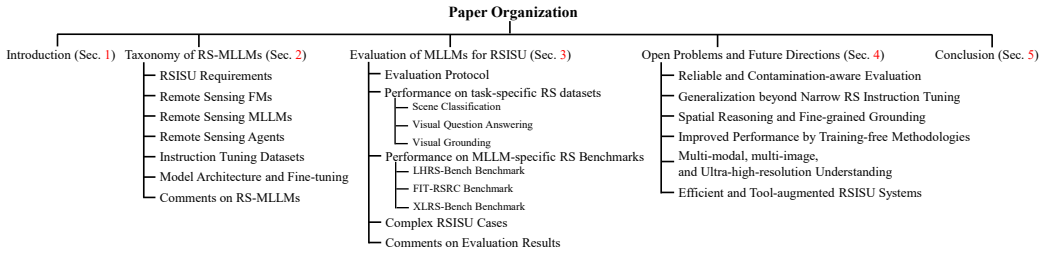
The rapid development of multimodal large language models (MLLMs) has introduced a flexible paradigm for remote sensing image scene understanding (RSISU), enabling natural-language interaction with remote sensing imagery. However, a systematic understanding of the capability boundaries, cross-task generalization, and task-specific limitations of existing remote sensing MLLMs (RS-MLLMs) is still lacking. This paper presents a systematic survey and diagnostic evaluation of MLLMs for RSISU. We review the technical evolution of RS-MLLMs, focusing on model design, multimodal learning, training data, and downstream capabilities. We further compare RS-MLLMs with general-purpose computer vision MLLMs (CV-MLLMs) across diverse RSISU tasks and benchmarks. RS-MLLMs remain competitive in domain-specific settings, particularly remote sensing visual grounding and high-resolution visual question answering. More notably, general-purpose CV-MLLMs can match or even outperform these specialized models on several RSISU tasks without remote sensing-specific fine-tuning. These findings demonstrate the strong transferability of general-purpose CV-MLLMs and show that current RS-MLLMs do not consistently outperform them across diverse RSISU tasks. Current MLLMs also face limitations in spatial and relational reasoning, fine-grained visual understanding, instruction diversity, and generalization across heterogeneous task formats. Based on these findings, we outline future directions toward reliable evaluation, multimodal and high-resolution reasoning, efficient deployment, and tool-augmented remote sensing agents. This survey provides a systematic reference for developing robust, generalizable, and practical MLLMs for RSISU.
Figures


Reference graph
Works this paper leans on
-
[1]
An Empirical Study of Remote Sensing Pretraining , year =
Di Wang and Jing Zhang and Bo Du and Guisong Xia and Dacheng Tao , journal =. An Empirical Study of Remote Sensing Pretraining , year =
-
[2]
Cong, Yezhen and Khanna, Samar and Meng, Chenlin and Liu, Patrick and Rozi, Erik and He, Yutong and Burke, Marshall and Lobell, David and Ermon, Stefano , journal=. Sat
-
[3]
Colorado Reed and Ritwik Gupta and Shufan Li and Sara Brockman and Christopher Funk and Brian Clipp and Salvatore Candido and Matthew Uyttendaele and Trevor Darrell , journal =. Scale-. 2022 , pages =
2022
-
[4]
Liu and Delong Chen and Zhan-Rong Guan and Xiaocong Zhou and Jiale Zhu and Jun Zhou , title =
F. Liu and Delong Chen and Zhan-Rong Guan and Xiaocong Zhou and Jiale Zhu and Jun Zhou , title =. IEEE Trans. Geosci. Remote Sens. , year =
-
[5]
Remote sensing vision-language foundation models without annotations via ground remote alignment , author=. Proc. Int. Conf. Learn. Represent. , volume=
-
[6]
Good at captioning, bad at counting: Benchmarking
Zhang, Chenhui and Wang, Sherrie , journal =. Good at captioning, bad at counting: Benchmarking
-
[7]
arXiv preprint arXiv:2406.07089 , primaryclass =
Wenjia Xu and Zijian Yu and Yixu Wang and Jiuniu Wang and Mugen Peng , title =. arXiv preprint arXiv:2406.07089 , primaryclass =. 2024 , archiveprefix =
Pith/arXiv arXiv 2024
-
[8]
Grounding multimodal large language models to the world , author=. Proc. Int. Conf. Learn. Represent. , volume=
-
[9]
Evaluating Tool-Augmented Agents in Remote Sensing Platforms , year =
Simranjit Singh and Michael Fore and Dimitrios Stamoulis , journal =. Evaluating Tool-Augmented Agents in Remote Sensing Platforms , year =
-
[10]
arXiv preprint arXiv:2402.14289 , primaryclass =
Baichuan Zhou and Ying Hu and Xi Weng and Junlong Jia and Jie Luo and Xien Liu and Ji Wu and Lei Huang , title =. arXiv preprint arXiv:2402.14289 , primaryclass =. 2024 , archiveprefix =
Pith/arXiv arXiv 2024
-
[11]
Feast your eyes: Mixture-of-resolution adaptation for multimodal large language models , author=. Proc. Int. Conf. Learn. Represent. , volume=
-
[12]
Visual Instruction Tuning , year =
Liu, Haotian and Li, Chunyuan and Wu, Qingyang and Lee, Yong Jae , booktitle =. Visual Instruction Tuning , year =
-
[13]
arXiv preprint arXiv:2308.12966 , primaryclass =
Jinze Bai and Shuai Bai and Shusheng Yang and Shijie Wang and Sinan Tan and Peng Wang and Junyang Lin and Chang Zhou and Jingren Zhou , title =. arXiv preprint arXiv:2308.12966 , primaryclass =. 2023 , archiveprefix =
Pith/arXiv arXiv 2023
-
[14]
Proceedings of the 30th ACM International conference on Multimedia , pages=
Visual grounding in remote sensing images , author=. Proceedings of the 30th ACM International conference on Multimedia , pages=
-
[15]
Improving one-stage visual grounding by recursive sub-query construction , author=. Proc. Eur. Conf. Comput. Vis. , pages=. 2020 , organization=
2020
-
[16]
2023 , pages =
Zhan, Yang and Xiong, Zhitong and Yuan, Yuan , journal =. 2023 , pages =
2023
-
[17]
Dubey, Abhimanyu and Jauhri, Abhinav and Pandey Abhinav and Kadian Abhishek and et al. , title =. arXiv preprint arXiv:2407.21783 , primaryclass =. 2024 , archiveprefix =
Pith/arXiv arXiv 2024
-
[18]
arXiv preprint arXiv:2304.14178 , primaryclass =
Qinghao Ye and Haiyang Xu and Guohai Xu and Jiabo Ye and Ming Yan and Yiyang Zhou and Junyang Wang and Anwen Hu and Pengcheng Shi and Yaya Shi and Chenliang Li and Yuanhong Xu and Hehong Chen and Junfeng Tian and Qi Qian and Ji Zhang and Fei Huang and Jingren Zhou , title =. arXiv preprint arXiv:2304.14178 , primaryclass =. 2024 , archiveprefix =
Pith/arXiv arXiv 2024
-
[19]
Liu, Haotian and Li, Chunyuan and Li, Yuheng and Li, Bo and Zhang, Yuanhan and Shen, Sheng and Lee, Yong Jae , month=
-
[20]
Improved baselines with visual instruction tuning , author=. Proc. IEEE Conf. Comput. Vis. Pattern Recognit. , pages=
-
[21]
LHRS-Bot: Empowering remote sensing with vgi-enhanced large multimodal language model , author=. Proc. Eur. Conf. Comput. Vis. , pages=. 2024 , organization=
2024
-
[22]
Multimodal large language models: A survey , author=. Proc. IEEE Int. Conf. Big Data , pages=. 2023 , organization=
2023
-
[23]
Wang, Weihan and Lv, Qingsong and Yu, Wenmeng and Hong, Wenyi and Qi, Ji and Wang, Yan and Ji, Junhui and Yang, Zhuoyi and Zhao, Lei and Song, Xixuan and others , journal=. Cog
-
[24]
arXiv preprint arXiv:2403.20213 , primaryclass =
Chao Pang and Jiang Wu and Jiayu Li and Yi Liu and Jiaxing Sun and Weijia Li and Xingxing Weng and Shuai Wang and Litong Feng and Gui-Song Xia and Conghui He , title =. arXiv preprint arXiv:2403.20213 , primaryclass =. 2024 , archiveprefix =
Pith/arXiv arXiv 2024
-
[25]
VHM: Versatile and honest vision language model for remote sensing image analysis , author=. Proc. AAAI Conf. Artif. Intell. , volume=
-
[26]
Geochat: Grounded large vision-language model for remote sensing , author=. Proc. IEEE Conf. Comput. Vis. Pattern Recognit. , pages=
-
[27]
2025 , publisher=
Hu, Yuan and Yuan, Jianlong and Wen, Congcong and Lu, Xiaonan and Liu, Yu and Li, Xiang , journal=. 2025 , publisher=
2025
-
[28]
Zhan, Yang and Xiong, Zhitong and Yuan, Yuan , journal=. Sky. 2025 , publisher=
2025
-
[29]
arXiv preprint arXiv:2406.10100 , primaryclass =
Junwei Luo and Zhen Pang and Yongjun Zhang and Tingzhu Wang and Linlin Wang and Bo Dang and Jiangwei Lao and Jian Wang and Jingdong Chen and Yihua Tan and Yansheng Li , title =. arXiv preprint arXiv:2406.10100 , primaryclass =. 2024 , archiveprefix =
Pith/arXiv arXiv 2024
-
[30]
arXiv preprint arXiv:2406.09385 , year =
Yue Zhou and Litong Feng and Yiping Ke and Xue Jiang and Junchi Yan and Xue Yang and Wayne Zhang , title =. arXiv preprint arXiv:2406.09385 , year =
-
[31]
arXiv preprint arXiv:2311.04498 , primaryclass =
Ao Zhang and Yuan Yao and Wei Ji and Zhiyuan Liu and Tat-Seng Chua , title =. arXiv preprint arXiv:2311.04498 , primaryclass =. 2023 , archiveprefix =
Pith/arXiv arXiv 2023
-
[32]
arXiv preprint arXiv:2306.15195 , primaryclass =
Keqin Chen and Zhao Zhang and Weili Zeng and Richong Zhang and Feng Zhu and Rui Zhao , title =. arXiv preprint arXiv:2306.15195 , primaryclass =. 2023 , archiveprefix =
Pith/arXiv arXiv 2023
-
[33]
Wu, Chenfei and Yin, Shengming and Qi, Weizhen and Wang, Xiaodong and Tang, Zecheng and Duan, Nan , journal=. Visual
-
[34]
Chen, Jun and Zhu, Deyao and Shen, Xiaoqian and Li, Xiang and Liu, Zechu and Zhang, Pengchuan and Krishnamoorthi, Raghuraman and Chandra, Vikas and Xiong, Yunyang and Elhoseiny, Mohamed , journal =
-
[35]
arXiv preprint arXiv:2309.15112 , primaryclass =
Pan Zhang and Xiaoyi Dong and Bin Wang and Yuhang Cao and Chao Xu and Linke Ouyang and Zhiyuan Zhao and Haodong Duan and Songyang Zhang and Shuangrui Ding and Wenwei Zhang and Hang Yan and Xinyue Zhang and Wei Li and Jingwen Li and Kai Chen and Conghui He and Xingcheng Zhang and Yu Qiao and Dahua Lin and Jiaqi Wang , title =. arXiv preprint arXiv:2309.151...
Pith/arXiv arXiv 2023
-
[36]
Instructblip: Towards general-purpose vision-language models with instruction tuning , author=. Proc. Adv. Neural Inf. Process. Syst. , volume=
-
[37]
Wang, Peng and Bai, Shuai and Tan, Sinan and Wang, Shijie and Fan, Zhihao and Bai, Jinze and Chen, Keqin and Liu, Xuejing and Wang, Jialin and Ge, Wenbin and Fan, Yang and Dang, Kai and Du, Mengfei and Ren, Xuancheng and Men, Rui and Liu, Dayiheng and Zhou, Chang and Zhou, Jingren and Lin, Junyang , journal =
-
[38]
Cong and Yingjie Hu and Chris Cundy and Ziyuan Li and Rui Zhu and Ni Lao , journal =
Gengchen Mai and Weiming Huang and Jin Sun and Suhang Song and Deepak Mishra and Ninghao Liu and Song Gao and Tianming Liu and G. Cong and Yingjie Hu and Chris Cundy and Ziyuan Li and Rui Zhu and Ni Lao , journal =. On the Opportunities and Challenges of Foundation Models for Geospatial Artificial Intelligence , year =
-
[39]
IGARSS 2024-2024 IEEE International Geoscience and Remote Sensing Symposium , pages=
One for all: Toward unified foundation models for Earth vision , author=. IGARSS 2024-2024 IEEE International Geoscience and Remote Sensing Symposium , pages=. 2024 , organization=
2024
-
[40]
and Nieusma, Jordan M
Lu, Siqi and Guo, Junlin and Zimmer-Dauphinee, James R. and Nieusma, Jordan M. and Wang, Xiao and VanValkenburgh, Parker and Wernke, Steven A. and Huo, Yuankai , journal=. Vision Foundation Models in Remote Sensing: A survey , year=
-
[41]
2020 , number =
Lobry, Sylvain and Marcos, Diego and Murray, Jesse and Tuia, Devis , journal =. 2020 , number =
2020
-
[42]
Bridging remote sensors with multisensor geospatial foundation models , author=. Proc. IEEE Conf. Comput. Vis. Pattern Recognit. , pages=
-
[43]
2024 , pages =
Zhang, Wei and Cai, Miaoxin and Zhang, Tong and Zhuang, Yin and Mao, Xuerui , journal =. 2024 , pages =
2024
-
[44]
Remote Sens
Osco, Lucas Prado and Lemos, Eduardo Lopes de and Gon. Remote Sens. , title =. 2023 , issn =
2023
-
[45]
2024 , volume=
Zhang, Zilun and Zhao, Tiancheng and Guo, Yulong and Yin, Jianwei , journal=. 2024 , volume=
2024
-
[46]
Remote sensing image scene classification meets deep learning: Challenges, methods, benchmarks, and opportunities , year =
Cheng, Gong and Xie, Xingxing and Han, Junwei and Guo, Lei and Xia, Gui-Song , journal =. Remote sensing image scene classification meets deep learning: Challenges, methods, benchmarks, and opportunities , year =
-
[47]
arXiv preprint arXiv:2406.12479 , primaryclass =
Linrui Xu and Ling Zhao and Wang Guo and Qiujun Li and Kewang Long and Kaiqi Zou and Yuhan Wang and Haifeng Li , title =. arXiv preprint arXiv:2406.12479 , primaryclass =. 2024 , archiveprefix =
Pith/arXiv arXiv 2024
-
[48]
arXiv preprint arXiv:2402.06475 , year=
Large language models for captioning and retrieving remote sensing images , author=. arXiv preprint arXiv:2402.06475 , year=
-
[49]
2024 , issn=
Bazi, Yakoub and Bashmal, Laila and Al Rahhal, Mohamad Mahmoud and Ricci, Riccardo and Melgani, Farid , journal=. 2024 , issn=
2024
-
[50]
Open Self-Supervised Features for Remote-Sensing Image Scene Classification Using Very Few Samples , year =
Chunping Qiu and Anzhu Yu and Xiaodong Yi and Naiyang Guan and Dian-xi Shi and Xiaochong Tong and Michael Schmitt , journal =. Open Self-Supervised Features for Remote-Sensing Image Scene Classification Using Very Few Samples , year =
-
[51]
Learning transferable visual models from natural language supervision , author=. Proc. Int. Conf. Mach. Learn. , pages=. 2021 , organization=
2021
-
[52]
Zhang , journal =
Di Wang and Qiming Zhang and Yufei Xu and Jing Zhang and Bo Du and Dacheng Tao and L. Zhang , journal =. Advancing Plain Vision Transformer Toward Remote Sensing Foundation Model , year =
-
[53]
Mat'ias Mendieta and Boran Han and Xingjian Shi and Yi Zhu and Chen Chen and Mu Li , journal =
-
[54]
2024 , publisher=
A billion-scale foundation model for remote sensing images , author=. 2024 , publisher=
2024
-
[55]
GeoGPT: An assistant for understanding and processing geospatial tasks , year =
Yifan Zhang and Cheng Wei and Zhengting He and Wenhao Yu , journal =. GeoGPT: An assistant for understanding and processing geospatial tasks , year =
-
[56]
The segment anything model (SAM) for remote sensing applications: From zero to one shot , author=. Int. J. Appl. Earth Obs. Geoinf. , volume=. 2023 , publisher=
2023
-
[57]
Exploring region features in remote sensing image captioning , year =
Kai Zhao and Wei Xiong , journal =. Exploring region features in remote sensing image captioning , year =
-
[58]
Understanding remote sensing imagery like reading a text document: What can remote sensing image captioning offer? , year =
Xiao Huang and Kaixuan Lu and Siqin Wang and Junyu Lu and Xiao Li and Ruiqian Zhang , journal =. Understanding remote sensing imagery like reading a text document: What can remote sensing image captioning offer? , year =
-
[59]
Improving visual question answering for remote sensing via alternate-guided attention and combined loss , year =
Jiangfan Feng and Etao Tang and Maimai Zeng and Zhujun Gu and Pinglang Kou and Wei Zheng , journal =. Improving visual question answering for remote sensing via alternate-guided attention and combined loss , year =
-
[60]
A multi-scale contextual attention network for remote sensing visual question answering , year =
Jiangfan Feng and Hui Wang , journal =. A multi-scale contextual attention network for remote sensing visual question answering , year =
-
[61]
Learning transferable cross-modality representations for few-shot hyperspectral and LiDAR collaborative classification , author=. Int. J. Appl. Earth Obs. Geoinf. , volume=. 2024 , publisher=
2024
-
[62]
National Science Review , volume=
A survey on multimodal large language models , author=. National Science Review , volume=. 2024 , publisher=
2024
-
[63]
Burke and D
Kumar Ayush and Burak Uzkent and Chenlin Meng and Kumar Tanmay and M. Burke and D. Lobell and Stefano Ermon , journal =. Geography-Aware Self-Supervised Learning , year =
-
[64]
Language models are few-shot learners , author=. Proc. Adv. Neural Inf. Process. Syst. , volume=
-
[65]
Junnan Li and Dongxu Li and Caiming Xiong and Steven C. H. Hoi , booktitle =. BLIP: Bootstrapping Language-Image Pre-training for Unified Vision-Language Understanding and Generation , year =
-
[66]
Segment anything , author=. Proc. IEEE Conf. Comput. Vis. Pattern Recognit. , pages=
-
[67]
Structured generative models for scene understanding , author=. Int. J. Comput. Vis. , volume=. 2025 , publisher=
2025
-
[68]
Skyscript: A large and semantically diverse vision-language dataset for remote sensing , year=
Wang, Zhecheng and Prabha, Rajanie and Huang, Tianyuan and Wu, Jiajun and Rajagopal, Ram , booktitle=. Skyscript: A large and semantically diverse vision-language dataset for remote sensing , year=
-
[69]
RingMo: A Remote Sensing Foundation Model With Masked Image Modeling , year=
Sun, Xian and Wang, Peijin and Lu, Wanxuan and Zhu, Zicong and Lu, Xiaonan and He, Qibin and Li, Junxi and Rong, Xuee and Yang, Zhujun and Chang, Hao and He, Qinglin and Yang, Guang and Wang, Ruiping and Lu, Jiwen and Fu, Kun , journal=. RingMo: A Remote Sensing Foundation Model With Masked Image Modeling , year=
-
[70]
arXiv preprint arXiv:2508.18265 , year=
Internvl3.5: Advancing open-source multimodal models in versatility, reasoning, and efficiency , author=. arXiv preprint arXiv:2508.18265 , year=
-
[71]
arXiv preprint arXiv:2511.21631 , year=
Qwen3-vl technical report , author=. arXiv preprint arXiv:2511.21631 , year=
-
[72]
Wang, Di and Hu, Meiqi and Jin, Yao and Miao, Yuchun and Yang, Jiaqi and Xu, Yichu and Qin, Xiaolei and Ma, Jiaqi and Sun, Lingyu and Li, Chenxing and Fu, Chuan and Chen, Hongruixuan and Han, Chengxi and Yokoya, Naoto and Zhang, Jing and Xu, Minqiang and Liu, Lin and Zhang, Lefei and Wu, Chen and Du, Bo and Tao, Dacheng and Zhang, Liangpei , journal=. Hyp...
2025
-
[73]
Spectral
Hong, Danfeng and Zhang, Bing and Li, Xuyang and Li, Yuxuan and Li, Chenyu and Yao, Jing and Yokoya, Naoto and Li, Hao and Ghamisi, Pedram and Jia, Xiuping and Plaza, Antonio and Gamba, Paolo and Benediktsson, Jon Atli and Chanussot, Jocelyn , journal=. Spectral. 2024 , volume=
2024
-
[74]
Liu, Danxu and Wang, Di and Wang, Hebaixu and Chen, Haoyang and Jiang, Wentao and Cheng, Yilin and Guo, Haonan and Cui, Wei and Zhang, Jing , booktitle=
-
[75]
Ma, Qiwei and Wang, Zhiyu and Liu, Wang and Lu, Xukun and Deng, Bin and Duan, Puhong and Kang, Xudong and Li, Shutao , journal=
-
[76]
2026 , publisher=
Jiang, Chaowei and Wang, Chao and Wu, Fan and Ma, Peifeng and Zou, Lichuan and Li, Tianyang and Ning, Jing and Tang, Yixian , journal=. 2026 , publisher=
2026
-
[77]
2025 , volume=
Li, Weijie and Yang, Wei and Hou, Yuenan and Liu, Li and Liu, Yongxiang and Li, Xiang , journal=. 2025 , volume=
2025
-
[78]
2024 , issn =
Predicting gradient is better: Exploring self-supervised learning for. 2024 , issn =
2024
-
[79]
HyperFree: A channel-adaptive and tuning-free foundation model for hyperspectral remote sensing imagery , author=. Proc. IEEE Conf. Comput. Vis. Pattern Recognit. , pages=
-
[80]
Skysense: A multi-modal remote sensing foundation model towards universal interpretation for earth observation imagery , author=. Proc. IEEE Conf. Comput. Vis. Pattern Recognit. , pages=
discussion (0)
Sign in with ORCID, Apple, or X to comment. Anyone can read and Pith papers without signing in.