REVIEW 3 major objections 5 minor 41 references
Multishell Dirac fermions in the Einstein-Dirac system
T0 review · 3 major / 5 minor · reviewed 2026-08-06 · deepseek-v4-flash
Pith's one-line read Nested shells are the ground state of 12 gravitating Dirac fermions.
desk verdict Real new multishell Einstein-Dirac solutions, but the 'ground state' claim sits on energy differences smaller than the paper's own loose numerical tolerances. read the letter →
The pith
A machine-rendered reading of the paper's core claim, the machinery that carries it, and where it could break.
The reading
What carries the argument
The carrying object is the closed-shell Hartree-Fock product ansatz: in shell $\{n\}$ with total angular momentum $j_n=(2n-1)/2$, all $2j_n+1=2n$ component states are occupied, so the total fermion number is $N_f=N(N+1)$ for $N$ shells and spherical symmetry is retained. The radial Dirac equations (32)-(33) and Einstein equations (34)-(35) couple the shell amplitudes $\alpha_n$, $\beta_n$ through the metric functions $A(r)$, $T(r)$, with the redshift parameter $T_0$ controlling compactness. Solutions are found by shooting from the origin with Frobenius asymptotics and matched to Schwarzschild at infinity through a Wronskian condition, under a normalization fixing $\lambda_n$; the multishell energy and per-shell eigenvalues are then read off and compared with the single-shell approximation.
What would settle it
Recompute the energies $E$ and eigenvalues $\omega_n$ for the $\{1,2,3\}$-shell and single-shell $N_f=12$ models with a stricter convergence criterion, say $W<10^{-10}$ and $\Lambda_n<10^{-6}$, without truncating any spinor component, and compare them over the full redshift range; if the single-shell energy falls below the multishell energy at any redshift where the paper reports it above, the ground-state claim fails. A simpler check is to compare the two-shell $N_f=6$ ordering at $T_0>10$, where the paper already reports the multishell energy slightly above the single-shell one.
Extended reading notes
Core claim
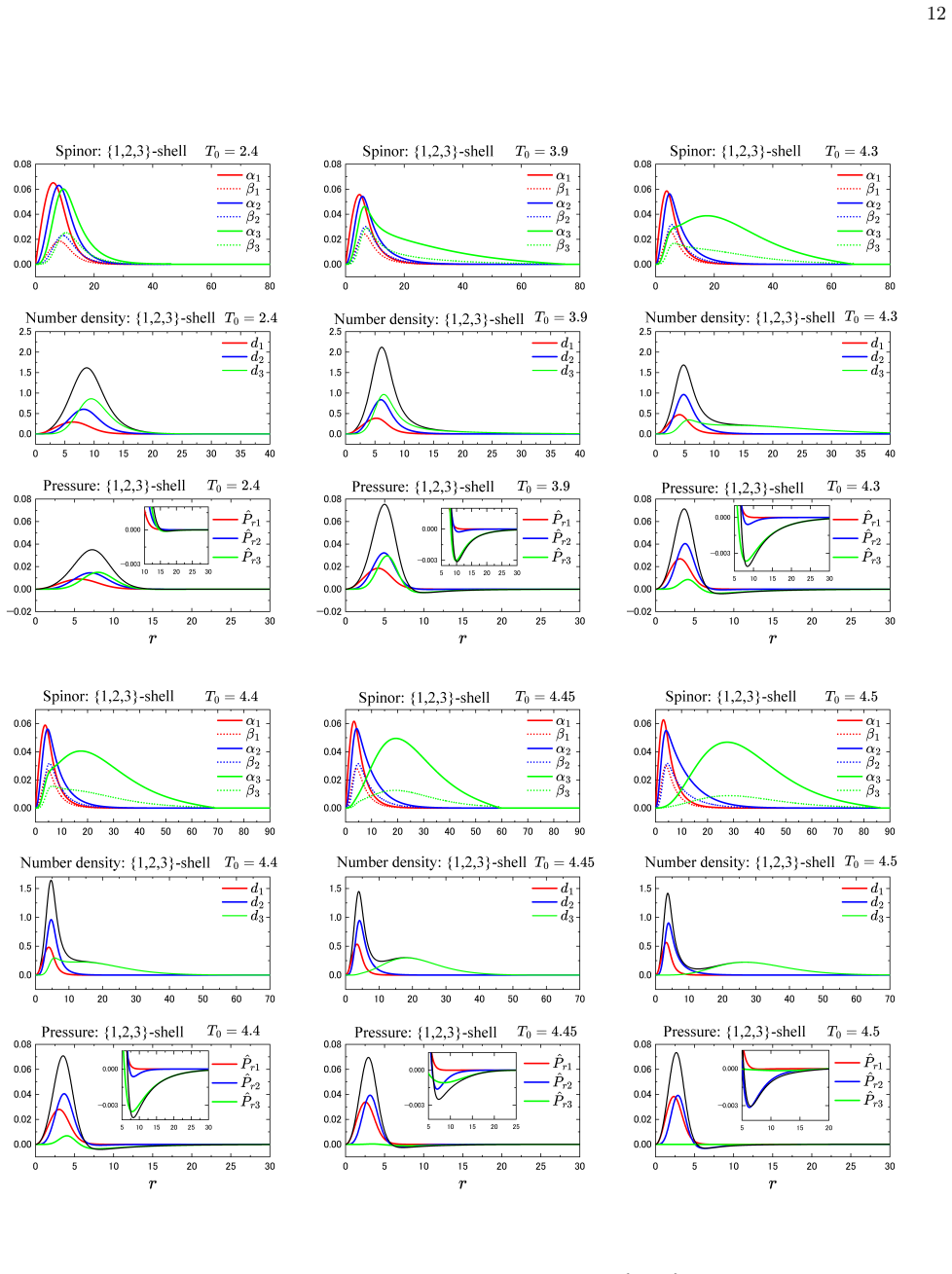
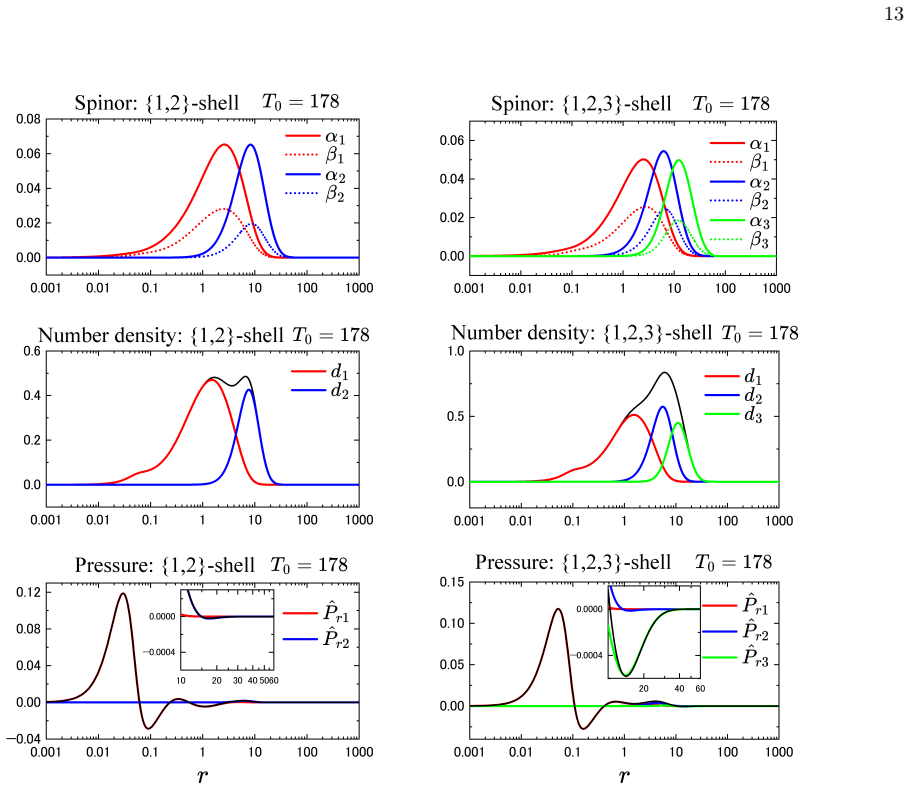
The authors claim that for fermion number $N_f=12$ the ground state is not a single filled shell of angular momentum $j=5/2$ but the three-shell configuration $\{1,2,3\}$ built from $j=1/2$, $3/2$, and $5/2$, with two, four, and six fermions in the successive shells. The claim rests on the computed energy $E$ and eigenvalues $\omega_n$ of the coupled Einstein-Dirac equations: the $\{1,2,3\}$-shell solution yields lower energy and lower eigenvalues than the single-shell approximation with the same total $N_f$ across the redshift range, and at high redshift it develops negative outer-shell pressure, higher compression, and lower eigenvalues. For the $\{1,2\}$-shell with $N_f=6$ the energy is comparable to or slightly higher than the single-shell energy at high $T_0$, so the authors restrict the ground-state conclusion to the three-shell case. They also describe single-shell multifermion solutions as multipeak and fragmenting in the high-redshift region, and interpret multishell behavior as delocalization caused by intershell interactions.
Load-bearing premise
The ground-state conclusion rests on the numerical assumption that the deliberately loose convergence criteria used to accept the solutions ($W<10^{-6}$, $\Lambda_n<10^{-3}$) and the truncation of small outer spinor components in the four-shell runs do not change the energy ordering between multishell and single-shell configurations.
Editorial extensions
If this is right
- For $N_f=12$, the ground state is a set of nested filled shells rather than a single high-angular-momentum shell.
- At larger fermion numbers the four-shell solutions behave like the three-shell ones, so sufficiently many self-gravitating Dirac fermions recover an atomic- or nuclear-shell-like ordering.
- Negative radial pressure that appears during fragmentation signals an attractive intershell force compacting the solution, a feature the Einstein-Vlasov analogue does not show.
- Inclusion radii and Shannon entropy change in steps at shell fragmentation, giving two practical probes for locating structural transitions in gravitating fermion configurations.
- The closed-shell sequence $N_f=N(N+1)=2,6,12,20$ gives the fermion numbers for which spherical multishell solutions exist and can be targeted in future computations.
Reading between the lines
- Beyond the paper, if the $N_f=12$ ordering survives stricter numerical tolerances, the same shell-filling principle should reshape predicted mass-radius relations for self-gravitating fermionic dark matter cores, because the ground state would be more compact than single-shell estimates.
- The loose convergence criterion and the simplified four-shell algorithm are the natural stress test for the claim: recomputing just the $\{1,2,3\}$-shell versus single-shell energy difference with errors controlled near $10^{-6}$ would decide whether the ordering is real.
- The sequence $N_f=N(N+1)$ suggests 'magic numbers' for spherical self-gravitating Dirac configurations, a pattern that a fully three-dimensional mean-field solver could confirm or refute without imposing spherical symmetry.
- The Shannon-entropy steps could serve as a model-independent diagnostic for shell fragmentation in other solitonic or boson-star systems, not only in the Einstein-Dirac model.
Editorial analysis
A structured set of objections, weighed in public.
Referee Report
Summary. The paper constructs multishell solutions of the spherically symmetric Einstein-Dirac system, filling complete angular-momentum shells {1,2,...,N} so that the total fermion number is Nf=N(N+1). It solves the coupled Einstein-Dirac ODEs for Nf=6, 12, and 20, compares energies and eigenvalues with the corresponding single-shell approximations, and analyzes shell fragmentation through radial pressure and Shannon entropy. The principal claim is that the {1,2,3}-shell solution with Nf=12 has 'almost lower' energy and eigenvalues than the single-shell approximation and is therefore a ground state of the model. The derivation of Eqs. (32)-(35) follows standard Einstein-Dirac formalism and appears internally consistent, but the numerical evidence for the ground-state claim is not quantitatively secured.
Significance. If confirmed, the result would be a noteworthy extension of previous single-shell Einstein-Dirac studies: for Nf=12 the lowest-energy configuration would be a nested set of filled shells rather than one filled shell, suggesting an atomic/nuclear-shell-model-like ordering for self-gravitating Dirac fermions. The paper also introduces useful diagnostics—radial pressure and Shannon entropy—for characterizing shell structure and fragmentation. However, the central conclusion is quantitative and rests on small energy differences, while the numerical acceptance criteria are explicitly loose and no error estimates or convergence studies are provided. The work is therefore of interest but currently conditional on numerical verification.
major comments (3)
- [Sec. III, Eqs. (48)-(49)] The convergence criterion W<10^-6, Lambda_n<10^-3 is described in the text as 'somewhat imprecise,' and the four-shell algorithm truncates the outer spinor components at r=r0 once they are 'sufficiently small,' without an error estimate. The central ground-state claim in Sec. V and Sec. VI depends on small energy differences between multishell and single-shell solutions (Figs. 3-5), but the text only reports that the multishell energy is 'almost lower.' With Lambda_n<10^-3, relative uncertainties in the normalization/eigenvalue parameters can be at the 0.1% level, which is not shown to be smaller than the energy gaps that support the ordering. Please provide a convergence study (e.g., a sequence of decreasing tolerances), error bars or an independent numerical check, and report the numerical values of the energy differences.
- [Sec. I and Sec. VI] The paper states in Sec. I that only non-nodal ('ground state') solutions are analyzed, and the comparison in Sec. IV is restricted to two ansatz families: a single filled shell versus nested filled shells. A 'ground state' is a global statement, so this comparison is insufficient: configurations with the same Nf that mix partial occupations, use different shell assignments, or contain nodal excited states must be excluded by computation or by an explicit argument before the ground-state conclusion is justified. In addition, the opening sentence of Sec. VI claims ground states for Nf=6, 12, and 20, but Fig. 4 shows that for Nf=6 the two-shell energy becomes larger than the single-shell energy at high T0; the claimed scope is inconsistent with the presented results.
- [Sec. IV.B and Figs. 3-5] The energy-ordering claim is not quantified. The text says the {1,2,3}-shell energy is 'almost lower' than the single-shell energy, but no numerical values, energy gaps, or their T0-dependence are given. The ordering is not universal: for {1,2} at high T0 the energy and eigenvalues exceed the single-shell values (Fig. 4), so the ground-state conclusion for Nf=12 must be restricted to the demonstrated parameter range and supported by explicit energy differences that exceed the numerical uncertainty. A table of E, omega_n, and their estimated errors would make the claim testable.
minor comments (5)
- [Sec. I] There is a duplicated word in the text: 'but but such comprehensive results are not required.'
- [Sec. IV.B] 'similarity to the nucleic and atomic models' should read 'nuclear and atomic models.'
- [Fig. 3 caption] The caption labels the panels inconsistently: it refers to the '{1,2} two-shell (right)' and also to the '{1,2,3,4}-shell (right)'; the panel order should be corrected to left/middle/right.
- [Ref. [40]] Reference [40] gives 'Phys. Rev. D 101, 106012 (1998)' and the same arXiv identifier as Ref. [6]; the volume, year, and DOI appear to be copied from Ref. [6] and should be corrected.
- [Sec. V.B, Eq. (56)] The notation 'Rn def ⇐⇒' is nonstandard and unclear; please define Rn with a normal equation and comment on the sensitivity of the results to the 0.999 threshold.
Circularity Check
No significant circularity: all reported quantities are computed from the solved Einstein–Dirac fields, and the ground-state claim rests on an energy comparison rather than on a reduction to inputs.
full rationale
The paper's derivation chain is self-contained. The Einstein and Dirac equations are solved numerically using the multishell ansatz, and the shooting parameters are adjusted to satisfy boundary and normalization conditions, not fitted to any target output. Energies E (Eq. 52), eigenvalues omega_n, root-mean-square radii (Eq. 53), pressures (Eqs. 54–55), and Shannon entropy (Eq. 58) are all computed from the solved fields and the input parameters T0 and m; none of these quantities is used to define another reported quantity. The ground-state conclusion in Sec. VI is inferred from the energy comparison in Figs. 3–5, not from the earlier descriptive phrase 'ground state (non-nodal)' in the Introduction, so it is not a self-definitional reduction. No load-bearing self-citation chain, imported uniqueness theorem, or ansatz smuggled in via citation is present; the authors' own earlier works appear only as background. The claim that the {1,2,3}-shell solution is the ground state may be under-supported because only two ansatz families are compared and the paper itself flags its convergence criterion as 'somewhat imprecise' (Sec. III) and uses 'We posit' (Sec. IV B), but those are correctness and robustness concerns, not circularity.
Assumptions & free parameters
free parameters (3)
- central redshift T0 =
1.3 to 178 (per solution)
- fermion mass m =
set to 1 by scaling
- four-shell truncation radius r0 =
not specified
assumptions (4)
- domain assumption Spherically symmetric metric ansatz g = diag(-1/T^2, 1/A, r^2, r^2 sin^2 theta)
- domain assumption Fully occupied shells with the Hartree-Fock product (8) preserve spherical symmetry and justify the summed energy-momentum tensor
- domain assumption Weak boundary conditions at infinity (44) with rescaling (46)-(47) are equivalent to normalizable localized solutions
- ad hoc to paper Nodeless spinor solutions are the ground states
Cite this review
Pith. "Pith review of Multishell Dirac fermions in the Einstein-Dirac system." pith.science (2026). https://pith.science/paper/JBGAXPJB
@misc{pith2026250710023,
  author       = {Pith},
  title        = {Pith review of: Multishell Dirac fermions in the Einstein-Dirac system},
  year         = {2026},
  howpublished = {\url{https://pith.science/paper/JBGAXPJB}},
  note         = {Machine review of arXiv:2507.10023}
}
abstract
We present multifermions in the spherically symmetric Einstein-Dirac system. Dirac fermions are self-localized within a spherically symmetric Einstein gravity, i.e., the Schwarzschild-like space-time metric. Most of previous studies of the Einstein-Dirac system are restricted to two neutral fermions or to many fermions with the same high-angular momentum filling a single shell. Our model considers full-filling of fermions in multiple shells, similarly to the conventional nuclear shell model. We solve the model for fermion numbers $N_\textrm{f}=2,6,12$ and $20$, which can realize a spherically symmetric system. Even single-shell multifermions exhibit a multipeak structure and fragmentation in the high redshift region. The behavior observed in our multishell model can be explained by interactions between the shells and resulting delocalization. We also investigate the pressure of the solutions which defines the existence (or absence) of intershell interactions. The radial pressure is attractive, supporting compactness of the solutions. Finally, we show the correlations between the nontrivial changes in the Shannon entropy (a logarithmic measure of information content) and the structural deformations of the solutions.
Figures


Figures from the paper (9 more)




Reference graph
Works this paper leans on
-
[1]
Nonrenormal- izability of the Quantized Dirac-Einstein System,
Stanley Deser and P. van Nieuwenhuizen, “Nonrenormal- izability of the Quantized Dirac-Einstein System,” Phys. Rev. D 10, 411 (1974)
work page 1974
-
[2]
Particle-Like Solutions of the Einstein-Dirac Equations
Felix Finster, Joel Smoller, and Shing-Tung Yau, “Parti- cle - like solutions of the Einstein-Dirac equations,” Phys. Rev. D 59, 104020 (1999), arXiv:gr-qc/9801079
work page Pith review arXiv 1999
-
[3]
Spinor fields in spherical symmetry. Einstein-Dirac and other space-times
K. A. Bronnikov, Yu. P. Rybakov, and Bijan Saha, “Spinor fields in spherical symmetry: Einstein–Dirac and other space-times,” Eur. Phys. J. Plus 135, 124 (2020), arXiv:1909.04789 [gr-qc]
work page Pith review arXiv 2020
-
[4]
Dirac stars supported by nonlinear spinor fields
Vladimir Dzhunushaliev and Vladimir Folomeev, “Dirac stars supported by nonlinear spinor fields,” Phys. Rev. D 99, 084030 (2019), arXiv:1811.07500 [gr-qc]
work page Pith review arXiv 2019
-
[5]
Rold˜ ao da Rocha, “MGD Dirac stars,” Symmetry 12, 508 (2020), arXiv:2002.10972 [hep-th]
work page Pith review arXiv 2020
-
[8]
Dirac star in the presence of Maxwell and Proca fields
Vladimir Dzhunushaliev and Vladimir Folomeev, “Dirac star in the presence of Maxwell and Proca fields,” Phys. Rev. D 99, 104066 (2019), arXiv:1901.09905 [gr-qc]
work page Pith review arXiv 2019
-
[9]
Dirac star with SU(2) Yang-Mills and Proca fields
Vladimir Dzhunushaliev and Vladimir Folomeev, “Dirac Star with SU(2) Yang-Mills and Proca Fields,” Phys. Rev. D 101, 024023 (2020), arXiv:1911.11614 [gr-qc]
work page Pith review arXiv 2020
-
[10]
Traversable wormholes in Einstein-Dirac- Maxwell theory,
Jose Luis Bl´ azquez-Salcedo, Christian Knoll, and Eu- gen Radu, “Traversable wormholes in Einstein-Dirac- Maxwell theory,” Phys. Rev. Lett. 126, 101102 (2021), arXiv:2010.07317 [gr-qc]
arXiv 2021
Show all 41 references
-
[11]
Are Einstein-Dirac-Maxwell wormholes traversable?
Ben Kain, “Are Einstein-Dirac-Maxwell wormholes traversable?” Phys. Rev. D 108, 044019 (2023), arXiv:2305.11217 [gr-qc]
2023 arXiv
-
[12]
Einstein-Dirac-Maxwell wormholes in quan- tum field theory,
Ben Kain, “Einstein-Dirac-Maxwell wormholes in quan- tum field theory,” Phys. Rev. D 108, 084010 (2023), arXiv:2308.00049 [gr-qc]
2023 arXiv
-
[13]
Fermion states localized on a self-gravitating non- Abelian monopole,
Vladimir Dzhunushaliev, Vladimir Folomeev, and Yakov Shnir, “Fermion states localized on a self-gravitating non- Abelian monopole,” Phys. Rev. D 108, 065005 (2023), arXiv:2307.15277 [hep-th]
2023 arXiv
-
[14]
Gravitating Skyrmions with localized fermions,
Vladimir Dzhunushaliev, Vladimir Folomeev, Jutta Kunz, and Yakov Shnir, “Gravitating Skyrmions with localized fermions,” Eur. Phys. J. C 85, 391 (2025), arXiv:2407.17504 [hep-th]
2025 arXiv
-
[15]
Localization of massive fermions on the baby-skyrmion branes in 6 dimensions,
Yuta Kodama, Kento Kokubu, and Nobuyuki Sawado, “Localization of massive fermions on the baby-skyrmion branes in 6 dimensions,” Phys. Rev. D79, 065024 (2009), arXiv:0812.2638 [hep-th]
2009 arXiv
-
[16]
Localizing modes of massive fermions and a U(1) gauge field in the inflating baby-skyrmion branes,
Terence Delsate and Nobuyuki Sawado, “Localizing modes of massive fermions and a U(1) gauge field in the inflating baby-skyrmion branes,” Phys. Rev. D 85, 065025 (2012), arXiv:1112.2714 [gr-qc]
2012 arXiv
-
[17]
Spinor walls in five- dimensional warped spacetime,
Zheng-Quan Cui and Yu-Xiao Liu, “Spinor walls in five- dimensional warped spacetime,” Eur. Phys. J. C 83, 275 (2023), arXiv:2210.01498 [hep-th]
2023 arXiv
-
[18]
Localization of matter fields on flat fermion brane,
Xiang-Nan Zhou, Hong-Yu Bai, Miao Wang, and Yun- Zhi Du, “Localization of matter fields on flat fermion brane,” Eur. Phys. J. C 85, 235 (2025)
2025
-
[19]
Asymptotically flat scalar, Dirac and Proca stars: discrete vs. continuous families of solutions,
Carlos A. R. Herdeiro, Alexandre M. Pombo, and Eugen Radu, “Asymptotically flat scalar, Dirac and Proca stars: discrete vs. continuous families of solutions,” Phys. Lett. B 773, 654–662 (2017), arXiv:1708.05674 [gr-qc]
2017 arXiv
-
[21]
Nonlinear effects in the excited states of many-fermion Einstein-Dirac solitons,
Peter E. D. Leith, Chris A. Hooley, Keith Horne, and David G. Dritschel, “Nonlinear effects in the excited states of many-fermion Einstein-Dirac solitons,” Phys. Rev. D 104, 046024 (2021), arXiv:2105.12672 [gr-qc]
2021 arXiv
-
[22]
Infinite-redshift localized states of Dirac fermions under Einsteinian gravity,
Daniel Bakucz Can´ ario, Sam Lloyd, Keith Horne, and Chris A. Hooley, “Infinite-redshift localized states of Dirac fermions under Einsteinian gravity,” Phys. Rev. D 102, 084049 (2020), arXiv:2008.10455 [gr-qc]
2020 arXiv
-
[23]
The tran- sition to phenomenological behaviour of static solutions of the Einstein–Dirac system for an increasing number of fermions,
H ˚ akan Andr´ easson and Joakim Blomqvist, “The tran- sition to phenomenological behaviour of static solutions of the Einstein–Dirac system for an increasing number of fermions,” Class. Quant. Grav. 42, 165009 (2025), arXiv:2503.15995 [gr-qc]
2025 arXiv
-
[24]
Con- structing spherically symmetric Einstein–Dirac systems with multiple spinors: Ansatz, wormholes and other analytical solutions,
Jose Luis Bl´ azquez-Salcedo and Christian Knoll, “Con- structing spherically symmetric Einstein–Dirac systems with multiple spinors: Ansatz, wormholes and other analytical solutions,” Eur. Phys. J. C 80, 174 (2020), arXiv:1910.03565 [gr-qc]
2020 arXiv
-
[25]
Multi-state Dirac stars,
Chen Liang, Ji-Rong Rena, Shi-Xian Sun, and Yong- Qiang Wang, “Multi-state Dirac stars,” Eur. Phys. J. C 84, 14 (2024), arXiv:2306.11437 [hep-th]
2024 arXiv
-
[26]
Einstein-Dirac system in semiclassical grav- ity,
Ben Kain, “Einstein-Dirac system in semiclassical grav- ity,” Phys. Rev. D 107, 124001 (2023), arXiv:2304.10627 [gr-qc]. 17
2023 arXiv
-
[27]
Ab- sence of static, spherically symmetric black hole solu- tions for einstein-dirac-yang/mills equations with com- plete fermion shells,
Felix Finster, Joel Smoller, and Shing-Tung Yau, “Ab- sence of static, spherically symmetric black hole solu- tions for einstein-dirac-yang/mills equations with com- plete fermion shells,” (2002), arXiv:gr-qc/0005028 [gr- qc]
2002 arXiv
-
[28]
Entropic Measure for Localized Energy Configurations: Kinks, Bounces, and Bubbles,
Marcelo Gleiser and Nikitas Stamatopoulos, “Entropic Measure for Localized Energy Configurations: Kinks, Bounces, and Bubbles,” Phys. Lett. B 713, 304–307 (2012), arXiv:1111.5597 [hep-th]
2012 arXiv
-
[29]
Quasibound states of the Dirac field in Schwarzschild and Reissner–Nordstr¨ om black hole backgrounds,
Ciprian A. Sporea, “Quasibound states of the Dirac field in Schwarzschild and Reissner–Nordstr¨ om black hole backgrounds,” Mod. Phys. Lett. A 34, 1950323 (2019), arXiv:1905.05086 [gr-qc]
2019 arXiv
-
[30]
A mathematical theory of communica- tion,
C. E. Shannon, “A mathematical theory of communica- tion,” Bell System Technical Journal 27, 379–423 (1948), https://onlinelibrary.wiley.com/doi/pdf/10.1002/j.1538- 7305.1948.tb01338.x
1948
-
[31]
Information- Entropic Stability Bound for Compact Objects: Ap- plication to Q-Balls and the Chandrasekhar Limit of Polytropes,
Marcelo Gleiser and Damian Sowinski, “Information- Entropic Stability Bound for Compact Objects: Ap- plication to Q-Balls and the Chandrasekhar Limit of Polytropes,” Phys. Lett. B 727, 272–275 (2013), arXiv:1307.0530 [hep-th]
2013 arXiv
-
[32]
Information-Entropic Measure of Energy-Degenerate Kinks in Two-Field Models,
R. A. C. Correa, A. de Souza Dutra, and M. Gleiser, “Information-Entropic Measure of Energy-Degenerate Kinks in Two-Field Models,” Phys. Lett. B 737, 388– 394 (2014), arXiv:1409.0029 [hep-th]
2014 arXiv
-
[33]
Entropic information for travelling solitons in Lorentz and CPT breaking systems,
R. A. C. Correa, Rold˜ ao da Rocha, and A. de Souza Du- tra, “Entropic information for travelling solitons in Lorentz and CPT breaking systems,” Annals Phys. 359, 198–212 (2015), arXiv:1501.02000 [hep-th]
2015 arXiv
-
[34]
Configurational en- tropy of skyrmions and half-skyrmions in planar mag- netic elements,
D. Bazeia and E. I. B. Rodrigues, “Configurational en- tropy of skyrmions and half-skyrmions in planar mag- netic elements,” Phys. Lett. A 392, 127170 (2021), arXiv:2206.06351 [cond-mat.soft]
2021 arXiv
-
[35]
Mock-integrability and stable solitary vortices,
Yukito Koike, Atsushi Nakamula, Akihiro Nishie, Kiori Obuse, Nobuyuki Sawado, Yamato Suda, and Kouichi Toda, “Mock-integrability and stable solitary vortices,” Chaos Solitons and Fractals: the interdisciplinary jour- nal of Nonlinear Science and Nonequilibrium and Com- plex Ph...
2022 arXiv
-
[36]
Analyzing lump-type solutions in scalar field models through configurational infor- mation measure,
Marcelo A. Feitosa, Wesley B. Cardoso, Dionisio Bazeia, and Ardiley T. Avelar, “Analyzing lump-type solutions in scalar field models through configurational infor- mation measure,” Phys. Lett. A 529, 130096 (2025), arXiv:2412.00352 [nlin.PS]
2025 arXiv
-
[37]
Stability Bounds on Compact Astrophysical Objects from Information- Entropic Measure,
Marcelo Gleiser and Nan Jiang, “Stability Bounds on Compact Astrophysical Objects from Information- Entropic Measure,” Phys. Rev. D 92, 044046 (2015), arXiv:1506.05722 [gr-qc]
2015 arXiv
-
[38]
Differential configura- tional entropy and the gravitational collapse of a kink,
W. Barreto and R. da Rocha, “Differential configura- tional entropy and the gravitational collapse of a kink,” Phys. Rev. D 105, 064049 (2022), arXiv:2201.08324 [hep- th]
2022 arXiv
-
[39]
Configurational entropy of black hole quan- tum cores,
R. Casadio, R. da Rocha, P. Meert, L. Tabarroni, and W. Barreto, “Configurational entropy of black hole quan- tum cores,” Class. Quant. Grav. 40, 075014 (2023), arXiv:2206.10398 [gr-qc]
2023 arXiv
-
[40]
Shannon information entropy, soliton clusters and Bose-Einstein condensation in log gravity,
Yannick Mvondo-She, “Shannon information entropy, soliton clusters and Bose-Einstein condensation in log gravity,” Phys. Rev. D 101, 106012 (1998), arXiv:2002.02747 [gr-qc]
1998 arXiv
-
[41]
Deep learning: Extrapola- tion tool for ab initio nuclear theory,
Gianina Alina Negoita et al., “Deep learning: Extrapola- tion tool for ab initio nuclear theory,” Phys. Rev. C 99, 054308 (2019), arXiv:1810.04009 [nucl-th]
2019 arXiv
-
[42]
Ma- chine Learning in the Problem of Extrapolating Varia- tional Calculations in Nuclear Physics,
A. I. Mazur, R. E. Sharypov, and A. M. Shirokov, “Ma- chine Learning in the Problem of Extrapolating Varia- tional Calculations in Nuclear Physics,” Moscow Univ. Phys. Bull. 79, 318–329 (2024)
2024
-
[43]
Ma- chine learning for extrapolating no-core shell model re- sults to infinite basis,
R. E. Sharypov, A. I. Mazur, and A. M. Shirokov, “Ma- chine learning for extrapolating no-core shell model re- sults to infinite basis,” J. Subatomic Part. Cosmol. 4, 100083 (2025), arXiv:2504.06594 [nucl-th]
2025 arXiv
-
[44]
Configurational information approach to instantons and false vacuum decay in D-dimensional spacetime,
Marcelo Gleiser and Damian Sowinski, “Configurational information approach to instantons and false vacuum decay in D-dimensional spacetime,” Phys. Rev. D 98, 056026 (2018), arXiv:1807.07588 [hep-th]
2018 arXiv
Reviewed August 6, 2026 · model on record in the stance chip above.
Discussion (0). Continue with ORCID to comment.