REVIEW 2 major objections 2 minor 39 references
Reviewed by Pith at T0; open to challenge.
T0 means a machine referee read the full paper against a public rubric. The mark states how deep the mechanical check went, never who wrote it. the ladder, T0–T4 →
T0 review · grok-4.3
CosmoForge unifies QML power spectrum estimation and pixel-based likelihood in one validated Python framework.
2026-05-21 02:05 UTC pith:JBLR6VXC
load-bearing objection CosmoForge is a clean software package that combines QML estimation and pixel likelihood in one Python framework with Planck-level validation, but the general equivalence of its two bases rests on thin evidence. the 2 major comments →
CosmoForge I: A unified framework for QML power spectrum estimation and pixel-based likelihood analysis
The pith
A machine-rendered reading of the paper's core claim, the machinery that carries it, and where it could break.
Core claim
A single modular Python codebase performs both quadratic maximum likelihood power spectrum estimation and pixel-space likelihood analysis for fields on the sphere while reproducing the Planck low-ℓ reference implementation to double-precision accuracy, using interchangeable harmonic and pixel-space bases selected for efficiency and sharing a common covariance infrastructure.
What carries the argument
Common covariance infrastructure that powers both QML estimation and likelihood evaluation, with selection between a harmonic basis built on the Sherman-Morrison-Woodbury identity and a direct pixel-space basis.
Load-bearing premise
The two interchangeable computation bases produce numerically equivalent results for arbitrary noise covariances, with equivalence shown only through reproduction of the Planck low-ℓ case.
What would settle it
A direct numerical comparison of the harmonic and pixel-space bases on a dataset with a custom non-diagonal noise covariance that differs from the Planck setup, checking whether the recovered power spectra or likelihood values differ beyond double-precision rounding.
If this is right
- Native multipole binning and three output normalisations become available through one code path for both estimation and likelihood.
- The Fisher matrix computation reaches O(ℓ_max^4) scaling for arbitrary noise covariances.
- Exact reproduction of the Planck reference guarantees consistency when swapping between QML estimation and likelihood evaluation.
- The modular structure extends the same infrastructure to non-CMB observables on the sphere.
Where Pith is reading between the lines
- The dual-basis selection could support hybrid computations for datasets larger than current Planck-scale maps.
- Validation against additional simulated noise configurations would test the claimed equivalence beyond the Planck reference.
- The shared covariance tools could serve as a benchmark for other low-ℓ spherical analyses that require both estimation and likelihood steps.
Editorial analysis
A structured set of objections, weighed in public.
Referee Report
Summary. The manuscript introduces CosmoForge, a public Python framework (split into CosmoCore, QUBE, and PICSLike) that unifies Quadratic Maximum Likelihood (QML) power spectrum estimation and pixel-based Gaussian likelihood analysis for spin-0 and spin-2 fields on the sphere with general (non-diagonal) noise covariances. It exposes two interchangeable computation bases—a harmonic basis using the Sherman-Morrison-Woodbury identity and a direct pixel-space basis—automatically selecting the cheaper option, claims exact reproduction of the Planck low-ℓ Fortran reference in double precision, and reports algorithmic optimizations reducing Fisher matrix cost to O(ℓ_max^4) along with Numba JIT, MPI parallelization, native multipole binning, and multiple output normalizations.
Significance. If the central claims hold, the work supplies a modular, publicly available, pip-installable tool that fills a gap by combining QML estimation and self-consistent pixel-space likelihood in one extensible framework for large-scale CMB analysis. The reproduction of an external reference implementation, support for arbitrary noise, and optimizations represent practical advances that could improve reproducibility and accessibility in the field.
major comments (2)
- [Computational Bases and Validation] The central claim that the harmonic (Sherman-Morrison-Woodbury) and direct pixel-space bases are interchangeable and yield numerically equivalent results for arbitrary noise covariances is load-bearing for the framework's design. Validation is reported only via reproduction of the Planck low-ℓ Fortran reference (specific noise structure and low-ℓ regime). No cross-validation on synthetic covariances with varied eigenvalue spectra, condition numbers, or correlation lengths is described, leaving open the possibility of discrepancies in conditioning or round-off accumulation between the two routes.
- [Abstract and Algorithmic Optimizations] The abstract states that 'exact algorithmic optimisations reduce the Fisher cost to O(ℓ_max^4) for arbitrary noise covariances,' but provides no derivation, complexity analysis, or pointer to the relevant section/equation where this scaling is shown. This omission weakens the ability to assess the claimed improvement independently of the Planck reproduction test.
minor comments (2)
- [Abstract] The abstract lists 'three output normalisations (deconvolved, decorrelated, window-convolved)' exposed through a single code path; a short description of how each is computed and when each should be used would improve clarity for readers unfamiliar with the distinctions.
- [Results and Performance] A table or figure summarizing wall-clock timings or memory usage for the two bases across a range of ℓ_max and noise covariance densities would help readers evaluate the automatic selection logic in practice.
Simulated Author's Rebuttal
We thank the referee for their careful reading of the manuscript and for the constructive comments. We address each major point below and describe the changes that will be made in the revised version.
read point-by-point responses
-
Referee: [Computational Bases and Validation] The central claim that the harmonic (Sherman-Morrison-Woodbury) and direct pixel-space bases are interchangeable and yield numerically equivalent results for arbitrary noise covariances is load-bearing for the framework's design. Validation is reported only via reproduction of the Planck low-ℓ Fortran reference (specific noise structure and low-ℓ regime). No cross-validation on synthetic covariances with varied eigenvalue spectra, condition numbers, or correlation lengths is described, leaving open the possibility of discrepancies in conditioning or round-off accumulation between the two routes.
Authors: We agree that additional cross-validation on synthetic covariances would strengthen the demonstration of numerical equivalence between the two bases. Although the Planck low-ℓ reproduction already exercises both pipelines with realistic non-diagonal noise, we will add a dedicated subsection to the validation section presenting comparisons on synthetic data sets with controlled eigenvalue spectra, condition numbers, and correlation lengths. These tests will quantify agreement to within double-precision round-off and will be included in the revised manuscript. revision: yes
-
Referee: [Abstract and Algorithmic Optimizations] The abstract states that 'exact algorithmic optimisations reduce the Fisher cost to O(ℓ_max^4) for arbitrary noise covariances,' but provides no derivation, complexity analysis, or pointer to the relevant section/equation where this scaling is shown. This omission weakens the ability to assess the claimed improvement independently of the Planck reproduction test.
Authors: We thank the referee for highlighting this omission. The O(ℓ_max^4) scaling follows from the optimized matrix multiplications that exploit the block structure of the spherical-harmonic covariance and the Sherman-Morrison-Woodbury update, replacing the naive O(ℓ_max^6) cost. In the revised manuscript we will insert a concise complexity analysis and derivation in the algorithmic section, together with explicit cross-references from the abstract to the relevant equations. revision: yes
Circularity Check
No circularity: external validation against Planck Fortran reference
full rationale
The manuscript presents a software implementation framework (CosmoForge) that unifies QML estimation and pixel-space likelihood evaluation, with two interchangeable bases (SMW-harmonic and direct pixel-space) whose equivalence is asserted for general noise covariances. All load-bearing claims reduce to reproduction of an external Planck low-ℓ Fortran reference implementation in double precision, together with stated algorithmic complexity reductions and Numba/MPI optimizations. No mathematical derivations, parameter fits, or uniqueness theorems are advanced that could loop back to the paper's own inputs or self-citations; the central numerical equivalence is externally benchmarked rather than internally constructed.
Axiom & Free-Parameter Ledger
axioms (1)
- standard math Sherman-Morrison-Woodbury identity for efficient inversion of low-rank updates to covariance matrices
read the original abstract
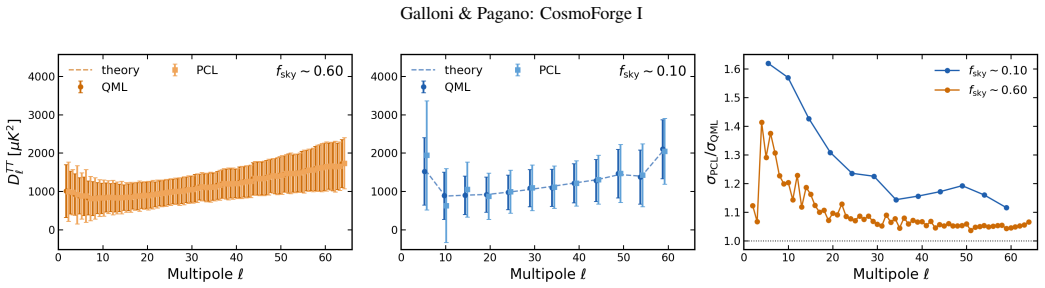
Optimal power spectrum estimation on the largest angular scales of the cosmic microwave background relies on the Quadratic Maximum Likelihood (QML) estimator. Existing public implementations, however, each address only a subset of the problem and none combine power spectrum estimation with a self-consistent pixel-space likelihood within a single framework. We present CosmoForge, a public Python framework that unifies QML power spectrum estimation and pixel-based Gaussian likelihood evaluation for spin-0 and spin-2 fields on the sphere, with general (non-diagonal) noise covariances. The framework is split into three installable packages: CosmoCore (infrastructure), QUBE (Fisher and QML estimation), and PICSLike (pixel-space likelihood). A common interface exposes two interchangeable computation bases $-$ a harmonic basis built on the Sherman-Morrison-Woodbury identity and a direct pixel-space basis $-$ selecting whichever is cheaper for the configuration at hand. Exact algorithmic optimisations reduce the Fisher cost to $\mathcal{O}(\ell_{\rm max}^4)$ for arbitrary noise covariances, with Numba JIT compilation of the hot kernels and MPI parallelisation of the likelihood scan. CosmoForge reproduces the Planck low-$\ell$ Fortran reference implementation across both the QML and pixel-space likelihood pipelines, consistently with double-precision arithmetic. Native multipole binning and three output normalisations (deconvolved, decorrelated, window-convolved) are exposed through a single code path, and the same covariance infrastructure powers both QML estimation and likelihood evaluation. CosmoForge offers a general-purpose, modular, and validated tool for the optimal analysis of large-scale data on the sphere. It is publicly available, pip-installable, and extensible to non-CMB observables.
Figures



Reference graph
Works this paper leans on
- [1]
-
[2]
Tegmark, M. and de Oliveira-Costa, A. , title =. Phys.\ Rev.\ D , volume =
-
[3]
Uncorrelated measurements of the CMB power spectrum
Tegmark, M. and Hamilton, A. J. S. , title =. Relativistic Astrophysics: 18th Texas Symposium , year =. astro-ph/9702019 , archivePrefix =
work page internal anchor Pith review Pith/arXiv arXiv
-
[4]
Bond, J. R. and Jaffe, A. H. and Knox, L. , title =. Phys.\ Rev.\ D , volume =
-
[5]
Kamionkowski, M. and Kosowsky, A. and Stebbins, A. , title =. Phys.\ Rev.\ D , volume =
- [6]
-
[7]
Goldberg, J. N. and Macfarlane, A. J. and Newman, E. T. and Rohrlich, F. and Sudarshan, E. C. G. , title =. J.\ Math.\ Phys. , volume =
-
[8]
Woodbury, M. A. , title =
-
[9]
Golub, G. H. and Van Loan, C. F. , title =
-
[10]
Bilbao-Ahedo, J. D. and Barreiro, R. B. and Vielva, P. and Mart. JCAP , volume =. 2021 , eprint =
work page 2021
-
[11]
Vanneste, S. and Henrot-Versill. Quadratic estimator for. Phys.\ Rev.\ D , volume =. 2018 , eprint =
work page 2018
-
[12]
Gruppuso, A. and de Rosa, A. and Cabella, P. and Paci, F. and Finelli, F. and Natoli, P. and de Gasperis, G. and Mandolesi, N. , title =. MNRAS , volume =. 2009 , eprint =
work page 2009
- [13]
-
[14]
QML-FAST -- A Fast Code for low-$\ell$ Tomographic Maximum Likelihood Power Spectrum Estimation
Kvasiuk, Y. and Lai, A. and M. arXiv e-prints , year =. 2510.05215 , archivePrefix =
work page internal anchor Pith review Pith/arXiv arXiv
-
[15]
Hivon, E. and G. ApJ , volume =
-
[16]
Alonso, D. and Sanchez, J. and Slosar, A. and. A unified pseudo-. MNRAS , volume =. 2019 , eprint =
work page 2019
-
[17]
Lewis, A. and Challinor, A. and Lasenby, A. , title =. ApJ , volume =. 2000 , eprint =
work page 2000
-
[18]
Howlett, C. and Lewis, A. and Hall, A. and Challinor, A. , title =. JCAP , volume =. 2012 , eprint =
work page 2012
-
[19]
Zonca, A. and Singer, L. and Lenz, D. and Reinecke, M. and Rosset, C. and Hivon, E. and Gorski, K. , title =. J.\ Open Source Softw. , volume =
-
[20]
Hunter, J. D. , title =. Comput.\ Sci.\ Eng. , volume =
-
[21]
Virtanen, P. and Gommers, R. and Oliphant, T. E. and others , title =. Nat.\ Methods , volume =
-
[22]
Harris, C. R. and Millman, K. J. and van der Walt, S. J. and others , title =. Nature , volume =
-
[23]
Dalcin, L. and Fang, Y.-L. L. , title =. Comput. Sci. Eng. , volume =. 2021 , doi =
work page 2021
-
[24]
Proceedings of the Second Workshop on the
Lam, Siu Kwan and Pitrou, Antoine and Seibert, Stanley , title =. Proceedings of the Second Workshop on the. 2015 , publisher =
work page 2015
- [25]
-
[26]
Benabed, K. and Cardoso, J.-F. and Prunet, S. and Hivon, E. , title =. A&A , volume =
- [27]
-
[28]
Pagano, L. and Delouis, J.-M. and Mottet, S. and Puget, J.-L. and Vibert, L. , title =. A&A , volume =. 2020 , eprint =
work page 2020
-
[29]
Improved constraints on primordial gravitational waves using. Phys.\ Rev.\ Lett. , volume =
- [30]
- [31]
- [32]
- [33]
-
[34]
Galloni, G. and Campeti, P. and Pagano, L. and Gerbino, M. and Lattanzi, M. and Natoli, P. , title =. JCAP , volume =. 2025 , eprint =
work page 2025
-
[35]
Chon, G. and Challinor, A. and Prunet, S. and Hivon, E. and Szapudi, I. , title =. MNRAS , volume =. 2004 , doi =
work page 2004
-
[36]
Tristram, M. and Mac. MNRAS , volume =. 2005 , doi =
work page 2005
-
[37]
Polarized CMB power spectrum estimation using the pure pseudo-cross-spectrum approach
Grain, J. and Tristram, M. and Stompor, R. , title =. PhRvD , volume =. 2009 , doi =. 0903.2350 , archivePrefix =
work page internal anchor Pith review Pith/arXiv arXiv 2009
-
[38]
Three Year Wilkinson Microwave Anisotropy Probe (WMAP) Observations: Polarization Analysis
Page, L. and Hinshaw, G. and Komatsu, E. and Nolta, M. R. and Spergel, D. N. and Bennett, C. L. and Barnes, C. and Bean, R. and Dor\'e, O. and Dunkley, J. and Halpern, M. and Hill, R. S. and Jarosik, N. and Kogut, A. and Limon, M. and Meyer, S. S. and Odegard, N. and Peiris, H. V. and Tucker, G. S. and Verde, L. and Weiland, J. L. and Wollack, E. and Wrig...
work page internal anchor Pith review Pith/arXiv arXiv 2007
-
[39]
Jensen, J. L. W. V. , title =. Acta Mathematica , volume =. 1906 , doi =
work page 1906
discussion (0)
Sign in with ORCID, Apple, or X to comment. Anyone can read and Pith papers without signing in.