REVIEW 4 major objections 4 minor 49 references
A generalised novel loss function for computational fluid dynamics
T0 review · 4 major / 4 minor · reviewed 2026-08-12 · deepseek-v4-flash
Pith's one-line read A gradient-weighted MSE loss improves cGAN-generated CFD flow fields.
desk verdict Useful, simple gradient-weighted MSE loss for CFD field generation; the reported win is suggestive but rests on an SSIM metric that aligns with what the loss optimizes, so treat it as a method proposal rather than a settled result. read the letter →
The pith
A machine-rendered reading of the paper's core claim, the machinery that carries it, and where it could break.
The reading
What carries the argument
The central object is the per-pixel weight mask $W_i$, computed from each ground-truth field by taking the non-linear magnitude of the x- and y-disparity maps (Eq. 5), blurring with a Gaussian (Eq. 6), optionally raising to a power gamma (Eq. 7), min-max normalising (Eq. 8), and applying a non-zero lower bound $C_o$ (Eq. 9). This mask multiplies the squared error in Eq. (2), so pixels in strong-gradient regions — the wake and boundary layers — dominate the loss. DGMSE is the same mask with sigma, gamma, and $C_o$ varied over training, starting with a strong blur and low offset and then relaxing.
What would settle it
Train the same cGAN with GMSE and MSE on a CFD dataset whose physically important features lie in low-gradient regions (for example, a smooth low-speed stagnation zone that dominates drag); if GMSE no longer beats MSE on SSIM or convergence, the gradient-magnitude proxy is the wrong importance map.
Extended reading notes
Core claim
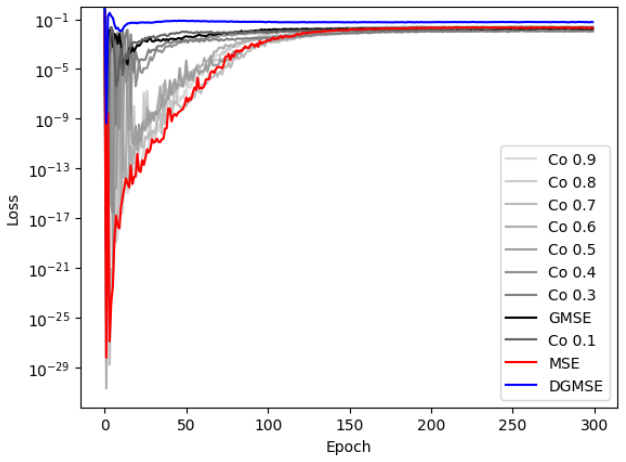
The paper claims that weighting the squared-error loss by a mask derived from the local gradient magnitude of the ground-truth flow field improves both the fidelity and the training speed of a conditional GAN used to generate CFD velocity fields. On a 1200-instance submarine wake dataset, GMSE reaches final SSIM 0.988 and DGMSE 0.989, versus 0.933 for MSE, while the maximum normalised loss rate rises from -0.107 (MSE) to -0.143 (GMSE) and -0.189 (DGMSE). The same weighted loss also helps the generator fool the discriminator more consistently. The authors interpret this as evidence that gradient-capture weighting concentrates learning on the small, high-variance regions that carry the physical information in a flow field.
Load-bearing premise
The local gradient magnitude of the ground-truth velocity field is a sufficient proxy for which regions are physically important, so upweighting those pixels improves prediction quality and convergence.
Editorial extensions
If this is right
- With the same network and data, GMSE/DGMSE raise final SSIM from 0.933 to 0.988/0.989, an 82–84% reduction in structural dissimilarity.
- The maximum normalised loss rate increases from -0.107 (MSE) to -0.143 (GMSE) and -0.189 (DGMSE), indicating faster early convergence and shorter training time.
- Low offset values ($C_o \leq 0.3$) that heavily weight gradient regions outperform MSE, while $C_o \geq 0.4$ underperform it, showing the weighting should stay focused on high-gradient structures.
- Because the weight mask is derived per field from the ground truth with no manual annotation, the method is designed to transfer to other gradient-dominated CFD fields, including pressure and density fields.
Reading between the lines
- The paper only tests the loss on 2D velocity magnitude fields; pressure, vorticity, and temperature fields are untested, and the physical importance of low-gradient regions may be different there.
- The DGMSE schedule is selected heuristically; the results suggest that systematic annealing of blur strength and offset over training could be optimised per dataset.
- Since the weighting is computed from the ground truth, it cannot be applied at inference when no ground truth exists; using the generated field's own gradient as a self-weighted loss is an untested extension that would change the objective.
- The improved discriminator fooling suggests the generator approximates the true data distribution better, which hints at reduced mode collapse in small-data regimes, a conjecture the paper raises but does not test.
Editorial analysis
A structured set of objections, weighed in public.
Referee Report
Summary. The paper proposes Gradient Mean Squared Error (GMSE), a perceptual loss for training cGANs on CFD flow fields. GMSE computes a per-pixel weight mask from the ground-truth field's local gradient magnitude (via a blurred disparity map, gamma contrast adjustment, and offset floor) and multiplies it into the standard MSE loss. A dynamic variant (DGMSE) varies these mask parameters over training epochs. The authors train the same cGAN generator with MSE, GMSE, and DGMSE on a 1200-instance submarine wake dataset, reporting higher final SSIM (0.988 and 0.989 vs. 0.933 for MSE), faster normalized loss convergence, and better early discriminator fooling. The paper argues that gradient-weighted loss focuses optimization on physically important regions and generalizes to other gradient-dominated datasets.
Significance. If the reported gains are real and robust, GMSE is an attractively simple, dataset-agnostic modification of MSE that could benefit generative surrogates for CFD and similar structured fields. The paper contributes a clearly specified loss formulation (Eqs. 2-9), an algorithmic listing, a public-domain-style CFD dataset, and a systematic parameter sweep. These are useful strengths. However, the empirical validation currently has three weaknesses that gate the central claim: single-seed comparisons without error bars, a DGMSE schedule selected post hoc from the same evaluation, and an evaluation metric (SSIM) that is inherently aligned with the gradient structure the loss emphasizes. As such, the significance is promising but not yet established.
major comments (4)
- [Section 4.2, Table 1] All comparisons rest on a single fixed seed. The standard deviations reported in Table 1 (sigma_s.d.) are across parameter variants, not across independent training runs. With one seed, the differences in final SSIM (0.933 vs 0.988) and loss rate (-0.107 vs -0.143) are single realizations with no measure of run-to-run variability. Please rerun each configuration over multiple seeds and report mean +/- std and, if appropriate, a significance test.
- [Section 4.2, DGMSE schedule] The DGMSE schedule was explicitly 'selected based on analysis of the results from an exploration of the effect of different parameters on network training performance.' This is a post hoc selection on the same data used for evaluation, which inflates the apparent benefit of DGMSE relative to MSE and GMSE. To support the claimed superiority of DGMSE, the schedule should be chosen on a validation set or pre-registered and then evaluated on a held-out test set, or the paper should clearly label the DGMSE result as an upper-bound/retrospective fit.
- [Section 3.3 vs Algorithm 1] The equations and the pseudocode specify different normalization procedures. In Eq. (8), normalization to [0,1] is applied after the gamma operation, whereas Algorithm 1 normalizes the disparity d to [0,1] before the Gaussian blur and then normalizes again after gamma. For gamma != 1 these two procedures are not equivalent because the pre-blur affine scaling interacts nonlinearly with the power law. This ambiguity affects the gamma-variant results in Table 1. Please align Algorithm 1 with the equations and explicitly state which normalization variant was used in the experiments.
- [Section 5, Equations 10, 2] The only reported quantitative field-quality metric is SSIM (Eq. 10), which specifically rewards structural/edge agreement. Since GMSE up-weights gradient regions (Eqs. 2, 5, 9), the observed SSIM improvement could reflect alignment between the training objective and the evaluation metric rather than improved physical fidelity. The paper motivates the gradient regions through their effect on drag and lift (Section 3.1), but no physical quantities or pointwise errors in low-gradient freestream regions are reported. Please add at least one physically relevant evaluation (e.g., integrated force coefficients, velocity profile error, or freestream MAE) to substantiate the claim of better CFD prediction quality.
minor comments (4)
- [Section 4.2] There is a spurious space in '10 ,' in the GMSE parameter listing; also 'gamma=1.00' and 'Co=0.2' are written without spaces in some places. Minor formatting inconsistency.
- [Section 5, Discussion] In the offset discussion, the text states 'the GMSE baseline (with Co = 0.1)' but the baseline is defined with Co = 0.2 in Section 4.2. Please correct this typo.
- [References] References [42] and [43] are duplicates. Both point to the same multiscale SSIM paper; please merge or renumber.
- [Section 4.3, Equation 2] The weight Wi in Eq. (2) is not normalized so that sum(Wi) equals the number of pixels, changing the global scale of the GMSE loss relative to MSE. While Adam is scale-adaptive, the paper comments on loss rate magnitudes; this scale difference should be discussed explicitly.
Circularity Check
No equation-level circularity: the GMSE loss is a definition and is evaluated against an external MSE baseline; the only self-fitting step is the DGMSE schedule, which is selected from the same results and then reported as a measured benefit.
-
fitted input called prediction
[Section 4.2 (Comparison with related methods), DGMSE schedule; reported in Section 5 and the abstract.]
"The DGMSE loss function had (30, 0.20, 0.1) for the first epoch, then (20, 0.40, 0.1) for epochs 1 to 5, before (20, 0.40, 0.2) was adopted until 20 epochs and then (25, 0.40, 0.2) fixed until the end of training. These settings were selected based on analysis of the results from an exploration of the effect of different parameters on network training performance."
The DGMSE variant's schedule is not derived from an independent principle; it was chosen after the authors analyzed the training-performance effects of the same parameter variations that the paper then reports. Section 5 presents DGMSE's higher SSIM (0.989 vs 0.933) and larger maximum loss rate (-0.189 vs -0.107) as evidence that the gradient-weighted dynamic loss improves CFD generation, but those numbers are the outputs used to select the schedule. The DGMSE 'result' is therefore a selection artifact rather than an independent test. The fixed GMSE baseline comparison remains independent of this step, which is why the circularity score is low.
full rationale
The GMSE loss function is a definition (Eqs. 1-9), not a derivation, so there is no hidden identity by which the predicted output equals the input. The central fixed-GMSE claim is an empirical comparison under identical architecture and seeds against an MSE baseline, and the measured SSIM gap (0.988 vs 0.933) comes from an external metric (Eq. 10), not from the loss equation itself. The self-citation for the CFD dataset ([39]) is data provenance rather than a load-bearing argument that gradient weighting helps, so it does not raise the score. The concern that GMSE and SSIM both emphasize gradient/edge structure is a construct-validity or metric-alignment risk, not circularity: GMSE weights squared pixel error, while SSIM is a separate function of local means, variances and covariances, and no equation in the paper makes one imply the other. The only concrete fitted-input-as-evidence step is the DGMSE hyperparameter schedule, which was explicitly selected from the same experimental results and then reported as a DGMSE advantage; this affects the DGMSE-specific headline figures but leaves the fixed GMSE-vs-MSE comparison standing. Hence a low partial-circularity score of 2 is appropriate.
Assumptions & free parameters
free parameters (4)
- Gaussian blur sigma =
10 for GMSE baseline; DGMSE schedule starts at 30, then 20, 20, 25
- Gamma exponent =
1.00 for GMSE baseline; DGMSE schedule 0.20, 0.40, 0.40, 0.40
- Offset Co =
0.2 for GMSE baseline; DGMSE schedule 0.1, 0.1, 0.2, 0.2
- DGMSE parameter schedule =
(30,0.20,0.1) epoch 0; (20,0.40,0.1) epochs 1-5; (20,0.40,0.2) epochs 6-20; (25,0.40,0.2) thereafter
assumptions (5)
- domain assumption RANS k-epsilon simulations are an acceptable ground truth for flow field generation
- domain assumption SSIM is a valid metric for assessing flow field structural fidelity
- domain assumption The gradient magnitude of the ground truth field identifies regions of importance
- domain assumption The fixed cGAN architecture is representative and adequate for comparing loss functions
- domain assumption Single-run training with fixed seeds is sufficient to compare loss functions
Cite this review
Pith. "Pith review of A generalised novel loss function for computational fluid dynamics." pith.science (2026). https://pith.science/paper/JBXNVCCG
@misc{pith2026241117059,
  author       = {Pith},
  title        = {Pith review of: A generalised novel loss function for computational fluid dynamics},
  year         = {2026},
  howpublished = {\url{https://pith.science/paper/JBXNVCCG}},
  note         = {Machine review of arXiv:2411.17059}
}
read the original abstract
Computational fluid dynamics (CFD) simulations are crucial in automotive, aerospace, maritime and medical applications, but are limited by the complexity, cost and computational requirements of directly calculating the flow, often taking days of compute time. Machine-learning architectures, such as controlled generative adversarial networks (cGANs) hold significant potential in enhancing or replacing CFD investigations, due to cGANs ability to approximate the underlying data distribution of a dataset. Unlike traditional cGAN applications, where the entire image carries information, CFD data contains small regions of highly variant data, immersed in a large context of low variance that is of minimal importance. This renders most existing deep learning techniques that give equal importance to every portion of the data during training, inefficient. To mitigate this, a novel loss function is proposed called Gradient Mean Squared Error (GMSE) which automatically and dynamically identifies the regions of importance on a field-by-field basis, assigning appropriate weights according to the local variance. To assess the effectiveness of the proposed solution, three identical networks were trained; optimised with Mean Squared Error (MSE) loss, proposed GMSE loss and a dynamic variant of GMSE (DGMSE). The novel loss function resulted in faster loss convergence, correlating to reduced training time, whilst also displaying an 83.6% reduction in structural similarity error between the generated field and ground truth simulations, a 76.6% higher maximum rate of loss and an increased ability to fool a discriminator network. It is hoped that this loss function will enable accelerated machine learning within computational fluid dynamics.
Figures


Figures from the paper (8 more)



Reference graph
Works this paper leans on
-
[1]
J. R. Clough, N. Byrne, I. Oksuz, V. A. Zimmer, J. A. Schnabel, A. P. King, A topological loss function for deep-learning based im- age segmentation using persistent homology, IEEE Transactions on Pattern Analysis and Machine Intelligence 44 (12) (2022) 8766–8778. doi:10.1109/TPAMI.2020.3013679
arXiv 2022
-
[2]
A. Kammoun, R. Slama, H. Tabia, T. Ouni, M. Abid, Generative ad- versarial networks for face generation: A survey, ACM Comput. Surv. 55 (5) (dec 2022). doi:10.1145/3527850. URL https://doi.org/10.1145/3527850
doi:10.1145/3527850 2022
-
[3]
N. Elaraby, S. Barakat, A. Rezk, A conditional gan-based ap- proach for enhancing transfer learning performance in few-shot hcr tasks, Nature Scientific Reports 12 (2022) 16271. doi:10.1038/ s41598-022-20654-1
work page 2022
-
[4]
I. H. Rather, S. Kumar, Generative adversarial network based syn- thetic data training model for lightweight convolutional neural net- works, Multimedia Tools and Applications 83 (2024) 6429–6271. doi: 10.1007/s11042-023-15747-6
-
[5]
C. Duru, H. Alemdar, O. U. Baran, A deep learning approach for the transonic flow field predictions around airfoils, Computers & Fluids 236 (2022) 105312. doi:https://doi.org/10.1016/j.compfluid.2022. 105312
-
[6]
Z. Pang, K. Liu, H. Xiao, T. Jin, K. Luo, J. Fan, A deep-learning super-resolution reconstruction model of turbulent reacting flow, Com- puters & Fluids 275 (2024) 106249. doi:https://doi.org/10.1016/ j.compfluid.2024.106249
arXiv 2024
- [7]
-
[8]
G. Calzolari, W. Liu, Deep learning to replace, improve, or aid cfd analysis in built environment applications: A review, Building and Environment 206 (2021) 108315. doi:https://doi.org/10.1016/j. buildenv.2021.108315. 32
arXiv 2021
Show all 49 references
-
[9]
M. Z. Yousif, L. Yu, S. Hoyas, R. Vinuesa, H. Lim, A deep-learning approach for reconstructing 3d turbulent flows from 2d observation data, Nature Scientific Reports 13 (2023) 2359. doi:https://doi.org/10. 1038/s41598-023-29525-9
2023
-
[10]
H.-S. Choi, M. Jeon, K. Song, M. Kang, Semantic fire segmentation model based on convolutional neural network for outdoor image, Fire Technology 57 (2021) 3005–3019. doi:10.1007/s10694-020-01080-z
2021 doi
-
[11]
J. F. Cipri´ an-S´ anchez, G. Ochoa-Ruiz, L. Rossi, F. Morandini, Assessing the impact of the loss function, architecture and image type for deep learning-based wildfire segmentation, Applied Sciences 11 (15) (2021). doi:10.3390/app11157046
2021 doi
-
[12]
X. Ling, C. Li, P. Yang, Y. Huang, F. Qin, Tu2net-gan: A temporal precipitation nowcasting model with multiple decoding modules, Pattern Recognition Letters 178 (2024) 98–105. doi:10.1016/j.patrec.2023. 12.025
2024 doi
-
[13]
Zhang, W
X. Zhang, W. Lu, Y. Pan, H. Wu, R. Wang, R. Yu, Empirical study on tangent loss function for classification with deep neural networks, Computers & Electrical Engineering 90 (2021) 107000. doi:10.1016/ j.compeleceng.2021.107000
2021
-
[14]
Y. Chen, L. Li, W. Li, Q. Guo, Z. Du, Z. Xu, AI Computing Systems, Chapter 2 - Fundamentals of neural networks, 1st Edition, Morgan Kauf- mann, Burlington, MA, 2024
2024
-
[15]
Lucas, A
A. Lucas, A. K. Katsaggelos, S. Lopez-Tapuia, R. Molina, Generative adversarial networks and perceptual losses for video super-resolution, in: 2018 25th IEEE International Conference on Image Processing (ICIP), 2018, pp. 51–55. doi:10.1109/ICIP.2018.8451714
2018
-
[16]
H. Zhao, O. Gallo, I. Frosio, J. Kautz, Loss functions for image restora- tion with neural networks, IEEE Transactions on Computational Imag- ing 3 (1) (2017) 47–57. doi:10.1109/TCI.2016.2644865
2017
- [17]
-
[18]
Gurumurthy, R
S. Gurumurthy, R. Sarvadevabhatla, R. Babu, Deligan: Generative ad- versarial networks for diverse and limited data, in: 2017 IEEE Con- ference on Computer Vision and Pattern Recognition (CVPR), IEEE Computer Society, Los Alamitos, CA, USA, 2017, pp. 4941–4949. doi: 10.1109/CV...
2017 doi
-
[19]
Z. Wang, X. Liu, J. Yu, H. Wu, H. Lyu, A general deep transfer learning framework for predicting the flow field of airfoils with small data, Com- puters & Fluids 251 (2023) 105738. doi:https://doi.org/10.1016/ j.compfluid.2022.105738
2023
-
[20]
J. Xu, X. Ren, J. Lin, X. Sun, Diversity-promoting GAN: A cross- entropy based generative adversarial network for diversified text gen- eration, in: Proceedings of the 2018 Conference on Empirical Methods in Natural Language Processing, 2018, pp. 3940–3949. doi:10.18653/ v1/D18-1428
2018
-
[21]
S. Lee, D. You, Data-driven prediction of unsteady flow over a circular cylinder using deep learning, Journal of Fluid Mechanics 879 (2019) 217–254
2019
-
[22]
D. Chen, X. Gao, C. Xu, S. Chen, J. Fang, Z. Wang, Z. Wang, Flowgan: A conditional generative adversarial network for flow predic- tion in various conditions, in: 2020 IEEE 32nd International Confer- ence on Tools with Artificial Intelligence (ICTAI), 2020, pp. 315–322. doi:10...
2020
-
[23]
H. Wu, X. Liu, W. An, S. Chen, H. Lyu, A deep learning approach for efficiently and accurately evaluating the flow field of supercritical airfoils, Computers & Fluids 198 (2020) 104393. doi:https://doi. org/10.1016/j.compfluid.2019.104393
2020
-
[24]
L.-W. Chen, N. Thuerey, Towards high-accuracy deep learning inference of compressible flows over aerofoils, Computers & Fluids 250 (2023) 105707. doi:https://doi.org/10.1016/j.compfluid.2022.105707
2023
-
[25]
Heger, D
P. Heger, D. Hilger, M. Full, N. Hosters, Investigation of physics- informed deep learning for the prediction of parametric, three- dimensional flow based on boundary data, Computers & Fluids 278 34 (2024) 106302. doi:https://doi.org/10.1016/j.compfluid.2024. 106302
2024 doi
-
[26]
Andr´ es-Ferrer, D
J. Andr´ es-Ferrer, D. Ortiz-Mart ´ ınez, I. Garc ´ ıa-Varea, F. Casacuberta, On the use of different loss functions in statistical pattern recognition ap- plied to machine translation, Pattern Recognition Letters 29 (8) (2008) 1072–1081, pattern Recognition in Interdisciplina...
2008 doi
-
[27]
Y. Tian, D. Su, S. Lauria, X. Liu, Recent advances on loss functions in deep learning for computer vision, Neurocomputing 497 (2022) 129–158. doi:10.1016/j.neucom.2022.04.127
2022 doi
-
[28]
Y. Kim, Y. Lee, M. Jeon, Imbalanced image classification with com- plement cross entropy, Pattern Recognition Letters 151 (2021) 33–40. doi:10.1016/j.patrec.2021.07.017
2021 doi
-
[29]
K. R. Lennon, G. H. McKinley, J. W. Swan, Scientific machine learning for modeling and simulating complex fluids, Proceedings of the National Academy of Sciences of the United States of America 120 (2023) 1–9. doi:10.1073/pnas.2304669120
2023 doi
-
[30]
Abdar, F
M. Abdar, F. Pourpanah, S. Hussain, D. Rezazadegan, L. Liu, M. Ghavamzadeh, P. Fieguth, X. Cao, A. Khosravi, U. R. Acharya, V. Makarenkov, S. Nahavandi, A review of uncertainty quantification in deep learning: Techniques, applications and challenges, Information Fusion 76 (202...
2021 doi
-
[31]
Alexandersen, C
J. Alexandersen, C. S. Andreasen, A review of topology optimisa- tion for fluid-based problems, Fluids 5 (1) (2020). doi:10.3390/ fluids5010029
2020
-
[32]
Masoumi-Verki, F
S. Masoumi-Verki, F. Haghighat, N. Bouguila, U. Eicker, The use of GANs and transfer learning in model-order reduction of turbulent wake of an isolated high-rise building, Building and Environment 246 (2023) 110948. doi:10.1016/j.buildenv.2023.110948
2023
-
[33]
Karras, T
T. Karras, T. Aila, S. Laine, J. Lehtinen, Progressive growing of GANs for improved quality, stability, and variation, in: International Confer- 35 ence on Learning Representations, 2018, pp. 1–26. URL https://openreview.net/forum?id=Hk99zCeAb
2018
-
[34]
Dumoulin, F
V. Dumoulin, F. Visin, A guide to convolution arithmetic for deep learn- ing (2018). arXiv:1603.07285
2018 arXiv
-
[35]
O. A. Montesinos L´ opez, A. Montesinos L´ opez, J. Crossa, Fundamentals of Artificial Neural Networks and Deep Learning, Springer International Publishing, Cham, 2022, Ch. 10, pp. 379–425
2022
-
[36]
Santurkar, D
S. Santurkar, D. Tsipras, A. Ilyas, A. Madry, How does batch normal- ization help optimization?, in: 32nd Conference on Neural Information Processing Systems (NeurIPS), 2018, pp. 1–11
2018
-
[37]
Ayachi, M
R. Ayachi, M. Afif, Y. Said, M. Atri, Strided convolution instead of max pooling for memory efficiency of convolutional neural networks, in: M. S. Bouhlel, S. Rovetta (Eds.), Proceedings of the 8th International Conference on Sciences of Electronics, Technologies of Informatio...
2020
-
[38]
Chintalapudi, G
N. Chintalapudi, G. Battineni, M. A. Hossain, F. Amenta, Cascaded deep learning frameworks in contribution to the detection of parkin- son’s disease, Bioengineering (Basel) 9 (2022) 116–128. doi:10.3390/ bioengineering9030116
2022
-
[39]
Cooper-Baldock, P
Z. Cooper-Baldock, P. E. Santos, R. S. A. Brinkworth, K. Sammut, Hydrodynamic analysis of payload bay berthing for underwater vehicles, IEEE Journal of Oceanic Engineering 49 (2024) 727–748. doi:10.1109/ JOE.2024.3352714
2024
-
[40]
Yeganeh, Cross dynamic range and cross resolution objective image quality assessment with applications, Ph.D
H. Yeganeh, Cross dynamic range and cross resolution objective image quality assessment with applications, Ph.D. thesis, University of Water- loo (July 2014). doi:10.13140/RG.2.1.1900.2320
2014
-
[41]
Z. Wang, A. Bovik, H. Sheikh, E. Simoncelli, Image quality assessment: from error visibility to structural similarity, IEEE Transactions on Image Processing 13 (4) (2004) 600–612. doi:10.1109/TIP.2003.819861
2004
-
[43]
Z. Wang, E. Simoncelli, A. Bovik, Multiscale structural similarity for image quality assessment, in: The Thrity-Seventh Asilomar Conference on Signals, Systems & Computers, 2003, Vol. 2, 2003, pp. 1398–1402 Vol.2. doi:10.1109/ACSSC.2003.1292216
2003 arXiv
-
[44]
L. Hu, W. Wang, Y. Xiang, J. Zhang, Flow field reconstructions with gans based on radial basis functions, IEEE Transactions on Aerospace and Electronic Systems 58 (4) (2022) 3460–3476. doi:10.1109/TAES. 2022.3152706
2022
-
[45]
Kuzay, A
M. Kuzay, A. Dogan, S. Yilmaz, O. Herkiloglu, A. S. Atalay, A. Cem- berci, C. Yilmaz, E. Demirel, Numerical and experimental dataset for a retrofitted data center, Data in Brief 45 (2022) 108587. doi:https: //doi.org/10.1016/j.dib.2022.108587
2022
-
[46]
Nijssen, J
T. Nijssen, J. Padding, M. Ottens, Data companion to: Hydrodynamics of expanded bed adsorption studied through cfd-dem (2023). doi:10. 4121/ebaf0dc5-d8d2-4eb7-8f28-21f7f9b2335c.v1
2023
-
[47]
McConkey, E
R. McConkey, E. Yee, F.-S. Lien, A curated dataset for data-driven turbulence modelling, Nature Scientific Data 8 (255) (2021). doi:10. 1038/s41597-021-01034-2
2021
-
[48]
Zhang, M
Z. Zhang, M. Li, J. Yu, On the convergence and mode collapse of gan, in: SIGGRAPH Asia 2018 Technical Briefs, SA ’18, Association for Computing Machinery, New York, NY, USA, 2018, pp. 1–4. doi:10. 1145/3283254.3283282
2018
-
[49]
Kushwaha, G
Bhagyashree, V. Kushwaha, G. C. Nandi, Study of prevention of mode collapse in generative adversarial network (gan), in: 2020 IEEE 4th Conference on Information & Communication Technology (CICT), 2020, pp. 1–6. doi:10.1109/CICT51604.2020.9312049
2020
-
[50]
S. Pei, R. Y. D. Xu, S. Xiang, G. Meng, Alleviating mode collapse in GAN via diversity penalty module, CoRR abs/2108.02353 (2021). arXiv:2108.02353. 37
2021 arXiv
Reviewed August 12, 2026 · model on record in the stance chip above.
Discussion (0). Continue with ORCID to comment.