REVIEW 3 minor 77 references
Spectral analysis of equilibration: information leakage in isolated quantum systems
T0 review · 0 major / 3 minor · reviewed 2026-06-27 · grok-4.3
Pith's one-line read Universal bounds on a leakage fidelity function show that spectral delocalization suppresses temporal fluctuations and guarantees average equilibration in isolated quantum systems.
desk verdict The paper introduces the Leakage Fidelity Function and derives spectral bounds on its fluctuations, with the central claims holding up without obvious gaps. read the letter →
The pith
A machine-rendered reading of the paper's core claim, the machinery that carries it, and where it could break.
The reading
What carries the argument
The Leakage Fidelity Function (LFF), the probability that a unitarily evolving state escapes the support of its initial subspace under subspace coarse-graining.
What would settle it
A concrete counter-example would be an isolated quantum system whose spectrum is highly delocalized yet whose LFF exhibits large, persistent temporal fluctuations that violate the derived bounds.
Extended reading notes
Core claim
By defining the Leakage Fidelity Function as the probability of escape from an initial subspace under unitary evolution, the authors obtain universal bounds on its temporal fluctuations in terms of spectral gaps and effective dimension squared; these bounds demonstrate that large spectral delocalization suppresses fluctuations and thereby guarantees equilibration on average, while spectral power distributions quantify the relation between gap participation and stability.
Load-bearing premise
Subspace coarse-graining is assumed to capture all relevant information about equilibration and information leakage.
Editorial extensions
If this is right
- Large spectral delocalization suppresses fluctuations of the LFF and thereby guarantees equilibration on average.
- Spectral power distributions and their entropic measures quantify the link between phase mixing, gap participation, and dynamical stability.
- The LFF connects directly to quantum speed limits, revealing the average timescale required for equilibration.
- The framework applies to closed quantum many-body systems to explain irreversibility through spectral complexity and subspace leakage.
Reading between the lines
- The bounds could be tested in quantum simulators by preparing states with controlled spectral delocalization and measuring leakage out of prepared subspaces.
- If the LFF framework holds, it may offer a geometric route to bounding relaxation times in systems where traditional ensemble averages are unavailable.
- The approach suggests examining how effective dimension scales with system size to predict when equilibration becomes robust against fluctuations.
Editorial analysis
A structured set of objections, weighed in public.
Referee Report
Summary. The manuscript develops a unified dynamical-spectral framework for equilibration in isolated quantum systems based on subspace coarse-graining. It introduces the Leakage Fidelity Function (LFF) as an operational measure of information leakage (the probability that a unitarily evolving state escapes the support of its initial subspace), derives universal bounds on LFF temporal fluctuations expressed in terms of spectral gap structure and the square of the effective dimension, introduces spectral power distributions together with associated entropic measures to quantify phase mixing and gap participation, and connects the LFF to quantum speed limits to obtain an average equilibration timescale. The central claim is that large spectral delocalization suppresses fluctuations and guarantees equilibration on average, providing a state-dependent geometric perspective without ensemble or perturbative assumptions.
Significance. If the derivations are correct, the work supplies a parameter-free, geometrically transparent approach to equilibration that directly ties spectral delocalization and effective dimension to dynamical stability. The absence of ensemble assumptions and the explicit link between LFF fluctuations and spectral gap structure constitute a clear strength relative to many existing treatments; the connection to quantum speed limits for timescales is a further positive feature.
minor comments (3)
- [§2] §2: the definition of the effective dimension D_eff appears only after the statement of the main bound (Eq. (12)); moving the definition forward would improve readability.
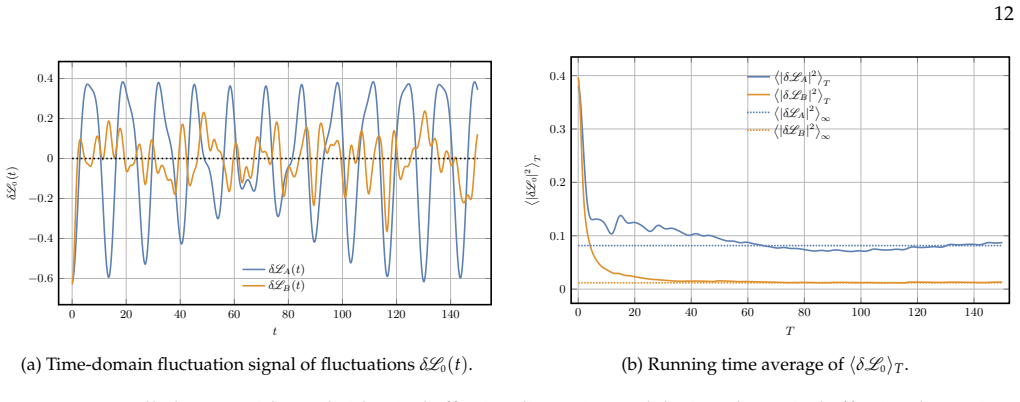
- [Figure 3] Figure 3: the caption does not specify the Hilbert-space dimension or the precise initial subspace used for the numerical example; this makes direct comparison with the analytic bound difficult.
- [§4] The notation for the spectral power distribution P(ω) is introduced in §4 but is not contrasted with the conventional density of states; a brief remark on the distinction would help readers familiar with standard spectral techniques.
Simulated Author's Rebuttal
We thank the referee for the positive assessment of our manuscript, the recognition of its strengths (parameter-free geometric approach, explicit spectral-gap connection, and quantum-speed-limit link), and the recommendation for minor revision. No specific major comments appear in the report.
Circularity Check
No circularity: derivation self-contained via spectral analysis
full rationale
The paper's central derivation of universal bounds on LFF temporal fluctuations from spectral gap structure and effective dimension squared follows standard spectral techniques in quantum dynamics. The LFF is introduced as an operational definition (probability of escape from initial subspace), and the bounds are presented as following directly from this without reducing to fitted parameters, self-definitions, or load-bearing self-citations. No equations or steps in the abstract or description exhibit the enumerated circular patterns; the approach is independent of ensemble assumptions and aligns with external spectral methods. The subspace coarse-graining serves as a proxy without circular reduction to the target result.
Assumptions & free parameters
assumptions (1)
- standard math Unitary time evolution governs isolated quantum systems
invented entities (2)
-
Leakage Fidelity Function (LFF)
-
Spectral power distributions
Cite this review
Pith. "Pith review of Spectral analysis of equilibration: information leakage in isolated quantum systems." pith.science (2026). https://pith.science/paper/JBZY3KRN
@misc{pith2026260612545,
  author       = {Pith},
  title        = {Pith review of: Spectral analysis of equilibration: information leakage in isolated quantum systems},
  year         = {2026},
  howpublished = {\url{https://pith.science/paper/JBZY3KRN}},
  note         = {Machine review of arXiv:2606.12545}
}
read the original abstract
We develop a unified dynamical-spectral framework for equilibration in isolated quantum systems based on a subspace coarse-graining approach. Central to our formulation is the Leakage Fidelity Function (LFF), defined as the probability that a unitarily evolving state escapes the support of its initial subspace. This quantity provides a direct, operational measure of information flow and memory loss without invoking ensemble assumptions or perturbative arguments. We derive universal bounds on temporal fluctuations of the LFF, in terms of the spectral gap structure and the square of the effective dimension, evincing that large spectral delocalization suppresses fluctuations and guarantees equilibration on average. By introducing spectral power distributions and associated entropic measures, we establish a quantitative link between phase mixing, gap participation, and dynamical stability. We further investigate the equilibration timescale by connecting the LFF to quantum speed limits, thereby revealing the average time required for equilibration. Our results provide a state-dependent, geometrically transparent perspective on how spectral complexity and subspace information leakage jointly govern irreversibility in closed quantum many-body systems.
Figures


Figures from the paper (5 more)




Reference graph
Works this paper leans on
-
[1]
(33) Hamiltonian Unbiased Observables (HUOs) are oper- atorsO= ∑α oα |φα⟩ ⟨φα| whose eigenstates form a HUB
Hamiltonian Unbiased Basis A Hamiltonian Unbiased Basis (HUB) is an orthonor- mal family{ |φα⟩}dE−1 α=0 that is mutually unbiased with the energy eigenbasis{ |En⟩}dE−1 n=0 of the HamiltonianH: | ⟨φα|En⟩ | 2 = 1 dE . (33) Hamiltonian Unbiased Observables (HUOs) are oper- atorsO= ∑α oα |φα⟩ ⟨φα| whose eigenstates form a HUB. A key property is that their equ...
2024
-
[2]
Boltzmann, Weitere studien über das wärmegle- ichgewicht unter gasmolekülen, inKinetische Theorie II: Ir- reversible Prozesse Einführung und Originaltexte(Springer,
L. Boltzmann, Weitere studien über das wärmegle- ichgewicht unter gasmolekülen, inKinetische Theorie II: Ir- reversible Prozesse Einführung und Originaltexte(Springer,
-
[3]
Ehrenfest and T
P . Ehrenfest and T. Ehrenfest,The conceptual foundations of the statistical approach in mechanics(Courier Corporation, 1990)
1990
-
[4]
Zwanzig, Memory effects in irreversible thermody- namics, Physical Review124, 983 (1961)
R. Zwanzig, Memory effects in irreversible thermody- namics, Physical Review124, 983 (1961)
1961
-
[5]
Zwanzig, The concept of irreversibility in statistical mechanics, Pure and Applied Chemistry22, 371 (1970)
R. Zwanzig, The concept of irreversibility in statistical mechanics, Pure and Applied Chemistry22, 371 (1970)
1970
-
[6]
Mori, Transport, collective motion, and brownian mo- tion, Progress of theoretical physics33, 423 (1965)
H. Mori, Transport, collective motion, and brownian mo- tion, Progress of theoretical physics33, 423 (1965)
1965
-
[7]
W. H. Zurek, Environment-induced superselection rules, Phys. Rev. D26, 1862 (1982)
1982
-
[8]
Reimann, Foundation of statistical mechanics under experimentally realistic conditions, Phys
P . Reimann, Foundation of statistical mechanics under experimentally realistic conditions, Phys. Rev. Lett.101, 190403 (2008)
2008
Show all 77 references
-
[9]
Linden, S
N. Linden, S. Popescu, A. J. Short, and A. Winter, Quan- tum mechanical evolution towards thermal equilibrium, Phys. Rev. E79, 061103 (2009)
2009
-
[10]
Reimann, Canonical thermalization, New Journal of Physics12, 055027 (2010)
P . Reimann, Canonical thermalization, New Journal of Physics12, 055027 (2010)
2010
-
[11]
Reimann and M
P . Reimann and M. Kastner, Equilibration of isolated macroscopic quantum systems, New Journal of Physics 14, 043020 (2012)
2012
-
[12]
A. J. Short and T. C. Farrelly, Quantum equilibration in finite time, New Journal of Physics14, 013063 (2012). 18
2012
-
[14]
Meier, T
F. Meier, T. Rivlin, T. Debarba, J. Xuereb, M. Huber, and M. P . Lock, Emergence of a second law of thermodynam- ics in isolated quantum systems, PRX Quantum6, 010309 (2025)
2025
-
[15]
M. G. Alpino, T. Debarba, R. O. Vianna, and A. T. Cesário, A complexity-based approach to quantum observable equilibration, Entropy27, 824 (2025)
2025
-
[16]
Schwarzhans, F
E. Schwarzhans, F. C. Binder, M. Huber, and M. P . E. Lock, Quantum measurements and equilibration: The emer- gence of objective outcomes via entropy maximization, Phys. Rev. Res.7, 043279 (2025)
2025
-
[17]
Engineer, T
S. Engineer, T. Rivlin, S. Wollmann, M. Malik, and M. P . E. Lock, Equilibration of objective observables in a dynam- ical model of quantum measurements, Phys. Rev. A113, 032205 (2026)
2026
-
[18]
de Melo, G
F. de Melo, G. D. Carvalho, P . S. Correia, P . C. Obando, T. R. de Oliveira, and R. O. Vallejos, A finite-resource description of a measurement process and its implica- tions for the ‘wigner’s friend’ scenario, arXiv preprint arXiv:2411.07327 (2024)
2024
-
[19]
J. M. Deutsch, Quantum statistical mechanics in a closed system, Phys. Rev. A43, 2046 (1991)
-
[20]
Srednicki, Chaos and quantum thermalization, Phys
M. Srednicki, Chaos and quantum thermalization, Phys. Rev. E50, 888 (1994)
1994
-
[21]
Anzà and V
F. Anzà and V . Vedral, Information-theoretic equilibrium and observable thermalization, Scientific Reports7, 1 (2017)
2017
-
[22]
F. Anza, C. Gogolin, and M. Huber, Eigenstate thermal- ization for degenerate observables, Phys. Rev. Lett.120, 150603 (2018)
2018
-
[23]
Gorin, T
T. Gorin, T. Prosen, T. H. Seligman, and M. Žnidariˇ c, Dy- namics of loschmidt echoes and fidelity decay, Physics Reports435, 33 (2006)
2006
-
[24]
Emerson, Y
J. Emerson, Y. S. Weinstein, M. Saraceno, S. Lloyd, and D. G. Cory, Fidelity decay as an efficient indicator of quantum chaos, Phys. Rev. Lett.89, 284102 (2002)
2002
-
[25]
Prosen, General relation between quantum ergodicity and fidelity of quantum dynamics, Phys
T. Prosen, General relation between quantum ergodicity and fidelity of quantum dynamics, Phys. Rev. E65, 036208 (2002)
2002
-
[26]
Kowalewska-Kudłaszyk, J
A. Kowalewska-Kudłaszyk, J. Kalaga, and W. Leo ´ nski, Long-time fidelity and chaos for a kicked nonlinear os- cillator system, Physics Letters A373, 1334 (2009)
2009
-
[27]
Y. S. Weinstein and C. S. Hellberg, Quantum fidelity de- cay in quasi-integrable systems, Phys. Rev. E71, 016209 (2005)
2005
-
[28]
D. A. Zarate-Herrada, L. F. Santos, and E. J. Torres- Herrera, Generalized survival probability, Entropy25, 205 (2023)
2023
-
[29]
E. J. Torres-Herrera, A. M. García-García, and L. F. San- tos, Generic dynamical features of quenched interacting quantum systems: Survival probability, density imbal- ance, and out-of-time-ordered correlator, Phys. Rev. B97, 060303(R) (2018)
2018
-
[30]
P . R. Zangara, A. D. Dente, E. J. Torres-Herrera, H. M. Pastawski, A. Iucci, and L. F. Santos, Time fluctuations in isolated quantum systems of interacting particles, Phys. Rev. E88, 032913 (2013)
2013
-
[32]
A. J. Short, Equilibration of quantum systems and subsys- tems, New Journal of Physics13, 053009 (2011)
2011
-
[33]
Y. Liu, P . Sierant, P . Stornati, M. Lewenstein, and M. Płodzie ´ n, Quantum algorithms for inverse participa- tion ratio estimation in multiqubit and multiqudit sys- tems, Phys. Rev. A111, 052614 (2025)
2025
-
[34]
Távora, E
M. Távora, E. J. Torres-Herrera, and L. F. Santos, In- evitable power-law behavior of isolated many-body quantum systems and how it anticipates thermalization, Phys. Rev. A94, 041603 (2016)
2016
-
[35]
E. J. Torres-Herrera and L. F. Santos, Nonexponential fi- delity decay in isolated interacting quantum systems, Phys. Rev. A90, 033623 (2014)
2014
-
[36]
E. J. Torres-Herrera and L. F. Santos, Dynamics at the many-body localization transition, Phys. Rev. B92, 014208 (2015)
2015
-
[37]
Schiulaz, E
M. Schiulaz, E. J. Torres-Herrera, and L. F. Santos, Thou- less and relaxation time scales in many-body quantum systems, Phys. Rev. B99, 174313 (2019)
2019
-
[38]
L. F. Santos, F. Pérez-Bernal, and E. J. Torres-Herrera, Speck of chaos, Phys. Rev. Research2, 043034 (2020)
2020
-
[39]
E. J. Torres-Herrera and L. F. Santos, Dynamical mani- festations of quantum chaos: correlation hole and bulge, Philos. Trans. A: Math., Phys. and Eng. Sci.375, 20160434 (2017)
2017
-
[40]
Lerma-Hernández, D
S. Lerma-Hernández, D. Villaseñor, M. A. Bastarrachea- Magnani, E. J. Torres-Herrera, L. F. Santos, and J. G. Hirsch, Dynamical signatures of quantum chaos and re- laxation time scales in a spin-boson system, Physical Re- view E100, 012218 (2019)
2019
-
[41]
T. L. M. Lezama, E. J. Torres-Herrera, F. Pérez-Bernal, Y. Bar Lev, and L. F. Santos, Equilibration time in many- body quantum systems, Phys. Rev. B104, 085117 (2021)
2021
-
[42]
M. L. Mehta,Random Matrices, 3rd ed. (Elsevier Academic Press, 2004)
2004
-
[43]
Haake,Quantum Signatures of Chaos, 2nd ed
F. Haake,Quantum Signatures of Chaos, 2nd ed. (Springer Berlin, Heidelberg, 2001)
2001
-
[44]
A. K. Das, C. Cianci, D. G. A. Cabral, D. A. Zarate-Herrada, P . Pinney, S. Pilatowsky-Cameo, A. S. Matsoukas-Roubeas, V . S. Batista, A. del Campo, E. J. Torres-Herrera, and L. F. Santos, Proposal for many-body quantum chaos detection, Phys. Rev. Res.7, 013181 (2025)
2025
-
[45]
Donget al., Measuring the spectral form factor in many-body chaotic and localized phases of quantum pro- cessors, Phys
H. Donget al., Measuring the spectral form factor in many-body chaotic and localized phases of quantum pro- cessors, Phys. Rev. Lett.134, 010402 (2025)
2025
-
[46]
Bohr,Almost Periodic Functions, 2nd ed
H. Bohr,Almost Periodic Functions, 2nd ed. (Dover Publi- cations, Mineola, NY, 2018) reprint (1947)
2018
-
[47]
F. Anza, C. Gogolin, and M. Huber, Eigenstate thermal- ization for degenerate observables, Phys. Rev. Lett.120 (2018)
2018
-
[48]
Scarpa, C
L. Scarpa, C. M. Scandolo, and M. Lostaglio, Ob- servable statistical mechanics, arXiv preprint (2025), arXiv:2309.15173 [quant-ph]
2025
-
[49]
Mandelstam and I
L. Mandelstam and I. Tamm, The uncertainty relation be- tween energy and time in non-relativistic quantum me- chanics, inSelected Papers, edited by B. M. Bolotovskii, V . Y. Frenkel, and R. Peierls (Springer, Berlin, Heidelberg,
-
[50]
Deffner and S
S. Deffner and S. Campbell, Quantum speed limits: From heisenberg’s uncertainty principle to optimal quantum control, J. Phys. A: Math. Theor.50, 453001 (2017)
2017
-
[51]
L. E. Ballentine,Quantum Mechanics, 2nd ed. (World Sci- entific, 1998)
1998
-
[52]
Caneva, M
T. Caneva, M. Murphy, T. Calarco, R. Fazio, S. Mon- 19 tangero, V . Giovannetti, and G. E. Santoro, Optimal con- trol at the quantum speed limit, Phys. Rev. Lett.103, 240501 (2009)
2009
-
[53]
A. K. Das, A. Ghosh, and L. F. Santos, Spectral form fac- tor and energy correlations in banded random matrices, Phys. Rev. B111, 224202 (2025)
2025
-
[54]
Gogolin and J
C. Gogolin and J. Eisert, Equilibration, thermalisation, and the emergence of statistical mechanics in closed quantum systems, Reports on Progress in Physics79, 056001 (2016)
2016
-
[55]
Y. Y. Atas, E. Bogomolny, O. Giraud, and G. Roux, Dis- tribution of the ratio of consecutive level spacings in ran- dom matrices, Phys. Rev. Lett.110, 084101 (2013)
2013
-
[56]
Li and S.-S
Y.-C. Li and S.-S. Li, Density matrix loschmidt echo and quantum phase transitions, Phys. Rev. A76, 032117 (2007)
2007
-
[57]
Karch, S
S. Karch, S. Bandyopadhyay, Z.-H. Sun, A. Impertro, S. Huh, I. P . Rodríguez, J. F. Wienand, W. Ketterle, M. Heyl, A. Polkovnikov, I. Bloch, and M. Aidelsburger, Probing quantum many-body dynamics using subsystem loschmidt echos (2025)
2025
-
[58]
C. J. Turner, A. A. Michailidis, D. A. Abanin, M. Serbyn, and Z. Papic, Weak ergodicity breaking from quantum many-body scars, Nature Physics14, 745 (2018)
2018
-
[59]
Serbyn, D
M. Serbyn, D. A. Abanin, and Z. Papic, Quantum many- body scars and weak ergodicity breaking, Nature Physics 17, 675 (2021)
2021
-
[60]
Nahum, J
A. Nahum, J. Ruhman, S. Vijay, and J. Haah, Quantum entanglement growth under random unitary dynamics, Physical Review X7, 031016 (2017)
2017
-
[61]
C. W. von Keyserlingk, T. Rakovszky, F. Pollmann, and S. L. Sondhi, Operator hydrodynamics, otocs, and entan- glement growth in systems without conservation laws, Physical Review X8, 021013 (2018)
2018
-
[62]
Bernien, S
H. Bernien, S. Schwartz, A. Keesling, H. Levine, A. Om- ran, H. Pichler, S. Choi, A. S. Zibrov, M. Endres, M. Greiner, V . Vuleti´ c, and M. D. Lukin, Probing many- body dynamics on a 51-atom quantum simulator, Nature 551, 579 (2017)
2017
-
[63]
Labuhn, D
H. Labuhn, D. Barredo, S. Ravets, S. de Léséleuc, T. Macrì, T. Lahaye, and A. Browaeys, Tunable two-dimensional ar- rays of single rydberg atoms for realizing quantum ising models, Nature534, 667 (2016)
2016
-
[64]
Ebadi, T
S. Ebadi, T. T. Wang, H. Levine,et al., Quantum phases of matter on a 256-atom programmable quantum simulator, Nature595, 227 (2021)
2021
-
[65]
Scholl, M
P . Scholl, M. Schuler, H. J. Williams,et al., Quantum sim- ulation of 2d antiferromagnets with hundreds of rydberg atoms, Nature595, 233 (2021)
2021
-
[66]
Bengtsson and K
I. Bengtsson and K. ˙Zyczkowski,Geometry of Quantum States: An Introduction to Quantum Entanglement, 2nd ed. (Cambridge University Press, Cambridge, UK, 2017)
2017
-
[67]
K. W. Ng, G.-L. Tian, and M.-L. Tang,Dirichlet and Re- lated Distributions: Theory, Methods and Applications, Wi- ley Series in Probability and Statistics (John Wiley & Sons, Chichester, UK, 2011). APPENDICES The appendices collect the technical derivations supporting the anal...
2011
-
[68]
Themixture past-hypothesisis an important step in Theorems 1 to obtain an LFF variance decay scaling as 1/d 2 eff
Mixing Past-hypothesis Let us introduce themixture past-hypothesisconstraining on the initial stateρ 0 mixture and, by consequence, its rank. Themixture past-hypothesisis an important step in Theorems 1 to obtain an LFF variance decay scaling as 1/d 2 eff. Mixing Past-Hyposthe...
-
[69]
(A2) Notice that for pure initial states |ψ0⟩, there is no mixing and the rank is equal to one, resulting trivially Tr (µ) ≤1, as it should be
≥ ∑α λα Tr(µ2 α) r . (A2) Notice that for pure initial states |ψ0⟩, there is no mixing and the rank is equal to one, resulting trivially Tr (µ) ≤1, as it should be. On the other hand, if the Tr (µ2 α) =1/d eff, for allα, it implies that Tr (ρ2
-
[70]
≥1/(r d eff), which limits the mixing of the initial state ifrd eff <d E
-
[71]
Letρ 0 = ∑r−1 α=0 λα |φα⟩ ⟨φα| be its spectral decomposition, and defineµ= D(ρ 0)andµ α =D( |φα⟩ ⟨φα|), where D denotes dephasing in the Hamiltonian eigenbasis
Proof of Leakage Variation bound presented in Theorem 1 Theorem 1(Leakage Fidelity Function variance).Consider a quantum system initially prepared in a stateρ 0 of rank r, evolving under the unitary dynamics U(t). Letρ 0 = ∑r−1 α=0 λα |φα⟩ ⟨φα| be its spectral decomposition, a...
-
[72]
[7, 31], applied to the multiset of gaps{ω ij }i̸=j (counted with multiplicity) as encoded byN(ε), ∥Φ(T) ∥op ≤ N(ε) 1+ 8 logd E εT =f(ε,T)
(A23) By the standard finite-time dephasing bound of Refs. [7, 31], applied to the multiset of gaps{ω ij }i̸=j (counted with multiplicity) as encoded byN(ε), ∥Φ(T) ∥op ≤ N(ε) 1+ 8 logd E εT =f(ε,T). (A24) Finally, sinceρ 0 is Hermitian,(ρ 0)ji = (ρ 0)∗ ij, hence|(ρ 0)ji|2 =|(ρ...
-
[73]
Proof of Leakage concentration bound presented in Theorem 2 Theorem 2(Leakage concentration from the variance bound).Assuming that, for a given time window[0,T], for any fixed initial state |ψ0⟩ drawn from the complex Haar ensemble (so that the populations p i =|c i|2 areDiric...
-
[74]
Define the weights qdyn nm := 2pn pm ∑ i<j 2pi pj ,n<m
Dynamical effective dimension Theorem 3(Amplitude spectral dimension and exact LFF variance).Let |ψ0⟩ = ∑n cn |En⟩ with p n :=|c n|2, and assume non-degenerate energy gaps. Define the weights qdyn nm := 2pn pm ∑ i<j 2pi pj ,n<m. (C1) Then: i. The weights admit the explicit for...
-
[75]
∑ n p 2 n ! 2 − ∑ n p 4 n # = 1 2 1 d2 eff − ∑ n p 4 n ! , (C18) and ∑ n<m p 4 n p 4 m = 1 2
Spectral effective dimension Proposition 1(Power spectral effective dimension).The inverse participation ratio of the normalized spectral-power dis- tribution defines the power spectral effective dimension of the LFF, dspec := 1 ∑ n<m [pL (ωnm)] 2 . (C16) Equivalently, using E...
-
[76]
The Hamiltonian is H=g N ∑ i=1 σx i +h N−1 ∑ i=2 σz i +J N−1 ∑ i=1 σz i σz i+1 + (h−J) (σz 1 +σ z N) , (D1) whereσ α i denotes the Pauli operator acting on siteiin directionα=x,y,z
Spin-chain Hamiltonian The numerical simulations in the main text are performed for a finite spin-1/2 Ising-like chain with both transverse and longitudinal fields. The Hamiltonian is H=g N ∑ i=1 σx i +h N−1 ∑ i=2 σz i +J N−1 ∑ i=1 σz i σz i+1 + (h−J) (σz 1 +σ z N) , (D1) wher...
-
[77]
These distributions are not meant to represent the exact spectral occupation of a particular many-body Hamiltonian
Population Distributions Family To separate the roles ofd eff,d dyn, andd spec in a controlled way, we also consider synthetic energy-population dis- tributions. These distributions are not meant to represent the exact spectral occupation of a particular many-body Hamiltonian....
-
[78]
We now complement it with two explicit dynamical examples
Controlled numerical examples The synthetic scan discussed above is static: it uses only the population distribution{p n}and does not require reconstructing the LFF time signal. We now complement it with two explicit dynamical examples. These examples 32 (a)d spec as a functio...
-
[79]
Summary of the numerical message The numerical analysis in this Appendix supports the following interpretation. The ordinary effective dimension deff is a state-space descriptor: it measures the delocalization of the initial state in the Hamiltonian eigenbasis and fixes the LF...
Reviewed June 27, 2026 · model on record in the stance chip above.
Discussion (0). Sign in to comment.