REVIEW 3 major objections 3 minor 67 references
Model validation and error attribution for a drifting qubit
T0 review · 3 major / 3 minor · reviewed 2026-08-12 · deepseek-v4-flash
Pith's one-line read Drifting RB error rates rule out wrong qubit noise models.
desk verdict Useful idea and careful statistics, but the headline claim is only demonstrated inside the simulated Gaussian OU family. read the letter →
The pith
A machine-rendered reading of the paper's core claim, the machinery that carries it, and where it could break.
The reading
What carries the argument
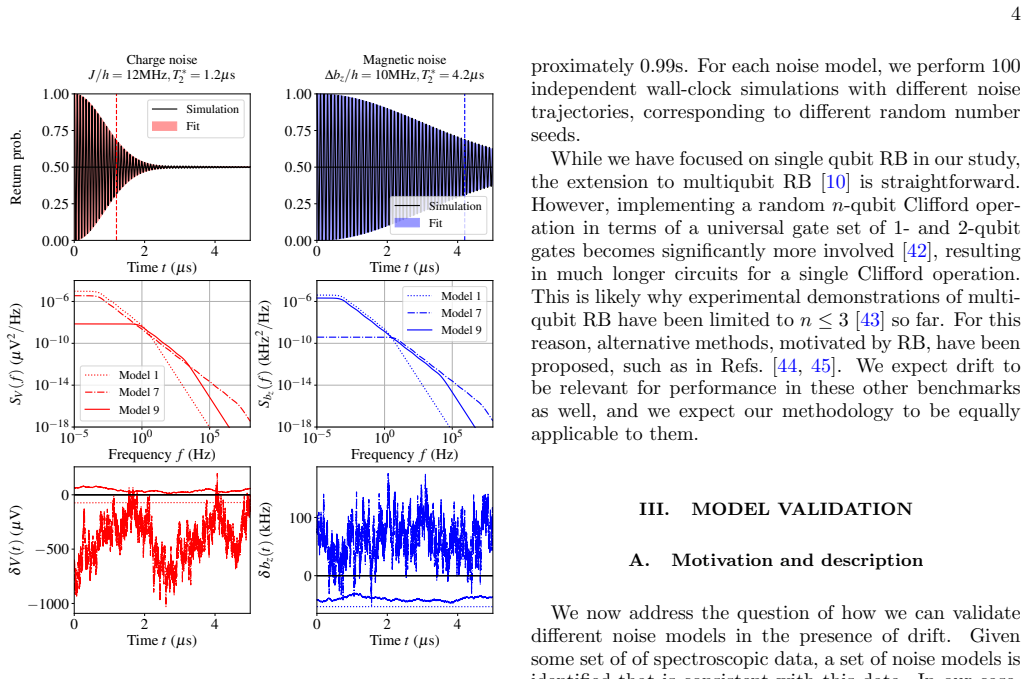
The central machinery is wall-clock randomized benchmarking simulation: a single noise trajectory built from independent Gaussian Ornstein-Uhlenbeck processes (one per decade, equal power, set by the measured charge and magnetic $T_2^*$) is maintained across 100 RB passes, and each pass yields an error rate $r$ (or, per circuit, a survival probability). The two-sample Kolmogorov-Smirnov statistic compares the cumulative distributions of these metrics between a reference model and a tested model, with rejection thresholds chosen to give equal type I error rates; the result is an empirical error-rate grid of type I and type II errors. The K-S statistic is the discriminator, the OU family is the hypothesis class, and the experiment duration sets which noise frequencies are actually sampled.
What would settle it
Measure the power spectral density of the charge and magnetic noise of a singlet-triplet qubit from $10^{-3}$ Hz to $10^{7}$ Hz and compare it to the equal-power, one-OU-per-decade spectrum with the stated cutoffs and powers; if the measured spectrum deviates beyond what the OU family can represent, or if a non-Gaussian two-level fluctuator is present, the K-S error-rate grid computed from this family will not describe the real device. Alternatively, run the wall-clock RB protocol on a device with a known non-Gaussian noise source and check whether the K-S test still separates the ten Gaussian models: a failure to reject all models would show the Gaussian spectral-shape assumption is essential.
Extended reading notes
Core claim
The central claim is that the distribution of randomized benchmarking (RB) error rates obtained over repeated passes can serve as a validation test for noise models, using a statistic as simple as the two-sample Kolmogorov-Smirnov test. Ten noise models of a singlet-triplet qubit, all matched to the same charge and magnetic $T_2^*$ dephasing times, are simulated in wall-clock RB, and the K-S test on the resulting distributions of per-pass error rates produces an error-rate grid that separates the models. The discriminating power is largest when the experimental window captures the low-frequency components of the noise; models with only low-frequency noise have weak power. The paper further shows that once a model is validated, error attribution by separating noise sources is not simply additive, because different noise components can interfere and partially cancel.
Load-bearing premise
The load-bearing premise is that the true device noise lies within the family of sum-of-OU spectra used in the paper; if the real noise has a different spectral shape or non-Gaussian components that this family cannot represent, the specific discrimination and attribution results need not transfer.
Editorial extensions
If this is right
- Instead of reporting a single RB error rate, the distribution of error rates across passes can be reported and used to constrain noise models.
- The test's power depends on the total experimental duration relative to the lowest noise frequency; adding delays between passes extends the frequency coverage.
- Noise models with high-frequency components (up to $10^7$ Hz in this study) act as strong discriminators against models lacking such components.
- Models with only low-frequency noise components have large rejection thresholds and weak discriminating power even with 100 independent noise realizations.
- Error attribution on a validated model is not guaranteed to be additive: separate contributions can sum to more or less than the parent trajectory's error.
Reading between the lines
- The distribution-based validation approach should extend to other drifting metrics, such as $T_2^*$ itself or single-gate fidelities, whenever the drift is driven by the same low-frequency noise.
- A direct experimental realization on a singlet-triplet qubit with independent noise spectroscopy would test whether the K-S-based error grid reproduces the known model separation in real hardware.
- The K-S test ignores temporal correlations in the error-rate time series; a test that uses the power spectrum of the drift could give even stronger model discrimination.
- For error attribution, the observed non-additivity suggests that per-mechanism error budgets should be quoted as ensemble statistics, not for individual noise realizations.
Editorial analysis
A structured set of objections, weighed in public.
Referee Report
Summary. The paper proposes using the distribution of drifting randomized benchmarking (RB) error rates, compared via two-sample Kolmogorov-Smirnov tests, to validate or rule out candidate noise models for a singlet-triplet qubit. The authors model charge and magnetic noise as sums of equal-power Ornstein-Uhlenbeck processes, one per frequency decade, calibrate ten candidate models to the same T2* values, generate full wall-clock RB simulations over 100 passes, and construct type I/II error grids. They find that models with different low-frequency content can be distinguished, while models sharing similar high-frequency content are more difficult to separate. They then use a 'validated' model to attribute RB error to charge versus magnetic axes and to low- versus high-frequency components, emphasizing non-additivity and sensitivity to the chosen frequency partition.
Significance. If the central claim holds, the paper offers a practical way to exploit RB drift data that experimentalists are likely already collecting, going beyond single-number T2* characterization. The statistical design is careful in several respects: per-model rejection thresholds are calibrated to equal type I error; Appendix K proves the monotone type I/II tradeoff; the FID/T2* analytic calculations in Appendix D are clean; RB fit quality and aliasing checks are documented. The demonstration is reproducible from the parameter tables. The main unverified step is that the reference 'experiment' is always drawn from the same Gaussian OU family used for the candidates, so the claim's external validity for out-of-family device noise is not yet established.
major comments (3)
- [Abstract and Sec. III C, Table I] The demonstration only tests discrimination within a closed family: the reference 'experiment' is one of the ten Gaussian, equal-power, one-OU-per-decade models in Table I, and the candidates are the other nine. The abstract's claim that the test 'can be used to rule out noise models' is not tested for out-of-family noise (e.g., non-Gaussian two-level fluctuators, unequal OU powers, a different spectral exponent, or spectral features outside the IR/UV cutoffs), even though Sec. II B states that Gaussianity is not essential and that extension to such components is straightforward. Since the mapping from noise statistics to RB-rate distributions is nonlinear and Appendices G and H show additivity failures on individual realizations, an out-of-family process could conceivably match an in-family distribution and be falsely accepted. Please add simulation(s) with a reference outside the candidate family, or explicitly restrict the claim to decisions among a specified candidate family.
- [Sec. IV B, Eq. (12), Appendix H] The error attribution to low- and high-frequency components is built on the ad hoc partition in Eq. (12), chosen at the 1/e point of the survival probability. Appendix H shows that with a different partition (Eq. H1) the additivity at large error rates is not satisfied, so the main-text conclusion that high-frequency noise contributes an approximately constant error level and low-frequency noise dominates worst-case error is partition-dependent. The paper should either derive an objective partition criterion from the protocol or explicitly present the attribution as illustrative for a chosen partition.
- [Sec. II C and Appendix E] The RB error rate r per pass is a point estimate obtained by fitting survival probabilities from only 10 circuits per depth, and the fit uncertainties are visible in Figs. 7 and 8. These uncertainties are not propagated into the KS statistic, so the 'drift' in the distribution of r is partly contaminated by fit noise. Because reference and candidate datasets are processed identically, the type I calibration is not affected, but the type II error rates in Fig. 3 could overstate discriminating power if fit noise contributes substantially. Please quantify the effect of fit uncertainty, for example by repeating the analysis with more circuits per depth or by propagating parametric fit uncertainties into the KS procedure.
minor comments (3)
- [Sec. III B] The labels 'false negative' and 'false positive' are reversed relative to standard usage: rejecting a true null hypothesis (the definition of α in Eq. (10)) is a false positive, while failing to reject a false null (the definition of β) is a false negative. Please correct the terminology.
- [Appendix H] The sentence 'Since a single RB pass takes approximately 1 s' conflicts with the main text, which states that 100 passes correspond to approximately 0.99 s. The pass duration should be corrected to the millisecond scale or the conflict explained.
- [Sec. III B] The notation α_{X,j} for the type I error rate and β_{X,jj'} for the type II error rate is clear, but the text could state explicitly that these are empirical rates estimated from a finite number of seeds; this is implied later in Sec. III C but would help the reader.
Circularity Check
No significant circularity: the RB error-rate distributions are genuine out-of-sample outputs of a wall-clock simulation, produced after noise powers are calibrated to T2*, and the KS thresholds and type II rates are disclosed calibration statistics rather than refits.
full rationale
The paper's only fitting step is the calibration of OU noise powers to the charge and magnetic T2* values (Sec. II B, Table I, Appendix D). The RB error-rate distributions used in the KS tests are then generated by full wall-clock simulations under each of the ten candidate models and are never used to refit or re-tune those models. The KS rejection thresholds are calibrated from same-model comparisons and are explicitly reported as hyperparameters (pX = 75), and the actual content of Fig. 3 is the type II error rates, which measure whether genuinely different models are distinguishable. This is a standard simulation-based identifiability study, not a fitted-input-called-prediction construction. The reference 'experiment' is itself generated from one of the candidate models, so the demonstration is confined to within-family discrimination; the abstract's claim is conditional on the candidate family and on sufficiently long measurement time. That is a scope limitation, not a circular step, and the paper itself identifies more realistic device models as future work in Sec. V. There are no load-bearing self-citations: the Clifford decomposition [36], the OU representation of 1/f noise [56], and the discrete PSD [58] are external technical results with stated assumptions. No equation in the paper reduces to its input by definition, and no fitted parameter is renamed as a prediction. The Gaussianity-is-not-essential assertion (Sec. II B) is an extrapolation that is not demonstrated, but it is a robustness concern, not circularity. Overall, the derivation chain is self-contained and the score is 0.
Assumptions & free parameters
free parameters (5)
- charge noise power pV (per model) =
sqrt(pV) = 134 to 201 microvolts across Models 1-10
- magnetic noise power pbz (per model) =
sqrt(pbz)/h = 26.9 to 37.9 kHz across Models 1-10
- IR/UV frequency cutoffs f_IR, f_UV (charge and magnetic) =
10^-3 to 10^7 Hz ranges, varied by hand across models
- KS rejection threshold percentile pX =
75 (type I error 0.25)
- RB error rate r per pass =
varies, e.g., r about 4.3e-4 for Model 7
assumptions (7)
- domain assumption Gaussian noise: charge and magnetic fluctuations are zero-mean Gaussian OU processes
- domain assumption A sum of independent OU processes, one per decade, approximates 1/f noise over the modeled band
- domain assumption T2* values of 1.2 microseconds (charge) and 4.2 microseconds (magnetic) are representative device numbers
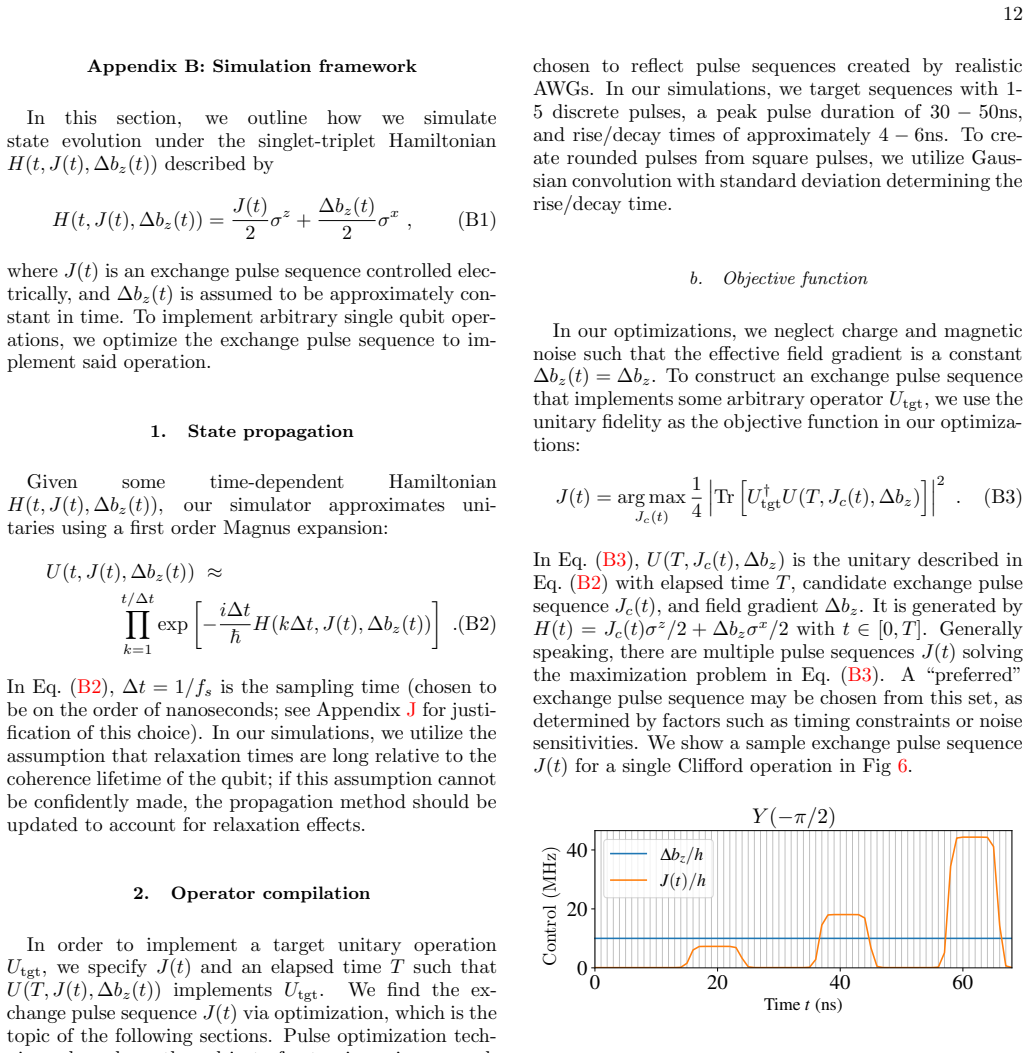
- domain assumption First-order Magnus expansion is accurate and relaxation effects are negligible for state propagation
- domain assumption The single-qubit Clifford group can be compiled from X(+-pi/2) and Z(+-pi/2) generator pulse sequences
- domain assumption SPAM error is negligible and does not affect the RB number
- ad hoc to paper The low/high frequency partition for attribution is set at the 1/e point of the survival probability versus depth, Eq. (12)
Cite this review
Pith. "Pith review of Model validation and error attribution for a drifting qubit." pith.science (2026). https://pith.science/paper/JCETT3C7
@misc{pith2026241118715,
  author       = {Pith},
  title        = {Pith review of: Model validation and error attribution for a drifting qubit},
  year         = {2026},
  howpublished = {\url{https://pith.science/paper/JCETT3C7}},
  note         = {Machine review of arXiv:2411.18715}
}
read the original abstract
Qubit performance is often reported in terms of a variety of single-value metrics, each providing a facet of the underlying noise mechanism limiting performance. However, the value of these metrics may drift over long time-scales, and reporting a single number for qubit performance fails to account for the low-frequency noise processes that give rise to this drift. In this work, we demonstrate how we can use the distribution of these values to validate or invalidate candidate noise models. We focus on the case of randomized benchmarking (RB), where typically a single error rate is reported but this error rate can drift over time when multiple passes of RB are performed. We show that using a statistical test as simple as the Kolmogorov-Smirnov statistic on the distribution of RB error rates can be used to rule out noise models, assuming the experiment is performed over a long enough time interval to capture relevant low frequency noise. With confidence in a noise model, we show how care must be exercised when performing error attribution using the distribution of drifting RB error rate.
Figures


Figures from the paper (7 more)




Reference graph
Works this paper leans on
-
[1]
RB number test The first metric we use in our model validation scheme outlined in Sec. III is the RB error rate r. We define our rejection threshold for our K-S test to be pX = 75. We show the empirical error rate grid for the X = r test in Fig. 3. Since these error rates are computed using a finite number of seeds, they are estimates of the true values. ...
-
[2]
Per-circuit error test In addition to performing model validation using the RB number, we also consider the per-circuit bitflip prob- abilities X = PUi (1|0, ∆, ti) for a circuit Ui. Using the same data generated by the 10 noise models from the previous section, we consider the K-S statistic for the per-circuit bitflip probability. We denote this by DPUi ...
-
[3]
Bluvstein, S
D. Bluvstein, S. J. Evered, A. A. Geim, S. H. Li, H. Zhou, T. Manovitz, S. Ebadi, M. Cain, M. Kali- nowski, D. Hangleiter, J. P. Bonilla Ataides, N. Maskara, I. Cong, X. Gao, P. Sales Rodriguez, T. Karolyshyn, G. Semeghini, M. J. Gullans, M. Greiner, V. Vuleti´ c, and M. D. Lukin, Logical quantum processor based on reconfigurable atom arrays, Nature 626, ...
2024
-
[4]
since charge noise is the dominant source of error. We want to analyze the contribution of low and high- frequency components of the noise to the error, but we find that results can vary based on how we choose to partition the OU components. We show this sensitivity in Appendix H. Here, we choose the partitioning of our noise based on the 1 /e point of th...
-
[5]
Acharya, I
R. Acharya, I. Aleiner, R. Allen, T. I. Andersen, M. Ans- mann, F. Arute, K. Arya, A. Asfaw, J. Atalaya, R. Bab- bush, D. Bacon, J. C. Bardin, J. Basso, A. Bengtsson, S. Boixo, G. Bortoli, A. Bourassa, J. Bovaird, L. Brill, M. Broughton, B. B. Buckley, D. A. Buell, T. Burger, B. Burkett, N. Bushnell, Y. Chen, Z. Chen, B. Chiaro, J. Cogan, R. Collins, P. C...
2023
-
[6]
L. Postler, F. Butt, I. Pogorelov, C. D. Marciniak, S. Heußen, R. Blatt, P. Schindler, M. Rispler, M. M¨ uller, and T. Monz, Demonstration of fault-tolerant steane quantum error correction, PRX Quantum 5, 030326 (2024)
work page 2024
-
[7]
Bylander, S
J. Bylander, S. Gustavsson, F. Yan, F. Yoshihara, K. Harrabi, G. Fitch, D. G. Cory, Y. Nakamura, J.-S. Tsai, and W. D. Oliver, Noise spectroscopy through dy- namical decoupling with a superconducting flux qubit, Nature Physics 7, 565 (2011)
2011
-
[8]
M. P. da Silva, C. Ryan-Anderson, J. M. Bello-Rivas, A. Chernoguzov, J. M. Dreiling, C. Foltz, F. Frachon, J. P. Gaebler, T. M. Gatterman, L. Grans-Samuelsson, D. Hayes, N. Hewitt, J. Johansen, D. Lucchetti, M. Mills, S. A. Moses, B. Neyenhuis, A. Paz, J. Pino, P. Siegfried, J. Strabley, A. Sundaram, D. Tom, S. J. Wernli, M. Zan- ner, R. P. Stutz, and K. ...
arXiv 2024
Show all 67 references
-
[9]
Mayer, C
K. Mayer, C. Ryan-Anderson, N. Brown, E. Durso- Sabina, C. H. Baldwin, D. Hayes, J. M. Dreiling, 10 C. Foltz, J. P. Gaebler, T. M. Gatterman, J. A. Gerber, K. Gilmore, D. Gresh, N. Hewitt, C. V. Horst, J. Jo- hansen, T. Mengle, M. Mills, S. A. Moses, P. E. Siegfried, B. Neyenh...
2024 arXiv
-
[10]
Harris, M
R. Harris, M. W. Johnson, S. Han, A. J. Berkley, J. Jo- hansson, P. Bunyk, E. Ladizinsky, S. Govorkov, M. C. Thom, S. Uchaikin, B. Bumble, A. Fung, A. Kaul, A. Kleinsasser, M. H. S. Amin, and D. V. Averin, Probing noise in flux qubits via macroscopic resonant tunneling, Phys. ...
2008
-
[11]
Magesan, J
E. Magesan, J. M. Gambetta, and J. Emerson, Charac- terizing quantum gates via randomized benchmarking, Phys. Rev. A 85, 042311 (2012)
2012
-
[12]
K. W. Chan, W. Huang, C. H. Yang, J. C. C. Hwang, B. Hensen, T. Tanttu, F. E. Hudson, K. M. Itoh, A. Laucht, A. Morello, and A. S. Dzurak, Assessment of a silicon quantum dot spin qubit environment via noise spectroscopy, Phys. Rev. Appl. 10, 044017 (2018)
2018
-
[13]
Knill, D
E. Knill, D. Leibfried, R. Reichle, J. Britton, R. B. Blakestad, J. D. Jost, C. Langer, R. Ozeri, S. Seidelin, and D. J. Wineland, Randomized benchmarking of quan- tum gates, Phys. Rev. A 77, 012307 (2008)
2008
-
[14]
Magesan, J
E. Magesan, J. M. Gambetta, and J. Emerson, Scalable and robust randomized benchmarking of quantum pro- cesses, Phys. Rev. Lett. 106, 180504 (2011)
2011
-
[15]
Proctor, M
T. Proctor, M. Revelle, E. Nielsen, K. Rudinger, D. Lob- ser, P. Maunz, R. Blume-Kohout, and K. Young, Detect- ing and tracking drift in quantum information processors, Nature Communications 11, 5396 (2020)
2020
-
[16]
Proctor, K
T. Proctor, K. Rudinger, K. Young, M. Sarovar, and R. Blume-Kohout, What randomized benchmarking ac- tually measures, Phys. Rev. Lett. 119, 130502 (2017)
2017
-
[17]
M. A. Fogarty, M. Veldhorst, R. Harper, C. H. Yang, S. D. Bartlett, S. T. Flammia, and A. S. Dzurak, Non- exponential fidelity decay in randomized benchmark- ing with low-frequency noise, Phys. Rev. A 92, 022326 (2015)
2015
-
[18]
P. V. Klimov, J. Kelly, Z. Chen, M. Neeley, A. Megrant, B. Burkett, R. Barends, K. Arya, B. Chiaro, Y. Chen, A. Dunsworth, A. Fowler, B. Foxen, C. Gidney, M. Giustina, R. Graff, T. Huang, E. Jeffrey, E. Lucero, J. Y. Mutus, O. Naaman, C. Neill, C. Quintana, P. Roushan, D. Sank...
2018
-
[19]
M. D. Shulman, O. E. Dial, S. P. Harvey, H. Bluhm, V. Umansky, and A. Yacoby, Demonstration of entan- glement of electrostatically coupled singlet-triplet qubits, Science 336, 202 (2012)
2012
-
[20]
Levy, Universal quantum computation with spin-1 /2 pairs and heisenberg exchange, Phys
J. Levy, Universal quantum computation with spin-1 /2 pairs and heisenberg exchange, Phys. Rev. Lett. 89, 147902 (2002)
2002
-
[21]
J. R. Petta, A. C. Johnson, J. M. Taylor, E. A. Laird, A. Yacoby, M. D. Lukin, C. M. Marcus, M. P. Hanson, and A. C. Gossard, Coherent manipulation of coupled electron spins in semiconductor quantum dots, Science 309, 2180 (2005)
2005
-
[22]
B. M. Maune, M. G. Borselli, B. Huang, T. D. Ladd, P. W. Deelman, K. S. Holabird, A. A. Kise- lev, I. Alvarado-Rodriguez, R. S. Ross, A. E. Schmitz, M. Sokolich, C. A. Watson, M. F. Gyure, and A. T. Hunter, Coherent singlet-triplet oscillations in a silicon- based double quant...
2012
-
[23]
Cerfontaine, T
P. Cerfontaine, T. Botzem, J. Ritzmann, S. S. Humpohl, A. Ludwig, D. Schuh, D. Bougeard, A. D. Wieck, and H. Bluhm, Closed-loop control of a gaas-based singlet- triplet spin qubit with 99.5% gate fidelity and low leak- age, Nature Communications 11, 4144 (2020)
2020
-
[24]
X. Wu, D. R. Ward, J. R. Prance, D. Kim, J. K. Gam- ble, R. T. Mohr, Z. Shi, D. E. Savage, M. G. Lagally, M. Friesen, S. N. Coppersmith, and M. A. Eriksson, Two- axis control of a singlet–triplet qubit with an integrated micromagnet, Proceedings of the National Academy of Scie...
2014
-
[25]
J. M. Nichol, L. A. Orona, S. P. Harvey, S. Fallahi, G. C. Gardner, M. J. Manfra, and A. Yacoby, High-fidelity en- tangling gate for double-quantum-dot spin qubits, npj Quantum Information 3, 3 (2017)
2017
-
[26]
R. M. Jock, N. T. Jacobson, P. Harvey-Collard, A. M. Mounce, V. Srinivasa, D. R. Ward, J. Anderson, R. Manginell, J. R. Wendt, M. Rudolph, T. Pluym, J. K. Gamble, A. D. Baczewski, W. M. Witzel, and M. S. Car- roll, A silicon metal-oxide-semiconductor electron spin- orbit qubit...
2018
-
[27]
E. J. Connors, J. Nelson, H. Qiao, L. F. Edge, and J. M. Nichol, Low-frequency charge noise in si/sige quantum dots, Phys. Rev. B 100, 165305 (2019)
2019
-
[28]
Cerfontaine, R
P. Cerfontaine, R. Otten, M. A. Wolfe, P. Bethke, and H. Bluhm, High-fidelity gate set for exchange-coupled singlet-triplet qubits, Phys. Rev. B 101, 155311 (2020)
2020
-
[29]
Fedele, A
F. Fedele, A. Chatterjee, S. Fallahi, G. C. Gardner, M. J. Manfra, and F. Kuemmeth, Simultaneous operations in a two-dimensional array of singlet-triplet qubits, PRX Quantum 2, 040306 (2021)
2021
-
[30]
Jirovec, A
D. Jirovec, A. Hofmann, A. Ballabio, P. M. Mutter, G. Tavani, M. Botifoll, A. Crippa, J. Kukucka, O. Sagi, F. Martins, J. Saez-Mollejo, I. Prieto, M. Borovkov, J. Arbiol, D. Chrastina, G. Isella, and G. Katsaros, A singlet-triplet hole spin qubit in planar ge, Nature Mate- ria...
2021
-
[31]
Dutta and P
P. Dutta and P. M. Horn, Low-frequency fluctuations in solids: 1 f noise, Rev. Mod. Phys. 53, 497 (1981)
1981
-
[32]
Struck, A
T. Struck, A. Hollmann, F. Schauer, O. Fedorets, A. Schmidbauer, K. Sawano, H. Riemann, N. V. Abrosi- mov, L. Cywi´ nski, D. Bougeard, and L. R. Schreiber, Low-frequency spin qubit energy splitting noise in highly purified 28si/sige, npj Quantum Information 6, 40 (2020)
2020
-
[33]
E. J. Connors, J. Nelson, L. F. Edge, and J. M. Nichol, Charge-noise spectroscopy of si/sige quantum dots via dynamically-decoupled exchange oscillations, Nature Communications 13, 940 (2022)
2022
-
[34]
Yoneda, J
J. Yoneda, J. S. Rojas-Arias, P. Stano, K. Takeda, A. Noiri, T. Nakajima, D. Loss, and S. Tarucha, Noise- correlation spectrum for a pair of spin qubits in silicon, Nature Physics 19, 1793 (2023)
2023
-
[35]
Martins, F
F. Martins, F. K. Malinowski, P. D. Nissen, E. Barnes, S. Fallahi, G. C. Gardner, M. J. Manfra, C. M. Mar- cus, and F. Kuemmeth, Noise suppression using symmet- ric exchange gates in spin qubits, Phys. Rev. Lett. 116, 116801 (2016)
2016
-
[36]
Paladino, Y
E. Paladino, Y. M. Galperin, G. Falci, and B. L. Alt- 11 shuler, 1 /f noise: Implications for solid-state quantum information, Rev. Mod. Phys. 86, 361 (2014)
2014
-
[37]
Burkard, T
G. Burkard, T. D. Ladd, A. Pan, J. M. Nichol, and J. R. Petta, Semiconductor spin qubits, Rev. Mod. Phys. 95, 025003 (2023)
2023
-
[38]
M. D. Reed, B. M. Maune, R. W. Andrews, M. G. Borselli, K. Eng, M. P. Jura, A. A. Kiselev, T. D. Ladd, S. T. Merkel, I. Milosavljevic, E. J. Pritchett, M. T. Rakher, R. S. Ross, A. E. Schmitz, A. Smith, J. A. Wright, M. F. Gyure, and A. T. Hunter, Reduced sensitivity to charge...
2016
-
[39]
M¨ uller, J
C. M¨ uller, J. H. Cole, and J. Lisenfeld, Towards under- standing two-level-systems in amorphous solids: insights from quantum circuits, Reports on Progress in Physics 82, 124501 (2019)
2019
-
[40]
X. Xue, T. F. Watson, J. Helsen, D. R. Ward, D. E. Sav- age, M. G. Lagally, S. N. Coppersmith, M. A. Eriksson, S. Wehner, and L. M. K. Vandersypen, Benchmarking gate fidelities in a si/sige two-qubit device, Phys. Rev. X 9, 021011 (2019)
2019
-
[41]
Kirton and M
M. Kirton and M. Uren, Noise in solid-state microstruc- tures: A new perspective on individual defects, interface states and low-frequency (1/ƒ) noise, Advances in Physics 38, 367 (1989)
1989
-
[42]
M¨ uller, J
C. M¨ uller, J. Lisenfeld, A. Shnirman, and S. Poletto, In- teracting two-level defects as sources of fluctuating high- frequency noise in superconducting circuits, Phys. Rev. B 92, 035442 (2015)
2015
-
[43]
D. C. McKay, S. Sheldon, J. A. Smolin, J. M. Chow, and J. M. Gambetta, Three-qubit randomized benchmarking, Phys. Rev. Lett. 122, 200502 (2019)
2019
-
[44]
H. Ball, T. M. Stace, S. T. Flammia, and M. J. Biercuk, Effect of noise correlations on randomized benchmarking, Phys. Rev. A 93, 022303 (2016)
2016
-
[45]
Qi and H
J. Qi and H. K. Ng, Randomized benchmarking in the presence of time-correlated dephasing noise, Phys. Rev. A 103, 022607 (2021)
2021
-
[46]
Bravyi and D
S. Bravyi and D. Maslov, Hadamard-free circuits expose the structure of the clifford group, IEEE Transactions on Information Theory 67, 4546 (2021)
2021
-
[47]
Viola, E
L. Viola, E. Knill, and S. Lloyd, Dynamical decoupling of open quantum systems, Phys. Rev. Lett.82, 2417 (1999)
1999
-
[48]
T. J. Proctor, A. Carignan-Dugas, K. Rudinger, E. Nielsen, R. Blume-Kohout, and K. Young, Direct randomized benchmarking for multiqubit devices, Phys. Rev. Lett. 123, 030503 (2019)
2019
-
[49]
Hines, M
J. Hines, M. Lu, R. K. Naik, A. Hashim, J.-L. Ville, B. Mitchell, J. M. Kriekebaum, D. I. Santiago, S. Seri- tan, E. Nielsen, R. Blume-Kohout, K. Young, I. Siddiqi, B. Whaley, and T. Proctor, Demonstrating scalable ran- domized benchmarking of universal gate sets, Phys. Rev. X...
2023
-
[50]
Viola and S
L. Viola and S. Lloyd, Dynamical suppression of deco- herence in two-state quantum systems, Phys. Rev. A 58, 2733 (1998)
1998
-
[51]
J. U. Kim and L. B. Kish, Recognizing different types of stochastic processes, Fluctuation and Noise Letters 06, L1 (2006)
2006
-
[52]
Grenander, Stochastic processes and statistical infer- ence, Arkiv f¨ or Matematik1, 195 (1950)
U. Grenander, Stochastic processes and statistical infer- ence, Arkiv f¨ or Matematik1, 195 (1950)
1950
-
[53]
Fleischer and A
I. Fleischer and A. Kooharian, On the Statistical Treat- ment of Stochastic Processes, The Annals of Mathemat- ical Statistics 29, 544 (1958)
1958
-
[54]
P. J. Diggle and N. I. Fisher, Nonparametric compar- ison of cumulative periodograms, Journal of the Royal Statistical Society: Series C (Applied Statistics) 40, 423 (1991)
1991
-
[55]
X. Wang, F. A. Calderon-Vargas, M. S. Rana, J. P. Kest- ner, E. Barnes, and S. Das Sarma, Noise-compensating pulses for electrostatically controlled silicon spin qubits, Phys. Rev. B 90, 155306 (2014)
2014
-
[56]
Maraj-Zygm¸ at, G
K. Maraj-Zygm¸ at, G. Sikora, M. Pitera, and A. Wy loma´ nska, Goodness-of-fit test for stochastic processes using even empirical moments statistic, Chaos: An Interdisciplinary Journal of Nonlinear Science 33, 013128 (2023)
2023
-
[57]
Khodjasteh and L
K. Khodjasteh and L. Viola, Dynamically error-corrected gates for universal quantum computation, Phys. Rev. Lett. 102, 080501 (2009)
2009
-
[58]
X. Wang, L. S. Bishop, E. Barnes, J. P. Kestner, and S. D. Sarma, Robust quantum gates for singlet-triplet spin qubits using composite pulses, Phys. Rev. A 89, 022310 (2014)
2014
-
[60]
Kaulakys, V
B. Kaulakys, V. Gontis, and M. Alaburda, Point process model of 1/f noise vs a sum of lorentzians, Phys. Rev. E 71, 051105 (2005)
2005
-
[61]
Virtanen, R
P. Virtanen, R. Gommers, T. E. Oliphant, M. Haber- land, T. Reddy, D. Cournapeau, E. Burovski, P. Pe- terson, W. Weckesser, J. Bright, S. J. van der Walt, M. Brett, J. Wilson, K. J. Millman, N. Mayorov, A. R. J. Nelson, E. Jones, R. Kern, E. Larson, C. J. Carey, ˙I. Po- lat, Y...
2020
-
[62]
Kasdin, Discrete simulation of colored noise and stochastic processes and 1 /f α power law noise genera- tion, Proceedings of the IEEE 83, 802 (1995)
N. Kasdin, Discrete simulation of colored noise and stochastic processes and 1 /f α power law noise genera- tion, Proceedings of the IEEE 83, 802 (1995). Appendix A: Simulation Parameters In our simulations, we choose the following parame- ters for our singlet-triplet Hamilton...
1995
-
[63]
(B2), ∆ t = 1/fs is the sampling time (chosen to be on the order of nanoseconds; see Appendix J for justi- fication of this choice)
State propagation Given some time-dependent Hamiltonian H(t, J(t), ∆bz(t)), our simulator approximates uni- taries using a first order Magnus expansion: U (t, J(t), ∆bz(t)) ≈ t/∆tY k=1 exp − i∆t ℏ H(k∆t, J(t), ∆bz(t)) .(B2) In Eq. (B2), ∆ t = 1/fs is the sampling time (chosen ...
-
[64]
preferred
Operator compilation In order to implement a target unitary operation Utgt, we specify J(t) and an elapsed time T such that U (T, J(t), ∆bz(t)) implements Utgt. We find the ex- change pulse sequence J(t) via optimization, which is the topic of the following sections. Pulse opt...
-
[65]
Charge T ∗ 2 Consider the first version of FID introduced in Sec. II B. Given the field gradient term is turned off (∆bz(t) = 0), a singlet-triplet qubit will evolve ac- cording to the Hamiltonian HST0 (t) = J(t)σz/2 = J0e(VFID+δV (t))/Iσz/2 = (JFID + δJ (t))σz/2, where VFID i...
-
[66]
Magnetic T ∗ 2 The derivation for mean Ramsey oscillations under magnetic noise with exchange off is similar to but sim- pler than the charge noise case. We now have the singlet state |0⟩ as the initial state evolving under the Hamilto- nian HST0 (t) = ∆ bz(t)σx/2 = (∆ bz + δb...
-
[67]
We identify the fit param- eter r in Eq
Each simulation data point is the mean probability over 10 circuits at a given depth, and the error bars are the 2 σ confidence interval calculated using a bootstrap over the 10 circuits performed for each depth. We identify the fit param- eter r in Eq. (9) using the SciPy cur...
-
[75]
4 using the 10 circuits of depth 256
We showcase the worst-case, median-case, and best- case type I and II error rates in Fig. 4 using the 10 circuits of depth 256. In these results, we see many of the same trends as were in the RB number test results, especially for the best and median cases. IV. ERROR A TTRIBUT...
Reviewed August 12, 2026 · model on record in the stance chip above.
Discussion (0). Continue with ORCID to comment.