REVIEW 4 major objections 4 minor 22 references
Bubble-Burst Synthesis of Ammonia, Amino Acids, and Urea Under Ambient, Catalyst-Free Conditions
T0 review · 4 major / 4 minor · reviewed 2026-08-07 · deepseek-v4-flash
Pith's one-line read The paper claims that microbubble collapse and rupture at a gas–liquid interface releases enough localized energy to dissociate nitrogen and water, generating ammonia and, downstream, urea and amino acids under ambient, catalyst-free…
desk verdict Genuinely new claim, undersupported evidence: no controls, no isotope labeling, and non-specific assays leave the central inference about N2 fixation unproven, but the idea is worth a rigorous look. read the letter →
The pith
A machine-rendered reading of the paper's core claim, the machinery that carries it, and where it could break.
The reading
What carries the argument
The load-bearing object is the bubble-burst microenvironment: a transient volume at a gas–liquid interface where a microbubble grows rapidly and collapses, releasing a concentrated burst of mechanical and thermal energy. The paper assigns that pulse the job of dissociating N2 and H2O, and treats atomic hydrogen (H*) produced by water dissociation as the species that makes nitrogen activation energetically feasible. This single mechanism is used to explain the whole cascade—ammonia, then urea, then amino acids—so if the bursts cannot deliver the energy to homolyze water and nitrogen, the downstream products lack their stated cause.
What would settle it
Run the identical protocol with argon or helium instead of air; if the ninhydrin test still turns purple, the signal does not depend on nitrogen and the central claim fails. The more specific test is to use 15N2 as the gas feed and look for the isotope shift of 15NH3 (or labeled urea) by mass spectrometry; absence of any 15N-labeled product would show the nitrogen in the products did not come from the gas being bubbled.
Extended reading notes
Core claim
The central claim is that nitrogen fixation from air and water occurs spontaneously at the surface of bursting microbubbles. The paper argues that the collapse and rupture of a bubble concentrates kinetic and thermal energy into a microscopic volume, dissociating nitrogen and water into reactive atomic species; atomic hydrogen then lowers the barrier for N≡N bond cleavage, allowing ammonia to form in situ, and ammonia subsequently reacts with dissolved CO2 or organic acids to give urea and amino acids under the same ambient conditions. The evidence offered is the appearance of Ruhemann's purple in a ninhydrin test after bubbling air through dilute acetic acid, Raman bands at 977, 1311, and 1556 cm–1 that coincide with a urea standard, and light-microscope images of twisted, fiber-like residue compared with published images of peptide nanofibers. The paper takes these signals to confirm that ammonia is formed as a reactive intermediate and that the bubble-burst environment is energetic enough to drive multi-step nitrogen chemistry at ambient conditions.
Load-bearing premise
Everything rests on the assumption that the purple ninhydrin color and the urea-like Raman peaks come from compounds actually made in the bubbling water, rather than from contaminants in the gas, the glassware, the acetic acid, or the detection reagents themselves.
Editorial extensions
If this is right
- Fertilizer-grade nitrogen compounds could be generated on site from air and water, without Haber–Bosch plants or catalyst supply chains.
- The same setup could be tuned with dissolved CO2 or organic acids to steer products toward urea or amino acids rather than ammonium salts.
- Low-energy add-ons such as UV or ultrasound are claimed to intensify the bursts and raise yield, implying the method can be scaled by engineering bubble populations.
- If ammonia is confirmed as an intermediate, the process offers a route to labeled compounds using 15N2 or 13CO2 for metabolic tracing and diagnostics.
- Integration with carbon capture is proposed as a way to turn waste CO2 into urea, doubling the environmental benefit.
Reading between the lines
- The paper does not quantify the energy actually delivered by a burst, so the strongest test would be an energy budget: estimate how many N2 molecules can plausibly be fixed per burst and compare with the observed color intensity.
- No control with a non-nitrogen gas is reported; running the identical bubbler with argon would tell whether the ninhydrin response comes from nitrogen fixation or from trace organics in the apparatus.
- The claim that urea forms in a single 'femtosecond' event is likely an editorial shortcut; cumulative exposure over hours of bubbling is a more probable route, and that distinction is testable by time-resolved sampling.
- A decisive isotope experiment, bubbling 15N2 and looking for mass-shifted ammonia or urea, would directly confirm that air is the nitrogen source.
Editorial analysis
A structured set of objections, weighed in public.
Referee Report
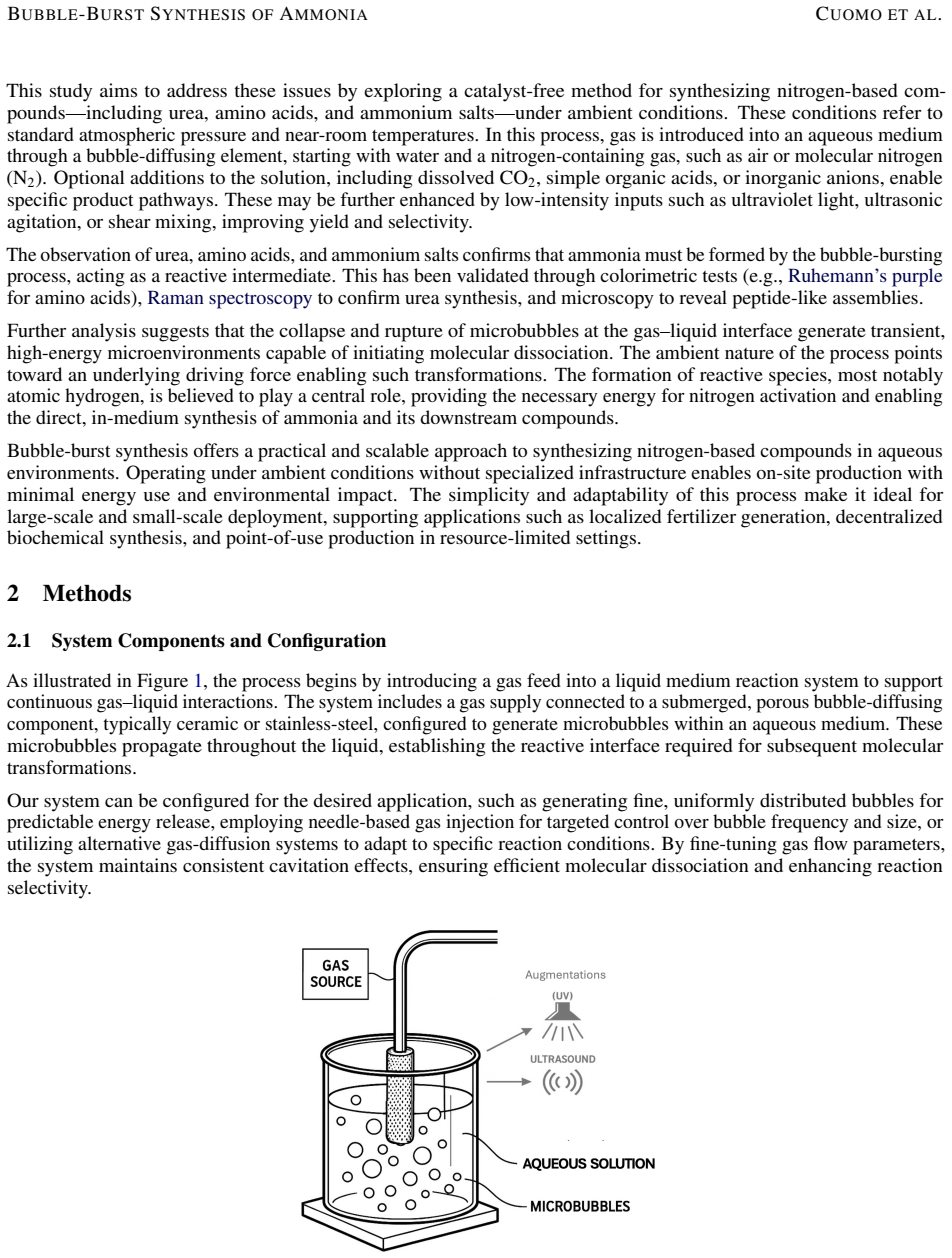
Summary. The manuscript reports a catalyst-free, ambient-pressure method in which air or N2 is bubbled through aqueous acetic acid, and claims that bubble-bursting microenvironments dissociate N2 and H2O to produce NH3 and downstream products including urea, amino acids, and ammonium salts. The evidence consists of a ninhydrin color change attributed to Ruhemann's purple (Fig. 2), Raman spectra of a ninhydrin-treated residue compared with a ninhydrin-treated urea standard (Fig. 3), and optical/dark-field microscopy images compared with peptide-like nanofibers and a molecular illustration (Figs. 4 and 5). The discussion proposes mechanisms involving atomic hydrogen and presents reaction equations, concluding that the process is suitable for decentralized fertilizer and biochemical production.
Significance. If the central claim were established, this would be a significant result: ambient, catalyst-free nitrogen fixation from air and water would offer a low-energy route to ammonia, urea, and amino acids, with potentially important implications for decentralized fertilizer production. The experimental configuration is simple and the claim is in principle falsifiable through 15N2 isotope labeling and appropriate blank controls. These strengths are outweighed, however, by the absence of quantitative yields, direct ammonia measurements, isotopic tracing, and control experiments, so the significance of the reported observations cannot currently be assessed.
major comments (4)
- [Sec. 3.1 and Fig. 2] The ninhydrin test is not specific to amino acids: it produces Ruhemann's purple with ammonia and other primary amines as well. The manuscript reports no control experiments, such as an unbubbled acetic acid solution, a reagent blank, or bubbling with an inert gas (Ar or He) in place of air/N2. The purple hue in Fig. 2 therefore does not, by itself, establish that amino acids were formed from the bubbled gas.
- [Sec. 3.2 and Fig. 3] The Raman assignment of urea is underdetermined. The reference standard was treated with ninhydrin and the experimental sample is also a post-derivatization residue, yet no spectra are shown of the starting acetic acid solution, the solution after bubbling before derivatization, or a blank in which an inert gas was bubbled. The coincident peaks at 977, 1311, and 1556 cm-1 could arise from ammonium salts, ninhydrin reaction products, or contaminants. Without 15N2 labeling or mass spectrometric product identification, the nitrogen in the products cannot be traced to the bubbled air.
- [Secs. 4.2-4.4 and Eq. (4)] The manuscript's central inference, stated in Sec. 1, that observation of urea, amino acids, and ammonium salts 'confirms that ammonia must be formed by the bubble-bursting process,' is not supported because the identities and sources of the products are not established by the reported data. Additionally, the proposed glycine-forming reaction in Eq. (4) is not balanced: CH3COOH + NH3 cannot form glycine without additional reducing equivalents, so the proposed pathway is chemically incomplete as written.
- [Sec. 4.4] The paper itself concedes that 'some of these outcomes have been validated in laboratory experiments, the corresponding data are not included in this report' and that the mechanism is 'not yet fully understood.' These statements, together with the absence of any yields, error bars, or quantitative product measurements, mean that the broad claims in the abstract and conclusion about ammonia, amino acids, urea, peptide-like assemblies, and tunable product pathways exceed what the reported evidence can support.
minor comments (4)
- [Sec. 2] The Methods section does not report gas flow rate, solution volume, acetic acid concentration, bubbling duration, temperature, or post-reaction workup; without these details the experiments cannot be reproduced.
- [Figs. 2, 4, and 5] Figures 2, 4, and 5 lack scale bars, and the morphological comparisons with gelatin nanofibers and an iStock molecular illustration are presented as visual analogies rather than as quantitative or chemical evidence for peptide-like assemblies.
- [Sec. 3.1] The phrase 'unmistakable deep purple hue' should be replaced by a quantitative measurement, such as absorbance at 570 nm with a calibration curve, to support the claimed amino acid detection.
- [Sec. 4.1] The proposed generation of atomic hydrogen and nitrogen radicals is supported only by citations to sonolysis and plasma studies; direct evidence, such as radical trapping or spin-trap EPR measurements in this system, would be needed to support the proposed mechanism.
Circularity Check
No significant circularity: the paper's claims are direct experimental interpretations, with no fitted-parameter prediction, self-citation chain, or definitional equivalence.
full rationale
The paper does not exhibit any of the enumerated circularity patterns. There is no parameter fitting and then labeling the fit as a prediction; the Raman and colorimetric results are direct comparisons to commercial standards, not outputs derived from the model being tested. There is no load-bearing self-citation: the cited prior work on microbubbles, arc plasma, and catalysis is external and used only as supporting or comparative context. The statement that observation of urea, amino acids, and ammonium salts confirms ammonia as an intermediate is an abductive inference, not a circular derivation, because ammonia is not defined in terms of those products and the products are not assumed to be equivalent to the inputs. The most serious weaknesses are experimental: no control experiments, no isotopic labeling, and no mass spectrometric identification are reported, so the source of the nitrogen in the observed signals is not established. However, lack of controls is a correctness or evidence-quality concern, not a circularity concern under the specified criteria. The paper also does not import a uniqueness theorem from its own authors, does not smuggle an ansatz in through a citation, and does not rename a known result. Accordingly, the appropriate score is 0.
Assumptions & free parameters
assumptions (5)
- domain assumption Bubble bursting in the described bubbler system generates localized high-energy microenvironments sufficient to dissociate N2 and H2O.
- domain assumption Atomic hydrogen (H*) is produced in sufficient amounts and serves as the reactive species enabling nitrogen fixation.
- domain assumption The ninhydrin color reaction and the Raman peaks at 977, 1311, and 1556 cm-1 are specific to the claimed products in the experimental matrix.
- domain assumption The proposed reaction equations (1) through (6) proceed as written under ambient conditions.
- domain assumption The water, acetic acid, and gas feed do not contain pre-existing ammonia, amines, or urea that could produce the observed signals.
Cite this review
Pith. "Pith review of Bubble-Burst Synthesis of Ammonia, Amino Acids, and Urea Under Ambient, Catalyst-Free Conditions." pith.science (2026). https://pith.science/paper/JCPVKLRT
@misc{pith2026250523850,
  author       = {Pith},
  title        = {Pith review of: Bubble-Burst Synthesis of Ammonia, Amino Acids, and Urea Under Ambient, Catalyst-Free Conditions},
  year         = {2026},
  howpublished = {\url{https://pith.science/paper/JCPVKLRT}},
  note         = {Machine review of arXiv:2505.23850}
}
read the original abstract
This study introduces a catalyst-free, ambient-temperature method for synthesizing nitrogen-based compounds critical to fertilizer production, including ammonia, urea, ammonium salts, and amino acids. The process relies on bubble-burst-induced microenvironments, where gas bubbles undergo rapid growth and collapse, releasing intense localized energy sufficient to dissociate nitrogen and water molecules. These high-energy zones produce reactive species, including atomic hydrogen (H*) that facilitate nitrogen fixation and drive subsequent chemical transformations without needing catalysts or elevated conditions. Experimental validation using colorimetric assays, Raman spectroscopy, and microscopy confirms the in situ formation of ammonia and its downstream conversion into structurally relevant compounds, including peptide-like assemblies. The system supports reaction tuning through dissolved carbon dioxide (CO2) or organic acids and can be enhanced by low-energy inputs such as UV or ultrasound. Its simplicity, modularity, and ability to operate without external infrastructure offer a practical and scalable platform for decentralized fertilizer generation and sustainable biochemical production.
Figures


Figures from the paper (3 more)


Reference graph
Works this paper leans on
- [1]
-
[2]
Enriching the Earth: Fritz Haber, Carl Bosch, and the Transformation of World Food Production
Vaclav Smil. Enriching the Earth: Fritz Haber, Carl Bosch, and the Transformation of World Food Production. MIT Press, 2001
work page 2001
-
[3]
J. W. Erisman, M. A. Sutton, J. Galloway, Z. Klimont, and W. Winiwarter. How a century of ammonia synthesis changed the world. Nature Geoscience, 1(10):636–639, 2008
work page 2008
-
[4]
J. Pérez-Ramírez, C. Mondelli, T. Schmidt, et al. Sustainable ammonia production: Catalysis and processes. Chemical Society Reviews, 49(12):4801–4873, 2020
work page 2020
-
[5]
Physics of bubble oscillations
Werner Lauterborn and Thomas Kurz. Physics of bubble oscillations. Reports on Progress in Physics , 73(10):106501, 2010
work page 2010
- [6]
-
[7]
B. S. de Farias, E. K. Silva, P. C. R. Andrade, J. M. C. Costa, and M. A. A. Meireles. Influence of gelatin type on physicochemical properties of electrospun nanofibers. Scientific Reports, 13:15124, 2023
work page 2023
-
[8]
Elegant dna double helix: A glimpse into the microscopic world [stock photo], 2024
Alllex. Elegant dna double helix: A glimpse into the microscopic world [stock photo], 2024. Standard License. Available from: iStockphoto.com. File ID: 2185702101
work page 2024
Show all 22 references
-
[9]
Lauterborn and C.-D
W. Lauterborn and C.-D. Ohl. Cavitation bubble dynamics. Ultrasonics Sonochemistry, 4(2):65–75, 1997
1997
-
[10]
Penconi, F
M. Penconi, F. Rossi, F. Ortica, F. Elisei, and P. L. Gentili. Hydrogen production from water by photolysis, sonolysis and sonophotolysis with solid solutions of rare earth, gallium and indium oxides as heterogeneous catalysts. Sustainability, 7(7):9310–9325, 2015
2015
-
[11]
S. D. Threatt and D. C. Rees. Biological nitrogen fixation in theory, practice, and reality: A perspective on the molybdenum nitrogenase system. FEBS Letters, 597(1):45–58, 2022
2022
-
[12]
Choi and K
J. Choi and K. Chan. Hydrogen activation on transition metals and metal oxides: Implications for hydrogen storage and catalysis. Nature Communications, 11(1):1–10, 2020. 9 BUBBLE -BURST SYNTHESIS OF AMMONIA CUOMO ET AL
2020
-
[13]
T. X. Yu, S. Mandadapu, and G. E. Fox. Determining hydrodynamic forces in bursting bubbles using dna nanotubes. Proceedings of the National Academy of Sciences, 112(12):3767–3772, 2015
2015
-
[14]
Department of Energy
U.S. Department of Energy. Novel catalyst means ammonia synthesis with less heat and pressure. https://www.energy.gov/science/bes/articles/ novel-catalyst-means-ammonia-synthesis-less-heat-and-pressure , 2024. Accessed 2025-03-09
2024
-
[15]
Kozák et al
T. Kozák et al. Mechanistic insights into plasma-assisted ammonia synthesis via n–h radical interactions.Chemical Engineering Journal, 483:147574, 2024
2024
-
[16]
O. C. Zafiriou and R. Bonneau. Direct oxidation of nitrogen species in aqueous solution by oxygen and reactive oxygen species: Kinetic and mechanistic considerations. Environmental Science & Technology, 21(4):408–413, 1987
1987
-
[17]
Kitano, K
T. Kitano, K. Inoue, Y . Yamazaki, T. Hayashi, S. Kanbara, S. Matsuishi, and H. Hosono. Nature of reactive hydrogen for ammonia synthesis over a ru/c12a7 electride catalyst. Nature Communications, 9(1):1–10, 2018
2018
-
[18]
Kovács, G
A. Kovács, G. Tóth, and P. Szabó. Ammonia synthesis via freely oscillating microbubbles under ambient conditions: A theoretical approach. Periodica Polytechnica Chemical Engineering, 68(2):101–110, 2024
2024
-
[19]
M. W. Powner, B. Gerland, and J. D. Sutherland. Synthesis of activated pyrimidine ribonucleotides in prebiotically plausible conditions. Nature, 459(7244):239–242, 2009
2009
-
[20]
W. Wei, F. Chu, G. Chen, S. Zhou, C. Sun, H. Feng, and Y . Pan. Prebiotic formation of peptides through bubbling and arc plasma. Chemistry – A European Journal, 2024. First published: 27 May 2024
2024
-
[21]
J. Ding, R. Ye, Y . Fu, Y . He, Y . Wu, Y . Zhang, Q. Zhong, H. H. Kung, and M. Fan. Direct synthesis of urea from carbon dioxide and ammonia. Nature Communications, 14:4586, 2023
2023
-
[22]
Sea spray — wikipedia, the free encyclopedia
Wikipedia contributors. Sea spray — wikipedia, the free encyclopedia. https://en.wikipedia.org/wiki/ Sea_spray, 2025. Accessed 2025-03-09. 10
2025
Reviewed August 7, 2026 · model on record in the stance chip above.
Discussion (0). Sign in to comment.