REVIEW 2 major objections 5 minor 61 references
Janus-faced influence of oxygen vacancy in high entropy oxide films with Mott electrons
T0 review · 2 major / 5 minor · reviewed 2026-08-06 · deepseek-v4-flash
Pith's one-line read Oxygen vacancies act as a two-faced control knob for the metal–insulator transition in high-entropy nickelate films, first lowering the transition temperature and then driving the system into a Mott–Anderson insulator.
desk verdict Solid new experimental observation of non-monotonic MIT response to oxygen vacancies in high-entropy nickelates, but the δ calibration is likely off by a factor of two. read the letter →
The pith
A machine-rendered reading of the paper's core claim, the machinery that carries it, and where it could break.
The reading
What carries the argument
The central object is the oxygen vacancy inside the Ni–O network of a negative-charge-transfer nickelate, where the ground state is dominated by the $d^8\underline{L}$ configuration. Each missing oxygen both dopes electrons into the Ni sites and removes a bonding oxygen, creating random local disorder and reduced Ni coordination. In the pristine film the MIT is a bond-disproportionation transition ($d^8\underline{L}+d^8\underline{L}\to d^8+d^8\underline{L}^2$) often described as polaron condensation; vacancies disrupt this order, which the paper invokes to explain the initial lowering of $T_{\mathrm{MIT}}$. At higher vacancy content, weakened Ni–O hybridization (a diminishing O K-edge pre-peak), lowered charge-transfer energy, and disorder on both cation and anion sublattices drive the system into a Mott–Anderson insulating state described by nearest-neighbor hopping. The vacancy concentration itself is estimated by fitting Ni L2-edge X-ray absorption spectra as a linear combination of NiO and the 150 mTorr film.
What would settle it
Measure the oxygen content of identically grown films by an independent method, such as ion-beam analysis with elastic recoil detection, and compare the results with the Ni L2-edge linear-combination estimates; if the 10 mTorr film does not sit near $\delta \approx 0.2$, or if films grown at fixed total pressure but different oxygen partial pressure do not reproduce the same phase sequence, the claimed vacancy-controlled phase diagram would need revision.
Extended reading notes
Core claim
The paper claims that in single-crystalline films of the high-entropy rare-earth nickelate [La$_{0.2}$Pr$_{0.2}$Nd$_{0.2}$Sm$_{0.2}$Eu$_{0.2}$]NiO$_{3-\delta}$, the oxygen-vacancy concentration is a non-monotonic driver of the metal–insulator transition. As growth oxygen pressure is lowered from 150 to 25 mTorr, the MIT temperature falls from about 185 K to a hysteresis-free, weakly localized state; further lowering to 15 mTorr pushes $T_{\mathrm{MIT}}$ up to 285 K, and at 10 mTorr the film is fully insulating below room temperature. X-ray absorption spectroscopy yields $\delta \approx 0.015$, 0.14, and 0.2 for the 50, 25, and 10 mTorr films, while room-temperature sheet resistance rises monotonically throughout. The authors interpret the initial drop as disruption of the bond-disproportionation and polaron-condensation mechanism that drives the pristine transition, and the final, fully insulating state as a Mott–Anderson insulator arising from combined disorder on the rare-earth and oxygen sublattices, going beyond the earlier "electron antidoping" picture.
Load-bearing premise
The load-bearing assumption is that the Ni$^{2+}$ spectral weight in Ni L2-edge X-ray absorption is a linear measure of oxygen-vacancy concentration, calibrated against NiO and a reference film assumed to be nearly stoichiometric, with no error bars or independent measurement of $\delta$.
Editorial extensions
If this is right
- Varying only the oxygen pressure during growth sweeps the same film through four electronic regimes: a first-order MIT metal, a hysteresis-free weakly localized metal, a strongly localized insulator, and a fully Anderson-localized insulator.
- The initial decrease of $T_{\mathrm{MIT}}$ gives experimental access to a low-vacancy regime previously predicted but hard to reach in simpler nickelates, with the response controlled by reduced charge-transfer energy rather than ordinary band filling.
- Since sheet resistance at room temperature rises monotonically while $T_{\mathrm{MIT}}$ is non-monotonic, vacancy engineering can separate these two transport properties, which matters for device design.
- The fully insulating state of the high-entropy film is not the site-selective Ni$^{2+}$ Mott state seen in LaNiO$_{3-\delta}$, but a Mott–Anderson insulator that needs disorder on both rare-earth and oxygen sublattices; a NdNiO$_{3-\delta}$ comparison film does not show the same localization.
Reading between the lines
- If the linear-combination calibration of $\delta$ is off, the qualitative non-monotonic shape as a function of growth pressure would likely survive, but the claim that vacancy concentration is the controlling variable would need re-anchoring; a direct oxygen-content measurement would settle which axis is real.
- The two-faced response should not be limited to this one compound: any negative-charge-transfer nickelate with a bond-disproportionation MIT and intrinsic A-site disorder could show the same initial drop followed by localization, so strain or A-site composition may be used to search for it elsewhere.
- The collapse of hysteresis at intermediate vacancy content suggests quenched disorder destroys the first-order character of the MIT before the metallic phase disappears; heating- and cooling-rate-dependent measurements could probe how sharp the remaining transition is.
- A series grown at fixed total pressure with varying O$_2$/Ar ratio would separate the effect of oxygen vacancies from other growth-pressure effects, a testable extension the paper does not carry out.
Signed reviews
Editorial analysis
A structured set of objections, weighed in public.
Referee Report
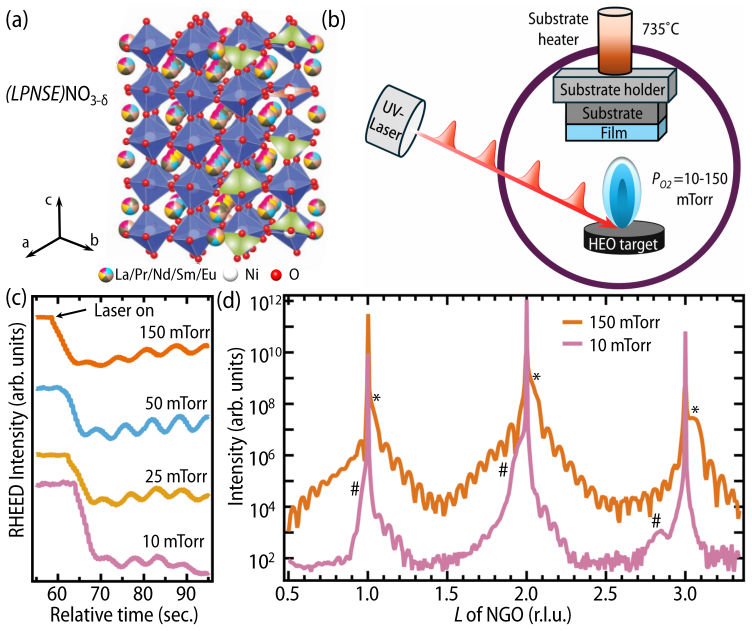
Summary. The manuscript reports a systematic study of oxygen-vacancy effects in single-crystalline high-entropy nickelate films [La0.2Pr0.2Nd0.2Sm0.2Eu0.2]NiO3−δ grown by pulsed laser deposition at oxygen pressures from 150 mTorr down to 10 mTorr. Structural characterization (RHEED, synchrotron XRD with Laue oscillations) indicates single-crystalline, perovskite-phase films, and XAS at the Ni L2 and O K edges is used to infer increasing oxygen-vacancy content with decreasing PO2. Temperature-dependent sheet resistance shows a monotonic increase of room-temperature resistance with decreasing PO2, while the MIT temperature first decreases from about 185 K (150 mTorr) to a hysteresis-free, reduced transition (25 mTorr), then increases to 285 K (15 mTorr), and finally the metallic phase is absent (10 mTorr). Low-temperature transport is analyzed with 2D Mott VRH for the 50 mTorr film, 3D weak localization for the 25 and 15 mTorr films, and nearest-neighbor hopping for the 10 mTorr film. The central claim is a 'Janus-faced' influence of oxygen vacancies, with a proposed phase diagram in δ spanning 0 to 0.2.
Significance. If the quantitative vacancy scale is correct, the non-monotonic evolution of the MIT in a high-entropy nickelate would be an interesting counterpoint to the monotonic effects reported for VO2, V2O3, and electron-doped RENiO3, and it would extend the study of disorder-driven phases into HEOs. The paper has clear strengths: the film series is well characterized structurally, the transport trend with PO2 is presented transparently, the magnetotransport analysis is detailed, and the comparison with a NdNiO3−δ film grown under the same conditions provides a useful control. The main caveat is that the quantitative δ axis, which is load-bearing for the phase diagram and for the comparison to electron antidoping, rests on a single linear-combination XAS analysis without error bars and with an assumed δ≈0 reference that itself shows a Ni2+ feature.
major comments (2)
- [XAS analysis and Fig. 5(c)] The quantitative oxygen-vacancy scale δ is load-bearing for the claimed phase diagram, but the linear-combination analysis in the XAS section does not establish it. Each oxygen vacancy in NiO3−δ formally donates two electrons and reduces two Ni3+ to Ni2+, so the fitted NiO (Ni2+) coefficient c is a Ni2+ fraction f with f ≈ 2δ, not δ itself. The reported values (δ ≈ 0.015, 0.14, 0.2) appear to set δ = c, which would overestimate δ by roughly a factor of two; the corrected scale would be about 0.0075, 0.07, and 0.1. Because Fig. 5(c) and the comparison with electron antidoping in RENiO3 rest on this specific calibration, the authors need to justify the mapping (or divide by the electron count), report error bars from the fitting, and provide an independent check (e.g., XPS quantification or lattice-parameter calibration). The non-monotonic TMIT vs PO2 trend would survive, but its mapping to δ is what supports the vacancy-concentration phase diagram.
- [XAS reference and O K-edge discussion] The zero of the δ scale is not established. The 150 mTorr film is assumed to have δ≈0, yet the text notes a minor Ni2+ feature around 870 eV; if this film already contains some Ni2+, all δ values shift. Additionally, the O K-edge shows a square-planar Ni2+ feature around 529.4 eV, and such Ni2+ sites have a different L-edge line shape than octahedral NiO; a two-component NiO + reference linear combination is therefore not a clean valence meter. The authors should quantify the reference Ni2+ content, test a three-component fit, or soften the quantitative δ claims in the abstract and in Fig. 5(c).
minor comments (5)
- [O K-edge paragraph] There is a typo 'due to to the 3d8L → c3d8 transition'; it should read 'due to the 3d8L → c3d8 transition.'
- [Magnetoconductance model description] In the sentence defining the Frydman model, 'a is constant and order of unity' is missing a verb; it should read 'a is a constant of order unity.'
- [Fig. 2 caption and main text] The notation 'P O2' appears with an unintended space in the text near Fig. 1; it should be PO2 for consistency.
- [Reference list] Reference [7] lacks a volume and page number ('Advanced Materials n/a, 2415351'); please update if available.
- [Abstract and text] The phrase 'Janus-faced' is used in the abstract and summary but not explicitly defined; consider adding one sentence specifying that it refers to opposite responses of TMIT at low versus high vacancy concentrations.
Circularity Check
No significant circularity: the Janus-faced MIT response is read directly from measured transport, not derived from a fitted or self-cited input.
full rationale
This is an experimental transport/XAS report. The central claim—non-monotonic TMIT versus oxygen vacancy content—is obtained by direct four-probe sheet-resistance measurements of films grown at different oxygen pressures (Fig. 3), and the δ values are independently estimated from Ni L2-edge XAS linear-combination fits using external NiO and the 150 mTorr film as references. No transport quantity is predicted from the fit parameters, and no equation in the paper reduces a claimed result to its input by construction. The XAS-based δ scale is a calibration, not a self-fulfilling prediction; concerns that the fitted NiO fraction may overcount vacancies by a factor of two or that the reference film contains residual Ni2+ are correctness/calibration issues, not circularity, and the non-monotonic trend survives as a function of growth pressure. Several references are to the group's prior work (Refs. 18, 22, 36, 38, 41), but they are used for background—e.g., that (LPNSE)NO exhibits an MIT, that the 870 eV feature may reflect nanoscale inhomogeneity, and that OVs weaken Ni-O hybridization—and none carries the load of the new result, which is supported by the in-paper data. The comparison with electron antidoping in RENiO3 relies on independent prior work (Refs. 24-28), not on a self-citation chain. I therefore find no circular step under the review criteria; the low score reflects only the presence of routine, non-load-bearing self-citations.
Assumptions & free parameters
free parameters (7)
- δ for 50 mTorr film =
0.015
- δ for 25 mTorr film =
0.14
- δ for 10 mTorr film =
0.2
- Mott VRH parameters (TM, ξ, Rhop) for 50 mTorr film =
TM=673 K, ξ=2.93 nm, Rhop=16.17 nm
- 3D WL parameters (σ0 and prefactor) for 25 and 15 mTorr films =
not reported numerically
- Activation energy Ea for 10 mTorr film =
~20 meV
- Magnetoconductance fit parameters (A', Hs) for 50 mTorr film =
varies with temperature
assumptions (4)
- domain assumption The 150 mTorr film has δ≈0 and the Ni2+ spectral weight in the XAS of other films scales linearly with vacancy concentration.
- domain assumption The insulator-to-metal transition in rare-earth nickelates is a bond disproportionation transition, and oxygen vacancies disrupt this order by hindering polaron formation.
- domain assumption The O K-edge pre-peak shift observed with increasing δ corresponds to a decrease in charge-transfer energy Δ.
- domain assumption The 25 and 15 mTorr films are in the 3D weak-localization regime, described by σ3d = σ0 + (e²/ℏπ³a)T^{p/2} with p=3/2.
Cite this review
Pith. "Pith review of Janus-faced influence of oxygen vacancy in high entropy oxide films with Mott electrons." pith.science (2026). https://pith.science/paper/JD6FCXXK
@misc{pith2026250705879,
  author       = {Pith},
  title        = {Pith review of: Janus-faced influence of oxygen vacancy in high entropy oxide films with Mott electrons},
  year         = {2026},
  howpublished = {\url{https://pith.science/paper/JD6FCXXK}},
  note         = {Machine review of arXiv:2507.05879}
}
abstract
Contrary to traditional approaches, high entropy oxides (HEOs) strategically employ cationic disorder to engineer tunable functionalities. This disorder, stemming from multiple elements at the same crystallographic site, disrupts local symmetry and induces local distortions. By examining a series of single-crystalline [La$_{0.2}$Pr$_{0.2}$Nd$_{0.2}$Sm$_{0.2}$Eu$_{0.2}$]NiO$_{3-\delta}$ thin films, we demonstrate herein that the creation of oxygen vacancies (OVs) further offers a powerful means of tailoring electronic behavior of HEOs by concurrently introducing disorder in the oxygen sublattice and doping electrons into the system. Increasing OV concentration leads to a monotonic increase in room-temperature sheet resistance. A striking feature is the Janus-faced response of the metal-insulator transition (MIT) to OVs due to the interplay among correlation energy scales, electron doping, and disorder. Unlike the monotonous influence of OV observed for the MIT in VO$_2$ and V$_2$O$_3$, initial OV doping lowers the MIT temperature here, whereas higher OV levels completely suppress the metallic phase. Magnetotransport measurements further reveal weak localization, strong localization as a function of $\delta$. Moreover, the disorder on both $RE$ and oxygen sublattices is responsible for the Mott-Anderson insulator state. These findings surpass the scope of the recently featured `electron antidoping' effect and demonstrate the promising opportunity to utilize OV engineering of HEOs for Mottronics and optoelectronics applications.
Figures


Figures from the paper (2 more)


Reference graph
Works this paper leans on
-
[1]
S. Yoo, S. Chae, T. Chiang, M. Webb, T. Ma, H. Paik, Y . Park, L. Williams, K. Nomoto, H. G. Xing, S. Trolier-McKinstry, E. Kioupakis, J. T. Heron, and W. D. Lu, Efficient data processing using tunable entropy-stabilized oxide memristors, Nature Electronics 7, 466 (2024)
work page 2024
-
[2]
J.-Y . Tsai, J.-Y . Chen, C.-W. Huang, H.-Y . Lo, W.-E. Ke, Y .-H. Chu, and W.-W. Wu, A high-entropy- oxides-based memristor: Outstanding resistive switching performance and mechanisms in atomic structural evolution, Advanced Materials 35, 2302979 (2023)
work page 2023
-
[3]
J. Zou, L. Tang, W. He, and X. Zhang, High-entropy oxides: Pioneering the future of multifunctional materials, ACS Nano 18, 34492 (2024)
work page 2024
-
[4]
C. Oses, C. Toher, and S. Curtarolo, High-entropy ceramics, Nature Reviews Materials 5, 295 (2020)
work page 2020
-
[5]
J. T. Sivak, S. S. I. Almishal, M. K. Caucci, Y . Tan, D. Srikanth, J. Petruska, M. Furst, L.-Q. Chen, C. M. Rost, J.-P. Maria, and S. B. Sinnott, Discovering high-entropy oxides with a machine-learning interatomic potential, Phys. Rev. Lett. 134, 216101 (2025)
work page 2025
-
[6]
A. R. Mazza, J.-Q. Yan, S. Middey, J. S. Gardner, A.-H. Chen, M. Brahlek, and T. Z. Ward, Embracing disorder in quantum materials design, Applied Physics Letters 124, 230501 (2024)
work page 2024
- [7]
-
[8]
A. R. Mazza, E. Skoropata, Y . Sharma, J. Lapano, T. W. Heitmann, B. L. Musico, V . Keppens, Z. Gai, 12 J. W. Freeland, T. R. Charlton, M. Brahlek, A. Moreo, E. Dagotto, and T. Z. Ward, Designing mag- netism in high entropy oxides, Advanced Science 9, 2200391 (2022)
work page 2022
Show all 61 references
-
[9]
Zheng, Q
Y . Zheng, Q. Zhang, C. Shi, Z. Zhou, Y . Lu, J. Han, H. Chen, Y . Ma, Y . Zhang, C. Lin, W. Xu, W. Ma, Q. Li, Y . Yang, B. Wei, B. Yang, M. Zou, W. Zhang, C. Liu, L. Dou, D. Yang, J.-L. Lan, D. Yi, X. Zhang, L. Gu, C.-W. Nan, and Y .-H. Lin, Carrier-phonon decoupling in perov...
2024
-
[10]
Zhang, S
A. Zhang, S. Oh, B. K. Choi, E. Rotenberg, T. D. Brown, C. D. Spataru, E. Kinigstein, J. Guo, J. D. Sugar, E. Salagre, A. Mascaraque, E. G. Michel, A. C. Shad, J. Zhu, M. D. Witman, S. Kumar, A. A. Talin, and E. J. Fuller, Tuning the spin transition and carrier type in rare-ea...
2024
-
[11]
Zhang, S
M. Zhang, S. Lan, B. B. Yang, H. Pan, Y . Q. Liu, Q. H. Zhang, J. L. Qi, D. Chen, H. Su, D. Yi, Y . Y . Yang, R. Wei, H. D. Cai, H. J. Han, L. Gu, C.-W. Nan, and Y .-H. Lin, Ultrahigh energy storage in high-entropy ceramic capacitors with polymorphic relaxor phase, Science 384...
2024
-
[12]
B. Yang, Y . Zhang, H. Pan, W. Si, Q. Zhang, Z. Shen, Y . Yu, S. Lan, F. Meng, Y . Liu, H. Huang, J. He, L. Gu, S. Zhang, L.-Q. Chen, J. Zhu, C.-W. Nan, and Y .-H. Lin, High-entropy enhanced capacitive energy storage, Nature Materials 21, 1074 (2022)
2022
-
[13]
Sarkar, Q
A. Sarkar, Q. Wang, A. Schiele, M. R. Chellali, S. S. Bhattacharya, D. Wang, T. Brezesinski, H. Hahn, L. Velasco, and B. Breitung, High-entropy oxides: Fundamental aspects and electrochemical proper- ties, Advanced Materials 31, 1806236 (2019)
2019
-
[14]
R. K. Patel, R. N. Jenjeti, R. Kumar, N. Bhattacharya, S. Kumar, S. K. Ojha, Z. Zhang, H. Zhou, K. Qu, Z. Wang, Z. Yang, C. Klewe, P. Shafer, S. Sampath, and S. Middey, Thickness dependent OER electrocatalysis of epitaxial thin film of high entropy oxide, Applied Physics Revie...
2023
-
[15]
P. W. Anderson, Absence of diffusion in certain random lattices, Physical review 109, 1492 (1958)
1958
-
[16]
A. Amir, Y . Oreg, and Y . Imry, Electron glass dynamics, Annu. Rev. Condens. Matter Phys. 2, 235 (2011)
2011
-
[17]
D. A. Abanin, E. Altman, I. Bloch, and M. Serbyn, Colloquium: Many-body localization, thermaliza- tion, and entanglement, Rev. Mod. Phys. 91, 021001 (2019)
2019
-
[18]
R. K. Patel, S. K. Ojha, S. Kumar, A. Saha, P. Mandal, J. W. Freeland, and S. Middey, Epitaxial stabi- lization of ultra thin films of high entropy perovskite, Applied Physics Letters 116, 071601 (2020)
2020
-
[19]
Middey, J
S. Middey, J. Chakhalian, P. Mahadevan, J. Freeland, A. Millis, and D. Sarma, Physics of ultrathin 13 films and heterostructures of rare-earth nickelates, Annual Review of Materials Research 46, 305 (2016)
2016
-
[20]
H. Park, A. J. Millis, and C. A. Marianetti, Site-selective mott transition in rare-earth-element nicke- lates, Phys. Rev. Lett. 109, 156402 (2012)
2012
-
[21]
Bisogni, S
V . Bisogni, S. Catalano, R. J. Green, M. Gibert, R. Scherwitzl, Y . Huang, V . N. Strocov, P. Zubko, S. Balandeh, J.-M. Triscone, et al., Ground-state oxygen holes and the metal–insulator transition in the negative charge-transfer rare-earth nickelates, Nature Communications ...
2016
-
[22]
Middey, D
S. Middey, D. Meyers, M. Kareev, Y . Cao, X. Liu, P. Shafer, J. W. Freeland, J.-W. Kim, P. J. Ryan, and J. Chakhalian, Disentangled cooperative orderings in artificial rare-earth nickelates, Phys. Rev. Lett. 120, 156801 (2018)
2018
-
[23]
Shamblin, M
J. Shamblin, M. Heres, H. Zhou, J. Sangoro, M. Lang, J. Neuefeind, J. A. Alonso, and S. Johnston, Experimental evidence for bipolaron condensation as a mechanism for the metal-insulator transition in rare-earth nickelates, Nature Communications 9, 86 (2018)
2018
-
[24]
J. Shi, Y . Zhou, and S. Ramanathan, Colossal resistance switching and band gap modulation in a perovskite nickelate by electron doping, Nature Communications 5, 4860 (2014)
2014
-
[25]
Kotiuga, Z
M. Kotiuga, Z. Zhang, J. Li, F. Rodolakis, H. Zhou, R. Sutarto, F. He, Q. Wang, Y . Sun, Y . Wang, N. A. Aghamiri, S. B. Hancock, L. P. Rokhinson, D. P. Landau, Y . Abate, J. W. Freeland, R. Comin, S. Ramanathan, and K. M. Rabe, Carrier localization in perovskite nickelates fr...
2019
-
[26]
J. Li, R. J. Green, Z. Zhang, R. Sutarto, J. T. Sadowski, Z. Zhu, G. Zhang, D. Zhou, Y . Sun, F. He, S. Ramanathan, and R. Comin, Sudden collapse of magnetic order in oxygen-deficient nickelate films, Phys. Rev. Lett. 126, 187602 (2021)
2021
-
[27]
Q. Liu, G. M. Dalpian, and A. Zunger, Antidoping in insulators and semiconductors having interme- diate bands with trapped carriers, Phys. Rev. Lett. 122, 106403 (2019)
2019
-
[28]
Shi, G.-D
Y . Shi, G.-D. Zhao, I. Dabo, S. Ramanathan, and L.-Q. Chen, Phase-field model of electronic antidop- ing, Phys. Rev. Lett. 132, 256502 (2024)
2024
-
[29]
S. S. Aamlid, M. Oudah, J. Rottler, and A. M. Hallas, Understanding the role of entropy in high entropy oxides, Journal of the American Chemical Society 145, 5991 (2023)
2023
-
[30]
Guo and B
Q. Guo and B. Noheda, From hidden metal-insulator transition to planckian-like dissipation by tuning the oxygen content in a nickelate, npj Quantum Materials 6, 72 (2021)
2021
-
[31]
Jeong, N
J. Jeong, N. Aetukuri, T. Graf, T. D. Schladt, M. G. Samant, and S. S. P. Parkin, Suppression of metal- 14 insulator transition in vo¡sub¿2¡/sub¿ by electric field–induced oxygen vacancy formation, Science 339, 1402 (2013)
2013
-
[32]
Y . Park, H. Sim, M. Jo, G.-Y . Kim, D. Yoon, H. Han, Y . Kim, K. Song, D. Lee, S.-Y . Choi, and J. Son, Directional ionic transport across the oxide interface enables low-temperature epitaxy of rutile tio2, Nature Communications 11, 1401 (2020)
2020
-
[33]
Brockman, N
J. Brockman, N. P. Aetukuri, T. Topuria, M. G. Samant, K. P. Roche, and S. S. P. Parkin, Increased metal-insulator transition temperatures in epitaxial thin films of v2o3 prepared in reduced oxygen environments, Applied Physics Letters 98, 152105 (2011)
2011
-
[34]
O. Y . Gorbenko, S. Samoilenkov, I. Graboy, and A. Kaul, Epitaxial stabilization of oxides in thin films, Chemistry of materials 14, 4026 (2002)
2002
-
[35]
W. Wei, D. Vu, Z. Zhang, F. J. Walker, and C. H. Ahn, Superconducting nd1- x eu x nio2 thin films using in situ synthesis, Science Advances 9, eadh3327 (2023)
2023
-
[36]
Bhattacharya, S
N. Bhattacharya, S. C. Joshi, R. K. Patel, J. Zhang, A. Saha, P. Mandal, S. K. Ojha, A. Gloskovskii, C. Schlueter, J. W. Freeland, Z. Zhang, H. Zhou, Z. Yang, and S. Middey, Nanoscale inhomogeneity and epitaxial strain control metallicity in single crystalline thin films of hi...
-
[37]
Abbate, G
M. Abbate, G. Zampieri, F. Prado, A. Caneiro, J. M. Gonzalez-Calbet, and M. Vallet-Regi, Electronic structure and metal-insulator transition in lanio3−δ, Phys. Rev. B 65, 155101 (2002)
2002
-
[38]
Middey, P
S. Middey, P. Rivero, D. Meyers, M. Kareev, X. Liu, Y . Cao, J. Freeland, S. Barraza-Lopez, and J. Chakhalian, Polarity compensation in ultra-thin films of complex oxides: The case of a perovskite nickelate, Scientific reports 4, 6819 (2014)
2014
-
[39]
Chakhalian, J
J. Chakhalian, J. M. Rondinelli, J. Liu, B. A. Gray, M. Kareev, E. J. Moon, N. Prasai, J. L. Cohn, M. Varela, I. C. Tung, M. J. Bedzyk, S. G. Altendorf, F. Strigari, B. Dabrowski, L. H. Tjeng, P. J. Ryan, and J. W. Freeland, Asymmetric orbital-lattice interactions in ultrathin...
2011
-
[40]
J. Liu, M. Kargarian, M. Kareev, B. Gray, P. J. Ryan, A. Cruz, N. Tahir, Y .-D. Chuang, J. Guo, J. M. Rondinelli, J. W. Freeland, G. A. Fiete, and J. Chakhalian, Heterointerface engineered electronic and magnetic phases of ndnio3 thin films, Nature Communications 4, 2714 (2013)
2013
-
[41]
Middey, D
S. Middey, D. Meyers, S. K. Ojha, M. Kareev, X. Liu, Y . Cao, J. W. Freeland, and J. Chakhalian, Epitaxial strain modulated electronic properties of interface controlled nickelate superlattices, Phys. Rev. B 98, 045115 (2018). 15
2018
-
[42]
Horiba, R
K. Horiba, R. Eguchi, M. Taguchi, A. Chainani, A. Kikkawa, Y . Senba, H. Ohashi, and S. Shin, Electronic structure of LaNio3−x: An in situ soft x-ray photoemission and absorption study, Phys. Rev. B 76, 155104 (2007)
2007
-
[43]
Q. Guo, S. Farokhipoor, C. Mag ´en, F. Rivadulla, and B. Noheda, Tunable resistivity exponents in the metallic phase of epitaxial nickelates, Nature Communications 11, 2949 (2020)
2020
-
[44]
R. D. S ´anchez, M. T. Causa, A. Caneiro, A. Butera, M. Vallet-Reg ´ı, M. J. Sayagu ´es, J. Gonz ´alez- Calbet, F. Garc ´ıa-Sanz, and J. Rivas, Metal-insulator transition in oxygen-deficient lanio3−x per- ovskites, Phys. Rev. B 54, 16574 (1996)
1996
-
[45]
Iglesias, M
L. Iglesias, M. Bibes, and J. Varignon, First-principles study of electron and hole doping effects in perovskite nickelates, Phys. Rev. B 104, 035123 (2021)
2021
-
[46]
J. L. Garc ´ıa-Mu˜noz, M. Suaaidi, M. J. Mart´ınez-Lope, and J. A. Alonso, Influence of carrier injection on the metal-insulator transition in electron- and hole-dopedr1−x ax nio3 perovskites, Phys. Rev. B52, 13563 (1995)
1995
-
[47]
J. Li, S. Ramanathan, and R. Comin, Carrier doping physics of rare earth perovskite nickelates renio3, Frontiers in Physics 10 (2022)
2022
-
[48]
Hadjimichael, B
M. Hadjimichael, B. Mundet, C. Dom ´ınguez, A. Waelchli, G. De Luca, J. Spring, S. J ¨ohr, S. McKe- own Walker, C. Piamonteze, D. T. L. Alexander, J.-M. Triscone, and M. Gibert, Competition between carrier injection and structural distortions in electron-doped perovskite nicke...
2023
-
[49]
Jaramillo, S
R. Jaramillo, S. D. Ha, D. M. Silevitch, and S. Ramanathan, Origins of bad-metal conductivity and the insulator–metal transition in the rare-earth nickelates, Nature Physics 10, 304 (2014)
2014
-
[50]
J. A. N. Bruin, H. Sakai, R. S. Perry, and A. Mackenzie, Similarity of scattering rates in metals showing t-linear resistivity, Science 339, 804 (2013)
2013
-
[51]
Faran and Z
O. Faran and Z. Ovadyahu, Magnetoconductance in the variable-range-hopping regime due to a quantum-interference mechanism, Phys. Rev. B 38, 5457 (1988)
1988
-
[52]
S. N. Mott, Conduction in Non-Crystalline Materials (Oxford University Press, 1993)
1993
-
[53]
Ramadoss, N
K. Ramadoss, N. Mandal, X. Dai, Z. Wan, Y . Zhou, L. Rokhinson, Y . P. Chen, J. Hu, and S. Ra- manathan, Sign reversal of magnetoresistance in a perovskite nickelate by electron doping, Phys. Rev. B 94, 235124 (2016)
2016
-
[54]
Frydman and Z
A. Frydman and Z. Ovadyahu, Spin and quantum interference effects in hopping conductivity, Solid State Communications 94, 745 (1995). 16
1995
-
[55]
Vaknin, A
A. Vaknin, A. Frydman, Z. Ovadyahu, and M. Pollak, High-field magnetoconductance in anderson insulators, Phys. Rev. B 54, 13604 (1996)
1996
-
[56]
Sivan, O
U. Sivan, O. Entin-Wohlman, and Y . Imry, Orbital magnetoconductance in the variable-range–hopping regime, Phys. Rev. Lett. 60, 1566 (1988)
1988
-
[57]
Scherwitzl, S
R. Scherwitzl, S. Gariglio, M. Gabay, P. Zubko, M. Gibert, and J.-M. Triscone, Metal-insulator tran- sition in ultrathin lanio3 films, Phys. Rev. Lett. 106, 246403 (2011)
2011
-
[58]
P. A. Lee and T. V . Ramakrishnan, Magnetoresistance of weakly disordered electrons, Phys. Rev. B 26, 4009 (1982)
1982
-
[59]
Bergmann, Weak localization in thin films: a time-of-flight experiment with conduction electrons, Physics Reports 107, 1 (1984)
G. Bergmann, Weak localization in thin films: a time-of-flight experiment with conduction electrons, Physics Reports 107, 1 (1984)
1984
-
[60]
X. Liao, V . Singh, and H. Park, Oxygen vacancy induced site-selective mott transition inlanio3, Phys. Rev. B 103, 085110 (2021)
2021
-
[61]
A. R. Mazza, S. R. Acharya, P. Wasik, J. Lapano, J. Li, B. L. Musico, V . Keppens, C. T. Nelson, A. F. May, M. Brahlek, C. Mazzoli, J. Pelliciari, V . Bisogni, V . R. Cooper, and T.Z. Ward, Variance induced decoupling of spin, lattice, and charge ordering in perovskite nickela...
2023
Reviewed August 6, 2026 · model on record in the stance chip above.
Discussion (0). Continue with ORCID to comment.