REVIEW 3 major objections 5 minor 52 references
The paper claims that anchoring Gaussian centers to predicted per-pixel ray maps creates a bidirectional appearance–geometry feedback loop that suppresses cumulative camera pose drift in feed-forward 3D reconstruction.
Reviewed by Pith at T0; open to challenge. T0 means a machine referee read the full paper against a public rubric. the ladder, T0–T4 →
T0 review · deepseek-v4-flash
2026-08-02 08:05 UTC pith:JDSZEO4Q
load-bearing objection A well-ablated empirical advance for pose-free 3DGS, but the headline drift-robustness claim is under-supported because the only pose teacher is COLMAP and no independent pose ground truth is reported. the 3 major comments →
NoDrift3R: Raymap-Guided Coupling for Drift-Robust Unposed Feed-Forward 3D Reconstruction
The pith
A machine-rendered reading of the paper's core claim, the machinery that carries it, and where it could break.
Core claim
The paper's central claim is that cumulative camera-pose drift, not lack of appearance capacity, is what limits pose-free feed-forward 3D reconstruction on long image sequences, and that the drift can be suppressed by explicitly coupling geometry and appearance rather than optimizing them separately. It proposes a Raymap-Guided Coupling Module (RGC) in which each predicted Gaussian center is anchored to a per-pixel ray map plus depth, and a unified objective supervises rendered RGB, ray-map consistency, and camera parameters. Because the RGB loss backpropagates through the anchored Gaussian positions into the ray maps while the ray-map loss directly regularizes those same positions, appearan
What carries the argument
The central object is a per-pixel ray map encoding ray origin and direction for every pixel, combined with a depth map. Gaussian centers are set by lifting pixels to 3D via the formula p = o + D·r, so predicted geometry directly determines where Gaussians sit. This ray-map-guided lifting replaces low-dimensional camera pose as the interface between pose estimation and Gaussian generation, giving the RGB loss a path into geometry and giving the ray-map loss a path into appearance. The training schedule is a second mechanism: overlap-aware intervals are clipped to a maximum, with stochastic replay of short-interval pairs, preserving local consistency while expanding to wide baselines.
Load-bearing premise
Everything rests on the premise that the SfM-derived pseudo-ground-truth camera poses and ray maps used as training targets are accurate enough and unbiased enough to teach the network genuine geometry; if those teachers carry systematic drift, the network may learn to reproduce rather than correct that drift.
What would settle it
Train or fine-tune the same architecture on sequences whose SfM pseudo-GT poses are artificially perturbed with controlled low-frequency drift, then evaluate on clean unperturbed long sequences; if the network learns the injected drift or fails to beat the baseline on 100+ frame trajectories, the claim that the RGC loop suppresses drift rather than memorizes the teacher is refuted. A direct measurement of predicted ray-map error against ground-truth camera trajectories on very long sequences would similarly show whether the supposed drift correction holds outside the training distribution.
If this is right
- Long-sequence pose-free reconstruction stays stable: rendering quality no longer drops as input views increase from 6 to 24, unlike prior pose-free methods.
- Pose estimation becomes more globally consistent under longer trajectories, directly addressing cumulative drift.
- The dual-frequency schedule avoids the usual trade-off between short-range local consistency and long-range coverage.
- Cross-dataset zero-shot generalization improves for both rendering and pose, especially on long sequences.
- Geometry supervision and appearance supervision become mutually reinforcing, so joint training is the source of the gain rather than any single loss.
Where Pith is reading between the lines
- The same ray-map coupling could transfer to other feed-forward 3DGS architectures that currently condition Gaussian generation on low-dimensional camera poses, potentially improving their long-sequence behavior as well.
- A natural test is whether the drift suppression persists when the SfM pseudo-GT teacher is deliberately corrupted with artificial drift; if the network learns the corruption instead of correcting it, the claimed causal mechanism is weaker than it appears.
- The ray-map interface could be extended to video sequences by deriving ray maps from optical flow or temporal coherence, reducing the dependence on separate SfM pre-processing.
- If the bidirectional loop is as robust as the ablations suggest, it may also reduce the amount of pose supervision needed in training, a direction the paper explicitly leaves open.
Editorial analysis
A structured set of objections, weighed in public.
Referee Report
Summary. The paper proposes NoDrift3R, a feed-forward 3D Gaussian Splatting method for pose-free reconstruction at inference. The two main components are a Raymap-Guided Coupling (RGC) module, which anchors Gaussian centers to predicted ray maps and depth, and a Dual-Frequency Viewpoint Scheduling strategy that combines an overlap-based easy-to-hard curriculum with stochastic replay of short-interval pairs. Training jointly optimizes RGB rendering, ray-map consistency, and camera regularization. Experiments on DL3DV, RE10K, ScanNet++, and Mip-NeRF360 report consistent improvements over prior pose-free methods, with the largest gains on long sequences and pose AUC. Ablations (Tables 6, 7, 11, 12) attribute the gains to the RGC coupling and replay schedule.
Significance. If the reported results are reproducible, this is a practically valuable contribution: the method is simple, uses a standard ViT backbone, and shows strong pose accuracy and long-sequence stability compared with YoNoSplat and other feed-forward baselines. The paper is thorough in its ablations and includes zero-shot and cross-dataset evaluations. However, the central 'drift-robust' and 'bidirectional feedback' claims rest on a supervision setup that uses COLMAP-derived poses and ray maps as ground truth during training. Because the paper itself acknowledges SfM pseudo-GT introduces sensor noise, the experimental design does not fully separate genuine drift correction from fitting to SfM's own biases. The lack of pose-error evaluation on a dataset with independent ground truth leaves this confound unresolved.
major comments (3)
- [3.2, Eq. (4)-(6), Appendix 'Clarification on pose-free inference vs. training'] The camera and raymap losses are supervised with COLMAP-derived extrinsics/intrinsics (Eq. 4; Appendix Eqs. 11-15). The abstract and intro state that SfM pseudo-GT poses introduce sensor noise. Under this setup, high pose AUC on DL3DV/RE10K and the zero-shot RE10K result (Table 3) could reflect successful imitation of COLMAP's biases rather than correction of real cumulative drift. ScanNet++ has independent ground truth, but Table 5 reports only rendering, not pose accuracy, so it does not break this loop. Please provide additional evidence: (i) pose errors on ScanNet++ or on synthetic data with known camera poses; (ii) analysis of whether model pose errors correlate with COLMAP drift on long sequences; (iii) comparison with a variant trained with raymap targets from an alternative geometric teacher or with self-supervised consistency losses. Without this, the headline claims of drift ro
- [Table 6] The ablation results give only weak support to the 'appearance refines geometry' half of the bidirectional claim. Removing the raymap loss (w/o raymap loss) reduces PSNR from 23.302 to 21.869 at 6 views, but pose AUC@5 only drops from 0.874 to 0.869; removing the RGB loss reduces PSNR dramatically (to 12.608) while pose AUC@5 remains 0.851. This suggests pose accuracy is driven primarily by geometric (raymap/camera) supervision, and the rendering-to-geometry contribution is marginal. The paper should either supply more sensitive evidence (error bars, per-sequence breakdown) or temper the 'bidirectional feedback loop' claim.
- [Tables 1, 2, 8, 9] The comparison with YoNoSplat and Depth Anything v3 (DAv3) is complicated by backbone initialization and parameter count. Ours-Giant (1.40B) is initialized from DAv3 pretrained weights, while YoNoSplat (1.02B) uses a different base model; Table 9 shows Ours-Large obtains lower rendering PSNR than YoNoSplat on DL3DV (24.341 vs 24.531 at 6 views). The main tables should clearly state which variant (Giant vs Large) is used, and the finetuned DAv3 baseline from Table 8 should appear in Table 2, since finetuning DAv3 alone reaches AUC@5 0.955/0.928/0.920. The marginal improvement over this stronger baseline is the appropriate yardstick for the proposed coupling.
minor comments (5)
- [Figure 3, Table 1, Table 13] Typos: 'Vallina' should be 'Vanilla' in Fig. 3(a); 'YonoSplat'/'Yono' inconsistent in Table 1; 'Ourdoor' should be 'Outdoor' in Table 13.
- [Section 3.3, Eq. (8), Table 7] Eq. (8) clips the interval to g_max=15, but Table 7 reports ablations with g_max=20 and g_max=∞. Please clarify when clipping is disabled and whether the replay version uses clipping.
- [Tables 1 and 4] The notation 'p,k' in table headers is undefined. Define that p denotes ground-truth poses and k denotes ground-truth intrinsics, and clarify the absence of these marks.
- [Tables 1-3, 9] The main tables use 'Ours' without indicating the model scale. Since Tables 1-3 use the Giant model and ablations use the Large model, please state the variant explicitly in captions to avoid confusion.
- [Figure 7 discussion] The text attributes gains to 'coherent fusion of Gaussians' on ScanNet++, but the figure does not show a direct visualization of Gaussian fusion. Either provide such a visualization or rephrase.
Circularity Check
No significant circularity: training targets are external COLMAP labels, and the claimed geometry-appearance coupling is validated by ablations rather than by construction.
full rationale
The paper's derivation chain is not circular. Camera and raymap supervision come from fixed external COLMAP labels: Eq. (4) supervises predicted camera parameters against COLMAP-derived extrinsics/intrinsics, and Appendix Eqs. (11)-(14) build raymap targets from those same extrinsic/intrinsic matrices. These are training targets, not the model's own outputs, so no prediction reduces to its input by definition. Eq. (1) defines Gaussian centers from predicted depth and raymaps; the RGB loss and the raymap loss are complementary supervision signals, not one defined in terms of the other. The central claim that Raymap-Guided Coupling and Dual-Frequency scheduling drive drift robustness is supported by in-paper ablations against non-circular baselines (Tables 6, 7, 11, 12), including a DAv3 Gaussian Head variant and detached-raymap variants, and by cross-dataset zero-shot evaluations (Tables 3, 5). The acknowledged limitation that training uses COLMAP pose/raymap supervision while inference is pose-free is a supervision and benchmark-validity concern, not a derivation-level circularity. Self-citations appear only as related-work references and baselines and are not load-bearing for the paper's central argument.
Axiom & Free-Parameter Ledger
free parameters (6)
- lambda_cam =
0.5
- lambda_ray =
1.0
- DINOv2 overlap threshold schedule =
annealed 1.0 -> 0.75
- g_max =
15
- p_small (replay probability) =
0.5
- g_small range =
U(6,...,10)
axioms (4)
- domain assumption COLMAP-derived poses and ray maps on DL3DV/RE10K are accurate enough to serve as supervision targets for Lcam and Lray.
- domain assumption DINOv2 cosine similarity between image pairs is a reliable proxy for visual overlap to order the curriculum.
- domain assumption Pretrained Depth Anything v3 weights provide a geometry/raymap prior that transfers to the Gaussian head and camera head.
- domain assumption 3DGS rendering is differentiable with respect to Gaussian centers derived from raymap/depth, and the gradients are stable enough for joint optimization.
read the original abstract
Pose-Free Feed-forward 3D Gaussian Splatting (3DGS) has recently emerged as a powerful paradigm for fast scene reconstruction. However, its performance degrades significantly in long image sequences due to cumulative camera pose estimation drift, which propagates errors into geometric modeling and severely limits rendering fidelity. In this work, we revisit the long-sequence bottleneck and identify pose drift as the primary factor restricting reconstruction quality. Furthermore, while SfM-based pseudo ground-truth poses introduce sensor noise, purely rendering-based supervision often leads to optimization instability and local minima due to the entangled optimization of geometry and pose. To address the challenges, we propose a synergistic pose-free framework that explicitly couples geometry and appearance via a Raymap-Guided Coupling Module (RGC). Concretely, we anchor Gaussian centers to raymap-induced geometry and jointly optimize RGB reconstruction, raymap consistency, and camera regularization under a unified objective, yielding a bidirectional feedback loop: stronger geometry improves rendering, and appearance supervision in turn refines geometry and pose. To further stabilize learning across wide temporal ranges, we introduce a Dual-Frequency Viewpoint Scheduling strategy that combines easy-to-hard interval expansion with replay of short-interval pairs. Extensive experiments across in-domain and cross-domain datasets show consistent gains in both rendering and pose estimation, with notably improved robustness on long sequences. Ablation studies validate our central insight: explicitly designed geometry-appearance synergy is the key to scalable and drift-robust pose-free feed-forward 3D reconstruction. Project page: https://xiangyu1sun.github.io/NoDrift3R-project-page/
Figures


Reference graph
Works this paper leans on
-
[1]
In: Proceedings of the Computer Vision and Pattern Recognition Conference
Charatan,D.,Li,S.L.,Tagliasacchi,A.,Sitzmann,V.:pixelsplat:3dgaussiansplats from image pairs for scalable generalizable 3d reconstruction. In: Proceedings of the Computer Vision and Pattern Recognition Conference. pp. 19457–19467 (2024) 2, 4
2024
-
[2]
arXiv preprint arXiv:2103.15595 (2021) 4
Chen, A., Xu, Z., Zhao, F., Zhang, X., Xiang, F., Yu, J., Su, H.: Mvsnerf: Fast generalizable radiance field reconstruction from multi-view stereo. arXiv preprint arXiv:2103.15595 (2021) 4
Pith/arXiv arXiv 2021
-
[3]
In: European conference on computer vision
Chen, Y., Xu, H., Zheng, C., Zhuang, B., Pollefeys, M., Geiger, A., Cham, T.J., Cai, J.: Mvsplat: Efficient 3d gaussian splatting from sparse multi-view images. In: European conference on computer vision. pp. 370–386. Springer (2024) 2, 4, 10, 12
2024
-
[4]
Advances in Neural Information Processing Systems37, 107064–107086 (2024) 4
Chen, Y., Zheng, C., Xu, H., Zhuang, B., Vedaldi, A., Cham, T.J., Cai, J.: Mvs- plat360: Feed-forward 360 scene synthesis from sparse views. Advances in Neural Information Processing Systems37, 107064–107086 (2024) 4
2024
-
[5]
arXiv preprint arXiv:2405.21060 (2024) 5
Dao, T., Gu, A.: Transformers are ssms: Generalized models and efficient algo- rithms through structured state space duality. arXiv preprint arXiv:2405.21060 (2024) 5
Pith/arXiv arXiv 2024
-
[6]
arXiv preprint arXiv:2512.08930 (2025) 5
Deng, Y., Peng, S., Zhang, J., Heal, K., Sun, T., Flynn, J., Marschner, S., Chai, L.: Selfi: Self improving reconstruction engine via 3d geometric feature alignment. arXiv preprint arXiv:2512.08930 (2025) 5
arXiv 2025
-
[7]
arXiv preprint arXiv:2010.11929 (2020) 4, 9
Dosovitskiy, A., Beyer, L., Kolesnikov, A., Weissenborn, D., Zhai, X., Unterthiner, T., Dehghani, M., Minderer, M., Heigold, G., Gelly, S., et al.: An image is worth 16x16 words: Transformers for image recognition at scale. arXiv preprint arXiv:2010.11929 (2020) 4, 9
Pith/arXiv arXiv 2010
-
[8]
arXiv preprint arXiv:2403.20309 (2024) 5
Fan, Z., Cong, W., Wen, K., Wang, K., Zhang, J., Ding, X., Xu, D., Ivanovic, B., Pavone, M., Pavlakos, G., et al.: Instantsplat: Sparse-view gaussian splatting in seconds. arXiv preprint arXiv:2403.20309 (2024) 5
Pith/arXiv arXiv 2024
-
[9]
In: The Fourteenth International Conference on Learning Representations (2026) 5
Fang, X., Gao, J., Wang, Z., Chen, Z., Ren, X., Lyu, J., Ren, Q., Yang, Z., Yang, X., Yan, Y., Lyu, C.: Dens3r: A foundation model for 3d geometry prediction. In: The Fourteenth International Conference on Learning Representations (2026) 5
2026
-
[10]
In: Proceedings of the IEEE/CVF conference on computer vi- sion and pattern recognition
Fu, Y., Liu, S., Kulkarni, A., Kautz, J., Efros, A.A., Wang, X.: Colmap-free 3d gaussian splatting. In: Proceedings of the IEEE/CVF conference on computer vi- sion and pattern recognition. pp. 20796–20805 (2024) 5
2024
-
[11]
arXiv preprint arXiv:2410.22128 (2024) 5
Hong, S., Jung, J., Shin, H., Han, J., Yang, J., Luo, C., Kim, S.: Pf3plat: Pose-free feed-forward 3d gaussian splatting. arXiv preprint arXiv:2410.22128 (2024) 5
Pith/arXiv arXiv 2024
-
[12]
arXiv preprint arXiv:2311.04400 (2023) 5
Hong, Y., Zhang, K., Gu, J., Bi, S., Zhou, Y., Liu, D., Liu, F., Sunkavalli, K., Bui, T., Tan, H.: Lrm: Large reconstruction model for single image to 3d. arXiv preprint arXiv:2311.04400 (2023) 5
Pith/arXiv arXiv 2023
-
[13]
In: Proceedings of the IEEE/CVF International Con- ference on Computer Vision
Huang, R., Mikolajczyk, K.: No pose at all: Self-supervised pose-free 3d gaussian splatting from sparse views. In: Proceedings of the IEEE/CVF International Con- ference on Computer Vision. pp. 27947–27957 (2025) 5
2025
-
[14]
In: Proceedings of the SIG- GRAPH Asia 2025 Conference Papers
Imtiaz, T., Chai, L., Heal, K., Luo, X., Park, J., Dy, J., Flynn, J.: Lvt: Large- scale scene reconstruction via local view transformers. In: Proceedings of the SIG- GRAPH Asia 2025 Conference Papers. pp. 1–12 (2025) 5 NoDrift3R 17
2025
-
[15]
ACM Transactions on Graphics (TOG)44(6), 1–16 (2025) 2, 3, 5, 7, 10, 12, 20
Jiang, L., Mao, Y., Xu, L., Lu, T., Ren, K., Jin, Y., Xu, X., Yu, M., Pang, J., Zhao, F., et al.: Anysplat: Feed-forward 3d gaussian splatting from unconstrained views. ACM Transactions on Graphics (TOG)44(6), 1–16 (2025) 2, 3, 5, 7, 10, 12, 20
2025
-
[16]
arXiv preprint arXiv:2410.17242 (2024) 5
Jin, H., Jiang, H., Tan, H., Zhang, K., Bi, S., Zhang, T., Luan, F., Snavely, N., Xu, Z.: Lvsm: A large view synthesis model with minimal 3d inductive bias. arXiv preprint arXiv:2410.17242 (2024) 5
Pith/arXiv arXiv 2024
-
[17]
In: Proceedings of the IEEE/CVF Conference on Computer Vision and Pattern Recognition
Kang, G., Nam, S., Yang, S., Sun, X., Khamis, S., Mohamed, A., Park, E.: ilrm: An iterative large 3d reconstruction model. In: Proceedings of the IEEE/CVF Conference on Computer Vision and Pattern Recognition. pp. 37332–37342 (2026) 2, 5
2026
-
[18]
In: Proceedings of the IEEE/CVF Conference on Computer Vision and Pattern Recognition
Kang, G., Yang, S., Nam, S., Lee, Y., Kim, J., Park, E.: Multi-view pyramid trans- former: Look coarser to see broader. In: Proceedings of the IEEE/CVF Conference on Computer Vision and Pattern Recognition. pp. 37380–37390 (2026) 5
2026
-
[19]
In: Proceedings of the Computer Vision and Pattern Recognition Conference
Kang, G., Yoo, J., Park, J., Nam, S., Im, H., Shin, S., Kim, S., Park, E.: Selfsplat: Pose-free and 3d prior-free generalizable 3d gaussian splatting. In: Proceedings of the Computer Vision and Pattern Recognition Conference. pp. 22012–22022 (2025) 2, 5
2025
-
[20]
arXiv preprint arXiv:2509.13414 (2025) 5
Keetha, N., Müller, N., Schönberger, J., Porzi, L., Zhang, Y., Fischer, T., Knapitsch, A., Zauss, D., Weber, E., Antunes, N., et al.: Mapanything: Univer- sal feed-forward metric 3d reconstruction. arXiv preprint arXiv:2509.13414 (2025) 5
Pith/arXiv arXiv 2025
-
[21]
ACM Trans
Kerbl, B., Kopanas, G., Leimkühler, T., Drettakis, G., et al.: 3d gaussian splatting for real-time radiance field rendering. ACM Trans. Graph.42(4), 139–1 (2023) 2, 4
2023
-
[22]
In: European conference on computer vision
Leroy, V., Cabon, Y., Revaud, J.: Grounding image matching in 3d with mast3r. In: European conference on computer vision. pp. 71–91. Springer (2024) 5
2024
-
[23]
Lin, C.H., Ma, W.C., Torralba, A., Lucey, S.: Barf: Bundle-adjusting neural radi- ancefields.In:ProceedingsoftheIEEE/CVFinternationalconferenceoncomputer vision. pp. 5741–5751 (2021) 5
2021
-
[24]
arXiv preprint arXiv:2511.10647 (2025) 5, 6, 9, 10, 20
Lin, H., Chen, S., Liew, J., Chen, D.Y., Li, Z., Shi, G., Feng, J., Kang, B.: Depth anything 3: Recovering the visual space from any views. arXiv preprint arXiv:2511.10647 (2025) 5, 6, 9, 10, 20
Pith/arXiv arXiv 2025
-
[25]
In: Proceedings of the Computer Vision and Pattern Recognition Conference
Ling, L., Sheng, Y., Tu, Z., Zhao, W., Xin, C., Wan, K., Yu, L., Guo, Q., Yu, Z., Lu, Y., et al.: Dl3dv-10k: A large-scale scene dataset for deep learning-based 3d vision. In: Proceedings of the Computer Vision and Pattern Recognition Conference. pp. 22160–22169 (2024) 10, 20
2024
-
[26]
In: Proceedings of the IEEE/CVF International Conference on Computer Vision
Meng, Q., Chen, A., Luo, H., Wu, M., Su, H., Xu, L., He, X., Yu, J.: Gnerf: Gan-based neural radiance field without posed camera. In: Proceedings of the IEEE/CVF International Conference on Computer Vision. pp. 6351–6361 (2021) 5
2021
-
[27]
Commu- nications of the ACM65(1), 99–106 (2021) 2, 4
Mildenhall, B., Srinivasan, P.P., Tancik, M., Barron, J.T., Ramamoorthi, R., Ng, R.: Nerf: Representing scenes as neural radiance fields for view synthesis. Commu- nications of the ACM65(1), 99–106 (2021) 2, 4
2021
-
[28]
In: Proceedings of the Computer Vision and Pattern Recognition Conference
Nam, S., Sun, X., Kang, G., Lee, Y., Oh, S., Park, E.: Generative densification: Learning to densify gaussians for high-fidelity generalizable 3d reconstruction. In: Proceedings of the Computer Vision and Pattern Recognition Conference. pp. 26683–26693 (2025) 2, 4
2025
-
[29]
arXiv preprint arXiv:2304.07193 (2023) 8, 9 18 X
Oquab, M., Darcet, T., Moutakanni, T., Vo, H., Szafraniec, M., Khalidov, V., Fernandez, P., Haziza, D., Massa, F., El-Nouby, A., et al.: Dinov2: Learning robust visual features without supervision. arXiv preprint arXiv:2304.07193 (2023) 8, 9 18 X. Sun et al
Pith/arXiv arXiv 2023
-
[30]
Advances in Neural Information Processing Sys- tems32(2019) 9
Paszke, A., Gross, S., Massa, F., Lerer, A., Bradbury, J., Chanan, G., Killeen, T., Lin, Z., Gimelshein, N., Antiga, L., et al.: Pytorch: An imperative style, high- performance deep learning library. Advances in Neural Information Processing Sys- tems32(2019) 9
2019
-
[31]
In: Proceedings of the IEEE/CVF international conference on computer vision
Ranftl, R., Bochkovskiy, A., Koltun, V.: Vision transformers for dense prediction. In: Proceedings of the IEEE/CVF international conference on computer vision. pp. 12179–12188 (2021) 6
2021
-
[32]
In: Proceedings of the IEEE conference on computer vision and pattern recognition
Schonberger, J.L., Frahm, J.M.: Structure-from-motion revisited. In: Proceedings of the IEEE conference on computer vision and pattern recognition. pp. 4104–4113 (2016) 3, 5, 10
2016
-
[33]
In: European conference on computer vision
Schönberger, J.L., Zheng, E., Frahm, J.M., Pollefeys, M.: Pixelwise view selection for unstructured multi-view stereo. In: European conference on computer vision. pp. 501–518. Springer (2016) 10
2016
-
[34]
In: Proceedings of the IEEE/CVF Conference on Computer Vision and Pattern Recognition
Sun, X., Jiang, H., Liu, L., Nam, S., Kang, G., Wang, X., Sui, W., Su, Z., Liu, W., Wang, X., et al.: Uni3r: Unified 3d reconstruction and semantic understanding via generalizable gaussian splatting from unposed multi-view images. In: Proceedings of the IEEE/CVF Conference on Computer Vision and Pattern Recognition. pp. 33280–33290 (2026) 2, 3, 5
2026
-
[35]
arXiv preprint arXiv:2407.04620 (2024) 5
Sun, Y., Li, X., Dalal, K., Xu, J., Vikram, A., Zhang, G., Dubois, Y., Chen, X., Wang, X., Koyejo, S., et al.: Learning to (learn at test time): Rnns with expressive hidden states. arXiv preprint arXiv:2407.04620 (2024) 5
Pith/arXiv arXiv 2024
-
[36]
arXiv preprint arXiv:2602.20160 (2026) 5
Wang, C., Tan, H., Yifan, W., Chen, Z., Liu, Y., Sunkavalli, K., Bi, S., Liu, L., Hu, Y.:tttlrm:Test-timetrainingforlongcontextandautoregressive3dreconstruction. arXiv preprint arXiv:2602.20160 (2026) 5
arXiv 2026
-
[37]
In: Proceedings of the Computer Vision and Pattern Recognition Conference
Wang, J., Chen, M., Karaev, N., Vedaldi, A., Rupprecht, C., Novotny, D.: Vggt: Visual geometry grounded transformer. In: Proceedings of the Computer Vision and Pattern Recognition Conference. pp. 5294–5306 (2025) 2, 5, 10, 12
2025
-
[38]
In: Proceedings of the IEEE/CVF conference on computer vision and pattern recognition
Wang, S., Leroy, V., Cabon, Y., Chidlovskii, B., Revaud, J.: Dust3r: Geometric 3d vision made easy. In: Proceedings of the IEEE/CVF conference on computer vision and pattern recognition. pp. 20697–20709 (2024) 5
2024
-
[39]
arXiv preprint arXiv:2507.13347 (2025) 2, 5, 10, 12
Wang, Y., Zhou, J., Zhu, H., Chang, W., Zhou, Y., Li, Z., Chen, J., Pang, J., Shen, C., He, T.: pi3: Permutation-equivariant visual geometry learning. arXiv preprint arXiv:2507.13347 (2025) 2, 5, 10, 12
Pith/arXiv arXiv 2025
-
[40]
IEEE transactions on image processing 13(4), 600–612 (2004) 9
Wang, Z., Bovik, A.C., Sheikh, H.R., Simoncelli, E.P.: Image quality assessment: from error visibility to structural similarity. IEEE transactions on image processing 13(4), 600–612 (2004) 9
2004
-
[41]
arXiv preprint arXiv:2102.07064 (2021) 5
Wang, Z., Wu, S., Xie, W., Chen, M., Prisacariu, V.A.: NeRF−−: Neural radiance fields without known camera parameters. arXiv preprint arXiv:2102.07064 (2021) 5
Pith/arXiv arXiv 2021
-
[42]
In: Proceedings of the Computer Vision and Pattern Recognition Conference
Xu, H., Peng, S., Wang, F., Blum, H., Barath, D., Geiger, A., Pollefeys, M.: Depth- splat: Connecting gaussian splatting and depth. In: Proceedings of the Computer Vision and Pattern Recognition Conference. pp. 16453–16463 (2025) 2, 4, 10, 12
2025
-
[43]
arXiv preprint arXiv:2511.07321 (2025) 2, 3, 5, 7, 10, 12, 14, 20
Ye, B., Chen, B., Xu, H., Barath, D., Pollefeys, M.: Yonosplat: You only need one model for feedforward 3d gaussian splatting. arXiv preprint arXiv:2511.07321 (2025) 2, 3, 5, 7, 10, 12, 14, 20
arXiv 2025
-
[44]
arXiv preprint arXiv:2410.24207 (2024) 2, 3, 5, 10, 12, 20
Ye, B., Liu, S., Xu, H., Li, X., Pollefeys, M., Yang, M.H., Peng, S.: No pose, no problem: Surprisingly simple 3d gaussian splats from sparse unposed images. arXiv preprint arXiv:2410.24207 (2024) 2, 3, 5, 10, 12, 20
Pith/arXiv arXiv 2024
-
[45]
In: Proceedings of the IEEE/CVF International Conference on Computer Vision
Yeshwanth, C., Liu, Y.C., Nießner, M., Dai, A.: Scannet++: A high-fidelity dataset of 3d indoor scenes. In: Proceedings of the IEEE/CVF International Conference on Computer Vision. pp. 12–22 (2023) 10 NoDrift3R 19
2023
-
[46]
In: European Conference on Computer Vision
Zhang, K., Bi, S., Tan, H., Xiangli, Y., Zhao, N., Sunkavalli, K., Xu, Z.: Gs-lrm: Large reconstruction model for 3d gaussian splatting. In: European Conference on Computer Vision. pp. 1–19. Springer (2024) 5
2024
-
[47]
In: Proceedings of the Computer Vision and Pattern Recognition Conference
Zhang, R., Isola, P., Efros, A.A., Shechtman, E., Wang, O.: The unreasonable effec- tiveness of deep features as a perceptual metric. In: Proceedings of the Computer Vision and Pattern Recognition Conference. pp. 586–595 (2018) 9
2018
-
[48]
In: Proceedings of the Computer Vision and Pattern Recognition Conference
Zhang, S., Wang, J., Xu, Y., Xue, N., Rupprecht, C., Zhou, X., Shen, Y., Wet- zstein, G.: Flare: Feed-forward geometry, appearance and camera estimation from uncalibrated sparse views. In: Proceedings of the Computer Vision and Pattern Recognition Conference. pp. 21936–21947 (2025) 5
2025
-
[49]
arXiv preprint arXiv:2505.23884 (2025) 5
Zhang, T., Bi, S., Hong, Y., Zhang, K., Luan, F., Yang, S., Sunkavalli, K., Freeman, W.T., Tan, H.: Test-time training done right. arXiv preprint arXiv:2505.23884 (2025) 5
Pith/arXiv arXiv 2025
-
[50]
arXiv preprint arXiv:2512.10950 (2025) 2, 5, 8, 12
Zhao, Q., Tan, H., Wang, Q., Bi, S., Zhang, K., Sunkavalli, K., Tulsiani, S., Jiang, H.: E-rayzer: Self-supervised 3d reconstruction as spatial visual pre-training. arXiv preprint arXiv:2512.10950 (2025) 2, 5, 8, 12
arXiv 2025
-
[51]
Zhou, T., Tucker, R., Flynn, J., Fyffe, G., Snavely, N.: Stereo magnification: Learn- ingviewsynthesisusingmultiplaneimages.arXivpreprintarXiv:1805.09817(2018) 10
Pith/arXiv arXiv 2018
-
[52]
In: Proceedings of the IEEE/CVF International Conference on Computer Vision
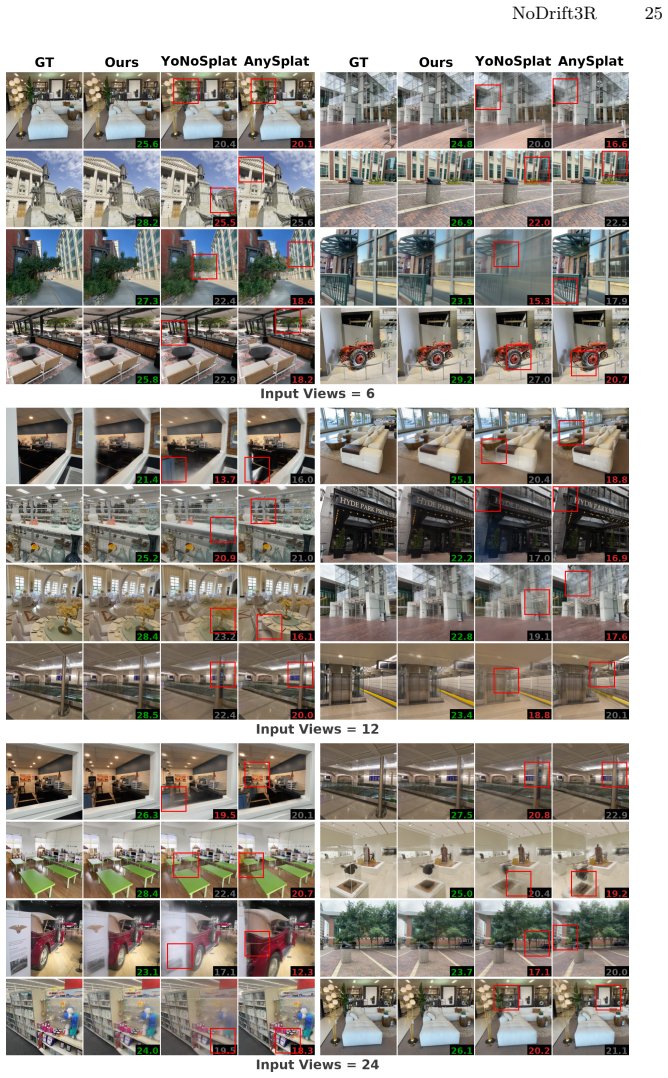
Ziwen, C., Tan, H., Zhang, K., Bi, S., Luan, F., Hong, Y., Fuxin, L., Xu, Z.: Long- lrm: Long-sequence large reconstruction model for wide-coverage gaussian splats. In: Proceedings of the IEEE/CVF International Conference on Computer Vision. pp. 4349–4359 (2025) 5 Fig. 8: Pose drift impact on novel view synthesis under long input sequences. As the number ...
arXiv 2025
discussion (0)
Sign in with ORCID, Apple, or X to comment. Anyone can read and Pith papers without signing in.