REVIEW 4 major objections 5 minor 1 cited by
Chaotic-Integrable Transition for Disordered Orbital Hatsugai-Kohmoto Model
T0 review · 4 major / 5 minor · reviewed 2026-08-12 · deepseek-v4-flash
Pith's one-line read The disordered orbital Hatsugai-Kohmoto model transitions from integrable to chaotic as interaction disorder is turned on, and OTOC plateau values fail to distinguish the phases.
desk verdict Solid model-specific extension with a new HK phase diagram, but the OTOC-plateau claim is over-reached and the numerics are too under-sampled to support the transition boundary. read the letter →
The pith
A machine-rendered reading of the paper's core claim, the machinery that carries it, and where it could break.
The reading
What carries the argument
The control parameter is the variance ratio $\langle U^2\rangle/\langle t_h^2\rangle$, comparing the disorder strength of the four-point interaction to that of the two-point hopping. The diagnostic machinery has three pieces: the adjacent gap ratio (a level-spacing statistic whose average distinguishes Poisson, about 0.386, from GOE, about 0.536), the spectral form factor (the squared Fourier transform of the energy-level density, whose ramp signals long-range level repulsion), and the late-time plateau of the out-of-time-order correlator (the saturation value of a squared commutator of Heisenberg-picture operators).
What would settle it
Recompute the adjacent-gap-ratio phase diagram for 12- and 16-orbital systems with hundreds of disorder realizations; the central claim would be refuted if the GOE threshold moves systematically away from $\langle U^2\rangle/\langle t_h^2\rangle \approx 0.33$, or if the OTOC plateau in SYK4 becomes temperature-dependent as $N$ grows.
Extended reading notes
Core claim
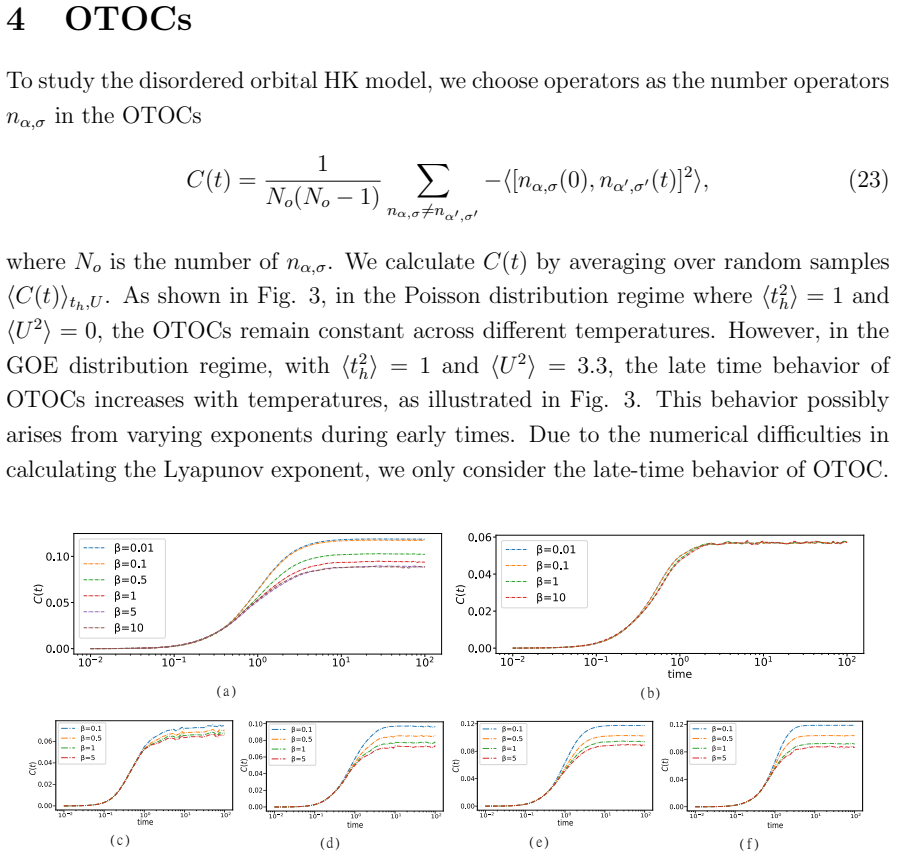
On its own terms, the paper's discovery is that the disordered orbital HK model exhibits a chaotic-integrable transition when the variance of the four-point interaction $U$ is turned on, while pure hopping disorder ($\langle U^2\rangle=0$) leaves the spectrum integrable. Quantitatively, for 10 orbitals with half-filling and zero total spin, the adjacent gap ratio reaches the GOE value for $\langle U^2\rangle/\langle t_h^2\rangle > 0.33$, and the spectral form factor shows a linear ramp consistent with random matrix theory. The paper's second, equally central claim is negative: comparing the HK model with SYK2, SYK4, and the disorder-free SYK model, the plateau value of the OTOC does not separate chaotic from integrable phases, and its temperature dependence is not a reliable many-body chaos indicator because it depends on regularization and system size.
Load-bearing premise
The load-bearing premise is that exact-diagonalization results for 6 to 10 orbitals, including cases with only one or five disorder samples, represent the thermodynamic limit, so the claimed transition boundary and OTOC temperature dependence are physical and not finite-size or sampling artifacts.
Editorial extensions
If this is right
- The disordered orbital HK model provides a solvable lattice setting where a non-zero variance of $U$ alone drives GOE level statistics and a dip-ramp-plateau spectral form factor.
- The phase diagram reports a transition boundary near $\langle U^2\rangle/\langle t_h^2\rangle \approx 0.33$ for the 10-orbital system, with the integrable regime shrinking as the orbital number grows.
- Because the SFF ramp appears only in the GOE regime, the spectral form factor can serve as a consistency check for the adjacent-gap-ratio phase diagram, but not as a standalone diagnostic, since disorder can mimic its shape.
- The OTOC plateau comparisons imply that studies using late-time OTOC saturation to label systems as chaotic should be re-examined.
Reading between the lines
- The paper leaves implicit a sharper formulation of its negative result: the OTOC plateau may track global conserved charges or regularization rather than integrability, since the HK model conserves charge while the Majorana SYK models conserve parity; comparing HK with a charge-conserving complex-fermion SYK model would test this.
- A practical diagnostic suggested by the contrast is to pair the adjacent gap ratio with the connected spectral form factor, because the SFF shape alone can mimic chaos in disordered integrable systems.
- The 10-orbital threshold at 0.33 comes from only five disorder samples and no scaling analysis, so an independent finite-size study is the natural next step before quoting the boundary as universal.
Signed reviews
Editorial analysis
A structured set of objections, weighed in public.
Referee Report
Summary. The manuscript studies the disordered orbital Hatsugai-Kohmoto (HK) model and its chaotic-integrable transition using the adjacent gap ratio, the spectral form factor (SFF), and out-of-time-order correlators (OTOCs). The authors report GOE level statistics when the interaction-disorder variance exceeds roughly one-third of the hopping variance, a dip-ramp-plateau SFF in the chaotic regime, and a phase diagram across 6, 8, and 10 orbitals. They then compare late-time OTOC plateaus of the HK model, SYK2, SYK4, and a disorder-free SYK model, concluding that OTOC plateau values do not effectively differentiate integrable from chaotic phases, and that the HK model's plateau is regularization dependent.
Significance. The paper proposes an interesting connection between the orbital HK model and SYK-type models and makes a falsifiable negative claim about OTOC plateau values as a chaos diagnostic. If the numerical results were supported by converged statistics, the comparison across SYK variants would be a useful contribution. The main strength is the clear formulation of a testable question; the main weakness is that the central numerical claims rest on very few disorder samples and no error bars or finite-size scaling, so the conclusions are not yet quantitatively established.
major comments (4)
- [§3.1, Fig. 1(c)] The phase diagram is constructed from 5 random samples for 10 orbitals, 100 samples for 8 orbitals, and no error bars are reported. Since the sample-to-sample spread of the mean adjacent gap ratio is of order 0.1, the standard error with 5 samples is about 0.05, which is one-third of the separation between the Poisson value (0.386) and the GOE value (0.536). The claimed transition at ⟨U²⟩/⟨t_h²⟩ > 0.33 is therefore not statistically distinguishable from a smooth crossover. Please provide error bars, a convergence check with increasing sample number, and a finite-size scaling analysis before drawing the phase boundary.
- [§3.2, Fig. 2(c)-(d)] The SFF 'linear ramp' in the 10-orbital case is based on only 5 random samples. No error bars or comparison with statistical fluctuations of the SFF are provided, so the support for GOE behavior from the SFF is not quantitative. The statement that the ramp appears 'with large orbitals considered' is also not backed by a systematic size scaling.
- [§4, Fig. 3(f)] The claim that 'the system size does not affect the temperature-dependent late-time behavior of OTOCs' is based on a single random sample at 8 orbitals. A one-sample result carries no statistical uncertainty and cannot support a size-independence claim. Please provide multiple samples, error bars, and a proper finite-size analysis for the OTOC plateau values.
- [§3.1] The text notes that 'the integrable regime tends to vanish' as the number of orbitals increases, but no extrapolation to the thermodynamic limit is supplied. Without such an analysis, the existence of a genuine chaotic-integrable transition, rather than a finite-size crossover, is not established. This concern is amplified because the phase boundary at 0.33 is read from the largest system with the fewest samples.
minor comments (5)
- [§1] In the first paragraph, 'Hatsugai and Komohto' should be 'Hatsugai and Kohmoto.'
- [Table 1] 'Multi-channel Kodon model' should be 'multi-channel Kondo model.'
- [§4] The disorder-free SYK model is cited as Ref. [21], but that reference is 'Correlated disorder in the SYK2 model'; the relevant paper on the disorder-free SYK model appears to be Ref. [24], and the citation should be corrected.
- [Fig. 3] The caption does not specify whether panels (c)-(f) are for the GOE or Poisson parameter regime; without this information, the size-independence claim is difficult to interpret.
- [Eq. (23)] The thermal expectation value in Eq. (23) is not explicitly defined; the angle brackets and the dependence on β should be stated.
Circularity Check
No significant circularity: the diagnostics are computed independently and the self-citations are not load-bearing.
full rationale
The paper's central results are obtained by direct exact diagonalization of the disordered orbital HK model: the adjacent-gap-ratio phase diagram (Sec. 3.1), the spectral form factor (Sec. 3.2), and the OTOC plateaus (Sec. 4) are all computed observables, not fitted parameters. The chaotic/integrable labels are assigned via the adjacent gap ratio (⟨r̃⟩ ≈ 0.536 for GOE, ≈ 0.386 for Poisson), and the OTOC and SFF behaviors are then measured independently; the agreement between these diagnostics is a cross-check, not a definitional identity. The comparison across SYK2, SYK4, and disorder-free SYK models is supported both by independent references ([11], [24]) and by the authors' own calculations shown in Fig. 4, so the citations to the authors' earlier papers ([20], [21]) are not load-bearing. The statements that randomness can produce dip-ramp-plateau SFF shapes in integrable systems are also backed by the paper's own Fig. 2. No equation is defined in terms of the quantity it claims to predict, and no fitted input is later called a prediction. The small number of disorder samples and the absence of finite-size scaling in the 10-orbital and 8-orbital results are statistical robustness concerns, not circularity; they do not make any step equivalent to its input by construction.
Assumptions & free parameters
free parameters (2)
- Interaction disorder variance ⟨U²⟩ =
0 to 4 (3.3 used for the GOE point)
- GOE/Poisson transition ratio =
≈0.33 for 10 orbitals
assumptions (5)
- domain assumption The disordered orbital HK model in position space is analogous to the SYK2+SYK4 model (Eq. (9) vs Eq. (11)).
- domain assumption The Gaussian disorder ensembles for hopping and interaction variances are the appropriate analog of SYK disorder.
- standard math Standard RMT predictions (Poisson and GOE gap ratio distributions, dip-ramp-plateau SFF) apply to this finite fermionic system at half-filling and zero total spin without further symmetry decomposition.
- domain assumption The number-operator OTOC in the HK model can be compared directly with Majorana-operator OTOCs in SYK models.
- domain assumption The thermodynamic limit behavior can be inferred from N_orb = 6, 8, 10 without finite-size scaling.
Cite this review
Pith. "Pith review of Chaotic-Integrable Transition for Disordered Orbital Hatsugai-Kohmoto Model." pith.science (2026). https://pith.science/paper/JF4IU7LF
@misc{pith2026241108496,
  author       = {Pith},
  title        = {Pith review of: Chaotic-Integrable Transition for Disordered Orbital Hatsugai-Kohmoto Model},
  year         = {2026},
  howpublished = {\url{https://pith.science/paper/JF4IU7LF}},
  note         = {Machine review of arXiv:2411.08496}
}
read the original abstract
We have drawn connections between the Sachdev-Ye-Kitaev model and the multi-orbit Hatsugai-Kohmoto model, emphasizing their similarities and differences regarding chaotic behaviors. The features of the spectral form factor, such as the dip-ramp-plateau structure and the adjacent gap ratio, indicate chaos in the disordered orbital Hatsugai-Kohmoto model. One significant conclusion is that the plateau value of the out-of-time-order correlator, whether in the Hatsugai-Kohmoto model, Sachdev-Ye-Kitaev model with two- or four-body interactions, or a disorder-free Sachdev-Ye-Kitaev model, does not effectively differentiate between integrable and chaotic phases in many-body systems. This observation suggests a limitation in using out-of-time-order correlator plateau values as a diagnostic tool for chaos. Our exploration of these ideas provides a deeper understanding of how chaos arises in non-Fermi liquid systems and the tools we use to study it. It opens the door to further questions, particularly about whether there are more effective ways to distinguish between chaotic and integrable phases in these complex systems.
Figures


Figures from the paper (2 more)


Forward citations
Cited by 1 Pith paper
-
Topic Review: Hatsugai-Kohmoto models: Exactly solvable playground for Mottness and Non-Fermi Liquid
A pedagogical review of the exactly solvable Hatsugai-Kohmoto model and its non-Fermi liquid and Mott insulating phases.
Reference graph
Works this paper leans on
-
[1]
A simple model of quantum holography. - 2015,
A. Kitaev, “A simple model of quantum holography. - 2015,” Talks at KITP, April 7 and May 27
work page 2015
-
[2]
The Spectrum in the Sachdev-Ye-Kitaev Model,
J. Polchinski and V. Rosenhaus, “The Spectrum in the Sachdev-Ye-Kitaev Model,” JHEP 04, 001 (2016) doi:10.1007/JHEP04(2016)001 [arXiv:1601.06768 [hep-th]]
arXiv 2016
-
[3]
Spectral and thermodynamic properties of the Sachdev-Ye-Kitaev model,
A. M. Garc ´ ıa-Garc ´ ıa and J. J. M. Verbaarschot, “Spectral and thermodynamic properties of the Sachdev-Ye-Kitaev model,” Phys. Rev. D 94, no.12, 126010 (2016) doi:10.1103/PhysRevD.94.126010 [arXiv:1610.03816 [hep-th]]
arXiv 2016
-
[4]
Black Holes and Random Matrices,
J. S. Cotler, G. Gur-Ari, M. Hanada, J. Polchinski, P. Saad, S. H. Shenker, D. Stan- ford, A. Streicher and M. Tezuka, “Black Holes and Random Matrices,” JHEP 05, 118 (2017) [erratum: JHEP 09, 002 (2018)] doi:10.1007/JHEP05(2017)118 [arXiv:1611.04650 [hep-th]]
arXiv 2017
-
[5]
Fast Scrambling at the Boundary,
A. Larzul, A. M. Sengupta, A. Georges and M. Schir` o, “Fast Scrambling at the Boundary,” [arXiv:2407.13617 [cond-mat.str-el]]
-
[6]
Ground state stability, symmetry, and degeneracy in Mott insulators with long range interactions
D. Manning-Coe and B. Bradlyn, “Ground state stability, symmetry, and degen- eracy in Mott insulators with long-range interactions,” Phys. Rev. B 108, no.16, 165136 (2023) doi:10.1103/PhysRevB.108.165136 [arXiv:2306.00221 [cond-mat.str- el]]. 15
work page Pith review arXiv 2023
-
[7]
Exactly Solvable Model of Correlated Lat- tice Electrons in Any Dimensions,
Y. Hatsugai, and M. Kohmoto, “Exactly Solvable Model of Correlated Lat- tice Electrons in Any Dimensions,” J. Phys. Soc. Jpn. 61, 2056-2069 (1992) doi:10.1143/JPSJ.61.2056
-
[8]
Topological Mott Insulator at Quarter Filling in the Interacting Haldane Model
P. Mai, B. E. Feldman and P. W. Phillips, “Topological Mott insulator at quarter filling in the interacting Haldane model,” Phys. Rev. Res. 5, no.1, 013162 (2023) doi:10.1103/PhysRevResearch.5.013162 [arXiv:2207.01638 [cond-mat.str-el]]
work page Pith review arXiv 2023
Show all 27 references
-
[9]
Semi-Classical Mechanics in Phase Space: A Study of Wigner’s Function,
M. V. Berry, “Semi-Classical Mechanics in Phase Space: A Study of Wigner’s Function,” Phil. Trans. Roy. Soc. Lond. A 287, 237-271 (1977) doi:10.1098/rsta.1977.0145
1977
-
[10]
Statistical theory of the energy levels of complex systems. I,
F. J. Dyson, “Statistical theory of the energy levels of complex systems. I,” J. Math. Phys. 3, 140-156 (1962) doi:10.1063/1.1703773
1962 doi
-
[11]
Chaotic- Integrable Transition in the Sachdev-Ye-Kitaev Model,
A. M. Garc ´ ıa-Garc ´ ıa, B. Loureiro, A. Romero-Berm´ udez and M. Tezuka, “Chaotic- Integrable Transition in the Sachdev-Ye-Kitaev Model,” Phys. Rev. Lett. 120, no.24, 241603 (2018) doi:10.1103/PhysRevLett.120.241603 [arXiv:1707.02197 [hep- th]]
2018 arXiv
-
[12]
Regular and irregular semiclassical wavefunctions,
M. V. Berry, “Regular and irregular semiclassical wavefunctions,” J. Phys. A 10, no.12, 2083 (1977) doi:10.1088/0305-4470/10/12/016
1977 doi
-
[13]
Semiclassical foun- dation of universality in quantum chaos,
S. Muller, S. Heusler, P. Braun, F. Haake and A. Altland, “Semiclassical foun- dation of universality in quantum chaos,” Phys. Rev. Lett. 93, 014103 (2004) doi:10.1103/PhysRevLett.93.014103 [arXiv:nlin/0401021 [nlin.CD]]
2004 arXiv
-
[14]
Characterization of chaotic quantum spectra and universality of level fluctuation laws,
O. Bohigas, M. J. Giannoni and C. Schmit, “Characterization of chaotic quantum spectra and universality of level fluctuation laws,” Phys. Rev. Lett. 52, 1-4 (1984) doi:10.1103/PhysRevLett.52.1 16
1984 doi
-
[15]
Distribution of the Ratio of Consecutive Level Spacings in Random Matrix Ensembles,
Y. Y. Atas, E. Bogomolny, O. Giraud and G. Roux, “Distribution of the Ratio of Consecutive Level Spacings in Random Matrix Ensembles,” Phys. Rev. Lett. 110, no.8, 084101 (2013) doi:10.1103/PhysRevLett.110.084101
2013 doi
-
[16]
False signals of chaos from quantum probes,
W. Kirkby, D. H. J. O’Dell and J. Mumford, “False signals of chaos from quantum probes,” doi:10.1103/PhysRevA.104.043308 [arXiv:2108.09391 [quant-ph]]
-
[17]
Spectral form factor in a random matrix theory,
E. Br´ ezin and S. Hikami, “Spectral form factor in a random matrix theory,” Phys. Rev. E 55, no.4, 4067 (1997) doi:10.1103/PhysRevE.55.4067
1997 doi
-
[18]
2D CFT Partition Functions at Late Times,
E. Dyer and G. Gur-Ari, “2D CFT Partition Functions at Late Times,” JHEP 08, 075 (2017) doi:10.1007/JHEP08(2017)075 [arXiv:1611.04592 [hep-th]]
2017 arXiv
-
[19]
Spectral form factor and semi-circle law in the time direction,
K. Okuyama, “Spectral form factor and semi-circle law in the time direction,” JHEP 02, 161 (2019) doi:10.1007/JHEP02(2019)161 [arXiv:1811.09988 [hep-th]]
2019 arXiv
-
[20]
Random- ness and Chaos in Qubit Models,
P. H. C. Lau, C. T. Ma, J. Murugan and M. Tezuka, “Random- ness and Chaos in Qubit Models,” Phys. Lett. B 795, 230-235 (2019) doi:10.1016/j.physletb.2019.05.052 [arXiv:1812.04770 [hep-th]]
2019 arXiv
-
[21]
Correlated disorder in the SYK2 model,
P. H. C. Lau, C. T. Ma, J. Murugan and M. Tezuka, “Correlated disorder in the SYK2 model,” J. Phys. A 54, no.9, 095401 (2021) doi:10.1088/1751-8121/abde77 [arXiv:2003.05401 [hep-th]]
2021 arXiv
-
[22]
Does scrambling equal chaos?,
T. Xu, T. Scaffidi and X. Cao, “Does scrambling equal chaos?,” Phys. Rev. Lett. 124, no.14, 140602 (2020) doi:10.1103/PhysRevLett.124.140602 [arXiv:1912.11063 [cond-mat.stat-mech]]
2020 arXiv
-
[23]
A bound on chaos,
J. Maldacena, S. H. Shenker and D. Stanford, “A bound on chaos,” JHEP 08, 106 (2016) doi:10.1007/JHEP08(2016)106 [arXiv:1503.01409 [hep-th]]
2016 arXiv
-
[24]
Disorder-free Sachdev-Ye-Kitaev models: Integra- bility and a precursor of chaos,
S. Ozaki and H. Katsura, “Disorder-free Sachdev-Ye-Kitaev models: Integra- bility and a precursor of chaos,” Phys. Rev. Res. 7, no.1, 013092 (2025) doi:10.1103/PhysRevResearch.7.013092 [arXiv:2402.13154 [cond-mat.str-el]]. 17
2025 arXiv
-
[25]
Refined quantum Lyapunov exponents from replica out- of-time-order correlators,
D. A. Trunin, “Refined quantum Lyapunov exponents from replica out- of-time-order correlators,” Phys. Rev. D 108, no.10, 105023 (2023) doi:10.1103/PhysRevD.108.105023 [arXiv:2308.02392 [hep-th]]
2023 arXiv
-
[26]
Detecting few-body quantum chaos: out-of-time ordered correlators at saturation,
D. Markovi´ c and M. ˇCubrovi´ c, “Detecting few-body quantum chaos: out-of-time ordered correlators at saturation,” JHEP 05, 023 (2022) doi:10.1007/JHEP05(2022)023 [arXiv:2202.09443 [hep-th]]
2022 arXiv
-
[27]
New Approach to Strong Correlation: Twisting Hubbard into the Orbital Hatsugai- Kohmoto Model,
P. Mai, J. Zhao, G. Tenkila, N. A. Hackner, D. Kush, D. Pan, P. W. Phillips “New Approach to Strong Correlation: Twisting Hubbard into the Orbital Hatsugai- Kohmoto Model,” [arXiv:2401.08746 [cond-mat.str-el]]. 18
Reviewed August 12, 2026 · model on record in the stance chip above.
Discussion (0). Continue with ORCID to comment.