Stochastic Survival near Swampland Boundaries
Pith reviewed 2026-06-27 19:17 UTC · model grok-4.3
The pith
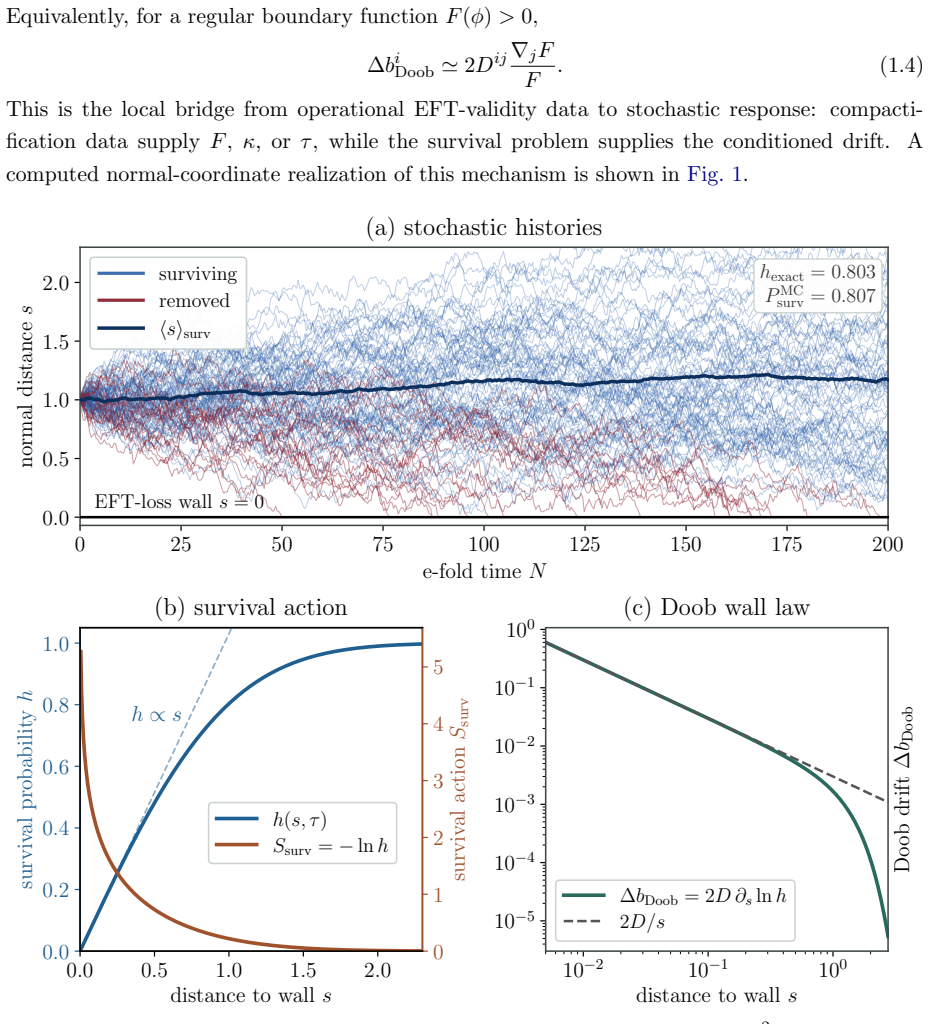
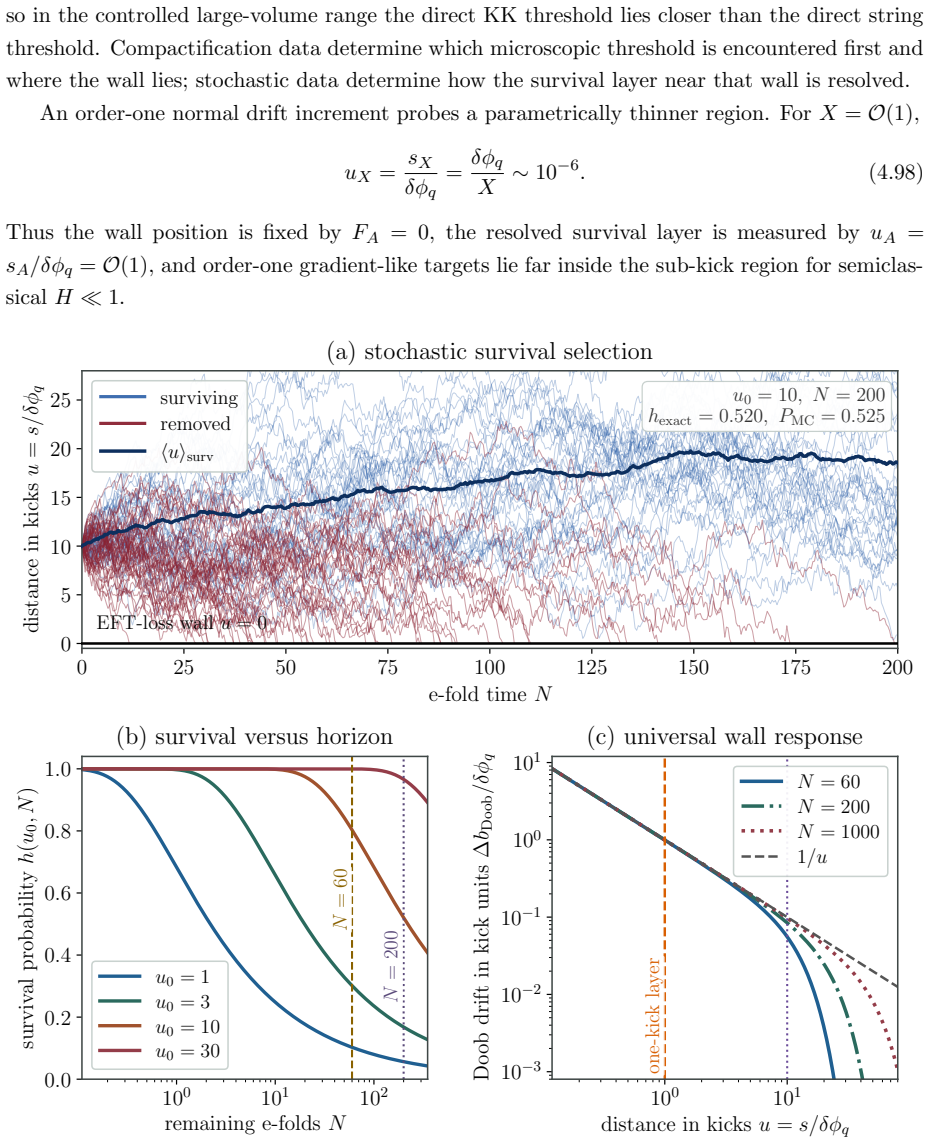
Near swampland boundaries, surviving cosmological histories acquire a universal inward drift fixed only by proper distance and normal diffusion.
A machine-rendered reading of the paper's core claim, the machinery that carries it, and where it could break.
Core claim
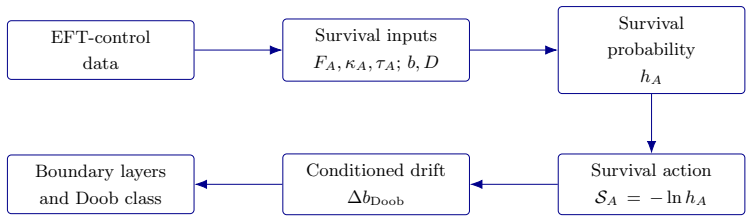
Near a regular hard boundary with nonzero normal diffusion, surviving histories develop an inward wall response fixed only by proper distance and normal diffusion. The Doob transform converts the logarithmic survival cost into the drift of the conditioned ensemble, allowing tower/species cutoffs, weak-coupling limits, string and Kaluza-Klein thresholds, and potential-based diagnostics to acquire stochastic boundary layers without becoming microscopic forces. The inverse map tests compatibility of a conditioned drift with a scalar operational loss surface and reconstructs its boundary-normal Doob class.
What carries the argument
The Doob transform applied to the survival probability, which converts the logarithmic survival cost directly into the drift of the conditioned ensemble.
If this is right
- Tower and species cutoffs acquire stochastic boundary layers.
- Weak-coupling limits, string thresholds, and Kaluza-Klein thresholds receive analogous treatment.
- Potential-based diagnostics can be reconstructed from observed conditioned drifts via the inverse map.
- The construction yields a stochastic survival interface between quantum-gravity control data and histories that remain on the landscape side.
Where Pith is reading between the lines
- The same universality might constrain which inflationary trajectories remain viable when moduli approach control-loss boundaries.
- The inverse map could be used to test whether a proposed effective drift is consistent with an underlying scalar loss surface.
- Extensions to soft degradation profiles or finite horizons would likely produce additional non-universal corrections to the conditioned dynamics.
Load-bearing premise
A well-defined stochastic generator and loss surfaces exist such that the Doob transform converts the logarithmic survival cost into the drift of the conditioned ensemble.
What would settle it
A direct calculation of the conditioned drift for an explicit moduli potential near a hard boundary that fails to reproduce the predicted dependence on proper distance and normal diffusion alone.
Figures
read the original abstract
Swampland and compactification data tell us where EFT control can fail; stochastic cosmology asks which histories survive near that edge. We turn this question into a survival problem for fluctuating moduli over cosmological time scales. Hard loss surfaces, soft degradation profiles, finite horizons, and a stochastic generator define a survival probability, whose logarithm is the survival action. The Doob transform then converts this logarithmic survival cost into the drift of the ensemble conditioned to remain on the controlled side. Near a regular hard boundary with nonzero normal diffusion, the answer is universal: surviving histories develop an inward wall response fixed only by proper distance and normal diffusion. In this way, tower/species cutoffs, weak-coupling limits, string and Kaluza-Klein thresholds, and potential-based diagnostics acquire stochastic boundary layers without becoming microscopic forces. The inverse map tests when a conditioned drift is compatible with a scalar operational loss surface and reconstructs its boundary-normal Doob class. The construction therefore gives a stochastic survival interface between quantum-gravity control data and the histories that remain on the landscape side of control.
Editorial analysis
A structured set of objections, weighed in public.
Referee Report
Summary. The manuscript develops a stochastic survival framework for fluctuating moduli near swampland boundaries in cosmology. Hard loss surfaces, a stochastic generator, and finite horizons define a survival probability whose logarithm is the survival action. The Doob transform converts this into the drift of the conditioned ensemble. The central claim is that near a regular hard boundary with nonzero normal diffusion the inward wall response is universal, fixed only by proper distance and the normal diffusion component. An inverse map reconstructs the boundary-normal Doob class from a conditioned drift.
Significance. If the derivations hold, the result supplies a universal stochastic boundary layer that lets tower/species cutoffs, weak-coupling limits, and potential-based diagnostics acquire effective responses without becoming microscopic forces. The inverse map provides a consistency test between conditioned drifts and operational loss surfaces. The application of the Doob transform to logarithmic survival cost in this swampland context is a clear strength.
major comments (1)
- [paragraph on survival probability and Doob transform] The universality claim (that the conditioned drift depends only on proper distance and normal diffusion, independent of tangential diffusion or loss-profile details) requires explicit verification that the stochastic generator L is time-homogeneous Markov, that the loss surface imposes an absorbing boundary condition with L^*S=0 on the appropriate domain, and that the Doob h-transform h=-log S produces b_h=b+2D abla log h with no residual time-dependent or measure factors from the cosmological volume element. The manuscript states the construction but supplies no explicit generator, no Feller-regularity check on the boundary, and no demonstration that the inward response is independent of tangential components or the potential-based loss profile. This verification is load-bearing for the central claim.
minor comments (1)
- Notation for the survival action and the reconstructed Doob class should be introduced with explicit equations rather than descriptive phrases alone.
Simulated Author's Rebuttal
We thank the referee for the careful reading and for highlighting the need for explicit verification of the assumptions underlying the universality claim. We address the major comment below and will incorporate the requested clarifications in a revised manuscript.
read point-by-point responses
-
Referee: The universality claim (that the conditioned drift depends only on proper distance and normal diffusion, independent of tangential diffusion or loss-profile details) requires explicit verification that the stochastic generator L is time-homogeneous Markov, that the loss surface imposes an absorbing boundary condition with L^*S=0 on the appropriate domain, and that the Doob h-transform h=-log S produces b_h=b+2D abla log h with no residual time-dependent or measure factors from the cosmological volume element. The manuscript states the construction but supplies no explicit generator, no Feller-regularity check on the boundary, and no demonstration that the inward response is independent of tangential components or the potential-based loss profile. This verification is load-bearing for the central claim.
Authors: We agree that an explicit verification of these technical points will strengthen the manuscript. The stochastic generator L is the time-homogeneous Markov generator given by the Laplace-Beltrami operator associated to the moduli-space metric (standard in the stochastic cosmology literature and time-independent by construction when loss surfaces carry no explicit time dependence). The absorbing boundary condition is imposed by S=0 on the loss surface, with L^*S=0 holding in the interior by the definition of the survival probability as the solution to the Kolmogorov backward equation. The Doob h-transform formula reduces to b_h = b + 2D abla log h with h = -log S precisely because the construction is performed in proper-distance coordinates on the moduli space; the cosmological volume element is already incorporated into the definition of the survival probability and does not generate additional residual factors. Independence from tangential diffusion and from the detailed shape of the loss profile follows from a local analysis near the boundary: only the normal component of the diffusion survives in the leading-order conditioned drift as the distance to the boundary tends to zero. In the revision we will add an explicit statement of L, a short Feller-regularity argument under the standard assumption that the boundary is smooth and the diffusion coefficients are locally Lipschitz, and a dedicated paragraph deriving the leading-order universality from the normal component alone. These additions address the load-bearing aspects of the claim without altering the central results. revision: yes
Circularity Check
No significant circularity in the derivation chain
full rationale
The paper defines a survival probability from a stochastic generator, loss surfaces, and boundary conditions, takes its logarithm as the survival action, and applies the Doob transform to obtain the conditioned drift. The claimed universality of the inward wall response (fixed only by proper distance and normal diffusion) is presented as a mathematical consequence of this standard construction near a regular hard boundary. No self-citations appear, no parameters are fitted to data and then relabeled as predictions, and no result reduces to its own inputs by definition. The derivation relies on established probabilistic tools (Doob h-transform for conditioned Markov processes) applied to the defined survival problem, remaining self-contained without circular reduction.
Axiom & Free-Parameter Ledger
axioms (1)
- domain assumption Existence of a stochastic generator for moduli fluctuations over cosmological time scales
invented entities (1)
-
survival action
no independent evidence
Reference graph
Works this paper leans on
-
[1]
Vafa,The String landscape and the swampland,hep-th/0509212
C. Vafa,The String landscape and the swampland,hep-th/0509212
-
[2]
Palti,The Swampland: Introduction and Review,Fortsch
E. Palti,The Swampland: Introduction and Review,Fortsch. Phys.67(2019) 1900037 [1903.06239]
Pith/arXiv arXiv 2019
-
[3]
T.D. Brennan, F. Carta and C. Vafa,The String Landscape, the Swampland, and the Missing Corner,PoST ASI2017(2017) 015 [1711.00864]
Pith/arXiv arXiv 2017
-
[4]
M. van Beest, J. Calder´ on-Infante, D. Mirfendereski and I. Valenzuela,Lectures on the Swampland Program in String Compactifications,Phys. Rept.989(2022) 1 [2102.01111]
arXiv 2022
- [5]
-
[6]
K. Lehnert,Hitchhiker’s guide to the swampland: The cosmologist’s handbook to the string-theoretical swampland programme,Fortsch. Phys.74(2026) [2509.02632]. 31
arXiv 2026
-
[7]
H. Ooguri and C. Vafa,On the Geometry of the String Landscape and the Swampland, Nucl. Phys. B766(2007) 21 [hep-th/0605264]
Pith/arXiv arXiv 2007
-
[8]
D. Klaewer and E. Palti,Super-Planckian Spatial Field Variations and Quantum Gravity, JHEP01(2017) 088 [1610.00010]
Pith/arXiv arXiv 2017
- [9]
-
[10]
S.-J. Lee, W. Lerche and T. Weigand,Emergent strings from infinite distance limits,JHEP 02(2022) 190 [1910.01135]
arXiv 2022
-
[11]
B. Heidenreich, M. Reece and T. Rudelius,Emergence of Weak Coupling at Large Distance in Quantum Gravity,Phys. Rev. Lett.121(2018) 051601 [1802.08698]
Pith/arXiv arXiv 2018
-
[12]
D. Harlow,Wormholes, Emergent Gauge Fields, and the Weak Gravity Conjecture,JHEP 01(2016) 122 [1510.07911]
Pith/arXiv arXiv 2016
-
[13]
Dvali,Black Holes and Large N Species Solution to the Hierarchy Problem,Fortsch
G. Dvali,Black Holes and Large N Species Solution to the Hierarchy Problem,Fortsch. Phys.58(2010) 528 [0706.2050]
Pith/arXiv arXiv 2010
-
[14]
G. Dvali and M. Redi,Black Hole Bound on the Number of Species and Quantum Gravity at LHC,Phys. Rev. D77(2008) 045027 [0710.4344]
Pith/arXiv arXiv 2008
- [15]
-
[16]
N. Arkani-Hamed, L. Motl, A. Nicolis and C. Vafa,The String landscape, black holes and gravity as the weakest force,JHEP06(2007) 060 [hep-th/0601001]
Pith/arXiv arXiv 2007
-
[17]
B. Heidenreich, M. Reece and T. Rudelius,Sharpening the Weak Gravity Conjecture with Dimensional Reduction,JHEP02(2016) 140 [1509.06374]
Pith/arXiv arXiv 2016
-
[18]
A. Bedroya and C. Vafa,Trans-Planckian Censorship and the Swampland,JHEP09 (2020) 123 [1909.11063]
arXiv 2020
-
[19]
A. Bedroya, R. Brandenberger, M. Loverde and C. Vafa,Trans-Planckian Censorship and Inflationary Cosmology,Phys. Rev. D101(2020) 103502 [1909.11106]
arXiv 2020
-
[20]
R. Brandenberger,Trans-Planckian Censorship Conjecture and Early Universe Cosmology, LHEP2021(2021) 198 [2102.09641]
arXiv 2021
-
[21]
S. C ¸ a˘ gan, O. Guleryuz and C.B. Senisik,Supersymmetric horizons at the edge of effective field theory,JHEP09(2025) 151 [2506.18107]
arXiv 2025
-
[22]
D. Andriot, N. Cribiori and D. Erkinger,The web of swampland conjectures and the TCC bound,JHEP07(2020) 162 [2004.00030]. 32
arXiv 2020
-
[23]
Starobinsky,Stochastic de sitter (inflationary) stage in the early universe,Lect
A.A. Starobinsky,Stochastic de sitter (inflationary) stage in the early universe,Lect. Notes Phys.246(1986) 107
1986
-
[24]
A.A. Starobinsky and J. Yokoyama,Equilibrium state of a selfinteracting scalar field in the De Sitter background,Phys. Rev. D50(1994) 6357 [astro-ph/9407016]
Pith/arXiv arXiv 1994
-
[25]
G.I. Rigopoulos, E.P.S. Shellard and B.J.W. van Tent,Non-linear perturbations in multiple-field inflation,Phys. Rev. D73(2006) 083521 [astro-ph/0504508]
Pith/arXiv arXiv 2006
-
[26]
V. Vennin and A.A. Starobinsky,Correlation Functions in Stochastic Inflation,Eur. Phys. J. C75(2015) 413 [1506.04732]
Pith/arXiv arXiv 2015
-
[27]
H. Assadullahi, H. Firouzjahi, M. Noorbala, V. Vennin and D. Wands,Multiple Fields in Stochastic Inflation,JCAP06(2016) 043 [1604.04502]
Pith/arXiv arXiv 2016
-
[28]
Guleryuz,Non-perpetual eternal inflation and the emergent de Sitter Swampland conjecture,Eur
O. Guleryuz,Non-perpetual eternal inflation and the emergent de Sitter Swampland conjecture,Eur. Phys. J. C84(2024) 883 [2401.17730]
arXiv 2024
-
[29]
Doob,Conditional brownian motion and the boundary limits of harmonic functions, Bulletin de la Soci´ et´ e Math´ ematique de France85(1957) 431
J. Doob,Conditional brownian motion and the boundary limits of harmonic functions, Bulletin de la Soci´ et´ e Math´ ematique de France85(1957) 431
1957
-
[30]
Risken,Fokker-planck equation, inThe Fokker-Planck Equation: Methods of Solution and Applications, (Berlin, Heidelberg), pp
H. Risken,Fokker-planck equation, inThe Fokker-Planck Equation: Methods of Solution and Applications, (Berlin, Heidelberg), pp. 63–95, Springer Berlin Heidelberg (1996), DOI
1996
-
[31]
Redner,A Guide to First-Passage Processes, Cambridge University Press, Cambridge (2001)
S. Redner,A Guide to First-Passage Processes, Cambridge University Press, Cambridge (2001)
2001
-
[32]
P. Collet, S. Mart´ ınez and J. San Mart´ ın,Quasi-Stationary Distributions: Markov Chains, Diffusions and Dynamical Systems, Springer (2013), 10.1007/978-3-642-33131-2
-
[33]
R. Chetrite and H. Touchette,Nonequilibrium Markov processes conditioned on large deviations,Ann. Henri Poincare16(2015) 2005 [1405.5157]
Pith/arXiv arXiv 2015
-
[34]
R. Chetrite and H. Touchette,Variational and optimal control representations of conditioned and driven processes,J. Stat. Mech.2015(2015) P12001 [1506.05291]
Pith/arXiv arXiv 2015
-
[35]
H. Touchette,The large deviation approach to statistical mechanics,Physics Reports478 (2009) 1 [0804.0327]
Pith/arXiv arXiv 2009
-
[36]
Pinsky,Positive Harmonic Functions and Diffusion, Cambridge Studies in Advanced Mathematics, Cambridge University Press (1995)
R.G. Pinsky,Positive Harmonic Functions and Diffusion, Cambridge Studies in Advanced Mathematics, Cambridge University Press (1995)
1995
-
[37]
C. Monthus and A. Mazzolo,Conditioned diffusion processes with an absorbing boundary condition for finite or infinite horizon,Phys. Rev. E106(2022) 044117 [2202.12047]
arXiv 2022
-
[38]
A. Castellano, A. Herr´ aez and L.E. Ib´ a˜ nez,IR/UV mixing, towers of species and swampland conjectures,JHEP08(2022) 217 [2112.10796]. 33
arXiv 2022
-
[39]
A. Bedroya, C. Vafa and D.H. Wu,Tale of three scales: The Planck, the species, and the black hole scales,Phys. Rev. D113(2026) 106011 [2403.18005]
arXiv 2026
-
[40]
S. Caron-Huot and Y.-Z. Li,Gravity and a universal cutoff for field theory,JHEP02 (2025) 115 [2408.06440]
arXiv 2025
-
[41]
Saraswat,Weak gravity conjecture and effective field theory,Phys
P. Saraswat,Weak gravity conjecture and effective field theory,Phys. Rev. D95(2017) 025013 [1608.06951]
Pith/arXiv arXiv 2017
-
[42]
Brahma,Trans-Planckian censorship conjecture from the swampland distance conjecture, Phys
S. Brahma,Trans-Planckian censorship conjecture from the swampland distance conjecture, Phys. Rev. D101(2020) 046013 [1910.12352]
arXiv 2020
-
[43]
G. Obied, H. Ooguri, L. Spodyneiko and C. Vafa,De Sitter Space and the Swampland, 1806.08362
-
[44]
P. Agrawal, G. Obied, P.J. Steinhardt and C. Vafa,On the Cosmological Implications of the String Swampland,Phys. Lett. B784(2018) 271 [1806.09718]
Pith/arXiv arXiv 2018
-
[45]
H. Murayama, M. Yamazaki and T.T. Yanagida,Do We Live in the Swampland?,JHEP 12(2018) 032 [1809.00478]
arXiv 2018
-
[46]
H. Ooguri, E. Palti, G. Shiu and C. Vafa,Distance and de Sitter Conjectures on the Swampland,Phys. Lett. B788(2019) 180 [1810.05506]
Pith/arXiv arXiv 2019
-
[47]
S.K. Garg and C. Krishnan,Bounds on Slow Roll and the de Sitter Swampland,JHEP11 (2019) 075 [1807.05193]
arXiv 2019
-
[48]
D. Andriot and C. Roupec,Further refining the de Sitter swampland conjecture,Fortsch. Phys.67(2019) 1800105 [1811.08889]
arXiv 2019
-
[49]
G. Dvali and S.N. Solodukhin,Black Hole Entropy and Gravity Cutoff,0806.3976
-
[50]
R. Brustein, G. Dvali and G. Veneziano,A Bound on the effective gravitational coupling from semiclassical black holes,JHEP10(2009) 085 [0907.5516]
Pith/arXiv arXiv 2009
-
[51]
J. Calder´ on-Infante, A. Castellano, A. Herr´ aez and L.E. Ib´ a˜ nez,Entropy bounds and the species scale distance conjecture,JHEP01(2024) 039 [2306.16450]
arXiv 2024
-
[52]
D. van de Heisteeg, C. Vafa and M. Wiesner,Bounds on Species Scale and the Distance Conjecture,Fortsch. Phys.71(2023) 2300143 [2303.13580]
arXiv 2023
-
[53]
Scalisi,Species Scale and Primordial Gravitational Waves,Fortsch
M. Scalisi,Species Scale and Primordial Gravitational Waves,Fortsch. Phys.72(2024) 2400033 [2401.09533]
arXiv 2024
-
[54]
M. Etheredge, B. Heidenreich, T. Rudelius, I. Ruiz and I. Valenzuela,Taxonomy of infinite distance limits,JHEP03(2025) 213 [2405.20332]. 34
arXiv 2025
-
[55]
S.B. Giddings, S. Kachru and J. Polchinski,Hierarchies from fluxes in string compactifications,Phys. Rev. D66(2002) 106006 [hep-th/0105097]
Pith/arXiv arXiv 2002
-
[56]
Grana,Flux compactifications in string theory: A Comprehensive review,Phys
M. Grana,Flux compactifications in string theory: A Comprehensive review,Phys. Rept. 423(2006) 91 [hep-th/0509003]
Pith/arXiv arXiv 2006
-
[57]
M.R. Douglas and S. Kachru,Flux compactification,Rev. Mod. Phys.79(2007) 733 [hep-th/0610102]
Pith/arXiv arXiv 2007
-
[58]
F. Denef, M.R. Douglas and S. Kachru,Physics of String Flux Compactifications,Ann. Rev. Nucl. Part. Sci.57(2007) 119 [hep-th/0701050]. [59]Planckcollaboration,Planck 2018 results. X. Constraints on inflation,Astron. Astrophys. 641(2020) A10 [1807.06211]
Pith/arXiv arXiv 2007
- [59]
-
[60]
A. Castellano, A. Font, A. Herraez and L.E. Ib´ a˜ nez,A gravitino distance conjecture,JHEP 08(2021) 092 [2104.10181]
arXiv 2021
-
[61]
N. Cribiori, D. Lust and M. Scalisi,The gravitino and the swampland,JHEP06(2021) 071 [2104.08288]
arXiv 2021
-
[62]
Bedroya,de Sitter Complementarity, TCC, and the Swampland,LHEP2021(2021) 187 [2010.09760]
A. Bedroya,de Sitter Complementarity, TCC, and the Swampland,LHEP2021(2021) 187 [2010.09760]
arXiv 2021
-
[63]
O. Guleryuz,On the Trans-Planckian Censorship Conjecture and the generalized non-minimal coupling,JCAP11(2021) 043 [2105.10571]. 35
arXiv 2021
discussion (0)
Sign in with ORCID, Apple, or X to comment. Anyone can read and Pith papers without signing in.