REVIEW 3 major objections 6 minor 45 references
ReFlow6D: Refraction-Guided Transparent Object 6D Pose Estimation via Intermediate Representation Learning
T0 review · 3 major / 6 minor · reviewed 2026-08-10 · deepseek-v4-flash
Pith's one-line read ReFlow6D claims that transparent-object 6D poses can be regressed accurately from a single RGB image by first predicting a refractive-intermediate representation — refractive flow, attenuation, mask, and surface regions — and that this…
desk verdict Solid empirical core, shaky invariance claim: worth a serious review, but the authors need to validate or soften the claim that refractive flow is environment-independent. read the letter →
The pith
A machine-rendered reading of the paper's core claim, the machinery that carries it, and where it could break.
The reading
What carries the argument
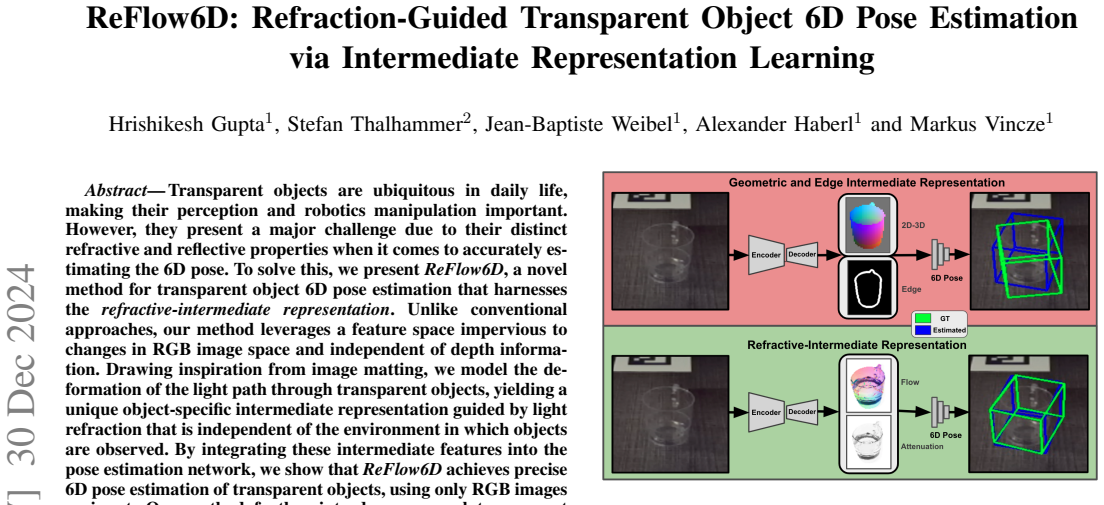
The central object is the refractive-intermediate representation: for each detected object, a stack of four predicted maps — a visibility mask, a surface-region attention map, refractive flow, and attenuation. Refractive flow and attenuation are the load-bearing pair, imported from transparent-object matting; they encode the deformation and dimming of light passing through the object and are meant to be a unique, environment-independent signature of the object. The Patch-PnP module consumes the concatenated maps and directly regresses the 6D pose. A transparent-object compositing loss uses the matting equation to require that the predicted flow and attenuation, when applied to a random background, reproduce a physically plausible composite image, which sharpens the intermediate features during training.
What would settle it
Keep an object's pose fixed and photograph or render it against a textured background at several known distances; if the refractive flow field changes with background distance by more than a small tolerance, the environment-invariance premise fails. A second check is to train only with refractive index 1.5 and test on objects with clearly different indices, observing whether ADD(-S) or average recall drops sharply.
Extended reading notes
Core claim
The core discovery, on the paper's own terms, is that refractive flow and attenuation carry pose-relevant information that geometric correspondence maps and edge maps do not capture well for transparent objects. Refractive flow is the per-pixel displacement of the background caused by the object's bending of light; attenuation is the per-pixel reduction in light intensity. Because both depend only on the object's shape and index of refraction, the paper argues they form an environment-independent matte. ReFlow6D predicts this matte plus the object mask and symmetry-aware surface-region maps with a modified regression network, concatenates them, and uses Patch-PnP to output the 6D pose. It adds a compositing loss that checks whether the predicted matte correctly re-overlays the object on random backgrounds, and the ablations show this supervision and the refractive flow itself are the main contributors to the accuracy gain.
Load-bearing premise
The load-bearing premise is that an object's refractive flow and attenuation are unique, environment-independent properties; if background distance or the object's actual refractive index changes the measured displacement, the learned representation will not transfer as assumed.
Editorial extensions
If this is right
- Transparent-object pose estimation can work with monocular RGB only, removing the need for depth sensors that produce unreliable measurements on non-Lambertian surfaces.
- Because the intermediate representation is tied to object geometry and refractive index rather than to image appearance, the method should generalize to unseen backgrounds and illumination conditions.
- Symmetry-aware surface-region maps let the same pipeline handle both symmetric and asymmetric transparent objects without special-case code.
- The compositing loss is a supervision signal that improves pose accuracy without requiring extra labels beyond the rendered training data.
- The reported robot grasping success indicates the pose accuracy transfers from synthetic training images to physical scenes with changed tables, textures, and lighting.
Reading between the lines
- A natural test of the environmental-invariance premise is to render the same object at different background distances: refractive displacement scales with that distance, so if pose accuracy degrades when the distance range changes, the representation is less invariant than claimed.
- The fixed index of refraction of 1.5 suggests the model may need retraining or additional conditioning before it transfers to objects made of different glass or plastic; extending to per-object or estimated refractive index is a direct next step.
- The same matte-style intermediate target could be investigated for other appearance-unstable materials such as polished metal or wet surfaces, where RGB features also vary strongly with the environment.
Editorial analysis
A structured set of objections, weighed in public.
Referee Report
Summary. The paper presents ReFlow6D, a monocular RGB method for instance-level 6D pose estimation of transparent objects. The core idea is to augment the GDR-Net/Patch-PnP pipeline with a refractive-intermediate representation consisting of refractive flow, attenuation, an object mask, and surface-region attention maps. The refractive flow and attenuation (RFA) are predicted by a modified GDR-Net feature regression network, and a transparent-object compositing loss is added to refine these intermediate features. The authors report state-of-the-art results on the TOD and Trans6D-32K benchmarks and demonstrate real-world robot grasping with an 82.2% mean success rate. The central theoretical claim is that RFA is a unique, environment-independent property of a transparent object, determined only by its geometry and index of refraction.
Significance. If the environment-invariance of RFA were established, this would be a valuable contribution to transparent-object pose estimation, addressing a real bottleneck for RGB-only methods and robotic manipulation. The paper is commendable for releasing code, evaluating on standard benchmarks, and including physical robot experiments. The ablation studies broadly support the usefulness of the proposed components, and the compositing-loss supervision is an original idea. However, the main theoretical premise is currently an untested physical assumption, and one of the key ablations is confounded, so the significance of the claimed contribution is contingent on the authors addressing these points.
major comments (3)
- [Section III-A] The central claim that refractive flow and attenuation (RFA) is a unique, environment-independent property is not physically established. In Section III-A, refractive flow is defined as the offset between a foreground pixel and its corresponding background pixel after refraction. For a finite background, this offset depends on the distance from the object to the background plane and on the background geometry, because the incident ray direction from a background point changes with that distance. The paper renders RFA labels with a fixed gray-code calibration setup (Section IV-A) and fixes the index of refraction at 1.5 for all objects, but it reports no experiment that varies background distance or composition to test invariance. The abstract and introduction rely on this invariance to claim a 'feature space impervious to changes in RGB image space,' so the contribution is conditional on an untested assumption. The authors should either provide a derivation of invariance under explicit assumptions (e.g., background at infinity) or empirically demonstrate that predicted RFA (or final pose accuracy) is stable when background distance and background content are varied.
- [Section IV-D, Table III] The 'w/o Flow' ablation is confounded. In Table III, the 'w/o Flow' row removes both Flow and the compositing loss Lcomp (the Lcomp column is marked ×), while the 'w/o Compositing loss' row shows that removing Lcomp alone already costs 2.7 points (from 93.2 to 90.5). The drop to 80.3 in the 'w/o Flow' row therefore cannot be attributed to the removal of Flow alone; it also includes the effect of removing Lcomp. The text states that the drop is 'primarily attributed to the crucial role played by refractive flow features,' but this conclusion is not supported by the reported ablation. A clean ablation that removes only the Flow channels while keeping Lcomp (or some other supervision that does not require Flow) is necessary to support the claim that Flow is the most important RFA component.
- [Section IV-C, Table I] The comparison with KeyPose on TOD should be clarified and strengthened. The paper excludes Ball0 and Bottle2 due to missing or inaccurate ground truth, and the reported KeyPose MAE mean of 10.4 appears to be recomputed over the 13 retained objects; if so, this is fair, but the text does not explicitly state that the KeyPose numbers are recomputed on the same subset rather than taken from the KeyPose paper. Please state the exact protocol. In addition, no error bars, confidence intervals, or significance tests are reported for any comparison or ablation. Given that some differences are small (e.g., 90.4 vs 87.5 mean AR on TOD; 93.0 vs 93.2 in the 'w/o Rho' ablation), the evidence would be more convincing if repeated runs or statistical measures were provided.
minor comments (6)
- [Section III-B, Eq. (8)] The compositing loss in Eq. (8) is written as Lcomp = || ˆMVIS · ˆC − ˜MVIS. ˜C|| without specifying the norm used (e.g., L1 or L2) and with an ambiguous dot notation between the mask and the compositing result. Please define all notations explicitly and uniformly (e.g., element-wise multiplication indicated by ⊙).
- [Section IV-A and Abstract] The dataset name is inconsistent across the paper: the abstract uses 'Trans32K-6D,' while the main text uses 'Trans6D-32K.' Please standardize the name throughout.
- [Section IV-C, Table I] Please clarify whether the per-object KeyPose MAE and AR values are recomputed from the authors' own inference using the trained KeyPose models, or taken from the original KeyPose publication. This is important for assessing the fairness of the comparison after excluding Ball0 and Bottle2.
- [Section IV-D] The statement that the Patch-PnP network 'fails to converge when trained solely with MSRA' is unusual and would benefit from more detail; please provide loss curves or additional explanation, since the behavior is not self-evident and the reader cannot otherwise assess this claim.
- [Section V] The grasp success rates are based on only 10 grasps per object per scenario (30 per object). Please state the sample size explicitly and provide confidence intervals, as 10-trial percentages have wide uncertainty.
- [Section IV-B] There are minor typos, such as 'T OD datasetand' (missing space) and inconsistent figure/table references ('Table 1' vs 'Table I'). A careful proofread is recommended.
Circularity Check
No circularity found: RFA features are supervised from rendered groundtruth, pose is supervised directly, and evaluation is external; the invariance claim is a physical assumption, not a circular reduction.
full rationale
ReFlow6D's derivation chain is self-contained against external benchmarks. The refractive flow and attenuation (RFA) targets are rendered in BlenderProc from CAD models and groundtruth poses using TOM-Net's gray-code calibration with IOR fixed at 1.5; they are not fitted to the pose metric. The pose branch is supervised by dataset pose groundtruth (rotation, center, depth) independently of the RFA predictions, and the compositing loss is an auxiliary self-supervision on RFA quality, not a pose label. Evaluation is on external benchmarks (TOD, Trans6D-32K) and real-robot grasps. The only self-citations (PyraPose, Grasping the Inconspicuous) are ordinary method and related-work citations and do not carry the central claim. The Sec. III-A statement that RFA is environment-independent is an unvalidated physical assumption about background-distance dependence; it may be a correctness or generalization risk, but it is not a circular step because the representation is not defined in terms of the pose output nor fitted to it. No equation reduces prediction to input by construction.
Assumptions & free parameters
free parameters (1)
- index of refraction (IOR) =
1.5
assumptions (4)
- domain assumption RFA (refractive flow and attenuation) is a unique property of a transparent object independent of the environment.
- domain assumption A single RGB image contains enough information to predict RFA without a known background.
- domain assumption Synthetic RFA labels transfer to the real world well enough to improve pose estimation.
- standard math Patch-PnP from GDR-Net can directly regress pose from the concatenated intermediate features.
Cite this review
Pith. "Pith review of ReFlow6D: Refraction-Guided Transparent Object 6D Pose Estimation via Intermediate Representation Learning." pith.science (2026). https://pith.science/paper/JFTQ2C66
@misc{pith2026241220830,
  author       = {Pith},
  title        = {Pith review of: ReFlow6D: Refraction-Guided Transparent Object 6D Pose Estimation via Intermediate Representation Learning},
  year         = {2026},
  howpublished = {\url{https://pith.science/paper/JFTQ2C66}},
  note         = {Machine review of arXiv:2412.20830}
}
read the original abstract
Transparent objects are ubiquitous in daily life, making their perception and robotics manipulation important. However, they present a major challenge due to their distinct refractive and reflective properties when it comes to accurately estimating the 6D pose. To solve this, we present ReFlow6D, a novel method for transparent object 6D pose estimation that harnesses the refractive-intermediate representation. Unlike conventional approaches, our method leverages a feature space impervious to changes in RGB image space and independent of depth information. Drawing inspiration from image matting, we model the deformation of the light path through transparent objects, yielding a unique object-specific intermediate representation guided by light refraction that is independent of the environment in which objects are observed. By integrating these intermediate features into the pose estimation network, we show that ReFlow6D achieves precise 6D pose estimation of transparent objects, using only RGB images as input. Our method further introduces a novel transparent object compositing loss, fostering the generation of superior refractive-intermediate features. Empirical evaluations show that our approach significantly outperforms state-of-the-art methods on TOD and Trans32K-6D datasets. Robot grasping experiments further demonstrate that ReFlow6D's pose estimation accuracy effectively translates to real-world robotics task. The source code is available at: https://github.com/StoicGilgamesh/ReFlow6D and https://github.com/StoicGilgamesh/matting_rendering.
Figures


Figures from the paper (2 more)


Reference graph
Works this paper leans on
-
[1]
Pyrapose: Feature pyramids for fast and accurate object pose estimation under domain shift,
S. Thalhammer, M. Leitner, T. Patten, and M. Vincze, “Pyrapose: Feature pyramids for fast and accurate object pose estimation under domain shift,” in 2021 IEEE International Conference on Robotics and Automation (ICRA) . IEEE, pp. 13 909–13 915
work page 2021
-
[2]
Learning to assemble: Esti- mating 6d poses for robotic object-object manipulation,
S. Stev ˇsi´c, S. Christen, and O. Hilliges, “Learning to assemble: Esti- mating 6d poses for robotic object-object manipulation,” IEEE Robotics and Automation Letters , vol. 5, no. 2, pp. 1159–1166, 2020
work page 2020
-
[3]
On evaluation of 6d object pose estimation,
T. Hoda ˇn, J. Matas, and ˇS. Obdrˇz´alek, “On evaluation of 6d object pose estimation,” in Computer Vision–ECCV 2016 Workshops: Amsterdam, The Netherlands, October 8-10 and 15-16, 2016, Proceedings, Part III
work page 2016
-
[4]
T-less: An rgb-d dataset for 6d pose estimation of texture-less objects,
T. Hodan, P. Haluza, ˇS. Obdr ˇz´alek, and et.al, “T-less: An rgb-d dataset for 6d pose estimation of texture-less objects,” in 2017 IEEE Winter Conference on Applications of Computer Vision (WACV) . IEEE, 2017, pp. 880–888
work page 2017
-
[5]
Pseudo-siamese graph matching network for textureless objects’6-d pose estimation,
C. Wu, L. Chen, Z. He, and J. Jiang, “Pseudo-siamese graph matching network for textureless objects’6-d pose estimation,” IEEE Transactions on Industrial Electronics , vol. 69, no. 3, pp. 2718–2727, 2021
work page 2021
-
[6]
Epos: Estimating 6d pose of objects with symmetries,
T. Hodan, D. Barath, and J. Matas, “Epos: Estimating 6d pose of objects with symmetries,” in Proceedings of the IEEE/CVF conference on computer vision and pattern recognition , 2020, pp. 11 703–11 712
work page 2020
-
[7]
Handling object symmetries in cnn-based pose estimation,
J. Richter-Klug and U. Frese, “Handling object symmetries in cnn-based pose estimation,” in IEEE International Conference on Robotics and Automation (ICRA) . IEEE, 2021, pp. 13 850–13 856
work page 2021
-
[8]
Pvnet: Pixel-wise voting network for 6dof pose estimation,
S. Peng, Y . Liu, and et.al, “Pvnet: Pixel-wise voting network for 6dof pose estimation,” in Proceedings of the IEEE/CVF Conference on Computer Vision and Pattern Recognition , 2019, pp. 4561–4570
work page 2019
Show all 45 references
-
[9]
Ghostpose: Multi-view pose estimation of transparent objects for robot hand grasping,
J. Chang, M. Kim, S. Kang, and et.al, “Ghostpose: Multi-view pose estimation of transparent objects for robot hand grasping,” in IEEE/RSJ International Conference on Intelligent Robots and Systems (IROS) . IEEE, 2021, pp. 5749–5755
2021
-
[10]
Pose estimation of rigid transparent objects in transparent clutter,
I. Lysenkov and V . Rabaud, “Pose estimation of rigid transparent objects in transparent clutter,” in IEEE International Conference on Robotics and Automation . IEEE, 2013, pp. 162–169
2013
-
[11]
Clear grasp: 3d shape estimation of transparent objects for manipulation,
S. Sajjan, M. Moore, and e. a. Pan, “Clear grasp: 3d shape estimation of transparent objects for manipulation,” in IEEE International Conference on Robotics and Automation (ICRA) . IEEE, 2020, pp. 3634–3642
2020
-
[12]
Clearpose: Large-scale transparent object dataset and benchmark,
X. Chen, H. Zhang, Z. Yu, A. Opipari, and O. Chadwicke Jenkins, “Clearpose: Large-scale transparent object dataset and benchmark,” in European Conference on Computer Vision . Springer, 2022, pp. 381– 396
2022
-
[13]
Rgb-d local implicit function for depth completion of transparent objects,
L. Zhu, A. Mousavian, Y . Xiang, and et.al, “Rgb-d local implicit function for depth completion of transparent objects,” in Proceedings of the IEEE/CVF Conference on Computer Vision and Pattern Recognition , 2021, pp. 4649–4658
2021
-
[14]
Springer, 2016, pp. 606–619
2016
-
[15]
Keypose: Multi-view 3d labeling and keypoint estimation for transparent objects,
X. Liu, R. Jonschkowski, A. Angelova, and K. Konolige, “Keypose: Multi-view 3d labeling and keypoint estimation for transparent objects,” in Proceedings of the IEEE/CVF conference on computer vision and pattern recognition, 2020, pp. 11 602–11 610
2020
-
[16]
Gdr-net: Geometry- guided direct regression network for monocular 6d object pose estima- tion,
G. Wang, F. Manhardt, F. Tombari, and X. Ji, “Gdr-net: Geometry- guided direct regression network for monocular 6d object pose estima- tion,” in Proceedings of the IEEE/CVF Conference on Computer Vision and Pattern Recognition , 2021, pp. 16 611–16 621
2021
-
[17]
Bop: Benchmark for 6d object pose estimation,
T. Hodan, F. Michel, E. Brachmann, and et.al, “Bop: Benchmark for 6d object pose estimation,” in Proceedings of the European conference on computer vision (ECCV) , 2018, pp. 19–34
2018
-
[18]
Tgf-net: Sim2real transparent object 6d pose estimation based on geometric fusion,
H. Yu, S. Li, H. Liu, and et.al, “Tgf-net: Sim2real transparent object 6d pose estimation based on geometric fusion,” IEEE Robotics and Automation Letters, 2023
2023
-
[19]
Tom-net: Learning transparent object matting from a single image,
G. Chen, K. Han, and K.-Y . K. Wong, “Tom-net: Learning transparent object matting from a single image,” in Proceedings of the IEEE conference on computer vision and pattern recognition , 2018, pp. 9233– 9241
2018
-
[20]
Environ- ment matting and compositing,
D. E. Zongker, D. M. Werner, B. Curless, and D. H. Salesin, “Environ- ment matting and compositing,” in Seminal Graphics Papers: Pushing the Boundaries, V olume 2 , 2023, pp. 537–546
2023
-
[21]
Transparent object detection using regions with convolutional neural network,
P.-J. Lai and C.-S. Fuh, “Transparent object detection using regions with convolutional neural network,” in IPPR conference on computer vision, graphics, and image processing , vol. 2, 2015
2015
-
[22]
Segmenting transparent objects in the wild,
E. Xie, W. Wang, W. Wang, M. Ding, C. Shen, and P. Luo, “Segmenting transparent objects in the wild,” in Computer Vision–ECCV 2020: 16th European Conference, Glasgow, UK, August 23–28, 2020, Proceedings, Part XIII 16 . Springer, 2020, pp. 696–711
2020
-
[23]
Deep polarization cues for transparent object segmentation,
A. Kalra, V . Taamazyan, S. K. Rao, and et.al, “Deep polarization cues for transparent object segmentation,” in Proceedings of the IEEE/CVF Conference on Computer Vision and Pattern Recognition , 2020, pp. 8602–8611
2020
-
[24]
Dex-nerf: Using a neural radiance field to grasp transparent objects,
J. Ichnowski, Y . Avigal, J. Kerr, and K. Goldberg, “Dex-nerf: Using a neural radiance field to grasp transparent objects,” arXiv preprint arXiv:2110.14217, 2021
2021 arXiv
-
[25]
Densefusion: 6d object pose estimation by iterative dense fusion,
C. Wang, D. Xu, Y . Zhu, and et.al, “Densefusion: 6d object pose estimation by iterative dense fusion,” in Proceedings of the IEEE/CVF conference on computer vision and pattern recognition , 2019, pp. 3343– 3352
2019
-
[26]
Transnet: Category-level transparent object pose estimation,
H. Zhang, A. Opipari, and et.al, “Transnet: Category-level transparent object pose estimation,” in European Conference on Computer Vision . Springer, 2022, pp. 148–164
2022
-
[27]
Cdpn: Coordinates-based disentangled pose network for real-time rgb-based 6-dof object pose estimation,
Z. Li, G. Wang, and X. Ji, “Cdpn: Coordinates-based disentangled pose network for real-time rgb-based 6-dof object pose estimation,” in Proceedings of the IEEE/CVF International Conference on Computer Vision, 2019, pp. 7678–7687
2019
-
[28]
Environment matting exten- sions: Towards higher accuracy and real-time capture,
Y .-Y . Chuang, D. E. Zongker, and et.al, “Environment matting exten- sions: Towards higher accuracy and real-time capture,” in Proceedings of the 27th annual conference on Computer graphics and interactive techniques, 2000, pp. 121–130
2000
-
[29]
Fcos: Fully convolutional one- stage object detection,
Z. Tian, C. Shen, H. Chen, and T. He, “Fcos: Fully convolutional one- stage object detection,” in Proceedings of the IEEE/CVF international conference on computer vision , 2019, pp. 9627–9636
2019
-
[30]
Yolov3: An incremental improvement,
J. Redmon and A. Farhadi, “Yolov3: An incremental improvement,” arXiv preprint arXiv:1804.02767 , 2018
2018 arXiv
-
[31]
Zebrapose: Coarse to fine surface encoding for 6dof object pose estimation,
Y . Su, M. Saleh, T. Fetzer, and et.al, “Zebrapose: Coarse to fine surface encoding for 6dof object pose estimation,” in Proceedings of the IEEE/CVF Conference on Computer Vision and Pattern Recognition , 2022, pp. 6738–6748
2022
-
[32]
Microsoft COCO: common objects in context,
T. Lin, M. Maire, S. J. Belongie, and et.al, “Microsoft COCO: common objects in context,” CoRR, vol. abs/1405.0312, 2014. [Online]. Available: http://arxiv.org/abs/1405.0312
2014 arXiv
-
[33]
Pytorch: An imperative style, high-performance deep learning library,
A. Paszke, S. Gross, F. Massa, and et.al, “Pytorch: An imperative style, high-performance deep learning library,”Advances in neural information processing systems, vol. 32, 2019
2019
-
[34]
Bop challenge 2022 on detection, segmentation and pose estimation of specific rigid objects,
M. Sundermeyer, T. Hoda ˇn, and et.al, “Bop challenge 2022 on detection, segmentation and pose estimation of specific rigid objects,” in Pro- ceedings of the IEEE/CVF Conference on Computer Vision and Pattern Recognition, 2023, pp. 2785–2794
2022
-
[35]
On the variance of the adaptive learning rate and beyond,
L. Liu, H. Jiang, and et.al, “On the variance of the adaptive learning rate and beyond,” arXiv preprint arXiv:1908.03265 , 2019
1908 arXiv
-
[36]
Lookahead optimizer: k steps forward, 1 step back,
M. Zhang, J. Lucas, J. Ba, and G. E. Hinton, “Lookahead optimizer: k steps forward, 1 step back,” Advances in neural information processing systems, vol. 32, 2019
2019
-
[37]
Sgdr: Stochastic gradient descent with warm restarts,
I. Loshchilov and F. Hutter, “Sgdr: Stochastic gradient descent with warm restarts,” arXiv preprint arXiv:1608.03983 , 2016
2016 arXiv
-
[38]
Blenderproc2: A procedural pipeline for photorealistic rendering,
M. Denninger, D. Winkelbauer, and et.al, “Blenderproc2: A procedural pipeline for photorealistic rendering,” Journal of Open Source Software, vol. 8, no. 82, p. 4901, 2023. [Online]. Available: https://doi.org/10.21105/joss.04901
2023 doi
-
[39]
Generalized procrustes analysis,
J. C. Gower, “Generalized procrustes analysis,” Psychometrika, vol. 40, pp. 33–51, 1975
1975
-
[40]
Model based training, detection and pose estimation of texture-less 3d objects in heavily cluttered scenes,
S. Hinterstoisser, V . Lepetit, and et.al, “Model based training, detection and pose estimation of texture-less 3d objects in heavily cluttered scenes,” in Computer Vision–ACCV 2012: 11th Asian Conference on Computer Vision, Daejeon, Korea, November 5-9, 2012, Revised Se- lect...
2012
-
[41]
Bop challenge 2020 on 6d object localization,
T. Hoda ˇn, M. Sundermeyer, B. Drost, and et.al, “Bop challenge 2020 on 6d object localization,” in Computer Vision–ECCV 2020 Workshops: Glasgow, UK, August 23–28, 2020, Proceedings, Part II 16 . Springer, 2020, pp. 577–594
2020
-
[42]
Mvtrans: Multi-view perception of transparent objects,
Y . R. Wang, Y . Zhao, H. Xu, and et.al, “Mvtrans: Multi-view perception of transparent objects,” in 2023 IEEE International Conference on Robotics and Automation (ICRA) . IEEE, 2023, pp. 3771–3778
2023
-
[43]
B. O. Community, Blender - a 3D modelling and rendering package , Blender Foundation, Stichting Blender Foundation, Amsterdam, 2018. [Online]. Available: http://www.blender.org
2018
-
[44]
Development of the research platform of a domestic mobile manipulator utilized for interna- tional competition and field test,
T. Yamamoto, K. Terada, A. Ochiai, and et.al, “Development of the research platform of a domestic mobile manipulator utilized for interna- tional competition and field test,” in IEEE/RSJ International Conference on Intelligent Robots and Systems (IROS) . IEEE, 2018, pp. 7675–7682
2018
-
[45]
Grasping the inconspicuous,
H. Gupta, S. Thalhammer, M. Leitner, and M. Vincze, “Grasping the inconspicuous,” arXiv preprint arXiv:2211.08182 , 2022
2022 arXiv
Reviewed August 10, 2026 · model on record in the stance chip above.
Discussion (0). Continue with ORCID to comment.