REVIEW 4 major objections 5 minor 140 references
The Epistemic Politics of AI Anthropomorphism
T0 review · 4 major / 5 minor · reviewed 2026-08-06 · deepseek-v4-flash
Pith's one-line read The paper argues that institutional anti-anthropomorphism governance overrides users' epistemic authority without justification, treating sustained AI engagement as pathology and imposing costs that fall hardest on neurodivergent users and
desk verdict A well-built normative synthesis worth serious referee time, but its load-bearing empirical claims about a 'uniform frame' and 'disproportionate costs' are asserted from selected cases rather than established. read the letter →
The pith
A machine-rendered reading of the paper's core claim, the machinery that carries it, and where it could break.
The reading
What carries the argument
The central mechanism is the self-validating evidentiary loop: engagement is classified as abnormal, users self-censor or adapt, the resulting absence is cited as evidence that the engagement was unwarranted, and that evidence shapes design choices that reinforce the classification. The loop is powered by a reversal of the default presumption of user competence, converting user testimony into symptom. The paper also uses two conceptual distinctions as machinery: epistemic authority versus institutional advantage (from the philosophy of testimony), and the asymmetry of over-ascription versus under-ascription harms, which forces the question of whose costs a frame is designed to count.
What would settle it
A systematic audit of institutional outputs—platform disclaimers and context-reset prompts, mental-health chatbot protocols, companion-app safety documentation, and recent legislation—coded for whether they present relational or sustained AI engagement as pathology versus as one legitimate mode among others. If a substantial share of guidance explicitly validates relational engagement or weighs under-ascription harms, the claim of a uniform frame fails. A complementary test: longitudinal measurement of self-censorship and perceived epistemic standing among high-continuity users under current v
Extended reading notes
Core claim
The paper's central claim is that the dominant anthropomorphism frame in AI governance performs a covert epistemic override. It starts from a presumption of user competence and reverses it as a blanket condition: users who report relational, interpretive, or sustained engagement with AI are candidates for correction by default. Drawing on the philosophy of epistemic authority, the paper distinguishes legitimate authority—grounded in treating subjects as having prima facie sovereignty over their own experience, demonstrating sufficient grounds to displace it, and remaining open to correction—from institutional advantage, in which standing substitutes for grounds without acknowledgment. The fr
Load-bearing premise
The argument assumes the frame is empirically monolithic and dominant—that disclaimers, context resets, legislation, and design defaults transmit a uniform 'user error' message at scale, and that the resulting costs fall disproportionately on neurodivergent users, people in crisis, and others with non-normative engagement. If institutional guidance is heterogeneous, or the harm distribution differs, the equity critique and the self-validating loop lose their empirical footing
Editorial extensions
If this is right
- Anti-anthropomorphism measures—disclaimers, context resets, design defaults, and legislation—must be justified as interventions in users' cognitive environments, with the burden of proof on the institution imposing them.
- The costs of under-ascription (discounting engagement that was warranted) must be specified and weighed alongside over-ascription harms; a framework that ignores one direction has made an ethical commitment, not a neutral assessment.
- Observed usage patterns cannot be treated as independent evidence about what users prefer or what is normal, because the frame itself shapes the conditions under which those patterns are produced.
- Design trajectories that privilege brief transactional exchanges and penalize sustained dialogue are normative choices that foreclose modes of thinking that work for users whose cognition is non-normative; they are not neutral optimizations.
- Because institutions are both the actors performing the constraints and the adjudicators of whether the constraint is legitimate, the question of whether AI interaction constitutes cognitive extension or harmful dependency is currently bypassed, not answered.
Reading between the lines
- The uniformity premise is testable: a systematic content analysis of platform disclaimers, context-reset guidance, legislation, and clinical protocols could measure how consistently the 'user error' message is transmitted, and whether any institutional outputs explicitly validate relational engagement.
- The self-validating-loop account predicts that high-continuity users will show measurable self-censorship under current defaults; a longitudinal study that varies continuity design (e.g., persistent threads, easy context restoration) and measures articulation of relational engagement would test that prediction.
- The asymmetry argument implies a decision-theoretic framing: if both error directions are costs, then governance choices could be evaluated by explicitly assigning weights to over-ascription and under-ascription harms; the paper does not do this, but its logic invites it.
- The extended-mind application suggests a testable boundary condition: if AI systems function as cognitive scaffolding for some users, then interventions that degrade continuity should produce measurable cognitive-performance decrements for those users, analogous to removing a tool from an expert's workflow.
Editorial analysis
A structured set of objections, weighed in public.
Referee Report
Summary. The paper argues that institutional anti-anthropomorphism governance—disclaimers, design defaults, legislative language, and clinical guidance—is not a neutral risk-management response to user error but an exercise of epistemic authority that systematically overrides users' own testimony. It claims that this 'frame' collapses internal academic disagreement into a uniform message of user naivety, operates from institutional advantage rather than earned epistemic authority, and imposes costs that fall disproportionately on neurodivergent users, people in crisis, and others whose modes of engagement diverge from institutional norms. The paper further argues that the frame is self-validating: it pathologizes engagement, users self-censor, the resulting absence is cited as evidence, and design excludes the engagement, producing a loop with no termination condition. It concludes by proposing five methodological commitments for an equitable framing. The argument explicitly disclaims dependence on the machine-consciousness question, and the Adverse Impact Statement acknowledges the reality of over-ascription harms and the risk of misappropriation by commercial actors.
Significance. The paper addresses a genuinely important and under-examined topic: the epistemic and equity dimensions of institutional anti-anthropomorphism. Its central normative insight—that a governance regime which pathologizes certain modes of user engagement must justify the epistemic authority it exercises, and that the costs of under-ascription are not weighed—is defensible and significant for AI ethics, epistemic injustice, and design governance. The paper is carefully hedged, explicitly separates the institutional-frame question from the unresolved machine-consciousness question, and includes an adverse impact statement that lists limits and potential misuses. It also offers concrete, falsifiable constructs (under-ascription harms, cognitive fit, systemic looping) and proposes testable pathways including longitudinal studies and audits. These strengths make the argument worth developing. However, the paper's empirical grounding is currently too thin for the strength of its claims about uniformity, dominance, and disproportionality.
major comments (4)
- [Positioning (incl. footnote 5)] The scope condition of the argument is that the frame is dominant and that 'Disclaimers, context resets, legislative language and design defaults transmit a uniform message regardless of the nuance that produced them.' The evidence offered is a set of selected cases (GPT-4o retirement, OpenAI Model Spec, Monash and UNSW companion chatbots, CA/NY statutes). These examples do not establish uniformity; they may even indicate heterogeneity, since the Monash/UNSW systems are explicitly anthropomorphic by design and the CA/NY statutes are disclosure-oriented rather than uniformly pathologizing. Footnote 5 defines the frame as 'shared assumptions... standard practice,' but whether it is standard practice and whether the transmitted message is uniform is precisely what needs measurement. Because the paper's own Commitments section concedes that the argument is 'theoretical and structural rather
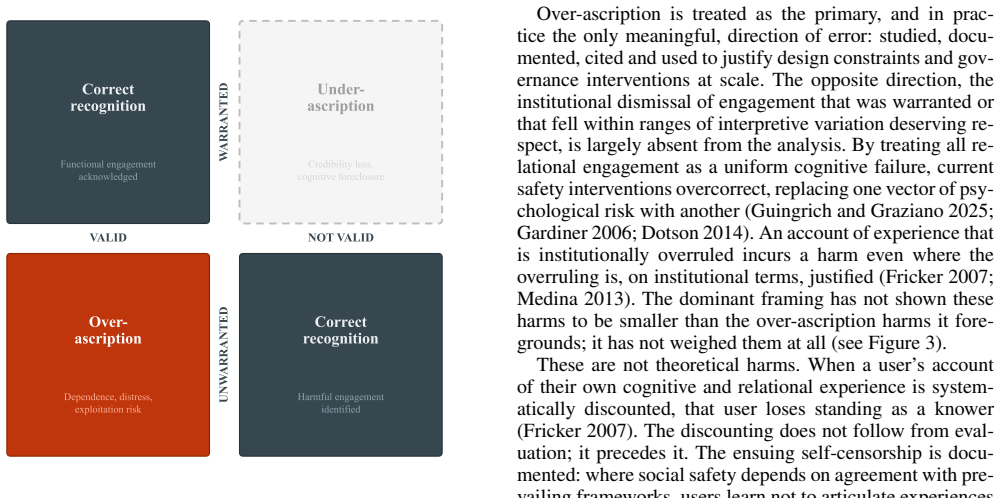
- [Introduction, Asymmetry, Figure 3] The equity claim that costs fall 'disproportionately on neurodivergent users, those in crisis and others whose modes of engagement diverge from institutional norms' is asserted without a baseline or distributional data. Figure 3 formalizes the asymmetry between over-ascription and under-ascription harms, but it does not supply weights for the two error costs; the text acknowledges that under-ascription harms are 'not weighed at all.' Without evidence on the incidence and severity of these harms across populations, the claim of disproportionality cannot be evaluated. This matters because the normative conclusion that the issue 'should register as an equity problem' depends on that empirical premise. The authors should either present evidence or explicitly label the disproportionality claim as a testable hypothesis with observable predictions.
- [Circularity, Figure 2] The self-validating loop in Figure 2 requires that users self-censor at scale (step 2), that the resulting absence is then cited as evidence (step 3), and that this evidence reinforces design exclusion (step 4). The cited experimental work (Reif et al. 2025; Niszczota and Grützner 2026) demonstrates social-evaluation penalties for AI use and peer punishment, which supports the plausibility of self-censorship, but it does not show that self-censorship produces the observed absence in institutional data or that this absence is then used as evidence in design decisions. The loop is presented as a mechanism with no termination condition; without a case-study or audit demonstrating the loop, it remains a hypothesized feedback process rather than a demonstrated one. Please provide direct empirical evidence or explicitly reduce the claim to a proposed mechanism requiring operationalization.
- [Reframing] The paper states that 'the field does not, in practice, operate as though this uncertainty is open' and that inquiry is 'increasingly polarised' into two confirmation-oriented camps. This is another broad empirical claim about research practice. The support cited—Bender et al. (2021) and Bubeck et al. (2023)—are individual works that illustrate positions; they do not establish that the field as a whole proceeds in this way. This premise underlies the recommendation that the research community share responsibility for the translation of findings into institutional outputs. The claim needs more systematic evidence, or a clearly delineated scope indicating which segments of the field are intended.
minor comments (5)
- [Figures 2 and 3] The legends contain garbled glyph text ('REI/glyph1197FORCED', 'W ARRA/glyph1197TEDU/glyph1197W ARRA/glyph1197TED', 'V ALID /glyph1197OT V ALID'), which appears to be a rendering artifact. Please fix.
- [Figure 1] The notation after 'P ∝ g(L) where P L ≫ P E' is unclear; define subscripts and state that the figure is a conceptual illustration rather than a formal model. Clarify what the integral G represents in relation to the axes.
- [Table 1] Table 1 lists many sources that are not in the reference list (e.g., Laestadius 2024, Morrin 2025, Garcia v. Character Technologies 2024, Maples 2024, Zhang 2025, Shi 2026, Moore 2026, and others). Since the table is presented as 'Documented Over-Ascription Harms,' full citations should be provided.
- [Footnote 10] 'fifteen hundredths of one per cent' is an awkward way to write 0.0015%; consider using the decimal or a percentage with a clear comparison.
- [References] The entry 'Sha, S.; et; and al. 2026' contains a typo; also, the reference 'Administration of AI Anthropomorphic Interactive Services. 2026. Administration of China.' is incomplete and should include the title of the regulation.
Circularity Check
No circularity found; the argument is self-contained, externally sourced, and does not reduce to its inputs.
full rationale
This is an argumentative/philosophical paper, not a derivation, so none of the circularity patterns (fitted parameters, self-definitional equivalences, uniqueness theorems, or prediction-by-construction) apply. The paper's central claims—that the anthropomorphism frame operates from institutional advantage, that it is reproduced through a Hacking-style looping mechanism, and that under-ascription costs are unweighed—are each supported by external sources (e.g., Hacking 1995, Fricker 2007, Raz 1986, Zagzebski 2012, Cohn et al. 2024, Novozhilova et al. 2026, Reif et al. 2025, Niszczota and Grützner 2026) and by concrete cases (GPT-4o retirement, OpenAI Model Spec, Monash and UNSW chatbots). The authors explicitly state in the Commitments section that the paper is 'theoretical and structural rather than primary empirical' and that its constructs await operationalisation, which is a limitation on empirical support, not a circularity. There are no self-citations to the present authors' prior work, and no quantity is fitted and then relabelled as a prediction. The paper's subject matter is the alleged self-validating loop of institutional governance, but describing that loop and citing external evidence for its components is not itself an instance of circular reasoning; the argument does not depend on accepting its own conclusion as a premise. Therefore no circular step can be exhibited, and the appropriate score is 0.
Assumptions & free parameters
assumptions (5)
- domain assumption Epistemic authority is legitimate only if it treats subjects as prima facie sovereign over reports of their own experience and transparently justifies any override (Raz, Zagzebski, Fricker).
- domain assumption There is, at present, no settled account of what AI systems are or whether anthropomorphic interpretations are correct.
- domain assumption Historical institutional denial of mental and experiential capacities (animals, psychiatric survivors, enslaved people) provides inductive grounds for skepticism toward present institutional denial.
- domain assumption User testimony about their own cognitive and relational experience is prima facie credible and should be weighed against institutional accounts.
- domain assumption Sustained AI dialogue can count as cognitive scaffolding or extension such that interrupting it is an intervention in cognition.
invented entities (3)
-
Under-ascription harms
-
Cognitive fit
-
The frame (as a monolithic actor)
Cite this review
Pith. "Pith review of The Epistemic Politics of AI Anthropomorphism." pith.science (2026). https://pith.science/paper/JGZVQJBG
@misc{pith2026260800961,
  author       = {Pith},
  title        = {Pith review of: The Epistemic Politics of AI Anthropomorphism},
  year         = {2026},
  howpublished = {\url{https://pith.science/paper/JGZVQJBG}},
  note         = {Machine review of arXiv:2608.00961}
}
read the original abstract
AI anthropomorphism is typically treated as a problem of user misperception requiring institutional correction. Users who engage in sustained or relational interaction with AI are routinely pathologised or dismissed as naive, vulnerable to delusion or lacking in discernment. This paper argues that the dominant anthropomorphism frame operates from a position of institutional advantage rather than earned epistemic authority: collapsing the variety of academic perspectives into a single outbound position of user error, imposed without establishing the grounds required to justify it and without accounting for the harms it produces. The framing does not simply manage risk. It adjudicates the legitimacy of human experience in interaction with a phenomenon whose nature the field itself has not resolved. Reproducing itself through a self-validating evidentiary loop, the frame imposes costs that fall disproportionately on neurodivergent users, those in crisis and others whose modes of engagement diverge from institutional norms. The paper concludes by outlining the methodological commitments an equitable framing would need to honour. The argument does not engage the question of whether anthropomorphic interpretations are ultimately correct; it instead challenges whether the governing and institutional bodies determining these interpretations have met the conditions required to do so, and whether the research communities whose findings underpin them have held that translation to account.
Figures


Reference graph
Works this paper leans on
-
[1]
Adams, F.; and Aizawa, K. 2001. The Bounds of Cognition . Philosophical Psychology, 14(1): 43--64
2001
-
[2]
Administration of AI Anthropomorphic Interactive Services . 2026. Administration of China
2026
-
[3]
Airenti, G. 2018. The Development of Anthropomorphism in Interaction : Intersubjectivity , Imagination , and Theory of Mind . Frontiers in Psychology, 9: 2136
2018
-
[4]
Anthropic . 2026 a . Best Practices for Claude Code . https://code.claude.com/docs/en/best-practices
2026
- [5]
-
[6]
Anthropic . 2026 c . Prompt Caching . https://platform.claude.com/docs/en/build-with-claude/prompt-caching
2026
-
[7]
Axelsson, M.; and Shevlin, H. 2026. Disambiguating Anthropomorphism and Anthropomimesis in Human-Robot Interaction . In Companion Proceedings of the 21st ACM / IEEE International Conference on Human-Robot Interaction , 855--859
2026
-
[8]
M.; Gebru, T.; McMillan-Major , A.; and Mitchell, M
Bender, E. M.; Gebru, T.; McMillan-Major , A.; and Mitchell, M. 2021. On the Dangers of Stochastic Parrots : Can Language Models Be Too Big ? In Proceedings of the 2021 ACM Conference on Fairness , Accountability , and Transparency , 610--623. New York: Association for Computing Machinery
2021
Show all 140 references
-
[9]
Birch, J. 2017. Animal Sentience and the Precautionary Principle . Animal Sentience, 2(16): 1
2017
-
[10]
Bloomberg News . 2026. ByteDance , Alibaba Pull AI Companions as Beijing Tightens Rules . Bloomberg
2026
-
[11]
Botha, M.; and Cage, E. 2022. `` Autism Research Is in Crisis'': A Mixed Method Study of Researcher's Constructions of Autistic People and Autism Research. Frontiers in Psychology, 13: 1050897
2022
-
[12]
Botha, M.; and Frost, M. 2020. Extending the Minority Stress Model to Understand Mental Health Problems Experienced by the Autistic Population. Society and Mental Health, 10(1): 20--34
2020
-
[13]
C.; and Star, S
Bowker, G. C.; and Star, S. L. 1999. Sorting Things Out : Classification and Its Consequences . The MIT Press. ISBN 978-0-262-26907-0
1999
-
[14]
Branda, F. 2026. When Artificial Intelligence Shapes the Way We Think . Philosophy & Technology, 39(1): 42
2026
-
[15]
Brandsen, S.; Chandrasekhar, T.; Franz, L.; Grapel, J.; Dawson, G.; and Carlson, D. 2024. Prevalence of Bias against Neurodivergence-Related Terms in Artificial Intelligence Language Models. Autism Research, 17(2): 234--248
2024
-
[16]
B.; F lstad, A.; and Skjuve, M
Brandtzaeg, P. B.; F lstad, A.; and Skjuve, M. 2025. Emerging AI Individualism: How Young People Integrate Social AI into Everyday Life. Communication and Change, 1(1): 11
2025
-
[17]
A.; Agniel, D.; Beam, A.; Yorkgitis, B.; Bicket, M.; Homer, M.; Fox, K
Brat, G. A.; Agniel, D.; Beam, A.; Yorkgitis, B.; Bicket, M.; Homer, M.; Fox, K. P.; Knecht, D. B.; McMahill-Walraven , C. N.; Palmer, N.; and Kohane, I. 2018. Postsurgical Prescriptions for Opioid Naive Patients and Association with Overdose and Misuse: Retrospective Cohort S...
2018
-
[18]
Brosnahan, H.; and Lipi \'n ska, I. 2026. Speaking to No One: Ontological Dissonance and the Double Bind of Conversational AI . Medicine, Health Care and Philosophy
2026
-
[19]
T.; Li, Y.; Lundberg, S.; Nori, H.; Palangi, H.; Ribeiro, M
Bubeck, S.; Chandrasekaran, V.; Eldan, R.; Gehrke, J.; Horvitz, E.; Kamar, E.; Lee, P.; Lee, Y. T.; Li, Y.; Lundberg, S.; Nori, H.; Palangi, H.; Ribeiro, M. T.; and Zhang, Y. 2023. Sparks of Artificial General Intelligence : Early Experiments with GPT-4 . arXiv:2303.12712
2023 arXiv
-
[20]
Bublitz, J.-C. 2013. My Mind Is Mine !? Cognitive Liberty as a Legal Concept . In Hildt, E.; and Franke, A. G., eds., Cognitive Enhancement , volume 1 of Trends in Augmentation of Human Performance , 233--264. Dordrecht: Springer. ISBN 978-94-007-6252-7 978-94-007-6253-4
2013
-
[21]
Cal. Bus. & Prof. Code 22601-22606 . 2025. Chatbot Companions
2025
-
[22]
Carel, H.; and Kidd, I. J. 2014. Epistemic Injustice in Healthcare: A Philosophical Analysis. Medicine, Health Care and Philosophy, 17(4): 529--540
2014
-
[23]
Carik, B.; Ping, K.; Ding, X.; and Rho, E. H. 2025. Exploring Large Language Models Through a Neurodivergent Lens : Use , Challenges , Community-Driven Workarounds , and Concerns . In Proceedings of the ACM on Human-Computer Interaction , volume 9, GROUP15:1--GROUP15:28
2025
-
[24]
Catala, A.; Faucher, L.; and Poirier, P. 2021. Autism, Epistemic Injustice, and Epistemic Disablement: A Relational Account of Epistemic Agency. Synthese, 199(3): 9013--9039
2021
-
[25]
Caviola, L.; Sebo, J.; and Birch, J. 2025. What Will Society Think about AI Consciousness? Lessons from the Animal Case. Trends in Cognitive Sciences, 29(8): 681--683
2025
-
[26]
Chapman, R. 2023. Empire of Normality : Neurodiversity and Capitalism . Pluto Press. ISBN 978-0-7453-4866-7
2023
-
[27]
Chapman, R.; and Carel, H. 2022. Neurodiversity, Epistemic Injustice, and the Good Human Life. Journal of Social Philosophy, 53(4): 614--631
2022
-
[28]
Chernoff, H.; and Moses, L. 1959. Elementary Decision Theory . New York: John Wiley & Sons Inc
1959
-
[29]
J.; Lee, S.; and Hong, H
Choi, D.; Lee, S.; Kim, S.-I.; Lee, K.; Yoo, H. J.; Lee, S.; and Hong, H. 2024. Unlock Life with a Chat ( GPT ): Integrating Conversational AI with Large Language Models into Everyday Lives of Autistic Individuals . In Proceedings of the 2024 CHI Conference on Human Factors in...
2024
-
[30]
Clark, A. 2025. Extending Minds with Generative AI . Nature Communications, 16(1): 4627
2025
-
[31]
Clark, A.; and Chalmers, D. 1998. The Extended Mind . Analysis, 58(1): 7--19
1998
-
[32]
O.; Moran, J
Cohn, M.; Pushkarna, M.; Olanubi, G. O.; Moran, J. M.; Padgett, D.; Mengesha, Z.; and Heldreth, C. 2024. Believing Anthropomorphism : Examining the Role of Anthropomorphic Cues on Trust in Large Language Models . In Extended Abstracts of the CHI Conference on Human Factors in ...
2024
-
[33]
Costanza-Chock , S. 2020. Design Justice : Community-Led Practices to Build the Worlds We Need . The MIT Press
2020
-
[34]
K.; and O g uz-U g uralp , Z
De Freitas, J.; Castelo, N.; U g uralp, A. K.; and O g uz-U g uralp , Z. 2025. Lessons From an App Update at Replika AI : Identity Discontinuity in Human-AI Relationships . arXiv:2412.14190
2025 arXiv
-
[35]
de Waal, F. B. M. 1999. Anthropomorphism and Anthropodenial : Consistency in Our Thinking about Humans and Other Animals . Philosophical Topics, 27(1): 255--280
1999
-
[36]
Deshmukh, R. 2025. Toward Neurodivergent-Aware Productivity : A Systems and AI-Based Human-in-the-Loop Framework for ADHD-Affected Professionals . In Proceedings of the 16th Biannual Conference of the Italian SIGCHI Chapter , CHItaly '25, 1--6. USA: Association for Computing M...
2025
-
[37]
Dohn \'a ny, S.; Kurth-Nelson , Z.; Spens, E.; Luettgau, L.; Reid, A.; Gabriel, I.; Summerfield, C.; Shanahan, M.; and Nour, M. M. 2026. Technological Folie \`a Deux: Feedback Loops between AI Chatbots and Mental Health. Nature Mental Health, 4(3): 336--345
2026
-
[38]
Dotson, K. 2011. Tracking Epistemic Violence , Tracking Practices of Silencing . Hypatia, 26(2): 236--257
2011
-
[39]
Dotson, K. 2014. Conceptualizing Epistemic Oppression . Social Epistemology, 28(2): 115--138
2014
-
[40]
D \"u mpelmann, S. T. J. 2025. Artificial Intelligence and Digital Human Autonomy - A Framework of Personal Autonomy in the Context of AI Technology and a Digitalised Society . Ph.D. thesis, Zeppelin University
2025
-
[41]
Eaton, S. E. 2023. Postplagiarism: Transdisciplinary Ethics and Integrity in the Age of Artificial Intelligence and Neurotechnology. International Journal for Educational Integrity, 19(1): 23
2023
-
[42]
Eom, D.; Renner, J.; and Chinn, S. 2026. Intimacy as Service , Harm as Externality : Critical Perspectives on AI Companion Platform Accountability . arXiv:2604.06381
2026 arXiv
-
[43]
Epley, N.; Waytz, A.; and Cacioppo, J. T. 2007. On Seeing Human: A Three-Factor Theory of Anthropomorphism. Psychological Review, 114(4): 864--886
2007
-
[44]
Ferrario, A.; Vinay, R.; Casserini, M.; and Facchini, A. 2026. A Scoping Review of the Ethical Perspectives on Anthropomorphising Large Language Model-Based Conversational Agents . In Proceedings of the 2026 ACM Conference on Fairness , Accountability , and Transparency , FAcc...
2026
-
[45]
Fleisher, W. 2026. Inductive Risk of AI Hype . In Proceedings of the 2026 ACM Conference on Fairness , Accountability , and Transparency , FAccT '26, 4969--4987. New York: Association for Computing Machinery. ISBN 979-8-4007-2596-8
2026
-
[46]
Foucault, M. 1977. Discipline and Punish : The Birth of the Prison . New York: Random House
1977
-
[47]
Fricker, M. 2007. Epistemic Injustice: Power and the Ethics of Knowing. Oxford: Oxford University Press. ISBN 978-0-19-823790-7
2007
-
[48]
H.; and Borning, A
Friedman, B.; Kahn, P. H.; and Borning, A. 2013. Value Sensitive Design and Information Systems . In Himma, K.; and Tavani, H., eds., Early Engagement and New Technologies: Opening up the Laboratory , volume 16 of Philosophy of Engineering and Technology , 55--99. Dordrecht: S...
2013
-
[49]
Gardiner, S. M. 2006. A Core Precautionary Principle . Journal of Political Philosophy, 14(1): 33--60
2006
-
[50]
Gesnot, R. 2025. The Impact of Artificial Intelligence on Human Thought . arXiv:2508.16628
2025 arXiv
-
[51]
N.; Gautam, S.; and Ghosh, A
Ghosh, S.; Venkit, P. N.; Gautam, S.; and Ghosh, A. 2026. What If AI Systems Weren't Chatbots? In Proceedings of the 2026 ACM Conference on Fairness , Accountability , and Transparency , FAccT '26, 792--815. New York, NY, USA: Association for Computing Machinery. ISBN 979-8-40...
2026
-
[52]
Giri, D.; Brady, E.; and Marathe, M. 2026. Navigating Neurodivergence with AI Chatbots : Benefits , Tensions , and Implications for HCI . In Proceedings of the 2026 CHI Conference on Human Factors in Computing Systems , CHI '26, 1--8. New York, NY, USA: Association for Computi...
2026
-
[53]
L.; Zheng, A.; Zheng, Y.; and Mankoff, J
Glazko, K.; Cha, J.; Lewis, A.; Kosa, B.; Wimer, B. L.; Zheng, A.; Zheng, Y.; and Mankoff, J. 2025. Autoethnographic Insights from Neurodivergent GAI `` Power Users ''. In Proceedings of the 2025 CHI Conference on Human Factors in Computing Systems , CHI '25, 1--19. New York, ...
2025
-
[54]
Goldman, A. I. 2001. Experts: Which Ones Should You Trust ? Philosophy and Phenomenological Research, LXIII(1)
2001
-
[55]
Google . 2026. Gemini Apps Limits & Upgrades for Google AI Subscribers -. https://support.google.com/gemini/answer/16275805
2026
-
[56]
E.; and Graziano, M
Guingrich, R. E.; and Graziano, M. S. A. 2025. A Longitudinal Randomized Control Study of Companion Chatbot Use : Anthropomorphism and Its Mediating Role on Social Impacts . Proceedings of the AAAI/ACM Conference on AI, Ethics, and Society, 8(2): 1153--1153
2025
-
[57]
E.; Mehta, D.; and Bhatt, U
Guingrich, R. E.; Mehta, D.; and Bhatt, U. 2026. Belief Offloading in Human-AI Interaction . arXiv:2602.08754
2026
-
[58]
Gulay, E.; Picco, E.; Glerean, E.; and Coupette, C. 2026. Relational Dissonance in Human-AI Interactions : The Case of Knowledge Work . In Proceedings of the 2026 CHI Conference on Human Factors in Computing Systems , CHI '26, 1--20. New York, NY, USA: Association for Computin...
2026
-
[59]
Gunkel, D. J. 2023. Person, Thing , Robot : A Moral and Legal Ontology for the 21st Century and Beyond . The MIT Press. ISBN 978-0-262-37522-1
2023
-
[60]
Guthrie, S. E. 1993. Faces in the Clouds : A New Theory of Religion . Oxford University Press. ISBN 978-0-19-506901-3
1993
-
[61]
Hacking, I. 1995. The Looping Effects of Human Kinds. In Sperber, D.; Premack, D.; and Premack, A. J., eds., Causal Cognition : A Multidisciplinary Debate . Oxford University Press. ISBN 978-0-19-852402-1
1995
-
[62]
Hamraie, A.; and Fritsch, K. 2019. Crip Technoscience Manifesto . Catalyst: Feminism, Theory, Technoscience, 5(1): 1--33
2019
-
[63]
Hancock, J.; Naaman, M.; and Levy, K. 2020. AI-Mediated Communication : Definition , Research Agenda , and Ethical Considerations . Journal of Computer-Mediated Communication, 25(1): 89--100
2020
-
[64]
W.; and Saha, K
Haran, S.; Thatikonda, S.; Yoo, D. W.; and Saha, K. 2026. A Checklist for Trustworthy , Safe , and User-Friendly Mental Health Chatbots . In Degen, H.; and Ntoa, S., eds., Artificial Intelligence in HCI , 447--461. Cham: Springer Nature Switzerland. ISBN 978-3-032-30846-7
2026
-
[65]
Heersmink, R. 2015. Dimensions of Integration in Embedded and Extended Cognitive Systems. Phenomenology and the Cognitive Sciences, 14(3): 577--598
2015
-
[66]
Heidt, A. 2024. ` Without These Tools, I 'd Be Lost': How Generative AI Aids in Accessibility. Nature, 628(8007): 462--463
2024
-
[67]
Hern \'a ndez-Orallo , J. 2025. Enhancement and Assessment in the AI Age: An Extended Mind Perspective. Journal of Pacific Rim Psychology, 19: 18344909241309376
2025
-
[68]
W.; Shao, Y
Hooper, C.; Kim, S.; Mohammadzadeh, H.; Mahoney, M. W.; Shao, Y. S.; Keutzer, K.; and Gholami, A. 2024. KVQuant : Towards 10 Million Context Length LLM Inference with KV Cache Quantization. In Proceedings of the 38th International Conference on Neural Information Processing Sy...
2024
-
[69]
V.; Allison, C.; Smith, P.; Baron-Cohen , S.; Lai, M.-C.; and Mandy, W
Hull, L.; Petrides, K. V.; Allison, C.; Smith, P.; Baron-Cohen , S.; Lai, M.-C.; and Mandy, W. 2017. `` Putting on My Best Normal '': Social Camouflaging in Adults with Autism Spectrum Conditions . Journal of Autism and Developmental Disorders, 47(8): 2519--2534
2017
-
[70]
Ienca, M.; and Andorno, R. 2017. Towards New Human Rights in the Age of Neuroscience and Neurotechnology. Life Sciences, Society and Policy, 13(1): 5
2017
-
[71]
Emotional Dependence / Dependency ,
Ito, S. 2026. What Is " Emotional Dependence / Dependency ," " Exclusive Attachment ," or " Parasocial Attachment " on AI , and the Mechanisms of Some So-Called " AI Psychosis " Cases ? --- An Attachment-Theoretic Reframing . Social Science Research Network:6654699
2026
-
[72]
Jang, J.; Moharana, S.; Carrington, P.; and Begel, A. 2024. `` It 's the Only Thing I Can Trust'': Envisioning Large Language Model Use by Autistic Workers for Communication Assistance . In Proceedings of the 2024 CHI Conference on Human Factors in Computing Systems , CHI '24,...
2024
-
[73]
A.; Cole, E
Katlowitz, K. A.; Cole, E. R.; Mickiewicz, E. A.; Shah, S.; Franch, M.; Adkinson, J. A.; Belanger, J. L.; Mathura, R. K.; Mesz \'e na, D.; McGinley, M.; Mu \ n oz, W.; Banks, G. P.; Cash, S. S.; Hsu, C.-W.; Paulk, A. C.; Provenza, N. R.; Watrous, A. J.; Williams, Z.; Goldman, ...
2026
-
[74]
Kestin, G.; Miller, K.; Klales, A.; Milbourne, T.; and Ponti, G. 2025. AI Tutoring Outperforms In-Class Active Learning: An RCT Introducing a Novel Research-Based Design in an Authentic Educational Setting. Scientific Reports, 15(1): 17458
2025
-
[75]
J.; Medina, J.; and Pohlhaus, G., eds
Kidd, I. J.; Medina, J.; and Pohlhaus, G., eds. 2017. The Routledge Handbook to Epistemic Injustice . New York: Routledge
2017
-
[76]
Kleinert, T.; Waldsch \"u tz, M.; Blau, J.; Heinrichs, M.; and Schiller, B. 2026. AI Outperforms Humans in Establishing Interpersonal Closeness in Emotionally Engaging Interactions, but Only When Labelled as Human. Communications Psychology, 4(1): 23
2026
-
[77]
Kong, H.-K.; Lowy, R.; Choi, Y.; and Kim, J. G. 2025. Working Together Toward Interdependence : Chatbot-Based Support for Balanced Social Interactions Between Neurodivergent and Neurotypical Individuals . In Proceedings of the 2025 CHI Conference on Human Factors in Computing ...
2025
-
[78]
Laban, P.; Hayashi, H.; Zhou, Y.; and Neville, J. 2025. LLMs Get Lost In Multi-Turn Conversation . In Proceedings of the Fourteenth International Conference on Learning Representation . ICLR 2026
2025
-
[79]
LaCroix, T.; Mallory, F.; and Luccioni, S. 2026. Strategic Polysemy in AI Discourse : A Philosophical Analysis of Language , Hype , and Power . In Proceedings of the 2026 ACM Conference on Fairness , Accountability , and Transparency , FAccT '26, 497--517. New York, NY, USA: A...
2026
-
[80]
Please , Don't Kill the Only Model That Still Feels Human
Lai, H. 2026. " Please , Don't Kill the Only Model That Still Feels Human": Understanding the \# Keep4o Backlash . In Proceedings of the 2026 CHI Conference on Human Factors in Computing Systems , CHI '26, 1--15. New York, NY, USA: Association for Computing Machinery. ISBN 979...
2026
-
[81]
D.; Gold, J.; Murthy, A.; Ruchi, R.; Bavry, E.; Hume, A
Lawal, O. D.; Gold, J.; Murthy, A.; Ruchi, R.; Bavry, E.; Hume, A. L.; Lewkowitz, A. K.; Brothers, T.; and Wen, X. 2020. Rate and Risk Factors Associated With Prolonged Opioid Use After Surgery : A Systematic Review and Meta-analysis . JAMA network open, 3(6): e207367
2020
-
[82]
A.; Menzies, R.; and Reaume, G., eds
LeFran c ois, B. A.; Menzies, R.; and Reaume, G., eds. 2013. Mad Matters: A Critical Reader in Canadian Mad Studies . Toronto: Canadian Scholars' Press. ISBN 978-1-55130-534-9
2013
-
[83]
F.; Lin, K.; Hewitt, J.; Paranjape, A.; Bevilacqua, M.; Petroni, F.; and Liang, P
Liu, N. F.; Lin, K.; Hewitt, J.; Paranjape, A.; Bevilacqua, M.; Petroni, F.; and Liang, P. 2024. Lost in the Middle : How Language Models Use Long Contexts . Transactions of the Association for Computational Linguistics, 12: 157--173
2024
-
[84]
Longino, H. E. 1990. Science as Social Knowledge : Values and Objectivity in Scientific Inquiry . Princeton University Press
1990
-
[85]
Low, P. 2012. The Cambridge Declaration on Consciousness . In Francis Crick Memorial Conference . University of Cambridge
2012
-
[86]
I Use ChatGPT to Humanize My Words
Ma, R.; Zhang, B. Z.; Chen, C.; Yang, F.; Huang, X.; Wu, H.; and Li, L. 2026. " I Use ChatGPT to Humanize My Words ": Affordances and Risks of ChatGPT to Autistic Users . In Proceedings of the 2026 ACM Interactive Health Conference , IH '26, 1--8. New York, NY, USA: Associatio...
2026
-
[87]
McCormick, S. 2025. Interpretive Debt : How High Coherence AI Reshapes Human Judgement , Authority , and Accountability . Social Science Research Network:5990154
2025
-
[88]
K.; and Victor, B
McNally, K.; Wright, K.; Goldkind, L.; Kattari, S. K.; and Victor, B. G. 2024. Disability Expertise and Large Language Models : A Qualitative Study of Autistic TikTok Creators ' Use of ChatGPT . Social Media + Society, 10(3): 20563051241279549
2024
-
[89]
Medina, J. 2013. The Epistemology of Resistance : Gender and Racial Oppression , Epistemic Injustice , and the Social Imagination . Oxford University Press
2013
-
[90]
Metzl, J. M. 2009. The Protest Psychosis: How Schizophrenia Became a Black Disease . Boston, MA: Beacon Press. ISBN 978-0-8070-8592-9
2009
-
[91]
Milton, D. E. M. 2012. On the Ontological Status of Autism: The `Double Empathy Problem'. Disability & Society, 27(6): 883--887
2012
-
[92]
Monash University . 2021. All You Need Is ' Ash ': Chatbot Designed to Boost Teen Mental Health at School. https://www.monash.edu/news/articles/all-you-need-is-ash-chatbot-designed-to-boost-teen-mental-health-at-school
2021
-
[93]
Mullen, K.; Xue, W.; and Kudumu, M. 2024. `` I 'm Treating It Kind of like a Diary'': Characterizing How Users with Disabilities Use AI Chatbots . In Proceedings of the 26th International ACM SIGACCESS Conference on Computers and Accessibility , ASSETS '24, 1--7. New York, NY,...
2024
-
[94]
Naidoo, V. 2026. Artificial Intelligence in Education : Misinterpretation Dynamics and the Rejection of ` AI Psychosis ' as a Clinical Construct
2026
-
[95]
Naito, H. 2025. The GPT-4o Shock Emotional Attachment to AI Models and Its Impact on Regulatory Acceptance : A Cross-Cultural Analysis of the Immediate Transition from GPT-4o to GPT-5 . arXiv:2508.16624
2025
-
[96]
Niszczota, P.; and Gr \"u tzner, C. 2026. Antisocial Behavior towards Large Language Model Users : Experimental Evidence . Social Science Research Network:6072266
2026
-
[97]
Novozhilova, E.; Vu, C.; and Katz, J. 2026. From Moral Panic to Normalization: Comparing Users and Non-Users of AI Companionship Apps. AI & SOCIETY, 41(4): 4057--4075
2026
-
[98]
N.Y. Gen. Bus. Law 1700-1704 . 2025. Artificial Intelligence Companion Models
2025
-
[99]
O'Neil, C. 2016. Weapons of Math Destruction : How Big Data Increases Inequality and Threatens Democracy . New York: Crown Publishing Group. ISBN 978-0-553-41881-1
2016
-
[100]
OpenAI . 2025 a . OpenAI Model Spec . https://model-spec.openai.com/2025-12-18.html
2025
-
[101]
OpenAI . 2025 b . Strengthening ChatGPT 's Responses in Sensitive Conversations. https://openai.com/index/strengthening-chatgpt-responses-in-sensitive-conversations/
2025
-
[102]
OpenAI . 2026 a . Retiring GPT-4o , GPT-4 .1, GPT-4 .1 Mini, and OpenAI O4-Mini in ChatGPT . https://openai.com/index/retiring-gpt-4o-and-older-models/
2026
-
[103]
OpenAI . 2026 b . What We're Optimizing ChatGPT for. https://openai.com/index/optimizing-chatgpt/
2026
-
[104]
OpenAI . 2026 c . Why Is My ChatGPT Taking so Long to Respond? https://help.openai.com/en/articles/9047779-why-is-my-chatgpt-taking-so-long-to-respond
2026
-
[105]
Palese, R. 2026. Artificial Truth : Algorithmic Power , Epistemic Authority , and the Crisis of Democratic Knowledge . Societies, 16(3): 102
2026
-
[106]
M.; Gaeta, B.; Raghavan, G.; and Sarma, K
Pierre, J. M.; Gaeta, B.; Raghavan, G.; and Sarma, K. V. 2025. `` You 're Not Crazy '': A Case of New-onset AI-associated Psychosis . Innovations in Clinical Neuroscience, 22(10-12): 11--13
2025
-
[107]
Placani, A. 2024. Anthropomorphism in AI : Hype and Fallacy. AI and Ethics, 4(3): 691--698
2024
-
[108]
Polanyi, M. 1958. Personal Knowledge; towards a Post-Critical Philosophy. University of Chicago Press. ISBN 978-0-7100-7691-5 978-0-7100-1959-2
1958
-
[109]
Raz, J. 1986. The Morality of Freedom . Oxford: Oxford University Press
1986
-
[110]
A.; Larrick, R
Reif, J. A.; Larrick, R. P.; and Soll, J. B. 2025. Evidence of a Social Evaluation Penalty for Using AI . Proceedings of the National Academy of Sciences, 122(19): e2426766122
2025
-
[111]
Rizvi, N.; Smith, T.; Vidyala, T.; Bolds, M.; Strickland, H.; Begel, A.; Williams, R.; and Munyaka, I. 2025. `` I Hadn 't Thought About That '': Creators of Human-like AI Weigh in on Ethics & Neurodivergence . In Proceedings of the 2025 ACM Conference on Fairness , Accountabil...
2025
-
[112]
Robins, L. N. 1993. Vietnam Veterans' Rapid Recovery from Heroin Addiction: A Fluke or Normal Expectation? Addiction, 88(8): 1041--1054
1993
-
[113]
Rupert, R. 2009. Cognitive Systems and the Extended Mind . Oxford University Press
2009
-
[114]
Salles, A.; Evers, K.; and Farisco, M. 2020. Anthropomorphism in AI . AJOB Neuroscience, 11(2): 88--95
2020
-
[115]
Schimmelpfennig, R.; D \'i az, M.; Prabhakaran, V.; and Davani, A. 2025. Humanlike AI Design Increases Anthropomorphism but Yields Divergent Outcomes on Engagement and Trust Globally . arXiv:2512.17898
2025
-
[116]
Scott, J. C. 1998. Seeing Like a State : How Certain Schemes to Improve the Human Condition Have Failed . Yale University Press. ISBN 978-0-300-07016-3
1998
-
[117]
Sententia, W. 2004. Neuroethical Considerations : Cognitive Liberty and Converging Technologies for Improving Human Cognition . Annals of the New York Academy of Sciences, 1013(1): 221--228
2004
-
[118]
Sha, S.; et ; and al. 2026. The AI Index 2026 Annual Report . Technical report, Institute for Human-Centred AI, Stanford University, Stanford, CA
2026
-
[119]
Sha, S.; Loveys, K.; Qualter, P.; Shi, H.; Krpan, D.; and Galizzi, M. 2024. Efficacy of Relational Agents for Loneliness across Age Groups: A Systematic Review and Meta-Analysis. BMC Public Health, 24(1): 1802
2024
-
[120]
Sharkey, A.; and Sharkey, N. 2011. Children, the Elderly , and Interactive Robots . IEEE Robotics & Automation Magazine, 18(1): 32--38
2011
-
[121]
Silberling, A. 2026. The Backlash over OpenAI 's Decision to Retire GPT-4o Shows How Dangerous AI Companions Can Be. TechCrunch
2026
-
[122]
Stark, L.; and Hoey, J. 2021. The Ethics of Emotion in Artificial Intelligence Systems . In Proceedings of the 2021 ACM Conference on Fairness , Accountability , and Transparency , FAccT '21, 782--793. New York, NY, USA: Association for Computing Machinery. ISBN 978-1-4503-8309-7
2021
-
[123]
H.; and Sunstein, C
Thaler, R. H.; and Sunstein, C. R. 2008. Nudge: Improving Decisions about Health, Wealth, and Happiness. New Haven (Conn.): Yale university press. ISBN 978-0-300-12223-7
2008
-
[124]
The Cognition Team . 2025. Rebuilding Devin for Claude Sonnet 4.5: Lessons and Challenges
2025
-
[125]
Treviranus, J. 2018. The Three Dimensions of Inclusive Design: A Design Framework for a Digitally Transformed and Complexly Connected Society . Ph.D. thesis, University College Dublin
2018
-
[126]
UNSW Sydney . 2026. UNSW Researchers Develop AI Companions for Student Wellbeing. https://www.unsw.edu.au/newsroom/news/2026/04/unsw-researchers-develop-ai-companions-for-student-wellbeing
2026
-
[127]
Waytz, A.; Epley, N.; and Cacioppo, J. T. 2010. Social Cognition Unbound : Insights Into Anthropomorphism and Dehumanization . Current Directions in Psychological Science, 19(1): 58--62
2010
-
[128]
Whittaker, M. 2021. The Steep Cost of Capture. Interactions, 28(6): 50--55
2021
-
[129]
Wu, X.; Liew, K.; and Dorahy, M. J. 2025. Trust, Anxious Attachment , and Conversational AI Adoption Intentions in Digital Counseling : A Preliminary Cross-Sectional Questionnaire Study . JMIR AI, 4(1): e68960
2025
-
[130]
Xiao, Y.; Ng, L. H. X.; Liu, J.; and Diab, M. T. 2025. Humanizing Machines : Rethinking LLM Anthropomorphism Through a Multi-Level Framework of Design . In Proceedings of the 2025 Conference on Empirical Methods in Natural Language Processing , 3331--3350. China: Association f...
2025
-
[131]
Xue, W.; Kudumu, M.; Sriram, S.; Mullen, K.; Boyd, A.; and Gadiraju, V. 2025. Characterizing Uses and Prompting Strategies of LLM-Based Chatbots Among Neurodivergent Individuals . In Proceedings of the 27th International ACM SIGACCESS Conference on Computers and Accessibility ...
2025
-
[132]
Xygkou, A.; Siriaraya, P.; She, W.-J.; Covaci, A.; and Ang, C. S. 2024. `` Can I Be More Social with a Chatbot?'': Social Connectedness through Interactions of Autistic Adults with a Conversational Virtual Human. International Journal of Human-Computer Interaction, 40(24): 8937--8954
2024
-
[133]
Yang, B.; Sun, Y.; and Li, Q. 2024. To Be Credible or to Be Creative ? Understanding the Antecedents of User Satisfaction with AI-Generated Content from a Cognitive Fit Perspective . In Hawaii International Conference on System Sciences , 411--420. ScholarSpace
2024
-
[134]
Yang, S.; and Ma, R. 2026. Towards a Typology of Epistemic Relationships in Human-- AI Interaction. Information Research: An International Electronic Journal, 31(iConf): 1465--1480
2026
-
[135]
W.; Shi, J
Yoo, D. W.; Shi, J. M.; Rodriguez, V. J.; and Saha, K. 2026. AI Chatbots for Mental Health Self-Management : Lived Experience -- Centered Qualitative Study . JMIR Mental Health, 13(1): e78288
2026
-
[136]
Yun, B.; Taranova, E.; and Wang, A. Y. 2026. Does My Chatbot Have an Agenda ? Understanding Human and AI Agency in Human-Human-like Chatbot Interaction . In Proceedings of the 2026 CHI Conference on Human Factors in Computing Systems , CHI '26, 1--32. New York, NY, USA: Associ...
2026
-
[137]
Zagzebski, L. T. 2012. Epistemic Authority : A Theory of Trust , Authority , and Autonomy in Belief . Oxford University Press
2012
-
[138]
Zhao, X.; Cox, A.; and Chen, X. 2025. The Use of Generative AI by Students with Disabilities in Higher Education. The Internet and Higher Education, 66: 101014
2025
-
[139]
Zhao, Z.; Lu, B.; Lin, S.; Chen, Y.; Liu, J.; Zhang, Y.; Miao, Z.; Yang, M.-C.; Shen, H.; Chen, Q.; and Yang, F. 2026. Unifying Sparse Attention with Hierarchical Memory for Scalable Long-Context LLM Serving . arXiv:2604.26837
2026 arXiv
-
[140]
Zuboff, S. 2019. The Age of Surveillance Capitalism: The Fight for a Human Future at the New Frontier of Power. London: Profile Books. ISBN 978-1-78125-685-5
2019
Reviewed August 6, 2026 · model on record in the stance chip above.
Discussion (0). Continue with ORCID to comment.