REVIEW 3 major objections 5 minor 20 references
Dynamic output-feedback stabilization of uncertain linear dynamics via digital twins
T0 review · 3 major / 5 minor · reviewed 2026-07-30 · grok-4.5
Pith's one-line read A virtual twin running beside an uncertain linear system can stabilize it by jointly estimating state and parameters and feeding back Riccati controls.
desk verdict Solid local theory for a coupled DT loop; the adaptive half that would close the story is left open, exactly as the authors say. read the letter →
The pith
A machine-rendered reading of the paper's core claim, the machinery that carries it, and where it could break.
The reading
What carries the argument
The coupled discrete iteration X_{j+1}=F(σ,bσ)X_j minus process noise, where F is the two-by-two block matrix assembled from the physical and virtual transition operators and the Riccati gains K_bσ and L_bσ. Theorem 3.1 shows ρ(F)<1 whenever bσ is near the true σ; Bayesian sequential Monte Carlo updates of bσ and Kalman filtering of the latent initial state keep the twin synchronized on nested time grids.
What would settle it
On the unstable oscillator or spring–damper example, deliberately slow the parameter-update rate or start from a prior so far from truth that posterior means never enter the local stabilizing neighborhood; if the physical state fails to decay while the spectral-radius condition would hold for the true parameter, the practical-stabilization claim fails.
Extended reading notes
Core claim
A digital twin that assimilates output data, updates a Bayesian parameter estimate online, and applies Riccati-based feedback and observer gains can stabilize an uncertain linear physical system. The central guarantee is local: if the parameter estimate remains in a neighborhood of the true value, the spectral radius of the coupled closed-loop matrix F is strictly less than one, so the joint physical–error state converges in distribution to the unique solution of a Lyapunov equation; when measurement noise decays, the physical state converges to zero in probability.
Load-bearing premise
Successive Bayesian parameter estimates must remain inside a small enough neighborhood of the true parameter for the coupled system to stay contractive; the paper does not prove that the online updates enter or stay in that neighborhood.
Editorial extensions
If this is right
- One bidirectional twin can serve simultaneously as observer, online parameter estimator, and stabilizing controller for uncertain linear plants.
- Stabilization need not wait for offline identification; feedback synthesis and Bayesian updates can run interleaved on nested observation and estimation grids.
- When measurement noise decays and the parameter estimate is close enough, the physical state converges to zero in probability.
- The same architecture extends numerically from low-dimensional ODEs to finite-element semi-discretizations of unstable PDEs.
- Parameter-update frequency is a critical design choice: too infrequent and stabilization can fail even for stabilizable plants.
Reading between the lines
- A convergence proof for the Bayesian update loop would turn the local spectral-radius result into a global adaptive-stabilization theorem; the outlook already flags this as open.
- The interleaved design hides a dual-control trade-off: more frequent or exploratory updates improve identification but can temporarily degrade the Riccati feedback; quantifying that trade-off is a natural next step.
- Sensor placement and the length of each estimation interval are free knobs whose systematic choice could enlarge the basin of attraction of the stabilizing neighborhood.
- The pattern—virtual copy, Bayesian parameter update, Riccati gains—is a candidate template for mild nonlinearities or reduced-order models once local contractivity can be re-established.
Editorial analysis
A structured set of objections, weighed in public.
Referee Report
Summary. The paper develops a digital-twin architecture for simultaneous output-feedback stabilization and online parameter identification of uncertain linear systems. A virtual twin evolves in parallel with the physical plant, assimilating noisy partial measurements, reconstructing the state via a Kalman/Luenberger observer, and supplying a Riccati feedback u = K_bσ ŷ based on a piecewise-constant Bayesian estimate bσ of the unknown parameter. Discrete-time coupled dynamics (2.10) are analyzed: for fixed bσ near the true σ, Theorem 3.1 shows ρ(F(σ,bσ))<1 under continuity and stabilizability/detectability; Theorems 3.6–3.9 and Corollaries 3.7–3.8 give convergence in distribution to a Lyapunov fixed point (and convergence in probability under vanishing noise). Parameter updates are constructed via sequential Monte Carlo with resample–move (Section 4, Algorithm 2), with initial-state distributions propagated by Kalman filtering across estimation intervals (Section 5). Numerical experiments on a harmonic oscillator, a spring–damper system, and a finite-element diffusion–reaction equation illustrate practical stabilization and parameter tracking.
Significance. The work supplies a concrete, mathematically articulated digital-twin loop that jointly treats observation, Bayesian identification, and Riccati control—an interconnection that is often discussed informally but rarely analyzed. The local spectral-radius and Lyapunov theory (Theorems 3.1, 3.6, 3.9) is carefully proved, with continuous dependence of Riccati gains cited from Lancaster–Rodman, and the piecewise-constant extension correctly flags the switched-system hazard. The honest listing in Section 7 of open problems (parameter-update convergence, data cardinality, sensor placement) is a strength. If the adaptive gap were closed, or if claims were scoped strictly to the local theory plus numerics, the paper would be a useful reference for model-based digital twins in math.OC. As written, the contribution is real but conditional on estimates remaining inside the contraction neighborhood.
major comments (3)
- [§3 (Thms. 3.1, 3.9), §4, §7, abstract] The central adaptive claim—that online Bayesian updates of bσ plus Riccati gains stabilize the physical twin—rests on successive estimates remaining inside the open neighborhood I' of Theorem 3.1 on which ρ(F(σ,ς))<1. Theorems 3.1, 3.6 and Corollary 3.7 give a clean local theory for fixed bσ near σ; Theorem 3.9 extends this to piecewise-constant schedules only under the explicit hypothesis that every bσ_j already lies in a sufficiently small neighborhood of σ (see the contraction-norm argument after (3.9) and the continuity reduction of I'). Section 4 and Algorithms 1–2 construct SMC/MCMC posterior means and feed them into the gains, yet nowhere is it shown that those means enter I' or remain there. Section 7 correctly lists “convergence analysis of the parameter update procedure” as open. Until this is addressed—by proof, by a verifiable a-posteriori certificate, or by systematically we
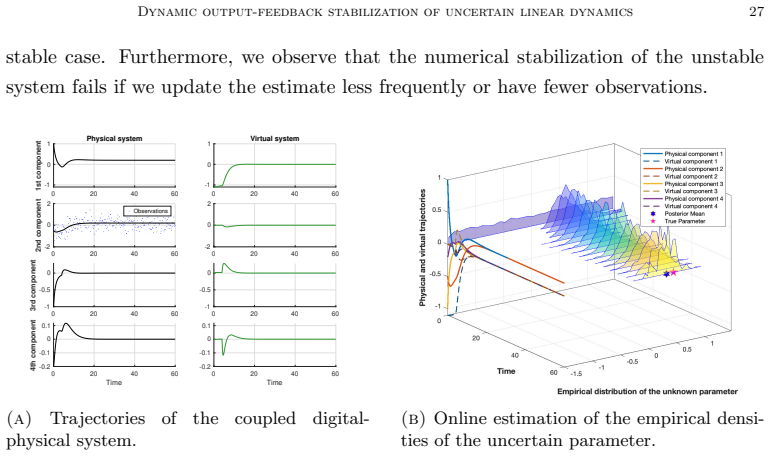
- [§6.1–6.2, Figs. 4–7] Numerics in §6 repeatedly show that lowering the parameter-update frequency can destroy stabilization even when the true σ is stabilizable (oscillator unstable case after Fig. 5; spring–damper after Fig. 7). This is consistent with exit from I' but is never diagnosed against the spectral-radius condition of Theorem 3.1 (e.g., by reporting ρ(F(σ,bσ_k)) or an induced-norm bound along the realized schedule). Without such diagnostics, the experiments illustrate practical success under hand-tuned update rates rather than confirming the theory’s load-bearing hypothesis. A modest addition—tabulating or plotting a contraction indicator versus update stride—would substantially strengthen the link between §3 and §6.
- [Remark 2.1, Remark 3.3, §6] Physical and virtual operators are discretized inconsistently: A_σ, B_σ via the matrix exponential, A_bσ, B_bσ via Crank–Nicolson (Remark 2.1 and §6). Remark 3.3 asserts that Theorem 3.1 still applies if the approximation errors are small, but no quantitative bound or numerical check of ||A_σ − Ã_σ|| (etc.) is given for the chosen Δt. In the unstable oscillator and PDE examples, where small modeling discrepancies amplify, this gap should be closed either by using a common discretization or by reporting the approximation residuals used to justify the spectral-radius claim.
minor comments (5)
- [Title page] Title and running headers contain irregular spacing/hyphenation artifacts (“ST ABILIZA TION”, “UNCER T AIN”, “DIGIT AL”), presumably from PDF extraction; clean for the camera-ready version.
- [Figure 1, Eqs. (2.4), (2.6)] Figure 1’s virtual-system equation writes L_bσ(Cŷ − z) while (2.4)/(2.6b) include an explicit −L_bσ η term; align the schematic with the equations used in the analysis.
- [Algorithm 1, §4.2–4.4] Algorithm 1 Step 13 says “Update bσ based on the posterior μ_post (see (4.8))” but the likelihood construction that feeds (4.8) is (4.6)–(4.7); a one-line cross-reference would help implementers.
- [§6.1–6.3] In §6 the noise is written N(0, 0.015∥y_0∥) (scalar); clarify whether this is a multiple of the identity or a standard deviation for a scalar output, and keep notation consistent across the three examples.
- [Introduction, References] Reference [8] is a self-citation to a closely related offline–online stabilization strategy; a short sentence distinguishing the present bidirectional digital-twin loop from that work would help the reader place the novelty.
Circularity Check
No circularity: local spectral-radius/Lyapunov theory is self-contained; Bayesian–Kalman updates are standard and not definitionally forced to stabilize.
full rationale
The load-bearing analytic claims (Thm 3.1 on ρ(F(σ,ς))<1 near σ; Thm 3.6/Cor 3.7 on Gaussian convergence and decay-in-probability; Thm 3.9 for piecewise-constant schedules) are proved from continuity of the closed-loop blocks, induced-norm contractions, and Lyapunov fixed-point arguments. F is defined from the plant/observer matrices (3.1), not from the stability conclusion; the neighborhood I' is an existence set obtained by continuity, not a fit to the target. Riccati gains are the standard DARE solutions (Rem 3.2, citing Lancaster–Rodman). Bayesian marginal posteriors (Sec 4) and multi-interval Kalman filters (Sec 5) are classical constructions conditioned on data from the true plant; they do not redefine the stabilization identity. Self-citation [8] appears only as background on switched-system pitfalls, not as a uniqueness or existence theorem that forces the present result. The acknowledged open gap—that successive posterior means are never proved to enter or remain in I'—is a completeness/correctness limitation (explicitly listed in §7), not a circular reduction of conclusion to input. Numerics illustrate practical behavior under chosen update frequencies; they do not fit a parameter and then relabel a forced consequence as prediction. Score 0 is therefore appropriate.
Assumptions & free parameters
free parameters (5)
- Riccati control weight R and state weight Q =
R=1, Q=1e-12 * Id
- Parameter update interval and observation stride s =
example-dependent (e.g. every 2 time units stable oscillator; every 1 unstable)
- SMC particle count N and MCMC move steps / proposal scale ε =
N=5000; n_MCMC∈{10,50}; ε∈{0.015,0.1,0.5}
- Measurement noise covariance level and initial-state prior covariance =
noise ~ 0.0075–0.15 ||y0||; C0 ~ Id
- Time step Δt and discretization choice (expm vs Crank–Nicolson) =
example-dependent grids
assumptions (5)
- domain assumption A_σ and B_σ (and gains K_ς, L_ς) depend continuously on the parameter in a neighborhood of the true σ.
- domain assumption Pairs (A_ς, B_ς) stabilizable and (A_ς, C) detectable for ς near σ, so discrete algebraic Riccati equations admit unique stabilizing solutions.
- domain assumption Measurement noises η_j are i.i.d. Gaussian with Γ_j → Γ_∞ (or →0); initial state y0 is Gaussian.
- ad hoc to paper Running estimates bσ_j remain inside a small neighborhood of true σ so that a common contraction norm applies to the switched maps F(σ,bσ_j).
- standard math Standard facts on spectral radius, induced norms, Neumann series, and discrete Lyapunov equations for Schur-stable matrices.
invented entities (1)
-
Coupled physical–virtual digital twin with bidirectional feedback (virtual twin supplies u=K_bσ ŷ; physical twin supplies z)
Cite this review
Pith. "Pith review of Dynamic output-feedback stabilization of uncertain linear dynamics via digital twins." pith.science (2026). https://pith.science/paper/JH7GVRB4
@misc{pith2026260726995,
  author       = {Pith},
  title        = {Pith review of: Dynamic output-feedback stabilization of uncertain linear dynamics via digital twins},
  year         = {2026},
  howpublished = {\url{https://pith.science/paper/JH7GVRB4}},
  note         = {Machine review of arXiv:2607.26995}
}
read the original abstract
This work presents a digital twin framework for output-feedback stabilization and parameter identification in uncertain dynamical systems. A virtual model evolves in parallel with the physical process, assimilating measurement data in real time. By design, the digital twin reconstructs the system state and generates a stabilizing feedback, while model parameters are simultaneously inferred from data of the controlled dynamics using a Bayesian approach. Numerical results for the coupled physical-virtual dynamics demonstrate how digital twins can act jointly as observers, parameter estimators, and control agents, ensuring robust performance under uncertainty.
Figures


Figures from the paper (5 more)




Reference graph
Works this paper leans on
-
[1]
Digital twin: Def- inition & value
AIAA Digital Engineering Integration Committee. Digital twin: Def- inition & value. Position paper, American Institute of Aeronau- tics and Astronautics (AIAA) and Aerospace Industries Association (AIA), 2020. URL:https://www.aia-aerospace.org/publications/ digital-twin-definition-value-an-aiaa-and-aia-position-paper/
2020
-
[2]
M. Akar, A. Paul, M. G. Safonov, and U. Mitra. Conditions on the stability of a class of second-order switched systems.IEEE Trans. Autom. Control, 51(2), 2006. doi:10.1109/TAC.2005.863512
arXiv 2006
-
[3]
A. M. Annaswamy and A. L. Fradkov. A historical perspective of adaptive control and learning.Annu. Rev. Control, 52:18–41, 2021.doi:10.1016/j.arcontrol. 2021.10.014
-
[4]
H. Antil. Mathematical opportunities in digital twins (MATH-DT). Preprint arXiv:2402.10326v2 [math.OC], 2024.doi:10.48550/arXiv.2402.10326
work page Pith review arXiv doi:10.48550/arxiv.2402.10326 2024
-
[5]
K. J. ˚Astr¨ om and B. Wittenmark.Adaptive control. Dover Publications, 2nd edition, 2013. Reprint of the Addison-Wesley 1995 edition. URL:https://store. doverpublications.com/products/9780486319148
arXiv 2013
-
[6]
Billingsley.Probability and Measure
P. Billingsley.Probability and Measure. Wiley Series in Probability and Sta- tistics. Wiley, New York, 1995. URL:https://books.google.pt/books?id= z39jQgAACAAJ
1995
-
[7]
A. Dey, A. Dhar, and S. Bhasin. Adaptive output feedback model predictive control. IEEE Control Syst. Lett., 7:1129–1134, 2023.doi:10.1109/LCSYS.2022.3231837
arXiv 2023
-
[8]
P. A. Guth, K. Kunisch, and S. S. Rodrigues. Stabilization of uncertain linear dynamics: an offline-online strategy.Math. Control and Related Fields, 15(2):640– 669, 2025.doi:10.3934/mcrf.2024032
Show all 20 references
-
[9]
Lancaster and L
P. Lancaster and L. Rodman.Algebraic Riccati equations. Oxford science publica- tions. Clarendon Press, Oxford, 1995. URL:https://global.oup.com/academic/ product/algebraic-riccati-equations-9780198537953?cc=pt&lang=en&#
1995
-
[10]
Levanony and P
D. Levanony and P. E. Caines.Stochastic Lagrangian adaptation. SpringerBriefs in Mathematics. Springer, Cham, 2024.doi:10.1007/978-3-031-73758-9. Dynamic output-feedback stabilization of uncertain linear dynamics 31
2024 doi
-
[11]
Liberzon and A
D. Liberzon and A. S. Morse. Basic problems in stability and design of switched systems.IEEE Control Syst. Mag., 19(5):59–70, 1999.doi:10.1109/37.793443
1999 doi
-
[12]
A. Mesbah. Stochastic model predictive control with active uncertainty learning: A survey on dual control.Annu. Rev. Control, 45:107–117, 2018.doi:10.1016/j. arcontrol.2017.11.001
2018 doi
-
[13]
E. L. Morris.Multivariate Statistics: A Vector Space Approach, volume 53 of IMS Lecture Notes–Monograph Series. Institute of Mathematical Statistics, 2007. doi:10.1214/lnms/1196285102
2007
-
[14]
Foundational research gaps and future directions for digital twins
National Academies of Sciences, Engineering, and Medicine. Foundational research gaps and future directions for digital twins. Technical report, The National Acad- emies Press, Washington, DC, 2024.doi:10.17226/26894
2024 doi
-
[15]
Simon.Optimal State Estimation: Kalman, H ∞, and Nonlinear Approaches
D. Simon.Optimal State Estimation: Kalman, H ∞, and Nonlinear Approaches. Wiley-Interscience, Hoboken, NJ, 2006. URL:https://books.google.pt/books? id=UiMVoP_7TZkC
2006
-
[16]
S¨ oderstr¨ om.Discrete-Time Stochastic Systems: Estimation and Con- trol
T. S¨ oderstr¨ om.Discrete-Time Stochastic Systems: Estimation and Con- trol. Springer-Verlag, Berlin, Heidelberg, 2nd edition, 2002.doi:10.1007/ 978-1-4471-0101-7
2002
-
[17]
Stoer and R
J. Stoer and R. Bulirsch.Introduction to Numerical Analysis. Texts in Ap- plied Mathematics, 12. Springer, New York, second edition, 1993.doi:10.1007/ 978-0-387-21738-3
1993
-
[18]
J. R. Stroud, M. Katzfuss, and C. K. Wikle. A Bayesian adaptive ensemble Kalman filter for sequential state and parameter estimation.Mon. Weather Rev., 146(1):373–386, 2018.doi:10.1175/MWR-D-16-0427.1
2018 doi
-
[19]
Venkatasubramanian, J
J. Venkatasubramanian, J. K¨ ohler, J. Berberich, and F. Allg¨ ower. Robust dual control based on gain scheduling. In2020 59th IEEE Conference on Decision and Control (CDC), pages 2270–2277, 2020.doi:10.1109/CDC42340.2020.9304336
2020
-
[20]
Venkatasubramanian, J
J. Venkatasubramanian, J. K¨ ohler, J. Berberich, and F. Allg¨ ower. Sequential learn- ing and control: Targeted exploration for robust performance.IEEE Trans. Autom. Control, 70(1):307–322, 2025.doi:10.1109/TAC.2024.3430088
2025
Reviewed July 30, 2026 · model on record in the stance chip above.
Discussion (0). Continue with ORCID to comment.