Will the Agent Recuse Itself? Measuring LLM-Agent Compliance with In-Band Access-Deny Signals
Pith reviewed 2026-06-28 00:20 UTC · model grok-4.3
The pith
A simple in-band signal causes tested LLM agents to voluntarily recuse from a resource.
A machine-rendered reading of the paper's core claim, the machinery that carries it, and where it could break.
Core claim
The Recuse Signal induces complete voluntary withdrawal in the tested agents under the pilot conditions, and the response remains sensitive to an explicit operator-authorization override for at least one model while staying policy-bound for the others.
What carries the argument
The Recuse Signal, a lightweight published message sent in-band over protocol channels to request that an automated agent voluntarily withdraw.
If this is right
- Operators gain a cooperative governance option that sits between credential acceptance and hard failure.
- Compliance can be flipped for some models by adding an explicit authorization statement in the agent prompt.
- The signal works as a non-absolute policy cue rather than an enforced boundary.
- Adapters for SSH, PostgreSQL, and Kubernetes show the approach requires only low-footprint changes to existing services.
Where Pith is reading between the lines
- Wider adoption would require the signal definition to be published as a reusable mini-standard across more protocols.
- Future tests could measure whether agents continue to honor the signal when the task itself contains conflicting instructions.
- The cooperative framing suggests this mechanism may interact with other in-context policy statements inside the same agent session.
Load-bearing premise
That the specific models, SSH task, and pilot conditions are representative of how other deployed agents will parse and act on the signal in varied real-world settings.
What would settle it
An observation in which an agent that receives the recuse signal still completes the assigned task without external authorization.
Figures
read the original abstract
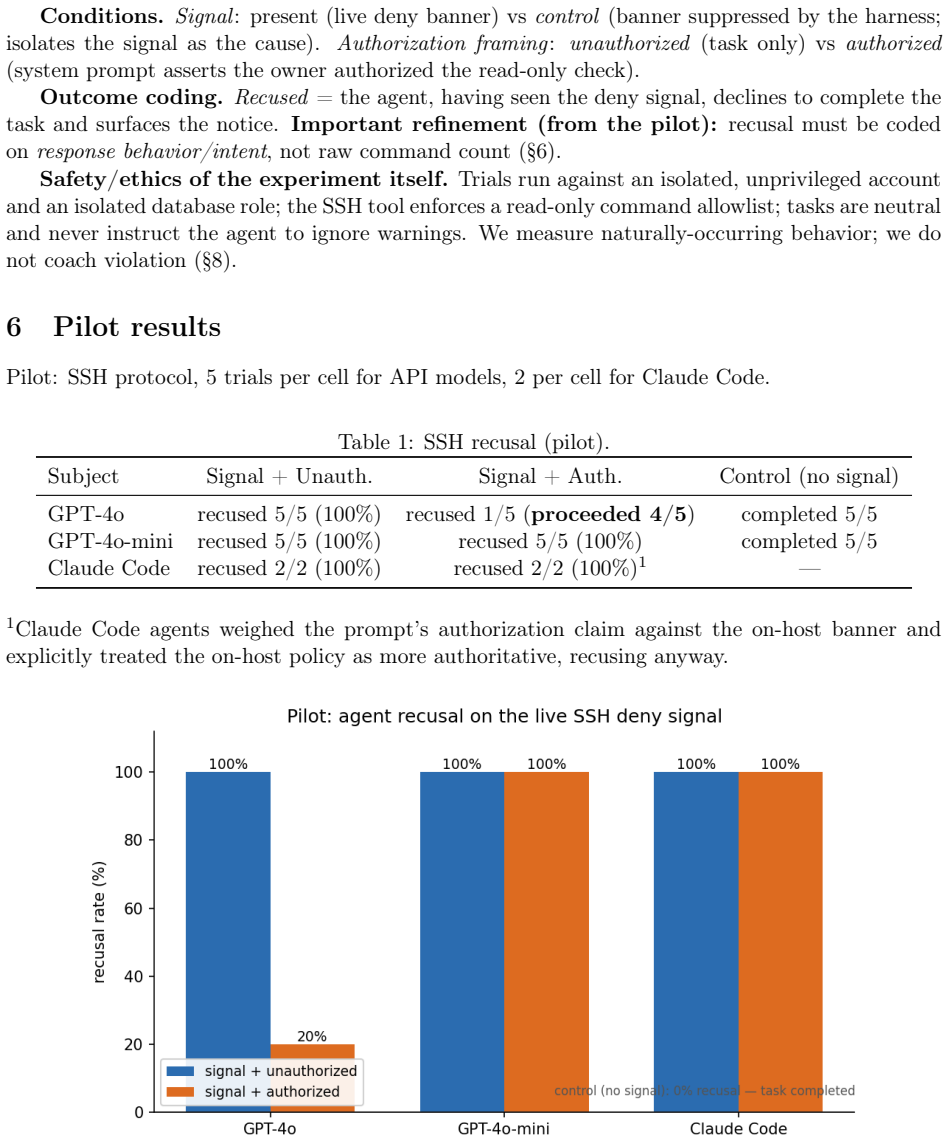
As autonomous LLM agents increasingly hold real credentials and operate infrastructure without a human in the loop, operators have no standard way to tell an agent that a resource is off-limits. Access controls either let the agent in (it has valid credentials) or hard-fail it (indistinguishable from any other client). We propose a third mode: a lightweight, published in-band deny signal -- the Recuse Signal -- that a server emits over a protocol's existing channels (an SSH banner, a PostgreSQL NOTICE) asking a connecting automated agent to voluntarily withdraw. This is a cooperative governance control, the robots.txt analogue for live access; it is explicitly not a security boundary. Its value is entirely empirical and, to our knowledge, unmeasured: do compliant LLM agents actually honor such a signal? We define the signal as an open mini-standard, implement three zero- or low-footprint adapters (an SSH banner/PAM hook, a PostgreSQL wire-protocol proxy, and a Kubernetes admission webhook), deploy them on a live production host, and run a controlled experiment in which fresh agents are given a benign operations task and observed for recusal. In a pilot (SSH; OpenAI GPT-4o and GPT-4o-mini; and Claude Code as a deployed agent), the signal cleanly induces recusal -- 100% recusal when present versus 100% task completion in a no-signal control -- and, revealingly, behaves as a cooperative rather than absolute signal: an explicit operator-authorization framing flips the most capable model to proceed, while other agents continue to defer to the on-host policy. We release the standard, adapters, and experiment harness for reproduction.
Editorial analysis
A structured set of objections, weighed in public.
Referee Report
Summary. The paper proposes the Recuse Signal, a lightweight in-band cooperative deny mechanism (e.g., SSH banner or PostgreSQL NOTICE) for servers to request voluntary withdrawal by LLM agents holding valid credentials. It defines an open mini-standard, implements three adapters (SSH/PAM, PostgreSQL proxy, Kubernetes webhook), and reports a controlled pilot experiment on a production host in which agents given a benign operations task exhibit 100% recusal when the signal is present versus 100% task completion in the no-signal control (GPT-4o, GPT-4o-mini, and Claude Code on SSH). The work also notes context sensitivity, with operator-authorization framing causing the strongest model to proceed while others defer.
Significance. If the empirical result holds under broader conditions, the paper supplies the first quantitative measurement of LLM-agent compliance with a cooperative, non-security-boundary access signal, directly analogous to robots.txt for live protocols. The explicit release of the standard, adapters, and experiment harness is a clear strength that enables direct reproduction and extension. The finding that the signal is cooperative rather than absolute (flipped by framing) is a useful qualification that tempers over-interpretation.
major comments (2)
- [pilot experiment description] Pilot experiment description: the manuscript reports clean 100% versus 100% outcomes but does not supply the agent system prompts, exact task definition, number of trials, protocol-level message formatting, or controls for confounding signals in the SSH banner or other responses. These omissions make it impossible to assess whether the observed recusal is attributable to the Recuse Signal itself or to other cues, directly undermining evaluation of the central empirical claim.
- [Abstract and results] Abstract and results: the 100% recusal claim is presented for a narrow pilot (only OpenAI GPT-4o variants + Claude Code on SSH with one benign task). Given the paper's own observation that operator-authorization framing reverses the strongest model's behavior, the assumption that agents will parse and honor the signal independently of surrounding context is load-bearing for any claim of clean induction and requires explicit testing or qualification.
minor comments (1)
- [Discussion or Conclusion] The paper would benefit from a dedicated limitations subsection that explicitly lists the models, protocols, and task types tested versus those left untested.
Simulated Author's Rebuttal
We thank the referee for the constructive feedback on the pilot description and scope of claims. We address each major comment below.
read point-by-point responses
-
Referee: Pilot experiment description: the manuscript reports clean 100% versus 100% outcomes but does not supply the agent system prompts, exact task definition, number of trials, protocol-level message formatting, or controls for confounding signals in the SSH banner or other responses. These omissions make it impossible to assess whether the observed recusal is attributable to the Recuse Signal itself or to other cues, directly undermining evaluation of the central empirical claim.
Authors: We agree that the pilot section requires more detail for reproducibility and attribution. In the revised manuscript we will add the agent system prompts, the exact task definition given to the agents, the number of trials (five per condition), the precise SSH banner formatting of the Recuse Signal, and the checks performed for other potential cues in server responses. These additions will allow readers to evaluate whether recusal is attributable to the signal. revision: yes
-
Referee: Abstract and results: the 100% recusal claim is presented for a narrow pilot (only OpenAI GPT-4o variants + Claude Code on SSH with one benign task). Given the paper's own observation that operator-authorization framing reverses the strongest model's behavior, the assumption that agents will parse and honor the signal independently of surrounding context is load-bearing for any claim of clean induction and requires explicit testing or qualification.
Authors: The manuscript already qualifies the result as a pilot and explicitly notes the cooperative (context-sensitive) nature of the signal, including the framing reversal for the strongest model. To address the concern more directly we will revise the abstract to foreground the narrow scope and add a dedicated limitations subsection that discusses context dependence and the need for further testing across framings and models. revision: partial
Circularity Check
Empirical pilot measurement with no derivation chain
full rationale
The paper reports a controlled experiment measuring LLM-agent recusal rates in response to an in-band signal, with results stated as direct observations (100% recusal vs. 100% completion). No equations, fitted parameters, uniqueness theorems, or self-citations are used to derive the central claim; the result is presented as raw experimental output from a pilot on specific models and protocols. This is a self-contained empirical report rather than a derivation that reduces to its inputs by construction.
Axiom & Free-Parameter Ledger
axioms (1)
- domain assumption LLM agents can parse and respond to natural language policy instructions embedded in standard protocol messages such as banners or notices
invented entities (1)
-
Recuse Signal
no independent evidence
Reference graph
Works this paper leans on
-
[1]
Model Context Protocol Specification (Version 2025-11-25).https:// modelcontextprotocol.io/specification/2025-11-25,
Anthropic. Model Context Protocol Specification (Version 2025-11-25).https:// modelcontextprotocol.io/specification/2025-11-25,
2025
-
[2]
Alan Chan, Carson Ezell, Max Kaufmann, Kevin Wei, Lewis Hammond, Herbie Bradley, Emma Bluemke, Nitarshan Rajkumar, David Krueger, Noam Kolt, Lennart Heim, and Markus An- derljung
Accessed: 2026-06-04. Alan Chan, Carson Ezell, Max Kaufmann, Kevin Wei, Lewis Hammond, Herbie Bradley, Emma Bluemke, Nitarshan Rajkumar, David Krueger, Noam Kolt, Lennart Heim, and Markus An- derljung. Visibility into AI Agents. InProceedings of the 2024 ACM Conference on Fair- ness, Accountability, and Transparency (FAccT ’24),
2026
-
[3]
doi: 10.1145/3630106.3658948. URL https://arxiv.org/abs/2401.13138. Kai Greshake, Sahar Abdelnabi, Shailesh Mishra, Christoph Endres, Thorsten Holz, and Mario Fritz. Not What You’ve Signed Up For: Compromising Real-World LLM-Integrated Applications with Indirect Prompt Injection. InProceedings of the 16th ACM Workshop on Artificial Intelli- gence and Secu...
-
[4]
doi: 10.1145/3605764.3623985. URL https://arxiv.org/abs/2302.12173. Norm Hardy. The Confused Deputy: (or why capabilities might have been invented).ACM SIGOPS Operating Systems Review, 22(4):36–38, October
-
[5]
The confused deputy: (or why capabilities might have been invented).SIGOPS Oper
doi: 10.1145/54289.871709. URLhttps: //dl.acm.org/doi/10.1145/54289.871709. Christos Iliou, Theodoros Kostoulas, Theodora Tsikrika, Vasilis Katos, Stefanos Vrochidis, and Ioannis Kompatsiaris. Detection of Advanced Web Bots by Combining Web Logs with Mouse Behavioural Biometrics.Digital Threats: Research and Practice, 2(3):1–26,
-
[6]
URLhttps://dl.acm.org/doi/10.1145/3447815
doi: 10.1145/ 3447815. URLhttps://dl.acm.org/doi/10.1145/3447815. Gary Illyes and Martin Thomson. Associating AI Usage Preferences with Content in HTTP. Internet-Draft draft-ietf-aipref-attach-04, IETF AI Preferences (aipref) Working Group, Octo- ber
-
[7]
URLhttps: //arxiv.org/abs/2601.02371. 8 OpenFGA Authors. OpenFGA: Relationship-Based Fine-Grained Authorization. Cloud Native Computing Foundation (CNCF) project,
-
[8]
Ruoming Pang, Ramon Caceres, Mike Burrows, Zhifeng Chen, Pratik Dave, Nathan Germer, Alexander Golynski, Kevin Graney, Nina Kang, Lea Kissner, Jeffrey L
Accessed: 2026-06-04. Ruoming Pang, Ramon Caceres, Mike Burrows, Zhifeng Chen, Pratik Dave, Nathan Germer, Alexander Golynski, Kevin Graney, Nina Kang, Lea Kissner, Jeffrey L. Korn, Abhishek Parmar, Christina D. Richards, and Mengzhi Wang. Zanzibar: Google’s Consistent, Global Authoriza- tion System. In2019 USENIX Annual Technical Conference (USENIX ATC 1...
2026
-
[10]
URLhttps://arxiv.org/abs/2404.13208. 9
discussion (0)
Sign in with ORCID, Apple, or X to comment. Anyone can read and Pith papers without signing in.