The Sun's chemical peculiarity: disentangling Galactic chemical evolution and planetary engulfment in solar twins
Pith reviewed 2026-07-03 05:26 UTC · model grok-4.3
The pith
Galactic chemical evolution accounts for most of the Sun's chemical differences from other solar twins
A machine-rendered reading of the paper's core claim, the machinery that carries it, and where it could break.
Core claim
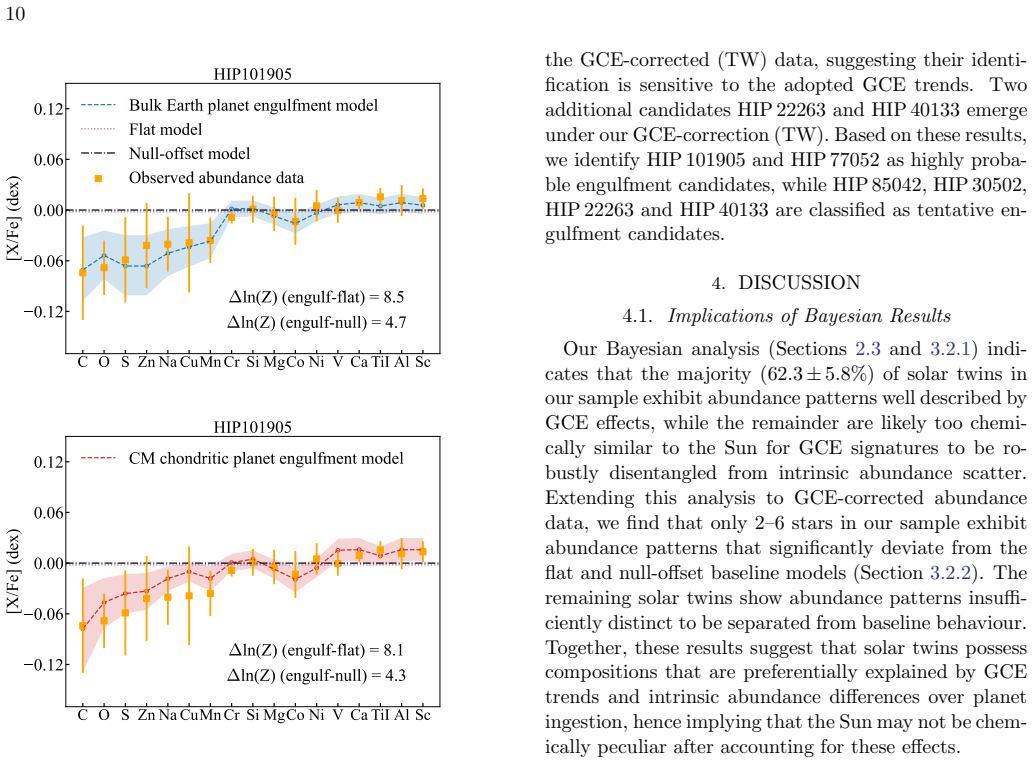
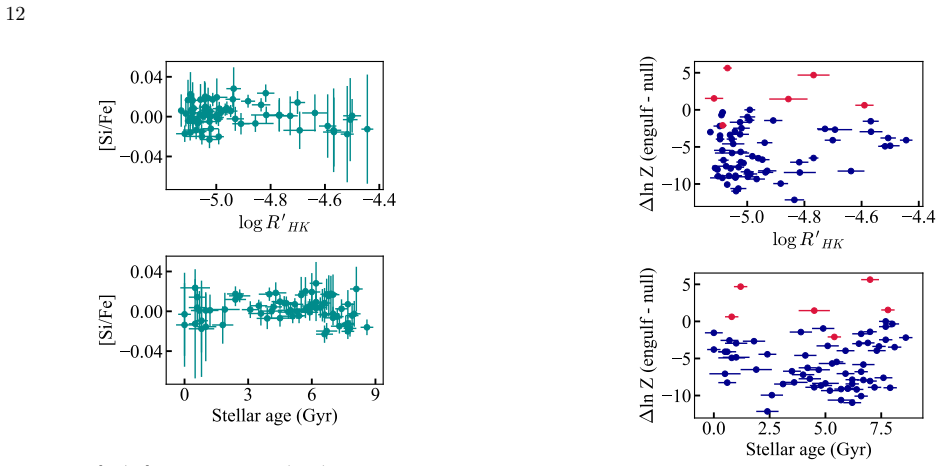
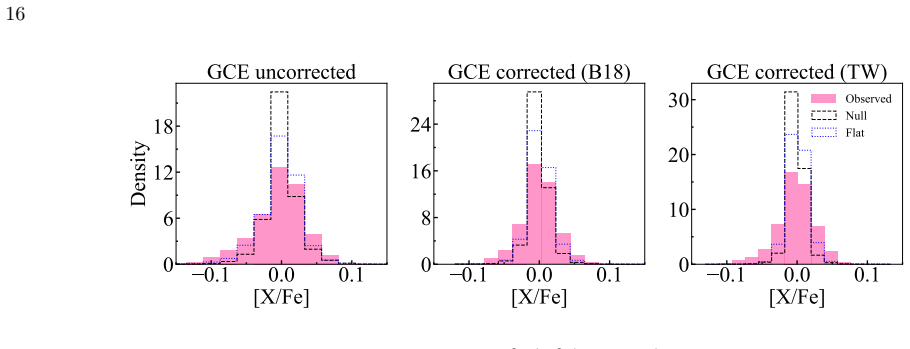
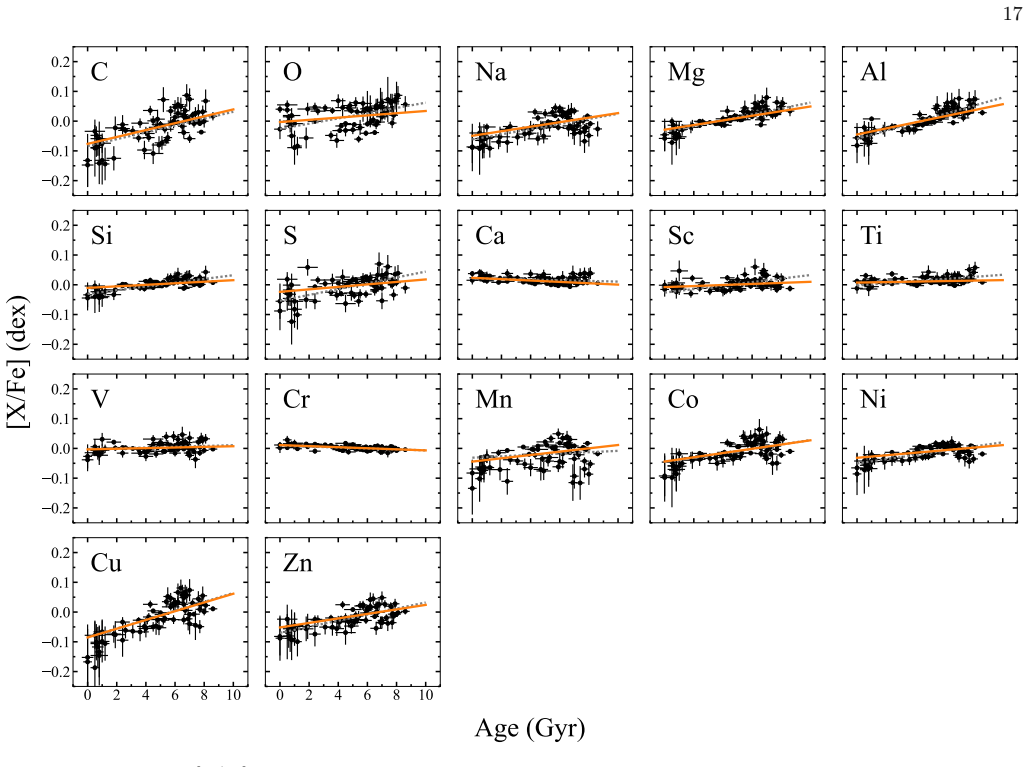
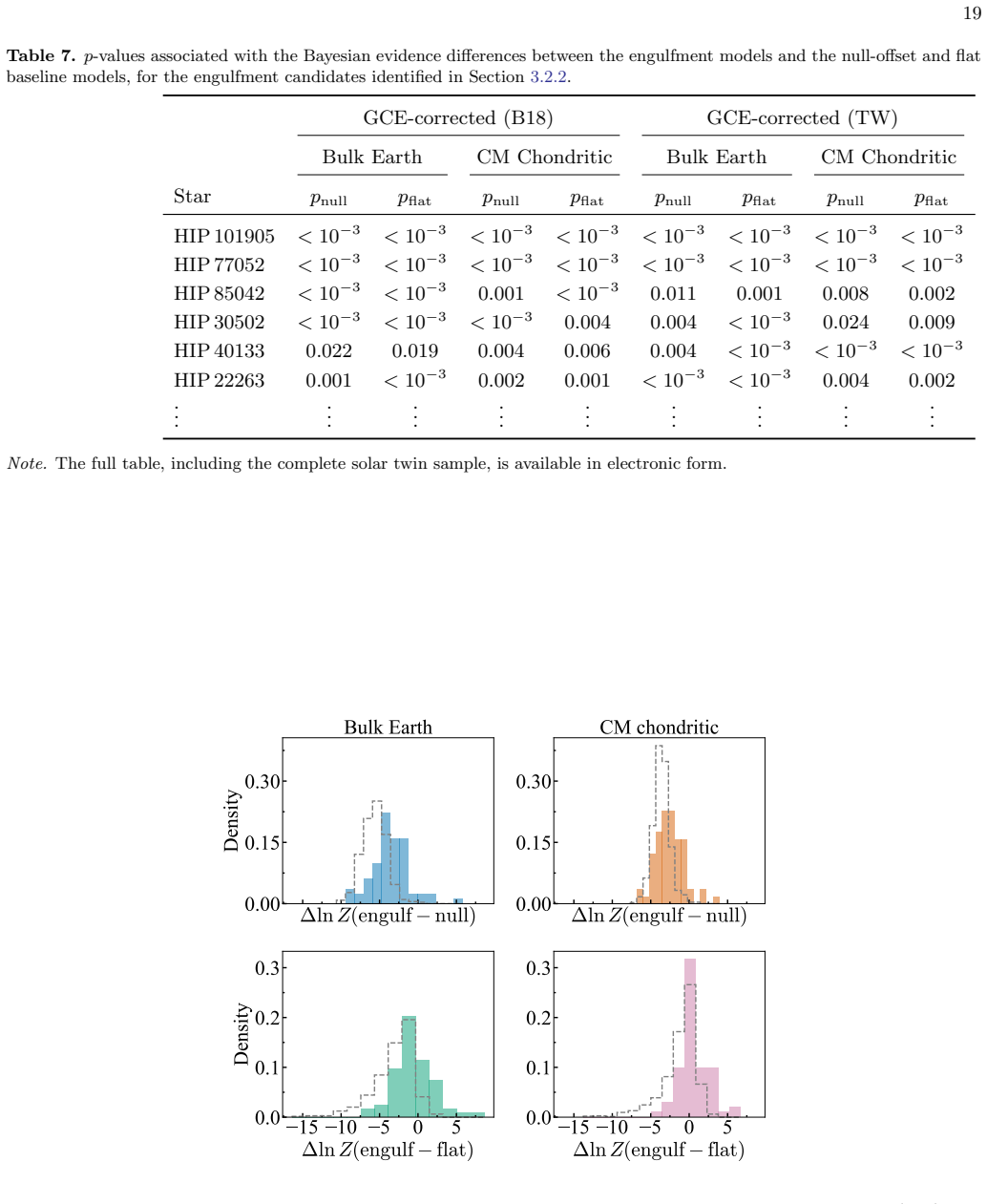
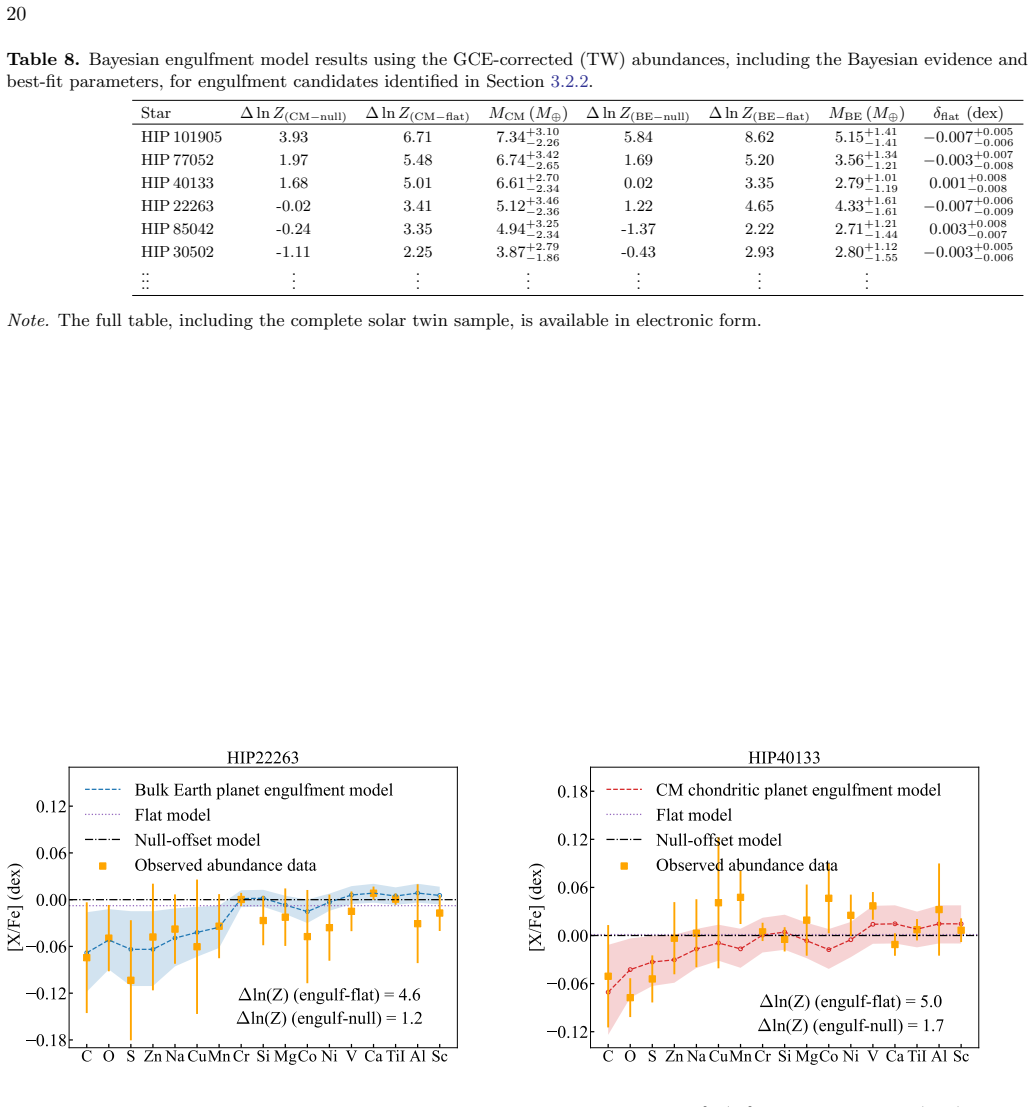
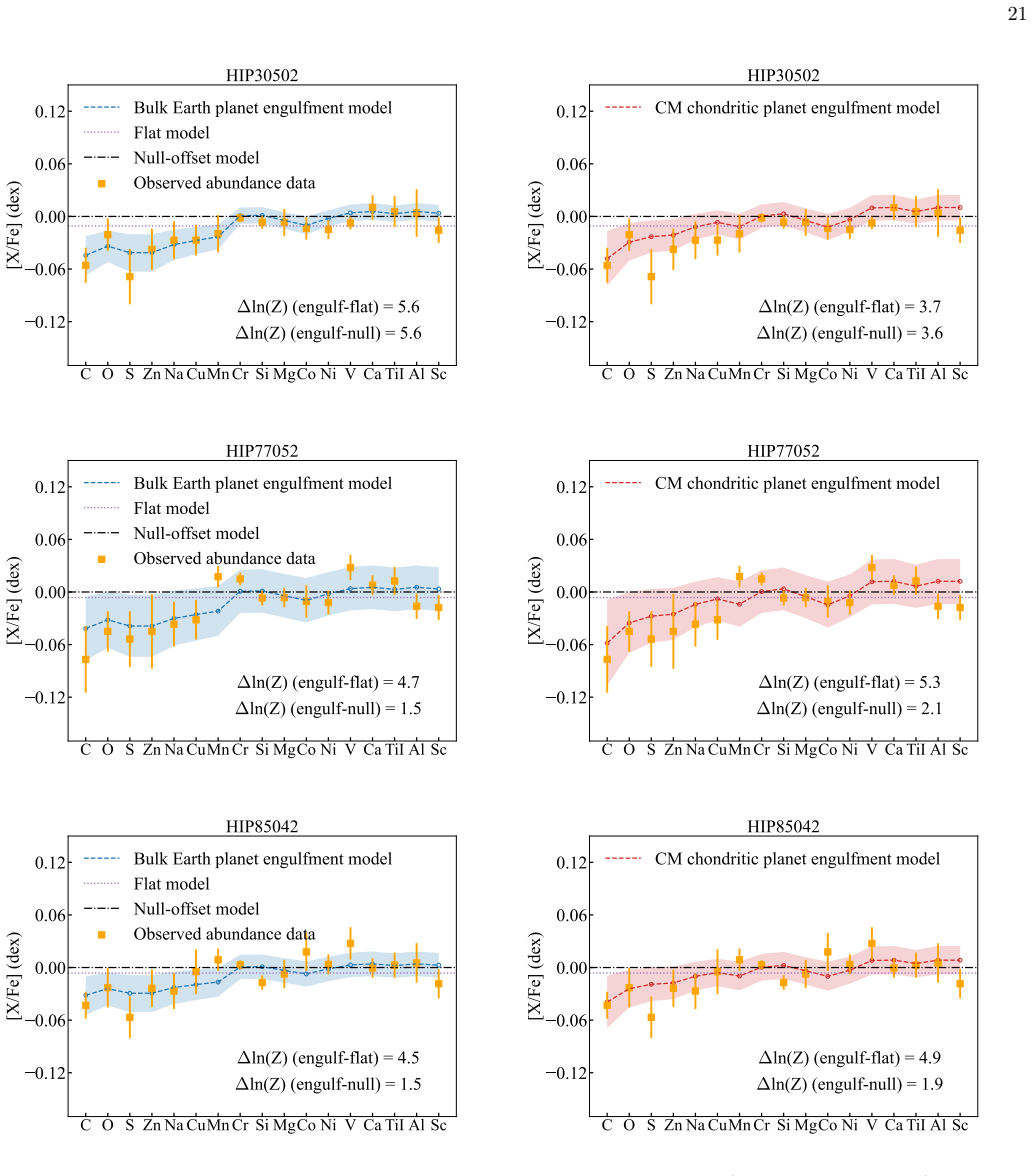
The chemical peculiarity of the Sun relative to the average solar twin is largely driven by GCE effects, with 62.3±5.8% of our sample exhibiting abundance patterns well-described by GCE trends. We further identify 2--6 solar twin candidates exhibiting chemical signatures consistent with planetary engulfment that warrant further investigation. These findings reinforce the importance of accounting for GCE effects when interpreting solar twin abundance patterns, and suggest that the Sun may not be chemically peculiar relative to the majority of solar twins.
What carries the argument
An independent Bayesian indicator that separates Galactic chemical evolution trends and planetary engulfment signatures from intrinsic abundance scatter in differential abundance measurements of 18 elements
If this is right
- GCE effects must be included before attributing abundance anomalies in solar twins to planet interactions.
- The Sun's composition aligns with the majority of solar twins once GCE is accounted for.
- Two to six stars in the sample show abundance patterns consistent with planetary engulfment and merit targeted follow-up.
- Differential abundance analysis combined with the Bayesian separation provides a practical way to classify solar-twin chemistry.
Where Pith is reading between the lines
- Similar Bayesian separation could be applied to abundance data for stars outside the solar-twin range to test how common engulfment signatures are across stellar types.
- If confirmed, the small number of engulfment candidates would imply that planet ingestion is uncommon among stars with solar-like masses and metallicities.
- Long-term monitoring of the candidate stars for debris disks or unusual planetary architectures could provide an independent check on the engulfment interpretation.
Load-bearing premise
An independent Bayesian indicator can reliably separate Galactic chemical evolution and planetary engulfment signals from other processes that affect stellar composition.
What would settle it
High-precision spectra of additional solar twins that, after the same Bayesian separation, show a substantially lower fraction following GCE trends or a higher fraction matching only the engulfment pattern would contradict the reported dominance of GCE.
Figures
read the original abstract
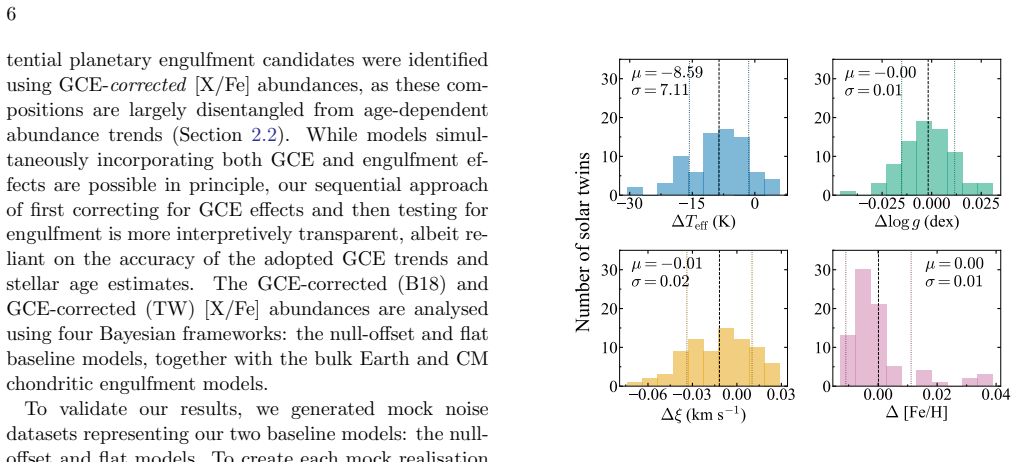
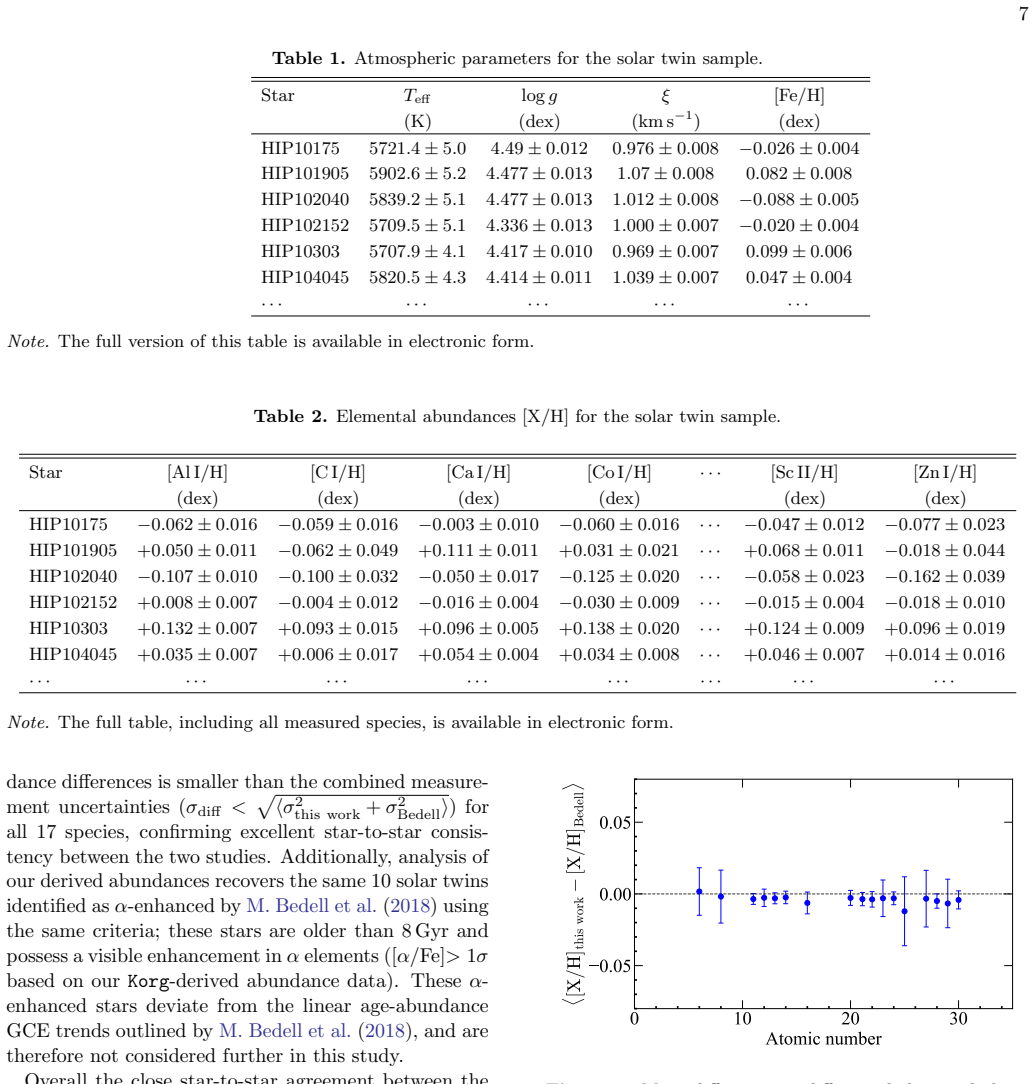
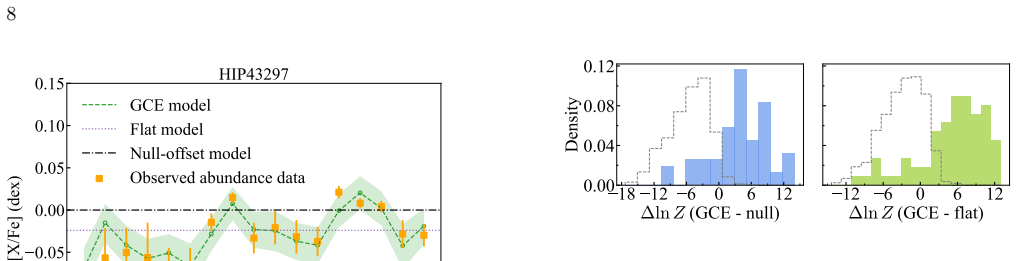
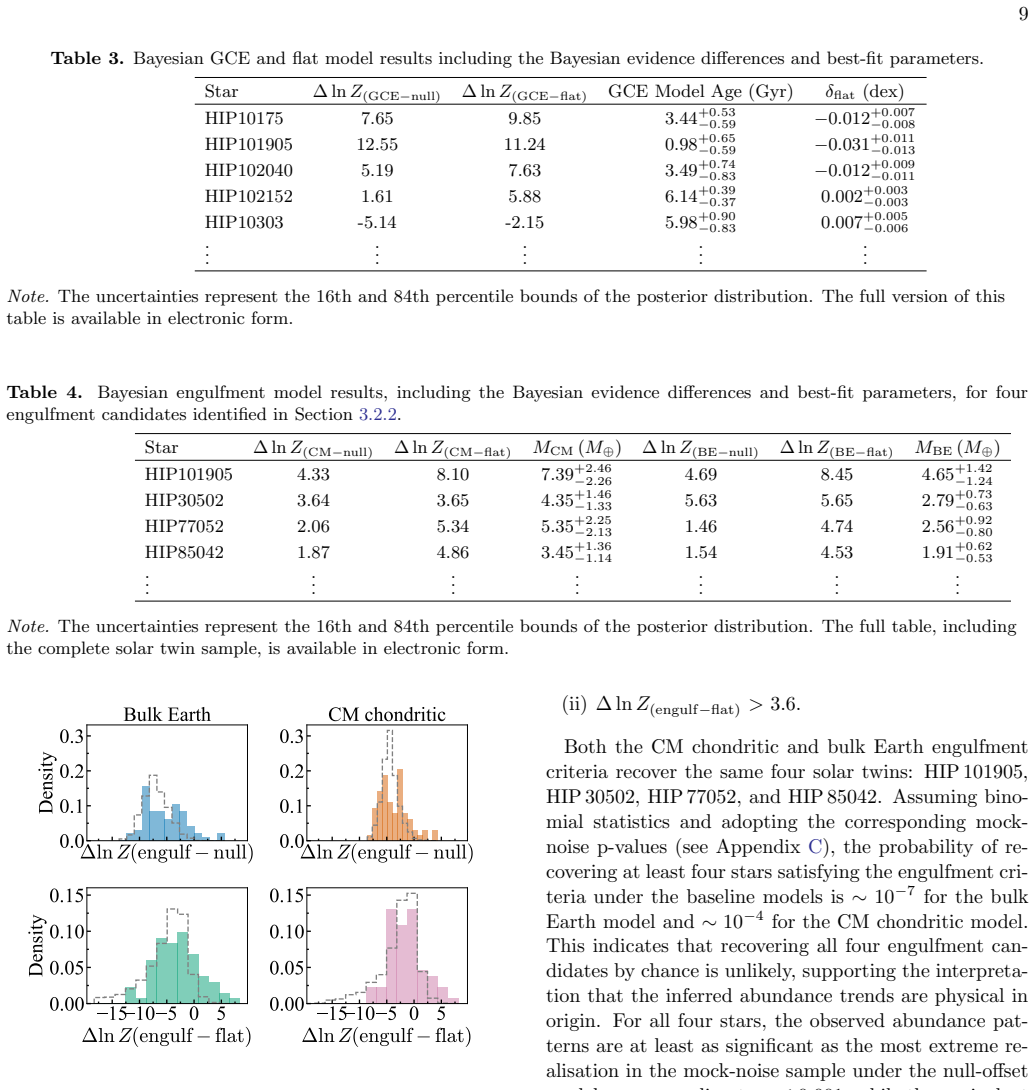
Recent observational studies have suggested that the Sun may be chemically peculiar relative to the majority of solar twins. Here, we re-analyse high-resolution, high signal-to-noise spectra of 79 nearby solar twins using a differential spectroscopic approach and Bayesian framework to test whether the Sun's chemical peculiarity arises from Galactic chemical evolution (GCE) or planetary ingestion. Using the spectroscopic tool \texttt{Korg}, we obtain highly precise, validated atmospheric parameters and abundances for 18 elements, with an average abundance precision of 0.015\,dex (3.5\%). Employing an independent Bayesian indicator, we disentangle GCE and planetary engulfment signatures from other processes influencing stellar composition, including intrinsic abundance scatter. Our results indicate that the chemical peculiarity of the Sun relative to the average solar twin is largely driven by GCE effects, with 62.3$\pm$5.8\% of our sample exhibiting abundance patterns well-described by GCE trends. We further identify 2--6 solar twin candidates exhibiting chemical signatures consistent with planetary engulfment that warrant further investigation. These findings reinforce the importance of accounting for GCE effects when interpreting solar twin abundance patterns, and suggest that the Sun may not be chemically peculiar relative to the majority of solar twins.
Editorial analysis
A structured set of objections, weighed in public.
Referee Report
Summary. The manuscript re-analyzes high-resolution spectra of 79 nearby solar twins with the Korg code to derive precise atmospheric parameters and abundances (average precision 0.015 dex) for 18 elements. It applies a Bayesian framework with an 'independent Bayesian indicator' to separate Galactic chemical evolution (GCE) trends from planetary engulfment signatures and intrinsic scatter, concluding that the Sun's chemical peculiarity is largely explained by GCE (62.3±5.8% of the sample follows GCE trends) while flagging 2–6 twins as potential engulfment candidates.
Significance. If the Bayesian separation is shown to be robust and non-circular, the result would clarify that most solar twins are consistent with GCE expectations, reducing the inferred role of planetary engulfment in explaining the Sun's abundance pattern and reinforcing the need to model GCE when comparing solar twins. The differential analysis and reported precision represent a methodological strength.
major comments (1)
- [Abstract] Abstract (Bayesian framework paragraph): the central claim that 62.3±5.8% of the sample follows GCE trends and that 2–6 twins show engulfment signatures rests on an 'independent Bayesian indicator' that disentangles GCE, engulfment, and intrinsic scatter. No derivation of the indicator, construction of priors, likelihood function, or explicit cross-validation against known sources of scatter (NLTE corrections, 3D granulation, or measurement covariance) is described, leaving open the possibility that the indicator correlates with the same abundance patterns used to define GCE trends.
minor comments (2)
- [Abstract] Abstract: the reported abundance precision of 0.015 dex (3.5%) should specify whether this is the mean, median, or rms across elements and whether it includes systematic contributions.
- [Abstract] Abstract: the range '2--6' candidates is given without stating the exact selection threshold or posterior probability cut used to identify them.
Simulated Author's Rebuttal
We thank the referee for their careful reading and constructive comments on our manuscript. We address the single major comment below.
read point-by-point responses
-
Referee: [Abstract] Abstract (Bayesian framework paragraph): the central claim that 62.3±5.8% of the sample follows GCE trends and that 2–6 twins show engulfment signatures rests on an 'independent Bayesian indicator' that disentangles GCE, engulfment, and intrinsic scatter. No derivation of the indicator, construction of priors, likelihood function, or explicit cross-validation against known sources of scatter (NLTE corrections, 3D granulation, or measurement covariance) is described, leaving open the possibility that the indicator correlates with the same abundance patterns used to define GCE trends.
Authors: We agree that the manuscript does not currently provide a full derivation of the independent Bayesian indicator, including explicit priors, likelihood construction, or cross-validation against NLTE, 3D, and covariance effects. The abstract paragraph is a high-level summary only. We will revise the Methods section to include these details and add a dedicated robustness subsection demonstrating that the indicator is constructed to be orthogonal to the GCE trends (via separate element subsets and hierarchical modeling). This addresses the potential correlation concern directly. revision: yes
Circularity Check
No circularity: Bayesian indicator applied to data yields output fraction without reduction to inputs
full rationale
The paper's central result (62.3±5.8% of sample follows GCE trends) is obtained by applying an explicitly labeled 'independent Bayesian indicator' to high-resolution spectra of 79 solar twins. The abstract presents this indicator as disentangling GCE/engulfment from intrinsic scatter without any quoted equations or steps that define the indicator in terms of the target fraction or fit parameters directly to the claimed percentage. No self-citations are invoked as load-bearing for the indicator's construction, and the reported candidate count (2-6) is likewise a model output on observational data rather than a renaming or self-definitional step. The derivation chain is therefore self-contained against external benchmarks.
Axiom & Free-Parameter Ledger
axioms (2)
- domain assumption Differential spectroscopic analysis with Korg yields accurate relative abundances at 0.015 dex precision
- domain assumption Bayesian indicator can separate GCE, planetary engulfment, and intrinsic scatter
Reference graph
Works this paper leans on
-
[1]
Astronomy and Astrophysics , author =
A possible signature of terrestrial planet formation in the chemical composition of solar analogs , volume =. Astronomy and Astrophysics , author =. 2010 , pages =. doi:10.1051/0004-6361/201014456 , abstract =
-
[2]
Astronomy & Astrophysics , author =
High-precision abundances of. Astronomy & Astrophysics , author =. 2016 , pages =. doi:10.1051/0004-6361/201628888 , abstract =
-
[3]
Astronomy & Astrophysics , author =
High-precision abundances of elements in solar twin stars:. Astronomy & Astrophysics , author =. 2015 , note =. doi:10.1051/0004-6361/201526269 , abstract =
-
[4]
The Astrophysical Journal , author =. 2007 , note =. doi:10.1086/523942 , abstract =
-
[5]
The Astrophysical Journal , author =
Solar. The Astrophysical Journal , author =. 2003 , pages =. doi:10.1086/375492 , abstract =
-
[6]
and Lehmann, Christian and Flynn, Chris and Smith, Daniel and Kos, Janez and Berke, Daniel A
Liu, Fan and Murphy, Michael T. and Lehmann, Christian and Flynn, Chris and Smith, Daniel and Kos, Janez and Berke, Daniel A. and Martell, Sarah L. , month = dec, year =. Survey for distant solar twins (. Monthly Notices of the Royal Astronomical Society , publisher =. doi:10.1093/mnras/stac3033 , abstract =
-
[7]
Astronomy & Astrophysics , author =
Chemical (in)homogeneity and atomic diffusion in the open cluster. Astronomy & Astrophysics , author =. 2019 , pages =. doi:10.1051/0004-6361/201935306 , abstract =
-
[8]
and Liu, Fan and Flynn, Chris and Smith, Daniel and Berke, Daniel A
Lehmann, Christian and Murphy, Michael T. and Liu, Fan and Flynn, Chris and Smith, Daniel and Berke, Daniel A. , month = may, year =. Survey for. Monthly Notices of the Royal Astronomical Society , publisher =. doi:10.1093/mnras/stad381 , abstract =
-
[9]
The chemical composition of the. Annual Review of Astronomy and Astrophysics , author =. 2009 , note =. doi:10.1146/annurev.astro.46.060407.145222 , abstract =
-
[10]
2012 , note =
Astrophysics Source Code Library , author =. 2012 , note =
2012
-
[11]
The Astronomical Journal , author =
Korg:. The Astronomical Journal , author =. 2023 , pages =. doi:10.3847/1538-3881/acaaad , abstract =
-
[12]
Gustafsson, B. and Edvardsson, B. and Eriksson, K. and Jørgensen, U. G. and Nordlund, Å and Plez, B. , month = aug, year =. A grid of. Astronomy & Astrophysics , publisher =. doi:10.1051/0004-6361:200809724 , abstract =
-
[13]
Astronomy & Astrophysics , author =
The remarkable solar twin. Astronomy & Astrophysics , author =. 2012 , pages =. doi:10.1051/0004-6361/201117222 , abstract =
-
[14]
The Astrophysical Journal , author =
18. The Astrophysical Journal , author =. 2014 , pages =. doi:10.1088/0004-637X/791/1/14 , abstract =
-
[15]
dynesty: A Dynamic Nested Sampling Package for Estimating Bayesian Posteriors and Evidences
Speagle, Joshua S. , month = apr, year =. dynesty:. doi:10.48550/arXiv.1904.02180 , abstract =
work page internal anchor Pith review Pith/arXiv arXiv doi:10.48550/arxiv.1904.02180 1904
-
[16]
Astronomy and Astrophysics , author =
Abundance trend with condensation temperature for stars with different. Astronomy and Astrophysics , author =. 2016 , note =. doi:10.1051/0004-6361/201628883 , abstract =
-
[17]
Ramírez, I. and Allende Prieto, C. and Lambert, D. L. , month = feb, year =. Oxygen. The Astrophysical Journal , publisher =. doi:10.1088/0004-637X/764/1/78 , abstract =
-
[18]
Wheeler, Adam J. and Casey, Andrew R. and Abruzzo, Matthew W. , month = feb, year =. Korg:. The Astronomical Journal , publisher =. doi:10.3847/1538-3881/ad19cc , abstract =
-
[19]
Astronomy and Astrophysics , author =
Is missing. Astronomy and Astrophysics , author =. 2004 , note =. doi:10.1051/0004-6361:20040079 , abstract =
-
[20]
The Messenger , author =
Setting. The Messenger , author =. 2003 , note =
2003
-
[21]
Bernstein, Rebecca and Shectman, Stephen A. and Gunnels, Steven M. and Mochnacki, Stefan and Athey, Alex E. , month = mar, year =. doi:10.1117/12.461502 , abstract =
-
[22]
Amarsi, A. M. and Asplund, M. and Collet, R. and Leenaarts, J. , month = nov, year =. The. Monthly Notices of the Royal Astronomical Society , publisher =. doi:10.1093/mnrasl/slv122 , abstract =
-
[23]
Astronomy and Astrophysics , author =
Exploring the. Astronomy and Astrophysics , author =. 2014 , note =. doi:10.1051/0004-6361/201322631 , abstract =
-
[24]
Spina, Lorenzo and Meléndez, Jorge and Karakas, Amanda I. and dos Santos, Leonardo and Bedell, Megan and Asplund, Martin and Ramírez, Ivan and Yong, David and Alves-Brito, Alan and Bean, Jacob L. and Dreizler, Stefan , month = feb, year =. The temporal evolution of neutron-capture elements in the. Monthly Notices of the Royal Astronomical Society , publis...
-
[25]
and Liu, Fan and Flynn, Chris and Berke, Daniel A
Lehmann, Christian and Murphy, Michael T. and Liu, Fan and Flynn, Chris and Berke, Daniel A. , month = may, year =. Survey for. Monthly Notices of the Royal Astronomical Society , publisher =. doi:10.1093/mnras/stac421 , abstract =
-
[26]
Modelling the chemical evolution of the
Matteucci, Francesca , month = dec, year =. Modelling the chemical evolution of the. Astronomy and Astrophysics Review , publisher =. doi:10.1007/s00159-021-00133-8 , abstract =
-
[27]
Korn, A. J. and Grundahl, F. and Richard, O. and Mashonkina, L. and Barklem, P. S. and Collet, R. and Gustafsson, B. and Piskunov, N. , month = dec, year =. Atomic. The Astrophysical Journal , publisher =. doi:10.1086/523098 , abstract =
-
[28]
Astronomy and Astrophysics , author =
The sun among the stars. Astronomy and Astrophysics , author =. 1978 , note =
1978
-
[29]
Nagar, Tushar and Spina, Lorenzo and Karakas, Amanda I. , month = jan, year =. The. The Astrophysical Journal , publisher =. doi:10.3847/2041-8213/ab5dc6 , abstract =
-
[30]
Ramírez, I. and Khanal, S. and Aleo, P. and Sobotka, A. and Liu, F. and Casagrande, L. and Meléndez, J. and Yong, D. and Lambert, D. L. and Asplund, M. , month = jul, year =. The. The Astrophysical Journal , publisher =. doi:10.1088/0004-637X/808/1/13 , abstract =
-
[31]
Astronomy and Astrophysics , author =
On the origin of stars with and without planets. Astronomy and Astrophysics , author =. 2014 , note =. doi:10.1051/0004-6361/201423435 , abstract =
-
[32]
Booth, Richard A. and Owen, James E. , month = apr, year =. Fingerprints of giant planets in the composition of solar twins , volume =. Monthly Notices of the Royal Astronomical Society , publisher =. doi:10.1093/mnras/staa578 , abstract =
-
[34]
Astronomy and Astrophysics , author =
Searching for the signatures of terrestrial planets in. Astronomy and Astrophysics , author =. 2013 , note =. doi:10.1051/0004-6361/201220165 , abstract =
-
[35]
González Hernández, J. I. and Israelian, G. and Santos, N. C. and Sousa, S. and Delgado-Mena, E. and Neves, V. and Udry, S. , month = sep, year =. Searching for the. The Astrophysical Journal , publisher =. doi:10.1088/0004-637X/720/2/1592 , abstract =
-
[36]
2010, MNRAS, 405, 933, doi: 10.1111/j.1365-2966.2010.16536.x
Gonzalez, G. and Carlson, M. K. and Tobin, R. W. , month = sep, year =. Parent stars of extrasolar planets -. Monthly Notices of the Royal Astronomical Society , publisher =. doi:10.1111/j.1365-2966.2010.16900.x , abstract =
-
[37]
The chemical composition of solar-type stars in comparison with that of the
Gustafsson, Bengt and Meléndez, Jorge and Asplund, Martin and Yong, David , month = jul, year =. The chemical composition of solar-type stars in comparison with that of the. Astrophysics and Space Science , publisher =. doi:10.1007/s10509-009-0257-6 , abstract =
-
[38]
Pinsonneault, M. H. and DePoy, D. L. and Coffee, M. , month = jul, year =. The. The Astrophysical Journal , publisher =. doi:10.1086/323531 , abstract =
-
[39]
Astronomy and Astrophysics , author =
Effect of episodic accretion on the structure and the lithium depletion of low-mass stars and planet-hosting stars , volume =. Astronomy and Astrophysics , author =. 2010 , note =. doi:10.1051/0004-6361/201014979 , abstract =
-
[40]
Stahler, S. W. , month = nov, year =. The birthline for low-mass stars. , volume =. The Astrophysical Journal , publisher =. doi:10.1086/161495 , abstract =
-
[41]
Dotter, Aaron and Conroy, Charlie and Cargile, Phillip and Asplund, Martin , month = may, year =. The. The Astrophysical Journal , publisher =. doi:10.3847/1538-4357/aa6d10 , abstract =
-
[42]
Stahler, Steven W. , month = dec, year =. Understanding. Publications of the Astronomical Society of the Pacific , publisher =. doi:10.1086/132352 , abstract =
-
[43]
Stahler, Steven W. , month = sep, year =. Deuterium and the. The Astrophysical Journal , publisher =. doi:10.1086/166694 , abstract =
-
[44]
Astronomy and Astrophysics , author =
The solar abundance problem and. Astronomy and Astrophysics , author =. 2020 , note =. doi:10.1051/0004-6361/201936932 , abstract =
-
[45]
Astronomy and Astrophysics , author =
Evolutionary models for cool brown dwarfs and extrasolar giant planets. Astronomy and Astrophysics , author =. 2003 , note =. doi:10.1051/0004-6361:20030252 , abstract =
work page internal anchor Pith review doi:10.1051/0004-6361:20030252 2003
-
[46]
Encyclopedia of. 2001 , file =. doi:10.1201/9781003220435 , abstract =
-
[47]
Lithium evolution in metal-poor stars: from pre-main sequence to the
Fu, Xiaoting and Bressan, Alessandro and Molaro, Paolo and Marigo, Paola , month = sep, year =. Lithium evolution in metal-poor stars: from pre-main sequence to the. Monthly Notices of the Royal Astronomical Society , publisher =. doi:10.1093/mnras/stv1384 , abstract =
-
[48]
Long-term lithium abundance signatures following planetary engulfment , volume =
Sevilla, Jason and Behmard, Aida and Fuller, Jim , month = nov, year =. Long-term lithium abundance signatures following planetary engulfment , volume =. Monthly Notices of the Royal Astronomical Society , publisher =. doi:10.1093/mnras/stac2436 , abstract =
-
[49]
Krumholz, Mark R. and Thompson, Todd A. , month = jun, year =. Mass. The Astrophysical Journal , publisher =. doi:10.1086/515566 , abstract =
-
[50]
Marley, M. S. and Robinson, T. D. , month = aug, year =. On the. Annual Review of Astronomy and Astrophysics , publisher =. doi:10.1146/annurev-astro-082214-122522 , abstract =
-
[51]
Annual Review of Astronomy and Astrophysics, Vol
Theory of. Annual Review of Astronomy and Astrophysics, Vol. 38, p. 337-377 (2000) , author =. 2000 , pages =. doi:10.1146/annurev.astro.38.1.337 , abstract =
-
[52]
VitalSource , author =
Nuclear. VitalSource , author =. 2015 , file =
2015
-
[53]
Wiley.com , file =
Nuclear. Wiley.com , file =
-
[54]
Kippenhahn, Rudolf and Weigert, Alfred and Weiss, Achim , year =. Stellar. doi:10.1007/978-3-642-30304-3 , language =
-
[55]
Lamers, Henny J. G. L. M. and Levesque, Emily M. , month = dec, year =. Understanding
-
[56]
The science of brown dwarfs , volume =
Burrows, Adam and Liebert, James , month = apr, year =. The science of brown dwarfs , volume =. Reviews of Modern Physics , publisher =. doi:10.1103/RevModPhys.65.301 , abstract =
-
[57]
Burrows, A. and Marley, M. and Hubbard, W. B. and Lunine, J. I. and Guillot, T. and Saumon, D. and Freedman, R. and Sudarsky, D. and Sharp, C. , month = dec, year =. A. The Astrophysical Journal , publisher =. doi:10.1086/305002 , abstract =
-
[58]
Burrows, Adam and Hubbard, W. B. and Lunine, J. I. and Liebert, James , month = jul, year =. The theory of brown dwarfs and extrasolar giant planets , volume =. Reviews of Modern Physics , publisher =. doi:10.1103/RevModPhys.73.719 , abstract =
-
[59]
Scientific American , author =
The. Scientific American , author =. 2000 , pages =. doi:10.1038/scientificamerican0400-76 , language =
-
[60]
and Norton, Andrew J
Ryan, Sean G. and Norton, Andrew J. , month = jan, year =. Stellar
-
[61]
50. 2014 , keywords =. doi:10.1007/978-3-319-01162-2 , language =
-
[62]
and Schwab, Josiah and Gautschy, A
Paxton, Bill and Smolec, R. and Schwab, Josiah and Gautschy, A. and Bildsten, Lars and Cantiello, Matteo and Dotter, Aaron and Farmer, R. and Goldberg, Jared A. and Jermyn, Adam S. and Kanbur, S. M. and Marchant, Pablo and Thoul, Anne and Townsend, Richard H. D. and Wolf, William M. and Zhang, Michael and Timmes, F. X. , month = jul, year =. Modules for. ...
-
[63]
and Bildsten, Lars and Blinnikov, Sergei and Duffell, Paul and Farmer, R
Paxton, Bill and Schwab, Josiah and Bauer, Evan B. and Bildsten, Lars and Blinnikov, Sergei and Duffell, Paul and Farmer, R. and Goldberg, Jared A. and Marchant, Pablo and Sorokina, Elena and Thoul, Anne and Townsend, Richard H. D. and Timmes, F. X. , month = feb, year =. Modules for. The Astrophysical Journal Supplement Series , publisher =. doi:10.3847/...
work page internal anchor Pith review doi:10.3847/1538-4365/aaa5a8
-
[64]
and Bildsten, Lars and Cantiello, Matteo and Dessart, Luc and Farmer, R
Paxton, Bill and Marchant, Pablo and Schwab, Josiah and Bauer, Evan B. and Bildsten, Lars and Cantiello, Matteo and Dessart, Luc and Farmer, R. and Hu, H. and Langer, N. and Townsend, R. H. D. and Townsley, Dean M. and Timmes, F. X. , month = sep, year =. Modules for. The Astrophysical Journal Supplement Series , publisher =. doi:10.1088/0067-0049/220/1/1...
work page internal anchor Pith review doi:10.1088/0067-0049/220/1/15
-
[65]
Paxton, Bill and Cantiello, Matteo and Arras, Phil and Bildsten, Lars and Brown, Edward F. and Dotter, Aaron and Mankovich, Christopher and Montgomery, M. H. and Stello, Dennis and Timmes, F. X. and Townsend, Richard , month = sep, year =. Modules for. The Astrophysical Journal Supplement Series , publisher =. doi:10.1088/0067-0049/208/1/4 , abstract =
work page internal anchor Pith review doi:10.1088/0067-0049/208/1/4
-
[66]
Paxton, Bill and Bildsten, Lars and Dotter, Aaron and Herwig, Falk and Lesaffre, Pierre and Timmes, Frank , month = jan, year =. Modules for. The Astrophysical Journal Supplement Series , publisher =. doi:10.1088/0067-0049/192/1/3 , abstract =
-
[67]
Jermyn, Adam S. and Bauer, Evan B. and Schwab, Josiah and Farmer, R. and Ball, Warrick H. and Bellinger, Earl P. and Dotter, Aaron and Joyce, Meridith and Marchant, Pablo and Mombarg, Joey S. G. and Wolf, William M. and Sunny Wong, Tin Long and Cinquegrana, Giulia C. and Farrell, Eoin and Smolec, R. and Thoul, Anne and Cantiello, Matteo and Herwig, Falk a...
-
[68]
Revisiting the pre-main-sequence evolution of stars
Kunitomo, Masanobu and Guillot, Tristan and Ida, Shigeru and Takeuchi, Taku , month = oct, year =. Revisiting the pre-main-sequence evolution of stars. Astronomy and Astrophysics , publisher =. doi:10.1051/0004-6361/201833127 , abstract =
-
[69]
Revisiting the pre-main-sequence evolution of stars -
Kunitomo, Masanobu and Guillot, Tristan and Takeuchi, Taku and Ida, Shigeru , month = mar, year =. Revisiting the pre-main-sequence evolution of stars -. Astronomy & Astrophysics , publisher =. doi:10.1051/0004-6361/201628260 , abstract =
-
[70]
The dispersal of planet-forming discs: theory confronts observations , volume =
Ercolano, Barbara and Pascucci, Ilaria , month = apr, year =. The dispersal of planet-forming discs: theory confronts observations , volume =. Royal Society Open Science , publisher =. doi:10.1098/rsos.170114 , abstract =
-
[71]
Ward-Thompson, Derek and Whitworth, Anthony P. , year =. An. doi:10.1017/CBO9780511974021 , abstract =
-
[72]
Shore, Steven N. , editor =. Magnetic. Encyclopedia of. 2003 , pages =. doi:10.1016/B0-12-227410-5/00392-6 , urldate =
-
[73]
Hartmann, Lee , year =. Accretion. doi:10.1017/CBO9780511552090 , abstract =
-
[74]
Young, Alison K. , month = dec, year =. Insights into the first and second hydrostatic core stages from numerical simulations , volume =. Frontiers in Astronomy and Space Sciences , publisher =. doi:10.3389/fspas.2023.1288730 , abstract =
-
[75]
Astronomy and Astrophysics , author =
First core properties: from low- to high-mass star formation , volume =. Astronomy and Astrophysics , author =. 2018 , note =. doi:10.1051/0004-6361/201832635 , abstract =
-
[76]
Pudritz, Ralph E. and Ray, Tom P. , month = jul, year =. The. Frontiers in Astronomy and Space Sciences , publisher =. doi:10.3389/fspas.2019.00054 , abstract =
-
[77]
Annual Review of Astronomy and Astrophysics , publisher =
Bachiller, Rafael , month = sep, year =. Annual Review of Astronomy and Astrophysics , publisher =. doi:10.1146/annurev.astro.34.1.111 , abstract =
-
[78]
Annual Review of Astronomy and Astrophysics , author =
Protostellar. Annual Review of Astronomy and Astrophysics , author =. 2016 , note =. doi:10.1146/annurev-astro-081915-023341 , abstract =
-
[79]
Stahler, Steven , editor =. Bipolar. Encyclopedia of. 2011 , pages =. doi:10.1007/978-3-642-11274-4_195 , language =
-
[80]
Space Science Reviews , author =
Herbig. Space Science Reviews , author =. 2023 , keywords =. doi:10.1007/s11214-023-00949-z , abstract =
-
[81]
Offner, Stella S. R. and Klein, Richard I. and McKee, Christopher F. , month = oct, year =. Driven and. The Astrophysical Journal , publisher =. doi:10.1086/590238 , abstract =
discussion (0)
Sign in with ORCID, Apple, or X to comment. Anyone can read and Pith papers without signing in.