REVIEW 1 major objections 1 minor 27 references
Scientific Statement Classification over arXiv.org
T0 review · 1 major / 1 minor · reviewed 2026-08-14 · deepseek-v4-flash
Pith's one-line read This paper introduces a 13-class scientific statement classification task built from 10.4 million author-marked arXiv paragraphs and reports a 0.91 F1 bidirectional LSTM baseline.
desk verdict A valuable open dataset and pipeline for scientific statement classification, but the headline 0.91 F1 is partly by construction and needs reframing. read the letter →
The pith
A machine-rendered reading of the paper's core claim, the machinery that carries it, and where it could break.
The reading
What carries the argument
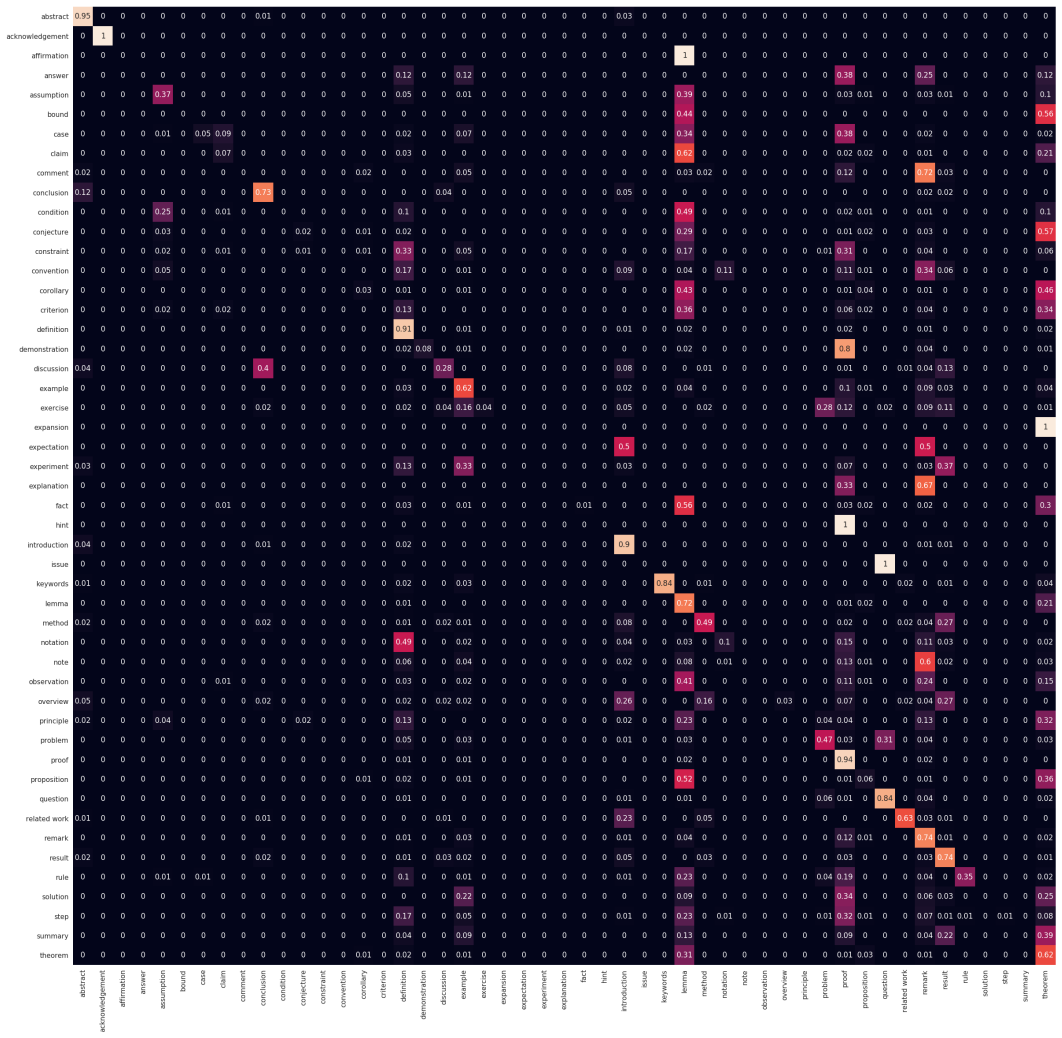
The load-bearing machinery is a machine-readable HTML5 conversion of the preprint corpus that preserves the exact environment scoping of author markup, together with a preprocessing pipeline that extracts the first logical paragraph of each marked-up environment, filters by language and conversion quality, and serializes mathematical expressions as font- and case-preserving lexeme tokens. The task design itself is carried by confusion-matrix nesting: classes that a BiLSTM systematically confuses are merged into abstract parent classes, most notably a proposition nest that absorbs lemma, theorem, corollary, conjecture, and related labels, while clearly separable classes such as abstract, acknowledgement, and proof are kept intact. This nesting procedure is what converts a noisy fifty-way labeling problem into the thirteen-class benchmark.
What would settle it
A human-annotation study on a random sample of the held-out test paragraphs, asking trained readers to assign the thirteen labels, would settle whether the 0.91 F1 reflects genuine separability: if human agreement is materially below or far above the model's score, or if humans cannot reliably distinguish the merged proposition nest, the benchmark's validity would be in question. Alternatively, training the same BiLSTM on thirteen classes chosen independently of the confusion analysis, for example by a panel of domain experts, and comparing F1 would reveal how much of the reported improvement is due to the grouping procedure.
Extended reading notes
Core claim
On the paper's own terms, the central discovery is that the fifty author-annotated paragraph labels in arXiv submissions collapse, under a confusion-matrix analysis of a BiLSTM classifier, into thirteen separable classes while retaining 99% of the 10.5 million annotated paragraphs. The same model family that scored 0.67 F1 on the fifty-class version reaches 0.91 F1 on the thirteen-class version, and a hierarchical attention network reaches 0.89, establishing the reduced task as well-posed for current methods. The paper also introduces a lexeme serialization for mathematical formulas that preserves font, weight, and case distinctions, and observes a small but consistent 0.01 F1 gain for context-aware models when the math modality is included.
Load-bearing premise
The load-bearing premise is that merging the original fifty labels into thirteen nests according to the confusion matrix of the same BiLSTM model family produces a task that is meaningfully aligned with how scientific statements are actually distinguished, rather than a redefinition tailored to what that model can already separate.
Editorial extensions
If this is right
- If the task is accepted, follow-up work has a 10.4-million-paragraph benchmark with thirteen labels, a held-out test set of 2.1 million paragraphs, and baselines ranging from 0.77 to 0.91 F1.
- The math lexeme serialization lets standard NLP pipelines include symbolic modality; the paper finds a 0.01 F1 gain for context-sensitive models when math tokens are retained.
- The confusion-nesting method offers a general recipe for task design on weakly labeled scholarly corpora: use a strong baseline's confusion matrix to define separable label nests.
- The paper's stated next step is a sequence-of-paragraphs classification task with full-document context, which should particularly help positionally anchored labels like abstract and conclusion.
Reading between the lines
- The headline F1 improvement from 0.67 to 0.91 is substantially an artifact of label regrouping; because the nests are constructed from the same model family's errors, the benchmark is partly circular and would be strengthened by an independent human-agreement study.
- If the thirteen classes reflect genuine linguistic nests, the same grouping should transfer to other machine-readable scholarly corpora without retraining the confusion analysis, which is a testable prediction.
- The math-modality gain being confined to context-aware models suggests that sequence models with longer context, such as transformers, may show a larger effect from formula lexemes than the 0.01 F1 observed with LSTMs.
Signed reviews
Editorial analysis
A structured set of objections, weighed in public.
Referee Report
Summary. The paper introduces a new large-scale scientific statement classification task derived from the arXMLiv HTML5 conversion of arXiv, extracting 10.5 million paragraph-level samples with 50 author-annotated labels. To make the task tractable, the authors inspect the confusion matrix of a BiLSTM encoder-decoder trained on an 80/20 split of the 50-class data and group the 50 labels into 13 'nests,' retaining 99% of the original paragraphs. They then evaluate several baselines on the reduced 13-class task, reporting that a BiLSTM encoder-decoder achieves a 0.91 F1 score, and they perform a control experiment omitting mathematical formulas to assess the contribution of the symbolic modality. The paper also releases the preprocessed dataset, preprocessing code, and baseline implementations.
Significance. If the proposed benchmark is valid, this is a substantial community resource: the dataset is two orders of magnitude larger than most prior statement-classification corpora, the preprocessing pipeline is described in detail and made publicly available, and the math-lexeme serialization is a novel contribution that may benefit the MathIR community. The paper also provides several reproducible baselines. However, the central evaluation is weakened by a circularity in the task design: the 13-class grouping is derived from the confusion matrix of the same model family on the same test split that is later used to report the headline F1, so the 0.91 figure is not an unbiased estimate of generalization to a predefined task. The data collection and preprocessing strengths are real, but the performance claims need to be re-framed or re-validated.
major comments (1)
- [§3, §5] The grouping into 13 nests is motivated solely by the confusion patterns of a single architecture (BiLSTM). No external evidence—such as human annotation agreement, functional taxonomy of scientific discourse, or an independent corpus study—is provided to establish that these nests are natural or meaningful classes. The paper acknowledges this is 'empirical curation' but does not discuss the associated validity threat. For a benchmark intended for the wider community, the task definition should be justified independently of any particular model's errors. At minimum, the authors should provide a post-hoc analysis showing that the groupings are stable across different model families or that a human-labeled subset confirms the nest structure.
minor comments (1)
- [Abstract, §1] The phrase 'aligns with known success rates from the state of the art' is vague. Please specify which known success rates are being referred to and how the comparison is quantified.
Circularity Check
The 0.91 F1 headline is partly circular: the 13-class task was constructed from the same BiLSTM's test-split confusion matrix, and the same split is then used to report the model's improved F1.
-
fitted input called prediction
[Section 3 'Task Design' (Figure 2) and Section 4 'Baselines' (Table 2, Figure 3)]
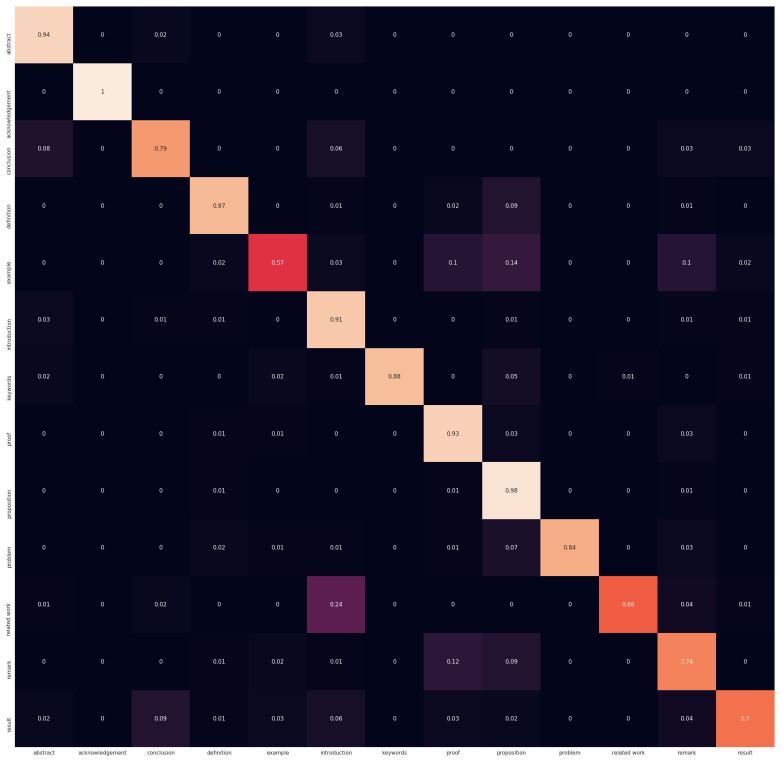
"We pre-partition the 50 class data into an 80/20 train/test split, which we consistently use in our modeling work. In order to inform if a classification task is well-posed, we pre-train a range of models known to perform well in the state of the art. In Figure 2, we share the confusion matrix of our best 50-class baseline model, a BiLSTM encoder-decoder. ... [we] group the observed inter-confused nests together into more abstract union classes. ... It achieves a baseline F1 score of 0.91, the best baseline presented in this paper."
The reduced 13-class task is derived from the confusion matrix of the BiLSTM on the fixed 80/20 split, and then the same model family is evaluated on that redesigned task using the same split. The class labels were therefore chosen using the test-set errors of the very architecture whose F1 is later advertised as 0.91. The reported improvement from 0.67 to 0.91 is partly a consequence of redefining the label set to match the model's known confusions, rather than a clean measure of generalization on a fixed benchmark. The paper's own zero-rule baseline rising from 0.201 to 0.388 confirms that a substantial part of the gain is mechanical regrouping, not modeling progress.
full rationale
The dataset construction itself is largely self-contained and valuable: labels come from author markup, preprocessing is documented, and the released resources are external artifacts. The central numerical claim, however, contains a circular step. Section 3 states that the 50-class data is pre-partitioned into an 80/20 train/test split used consistently, and that the 13-class task is motivated by inspecting the confusion matrix of the best 50-class BiLSTM baseline (Figure 2). Section 4 reports that the same BiLSTM encoder-decoder achieves 0.91 F1 on the 13-class task, with a confusion matrix evaluated on the same unseen test set. Because the class regrouping was chosen to merge the classes that this model family confused on that very test split, the F1 gain from 0.67 to 0.91 is not a clean estimate of performance on a fixed, pre-defined benchmark; it is an optimistic post-hoc evaluation. The paper's own zero-rule numbers show part of the gain is mechanical: the trivial majority-class baseline rises from 0.201 to 0.388 after regrouping. This is task-design leakage rather than gradient leakage. Still, the underlying data release, the preprocessing, and the relative ranking of baselines retain independent value, so the circularity is partial and the score is 6 rather than 8.
Assumptions & free parameters
free parameters (3)
- 13-class grouping =
25 original labels grouped into 13 nests
- BiLSTM hidden sizes =
128, 64, 64
- Paragraph size =
480 words
assumptions (3)
- domain assumption Author \newtheorem environments correspond to the intended statement type.
- domain assumption The first logical paragraph of a marked-up environment is a self-contained statement.
- ad hoc to paper A confusion-matrix-based regrouping of labels is a principled way to define a classification task.
Cite this review
Pith. "Pith review of Scientific Statement Classification over arXiv.org." pith.science (2026). https://pith.science/paper/JINAWJS7
@misc{pith2026190810993,
  author       = {Pith},
  title        = {Pith review of: Scientific Statement Classification over arXiv.org},
  year         = {2026},
  howpublished = {\url{https://pith.science/paper/JINAWJS7}},
  note         = {Machine review of arXiv:1908.10993}
}
read the original abstract
We introduce a new classification task for scientific statements and release a large-scale dataset for supervised learning. Our resource is derived from a machine-readable representation of the arXiv.org collection of preprint articles. We explore fifty author-annotated categories and empirically motivate a task design of grouping 10.5 million annotated paragraphs into thirteen classes. We demonstrate that the task setup aligns with known success rates from the state of the art, peaking at a 0.91 F1-score via a BiLSTM encoder-decoder model. Additionally, we introduce a lexeme serialization for mathematical formulas, and observe that context-aware models could improve when also trained on the symbolic modality. Finally, we discuss the limitations of both data and task design, and outline potential directions towards increasingly complex models of scientific discourse, beyond isolated statements.
Figures

Reference graph
Works this paper leans on
-
[1]
Transforming large collections of scientific publications to XML
Heinrich Stamerjohanns, Michael Kohlhase, Deyan Ginev, Catalin David, and Bruce Miller. Transforming large collections of scientific publications to XML. Mathematics in Computer Science, 3(3):299–307, 2010. URL http://kwarc.info/kohlhase/papers/mcs10.pdf
work page 2010
-
[2]
arXMLiv:08.2018 dataset, an HTML5 conversion of arXiv.org
Deyan Ginev. arXMLiv:08.2018 dataset, an HTML5 conversion of arXiv.org. https:// sigmathling.kwarc.info/resources/arxmliv-dataset-082018/ , 2018
work page 2018
-
[3]
LaTeXML: A LATEX to XML converter
Bruce Miller. LaTeXML: A LATEX to XML converter. http://dlmf.nist.gov/LaTeXML/, 2019
work page 2019
-
[4]
Fernández, Michael Kay, Jonathan Ro- bie, and Jérôme Siméon
Anders Berglund, Scott Boag, Don Chamberlin, Mary F. Fernández, Michael Kay, Jonathan Ro- bie, and Jérôme Siméon. XML Path Language (XPath) 2.0. W3C recommendation, World Wide Web Consortium (W3C). URL http://www.w3.org/TR/2007/REC-xpath20-20070123/
work page 2007
-
[5]
LLaMaPUn: common language and mathematics processing algorithms
Deyan Ginev and Jan Frederik Schaefer. LLaMaPUn: common language and mathematics processing algorithms. https://github.com/dginev/llamapun/, 2019
work page 2019
-
[6]
Jeffrey Pennington, Richard Socher, and Christopher D. Manning. Glove: Global vectors for word representation. In Empirical Methods in Natural Language Processing (EMNLP), pages 1532–1543, 2014. URL http://www.aclweb.org/anthology/D14-1162
work page 2014
-
[7]
whatlang: Natural language detection library for rust
Sergey Potapov. whatlang: Natural language detection library for rust. https://crates. io/crates/whatlang
-
[8]
N-gram-based text categorization
William Cavnar and John Trenkle. N-gram-based text categorization. Proceedings of the Third Annual Symposium on Document Analysis and Information Retrieval , 05 2001. URL https://www.let.rug.nl/~vannoord/TextCat/textcat.pdf
work page 2001
Show all 27 references
-
[9]
Statement classification dataset, 10.5 million plain-text para- graphs from arXMLiv:08.2018
Deyan Ginev. Statement classification dataset, 10.5 million plain-text para- graphs from arXMLiv:08.2018. https://sigmathling.kwarc.info/resources/ arxmliv-statements-082018/, 2019. SIGMathLing – Special Interest Group on Math Linguistics
2018
-
[10]
A History of Mathematical Notations
Florian Cajori. A History of Mathematical Notations . Courier Dover Publications, 1993. Originally published in 1929
1993
-
[11]
Keras: The python deep learning library
François Chollet et al. Keras: The python deep learning library. https://keras.io, 2015
2015
-
[12]
Martín Abadi, Ashish Agarwal, Paul Barham, Eugene Brevdo, Zhifeng Chen, Craig Citro, Greg S. Corrado, Andy Davis, Jeffrey Dean, Matthieu Devin, Sanjay Ghemawat, Ian Goodfellow, Andrew Harp, Geoffrey Irving, Michael Isard, Yangqing Jia, Rafal Jozefowicz, Lukasz Kaiser, Manjunat...
2015
-
[13]
Statement classification task: Jupyter notebooks for baselines and analysis
Deyan Ginev. Statement classification task: Jupyter notebooks for baselines and analysis. https://github.com/dginev/arxiv-statement-classification , 2019
2019
-
[14]
Kingma and Jimmy Ba
Diederik P. Kingma and Jimmy Ba. Adam: A method for stochastic optimization. In Yoshua Bengio and Yann LeCun, editors, 3rd International Conference on Learning Representations, ICLR 2015, San Diego, CA, USA, May 7-9, 2015, Conference Track Proceedings, 2015. URL http://arxiv.o...
2015 arXiv
-
[15]
Smola, and Eduard H
Zichao Yang, Diyi Yang, Chris Dyer, Xiaodong He, Alexander J. Smola, and Eduard H. Hovy. Hierarchical attention networks for document classification. In Kevin Knight, Ani Nenkova, and Owen Rambow, editors, NAACL HLT 2016, The 2016 Conference of the North American Chapter of the...
2016
-
[16]
An implementation of hierchical attention networks for document clas- sification in Keras
Floris Hoogenboom. An implementation of hierchical attention networks for document clas- sification in Keras. https://github.com/FlorisHoogenboom/keras-han-for-docla , 2018. 9
2018
-
[17]
Learning Phrase Representations using RNN En- coder–Decoder for Statistical Machine Translation
Kyunghyun Cho, Bart van Merrienboer, Caglar Gulcehre, Dzmitry Bahdanau, Fethi Bougares, Holger Schwenk, and Yoshua Bengio. Learning Phrase Representations using RNN En- coder–Decoder for Statistical Machine Translation. In Proceedings of the 2014 Conference on Empirical Method...
2014 doi
-
[18]
Salakhutdinov
Devendra Singh Sachan, Manzil Zaheer, and Ruslan R. Salakhutdinov. Revisiting LSTM net- works for semi-supervised text classification via mixed objective function. In AAAI 2019,
2019
-
[19]
Statement classification: online demonstration
Deyan Ginev. Statement classification: online demonstration. Showcase at https:// corpora.mathweb.org/classify_paragraph. Code at https://github.com/dginev/ showcase-statement-classification , 2019
2019
-
[20]
Stephen M. Watt. Mathematical document classification via symbol frequency analysis. In Petr Sojka, editor, Towards Digital Mathematics Library, DML workshop. Masaryk University, Brno,
-
[21]
Logical structure analysis of scientific publications in mathematics
Valery Solovyev and Nikita Zhiltsov. Logical structure analysis of scientific publications in mathematics. In Proceedings of the International Conference on Web Intelligence, Mining and Semantics, WIMS ’11, pages 21:1–21:9, New York, NY , USA, 2011. ACM. ISBN 978-1-4503- 0148-0...
2011
-
[22]
NTCIR-12 MathIR task overview
Akiko Aizawa, Michael Kohlhase, Iadh Ounis, and Richard Zanibbi. NTCIR-12 MathIR task overview. In Noriko Kando, Tetsuya Sakai, and Mark Sanderson, editors, Proceedings of the 12th NTCIR Conference on Evaluation of Informa- tion Access Technologies , pages 299–308, Tokyo, Japa...
2016
-
[23]
Understanding the logical and semantic structure of large documents
Muhammad Mahbubur Rahman and Tim Finin. Understanding the logical and semantic structure of large documents. https://arxiv.org/abs/1709.00770, 2017
2017 arXiv
-
[24]
Clement, Matthew Bierbaum, Kevin P
Colin B. Clement, Matthew Bierbaum, Kevin P. O’Keeffe, and Alexander A. Alemi. On the use of arXiv as a dataset. https://arxiv.org/abs/1905.00075, 2019
1905 arXiv
-
[25]
Dai, Christopher Olah, and Quoc V
Andrew M. Dai, Christopher Olah, and Quoc V . Le. Document embedding with paragraph vectors. http://arxiv.org/abs/1507.07998, 2015. 10
2015 arXiv
-
[2008]
URL https://www.fi.muni.cz/usr/sojka/download/dml2008/16.pdf
-
[2019]
URL https://www.kdd.org/kdd2018/files/deep-learning-day/DLDay18_ paper_46.pdf
Reviewed August 14, 2026 · model on record in the stance chip above.
Discussion (0). Continue with ORCID to comment.