REVIEW 4 major objections 5 minor 1 cited by
Piloting Structure-Based Drug Design via Modality-Specific Optimal Schedule
T0 review · 4 major / 5 minor · reviewed 2026-08-15 · deepseek-v4-flash
Pith's one-line read The paper claims that multi-modality drug generation has a path-dependent variational bound, and that optimizing the noise path yields 95.9% valid drug poses.
desk verdict Multi-modality noise schedules matter a lot, and the proposed VOS works empirically, but the 'VLB-optimal' label outruns the math the authors actually provide. read the letter →
The pith
A machine-rendered reading of the paper's core claim, the machinery that carries it, and where it could break.
The reading
What carries the argument
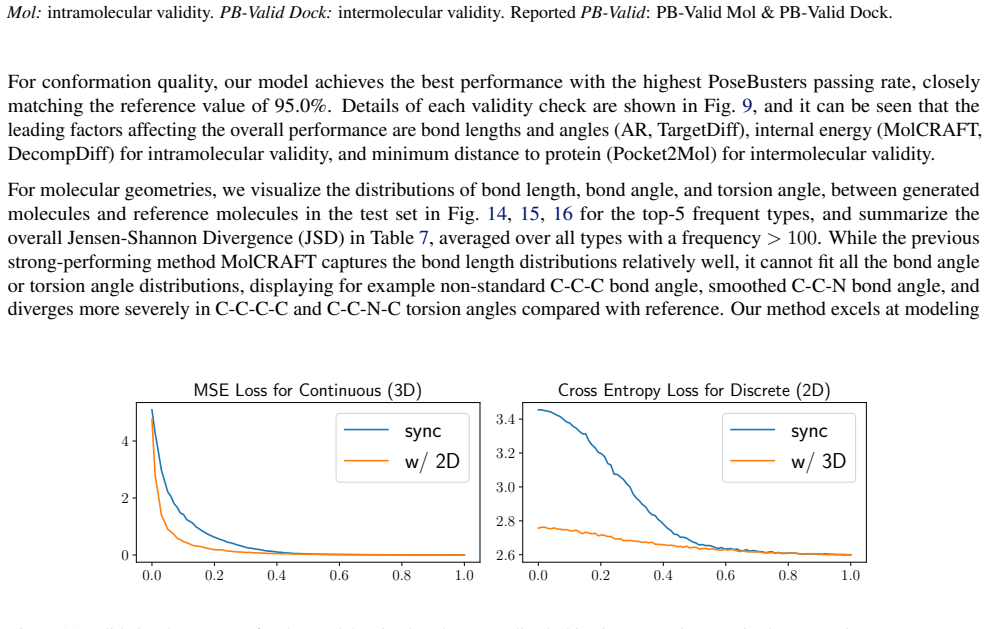
The machinery is the 2D noise-level square $(t_c,t_d)$ and the cost surface on it. A theorem shows that for any monotone schedule $\beta_m(t)$ there is a time-rescaling $f(t)$ with $\beta_m(t)=\tilde{\beta}_m(f(t))$; hence every joint schedule is a monotone path from $(0,0)$ to $(1,1)$ in the square, and the schedule-design space becomes paths rather than arbitrary functions. A model trained with the generalized loss (Eq. 14) denoises at every pair $(t_c,t_d)$, so the instantaneous cost $C(t_c,t_d)=\frac12\lVert x-\tilde{x}_\phi(\theta,\beta)\rVert^2$ is available over the whole square. Dynamic programming over a B-spline-smoothed 20×20 grid of these costs finds the minimal cumulative-cost path, and backtracking it yields the optimal schedule $\beta^*(t)=(\tilde{\beta}_c(f(t)),\tilde{\beta}_d(g(t)))$. In the paper's reading, one model trained this way covers all schedules simultaneously, so the derived schedule can be used at inference time without retraining.
What would settle it
On a held-out set, evaluate the model's squared denoising error on a fine grid of $(t_c,t_d)$ pairs — especially pairs far from the default schedule, such as high 3D noise combined with low 2D noise — and compare the measured surface to the B-spline cost surface used in the dynamic program; large mismatches mean the derived schedule is not truly VLB-optimal. As a second check, rerun the search on a cost matrix estimated from a different random batch; if the returned path changes substantially, the schedule is not a stable optimum.
Extended reading notes
Core claim
The central claim is that the variational lower bound for the twisted probability path depends on the whole joint noise schedule, not just its endpoints. Writing the schedule as $\beta(t)=(\beta_c(t),\beta_d(t))$ for continuous coordinates and discrete topology, the bound is the line integral of the per-point denoising error along the curve that $\beta$ traces in the 2D noise-level square; different curves with the same endpoints produce different bounds, directly contradicting the single-modality invariance result. The paper further claims that any monotone schedule can be represented by two time-rescaling functions $t_c=f(t)$, $t_d=g(t)$ applied to fixed base schedules, so the search space collapses to monotone paths in the unit square. Training with a generalized surface-integral loss over all $(t_c,t_d)$ pairs lets one network evaluate the bound for any schedule, and dynamic programming on the smoothed cost surface returns the optimal path. This path is interpreted as two-stage generation — first sketching the 3D shape, then docking the 2D graph into it — and MolPilot equipped with it achieves 95.9% PoseBusters-valid molecules on CrossDock, 79.1% on the OOD PoseBusters set, and 44.0% RMSD<2 Å local-docking accuracy on PoseBusters V2.
Load-bearing premise
The entire optimality argument depends on the trained model being equally good at denoising for every combination of 3D and 2D noise levels; if its error is uneven across that grid, the cost surface used to pick the schedule is wrong and the derived schedule is not guaranteed to be optimal.
Editorial extensions
If this is right
- PoseBusters passing rate rises from MolCRAFT's 84.6% to 95.9% on CrossDock and from 57.8% to 79.1% on the out-of-distribution PoseBusters set, with the largest gains in internal-energy and geometry checks.
- A single checkpoint serves both de novo design and docking: fixing the 2D topology induces a conditional distribution over positions that reaches 44.0% RMSD<2 Å on PoseBusters V2, comparable to dedicated local docking tools.
- VOS transfers beyond Bayesian Flow Networks: adding the generalized loss and optimal schedule to diffusion-based TargetDiff raises PoseBusters validity on CrossDock from 50.5% to 58.1%.
- Because the model learns the full loss surface, schedules can be interpolated or extrapolated at test time; moving from the identity schedule toward the optimal one improves Vina scores monotonically.
- The optimal schedule's two-stage shape — 3D shape sketching followed by topology-driven docking — provides a concrete explanation for why default 3D-dominant schedules generate distorted bond lengths and angles.
Reading between the lines
- The path-integral argument is not specific to drug molecules: any generative model with factorized noise over heterogeneous modalities (sequence plus structure, graph plus geometry, text plus image) has the same endpoint-invariance failure, so a similar schedule search could be run without changing the architecture.
- A testable extension is pocket-specific scheduling: rather than one global optimal schedule, estimate the cost surface conditioned on a particular protein pocket and derive $\beta^*$ per target; the paper's interpolation results suggest performance would track local surface shape.
- The two-stage structure of $\beta^*$ suggests an interpretable control knob that the paper does not exploit: by choosing curves biased toward more sketching or more docking, one could explicitly trade geometry fidelity against topological diversity.
- The claim that the generalized-loss model is uniformly accurate everywhere is strong; a stress test comparing per-region denoising residuals on off-training-manifold $(t_c,t_d)$ pairs would show whether the schedule search or the training objective is doing the heavy lifting.
Signed reviews
Editorial analysis
A structured set of objections, weighed in public.
Referee Report
Summary. The paper proposes VLB-Optimal Scheduling (VOS), a method for designing noise schedules in multi-modality structure-based drug design. Building on Bayesian Flow Networks, the authors argue that the variational lower bound for the joint continuous-3D/discrete-2D generation process is a path integral in the two-dimensional noise-level plane, so the schedule should be chosen by optimizing this integral. Their pipeline trains a single model with a generalized surface-integral loss (Eq. 14), evaluates the per-point denoising cost C(t_c,t_d) on an M×M grid, fits a B-spline surface, and applies dynamic programming (Algorithm 2) to find a minimal cumulative-cost path from (0,0) to (1,1). The resulting time-rescaling functions are mapped back to a noise schedule β*. The integrated model MolPilot is reported to achieve a PoseBusters passing rate of 95.9% on CrossDock and 79.1% on an out-of-distribution PoseBusters set, together with a 44.0% RMSD<2Å rate on molecular docking. The paper also provides an OOD benchmark construction by sequence-identity filtering, an ablation on schedule interpolation, and a transfer experiment with the diffusion model TargetDiff.
Significance. If the VLB-optimality claim were established, VOS would give a principled and general recipe for multi-modality schedule design, replacing the mostly heuristic schedules used in current SBDD generators. The empirical contributions are substantial: the authors carefully curate an OOD test set, report detailed geometric distribution metrics, demonstrate transfer to a diffusion baseline, and provide code. The claim that the searched schedule is VLB-optimal is, however, the central theoretical contribution, and it is currently not supported at the level the paper claims. The paper is therefore of interest to the generative-modeling and SBDD communities, but the theoretical framing requires substantial revision or clarification before the main claim can be accepted.
major comments (4)
- [Appendix A.3, Eq. (16), Remark 4.5] The paper's central claim that the DP-searched schedule β* maximizes the VLB is not established because the objective actually minimized by the dynamic program is not the VLB. Appendix A.3 explicitly states that the accuracy level α is taken as the derivative of the default schedule β̃(t) rather than the candidate path, and that 'the optimization objective no longer corresponds to the exact likelihood, but a rescaled sum of KL divergence terms that put more weight on the continuous variable.' Thus Eq. (16) optimizes a surrogate weighted objective, so J(1,1) cannot be claimed to be an unbiased Monte-Carlo estimate of the optimal VLB (Remark 4.5). The authors should either prove a formal relation between the surrogate and the VLB (e.g., a bound or a monotone transformation) or clearly re-frame the method as a heuristic schedule search with good empirical performance.
- [Proposition 4.3 and Appendix B.5] The proof of Proposition 4.3 asserts that training with the generalized loss (Eq. 14) makes the model 'achieve minimal prediction error everywhere in the joint noise space', and that its predictions are therefore 'accurate along any submanifold'. This is a pointwise-accuracy inference drawn from an average loss minimization, and it does not follow for a finite-capacity neural network. The manuscript itself concedes in A.2 that the model 'is not invariant w.r.t. noisy input at different scales.' Since the DP cost matrix C(t_c,t_d) is evaluated with this model, systematic errors in low-density or high-curvature regions of the (t_c,t_d) plane could bias the selected schedule. The authors should provide direct evidence that the estimated cost field is accurate over the whole grid, for example by comparing the DP-selected path against a path obtained on a held-out cost surface or by reporting residual errors of the B-spline fit.
- [Appendix A.1, convergence guarantee] The 'convergence guarantee' paragraph in A.1 claims that the discrete DP solution converges to the continuous VLB-optimal path as the grid resolution goes to infinity. This is asserted without proof, and it relies on the two contested assumptions above: that the cost field is pointwise accurate and that the DP objective equals the VLB. In addition, the valid DP steps are approximated by the gradient of a B-spline surface fitted from only M=20 cost evaluations, and no error analysis is provided for this approximation. The asymptotic-optimality claim should either be proven under explicit assumptions, or removed and replaced by a weaker statement about the discrete surrogate objective.
- [Section 5.2 and Table 1, comparison protocol] The comparison protocol mixes results from the original papers (♡), official samples (†), and re-runs of baseline code (♢), with different sampling budgets per target (100 molecules for MolPilot and the OOD baselines, but an unspecified number for some ID baselines). Since PoseBusters passing rate is sensitive to sampling effort and post-processing, the authors should state the exact sampling and evaluation protocol for every reported number, and ideally provide error bars or multiple seeds for the main claims. This does not change the qualitative conclusion but is necessary to substantiate the 'SOTA' claim in Table 1.
minor comments (5)
- [Appendix D.2, Table 7 caption] The caption reads 'Jenson-Shannon Divergence', which should be 'Jensen-Shannon Divergence'.
- [Figures 14–16] Several labels in these figures are typeset as 'T argetDiff' and 'DecompDiff' with a spurious space; please fix the typography in the camera-ready version.
- [Appendix A.1, 'Convergence guarantee'] The phrase 'the same number of evaluations of the generative model ˜xϕ is required' suggests each grid point is evaluated once on a batch, but the cost estimate in Definition 4.4 uses an expectation over x; the exact number of samples per grid point should be stated.
- [Section 4.3, Definition 4.4] The cost C(t_c,t_d) in Eq. (15) is written as ∥x−˜xϕ(θ,β)∥² but the dependence on the sampled batch and on t is implicit; clarifying that this is an empirical average over data and posterior samples would help reproducibility.
- [Appendix B.4, Eq. (10)] The step 'By redefining ˜xϕ(θ,β) := F(β_c,β_d)' is confusing because Eq. (10) writes a single squared norm while F is a two-component vector; please make the notation consistent so the line-integral interpretation is unambiguous.
Circularity Check
One internal validation is self-referential: the 'VLB-optimal' schedule is selected by minimizing the same scaled-KL objective used in Table 4, so that comparison is forced; external SBDD benchmarks remain independent.
-
fitted input called prediction
[Sec. 4.3, Definition 4.4, Eq. 16, and Table 4]
"C(tc,td) = 1/2∥x− x̃φ(θ,β)∥² (15) ... J(tc,td) = min(ϵc,ϵd) [J(tc−ϵc,td−ϵd)+αC(tc,td)] (16) ... Table 4 empirically validates the derived schedule with better VLB than default."
The DP in Algorithm 2 selects β* by minimizing the cumulative cost ΣαC over the (tc,td) grid, with C defined in Eq. 15 as the model's squared prediction error and α absorbing the schedule derivative. Table 4's 'Validation loss' is described as 'the sum of scaled KL divergence at sample time,' i.e., the same line-integral objective that the DP minimizes. Consequently, the optimal schedule having lower validation loss than default is guaranteed by the optimization itself, not an independent check that the schedule maximizes VLB. This part of the validation reduces by construction to the fitted cost surface.
full rationale
The central schedule-search procedure is not circular in the strong sense: the model is first trained with the generalized loss (Eq. 14), the cost matrix is evaluated on a grid, the DP selects a path before sampling, and the headline PoseBusters, Vina, and geometry results are measured on held-out complexes with external tools. Those external improvements are not forced by the schedule-selection objective. The self-citations to MolCRAFT and other prior BFN works are not load-bearing theorems; they provide baselines and architecture choices, and the empirical comparison against them is independent. The main circular element is the internal validation in Table 4, which re-scores the schedule with essentially the same scaled-KL line-integral objective used to choose it, so the 'better VLB' result is by construction. Separately, the strict 'VLB-optimal' claim is weakened by two non-circular support gaps: Appendix A.3 admits that setting α to the default schedule's derivative changes the optimization objective, so the DP solves a rescaled surrogate rather than the exact VLB; and the proof of Proposition 4.3 (Appendix B.5) asserts uniform pointwise accuracy from training on the generalized loss, an unverified capacity assumption. These are correctness-risk issues, not circularity, and do not undermine the independent external benchmarking.
Assumptions & free parameters
free parameters (4)
- beta_1 (discrete noise scale) =
1.5
- sigma_1 (continuous noise scale) =
0.05
- DP grid resolution M =
20
- Accuracy level alpha =
derivative of default schedule
assumptions (4)
- domain assumption The BFN framework's variational distribution q(y1:n|x) factorizes over timesteps and modalities; the joint VLB is the sum of per-modality KL terms.
- ad hoc to paper The model trained with the generalized surface loss (Eq. 14) achieves minimal prediction error everywhere in the joint noise space, so the cost field is accurate along any path.
- domain assumption The loss surface is smooth enough that B-spline interpolation from M=20 grid points yields an accurate cost field.
- domain assumption Vina scores are a valid proxy for interaction quality and drug-likeness.
Cite this review
Pith. "Pith review of Piloting Structure-Based Drug Design via Modality-Specific Optimal Schedule." pith.science (2026). https://pith.science/paper/JIZR6NTZ
@misc{pith2026250507286,
  author       = {Pith},
  title        = {Pith review of: Piloting Structure-Based Drug Design via Modality-Specific Optimal Schedule},
  year         = {2026},
  howpublished = {\url{https://pith.science/paper/JIZR6NTZ}},
  note         = {Machine review of arXiv:2505.07286}
}
read the original abstract
Structure-Based Drug Design (SBDD) is crucial for identifying bioactive molecules. Recent deep generative models are faced with challenges in geometric structure modeling. A major bottleneck lies in the twisted probability path of multi-modalities -- continuous 3D positions and discrete 2D topologies -- which jointly determine molecular geometries. By establishing the fact that noise schedules decide the Variational Lower Bound (VLB) for the twisted probability path, we propose VLB-Optimal Scheduling (VOS) strategy in this under-explored area, which optimizes VLB as a path integral for SBDD. Our model effectively enhances molecular geometries and interaction modeling, achieving state-of-the-art PoseBusters passing rate of 95.9% on CrossDock, more than 10% improvement upon strong baselines, while maintaining high affinities and robust intramolecular validity evaluated on held-out test set. Code is available at https://github.com/AlgoMole/MolCRAFT.
Figures


Figures from the paper (13 more)




Forward citations
Cited by 1 Pith paper
-
Kinetic Langevin Diffusion for Crystalline Materials Generation
KLDM runs the diffusion process for crystal coordinates in Euclidean velocity space via left-trivialized kinetic Langevin dynamics on a torus, and reports competitive or state-of-the-art performance on CSP and DNG benchmarks.
Reference graph
Works this paper leans on
-
[1]
J., Bambrick, J., et al
Abramson, J., Adler, J., Dunger, J., Evans, R., Green, T., Pritzel, A., Ronneberger, O., Willmore, L., Ballard, A. J., Bambrick, J., et al. Accurate structure prediction of biomolecular interactions with alphafold 3. Nature, pp.\ 1--3, 2024
2024
-
[2]
Bouysset, C. and Fiorucci, S. Prolif: a library to encode molecular interactions as fingerprints. Journal of cheminformatics, 13 0 (1): 0 72, 2021
work page 2021
-
[3]
M., and Deane, C
Buttenschoen, M., Morris, G. M., and Deane, C. M. Posebusters: Ai-based docking methods fail to generate physically valid poses or generalise to novel sequences. Chemical Science, 15 0 (9): 0 3130--3139, 2024
2024
-
[4]
Generative flows on discrete state-spaces: Enabling multimodal flows with applications to protein co-design
Campbell, A., Yim, J., Barzilay, R., Rainforth, T., and Jaakkola, T. Generative flows on discrete state-spaces: Enabling multimodal flows with applications to protein co-design. In Salakhutdinov, R., Kolter, Z., Heller, K., Weller, A., Oliver, N., Scarlett, J., and Berkenkamp, F. (eds.), Proceedings of the 41st International Conference on Machine Learning...
2024
-
[5]
Diffdock: Diffusion steps, twists, and turns for molecular docking
Corso, G., Stärk, H., Jing, B., Barzilay, R., and Jaakkola, T. Diffdock: Diffusion steps, twists, and turns for molecular docking. International Conference on Learning Representations (ICLR), 2023
work page 2023
-
[6]
H., Doucet, A., Strudel, R., Dyer, C., Durkan, C., et al
Dieleman, S., Sartran, L., Roshannai, A., Savinov, N., Ganin, Y., Richemond, P. H., Doucet, A., Strudel, R., Dyer, C., Durkan, C., et al. Continuous diffusion for categorical data. arXiv preprint arXiv:2211.15089, 2022
arXiv 2022
-
[7]
Eberhardt, J., Santos-Martins, D., Tillack, A. F., and Forli, S. Autodock vina 1.2. 0: New docking methods, expanded force field, and python bindings. Journal of chemical information and modeling, 61 0 (8): 0 3891--3898, 2021
work page 2021
-
[8]
G., Masuda, T., Sunseri, J., Jia, A., Iovanisci, R
Francoeur, P. G., Masuda, T., Sunseri, J., Jia, A., Iovanisci, R. B., Snyder, I., and Koes, D. R. Three-dimensional convolutional neural networks and a cross-docked data set for structure-based drug design. Journal of chemical information and modeling, 60 0 (9): 0 4200--4215, 2020
work page 2020
Show all 34 references
-
[9]
K., Atkinson, T., and Gomez, F
Graves, A., Srivastava, R. K., Atkinson, T., and Gomez, F. Bayesian flow networks. arXiv preprint arXiv:2308.07037, 2023
2023 arXiv
-
[10]
W., Peng, X., Su, Y., Peng, J., and Ma, J
Guan, J., Qian, W. W., Peng, X., Su, Y., Peng, J., and Ma, J. 3d equivariant diffusion for target-aware molecule generation and affinity prediction. In The Eleventh International Conference on Learning Representations, 2022
2022
-
[11]
D ecomp D iff: Diffusion models with decomposed priors for structure-based drug design
Guan, J., Zhou, X., Yang, Y., Bao, Y., Peng, J., Ma, J., Liu, Q., Wang, L., and Gu, Q. D ecomp D iff: Diffusion models with decomposed priors for structure-based drug design. In Krause, A., Brunskill, E., Cho, K., Engelhardt, B., Sabato, S., and Scarlett, J. (eds.), Proceeding...
2023
-
[12]
R., Joshi, C
Harris, C., Didi, K., Jamasb, A. R., Joshi, C. K., Mathis, S. V., Lio, P., and Blundell, T. Benchmarking generated poses: How rational is structure-based drug design with generative models? arXiv preprint arXiv:2308.07413, 2023
2023 arXiv
-
[13]
Interaction-based retrieval-augmented diffusion models for protein-specific 3d molecule generation
Huang, Z., Yang, L., Zhou, X., Qin, C., Yu, Y., Zheng, X., Zhou, Z., Zhang, W., Wang, Y., and Yang, W. Interaction-based retrieval-augmented diffusion models for protein-specific 3d molecule generation. In Forty-first International Conference on Machine Learning, 2024 a . URL ...
2024
-
[14]
Protein-ligand interaction prior for binding-aware 3d molecule diffusion models
Huang, Z., Yang, L., Zhou, X., Zhang, Z., Zhang, W., Zheng, X., Chen, J., Wang, Y., Bin, C., and Yang, W. Protein-ligand interaction prior for binding-aware 3d molecule diffusion models. In The Twelfth International Conference on Learning Representations, 2024 b
2024
-
[15]
Structure-based drug design with geometric deep learning
Isert, C., Atz, K., and Schneider, G. Structure-based drug design with geometric deep learning. Current Opinion in Structural Biology, 79: 0 102548, April 2023. ISSN 0959440X. doi:10.1016/j.sbi.2023.102548. URL https://linkinghub.elsevier.com/retrieve/pii/S0959440X23000222
2023
-
[16]
C., Leach, A
Jones, G., Willett, P., Glen, R. C., Leach, A. R., and Taylor, R. Development and validation of a genetic algorithm for flexible docking. Journal of molecular biology, 267 0 (3): 0 727--748, 1997
1997
-
[17]
Variational diffusion models
Kingma, D., Salimans, T., Poole, B., and Ho, J. Variational diffusion models. Advances in neural information processing systems, 34: 0 21696--21707, 2021
2021
-
[18]
Lin, H., Huang, Y., Zhang, O., Liu, Y., Wu, L., Li, S., Chen, Z., and Li, S. Z. Functional-group-based diffusion for pocket-specific molecule generation and elaboration. In Oh, A., Naumann, T., Globerson, A., Saenko, K., Hardt, M., and Levine, S. (eds.), Advances in Neural Inf...
2023 arXiv
-
[19]
Generating 3d molecules for target protein binding
Liu, M., Luo, Y., Uchino, K., Maruhashi, K., and Ji, S. Generating 3d molecules for target protein binding. In International Conference on Machine Learning, 2022
2022
-
[20]
A 3D Generative Model for Structure - Based Drug Design
Luo, S., Guan, J., Ma, J., and Peng, J. A 3D Generative Model for Structure - Based Drug Design . Advances in Neural Information Processing Systems, 34: 0 6229--6239, 2021. URL http://arxiv.org/abs/2203.10446
2021 arXiv
-
[21]
A., and Wegner, J
M \'e ndez-Lucio, O., Ahmad, M., del Rio-Chanona, E. A., and Wegner, J. K. A geometric deep learning approach to predict binding conformations of bioactive molecules. Nature Machine Intelligence, 3 0 (12): 0 1033--1039, 2021
2021
-
[22]
P ocket2 M ol: Efficient molecular sampling based on 3 D protein pockets
Peng, X., Luo, S., Guan, J., Xie, Q., Peng, J., and Ma, J. P ocket2 M ol: Efficient molecular sampling based on 3 D protein pockets. In Chaudhuri, K., Jegelka, S., Song, L., Szepesvari, C., Niu, G., and Sabato, S. (eds.), Proceedings of the 39th International Conference on Mac...
2022
-
[23]
Moldiff: Addressing the atom-bond inconsistency problem in 3d molecule diffusion generation
Peng, X., Guan, J., Liu, Q., and Ma, J. Moldiff: Addressing the atom-bond inconsistency problem in 3d molecule diffusion generation. In International Conference on Machine Learning, pp.\ 27611--27629. PMLR, 2023
2023
-
[24]
S., Yu, H
Powers, A. S., Yu, H. H., Suriana, P. A., and Dror, R. O. Fragment-based ligand generation guided by geometric deep learning on protein-ligand structures. In ICLR2022 Machine Learning for Drug Discovery, 2022. URL https://openreview.net/forum?id=192L9cr-8HU
2022
-
[25]
Empower structure-based molecule optimization with gradient guidance
Qiu, K., Song, Y., Yu, J., Ma, H., Cao, Z., Zhang, Z., Wu, Y., Zheng, M., Zhou, H., and Ma, W.-Y. Empower structure-based molecule optimization with gradient guidance. arXiv e-prints, pp.\ arXiv--2411, 2025
2025
-
[26]
Mol CRAFT : Structure-based drug design in continuous parameter space
Qu, Y., Qiu, K., Song, Y., Gong, J., Han, J., Zheng, M., Zhou, H., and Ma, W.-Y. Mol CRAFT : Structure-based drug design in continuous parameter space. In Forty-first International Conference on Machine Learning, 2024. URL https://openreview.net/forum?id=KaAQu5rNU1
2024
-
[27]
Structure-based Drug Design with Equivariant Diffusion Models , October 2022
Schneuing, A., Du, Y., Harris, C., Jamasb, A., Igashov, I., Du, W., Blundell, T., Lió, P., Gomes, C., Welling, M., Bronstein, M., and Correia, B. Structure-based Drug Design with Equivariant Diffusion Models , October 2022. URL http://arxiv.org/abs/2210.13695. arXiv:2210.13695...
2022 arXiv
-
[28]
Unified generative modeling of 3d molecules via bayesian flow networks
Song, Y., Gong, J., Qu, Y., Zhou, H., Zheng, M., Liu, J., and Ma, W.-Y. Unified generative modeling of 3d molecules via bayesian flow networks. arXiv preprint arXiv:2403.15441, 2024 a
2024 arXiv
-
[29]
Equivariant flow matching with hybrid probability transport for 3d molecule generation
Song, Y., Gong, J., Xu, M., Cao, Z., Lan, Y., Ermon, S., Zhou, H., and Ma, W.-Y. Equivariant flow matching with hybrid probability transport for 3d molecule generation. Advances in Neural Information Processing Systems, 36, 2024 b
2024
-
[30]
and S \"o ding, J
Steinegger, M. and S \"o ding, J. Mmseqs2 enables sensitive protein sequence searching for the analysis of massive data sets. Nature biotechnology, 35 0 (11): 0 1026--1028, 2017
2017
-
[31]
Midi: Mixed graph and 3d denoising diffusion for molecule generation, 2023
Vignac, C., Osman, N., Toni, L., and Frossard, P. Midi: Mixed graph and 3d denoising diffusion for molecule generation, 2023. URL https://arxiv.org/abs/2302.09048
2023 arXiv
-
[32]
Molecule generation for target protein binding with structural motifs
ZHANG, Z., Zheng, S., Min, Y., and Liu, Q. Molecule generation for target protein binding with structural motifs. In International Conference on Learning Representations, 2023. URL https://openreview.net/forum?id=Rq13idF0F73
2023
-
[33]
Uni-mol: A universal 3d molecular representation learning framework
Zhou, G., Gao, Z., Ding, Q., Zheng, H., Xu, H., Wei, Z., Zhang, L., and Ke, G. Uni-mol: A universal 3d molecular representation learning framework. In The Eleventh International Conference on Learning Representations, 2023. URL https://openreview.net/forum?id=6K2RM6wVqKu
2023
-
[34]
write newline
" write newline "" before.all 'output.state := FUNCTION n.dashify 't := "" t empty not t #1 #1 substring "-" = t #1 #2 substring "--" = not "--" * t #2 global.max substring 't := t #1 #1 substring "-" = "-" * t #2 global.max substring 't := while if t #1 #1 substring * t #2 gl...
Reviewed August 15, 2026 · model on record in the stance chip above.
Discussion (0). Continue with ORCID to comment.