REVIEW 4 major objections 5 minor 46 references
Affine Frequency Division Multiplexing Over Wideband Doubly-Dispersive Channels With Time-Scaling Effects
T0 review · 4 major / 5 minor · reviewed 2026-08-06 · deepseek-v4-flash
Pith's one-line read One optimized chirp parameter keeps the AFDM channel sparse under wideband time-scaling Doppler and outperforms four rival modulations in simulation.
desk verdict Wideband AFDM paper with a useful detector and a serious algebra error in the sparsity analysis; the c1 design is built on the wrong ψ coefficient. read the letter →
The pith
A machine-rendered reading of the paper's core claim, the machinery that carries it, and where it could break.
The reading
What carries the argument
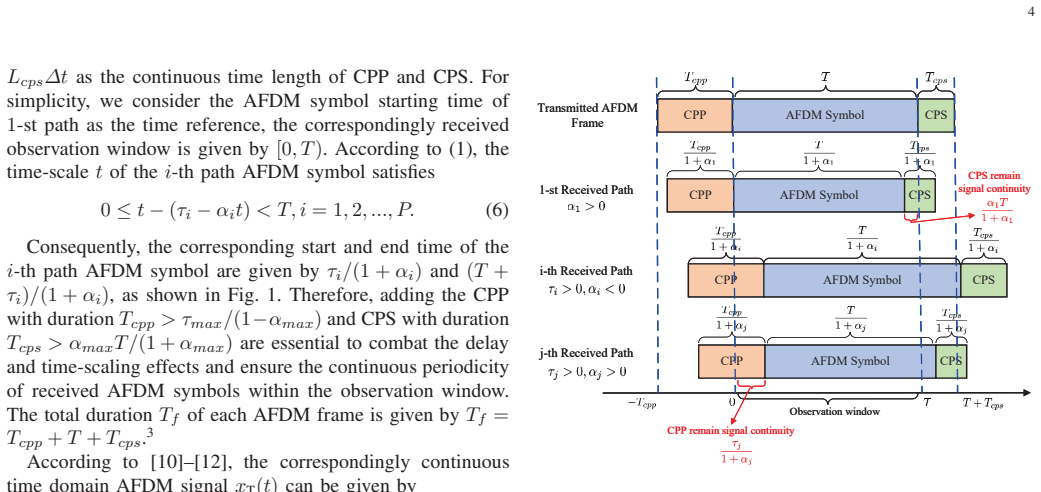
The load-bearing object is the AFDM chirp parameter $c_1$, which controls the quadratic phase in both the inverse DAF transform and the received channel matrix. In this wideband model the Doppler scale $\alpha_i$ enters the channel as a time-dependent delay, so $c_1$ must absorb a term proportional to $\alpha_i n^2$; the optimized value in (45) is chosen so that the POSP-derived support intervals of distinct paths do not overlap. The CPP and CPS prefixes keep the received AFDM symbol chirp-periodic inside the observation window, while the CD-D-OAMP detector alternates a distributed LMMSE estimate in the sparse time domain with symbol-by-symbol detection in the DAF domain, using the unitary DAF transform to cross between them.
What would settle it
Compute the exact DAF-domain channel matrix for a small block, say $N=32$, with two paths whose delays differ by one sample and $\alpha_{\max}=10^{-4}$, and check whether the support intervals predicted by (30)-(32) contain the actually nonzero entries; if the paths overlap in the exact matrix under the $c_1$ of (45), the no-overlap premise fails.
Extended reading notes
Core claim
The central claim is that in time-scaled wideband doubly-dispersive channels, an AFDM system equipped with the CPP/CPS frame and the chirp parameter $c_1$ of (45) keeps a sparse discrete affine Fourier domain channel and thereby retains full path diversity. With narrowband parameters, Doppler scaling smears each path across many delay-Doppler bins; the optimized $c_1$ makes the per-path support intervals $[Q_{\ell_i,\alpha_i},\tilde{Q}_{\ell_i,\alpha_i}]$ disjoint for resolvable paths. The paper supports this by a stationary-phase approximation of the channel coefficients, a pairwise-error-probability bound whose slope matches maximum-likelihood simulations, and BER comparisons showing the proposed system below OFDM, OCDM, OTFS, and narrowband AFDM in underwater and THz wideband settings.
Load-bearing premise
The whole parameter design assumes that the stationary-phase approximation, imported without derivation, correctly predicts which delay-Doppler bins each path occupies; if that approximation is inaccurate for finite block sizes, the optimized chirp parameter will not separate paths and the claimed diversity gain disappears.
Editorial extensions
If this is right
- With the optimized $c_1$ and CPP/CPS framing, wideband Doppler scaling no longer destroys DAF-domain sparsity: each resolvable path lands in its own support interval, so path diversity can be collected.
- The PEP bound in (61)-(62) gives a full-diversity slope in SNR for the proposed parameters; the paper verifies it with ML detection for $P=2,3,4$ paths.
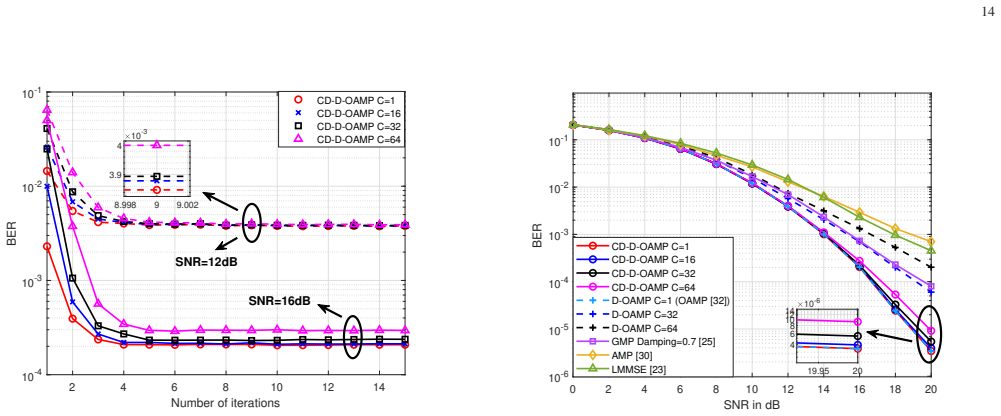
- The CD-D-OAMP detector with $C$ groups reduces per-iteration complexity from $O(N^3)$ to $O(CN_c^3 + CN_c^2|D_c| + N\log N + NQ)$, with only a small BER penalty as $C$ grows.
- In simulations, AFDM with the wideband-optimized $c_1$ achieves lower BER than OFDM, OCDM, OTFS, and narrowband AFDM under both underwater acoustic ($\alpha_{\max}=10^{-4}$) and THz wireless ($\alpha_{\max}=4.6\cdot10^{-7}$) channels.
- The design constraint (51) tells the system designer the usable range of $N$ for given $\alpha_{\max}$ and delay spread; beyond it, the path supports become too wide to separate.
Reading between the lines
- Beyond the paper: if the POSP support intervals remain accurate for finite $N$, the same single-parameter design recipe could be applied to other chirp-based waveforms, by picking $c_1$ so that the $\alpha_i$-dependent support widths are disjoint.
- Beyond the paper: the CD-D-OAMP idea is not tied to AFDM's specific transform; any unitary cross-domain pair with one sparse domain could use the same distributed LMMSE plus symbol-wise projection loop, so the detector recipe may transfer to other wideband waveforms.
- Beyond the paper: a stress test the paper does not run is to push $\alpha_{\max}$ toward $1/(4N)$, where (46) binds, and check whether the BER advantage over OTFS disappears at the predicted block size.
- Beyond the paper: the paper treats $\alpha_{\max}$ as small (at most $10^{-4}$ in its examples); at larger Doppler scale factors the support width $L_i$ grows linearly in $N$, so the authors' own formula implies that either $N$ must shrink or the sparsity-based receiver will lose its edge.
Signed reviews
Editorial analysis
A structured set of objections, weighed in public.
Referee Report
Summary. The paper proposes an affine frequency division multiplexing (AFDM) transmission scheme for wideband doubly-dispersive channels with time-scaling Doppler effects. It introduces a chirp-periodic prefix/suffix (CPP/CPS) frame structure, derives a discrete affine Fourier (DAF)-domain input-output relation, uses the principle of stationary phase (POSP) to claim sparsity of the DAF-domain channel, optimizes the AFDM chirp parameter c1, derives a pairwise error probability (PEP) bound, and proposes a cross-domain distributed orthogonal approximate message passing (CD-D-OAMP) detector with a state-evolution analysis. The claims are supported by simulations for underwater acoustic and terahertz channels, comparing the proposed AFDM with OFDM, OCDM, OTFS, and narrowband-AFDM.
Significance. The problem is well motivated: time-scaling effects are known to break the standard narrowband Doppler model, and most existing AFDM/OTFS analyses ignore them. If the derivation is made rigorous, the paper would be a solid contribution: it provides a concrete CPP/CPS frame structure, a closed-form chirp parameter design, a low-complexity distributed detector with a useful complexity table, and broad simulation evidence. The PEP and state-evolution analyses are useful complements. However, the central technical claim—that the optimized chirp parameter in Eq. (45) separates paths and yields sparsity and diversity—depends on the POSP-based support intervals in Eqs. (30)-(32), and those are not yet rigorously established. The significance is therefore conditional on fixing the derivation.
major comments (4)
- [II-B/II-C, Eqs. (9), (10), (20), (24c)] The derivation of the DAF-domain channel is not reproducible as written. The piecewise function ψ_{m,t} in Eq. (9) is defined through breakpoints indexed by ρ = 1, ..., \tilde C with \tilde C = 2Nc1 in Eq. (10), but the optimized c1 in Eq. (45) is not guaranteed to make 2Nc1 an integer. In Eq. (20), F_i(p,q) contains ψ_{m,t'_i} with no definition of m and no summation over m, so F_i(p,q) is not a well-defined function of (p,q). The same undefined symbol enters θ_{p,q}(n) in Eq. (24c), the stationary point in Eq. (26), and the support bounds in Eqs. (31)-(32). The authors should define the sampled ψ term explicitly, including the correct summation index and the correct coefficient, and should either restrict c1 to values for which 2Nc1 is integer or re-derive the piecewise construction for non-integer c1.
- [II-C/II-D, Eqs. (23)-(34)] The POSP approximation is imported from continuous-time radar analysis and applied to the discrete quadratic-phase sum in Eq. (23) without a proof that it is valid for this discrete, finite-length sum. The approximations in Eqs. (27)-(28) and the resulting support intervals in Eqs. (29)-(32) are load-bearing for the chirp parameter design in Section III, but no validity condition on K = 2c1(α_i^2 + 2α_i), N, c1, or α_i is provided. The single illustration in Fig. 2 for one row and one channel realization is not sufficient. A derivation, or at least a systematic numerical verification over the parameter ranges used in Figs. 3, 4, 10, 11, and 13, should be supplied.
- [III, Eqs. (42)-(45)] The transition from the general no-overlap condition (41a) to the closed-form c1 in Eq. (45) relies on the additional assumption min(ℓ_j − ℓ_i) = 1, which is described as the dense-delay case. This assumption is not derived from the channel model and is not stated as an explicit system condition in the simulation setup. If the actual minimum delay separation differs from one sample, the formula may not give the intended separation guarantee; and if the POSP intervals are inaccurate, the no-overlap condition in Eq. (40) may not be sufficient at all. The paper should state this assumption explicitly and verify that the simulated channels satisfy it.
- [IV, Eqs. (60)-(61)] The PEP bound in Eq. (61) is only meaningful if the rank R of Ω_{x,\hat x} is known; in particular, the diversity claim requires R to equal the number of resolvable paths P (or at least to be established). The paper does not prove that the optimized c1 in Eq. (45) achieves R = P for the time-scaled wideband channel. Without this rank analysis, the diversity conclusion drawn from Figs. 3 and 4 is not established by the PEP argument. Please add a rank analysis or state clearly the conditions under which Eq. (61) holds.
minor comments (5)
- [IV, Eq. (60)] The Chernoff bound should read Q(x) ≤ exp(−x^2/2); as printed, the exponent '1/2x2' has the wrong sign.
- [Abstract] The phrase 'in the literatures' should be 'in the literature'.
- [II-D, Eq. (33)] The significant-region width Nv is introduced without a quantitative selection criterion, and it directly affects the optimized c1 in Eq. (45). Please state how Nv is chosen in the simulations.
- [Table I] The symbol |\tilde D_c| in the D-OAMP complexity row should be defined in the table caption or immediately before the table, since the definition currently appears only in the body text.
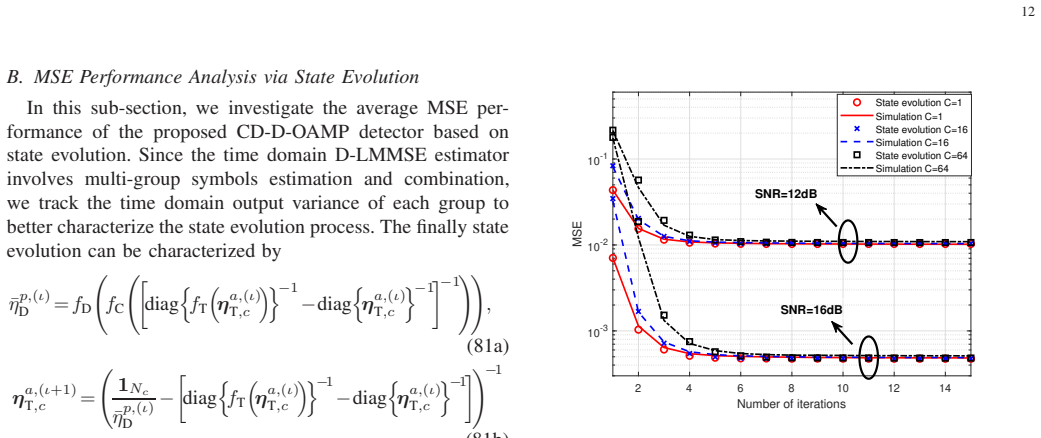
- [V-B, Eq. (83)] The state-evolution analysis uses a Monte Carlo approximation for the nonlinear function f_D; this is acknowledged in the text, but the limitation should also be stated in the conclusion where the state-evolution result is summarized.
Circularity Check
No significant circularity: the chirp parameter is solved analytically from POSP-approximated support intervals and then tested against the exact simulated channel, so the central comparison is not circular; the main weaknesses are non-circular proof gaps in Eq. (20) and the POSP support derivation.
full rationale
The claimed derivation is not circular in the sense of fitting a quantity and then predicting that same quantity. The optimized chirp parameter c1 in (45) is obtained analytically from the POSP-approximated support intervals (30)-(32): the interval separation constraint (40)-(42) is solved for c1, not fitted to BER data. The BER comparisons in Figs. 4, 10, 11, and 13 use the exact wideband channel model in (1)/(11)/(13) and the exact DAF transform, not the POSP support approximation; Fig. 2 separately checks the POSP support against the exact channel. Hence the central 'prediction' (sparse DAF-domain channel and diversity gain) is tested against an independent numerical channel, not against the same approximate model that generated c1. The state-evolution analysis uses a Monte Carlo estimate of f_D in (83), explicitly acknowledged as a simplification following [39]; this is not a fitted parameter renamed as a prediction. The load-bearing weak points are non-circular correctness gaps: Eq. (20) contains ψ_{m,t'_i} with an undefined index m, and the support bounds (30)-(32) are imported from the unproved POSP assertion in Section II-C ('we directly apply the conclusions of the POSP method and omit the mathematical derivations'). Self-citations ([14], [31], [28], [29]) appear in background comparisons and are not load-bearing; no uniqueness theorem from the authors is invoked to forbid alternatives. Accordingly, no circular reduction is exhibited, and the score is low, reflecting only minor self-citation/background usage and acknowledged derivation gaps rather than circularity.
Assumptions & free parameters
free parameters (2)
- Nv (significant-region width in DAF domain) =
2 (used in all simulations)
- c2 (second AFDM chirp parameter) =
arbitrary irrational number (not numerically specified)
assumptions (6)
- domain assumption POSP approximation is accurate for the discrete chirp sum in Eq. (23)
- domain assumption Wideband channel model g(t,τ) with time-dependent delays τ_i - α_i t (Eq. (1))
- domain assumption CPP and CPS of lengths Tcpp > τmax/(1-αmax) and Tcps > αmax T/(1+αmax) restore periodicity inside the observation window
- ad hoc to paper Minimum resolvable delay separation of 1 sample in dense-delay scenarios
- domain assumption Typical Doppler scales satisfy |2α_i| > α_i^2 and αmax small enough for α^2 terms to be dropped
- standard math High-SNR PEP bound using Q(x) ≤ exp(-x²/2)
Cite this review
Pith. "Pith review of Affine Frequency Division Multiplexing Over Wideband Doubly-Dispersive Channels With Time-Scaling Effects." pith.science (2026). https://pith.science/paper/JJ2EF3KS
@misc{pith2026250703537,
  author       = {Pith},
  title        = {Pith review of: Affine Frequency Division Multiplexing Over Wideband Doubly-Dispersive Channels With Time-Scaling Effects},
  year         = {2026},
  howpublished = {\url{https://pith.science/paper/JJ2EF3KS}},
  note         = {Machine review of arXiv:2507.03537}
}
read the original abstract
The recently proposed affine frequency division multiplexing (AFDM) modulation has been considered as a promising technology for narrowband doubly-dispersive channels. However, the time-scaling effects, i.e., pulse widening and pulse shortening phenomena, in extreme wideband doubly-dispersive channels have not been considered in the literatures. In this paper, we investigate such wideband transmission and develop an efficient transmission structure with chirp-periodic prefix (CPP) and chirp-periodic suffix (CPS) for AFDM system. We derive the input-output relationship of AFDM system under time-scaled wideband doubly-dispersive channels and demonstrate the sparsity in discrete affine Fourier (DAF) domain equivalent channels. We further optimize the AFDM chirp parameters to accommodate the time-scaling characteristics in wideband doubly-dispersive channels and verify the superiority of the derived chirp parameters by pairwise error probability (PEP) analysis. We also develop an efficient cross domain distributed orthogonal approximate message passing (CD-D-OAMP) algorithm for AFDM symbol detection and analyze its corresponding state evolution. By analyzing the detection complexity of CD-D-OAMP detector and evaluating the error performance of AFDM systems based on simulations, we demonstrate that the AFDM system with our optimized chirp parameters outperforms the existing competitive modulation schemes in time-scaled wideband doubly-dispersive channels. Moreover, our proposed CD-D-OAMP detector can achieve the desirable trade-off between the complexity and performance, while supporting parallel computing to significantly reduce the computational latency.
Figures


Figures from the paper (7 more)




Reference graph
Works this paper leans on
-
[1]
Multicarrier communication over underwater acoustic channels with nonu niform Doppler shifts,
B. Li, S. Zhou, M. Stojanovic, L. Freitag, and P . Willett, “Multicarrier communication over underwater acoustic channels with nonu niform Doppler shifts,” IEEE J. Ocean. Eng ., vol. 33, no. 2, pp. 1638–1649, Apr. 2008
work page 2008
-
[2]
C. R. Berger, S. Zhou, J. C. Preisig, and P . Willett, “Spar se channel estimation for multicarrier underwater acoustic communic ation: From subspace methods to compressed sensing,” IEEE Trans. Signal Process ., vol. 58, no. 3, pp. 1708–1721, Mar. 2010
work page 2010
-
[3]
Orthogonal delay scale space modulation: A new technique for wideband time-varying chan nels,
K. P . Arunkumar and C. R. Murthy, “Orthogonal delay scale space modulation: A new technique for wideband time-varying chan nels,” IEEE Trans. Signal Process ., vol. 70, pp. 2625–2638, May 2022
work page 2022
-
[4]
Perfo rmance degradation of OFDM systems due to Doppler spreading,
T. Wang, J. G. Proakis, E. Masry, and J. R. Zeidler, “Perfo rmance degradation of OFDM systems due to Doppler spreading,” IEEE Trans. Wireless Commun., vol. 5, no. 6, pp. 1422–1432, Jun. 2006
work page 2006
-
[5]
Orthogonal time frequency space modul ation,
R. Hadani et al., “Orthogonal time frequency space modul ation,” in Proc. IEEE Wireless Commun. Netw. Conf. (WCNC), San Francisco, CA, USA, Mar. 2017, pp. 1–6. 15
work page 2017
-
[6]
A unifying view of OTFS and its many variants,
Q. Deng, Y . Ge, and Z. Ding, “A unifying view of OTFS and its many variants,” IEEE Commun. Surv. Tuts ., early access, 2025
work page 2025
-
[7]
Orthogonal chirp division multip lexing,
X. Ouyang and J. Zhao, “Orthogonal chirp division multip lexing,” IEEE Trans. Commun., vol. 64, no. 9, pp. 3946–3957, Sep. 2016
work page 2016
-
[8]
AFDM: A full div ersity next generation waveform for high mobility communications ,
A. Bemani, N. Ksairi, and M. Kountouris, “AFDM: A full div ersity next generation waveform for high mobility communications ,” in Proc. IEEE Int. Conf. Commun. W orkshops (ICC W orkshops) , Montreal, QC, Canada, Jun. 2021, pp. 1–6
work page 2021
Show all 46 references
-
[9]
Affine frequenc y division multiplexing for next generation wireless communications ,
A. Bemani, N. Ksairi, and M. Kountouris, “Affine frequenc y division multiplexing for next generation wireless communications ,” IEEE Trans. Wireless Commun., vol. 22, no. 11, pp. 8214–8229, Nov. 2023
2023
-
[10]
Affine frequency division multiplexing (A FDM) for wire- less communications
Ali Bemani. “Affine frequency division multiplexing (A FDM) for wire- less communications.” Networking and Internet Architectu re [cs.NI]. Sorbonne Universit´ e, 2023. English. NNT: 2023SORUS610. t el- 04606502
2023
-
[11]
Integrated se nsing and communications with affine frequency division multiplexin g,
A. Bemani, N. Ksairi, and M. Kountouris, “Integrated se nsing and communications with affine frequency division multiplexin g,” IEEE Wireless Commun. Lett ., vol. 13, no. 5, pp. 1255–1259, May 2024
2024
-
[12]
Affine frequency divis ion multiplex- ing: Extending OFDM for scenario-flexibility and resilienc e,
H. Yin, Y . Tang, A. Bemani et al., “Affine frequency divis ion multiplex- ing: Extending OFDM for scenario-flexibility and resilienc e,” arXiv: 2502.04735, 2024
2024 arXiv
-
[13]
H. S. Rou et al., “From orthogonal time-frequency space to affine frequency-division multiplexing: A comparative study of n ext-generation waveforms for integrated sensing and communications in dou bly disper- sive channels,” IEEE Sig. Proc. Mag ., vol. 41, no. 5, pp. 71–86, Sep. 2024
2024
-
[14]
A ffine frequency division multiplexing with index modulation: Fu ll diversity condition, performance analysis, and low-complexity dete ction,
Y . Tao, M. Wen, Y . Ge, J. Li, E. Basar, and N. Al-Dhahir, “A ffine frequency division multiplexing with index modulation: Fu ll diversity condition, performance analysis, and low-complexity dete ction,” IEEE J. Sel. Areas Commun ., vol. 43, no. 4, pp. 1041-1055, Apr. 2025
2025
-
[15]
Diagonally reconstructed channel estimation for MIMO-AFDM with inter-doppler interference in doubly selective channels,
H. Yin, X. Wei, Y . Tang, and K. Y ang, “Diagonally reconstructed channel estimation for MIMO-AFDM with inter-doppler interference in doubly selective channels,” IEEE Trans. Wireless Commun ., vol. 23, no. 10, pp. 14066-14079, Oct. 2024
2024
-
[16]
Joint channel, data, and radar parameter estimatio n for AFDM systems in doubly-dispersive channels,
K. R. R. Ranasinghe, H. S. Rou, G. T. F. de Abreu, T. Takaha shi, and K. Ito, “Joint channel, data, and radar parameter estimatio n for AFDM systems in doubly-dispersive channels,” IEEE Trans. Wireless Commun., vol. 24, no. 2, pp. 1602–1619, Feb. 2025
2025
-
[17]
Effect of Doppler spr ead in OFDM- based UWB systems,
I. R. Capoglu, Y . Li, and A. Swami, “Effect of Doppler spr ead in OFDM- based UWB systems,” IEEE Trans. Wireless Commun., vol. 4, no. 5, pp. 2559–2567, Sep. 2007
2007
-
[18]
Multipl e-resampling receiver design for OFDM over Doppler-distorted underwate r acoustic channels,
K. Tu, T. Duman,M. Stojanovic, and J. Proakis, “Multipl e-resampling receiver design for OFDM over Doppler-distorted underwate r acoustic channels,” IEEE J. Ocean. Eng .,vol. 38, no. 2, pp. 333–345, Apr. 2013
2013
-
[19]
On the Doppler squi nt effect in OTFS systems over doubly-dispersive channels: Mo deling and evaluation,
X. Wang, X. Shi, J. Wang, and J. Song, “On the Doppler squi nt effect in OTFS systems over doubly-dispersive channels: Mo deling and evaluation,” IEEE Trans. Wireless Commun ., vol. 22, no. 12, pp. 8781–8796, Dec. 2023
2023
-
[20]
Doppler interferenc e analysis for OTFS-based LEO satellite systems,
R. He, X. Zhang, Q. Cui, and X. Tao, “Doppler interferenc e analysis for OTFS-based LEO satellite systems,” IEEE J. Sel. Areas Commun ., vol. 43, no. 1, pp. 75–89, Jan. 2025
2025
-
[21]
Analysis of Doppler and multip ath on or- thogonal chirp division multiplexing in shallow water acou stic channel,
B. Yiqi and H. Chuanlin, “Analysis of Doppler and multip ath on or- thogonal chirp division multiplexing in shallow water acou stic channel,” IEEE Access , vol. 10, pp. 95928–95935, 2022
2022
-
[22]
Underwater acousti c commu- nications based on OCDM for Internet of Underwater Things,
B. Wang, Y . Wang, Y . Li, and X. Guan, “Underwater acousti c commu- nications based on OCDM for Internet of Underwater Things,” IEEE Internet Things J ., vol. 10, no. 24, pp. 22128–22142, Dec. 2023
2023
-
[23]
Performance analys is of ZF and MMSE equalizers for MIMO systems: An in-depth study of the hi gh SNR regime,
Y . Jiang, M. K. V aranasi, and J. Li, “Performance analys is of ZF and MMSE equalizers for MIMO systems: An in-depth study of the hi gh SNR regime,” IEEE Trans. Inf. Theory, vol . 57, no. 4, pp. 2008–2026, Apr. 2011
2008
-
[24]
Low complexity LMMSE re- ceiver for OTFS,
S. Tiwari, S. S. Das, and V . Rangamgari, “Low complexity LMMSE re- ceiver for OTFS,” IEEE Commun. Lett ., vol. 23, no. 12, pp. 2205–2209, Dec. 2019
2019
-
[25]
Interf erence can- cellation and iterative detection for orthogonal time freq uency space modulation,
P . Raviteja, K. T. Phan, Y . Hong, and E. Viterbo, “Interf erence can- cellation and iterative detection for orthogonal time freq uency space modulation,” IEEE Trans. Wireless Commun ., vol. 17, no. 10, pp. 6501–6515, Oct. 2018
2018
-
[26]
Receiver design for OTFS with a fractionally spaced sampling approach,
Y . Ge, Q. Deng, P . C. Ching, and Z. Ding, “Receiver design for OTFS with a fractionally spaced sampling approach,” IEEE Trans. Wireless Commun., vol. 20, no. 7, pp. 4072–4086, Jul. 2021
2021
-
[27]
Orthogonal time frequency s pace detection via low-complexity expectation propagation
Y . Shan, F. Wang and Y . Hao, “Orthogonal time frequency s pace detection via low-complexity expectation propagation”, IEEE Trans. Wireless Commun., vol. 21, no. 12, pp. 10887-10901, Dec. 2022
2022
-
[28]
OTFS signaling f or uplink NOMA of heterogeneous mobility users,
Y . Ge, Q. Deng, P . C. Ching, and Z. Ding, “OTFS signaling f or uplink NOMA of heterogeneous mobility users,” IEEE Trans. Commun ., vol. 69, no. 5, pp. 3147–3161, May 2021
2021
-
[29]
O TFS signaling for SCMA with coordinated multi-point vehicle co mmunica- tions
Y . Ge, Q. Deng, D. Gonz´ alez, G., Y . L. Guan and Z. Ding, “O TFS signaling for SCMA with coordinated multi-point vehicle co mmunica- tions”, IEEE Trans. V eh. Technol ., vol. 72, no. 7, pp. 9044-9057, Jul. 2023
2023
-
[30]
Message pass ing algo- rithms for compressed sensing: I motivation and constructi on,
D. L. Donoho, A. Maleki, and A. Montanari, “Message pass ing algo- rithms for compressed sensing: I motivation and constructi on,” in Proc. Inf. Theory W orkshop Inf. Theory , 2010, pp. 1–5
2010
-
[31]
Message feedba ck inter- ference cancellation aided UAMP iterative detector for OTF S systems,
X. Li, H. Wang, Y . Ge, X. Shen and J. Zhao, “Message feedba ck inter- ference cancellation aided UAMP iterative detector for OTF S systems,” IEEE Wireless Commun. Lett. , vol. 13, no. 4, pp. 924-928, Apr. 2024
2024
-
[32]
Orthogonal AMP ,
J. Ma and L. Ping, “Orthogonal AMP ,” IEEE Access , vol. 5, pp. 2020–2033, 2017
2020
-
[33]
V ector appr oximate message passing,
S. Rangan, P . Schniter, and A. K. Fletcher, “V ector appr oximate message passing,” IEEE Trans. Signal Process ., vol. 65, no. 10, pp. 6664–6684, Oct. 2019
2019
-
[34]
Large-scale MIMO detection for 3GPP LTE: Algorithms and FP GA implementations,
M. Wu, B. Yin, G. Wang, C. Dick, J. R. Cavallaro, and C. Stu der, “Large-scale MIMO detection for 3GPP LTE: Algorithms and FP GA implementations,” IEEE J. Sel. Topics Signal Process ., vol. 8, no. 5, pp. 916–929, Oct. 2014
2014
-
[35]
A low complexity signal detec- tion scheme based on improved Newton iteration for massive M IMO systems,
F. Jin, Q. Liu, H. Liu, and P . Wu, “A low complexity signal detec- tion scheme based on improved Newton iteration for massive M IMO systems,” IEEE Commun. Lett ., vol. 23, no. 4, pp. 748–751, Apr. 2019
2019
-
[36]
Low-com plexity soft-output signal detection based on Gauss Seidel method f or uplink multiuser large-scale MIMO systems,
L. Dai, X. Gao, X. Su, S. Han, C. L. I, and Z. Wang, “Low-com plexity soft-output signal detection based on Gauss Seidel method f or uplink multiuser large-scale MIMO systems,” IEEE Trans. V eh. Technol., vol. 64, no. 10, pp. 4839–4845, Oct. 2015
2015
-
[37]
Steepest de scent method based soft-output detection for massive MIMO uplink ,
Y . Xue, C. Zhang, S. Zhang, Z. Wu, and X. Y ou, “Steepest de scent method based soft-output detection for massive MIMO uplink ,” in Proc. IEEE Int. W orkshop Signal Process. Syst ., 2016, pp. 273–278
2016
-
[38]
Conjugate gradient based soft-output detection and precoding in massive MIMO s ystems,
B. Yin, M. Wu, J. R. Cavallaro, and C. Studer, “Conjugate gradient based soft-output detection and precoding in massive MIMO s ystems,” in Proc. IEEE Glob. Telecommun. Conf ., Dec. 2014, pp. 3696–3701
2014
-
[39]
Cross domain iterati ve detection for orthogonal time frequency space modulation,
S. Li, W. Y uan, Z. Wei, and J. Y uan, “Cross domain iterati ve detection for orthogonal time frequency space modulation,” IEEE Trans. Wireless Commun., vol. 21, no. 4, pp. 2227–2242, Sep. 2021
2021
-
[40]
Zhou and Z
S. Zhou and Z. Wang, OFDM for Underwater Acoustic Communica- tions. Hoboken, NJ, USA: Wiley, 2014
2014
-
[41]
Residual D oppler ef- fect analysis of the FBMC/OQAM communication system in unde rwater acoustic channel,
G. Qiao, X. Liu, L. Ma, S. Mazhar, and Y . Zhao, “Residual D oppler ef- fect analysis of the FBMC/OQAM communication system in unde rwater acoustic channel,” IEEE Commun. Lett ., vol. 25, no. 9, pp. 3090–3093, Sep. 2021
2021
-
[42]
Iterative p er-vector equal- ization for orthogonal signal-division multiplexing over time-varying underwater acoustic channels,
J. Han, S. P . Chepuri, Q. Zhang, and G. Leus, “Iterative p er-vector equal- ization for orthogonal signal-division multiplexing over time-varying underwater acoustic channels,” IEEE J. Ocean. Eng ., vol. 44, no. 1, pp. 240–255, Jan. 2019
2019
-
[43]
Discrete time -scale character- ization of wideband time-varying systems,
Y . Jiang and A. Papandreou-Suppappola, “Discrete time -scale character- ization of wideband time-varying systems,” IEEE Trans. Signal Process., vol. 54, no. 4, pp. 1364–1375, Apr. 2006
2006
-
[44]
Wideband channel estimation for THz m assive MIMO,
J. Tan and L. Dai, “Wideband channel estimation for THz m assive MIMO,” China Commun ., vol. 18, no. 5, pp. 66–80, May 2021
2021
-
[45]
OTFS-based CV -QKD s ystems for doubly selective THz channels,
X. Liu, C. Xu, S. X. Ng, and L. Hanzo, “OTFS-based CV -QKD s ystems for doubly selective THz channels,” IEEE Trans. Commun., early access, 2025
2025
-
[46]
M. A. Richards, Fundamentals of Radar Signal Processing . NewY ork, NY , USA: McGraw-Hill, 2005
2005
Reviewed August 6, 2026 · model on record in the stance chip above.
Discussion (0). Continue with ORCID to comment.