REVIEW 4 major objections 6 minor 63 references
CPTuning: Contrastive Prompt Tuning for Generative Relation Extraction
T0 review · 4 major / 6 minor · reviewed 2026-08-10 · deepseek-v4-flash
Pith's one-line read CPTuning claims that contrastive prompt tuning with layer-based label smoothing lets a sequence-to-sequence model assign each candidate relation a probability above or below a threshold, so thresholding generated candidates extracts all…
desk verdict Solid multi-relation RE results, but the core threshold objective and inference rule are written backwards. read the letter →
The pith
A machine-rendered reading of the paper's core claim, the machinery that carries it, and where it could break.
The reading
What carries the argument
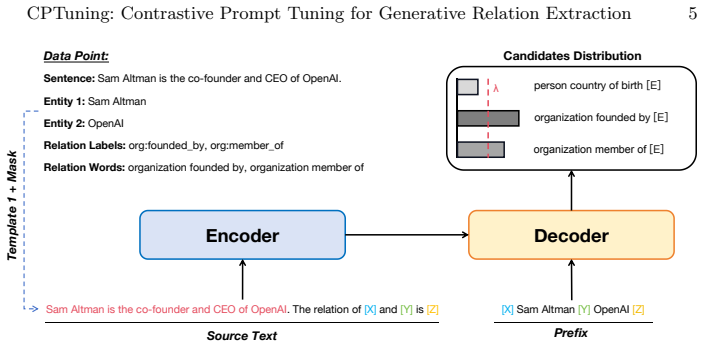
The central object is a thresholded probability mass over verbalized relation phrases. The training objective is $L(\theta) = L_{\mathrm{ctl}}(\theta) + \mu L_{\mathrm{lbls}}(\theta)$, where $L_{\mathrm{lbls}}$ is the layer-based label smoothing loss that distributes target probability $1-\beta$ to the gold token and $\beta/(|T_i|-1)$ to the other tokens allowed at layer $i$ of the Trie, and $L_{\mathrm{ctl}}$ is a contrastive loss that penalizes gold-relation scores $f(r_i)$ below $\zeta$ and fake-relation scores above $\zeta$. The score $f$ is a length-normalized negative log-likelihood. Decoding uses a Trie, a prefix tree over the verbalized relation vocabulary, to restrict beam search to valid relation phrases, and the final threshold $\lambda$ converts the ranked candidate list into the extracted relation set.
What would settle it
Manually inspect a sample of the fake negative relations used in Eq. 7 on the NYT training set: if a meaningful fraction of them are actually expressed in the sentence, then the contrastive loss is suppressing true relations, and replacing random negatives with verified or entity-type-incompatible negatives should raise multi-relation F1 above the reported 91.2-91.4.
Extended reading notes
Core claim
The paper claims that entity pair overlap can be handled by a generative model that learns a graded, threshold-able likelihood over relation phrases rather than a one-hot gold label. Concretely, CPTuning combines layer-based label smoothing, which gives every valid token at each decoding layer a small nonzero target probability, with a contrastive loss that pushes gold relations above a threshold $\zeta$ and randomly sampled fake relations below it. At inference, Trie-constrained prefix-given beam search generates a set of candidate relations and a length-normalized log-likelihood score $f(r_i)$ is compared with a threshold $\lambda$ to decide which relations exist. The paper reports that T5-large trained this way reaches the best micro F1 among compared methods on TACRED, TACREV and NYT, with Re-TACRED used in ablations and low-resource experiments, outperforming both classificational and generative baselines in single- and multi-relation settings.
Load-bearing premise
The load-bearing premise is that a relation sampled at random from the relation vocabulary and not labelled for a given entity pair is genuinely absent; on automatically annotated data such as NYT this can fail because a sampled relation may be true but simply unannotated.
Editorial extensions
If this is right
- On NYT, a dataset built for entity pair overlap, CPTuning with T5-large reaches micro F1 of 91.4 while the strongest prior generative prompt-tuning baseline reaches 87.27, so thresholded generative decoding works for multi-relation extraction.
- On single-relation datasets, the same training recipe beats the previous best generative method by 1.8 F1 points on TACRED and 0.9 on TACREV, so supporting multiple relations does not degrade single-relation accuracy.
- Ablation removes either the contrastive loss or the layer-based label smoothing and NYT F1 drops from 91.2 to about 87.7-87.9, indicating both components are needed for the reported multi-relation gain.
- With only 8-32 labeled instances per relation, CPTuning is competitive with or better than prior prompt-tuning baselines on most settings, suggesting the thresholded likelihood signal remains useful in low-resource conditions.
Reading between the lines
- The paper leaves implicit that the same contrastive thresholding recipe could apply to other structured generation problems with variable numbers of valid outputs per input, such as event extraction or open information extraction, since the machinery only requires a verbalized candidate set and a decision threshold.
- Because the negative relations in Eq. 7 are sampled uniformly from the relation vocabulary, the method's practical ceiling on distantly supervised data may be set by annotation noise; an obvious test is to replace uniform negatives with entity-type-constrained or confidence-weighted negatives and check whether multi-relation F1 rises.
- The H-index analysis in the paper suggests likelihood and semantic similarity align under CPTuning; one concrete extension is to use semantic similarity rankings as an additional training signal, which could reduce the number of beam candidates needed at inference.
Signed reviews
Editorial analysis
A structured set of objections, weighed in public.
Referee Report
Summary. The paper proposes CPTuning, a contrastive prompt-tuning method for generative relation extraction. It reformulates RE as a Seq2Seq text-infilling task with sentinel tokens, uses Trie-constrained beam search to generate candidate verbalized relations, and combines layer-based label smoothing (LBLS) with a contrastive loss (CTL) to let the model assign probability mass above or below a threshold. Experiments on TACRED, TACREV, Re-TACRED, and NYT report state-of-the-art micro-F1 scores for T5-large, with ablations showing that both LBLS and CTL contribute to the gains.
Significance. If the method works as described, it addresses a real limitation of generative prompt-tuning RE—entity-pair overlap—and the reported gains over GenPT and other baselines are substantial. The paper's ablations (Table 3) support the contribution of both proposed components, and the H-index analysis (Table 4) is a useful diagnostic of semantic behavior. However, the central scoring and threshold mechanism is written inconsistently, so the claimed results cannot be verified from the text; no code is provided.
major comments (4)
- [§3.2, §3.3, Eq. (3), Eq. (7), Algorithm 1] Eq. (3) defines f(ri) = −Σ log P(ri(j)) / |ri|^α, so larger f means lower token probability. Eq. (7) then minimizes max(ζ − f(ri), 0) for gold relations, which is zero only when f(ri) ≥ ζ (i.e., low probability), and max(f(rj) − ζ, 0) for fake relations, which is zero only when f(rj) ≤ ζ (i.e., high probability). Algorithm 1 line 14 keeps candidates with f(ri) > λ, again selecting low-probability candidates. Taken literally, the training objective and inference rule suppress gold relations and promote fake ones, so the reported F1 gains in Table 2 cannot follow from the written algorithm. Please correct the sign of f or flip the inequalities, and clarify which convention was actually implemented.
- [§4.4, Table 2] Results in Table 2 are reported as single micro-F1 numbers without error bars, significance tests, or the number of seeds, despite the abstract's claim of "significantly outperforms." The authors should either report multiple runs with variance and a statistical test or soften the significance claim.
- [§5, Figure 5] Figure 5 shows performance of CPTuning-s1 and -s2 against μ on TACRED and NYT, and μ = 0.1 selected from these curves is then fixed for all experiments, including TACREV and Re-TACRED. If these curves are computed on the test splits, this is tuning on the test set; please specify the split used and report sensitivity to λ and ζ, which are otherwise fixed without analysis.
- [§3.3, Eq. (7)] Equation (7) samples fake relations R− uniformly from the verbalized relation vocabulary and treats them as definitely absent. In a distantly supervised multi-relation dataset such as NYT, an unannotated relation can be true for a given entity pair, so random negative sampling can suppress correct relations and undermine the EPO handling the method targets. Please discuss this issue and consider filtering negatives by entity-type constraints or evaluating alternative negative-sampling strategies.
minor comments (6)
- [§5, Figure 5] The manuscript contains template artifacts: Section 5 includes "2 F. Author et al." and Springer template captions (e.g., "Fig. 1: Caption") immediately before Figure 5; these should be removed.
- [§4.4 and Figure 4] There are typos: "ralation" in the Section 4.4 headings, "citiy" in Figure 4, and "T able" in table captions.
- [§3.2, Algorithm 1] Algorithm 1 initializes r1..rK as the prefix z, but candidate relations should arguably be continuations after the prefix; please clarify how full target texts are represented.
- [General] No code or reproducibility statement is provided; given the sign ambiguity in Eq. (3)/(7), releasing code would materially help verification.
- [§3.3, Eq. (6)] Equation (6) uses r*(i) both as the predicted token and as the summation index; please clean up the notation to avoid confusion.
- [§4.1, Table 1] The text says the NYT training and test sets contain 9782 and 987 EPO entity pairs, but Table 1 only lists "Yes" in the EPO column; please make the table consistent with the text.
Circularity Check
No circular derivation: reported gains are external-benchmark measurements with standard hyperparameter tuning; the only notable issue is an internal sign inconsistency, not circularity.
full rationale
The paper's central claims are empirical comparisons on four external benchmarks (TACRED, TACREV, Re-TACRED, NYT), and the reported F1 numbers are new measurements of a proposed training objective rather than quantities derived from the method's own assumptions. The contrastive loss (Eq. 7) and scoring rule (Eq. 3) are not equivalent to the training labels by construction: they define a learned thresholding scheme whose effectiveness is tested in Table 3, including ablations showing that adding LBLS and CTL changes performance. Hyperparameters such as alpha, beta, lambda, zeta, and mu are manually set or selected via the Figure 5 sweep; choosing a balance factor on development data is standard model selection, not a fitted parameter renamed as a prediction. The method builds on prior external work (GenPT [11], SURE [28], BRIO [26]) rather than on a self-citation chain, and no uniqueness claim is imported from the authors' own prior results. A separate correctness concern, outside circularity, is that Eq. 3 defines f as length-normalized negative log-likelihood, so smaller f corresponds to higher token probability, while Eq. 7 and Algorithm 1 treat larger f as more favorable; this is an internal sign inconsistency that makes the written algorithm hard to reproduce as stated, but it does not make the derivation circular because the reported results are not forced by the equations alone.
Assumptions & free parameters
free parameters (6)
- alpha (length penalty in Eq. 3) =
0.6
- beta (label smoothing weight in Eq. 6) =
0.2
- lambda (relation existence threshold, Algorithm 1) =
1.0
- zeta (contrastive margin in Eq. 7) =
1.2
- mu (loss balance factor in Eq. 8) =
0.1
- K (beam size and number of sampled relations) =
16
assumptions (4)
- domain assumption Verbalized relation phrases preserve enough semantics for a T5 model to generate and score relations.
- domain assumption Randomly sampled relations from v(Y) are genuinely absent for the entity pair during contrastive training.
- ad hoc to paper A single global threshold lambda (and margin zeta) can separate true from false relation scores across all entity pairs after label smoothing.
- standard math All candidate relations for an instance share an identical prefix z, so P(z|M(s)) can be dropped from Eq. 1.
Cite this review
Pith. "Pith review of CPTuning: Contrastive Prompt Tuning for Generative Relation Extraction." pith.science (2026). https://pith.science/paper/JJ6XN2GM
@misc{pith2026250102196,
  author       = {Pith},
  title        = {Pith review of: CPTuning: Contrastive Prompt Tuning for Generative Relation Extraction},
  year         = {2026},
  howpublished = {\url{https://pith.science/paper/JJ6XN2GM}},
  note         = {Machine review of arXiv:2501.02196}
}
read the original abstract
Generative relation extraction (RE) commonly involves first reformulating RE as a linguistic modeling problem easily tackled with pre-trained language models (PLM) and then fine-tuning a PLM with supervised cross-entropy loss. Although having achieved promising performance, existing approaches assume only one deterministic relation between each pair of entities without considering real scenarios where multiple relations may be valid, i.e., entity pair overlap, causing their limited applications. To address this problem, we introduce a novel contrastive prompt tuning method for RE, CPTuning, which learns to associate a candidate relation between two in-context entities with a probability mass above or below a threshold, corresponding to whether the relation exists. Beyond learning schema, CPTuning also organizes RE as a verbalized relation generation task and uses Trie-constrained decoding to ensure a model generates valid relations. It adaptively picks out the generated candidate relations with a high estimated likelihood in inference, thereby achieving multi-relation extraction. We conduct extensive experiments on four widely used datasets to validate our method. Results show that T5-large fine-tuned with CPTuning significantly outperforms previous methods, regardless of single or multiple relations extraction.
Figures


Figures from the paper (4 more)


Reference graph
Works this paper leans on
-
[1]
Alt, C., Gabryszak, A., Hennig, L.: TACRED revisited: A thorough evaluation of the TACRED relation extraction task. In: ACL 2020. pp. 1558–1569 (2020)
work page 2020
-
[2]
Balazevic, I., Allen, C., Hospedales, T.M.: Tucker: Tensor factorization for knowl- edge graph completion. In: EMNLP-IJCNLP 2019. pp. 5184–5193 (2019)
work page 2019
-
[3]
In: Findings of the Association for Computational Linguistics: ACL/IJCNLP 2021
Bao, S., He, H., Wang, F., Wu, H., Wang, H., Wu, W., Guo, Z., Liu, Z., Xu, X.: PLATO-2: towards building an open-domain chatbot via curriculum learning. In: Findings of the Association for Computational Linguistics: ACL/IJCNLP 2021. Findings of ACL, vol. ACL/IJCNLP 2021, pp. 2513–2525 (2021)
work page 2021
-
[4]
Bengio, Y., Louradour, J., Collobert, R., Weston, J.: Curriculum learning. In: ICML 2009. ACM International Conference Proceeding Series, vol. 382, pp. 41–48 (2009)
work page 2009
-
[5]
Advances in neural information processing systems 33, 1877–1901 (2020)
Brown, T., Mann, B., Ryder, N., Subbiah, M., Kaplan, J.D., Dhariwal, P., Nee- lakantan, A., Shyam, P., Sastry, G., Askell, A., et al.: Language models are few-shot learners. Advances in neural information processing systems 33, 1877–1901 (2020)
2020
-
[6]
Chen, X., Zhang, N., Xie, X., Deng, S., Yao, Y., Tan, C., Huang, F., Si, L., Chen, H.: Knowprompt: Knowledge-aware prompt-tuning with synergistic optimization for relation extraction. In: WWW 2022. pp. 2778–2788 (2022) CPTuning: Contrastive Prompt Tuning for Generative Relation Extraction 15
work page 2022
-
[7]
In: Findings of the Association for Computational Linguistics: ACL/IJCNLP 2021
Cui, L., Wu, Y., Liu, J., Yang, S., Zhang, Y.: Template-based named entity recog- nition using BART. In: Findings of the Association for Computational Linguistics: ACL/IJCNLP 2021. Findings of ACL, vol. ACL/IJCNLP 2021, pp. 1835–1845 (2021)
work page 2021
-
[8]
Detroja, K., Bhensdadia, C.K., Bhatt, B.S.: A survey on relation extraction. Intell. Syst. Appl. 19, 200244 (2023)
work page 2023
Show all 63 references
-
[9]
In: NAACL-HLT 2019
Devlin, J., Chang, M., Lee, K., Toutanova, K.: BERT: pre-training of deep bidirec- tional transformers for language understanding. In: NAACL-HLT 2019. pp. 4171– 4186 (2019)
2019
-
[10]
Guo, J., Tan, X., Xu, L., Qin, T., Chen, E., Liu, T.: Fine-tuning by curriculum learning for non-autoregressive neural machine translation. In: The Thirty-Fourth AAAI Conference on Artificial Intelligence, AAAI 2020, The Thirty-Second In- novative Applications of Artificial In...
2020
-
[11]
In: Findings of the Association for Computational Linguistics: EMNLP 2022
Han, J., Zhao, S., Cheng, B., Ma, S., Lu, W.: Generative prompt tuning for rela- tion classification. In: Findings of the Association for Computational Linguistics: EMNLP 2022. pp. 3170–3185 (2022)
2022
-
[12]
AI Open 3, 182–192 (2022)
Han, X., Zhao, W., Ding, N., Liu, Z., Sun, M.: PTR: prompt tuning with rules for text classification. AI Open 3, 182–192 (2022)
2022
-
[13]
CoRR abs/2012.04821 (2020)
Jiang, H., Bao, Q., Cheng, Q., Yang, D., Wang, L., Xiao, Y.: Complex relation extraction: Challenges and opportunities. CoRR abs/2012.04821 (2020)
2020 arXiv
-
[14]
Joshi, M., Chen, D., Liu, Y., Weld, D.S., Zettlemoyer, L., Levy, O.: Spanbert: Im- proving pre-training by representing and predicting spans. Trans. Assoc. Comput. Linguistics 8, 64–77 (2020)
2020
-
[15]
In: Proceedings of the 2022 Conference of the North Amer- ican Chapter of the Association for Computational Linguistics: Human Language Technologies, NAACL 2022
Josifoski, M., Cao, N.D., Peyrard, M., Petroni, F., West, R.: Genie: Generative information extraction. In: Proceedings of the 2022 Conference of the North Amer- ican Chapter of the Association for Computational Linguistics: Human Language Technologies, NAACL 2022. pp. 4626–46...
2022
-
[16]
In: Proceedings of the 2021 Conference on Empirical Methods in Natural Language Processing, EMNLP 2021
Lester, B., Al-Rfou, R., Constant, N.: The power of scale for parameter-efficient prompt tuning. In: Proceedings of the 2021 Conference on Empirical Methods in Natural Language Processing, EMNLP 2021. pp. 3045–3059 (2021)
2021
-
[17]
In: CoNLL 2017
Levy, O., Seo, M., Choi, E., Zettlemoyer, L.: Zero-shot relation extraction via reading comprehension. In: CoNLL 2017. pp. 333–342 (2017)
2017
-
[18]
In: ACL 2020
Lewis, M., Liu, Y., Goyal, N., Ghazvininejad, M., Mohamed, A., Levy, O., Stoy- anov, V., Zettlemoyer, L.: BART: denoising sequence-to-sequence pre-training for natural language generation, translation, and comprehension. In: ACL 2020. pp. 7871–7880 (2020)
2020
-
[19]
Li, X.L., Liang, P.: Prefix-tuning: Optimizing continuous prompts for generation. In: Proceedings of the 59th Annual Meeting of the Association for Computational Linguistics and the 11th International Joint Conference on Natural Language Pro- cessing, ACL/IJCNLP 2021, (Volume ...
2021
-
[20]
In: ACL 2019
Li, X., Yin, F., Sun, Z., Li, X., Yuan, A., Chai, D., Zhou, M., Li, J.: Entity-relation extraction as multi-turn question answering. In: ACL 2019. pp. 1340–1350 (2019)
2019
-
[21]
In: IJCAI 2020
Liu, J., Ren, Y., Tan, X., Zhang, C., Qin, T., Zhao, Z., Liu, T.: Task-level curricu- lum learning for non-autoregressive neural machine translation. In: IJCAI 2020. pp. 3861–3867 (2020)
2020
-
[22]
ACM Comput
Liu, P., Yuan, W., Fu, J., Jiang, Z., Hayashi, H., Neubig, G.: Pre-train, prompt, and predict: A systematic survey of prompting methods in natural language processing. ACM Comput. Surv. 55(9), 195:1–195:35 (2023) 16 Duan et al
2023
-
[23]
CoRR abs/2103.10385 (2021)
Liu, X., Zheng, Y., Du, Z., Ding, M., Qian, Y., Yang, Z., Tang, J.: GPT under- stands, too. CoRR abs/2103.10385 (2021)
2021 arXiv
-
[24]
In: ACL 2020
Liu, X., Lai, H., Wong, D.F., Chao, L.S.: Norm-based curriculum learning for neural machine translation. In: ACL 2020. pp. 427–436 (2020)
2020
-
[25]
CoRR abs/1907.11692 (2019)
Liu, Y., Ott, M., Goyal, N., Du, J., Joshi, M., Chen, D., Levy, O., Lewis, M., Zettlemoyer, L., Stoyanov, V.: Roberta: A robustly optimized BERT pretraining approach. CoRR abs/1907.11692 (2019)
2019 arXiv
-
[26]
In: Proceedings of the 60th Annual Meeting of the Association for Computational Linguistics (Volume 1: Long Papers), ACL 2022
Liu, Y., Liu, P., Radev, D.R., Neubig, G.: BRIO: bringing order to abstractive summarization. In: Proceedings of the 60th Annual Meeting of the Association for Computational Linguistics (Volume 1: Long Papers), ACL 2022. pp. 2890–2903 (2022)
2022
-
[27]
arXiv preprint arXiv:1711.05101 (2017)
Loshchilov, I., Hutter, F.: Decoupled weight decay regularization. arXiv preprint arXiv:1711.05101 (2017)
2017 arXiv
-
[28]
In: Findings of the Association for Computational Linguistics: EMNLP 2022
Lu, K., Hsu, I., Zhou, W., Ma, M.D., Chen, M.: Summarization as indirect super- vision for relation extraction. In: Findings of the Association for Computational Linguistics: EMNLP 2022. pp. 6575–6594 (2022)
2022
-
[29]
In: Findings of the Association for Computational Linguistics: ACL/IJCNLP 2021
Lyu, S., Chen, H.: Relation classification with entity type restriction. In: Findings of the Association for Computational Linguistics: ACL/IJCNLP 2021. Findings of ACL, vol. ACL/IJCNLP 2021, pp. 390–395 (2021)
2021
-
[30]
In: Proceedings of the 2022 Conference of the North American Chapter of the Association for Computational Linguistics: Human Language Technologies
Maharana, A., Bansal, M.: On curriculum learning for commonsense reasoning. In: Proceedings of the 2022 Conference of the North American Chapter of the Association for Computational Linguistics: Human Language Technologies. pp. 983–992 (2022)
2022
-
[31]
M¨ uller, R., Kornblith, S., Hinton, G.E.: When does label smoothing help? In: Advances in Neural Information Processing Systems 32: Annual Conference on Neural Information Processing Systems 2019, NeurIPS 2019. pp. 4696–4705 (2019)
2019
-
[32]
In: Proceedings of the first workshop on fact extraction and VERification (FEVER)
Obamuyide, A., Vlachos, A.: Zero-shot relation classification as textual entail- ment. In: Proceedings of the first workshop on fact extraction and VERification (FEVER). pp. 72–78 (2018)
2018
-
[33]
In: ICLR 2021 (2021)
Paolini, G., Athiwaratkun, B., Krone, J., Ma, J., Achille, A., Anubhai, R., dos Santos, C.N., Xiang, B., Soatto, S.: Structured prediction as translation between augmented natural languages. In: ICLR 2021 (2021)
2021
-
[34]
arXiv preprint arXiv:2107.09332 (2021)
Park, S., Kim, H.: Improving sentence-level relation extraction through curriculum learning. arXiv preprint arXiv:2107.09332 (2021)
2021 arXiv
-
[35]
In: EMNLP
Peng, H., Gao, T., Han, X., Lin, Y., Li, P., Liu, Z., Sun, M., Zhou, J.: Learning from context or names? an empirical study on neural relation extraction. In: EMNLP
-
[36]
In: EMNLP-IJCNLP
Peters, M.E., Neumann, M., IV, R.L.L., Schwartz, R., Joshi, V., Singh, S., Smith, N.A.: Knowledge enhanced contextual word representations. In: EMNLP-IJCNLP
-
[37]
In: NAACL-HLT 2019
Platanios, E.A., Stretcu, O., Neubig, G., P´ oczos, B., Mitchell, T.M.: Competence- based curriculum learning for neural machine translation. In: NAACL-HLT 2019. pp. 1162–1172 (2019)
2019
-
[38]
Raffel, C., Shazeer, N., Roberts, A., Lee, K., Narang, S., Matena, M., Zhou, Y., Li, W., Liu, P.J.: Exploring the limits of transfer learning with a unified text-to-text transformer. J. Mach. Learn. Res. 21, 140:1–140:67 (2020)
2020
-
[39]
In: Balc´ azar, J.L., Bonchi, F., Gionis, A., Sebag, M
Riedel, S., Yao, L., McCallum, A.: Modeling relations and their mentions without labeled text. In: Balc´ azar, J.L., Bonchi, F., Gionis, A., Sebag, M. (eds.) Machine Learning and Knowledge Discovery in Databases, European Conference, ECML PKDD 2010. Lecture Notes in Computer S...
2010
-
[40]
arXiv preprint arXiv:2109.03659 (2021)
Sainz, O., de Lacalle, O.L., Labaka, G., Barrena, A., Agirre, E.: Label verbalization and entailment for effective zero-and few-shot relation extraction. arXiv preprint arXiv:2109.03659 (2021)
2021 arXiv
-
[41]
In: ACL 2019
Soares, L.B., FitzGerald, N., Ling, J., Kwiatkowski, T.: Matching the blanks: Dis- tributional similarity for relation learning. In: ACL 2019. pp. 2895–2905 (2019)
2019
-
[42]
Soviany, P., Ionescu, R.T., Rota, P., Sebe, N.: Curriculum learning: A survey. Int. J. Comput. Vis. 130(6), 1526–1565 (2022)
2022
-
[43]
Stoica, G., Platanios, E.A., P´ oczos, B.: Re-tacred: Addressing shortcomings of the TACRED dataset. In: Thirty-Fifth AAAI Conference on Artificial Intelligence, AAAI 2021, Thirty-Third Conference on Innovative Applications of Artificial Intel- ligence, IAAI 2021, The Eleventh...
2021
-
[44]
CoRR abs/1610.02424 (2016)
Vijayakumar, A.K., Cogswell, M., Selvaraju, R.R., Sun, Q., Lee, S., Crandall, D.J., Batra, D.: Diverse beam search: Decoding diverse solutions from neural sequence models. CoRR abs/1610.02424 (2016)
2016 arXiv
-
[45]
In: EMNLP 2021
Wang, C., Liu, X., Chen, Z., Hong, H., Tang, J., Song, D.: Zero-shot information extraction as a unified text-to-triple translation. In: EMNLP 2021. pp. 1225–1238 (2021)
2021
-
[46]
In: Findings of the Association for Computational Linguistics: ACL/IJCNLP 2021
Wang, R., Tang, D., Duan, N., Wei, Z., Huang, X., Ji, J., Cao, G., Jiang, D., Zhou, M.: K-adapter: Infusing knowledge into pre-trained models with adapters. In: Findings of the Association for Computational Linguistics: ACL/IJCNLP 2021. Findings of ACL, vol. ACL/IJCNLP 2021, p...
2021
-
[47]
IEEE Trans
Wang, X., Chen, Y., Zhu, W.: A survey on curriculum learning. IEEE Trans. Pattern Anal. Mach. Intell. 44(9), 4555–4576 (2022)
2022
-
[48]
In: EMNLP 2020
Wolf, T., Debut, L., Sanh, V., Chaumond, J., Delangue, C., Moi, A., Cistac, P., Rault, T., Louf, R., Funtowicz, M., Davison, J., Shleifer, S., von Platen, P., Ma, C., Jernite, Y., Plu, J., Xu, C., Scao, T.L., Gugger, S., Drame, M., Lhoest, Q., Rush, A.M.: Transformers: State-o...
2020
-
[49]
In: Proceedings of the 28th ACM International Conference on Information and Knowledge Management, CIKM 2019
Wu, S., He, Y.: Enriching pre-trained language model with entity information for relation classification. In: Proceedings of the 28th ACM International Conference on Information and Knowledge Management, CIKM 2019. pp. 2361–2364 (2019)
2019
-
[50]
In: ACL 2020
Xu, B., Zhang, L., Mao, Z., Wang, Q., Xie, H., Zhang, Y.: Curriculum learning for natural language understanding. In: ACL 2020. pp. 6095–6104 (2020)
2020
-
[51]
Xue, F., Sun, A., Zhang, H., Chng, E.S.: Gdpnet: Refining latent multi-view graph for relation extraction. In: Thirty-Fifth AAAI Conference on Artificial Intelligence, AAAI 2021, Thirty-Third Conference on Innovative Applications of Artificial Intel- ligence, IAAI 2021, The El...
2021
-
[52]
In: EMNLP 2020
Yamada, I., Asai, A., Shindo, H., Takeda, H., Matsumoto, Y.: LUKE: deep contex- tualized entity representations with entity-aware self-attention. In: EMNLP 2020. pp. 6442–6454 (2020)
2020
-
[53]
Yang, S., Song, D.: FPC: fine-tuning with prompt curriculum for relation extrac- tion. In: Proceedings of the 2nd Conference of the Asia-Pacific Chapter of the Association for Computational Linguistics and the 12th International Joint Con- ference on Natural Language Processin...
2022
-
[54]
In: NAACL- HLT 2021
Yasunaga, M., Ren, H., Bosselut, A., Liang, P., Leskovec, J.: QA-GNN: reasoning with language models and knowledge graphs for question answering. In: NAACL- HLT 2021. pp. 535–546 (2021) 18 Duan et al
2021
-
[55]
In: EMNLP 2018
Zhang, Y., Qi, P., Manning, C.D.: Graph convolution over pruned dependency trees improves relation extraction. In: EMNLP 2018. pp. 2205–2215 (2018)
2018
-
[56]
In: EMNLP 2017
Zhang, Y., Zhong, V., Chen, D., Angeli, G., Manning, C.D.: Position-aware atten- tion and supervised data improve slot filling. In: EMNLP 2017. pp. 35–45 (2017)
2017
-
[57]
In: ACL 2019
Zhang, Z., Han, X., Liu, Z., Jiang, X., Sun, M., Liu, Q.: ERNIE: enhanced language representation with informative entities. In: ACL 2019. pp. 1441–1451 (2019)
2019
-
[58]
CoRR abs/2306.02051 (2023)
Zhao, X., Deng, Y., Yang, M., Wang, L., Zhang, R., Cheng, H., Lam, W., Shen, Y., Xu, R.: A comprehensive survey on deep learning for relation extraction: Recent advances and new frontiers. CoRR abs/2306.02051 (2023)
2023 arXiv
-
[59]
In: EMNLP 2020
Zhao, X., Wu, W., Xu, C., Tao, C., Zhao, D., Yan, R.: Knowledge-grounded dia- logue generation with pre-trained language models. In: EMNLP 2020. pp. 3377– 3390 (2020)
2020
-
[60]
In: EMNLP 2021
Zhou, W., Chen, M.: Learning from noisy labels for entity-centric information extraction. In: EMNLP 2021. pp. 5381–5392 (2021)
2021
-
[61]
In: AACL/IJCNLP 2022
Zhou, W., Chen, M.: An improved baseline for sentence-level relation extraction. In: AACL/IJCNLP 2022. pp. 161–168 (2022)
2022
-
[62]
In: ACL 2020
Zhou, Y., Yang, B., Wong, D.F., Wan, Y., Chao, L.S.: Uncertainty-aware curricu- lum learning for neural machine translation. In: ACL 2020. pp. 6934–6944 (2020)
2020
-
[2020]
3661–3672 (2020)
pp. 3661–3672 (2020)
2020
Reviewed August 10, 2026 · model on record in the stance chip above.
Discussion (0). Continue with ORCID to comment.