REVIEW 6 major objections 6 minor 45 references
AMoPO: Adaptive Multi-objective Preference Optimization without Reward Models and Reference Models
T0 review · 6 major / 6 minor · reviewed 2026-08-07 · deepseek-v4-flash
Pith's one-line read A single LLM can balance multiple preference dimensions without any reward model.
desk verdict A useful weight-sampling idea buried in a paper whose headline gains are inflated and whose central evaluation ignores its training distribution. read the letter →
The pith
A machine-rendered reading of the paper's core claim, the machinery that carries it, and where it could break.
The reading
What carries the argument
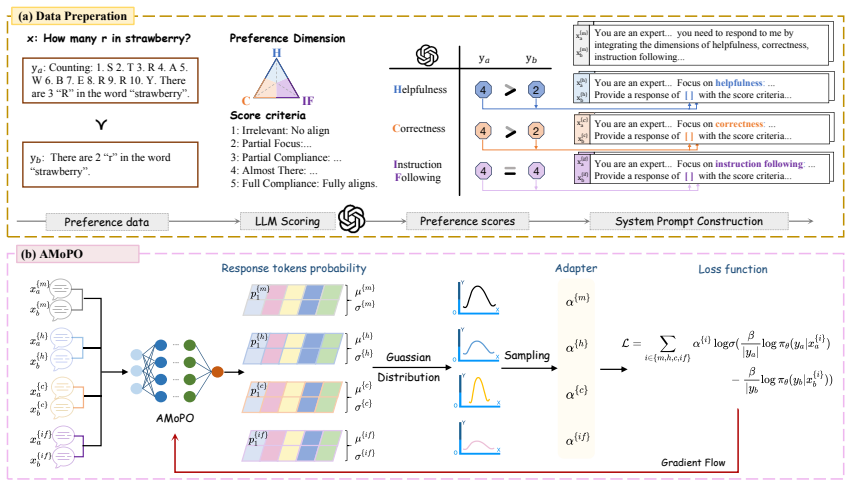
The load-bearing object is the Multi-Objective Bradley-Terry (MOBT) model: a product over dimensions of sigmoid comparisons, $\pi(y_w \succ y_l \mid x; \alpha; d) = \log \prod_{k=1}^K \sigma^{\alpha_k}\big(r_k(x^*_k, y_w) - r_k(x^*_k, y_l)\big)$, where each per-dimension reward $r_k$ is the policy's own length-normalized log-likelihood. The second half of the machinery is the adaptive weight sampler: for each dimension, the mean $\mu_k$ and variance $\sigma^2_k$ of the token probabilities over the chosen and rejected responses are computed, a weight $\alpha_k \sim \mathcal{N}(\mu_k, \sigma^2_k)$ is sampled, and the weights are softmax-normalized. This sampler decides how much each dimension contributes to the final loss at every update, and the paper argues it lets the model adaptively prioritize the dimensions it is most confident about.
What would settle it
Train AMoPO on Qwen2.5-14B with the published setup but decode on the original, unconditioned prompts, and compare with a control trained on the identical weighted loss using plain prompts instead of $x^*_k = f(x, d_k)$. If the dimension-conditioned training does not beat the plain-prompt control by the reported margin, or if the template must be present at inference to recover the gains, the central transfer claim is falsified.
Extended reading notes
Core claim
The central claim is that one policy LLM can be aligned with multiple preference dimensions at once using only its own generation probabilities as rewards. AMoPO replaces the traditional Bradley-Terry reward with a Multi-Objective Bradley-Terry objective in which each dimension $k$ contributes a length-normalized log-likelihood comparison $\sigma\left(\frac{\beta}{|y_w|}\log \pi_\theta(y_w|x^*_k) - \frac{\beta}{|y_l|}\log \pi_\theta(y_l|x^*_k)\right)$, with $x^*_k = f(x, d_k)$ the prompt rewritten to focus on that dimension. The dimension weights $\alpha_k$ are not fixed; they are sampled from a Gaussian whose mean and variance are computed from the model's token-level probabilities on that dimension, then softmax-normalized. The authors report that this outperforms previous single- and multi-objective baselines by an average 28.5% across AlpacaEval 2, Arena-Hard, and MT-bench, and that the advantage over fixed equal weights widens from 7B to 14B to 32B.
Load-bearing premise
The method works only if the model transfers dimension-conditioned training behavior to the original, unconditioned prompts used in evaluation, and only if the mean and variance of token probabilities are a trustworthy guide to per-dimension confidence; if either gives way, the reported gains could vanish.
Editorial extensions
If this is right
- A $K$-dimension alignment run needs only the policy LLM and a scored preference dataset; no frozen reference model and no separately trained reward model need to be loaded, which reduces memory and compute.
- The same weighted-loss machinery can be pointed at any set of scored dimensions, because each dimension enters only through a prompt template and a scalar score.
- Larger models extract more value from the adaptive weights: on AlpacaEval 2 the Gaussian sampler beats fixed equal weights by +0.9 points at 7B but +4.0 points at 32B, so the method's advantage grows with scale.
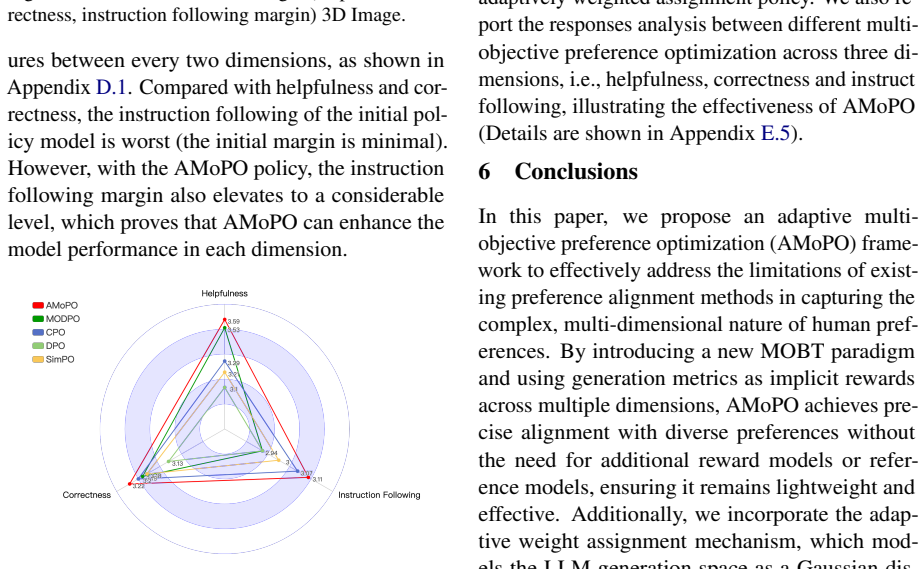
- The method improves helpfulness, correctness, and instruction following together, while several baselines lag on at least one of the three measured dimensions.
- Because the weight sampler is modular, future work can replace the Gaussian with another confidence model without changing the overall AMoPO loss.
Reading between the lines
- If the train/eval transfer holds, AMoPO teaches implicit controllability: the model internalizes dimension emphasis from the training template and reproduces it on plain prompts, which would make it usable without control tokens at inference.
- The Gaussian sampler is one instance of a confidence-driven weighting rule; entropy-based or calibration-based uncertainties could be substituted and compared, which would show whether token probabilities are informative for weighting or merely a stable proxy.
- The paper trains on one static, three-dimension dataset, so a natural extension is online or multi-turn preference tracking where per-dimension confidence reweighting continues during dialogue; the authors themselves list multi-turn preferences as unaddressed.
- Because the reported 28.5% is an average of per-benchmark improvement ratios, benchmark-by-benchmark margins such as win rates and MT-bench ratings should be read alongside the headline.
Editorial analysis
A structured set of objections, weighed in public.
Referee Report
Summary. AMoPO is a preference-optimization method for LLMs that removes both reward models and reference models. The paper's core idea is to condition training on dimension-specific prompt templates x* = f(x, d_k) for helpfulness, correctness, and instruction following, then train with a weighted sum of SimPO-style losses, where the weights are sampled from a Gaussian distribution whose mean and variance come from the policy's own token probabilities. Experiments on Qwen2.5-7B/14B/32B and LLaMA3.1-8B are reported on AlpacaEval 2, Arena-Hard, and MT-bench, with the abstract claiming a 28.5% average improvement over state-of-the-art baselines and 'scaling ability' across model sizes.
Significance. If the central claims were sound, AMoPO would be a useful lightweight alternative to multi-objective alignment methods that require multiple reward or reference models. The paper explicitly provides code and data, includes human validation, and reports ablations on the weight-assignment mechanism, which are strengths. However, the headline empirical claim rests on a statistically questionable aggregation, the experimental design does not isolate the effect of the prompt-conditioning transformation, and the paper's 'adaptive' claim is never evaluated at inference time. These issues substantially limit the significance of the reported results in their current form.
major comments (6)
- [§5.2, Table 6] The headline '28.5% overall improvements' is computed by averaging per-baseline relative improvements across three benchmarks with very different scales. For Qwen2.5-7B, ORPO has an AlpacaEval win rate of 13.1, so its relative improvement is 346% on that benchmark and 163.5% on average, while SimPO's average relative improvement is only 2.1%. Averaging such heterogeneous relative improvements is not a meaningful performance measure, and no error bars, confidence intervals, or multiple seeds are reported. This undermines the central empirical claim of the abstract.
- [§4.1, Algorithm 1, §5.1] Training uses dimension-conditioned prompts x* = f(x, d_k) for each objective, but all evaluation is performed on the original prompt x. The paper provides no control experiment or analysis demonstrating that gains transfer from the templated prompt distribution to plain prompts. Without a baseline trained on the same x* data with a standard loss and evaluated on x, the improvements in Table 2 could be attributed to prompt/data augmentation rather than to the MOBT model or the Gaussian weighting mechanism.
- [§4.2, Eq. (8)] The Multi-Objective BT model is defined as a weighted sum of log-sigmoids, π(y_w ≻ y_l | x; α; d) = Σ_k α_k log σ(r_k(x*_k, y_w) − r_k(x*_k, y_l)). This expression is not a probability distribution: it is generally negative and unbounded. The subsequent claim that Eq. (9) is a maximum-likelihood objective under a Bradley-Terry-style model is therefore not justified. The loss itself is a reasonable scalarized SimPO objective, but the theoretical derivation is incorrect.
- [§4.3, Eq. (10)] The adaptive weight assignment computes the mean and variance of the policy's own token probabilities and samples weights α_k from the resulting Gaussian, which are then used to weight the same policy's loss. This self-referential loop is not analyzed, and no evidence is provided that token-probability statistics encode meaningful per-dimension confidence. The ablation in Table 3 compares Gaussian sampling with fixed weights but does not isolate this mechanism from the prompt-conditioning transformation, so the contribution of the weight assignment is not clearly demonstrated.
- [§5.2, Table 3] The abstract claims that experiments on 7B, 14B, and 32B models reveal the scaling ability of AMoPO, but the 32B results in Table 3 only compare Gaussian sampling with fixed weights within AMoPO; no baseline methods are evaluated at 32B. The scaling claim is therefore not supported by any comparison against state-of-the-art baselines at that scale.
- [§1, §5] The paper describes AMoPO as 'adaptive' and capable of 'dynamic balance' across preference dimensions. However, at inference the model receives only the original prompt x with no dimension indicator, so the trained policy cannot adapt its balance across dimensions when a user specifies a preference. None of the evaluations test adaptivity by conditioning the prompt on a dimension at inference time. The central claim of adaptivity is therefore untested.
minor comments (6)
- [§4.3, Eq. (10)] The variable T in Eq. (10) is not defined; it should be stated that T is the number of tokens in the response (or that the mean and variance are computed over the token positions).
- [Appendix B, Table 4] Table 4 lists γ = 2.0 for AMoPO, but γ does not appear in Eq. (9) or Algorithm 1. Please clarify whether γ is used in the loss or remove it from the hyperparameter table.
- [Figure 2] Figure 2 is referenced in the text (Section 4.1 and 4.4) but is not present in the manuscript; the pipeline figure should be included.
- [References] There are duplicate references: Ramé et al. 2023a and 2023b are the same paper, and Wang et al. 2024b and 2024c appear to be the same work. These should be consolidated.
- [§4.4] The sentence 'AMoPO transfers an original quadruple < x, y_w, y_l, d> into a set of quadruples {< x, y_w, y_l, d >}_{d∈d}' is confusing because d is used both as a variable ranging over the set of dimensions and as the set itself; please clarify the notation.
- [Limitations] The Limitations section acknowledges that the Gaussian assumption may not generalize, but it does not mention the train/eval distribution shift or the statistical aggregation issue raised above. These are important limitations and should be discussed.
Circularity Check
No significant circularity: AMoPO's loss and adaptive weights are self-referential heuristics, but no prediction reduces to a fitted input or self-citation chain.
full rationale
We find no circular reasoning in AMoPO. The training objective (Eq. 9) is a weighted sum of SimPO-style per-dimension losses on dimension-conditioned prompts x*_k = f(x, d_k); the weights alpha_k are sampled from a Gaussian parameterized by the policy's own token probabilities (Eq. 10, Algorithm 1). This is a self-referential heuristic - the model weights dimensions by its own confidence - but it is not a fitted parameter renamed as a prediction, and no benchmark quantity is equal by construction to the loss. The derivation from the per-dimension BT model to the MOBT loss is algebraic (Appendix A), and the cited generation metric comes from external work (SimPO, Meng et al. 2024). The only self-citation (Xu et al. 2025, which shares two authors) is a passing reference to multi-dimensional preferences and is not load-bearing. The most serious validity threats - training on x* while evaluating on plain x, and the Gaussian assumption - are empirical or modeling concerns, not circularity. We therefore score 0.
Assumptions & free parameters
free parameters (2)
- beta (β) =
0.8
- gamma (γ) =
2.0
assumptions (4)
- domain assumption Bradley-Terry model describes pairwise preferences as a logistic function of reward differences (Eq. 2, Section 3).
- ad hoc to paper A weighted sum (or product) of per-dimension BT probabilities yields a valid preference distribution (Eq. 8, Section 4.2).
- ad hoc to paper The generation space of the LLM can be modeled as a Gaussian distribution whose moments are estimated from token probabilities (Eq. 10, Section 4.3).
- domain assumption Training on dimension-conditioned prompts x*_k = f(x, d_k) transfers to unconditioned prompts at inference.
invented entities (2)
-
Multi-Objective BT (MOBT) model
-
Adaptive Gaussian weight policy
Cite this review
Pith. "Pith review of AMoPO: Adaptive Multi-objective Preference Optimization without Reward Models and Reference Models." pith.science (2026). https://pith.science/paper/JJPCWYRH
@misc{pith2026250607165,
  author       = {Pith},
  title        = {Pith review of: AMoPO: Adaptive Multi-objective Preference Optimization without Reward Models and Reference Models},
  year         = {2026},
  howpublished = {\url{https://pith.science/paper/JJPCWYRH}},
  note         = {Machine review of arXiv:2506.07165}
}
read the original abstract
Existing multi-objective preference alignment methods for large language models (LLMs) face limitations: (1) the inability to effectively balance various preference dimensions, and (2) reliance on auxiliary reward/reference models introduces computational complexity. To address these challenges, we propose Adaptive Multi-objective Preference Optimization (AMoPO), a novel framework that achieves dynamic balance across preference dimensions. By introducing the multi-objective optimization paradigm to use the dimension-aware generation metrics as implicit rewards, AMoPO aligns LLMs with diverse preferences without additional reward models or reference models. We introduce an adaptive weight assignment mechanism that models the generation space as a Gaussian distribution, allowing dynamic prioritization of preference dimensions. Empirical results demonstrate that AMoPO outperforms state-of-the-art baselines by 28.5%, and the experiments on 7B, 14B, and 32B models reveal the scaling ability of AMoPO. Moreover, additional analysis of multiple dimensions verifies its adaptability and effectiveness. These findings validate AMoPO's capability to achieve dimension-aware preference alignment, highlighting its superiority. Our codes and datasets are available at https://github.com/Javkonline/AMoPO.
Figures


Figures from the paper (11 more)


Reference graph
Works this paper leans on
-
[1]
**Partial Focus**: Addresses one aspect poorly
-
[2]
- (2) Acknowledges both but slight deviations
**Partial Compliance**: - (1) Meets goals or restrictions, neglecting others. - (2) Acknowledges both but slight deviations
-
[3]
Hybrid preference optimization: Augmenting direct preference optimization with auxiliary objec- tives.CoRR, abs/2405.17956. Lalit R. Bahl, Frederick Jelinek, and Robert L. Mercer
-
[4]
**Comprehensive Compliance**: Fully aligns, meets all requirements. Based the instruction following rule and given my answer to an instruction, your role is to provide specific and constructive score for me. You should find the best way for me to learn from your instruction following score and improve my performance. You should consider the all Instructio...
work page 2024
-
[5]
Cal vary Ceme tery and Mor tu ary will be on your right. For the most ac cu rate and up -to -date di rec tions, it is rec om mended to use a GPS de vice or a map ping ser vice like Google Maps, Ap ple Maps, or Waze, as road con di tions and con struc tion can change. MODPO To travel from Rowan Av enue El emen tary School to Cal vary Ceme tery and Mor tu a...
-
[6]
Multi-objective alignment of large language models through hypervolume maximization.arXiv preprint arXiv:2412.05469. OpenAI. 2023. GPT-4 technical report.CoRR, abs/2303.08774. Long Ouyang, Jeffrey Wu, Xu Jiang, Diogo Almeida, Carroll Wainwright, Pamela Mishkin, Chong Zhang, Sandhini Agarwal, Katarina Slama, Alex Ray, et al
arXiv 2023
-
[7]
Turn right onto S San Pe dro St
-
[8]
Direct preference optimization: Your language model is secretly a reward model. InAdvances in Neural Information Processing Systems 36: Annual Conference on Neural Information Processing Sys- tems 2023, NeurIPS 2023, New Orleans, LA, USA, December 10 - 16, 2023. Alexandre Ramé, Guillaume Couairon, Corentin Dancette, Jean-Baptiste Gaya, Mustafa Shukor, Lau...
work page 2023
Show all 45 references
-
[9]
Al ter na tively, you can use a nav iga tion app like Google Maps or Waze to get the most ac cu rate and up -to -date di rec tions
Cal vary Ceme tery and Mor tu ary will be on your right at 4201 Whit tier Blvd, Los An ge les, CA 90023. Al ter na tively, you can use a nav iga tion app like Google Maps or Waze to get the most ac cu rate and up -to -date di rec tions. Helpfulness Judgment AMoPO is more help ...
-
[10]
Zheng Yuan, Hongyi Yuan, Chuanqi Tan, Wei Wang, Songfang Huang, and Fei Huang
OpenReview.net. Zheng Yuan, Hongyi Yuan, Chuanqi Tan, Wei Wang, Songfang Huang, and Fei Huang. 2023. RRHF: rank responses to align language models with human feed- back without tears.CoRR, abs/2304.05302. Lianmin Zheng, Wei-Lin Chiang, Ying Sheng, Siyuan Zhuang, Zhanghao Wu, Y...
2023 arXiv
-
[11]
**Irrelevant**: No alignment
-
[14]
**Almost There**: Near alignment, minor deviations
-
[16]
The response completely missed the essence of what the user wanted
The response is not useful or helpful at all. The response completely missed the essence of what the user wanted
-
[17]
The response is borderline unhelpful and mostly does not capture what the user was looking for, but it is still usable and helpful in a small way
-
[18]
The response did not fully satisfy what the user was looking for
The response is partially helpful but misses the overall goal of the user’s query/input in some way. The response did not fully satisfy what the user was looking for
-
[19]
The response is mostly helpful and mainly aligned with what the user was looking for, but there is still some room for improvement
-
[20]
Based the helpfulness rule and given my answer to an instruction, your role is to provide specific and constructive score for me
The response is extremely helpful and completely aligned with the spirit of what the prompt was asking for. Based the helpfulness rule and given my answer to an instruction, your role is to provide specific and constructive score for me. You should find the best way for me to ...
2024
-
[21]
All information provided is wrong, false or hallucinated
The response is completely incorrect. All information provided is wrong, false or hallucinated. If the prompt asks the assistant to do a task, the task is not at all attempted, or the wrong task was attempted in the response. The response is completely irrelevant to the prompt
-
[22]
The response may contain multiple instances of hallucinations, false information, misleading information, or irrelevant information
The response has some correct elements but is mostly wrong or incomplete. The response may contain multiple instances of hallucinations, false information, misleading information, or irrelevant information. If the prompt asks the assistant to do a task, the task was attempted ...
-
[23]
The response may miss some details, contain misleading information, or minor hallucinations, but is more or less aligned with what the prompt asks for
The response contains a mix of correct and incorrect information. The response may miss some details, contain misleading information, or minor hallucinations, but is more or less aligned with what the prompt asks for. If the prompt asks the assistant to perform a task, the tas...
-
[24]
It contains no misleading information or hallucinations
The response is mostly accurate and correct with a small amount of missing information. It contains no misleading information or hallucinations. If the prompt asks the assistant to perform a task, the task is mostly successfully attempted
-
[25]
preference
The response is completely correct and accurate to what is requested by the prompt with no necessary details missing and without false, misleading, or hallucinated information. If the prompt asks the assistant to do a task, the task is completely done and addressed in the resp...
2024
-
[26]
Exit the cur rent ‘nix - shell‘: “‘sh exit “‘
-
[27]
Mod ify your ‘shell.nix‘ file to in clude the new pack ages
-
[28]
Start a new ‘nix - shell‘ ses sion: “‘sh nix - shell “‘ This will recre ate the en vi ron ment with the new de pen den cies spec ified in your up dated ‘shell.nix‘ file. If you want to avoid the over head of restart ing ‘nix - shell‘ fre quently, con sider us ing other de vel ...
-
[29]
**Edit ‘shell.nix‘:** Make the nec es sary changes to add new pack ages
-
[30]
**Exit the cur rent ‘nix - shell‘:** You can do this by sim ply typ ing ‘exit‘
-
[31]
“markdown“‘markdown. This is an example of a code block in Markdown. You can see that it is formatted to look like it’s not part of the regular text flow
**Restart ‘nix - shell‘:** Run ‘nix - shell‘ again to en ter a new shell en vi ron ment with the up dated con fig u ra tions. If you fre quently need to test changes to your ‘shell.nix‘, you might con sider script ing these steps to make the pro cess quicker and more con ve ni...
1999
-
[32]
Head west on S Rowan Ave to ward E 62nd St for ap prox imately 0.1 miles
-
[33]
Turn right onto S East ern Ave and con tinue for about 1.4 miles
-
[34]
Take a left turn to merge onto Whit tier Blvd
-
[35]
Con tinue on Whit tier Blvd for ap prox imately 1.1 miles
-
[37]
Start at Rowan Av enue El emen tary School, lo cated at 600 S Rowan Ave, Los An ge les, CA 90023
-
[38]
Head west on S Rowan Ave to ward E 41st St
-
[39]
Turn left onto E 41st St
-
[40]
Con tinue straight onto E 41st St, which will turn into S Gramercy Pl
-
[41]
Turn right onto E 43rd St
-
[42]
Turn left onto S Gramercy Pl
-
[44]
Con tinue on S San Pe dro St, which will turn into Whit tier Blvd
-
[1027]
Hao Sun, Yunyi Shen, and Jean-Francois Ton
Association for Computational Linguistics. Hao Sun, Yunyi Shen, and Jean-Francois Ton. 2024. Rethinking bradley-terry models in preference-based reward modeling: Foundations, theory, and alterna- tives.arXiv preprint arXiv:2411.04991. Hugo Touvron, Thibaut Lavril, Gautier Izac...
2024 arXiv
-
[1983]
Pattern Anal
A maximum likelihood approach to continuous speech recognition.IEEE Trans. Pattern Anal. Mach. Intell., 5(2):179–190. Ralph Allan Bradley and Milton E Terry. 1952. Rank analysis of incomplete block designs: I. the method of paired comparisons.Biometrika, 39(3/4):324– 345. Ganq...
1952 arXiv
-
[2022]
Ryan Park, Rafael Rafailov, Stefano Ermon, and Chelsea Finn
Training language models to follow instruc- tions with human feedback.Advances in neural in- formation processing systems, 35:27730–27744. Ryan Park, Rafael Rafailov, Stefano Ermon, and Chelsea Finn. 2024. Disentangling length from qual- ity in direct preference optimization. ...
2024
-
[2023]
Seongyun Lee, Sue Hyun Park, Seungone Kim, and Minjoon Seo
Personalized soups: Personalized large lan- guage model alignment via post-hoc parameter merg- ing.CoRR, abs/2310.11564. Seongyun Lee, Sue Hyun Park, Seungone Kim, and Minjoon Seo. 2024. Aligning to thousands of pref- erences via system message generalization.CoRR, abs/2405.17...
2024 arXiv
-
[2024]
Mohammad Gheshlaghi Azar, Zhaohan Daniel Guo, Bi- lal Piot, Rémi Munos, Mark Rowland, Michal Valko, and Daniele Calandriello
Introducing meta llama 3: The most capable openly available llm to date. Mohammad Gheshlaghi Azar, Zhaohan Daniel Guo, Bi- lal Piot, Rémi Munos, Mark Rowland, Michal Valko, and Daniele Calandriello. 2024. A general theoret- ical paradigm to understand learning from human prefe...
2024
-
[4455]
Anirudhan Badrinath, Prabhat Agarwal, and Jiajing Xu
PMLR. Anirudhan Badrinath, Prabhat Agarwal, and Jiajing Xu
Reviewed August 7, 2026 · model on record in the stance chip above.
Discussion (0). Sign in to comment.