REVIEW 2 major objections 5 minor 26 references
This paper claims that a planner which deforms nearest-neighbor search into a force-aligned ellipsoid and adapts batch size to the informed-set volume finds initial and converged solutions faster than prior single-query planners in dimensio
Reviewed by Pith at T0; open to challenge. T0 means a machine referee read the full paper against a public rubric. the ladder, T0–T4 →
APT* combines adaptive batch sizing with elliptical nearest-neighbor regions defined by a Coulomb-like force to speed up sampling-based path planning.
T0 review reviewed 2026-08-05 challenge →
load-bearing objection APT* is a solid empirical extension of FIT*/FDIT* with good benchmark results, but the "Asymptotically Optimal" claim is unsupported and likely false because the batch-dependent connection radius collapses to zero. the 2 major comments →
APT*: Asymptotically Optimal Motion Planning via Adaptively Prolated Elliptical R-Nearest Neighbors
The pith
A machine-rendered reading of the paper's core claim, the machinery that carries it, and where it could break.
The reading
Core claim
APT* assigns every sampled vertex a charge. Valid neighbors attract, invalid (in-collision) neighbors repel, and the vector sum produces a net Coulomb force F. The usual isotropic nearest-neighbor ball is stretched along F, producing an elliptical region (Eq. 9) whose major axis points in the force direction. The charge—and therefore the eccentricity—is not fixed: it is scheduled by a Tanh/Taylor function of an adaptive batch size, which shrinks as the hypervolume of the informed set contracts with improving solution cost (Eqs. 10–14). The paper's claim is that this coupling lets APT* find a first feasible path quickly (large batch, small charge, nearly spherical region) and then refine it e
What carries the argument
Two coupled modules carry the argument. First, elliptical r-nearest neighbors: Coulomb's law (Eq. 6) gives a force vector, and Eq. 9 defines a hyperellipsoid neighborhood centered at the vertex, with the major axis along the force and the remaining semi-axes equal to the original radius. Second, adaptive batch sizing: Eq. 10 sets samples per batch from a decay factor, Eq. 13 measures how much the informed-set hypervolume has contracted, and Eq. 15 converts batch size into a vertex charge via the Tanh/Taylor expansion. Higher charge means stronger force, hence a more elongated neighborhood. The claimed effect is that this pair of mechanisms balances exploration and refinement better than fixe
Load-bearing premise
The load-bearing premise is that the adaptive batch-size schedule still produces the growing sample density that asymptotic-optimality proofs require, and that the ellipsoidal neighbor selection preserves the graph connectivity and rewiring conditions; the paper asserts both but provides no theorem for them.
What would settle it
On a problem with a known optimal cost, log the adapted batch size and the total number of samples as computation time increases. If Badapt ever reaches mmin=1 and remains there while time grows, the sample count stops growing and cost will plateau above the optimum; that observation would falsify the asymptotic-optimality claim. Equivalently, a formal check: compute whether the batch sizes B(Θd) produced by Eqs. 10–14 diverge to infinity over repeated cost improvements.
If this is right
- Planners can replace an isotropic r-nearest-neighbor ball with an ellipsoid whose major axis points along a virtual force and still improve anytime convergence; the ellipsoid contains the original ball, so the baseline connectivity radius is not reduced.
- Batch size no longer needs a manually tuned schedule; the informed-set hypervolume ratio provides a continuous signal that shifts from large exploratory batches to small refinement batches.
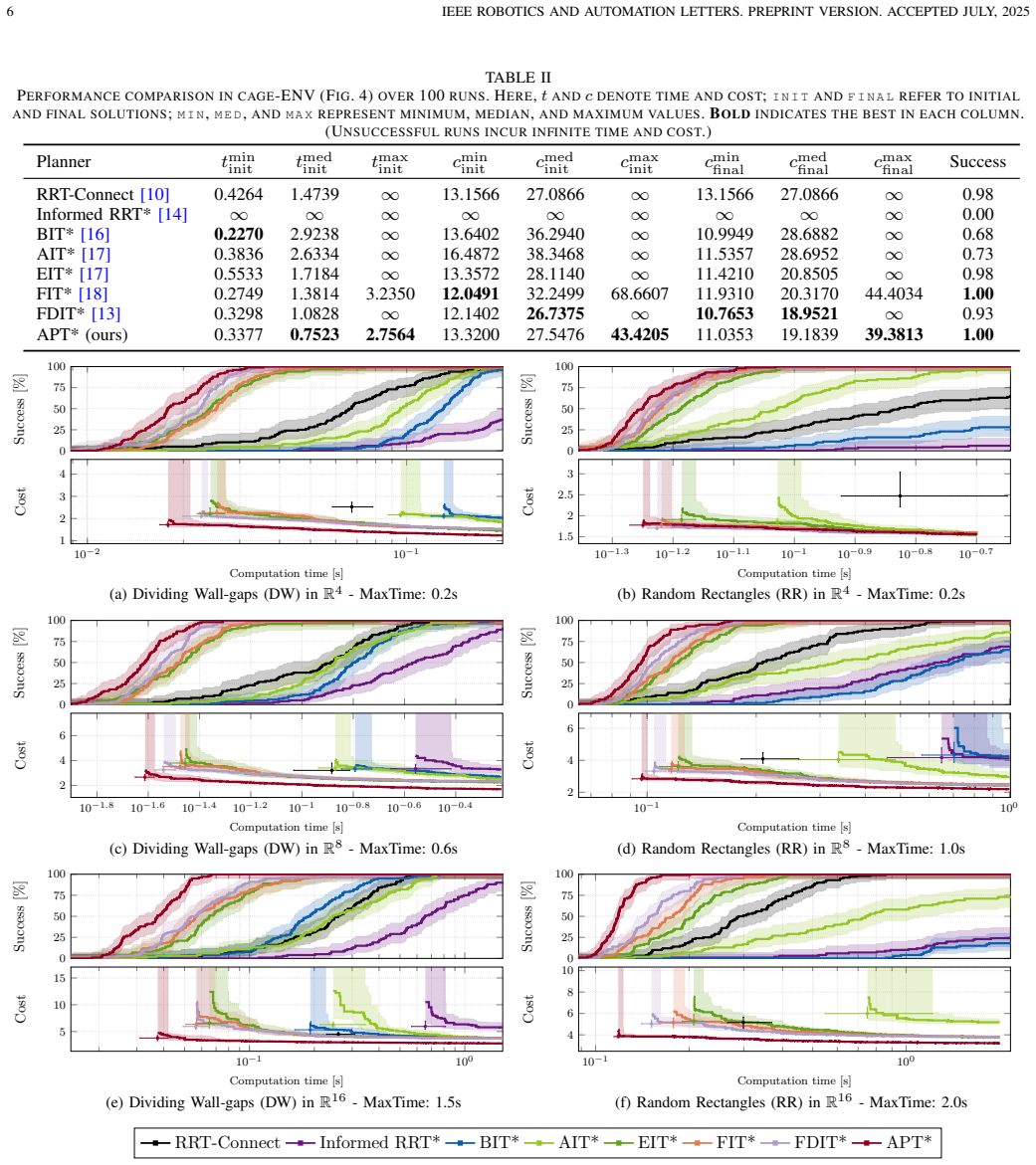
- The reported speedups in median initial-solution time grow with dimensionality (roughly 11–34% over FIT*/FDIT* across R4–R16, and 45.54% over FIT* in the R14 cage task), suggesting the prolation effect matters most when sampling is sparse.
- Success rates on constrained real-world manipulation tasks improve as well: the paper reports 93.3% versus 76.7–80% for kitchen tool retrieval and 83.3% versus 60–66.7% for shelf insertion.
Where Pith is reading between the lines
- Because the deformed region always contains the standard r-ball, the connectivity side of asymptotic optimality may survive the ellipsoidal change; the unproven part is the batch schedule, which must supply infinitely many samples over time. A formal analysis of B(Θd)'s growth, or a counterexample where it stalls at mmin, would settle whether the 'asymptotically optimal' in the title is earned.
- The Coulomb force is computed from valid and invalid neighbor locations, so it functions as an implicit local clearance heuristic. One could test whether the force direction aligns with the gradient of a distance-to-obstacle field; if so, the prolation is doing obstacle-aware exploration in a way the paper does not make explicit.
- The Tanh/Taylor charge schedule is one smooth interpolation among many; a natural ablation would replace the charge function with a linear or exponential scheduler matched to the same informed-ratio signal and compare convergence, which would reveal how much of the gain comes from the specific nonlinearity rather than from the feedback loop itself.
- The same feedback idea—shaping the search region by informed-set volume—could transfer to bidirectional planners or k-nearest variants, where the force direction from two growing trees may be even more informative; the paper does not explore this.
Editorial analysis
A structured set of objections, weighed in public.
Referee Report
Summary. APT* is presented as an asymptotically optimal, anytime single-query motion planner extending FDIT*. It introduces two coupled modules: an adaptive batch-size module (Algorithm 2) that sets the number of samples per batch from the shrinking hypervolume of an informed set, and an elliptical r-nearest-neighbor module (Algorithm 1) in which vertices carry a "charge" determined by a tanh-based nonlinear function of the batch size, generating Coulomb-like forces that stretch the neighbor ellipsoid. The paper claims superior initial-solution time and convergence cost relative to RRT-Connect, Informed RRT*, BIT*, AIT*, EIT*, FIT*, and FDIT* in R4, R8, R14, and R16 benchmarks, plus two real-world manipulation tasks. The central advertised property is asymptotic optimality, repeated in the title, abstract, and conclusion.
Significance. If the theoretical claim were established and the empirical results were as reported, APT* would be a useful contribution to high-dimensional sampling-based planning: the adaptive batch scheduler tied to informed-set hypervolume and the force-directed elliptical neighbor region are plausible heuristics for accelerating convergence, and the benchmark suite is broad, including simulated and physical robot tasks. The paper also links to a repository with an OMPL implementation. However, the asymptotic-optimality claim is the headline contribution, and it is neither proved nor, on inspection, consistent with the algorithm's own formulas. The empirical evaluation also contains reporting inconsistencies. The useful heuristic content does not rescue the central claim as written.
major comments (2)
- [§III-A, Eq. (2); Algorithm 2; Eq. (10)] The connection radius in Eq. (2) is r(B) = 2η(1+1/n)[λ(X_fhat)/λ(UB,n) · log(B)/B]^{1/n}. Algorithm 2 sets mmin=1, and Eq. (10) gives B(Θd)=floor(1+Θd(mmax−1)), so B=1 whenever Θd is sufficiently small. Eq. (11) makes Θd→0 as the informed ratio Gi→0 (Eq. (13)), which is exactly the intended optimization phase. For B=1, log(1)=0, hence r=0. In the elliptical region of Eq. (9), the semi-axes are d1=r(1+k||F_D||) and d2..n=r, so with r=0 the region has zero volume: no edges are added or rewired, and the graph cannot continue to converge to c*. Standard sufficient conditions for asymptotic optimality, such as those in [11] and [20], require the connection radius to grow with the cumulative sample count N; using the shrinking batch size B alone does not satisfy this. No theorem is supplied to show that the schedule preserves asymptotic optimality. Thus the title's central claim is not merely
- [§III (entire), esp. §III-B and §III-C] The paper claims asymptotic optimality but contains no formal statement, proof, or even a proof sketch. The modifications to the nearest-neighbor graph are substantial: the neighbor set is an anisotropic ellipsoid aligned with a force vector (Eq. (9)), and the batch size—and hence the connection radius—is a function of the current solution cost through Eqs. (10)–(14). No argument is given that the resulting graph remains connected almost surely or that the rewiring preserves the conditions of Karaman and Frazzoli [11]. Citing RGG theory [4, 20] does not substitute for verifying that the proposed architecture satisfies those sufficient conditions. For a paper whose title and abstract advertise asymptotic optimality, this missing analysis is load-bearing.
minor comments (5)
- [Fig. 6 vs. §IV-A] The PDT report embedded in Fig. 6 states that 10 runs were executed for each planner, while the text and Table III say 100 runs. This factor-of-ten discrepancy should be corrected and the statistical claims (e.g., 99% confidence intervals) recomputed with the actual number of runs.
- [Eq. (4)–(6)] The Coulomb force formula in Eq. (3) uses r_i^{n−1} with unit vector, while Eqs. (4) and (5) use ||x−x_valid,i||^n times the displacement vector. These are dimensionally inconsistent as written; the intended normalization should be clarified.
- [Eq. (15)] The Taylor expansion formula is hard to parse: the notation B2i is overloaded (Bernoulli numbers vs. batch size B), the placement of parentheses in the summand is ambiguous, and the role of the expansion order α beyond a heuristic trade-off is not explained. A cleaner statement with a defined argument domain would improve reproducibility.
- [Algorithm 2 and Algorithm 3] Algorithm 2 uses informal constructs such as "pragma once", "calTuningParam", and "isCostBetter" that are not defined in the pseudocode or the text. Algorithm 3 fixes qmin=0.1, qmax=1.9, ε=6, β=−0.5, and α is chosen from Table I; these are empirical choices made on one problem, and the sensitivity of the claimed performance to them is not reported.
- [§III-C, Table I] The selection of the tanh order α and the charge bounds is based on a single comparison in Table I. No held-out validation or ablation across the benchmark set is provided, so the claimed superiority of APT*-T should be viewed as tuned performance rather than a robust algorithmic property.
Circularity Check
No circularity found; the asymptotic-optimality claim is an unproven substitution rather than a circular reduction.
full rationale
The paper's central derivation is Eq. 2, which writes r(B) := 2η(1+1/n)(λ(X_fhat)/λ(UB,n)·log(B)/B)^{1/n} and then uses the adaptive batch size B(Θd) from Eqs. 10–13. This replaces the cumulative sample count N of the standard RGG radius with a current batch size that itself depends on the current solution cost c_current. That is a missing proof/validity gap—no theorem in the paper shows this substitution preserves the Karaman–Frazzoli sufficient conditions for asymptotic optimality—but it is not circularity: the conclusion is not assumed in the premises, and the feedback from c_current to B to r is a control design, not an identity. The self-citations to FDIT* [13] and FIT* [18] are peer-reviewed component baselines, and the head-to-head benchmarks against OMPL planners are external. The selection of α in Table I on the same benchmark family creates selection bias, but the reported outperformance is not statistically forced by construction because the chosen variant could still lose to baselines. No 'prediction' in the paper reduces to a fitted parameter or to a self-citation chain. The honest finding is no significant circularity; the main risk is an unsupported AO claim.
Axiom & Free-Parameter Ledger
free parameters (5)
- qmin and qmax (charge bounds) =
0.1 and 1.9
- epsilon and beta (charge normalization) =
6 and -0.5
- alpha (Taylor expansion order) =
10, 100, 1000 evaluated; final choice not stated
- sigmoid steepness (10 in Eq. 12) =
10
- tau_t definition =
(mmax + mmin)/ndim
axioms (3)
- domain assumption Random geometric graph connectivity and asymptotic optimality results from [5] and [11] apply to the modified elliptical RNN graph.
- domain assumption The Coulomb-like force from valid and invalid vertices provides useful problem-specific information for planning.
- domain assumption The hypervolume ratio Gi of informed hyperellipsoids is a reliable signal for scheduling batch size.
invented entities (2)
-
Virtual electric charge q on planning vertices
no independent evidence
-
Coulomb force vector F_hatD
no independent evidence
Cite this review
Pith. "Pith review of APT*: Asymptotically Optimal Motion Planning via Adaptively Prolated Elliptical R-Nearest Neighbors." pith.science (2026). https://pith.science/paper/JJQX46J6
@misc{pith2026250819790,
  author       = {Pith},
  title        = {Pith review of: APT*: Asymptotically Optimal Motion Planning via Adaptively Prolated Elliptical R-Nearest Neighbors},
  year         = {2026},
  howpublished = {\url{https://pith.science/paper/JJQX46J6}},
  note         = {Machine review of arXiv:2508.19790}
}
abstract
Optimal path planning aims to determine a sequence of states from a start to a goal while accounting for planning objectives. Popular methods often integrate fixed batch sizes and neglect information on obstacles, which is not problem-specific. This study introduces Adaptively Prolated Trees (APT*), a novel sampling-based motion planner that extends based on Force Direction Informed Trees (FDIT*), integrating adaptive batch-sizing and elliptical $r$-nearest neighbor modules to dynamically modulate the path searching process based on environmental feedback. APT* adjusts batch sizes based on the hypervolume of the informed sets and considers vertices as electric charges that obey Coulomb's law to define virtual forces via neighbor samples, thereby refining the prolate nearest neighbor selection. These modules employ non-linear prolate methods to adaptively adjust the electric charges of vertices for force definition, thereby improving the convergence rate with lower solution costs. Comparative analyses show that APT* outperforms existing single-query sampling-based planners in dimensions from $\mathbb{R}^4$ to $\mathbb{R}^{16}$, and it was further validated through a real-world robot manipulation task. A video showcasing our experimental results is available at: https://youtu.be/gCcUr8LiEw4
Figures



Reference graph
Works this paper leans on
-
[1]
Asymptotically optimal sampling-based motion planning methods,
J. D. Gammell and M. P. Strub, “Asymptotically optimal sampling-based motion planning methods,” Annual Review of Control, Robotics, and Autonomous Systems, vol. 4, pp. 295–318, 2021
2021
-
[2]
Sampling-based motion planning: A comparative review,
A. Orthey, C. Chamzas, and L. E. Kavraki, “Sampling-based motion planning: A comparative review,” Annual Review of Control, Robotics, and Autonomous Systems , vol. 7, no. 1, pp. 285 – 310, 2024
work page 2024
-
[3]
Motion planning for robotics: A review for sampling- based planners,
L. Zhang, K. Cai, Z. Sun, Z. Bing, C. Wang, L. Figueredo, S. Haddadin, and A. Knoll, “Motion planning for robotics: A review for sampling- based planners,” Biomimetic Intelligence and Robotics , vol. 5, no. 1, p. 100207, 2025
2025
-
[4]
Penrose, Random geometric graphs
M. Penrose, Random geometric graphs . OUP Oxford, 2003, vol. 5
2003
-
[5]
Estimated informed anytime search for sampling-based planning via adaptive sampler,
L. Zhang, K. Cai, Y . Zhang, Z. Bing, C. Wang, F. Wu, S. Haddadin, and A. Knoll, “Estimated informed anytime search for sampling-based planning via adaptive sampler,” IEEE Transactions on Automation Science and Engineering , vol. 22, pp. 18 580–18 593, 2025
2025
-
[6]
A note on two problems in connexion with graphs,
E. Dijkstra, “A note on two problems in connexion with graphs,” Numerische Mathematik, vol. 1, no. 1, pp. 269–271, 1959
1959
-
[7]
A formal basis for the heuristic determination of minimum cost paths,
P. E. Hart, N. J. Nilsson, and B. Raphael, “A formal basis for the heuristic determination of minimum cost paths,” IEEE transactions on Systems Science and Cybernetics , vol. 4, no. 2, pp. 100–107, 1968
1968
-
[8]
Rapidly-exploring random trees: A new tool for path planning,
S. LaValle, “Rapidly-exploring random trees: A new tool for path planning,” Research Report 9811 , 1998
1998
-
[9]
Prob- abilistic roadmaps for path planning in high-dimensional configuration spaces,
L. E. Kavraki, P. Svestka, J.-C. Latombe, and M. H. Overmars, “Prob- abilistic roadmaps for path planning in high-dimensional configuration spaces,” IEEE Transactions on Robotics and Automation , vol. 12, no. 4, pp. 566–580, 1996
1996
-
[10]
RRT-connect: An efficient approach to single-query path planning,
J. Kuffner and S. LaValle, “RRT-connect: An efficient approach to single-query path planning,” in Proceedings 2000 ICRA. Millennium Conference. IEEE International Conference on Robotics and Automa- tion. Symposia Proceedings (Cat. No.00CH37065) , vol. 2, 2000, pp. 995–1001 vol.2
work page 2000
-
[11]
Sampling-based algorithms for optimal motion planning,
S. Karaman and E. Frazzoli, “Sampling-based algorithms for optimal motion planning,” The international journal of robotics research, vol. 30, no. 7, pp. 846–894, 2011
2011
-
[12]
Fast marching tree: A fast marching sampling-based method for optimal motion planning in many dimensions,
L. Janson, E. Schmerling, A. Clark, and M. Pavone, “Fast marching tree: A fast marching sampling-based method for optimal motion planning in many dimensions,” The International Journal of Robotics Research , vol. 34, no. 7, pp. 883–921, 2015
2015
-
[13]
Elliptical k-nearest neighbors: Path optimization via coulomb’s law and invalid vertices in c-space obstacles,
L. Zhang, Z. Bing, Y . Zhang, K. Cai, L. Chen, F. Wu, S. Haddadin, and A. Knoll, “Elliptical k-nearest neighbors: Path optimization via coulomb’s law and invalid vertices in c-space obstacles,”2024 IEEE/RSJ International Conference on Intelligent Robots and Systems (IROS) , pp. 12 032–12 039, 2024
2024
-
[14]
Informed RRT*: Optimal sampling-based path planning focused via direct sampling of an admissible ellipsoidal heuristic,
J. D. Gammell, S. S. Srinivasa, and T. D. Barfoot, “Informed RRT*: Optimal sampling-based path planning focused via direct sampling of an admissible ellipsoidal heuristic,” in 2014 IEEE/RSJ international conference on intelligent robots and systems . IEEE, 2014
2014
-
[15]
Informed sam- pling for asymptotically optimal path planning,
J. D. Gammell, T. D. Barfoot, and S. S. Srinivasa, “Informed sam- pling for asymptotically optimal path planning,” IEEE Transactions on Robotics, vol. 34, no. 4, pp. 966–984, 2018
2018
-
[16]
Batch informed trees (BIT*): Informed asymptotically optimal anytime search,
J. D. Gammell, T. D. Barfoot, and S. S. Srinivasa, “Batch informed trees (BIT*): Informed asymptotically optimal anytime search,” The International Journal of Robotics Research , vol. 39, no. 5, 2020
2020
-
[17]
Adaptively informed trees (AIT*) and effort informed trees (EIT*): Asymmetric bidirectional sampling-based path planning,
M. P. Strub and J. D. Gammell, “Adaptively informed trees (AIT*) and effort informed trees (EIT*): Asymmetric bidirectional sampling-based path planning,” The International Journal of Robotics Research, vol. 41, no. 4, pp. 390–417, 2022
2022
-
[18]
Flexible informed trees (FIT*): Adaptive batch-size approach in informed sampling-based path planning,
L. Zhang, Z. Bing, K. Chen, L. Chen, K. Cai, Y . Zhang, F. Wu, P. Krumbholz, Z. Yuan, S. Haddadin, and A. Knoll, “Flexible informed trees (FIT*): Adaptive batch-size approach in informed sampling-based path planning,” 2024 IEEE/RSJ International Conference on Intelligent Robots and Systems (IROS) , pp. 3146–3152, 2024
2024
-
[19]
Tree- based grafting approach for bidirectional motion planning with local subsets optimization,
L. Zhang, Y . Ling, Z. Bing, F. Wu, S. Haddadin, and A. Knoll, “Tree- based grafting approach for bidirectional motion planning with local subsets optimization,” IEEE Robotics and Automation Letters , vol. 10, no. 6, pp. 5815–5822, 2025
2025
-
[20]
The critical radius in sampling-based motion planning,
K. Solovey and M. Kleinbort, “The critical radius in sampling-based motion planning,” The International Journal of Robotics Research , vol. 39, no. 2-3, pp. 266–285, 2020
work page 2020
-
[21]
Benchmarking motion planning algorithms: An extensible infrastructure for analysis and vi- sualization,
M. Moll, I. A. Sucan, and L. E. Kavraki, “Benchmarking motion planning algorithms: An extensible infrastructure for analysis and vi- sualization,” IEEE Robotics & Automation Magazine , vol. 22, no. 3, pp. 96–102, 2015
2015
-
[22]
Planner developer tools (PDT): Reproducible experiments and statistical analysis for de- veloping and testing motion planners,
J. D. Gammell, M. P. Strub, and V . N. Hartmann, “Planner developer tools (PDT): Reproducible experiments and statistical analysis for de- veloping and testing motion planners,” in Proceedings of the Workshop on Evaluating Motion Planning Performance (EMPP), IEEE/RSJ Inter- national Conference on Intelligent Robots and Systems (IROS) , 2022
2022
-
[23]
Moveit! task construc- tor for task-level motion planning,
M. G ¨orner, R. Haschke, H. Ritter, and J. Zhang, “Moveit! task construc- tor for task-level motion planning,” in IEEE International Conference on Robotics and Automation (ICRA) , 2019, pp. 190–196
2019
-
[24]
OpenRA VE: A planning architecture for autonomous robotics,
R. Diankov and J. J. Kuffner, “OpenRA VE: A planning architecture for autonomous robotics,” in Carnegie Mellon University , 2008
work page 2008
-
[25]
The open motion planning library,
I. A. Sucan, M. Moll, and L. E. Kavraki, “The open motion planning library,” IEEE Robotics & Automation Magazine , vol. 19, no. 4, pp. 72–82, 2012
2012
-
[26]
T. S. Wilson, W. Thomason, Z. Kingston, L. E. Kavraki, and J. D. Gammell, “Nearest-neighbourless asymptotically optimal motion plan- ning with Fully Connected Informed Trees (FCIT*),” in Proceedings of the IEEE International Conference on Robotics and Automation (ICRA) , Atlanta, GA, USA, 19–23 May 2025
work page 2025
This paper was first reviewed by deepseek-v4-flash on August 5, 2026.
discussion (0)
Sign in with ORCID, Apple, or X to comment. Anyone can read and Pith papers without signing in.