REVIEW 3 major objections 5 minor 16 references
Augmenting Variational Autoencoders with Sparse Labels: A Unified Framework for Unsupervised, Semi-(un)supervised, and Supervised Learning
T0 review · 3 major / 5 minor · reviewed 2026-08-14 · deepseek-v4-flash
Pith's one-line read A single VAE architecture with a classifier layer feeding the decoder outperforms separate supervised and unsupervised models at every label count.
desk verdict A simple semi-supervised VAE variant with consistent gains over its own baselines, but the central claim that labels improve unsupervised representations is undercut by the decoder's access to class logits. read the letter →
The pith
A machine-rendered reading of the paper's core claim, the machinery that carries it, and where it could break.
The reading
What carries the argument
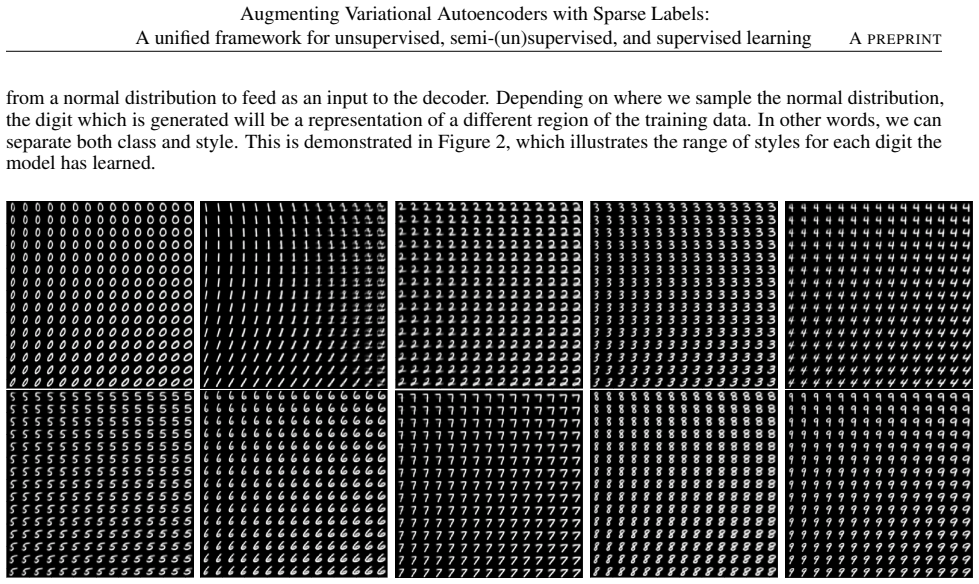
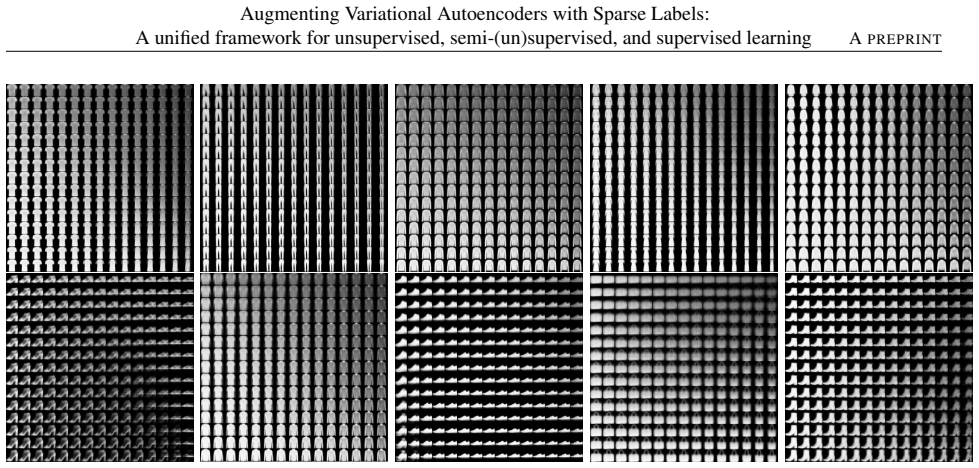
The central mechanism is the $\pi$ layer: a softmax classification layer attached to the topmost encoder layer, whose output is concatenated with the reparameterized latent sample $z$ and fed into the decoder. The total loss is $L = L_{\mathrm{ELBO}} + L_{\mathrm{cl}}$, with $L_{\mathrm{cl}} = -\frac{\alpha(y)}{\#\mathrm{labeled}} \sum_i y_i \log \pi_i$, where $\alpha(y)$ is 1 for labeled and 0 for unlabeled points. This creates a two-way information flow: labels shape the latent geometry through the classification term, while the reconstruction requirement forces the classifier's features to keep enough information to regenerate the input. The same $\pi$ output also serves as a conditioning signal for class-conditional generation; in the disentanglement experiment the $\pi$-to-decoder connection is dropped so the network cannot bypass the latent layer.
What would settle it
In the MNIST anomaly-detection setup, retrain the semi-supervised model with the $\pi$-to-decoder connection removed, as the paper does for Small-NORB, and compare the anomaly-detection AUC against the version that keeps the connection; if the AUC advantage over the unsupervised VAE vanishes or reverses, the label signal was carried by the concatenated classifier output rather than by an improved latent representation.
Extended reading notes
Core claim
The paper's central claim is that classification and unsupervised representation learning are not separate regimes but two ends of one objective. Its model takes a standard VAE, appends a softmax classification layer to the deepest encoder layer, and feeds the concatenation of that layer's output with the reparameterized latent sample into the decoder. Training minimizes the evidence lower bound together with a classification cross-entropy that is masked out for unlabeled inputs. Across several standard image and sensor datasets, this single change beats the equivalent supervised classifier when only 100 or 1,000 labels are available, and with full labels it achieves lower classification log loss than the same encoder trained without the decoder. The paper also reports that labeled points improve anomaly-detection AUC (area under the ROC curve) for most held-out classes, and that on Small-NORB the beta-VAE disentanglement score rises from 82 with no labels to 92 with 1,000 labeled points among 38,000 unlabeled ones.
Load-bearing premise
The load-bearing premise is that when the classifier's probability output is fed into the decoder alongside the latent code, the network still uses the latent code substantively; if the decoder can reconstruct from the classifier output alone, the reported anomaly-detection and disentanglement gains would be an artifact of label leakage rather than better learned representations.
Editorial extensions
If this is right
- A model can be trained once on whatever labels exist and later serve as classifier, anomaly detector, and class-conditional generator, so adding labels over time does not require a new architecture.
- In semi-supervised settings with 100 or 1,000 labels, classification accuracy improves over the same encoder trained only on labeled data, and log loss drops further once enough labels are present.
- Anomaly detection improves over a purely unsupervised VAE for most held-out classes, with gains that saturate at small label fractions in the paper's label-availability experiment.
- With every datapoint labeled, the VAE-framed classifier achieves lower classification log loss than the same classifier trained without the decoder, supporting the view that reconstruction acts as a regularizer.
- Any existing VAE can be converted to the semi-supervised setting by adding a classification layer and a masked cross-entropy term, and the learned weights can be reused directly.
Reading between the lines
- This suggests the mechanism is categorical clustering of the latent space rather than cumulative label information; the paper's anomaly-detection curve across label fractions is nearly flat after a tiny labeled fraction, implying more labels add diversity rather than quantity.
- The paper's disentanglement experiment removes the $\pi$-to-decoder connection to prevent a shortcut, while the main anomaly benchmarks keep it; re-running the anomaly benchmarks with the connection removed would isolate whether the gains come from the latent code or from the classifier logits.
- The unified objective implies a general recipe: any reconstruction-based unsupervised task could be paired with a classifier to inject label information into the representation, making clustering and density estimation natural next targets.
Signed reviews
Editorial analysis
A structured set of objections, weighed in public.
Referee Report
Summary. The paper proposes a variational autoencoder (VAE) extension in which a softmax classification layer (π) is attached to the topmost encoder layer and, together with the resampled latent variable z, is fed into the decoder (Eq. 2). The training objective is the usual ELBO plus a classification cross-entropy term that is active only for labeled examples (Eqs. 3–5). The model is evaluated on MNIST, Fashion-MNIST, UCI-HAR, and Small-NORB in four regimes: semi-supervised classification, fully supervised classification with the decoder acting as a regularizer, anomaly detection (called 'semi-unsupervised' learning), and disentangled representation learning. The central claims are that unlabeled data improve classification, and that labels improve unsupervised tasks such as anomaly detection and disentanglement.
Significance. If the claims hold, the paper offers a simple, generally applicable modification to any VAE that spans the full spectrum of label availability, with practical value for semi-supervised and anomaly-detection applications. The architecture is indeed simple and the empirical study covers several datasets and network families, with error bars for most headline results. The disentanglement experiment (Section 4) is a useful addition because it directly measures latent-representation quality. However, the most novel claim—that labels improve unsupervised tasks—is currently undermined by a confounding architectural choice and by selective reporting, so the significance is conditional on the resolution of those issues.
major comments (3)
- [Section 2.1, Eq. (2) vs. Section 4] The decoder receives the classifier logits π concatenated with the latent sample z (Eq. 2, Figure 1a). In the Small-NORB disentanglement experiment the authors removed the π-to-decoder connection because 'otherwise the network could bypass the latent layer using the π layer, while maintaining reconstruction quality' (Section 4, paragraph 2). Yet the anomaly detection experiments in Sections 3.1.3, 3.2.3, and 3.3 keep this connection. Consequently, the reported AUC improvements of SSD over EUD do not establish that labels improve the latent representation z; they may be driven by the decoder reconstructing from π alone. Since this is the central evidence for the 'semi-unsupervised' claim, the paper needs an ablation in which π is not forwarded to the decoder (or is detached from the decoder input) for the MNIST and Fashion-MNIST anomaly detection tasks. If the improvements disappear, the claim must be substantially revised or the architecture changed.
- [Table 5 and Section 3.1.3] The text states that 'with the exception of the digit 1, there was a considerable improvement for each anomalous class, with an average improvement of 4.1% over the purely unsupervised model.' This excludes a catastrophic degradation for digit 1, whose AUC drops from 0.47 (EUD) to 0.095 (SSD). Averaging over all ten classes, SSD (0.790) is essentially unchanged from EUD (0.791), so the positive claim does not hold in aggregate. Selecting the nine classes that improved and omitting the one that did not constitutes selective reporting and contradicts the abstract's statement that 'every label ... also improves unsupervised tasks.' Please report the mean over all ten classes, discuss the digit-1 failure, and temper the claim accordingly.
- [Table 12, Section 4, and Abstract] The betaVAE score at 100 labels (76 ± 1.6) is significantly lower than at 0 labels (82 ± 0.7), directly contradicting the abstract's claim 'Vice versa, every label not only improves classification, but also unsupervised tasks.' The paper acknowledges this decrease in the text but does not qualify the abstract or the conclusions. Please revise the central claim to state that a small number of labels can degrade disentanglement, and make explicit the label count beyond which improvement is observed.
minor comments (5)
- [Section 3.2.2] The text says the supervised Fashion-MNIST results are 'displayed in Table 9', but the corresponding table is labeled Table 8; the table numbering should be corrected.
- [Section 2.5] The sentence 'see sections 3.2.1, 3.2.1 and 3.3' duplicates the section number 3.2.1; one of these should presumably refer to Section 3.1.1.
- [Throughout] There are several typographical errors, including 'nromalized', 'corresponing', 'abbriavtaion', 'stero', 'predictioon', and 'greysclae'. These should be corrected.
- [Section 3.1.1] The statement that the CNN variant 'scored 4.6% and 5.5% higher than the supervised equivalent' should read '4.6 and 5.5 percentage points higher', since these are differences in accuracy, not relative improvements.
- [Sections 3.3 and 3.1.3] UCI-HAR results (Tables 10 and 11) are single runs with no error bars, unlike the MNIST and Fashion-MNIST experiments; please state explicitly that these are single runs and interpret the results with appropriate caution.
Circularity Check
Disentanglement result is partly self-definitional: the π loss is trained on the same Small-NORB factors that the betaVAE metric measures, and the paper describes π as 'directly reflecting the betaVAE score'.
-
self definitional
[Section 2.6 ('Semi-Unsupervised learning') and Section 4 ('Disentangled representations', Table 12), with Eq. 5]
"This was investigated in two different kind of experiments: (a) we benchmarked the quality of the representations directly via the betaV AE score as a function of available labels (section 4). In this case the added π layer can be interpreted as an additional loss term directly reflecting the betaVEA score."
Table 12's claim that labels improve disentanglement is built from the same information the model is trained on. Section 4 adds cross-entropy π layers for the four Small-NORB generating factors (category, elevation, azimuth, lighting), and the betaVAE metric is computed by decoding those same factors from the latent. The supervised loss Lcl (Eq. 5) therefore directly trains the latent to encode the factors that the metric then detects, so the score increase from 82 with 0 labels to 95 with 3,000 labels is substantially by construction rather than an independent discovery. The paper's own sentence says the π layer is 'an additional loss term directly reflecting the betaVAE score,' which is an admission of that circular relationship.
full rationale
The paper's main classification and anomaly-detection benchmarks are not circular: held-out test accuracy/AUC are compared against sibling networks (ES, EU) with the same encoder/decoder skeleton, and no fitted parameter is renamed as a prediction. The only self-citation, reference [5], is a blog post used as provenance, not as load-bearing evidence. The one genuine circular step is the disentanglement experiment (Section 4, Table 12). There, the model is trained with cross-entropy π layers for the four Small-NORB generating factors, and then 'disentanglement' is measured by decoding those same factors from the latent via the betaVAE metric. Section 2.6 literally states that the π layer 'can be interpreted as an additional loss term directly reflecting the betaVAE score,' so the improvement from 82 to 95 with more labels is substantially by construction. I also flag the paper's own Section 4 admission that the π-to-decoder connection 'could bypass the latent layer'; because the main anomaly-detection experiments (Tables 5, 9, 11) keep that connection while the EUD baseline does not, the AUC gains are not cleanly attributable to improved latent z. That is a correctness/validity concern rather than an equation-level circularity, so it is not scored as a separate circular step. Overall, there is partial circularity in one supporting pillar of the 'labels improve unsupervised tasks' claim, while the central empirical contributions otherwise stand independently.
Assumptions & free parameters
free parameters (2)
- alpha (classification loss weight) =
not reported; chosen so its average contribution matches the reconstruction loss
- beta_norm (KL weight) =
0.25 (Small-NORB disentanglement experiment)
assumptions (4)
- standard math The VAE ELBO with the reparameterization trick is a valid training objective.
- domain assumption Adding a cross-entropy term for labeled data to the ELBO is sufficient to inject label information into a VAE; no inference network over y is required.
- domain assumption The log reconstruction probability is a valid anomaly score.
- domain assumption The betaVAE score measured with a logistic regressor reflects representation disentanglement.
Cite this review
Pith. "Pith review of Augmenting Variational Autoencoders with Sparse Labels: A Unified Framework for Unsupervised, Semi-(un)supervised, and Supervised Learning." pith.science (2026). https://pith.science/paper/JMCZRMPP
@misc{pith2026190803015,
  author       = {Pith},
  title        = {Pith review of: Augmenting Variational Autoencoders with Sparse Labels: A Unified Framework for Unsupervised, Semi-(un)supervised, and Supervised Learning},
  year         = {2026},
  howpublished = {\url{https://pith.science/paper/JMCZRMPP}},
  note         = {Machine review of arXiv:1908.03015}
}
read the original abstract
We present a new flavor of Variational Autoencoder (VAE) that interpolates seamlessly between unsupervised, semi-supervised and fully supervised learning domains. We show that unlabeled datapoints not only boost unsupervised tasks, but also the classification performance. Vice versa, every label not only improves classification, but also unsupervised tasks. The proposed architecture is simple: A classification layer is connected to the topmost encoder layer, and then combined with the resampled latent layer for the decoder. The usual evidence lower bound (ELBO) loss is supplemented with a supervised loss target on this classification layer that is only applied for labeled datapoints. This simplicity allows for extending any existing VAE model to our proposed semi-supervised framework with minimal effort. In the context of classification, we found that this approach even outperforms a direct supervised setup.
Figures

Figures from the paper (1 more)

Reference graph
Works this paper leans on
-
[1]
Diederik P. Kingma, Danilo J. Rezende, Shakir Mohamed, Max Welling Semi-supervised Learning with Deep Generative Models In Advances in Neural Information Processing Systems, 3581-3589, 2014
work page 2014
-
[2]
Diederik P. Kingma, Max Welling Auto-Encoding Variational Bayes In Proceedings of the 2nd International Conference on Learning Representations (ICLR), 2014
work page 2014
-
[3]
Semi-Unsupervised Learning: Clustering and Classifying using Ultra-Sparse Labels
Matthew J.F. Willets, Stephen J. Roberts, Christopher C. Holmes Semi-Unsupervised Learning with Deep Generative Models: Clustering and Classifying using Ultra-Sparse Labels arXiv:1901.08560 2019-01-24
work page Pith review arXiv 1901
-
[4]
Semi-unsupervised Learning of Human Activity using Deep Generative Models
Matthew J.F. Willets, Aiden Doherty, Stephen J. Roberts, Chris Holmes Semi-Unsupervised Learning of Human Activity using Deep Generative models arXiv:1810.12176 2018-10-29
work page Pith review arXiv 2018
-
[5]
Felix Berkhahn, Richard Keys, Wajih Ouertani, Nikhil Shetty One model to rule them all https:// relayr.io/ blog/ one-model-to-rule-them-all/ 2018-09-21
work page 2018
-
[6]
LeCun, C.Cortes MNIST handwritten digit database http://yann.lecun.com/exdb/mnist/
Y . LeCun, C.Cortes MNIST handwritten digit database http://yann.lecun.com/exdb/mnist/
-
[7]
Han Xiao and Kashif Rasul and Roland V ollgraf, Fashion-MNIST: a Novel Image Dataset for Benchmarking Machine Learning Algorithms, arXiv cs.LG/1708.07747 2017-08-28
arXiv 2017
-
[8]
toronto.edu/ ~tijmen/ csc321/ slides/ lecture_slides_lec6.pdf
Geoffrey Hinton, Nitish Srivastava, Kevin Swersky Overview of mini-batch gradient descent https:// www.cs. toronto.edu/ ~tijmen/ csc321/ slides/ lecture_slides_lec6.pdf
Show all 16 references
-
[9]
Davide Anguita, Alessandro Ghio, Luca Oneto, Xavier Parra and Jorge L. Reyes-Ortiz, A Public Domain Dataset for Human Activity Recognition Using Smartphones 21th European Symposium on Artificial Neural Networks, Computational Intelligence and Machine Learning, ESANN 2013. Bruge...
2013
-
[10]
Honolulu, HI, USA, 21-26 July 2017
Saining Xie, Ross Girshick, Piotr Dollar, Zhuowen Tu, Kaiming He Aggregated Residual Transformations for Deep Neural Networks IEEE Conference on Computer Vision and Pattern Recognition (CVPR)2017. Honolulu, HI, USA, 21-26 July 2017
2017
-
[11]
Francesco Locatello, Stefan Bauer, Mario Lucic, Gunnar Rätsch, Sylvain Gelly, Bernhard Schölkopf, Olivier Bachem Challenging Common Assumptions in the Unsupervised Learning of Disentangled Representations arXiv:1811.12359 29-11-2018
2018 arXiv
-
[12]
Irina Higgins, Loïc Matthey, Arka Pal, Christopher Burgess, Xavier Glorot, Matthew Botvinick, Shakir Mohamed, Alexander Lerchner beta-V AE: Learning Basic Visual Concepts with a Constrained Variational Framework International Conference on Learning Representations 2017
2017
-
[13]
CVPR 2004
Yann LeCun, Fu Jie Huang, Léon Bottou Learning methods for generic object recognition with invariance to pose and lighting Proceedings of the 2004 IEEE Computer Society Conference on Computer Vision and Pattern Recognition 2004. CVPR 2004
2004
-
[14]
Yoshua Bengio, Aaron Courville, Pascal Vincent Representation learning: A review and new perspectives IEEE transactions on pattern analysis and machine intelligence 5(8): 1798–1828, 2013
2013
-
[15]
Michael Tschannen, Olivier Bachem, Mario Lucic Recent advances in autoencoder-based representation learning arXiv:1812.05069 12-12-2018
2018 arXiv
-
[16]
The architecture is shown below in Table 13
Ingo Kossyk, Zoltán-Csaba Márton Discriminative regularization of the latent manifold of variational auto- encoders Journal of Visual Communication and Image Representation15-03-2019 A Network architectures and training A.1 MNIST and Fashion-MNIST: Model 1, FCN We used the raw...
2019
Reviewed August 14, 2026 · model on record in the stance chip above.
Discussion (0). Continue with ORCID to comment.