REVIEW 4 major objections 4 minor 1 cited by
SOPSeg: Prompt-based Small Object Instance Segmentation in Remote Sensing Imagery
T0 review · 4 major / 4 minor · reviewed 2026-08-05 · deepseek-v4-flash
Pith's one-line read SOPSeg claims SAM's 1/16 downsampling is the key barrier to small-object segmentation, and its region-magnified, oriented-prompt variant reaches 82.96% mIoU on iSAID.
desk verdict Solid SAM adaptation for small remote sensing objects, but the baseline evaluation is under-specified and the ReSOS dataset needs independent validation. read the letter →
The pith
A machine-rendered reading of the paper's core claim, the machinery that carries it, and where it could break.
The reading
What carries the argument
The load-bearing mechanism is region-adaptive magnification: a square crop around an instance, with side length S growing piecewise-linearly with object size d, is resized to a fixed input of 256×256. Small objects therefore get magnification factors of 4 or more before hitting the frozen SAM encoder, counteracting the 1/16 downsampling that normally melts a 32×32 object into 2×2 pixels. The oriented prompt mechanism converts a rotated box into three points on the object's principal axis, which SAM's point encoder already understands. The enhanced decoder completes the system: an edge token and mask tokens attend to image features in parallel, then residual refinement blocks upsample predict
What would settle it
Run all baselines on the same seven iSAID classes with the same fine-tuning schedule and box prompts; if SOPSeg's 82.96% mIoU no longer beats UGBS by a clear margin, the claimed advantage fails. A second test: disable the oriented prompt on axis-aligned categories and see whether mIoU drops; the reported 2.29-point ablation gain predicts that it should.
Extended reading notes
Core claim
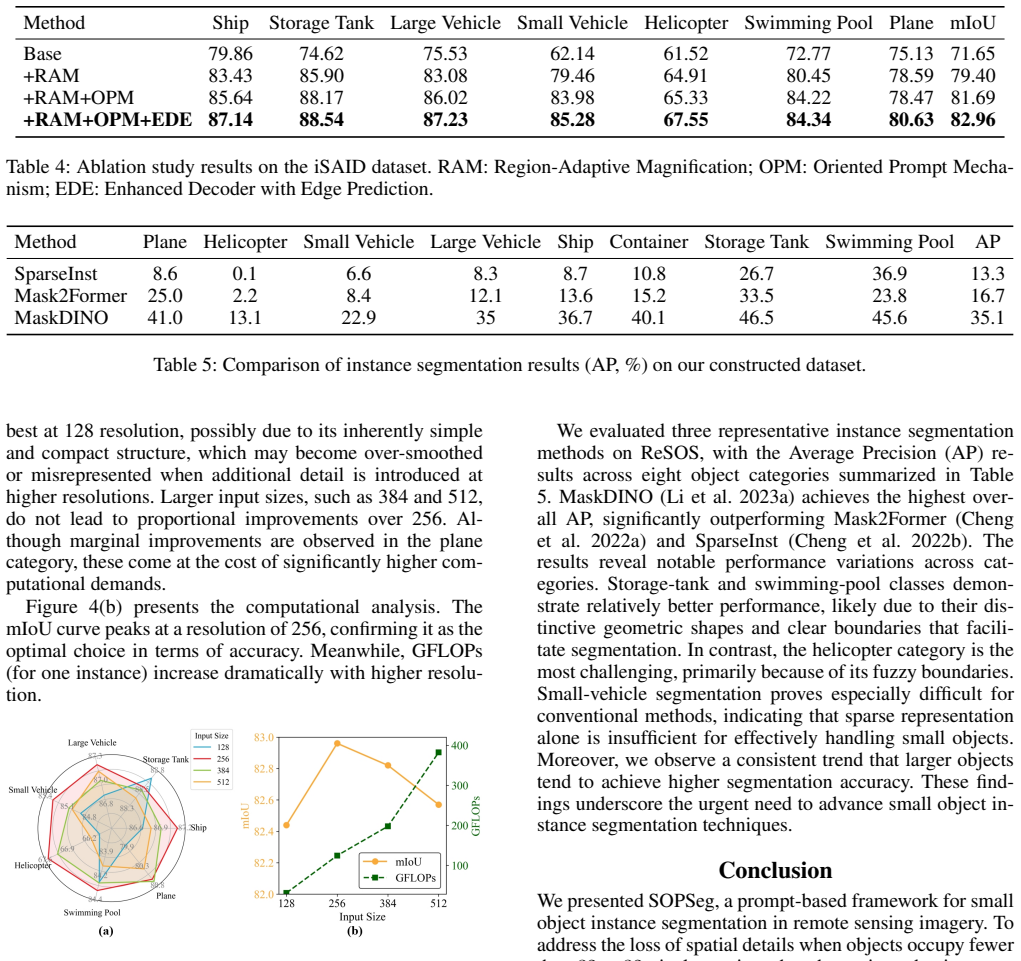
The central claim is that SAM's weak small-object performance is primarily a resolution problem, not a capacity problem. A 32×32 object occupies 2×2 feature cells after SAM's 1/16 downsampling, so SOPSeg crops each instance's neighborhood and resizes it to a 256×256 input, magnifying small objects before encoding. An oriented prompt built from the center and the two short-side midpoints of a rotated bounding box lets the frozen SAM point encoder represent arbitrary orientations. A two-stage decoder predicts edges and refines masks from 1/8 to full resolution. On the seven small-object classes of iSAID, the full method reaches 82.96% mIoU, and the magnification component alone contributes 7.8
Load-bearing premise
The reported comparisons assume the baselines were run under the same fine-tuning conditions as SOPSeg; the paper does not state this, so if the other methods were evaluated zero-shot or with default weights the lead over them could be an artifact of unequal training.
Editorial extensions
If this is right
- Frozen SAM encoders plus a lightly trained decoder are enough for accurate small-object masks, so new remote sensing categories can be added without retraining the full segmentation backbone.
- Detection datasets with oriented boxes can be upgraded to segmentation datasets at scale; the automatically generated ReSOS with 709k masks is the demonstration.
- Rotated objects do not require rotated attention or rotated convolutions; a three-point oriented prompt suffices with SAM's point encoder.
- A 256×256 crop input is the accuracy/efficiency sweet spot, suggesting small-object segmentation can avoid SAM's full 1024×1024 inference cost.
Reading between the lines
- A testable extension: ReSOS's manual filtering step could be replaced by a confidence-thresholded pipeline, since the paper reports removing only a small number of abnormal annotations.
- The three-point oriented prompt could transfer to interactive annotation UIs, where an annotator marks the center and the two short-side midpoints instead of drawing rotated boxes.
- Because ReSOS masks are generated by SOPSeg itself, any future improvement to SOPSeg should directly improve the dataset, creating a flywheel that the paper does not explicitly discuss.
- The same crop-magnify-and-prompt recipe may transfer to satellite video small-object segmentation, though video temporal consistency is not addressed here.
Editorial analysis
A structured set of objections, weighed in public.
Referee Report
Summary. The paper proposes SOPSeg, a prompt-based instance segmentation framework for small objects in remote sensing imagery, built on SAM-Large. It introduces three components: (1) region-adaptive magnification (RAM), which crops and resizes local object regions to preserve spatial details; (2) an oriented prompt mechanism that encodes oriented bounding boxes as three keypoints; and (3) an edge-aware decoder with progressive multi-scale refinement and IoU prediction. The framework is trained on seven classes of iSAID and evaluated on NWPU-VHR10 and SAT-MTB, reporting mIoU/BIoU improvements over SAM, SAM2, ROS-SAM, UGBS, MatAnything, and HQ-SAM. The authors also construct ReSOS, a small-object instance segmentation dataset derived from SODA-A with about 709k SOPSeg-generated, manually filtered masks, on which SparseInst, Mask2Former, and MaskDINO are benchmarked.
Significance. If the reported gains are robust, SOPSeg would be a useful adaptation of SAM for tiny instances, and the proposed RAM and oriented-prompt ideas could transfer to other prompt-based segmentation models. The paper also contributes a large-scale dataset that addresses a real annotation bottleneck. The component ablations are informative and the writing is generally clear. However, the comparison protocol is incompletely specified, and the ReSOS benchmark relies on masks produced by the same class of model, so the evidence for the central superiority claim is currently incomplete. The claims are fixable with additional experiments and clarification, but as presented the quantitative evidence is not yet convincing.
major comments (4)
- [Comparison Method and Implementation Details; Tables 1 and 2] The manuscript does not state whether SAM, SAM2, ROS-SAM, UGBS, MatAnything, and HQ-SAM were fine-tuned on iSAID under the same protocol or evaluated zero-shot with default weights. Only SOPSeg training is specified (frozen SAM-Large encoder, lr 5e-5, 32 epochs). UGBS is said to use 'our proposed RAM strategy', but no equivalent region magnification or prompt preprocessing is described for the other baselines. If these baselines were not trained or fine-tuned on the target distribution, the +2.09 mIoU over UGBS on iSAID and the +0.42/+3.06 IoU gains on NWPU/SAT-MTB cannot be attributed to the proposed modules. Please specify the exact protocol for every baseline and, where appropriate, fine-tune all methods with matched region extraction and prompts.
- [Evaluation Metrics and Comparison with Other Methods; Tables 1-4] No error bars, number of seeds, or statistical tests are reported. On NWPU-VHR10, the gain over UGBS is 0.42 IoU (86.55 vs 86.13), which is small relative to typical run-to-run variation. Without variance estimates, the 'consistently outperforms' claim is not statistically supported. Report mean ± std over at least three runs and, if possible, a paired test on per-instance or per-image IoU to establish significance.
- [Evaluation on the Constructed Dataset; Table 5] ReSOS masks are generated by SOPSeg and then manually filtered, but no independent validation of mask quality is reported. Table 5 evaluates SparseInst, Mask2Former, and MaskDINO on ReSOS, so the reported APs reflect agreement with model-generated labels. If ReSOS is presented as a benchmark, its annotation quality must be quantified—for example, by computing IoU agreement with human annotations on a sampled subset, inter-annotator consistency, or quality metrics before and after filtering. Without such validation, the dataset contribution is circular with respect to SOPSeg's own outputs.
- [Experimental Setup; Oriented Prompt Mechanism] The source of oriented bounding boxes for iSAID, NWPU-VHR10, and SAT-MTB is not described. iSAID provides horizontal boxes and masks, so it is unclear whether oriented boxes are derived from masks or annotated separately. Since the oriented prompt mechanism is a core contribution, the derivation process for OBBs in each dataset should be stated explicitly, otherwise the experiments are not reproducible.
minor comments (4)
- [Eq. (4)] The formulas P1 = C + C1 / 2 and P2 = C + C2 / 2 should be written as (C + C1)/2 and (C + C2)/2 to avoid ambiguity about operator precedence.
- [Table 1] The GFLOPs are reported as 'on 10 instance on a image'. Please clarify whether this is per instance, per image with 10 instances, and at which input resolution; the measurement protocol should be specified for all methods.
- [Dataset Selection] The paper selects 7 out of 15 iSAID categories 'that best represent small object challenges' but does not give a quantitative criterion. This choice changes mIoU comparability with full-dataset results; please justify the selection or report all categories.
- [Dataset Description] The text says a detailed description of ReSOS is provided in the appendix, but no appendix is included in the submitted manuscript. Since ReSOS is a core contribution, the construction protocol, filtering rules, statistics, and licensing should be available in the main paper or a clearly accessible supplement.
Circularity Check
No significant circularity: the core model comparisons use independent human-annotated benchmarks; the ReSOS dataset is model-assisted but is not used to validate SOPSeg.
full rationale
The paper's central quantitative claims (Tables 1, 2, and 4) are empirical comparisons against external human-annotated datasets (iSAID, NWPU-VHR10, SAT-MTB), measured with standard IoU/BIoU metrics, not derived from or fitted to SOPSeg's own outputs. SOPSeg is trained on iSAID with a frozen SAM encoder and its own decoder, and each component is ablated in a controlled manner. No equation defines the reported mIoU in terms of the method's own predictions. The ReSOS dataset is indeed generated by SOPSeg followed by manual filtering, as stated: 'we automatically generate approximately 709k instance masks for small objects based on images and oriented bounding boxes from the SODA-A dataset, followed by manual filtering.' However, the paper never uses ReSOS to validate SOPSeg; Table 5 only evaluates SparseInst, Mask2Former, and MaskDINO on ReSOS, so the dataset-construction claim does not reduce to a self-prediction. The unspecified baseline training protocol (zero-shot vs. fine-tuned) is a legitimate experimental-fairness concern, but it is not circularity under the definitions used here. There is no load-bearing self-citation chain, no imported uniqueness theorem, and no ansatz smuggled in via citation. Accordingly, no circular step can be exhibited from the paper's own equations or claims.
Assumptions & free parameters
free parameters (5)
- m =
32
- k0 =
2
- Smax =
1024
- Sin =
256
- lambda_iou =
5.0
assumptions (4)
- domain assumption SAM's frozen image encoder, after position embedding interpolation and region magnification, preserves enough spatial detail for small object segmentation.
- domain assumption iSAID annotations for the selected 7 classes are reliable ground truth for training and evaluation.
- domain assumption All comparison methods were evaluated under conditions equivalent to SOPSeg (e.g., same training protocol).
- domain assumption The automatic masks in ReSOS, after manual filtering, are accurate enough to serve as ground truth.
invented entities (1)
-
ReSOS dataset
Cite this review
Pith. "Pith review of SOPSeg: Prompt-based Small Object Instance Segmentation in Remote Sensing Imagery." pith.science (2026). https://pith.science/paper/JMQYXNUQ
@misc{pith2026250903002,
  author       = {Pith},
  title        = {Pith review of: SOPSeg: Prompt-based Small Object Instance Segmentation in Remote Sensing Imagery},
  year         = {2026},
  howpublished = {\url{https://pith.science/paper/JMQYXNUQ}},
  note         = {Machine review of arXiv:2509.03002}
}
read the original abstract
Extracting small objects from remote sensing imagery plays a vital role in various applications, including urban planning, environmental monitoring, and disaster management. While current research primarily focuses on small object detection, instance segmentation for small objects remains underexplored, with no dedicated datasets available. This gap stems from the technical challenges and high costs of pixel-level annotation for small objects. While the Segment Anything Model (SAM) demonstrates impressive zero-shot generalization, its performance on small-object segmentation deteriorates significantly, largely due to the coarse 1/16 feature resolution that causes severe loss of fine spatial details. To this end, we propose SOPSeg, a prompt-based framework specifically designed for small object segmentation in remote sensing imagery. It incorporates a region-adaptive magnification strategy to preserve fine-grained details, and employs a customized decoder that integrates edge prediction and progressive refinement for accurate boundary delineation. Moreover, we introduce a novel prompting mechanism tailored to the oriented bounding boxes widely adopted in remote sensing applications. SOPSeg outperforms existing methods in small object segmentation and facilitates efficient dataset construction for remote sensing tasks. We further construct a comprehensive small object instance segmentation dataset based on SODA-A, and will release both the model and dataset to support future research.
Figures


Figures from the paper (1 more)
Forward citations
Cited by 1 Pith paper
-
CROSS: Cascaded Distillation and Dual-Constraint Grounding for Remote Sensing Referring Segmentation
CROSS adds SAM-derived structural distillation and spatial-contrastive negatives to a SigLIP-SAM pipeline, achieving state-of-the-art cIoU on two remote sensing referring segmentation benchmarks.
Reference graph
Works this paper leans on
-
[1]
, " * write output.state after.block = add.period write newline
ENTRY address archivePrefix author booktitle chapter edition editor eid eprint howpublished institution isbn journal key month note number organization pages publisher school series title type volume year label extra.label sort.label short.list INTEGERS output.state before.all mid.sentence after.sentence after.block FUNCTION init.state.consts #0 'before.a...
-
[2]
write newline
" write newline "" before.all 'output.state := FUNCTION n.dashify 't := "" t empty not t #1 #1 substring "-" = t #1 #2 substring "--" = not "--" * t #2 global.max substring 't := t #1 #1 substring "-" = "-" * t #2 global.max substring 't := while if t #1 #1 substring * t #2 global.max substring 't := if while FUNCTION word.in bbl.in capitalize " " * FUNCT...
-
[3]
Chen, K.; Liu, C.; Chen, H.; Zhang, H.; Li, W.; Zou, Z.; and Shi, Z. 2023 a . RSPrompter: Learning to prompt for remote sensing instance segmentation based on visual foundation model. arXiv preprint arXiv:2306.16269
arXiv 2023
-
[4]
Chen, T.; Zhu, L.; Ding, C.; Cao, R.; Wang, Y.; Li, Z.; Sun, L.; Mao, P.; and Zang, Y. 2023 b . SAM-Adapter: Adapting segment anything in underperformed scenes. In Proceedings of the IEEE/CVF International Conference on Computer Vision Workshops, 3359--3368
work page 2023
-
[5]
Cheng, B.; Girshick, R.; Doll \'a r, P.; Berg, A. C.; and Kirillov, A. 2021. Boundary IoU: Improving object-centric image segmentation evaluation. In Proceedings of the IEEE/CVF conference on computer vision and pattern recognition, 15334--15342
work page 2021
-
[6]
G.; Kirillov, A.; and Girdhar, R
Cheng, B.; Misra, I.; Schwing, A. G.; Kirillov, A.; and Girdhar, R. 2022 a . Masked-attention mask transformer for universal image segmentation. In Proceedings of the IEEE/CVF conference on computer vision and pattern recognition, 1290--1299
work page 2022
-
[7]
Cheng, G.; and Han, J. 2016. A Survey on Object Detection in Optical Remote Sensing Images. ISPRS Journal of Photogrammetry and Remote Sensing, 117: 11--28
work page 2016
-
[8]
Cheng, G.; Yuan, X.; Yao, X.; Yan, K.; Zeng, Q.; Xie, X.; and Han, J. 2023. Towards Large-Scale Small Object Detection: Survey and Benchmarks. IEEE Transactions on Pattern Analysis and Machine Intelligence, 45(11): 13467--13488
work page 2023
Show all 29 references
-
[9]
Cheng, T.; Wang, X.; Chen, S.; Zhang, W.; Zhang, Q.; Huang, C.; Zhang, Z.; and Liu, W. 2022 b . Sparse instance activation for real-time instance segmentation. In Proceedings of the IEEE/CVF conference on computer vision and pattern recognition, 4433--4442
2022
-
[10]
Ding, J.; Xue, N.; Long, Y.; Xia, G.-S.; and Lu, Q. 2019. Learning RoI Transformer for Oriented Object Detection in Aerial Images. In Proceedings of the IEEE/CVF Conference on Computer Vision and Pattern Recognition, 2849--2858
2019
-
[11]
Ke, L.; Ye, M.; Danelljan, M.; Tai, Y.-W.; Tang, C.-K.; Yu, F.; et al. 2023. Segment anything in high quality. Advances in Neural Information Processing Systems, 36: 29914--29934
2023
-
[12]
C.; Lo, W.-Y.; et al
Kirillov, A.; Mintun, E.; Ravi, N.; Mao, H.; Rolland, C.; Gustafson, L.; Xiao, T.; Whitehead, S.; Berg, A. C.; Lo, W.-Y.; et al. 2023. Segment anything. In Proceedings of the IEEE/CVF International Conference on Computer Vision, 4015--4026
2023
-
[13]
Li, C.; Xu, C.; Cui, Z.; Wang, D.; Zhang, T.; and Yang, J. 2020. Feature-Attentioned Object Detection in Remote Sensing Imagery. In 2020 IEEE International Conference on Image Processing (ICIP), 3886--3890
2020
-
[14]
M.; and Shum, H.-Y
Li, F.; Zhang, H.; Xu, H.; Liu, S.; Zhang, L.; Ni, L. M.; and Shum, H.-Y. 2023 a . Mask dino: Towards a unified transformer-based framework for object detection and segmentation. In Proceedings of the IEEE/CVF conference on computer vision and pattern recognition, 3041--3050
2023
-
[15]
Li, J.; Jain, J.; and Shi, H. 2024. Matting Anything. In Proceedings of the IEEE/CVF Conference on Computer Vision and Pattern Recognition (CVPR) Workshops, 1775--1785
2024
-
[16]
Li, S.; Zhou, Z.; Zhao, M.; Yang, J.; Guo, W.; Lv, Y.; Kou, L.; Wang, H.; and Gu, Y. 2023 b . A multitask benchmark dataset for satellite video: Object detection, tracking, and segmentation. IEEE transactions on geoscience and remote sensing, 61: 1--21
2023
-
[17]
Liu, S.; Ma, Y.; Zhang, X.; Wang, H.; Ji, J.; Sun, X.; and Ji, R. 2024. Rotated Multi-Scale Interaction Network for Referring Remote Sensing Image Segmentation. In Proceedings of the IEEE/CVF Conference on Computer Vision and Pattern Recognition (CVPR), 26658--26668
2024
-
[18]
Milletari, F.; Navab, N.; and Ahmadi, S.-A. 2016. V-net: Fully convolutional neural networks for volumetric medical image segmentation. In 2016 fourth international conference on 3D vision (3DV), 565--571. Ieee
2016
-
[19]
V.; Carion, N.; Wu, C.-Y.; Girshick, R.; Dollár, P.; and Feichtenhofer, C
Ravi, N.; Gabeur, V.; Hu, Y.-T.; Hu, R.; Ryali, C.; Ma, T.; Khedr, H.; Rädle, R.; Rolland, C.; Gustafson, L.; Mintun, E.; Pan, J.; Alwala, K. V.; Carion, N.; Wu, C.-Y.; Girshick, R.; Dollár, P.; and Feichtenhofer, C. 2024. SAM 2: Segment Anything in Images and Videos. arXiv:2408.00714
2024 arXiv
-
[20]
Ren, S.; He, K.; Girshick, R.; and Sun, J. 2016. Faster R-CNN: Towards real-time object detection with region proposal networks. IEEE transactions on pattern analysis and machine intelligence, 39(6): 1137--1149
2016
-
[21]
Shan, Z.; Liu, Y.; Zhou, L.; Yan, C.; Wang, H.; and Xie, X. 2025. Ros-sam: High-quality interactive segmentation for remote sensing moving object. In Proceedings of the Computer Vision and Pattern Recognition Conference, 3625--3635
2025
-
[22]
Su, H.; Wei, S.; Yan, M.; Wang, C.; Shi, J.; and Zhang, X. 2019. Object detection and instance segmentation in remote sensing imagery based on precise mask R-CNN. In IGARSS 2019-2019 IEEE International Geoscience and Remote Sensing Symposium, 1454--1457. IEEE
2019
-
[23]
Wang, D.; Zhang, J.; Du, B.; Xu, M.; Liu, L.; Tao, D.; and Zhang, L. 2023. Samrs: Scaling-up remote sensing segmentation dataset with segment anything model. Advances in Neural Information Processing Systems, 36: 8815--8827
2023
-
[24]
Waqas Zamir, S.; Arora, A.; Gupta, A.; Khan, S.; Sun, G.; Shahbaz Khan, F.; Zhu, F.; Shao, L.; Xia, G.-S.; and Bai, X. 2019. iSAID: A Large-scale Dataset for Instance Segmentation in Aerial Images. In Proceedings of the IEEE/CVF Conference on Computer Vision and Pattern Recogn...
2019
-
[25]
Xie, X.; Cheng, G.; Wang, J.; Yao, X.; and Han, J. 2021. Oriented R-CNN for Object Detection. In Proceedings of the IEEE/CVF International Conference on Computer Vision, 3520--3529
2021
-
[26]
Yang, D.; Wang, B.; Li, W.; and He, C. 2024. Exploring the user guidance for more accurate building segmentation from high-resolution remote sensing images. International Journal of Applied Earth Observation and Geoinformation, 126: 103609
2024
-
[27]
Yang, X.; Yang, J.; Yan, J.; Zhang, Y.; Zhang, T.; Guo, Z.; Sun, X.; and Fu, K. 2019. SCRDet: Towards More Robust Detection for Small, Cluttered and Rotated Objects. In Proceedings of the IEEE/CVF International Conference on Computer Vision, 8232--8241
2019
-
[28]
Zhang, Z.; Wang, H.; Xu, F.; and Jin, Y.-Q. 2017. Complex-Valued Convolutional Neural Network and Its Application in Polarimetric SAR Image Classification. IEEE Transactions on Geoscience and Remote Sensing, 55(12): 7177--7188
2017
-
[29]
Zhao, W.; Persello, C.; and Stein, A. 2021. Building Outline Delineation: From Aerial Images to Polygons with an Improved End-to-End Learning Framework. ISPRS Journal of Photogrammetry and Remote Sensing, 175: 119--131
2021
Reviewed August 5, 2026 · model on record in the stance chip above.
Discussion (0). Sign in to comment.