REVIEW 2 major objections 5 minor 52 references
Beyond Top-K: Replacing Black-Box Retrieval with Interpretable Agentic Operations
T0 review · 2 major / 5 minor · reviewed 2026-08-07 · deepseek-v4-flash
Pith's one-line read On tabular reports where a number's unit sits 13 lines above it, chunk-embed-retrieve is structurally unsound; a deterministic grep-and-read agent answers 58.8% of verified questions, tuned dense only 35.3%.
desk verdict Honest, well-measured case for embedding-free retrieval on tabular documents, but the headline margin rests on a self-authored benchmark that grew non-blind. read the letter →
The pith
A machine-rendered reading of the paper's core claim, the machinery that carries it, and where it could break.
The reading
What carries the argument
The carrying mechanism is the unit-inheritance measurement: in the test document every numeric table row inherits its unit — lakh or crore, a factor of 100 — from the nearest unit-declaring header above it, at a median distance of 13 lines ($p_{90}$ = 26, maximum 143), and inherits its fiscal year from a header that may sit many pages away. A chunk is unit-preserving only if it contains the governing declaration, so the paper builds a table-aware chunker as a deliberate steelman — it searches backwards up to 200 lines and prepends the governing unit and year rows — which cuts unitless numeric chunks from 18.0% to 0.3% yet leaves the fraction of numeric chunks with no fiscal-year header flat between 27.2% and 30.1% across a five-fold range of chunk sizes. That flat residue is the load-bearing observation: no partition fixed before the query is known can recover a year declared once for a table spanning many pages, whereas READ is span-addressed rather than chunk-addressed — the agent chooses the line range $[a,b]$ after seeing where its evidence lies and can extend a read upward to include the governing header. READ itself is a read-only MCP server with four tools — grep (normalized line search over two shadow forms of each line), list and outline (structural navigation), and read (bounded, line-numbered spans capped at 400 lines) — with no embedding model and no learned component.
What would settle it
Run the head-to-head on a second audited state finance report with questions and gold answers written and mechanically verified before any system runs, and scored by graders blind to system identity: the paper's structural claim predicts READ leads the best tuned dense configuration by roughly 20 points and that about 28% of numeric chunks carry no fiscal year under any fixed partition. Tuned dense matching READ would refute the interface claim, and a chunker that repeats table header rows across page breaks and drives the yearless rate below 5% would refute the flat-residue observation.
Extended reading notes
Core claim
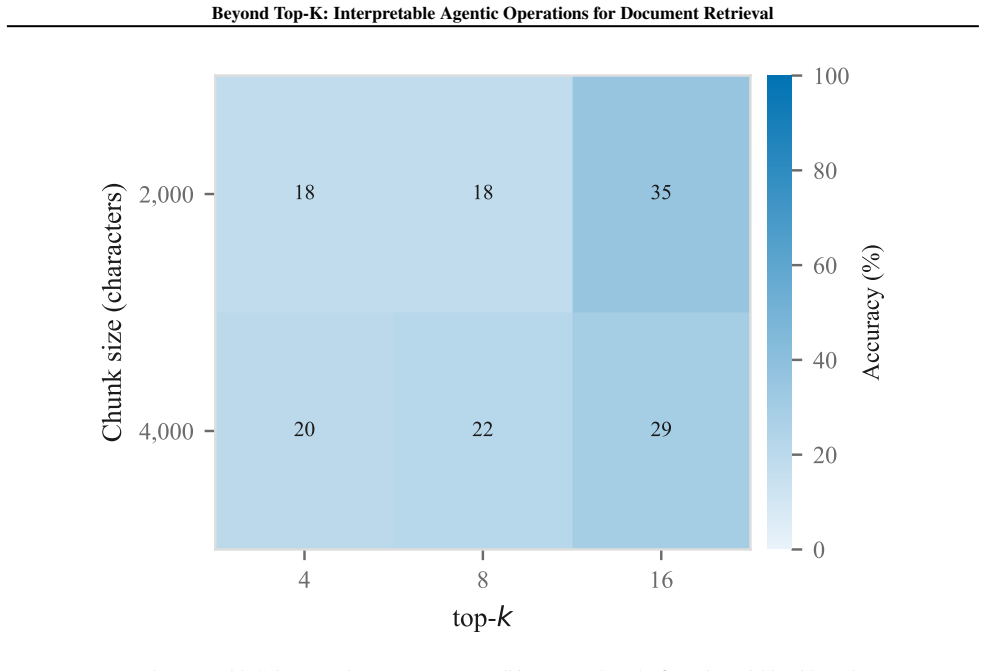
The paper claims that on exactness-critical structured documents the dominant retrieval design — partitioning the document into chunks offline, embedding each chunk, and returning the top-$k$ nearest neighbours of the query — is the wrong primitive, and it demonstrates the claim on a 780-page audited government finance report in which 86.8% of content lines are table rows, numeric tokens repeat 3.68-fold, and a figure inherits its unit from a header a median of 13 lines above it. Because a chunk boundary therefore severs a number from whether it is in lakh or crore — an ambiguity of two orders of magnitude — the paper builds READ (Reliable Embedding-free Agentic Document-search), an agent that reads the intact document through three deterministic operation classes: normalized lexical search, structural navigation, and bounded span reads, exposed over the Model Context Protocol so that every trajectory is a replayable audit trail of citable line ranges. READ answers 58.8% of 51 gold-verified questions against 15.7% for dense top-$k$ retrieval ($p_{\mathrm{Holm}} = 2\times 10^{-5}$), against 35.3% for the best dense configuration found by sweeping chunk size and depth ($p_{\mathrm{Holm}} = 0.017$), and against 27.5% for the same agent loop whose search tool returns top-$k$ chunks — the last comparison attributing the gain to the interface rather than to iteration. The paper states the boundary of its own evidence: BM25 at 51.0% is statistically indistinguishable from READ, so the result separates embedding-based from embedding-free retrieval, not agentic search from lexical search.
Load-bearing premise
The load-bearing premise is that the 51-question benchmark — drafted by the authors who also built READ, and extended in two non-blind batches after inspection revealed coverage gaps — fairly represents exactness-critical questions on this document class; if the question mix is inadvertently tilted toward lexical and structural retrieval, the reported margins over dense and agentic top-k retrieval are inflated.
Editorial extensions
If this is right
- A practitioner with a lexical index and no agent would capture most of the available gain on this document class: BM25 at a third of READ's cost is not significantly worse, so the vector index is the component doing the damage rather than the missing piece.
- No fixed-size partition made before the query is known can eliminate the attribution floor — roughly 28% of numeric chunks in this corpus lack a fiscal-year header at every chunk size — so the only remedy within the top-k paradigm is retrieving deeper and covering headers by chance.
- The accuracy gap is explained by a visible failure taxonomy rather than by generation quality: dense retrieval fails to surface the gold evidence on 13 of 51 questions and abstains on 11 answerable ones, against 4 and 1 for READ.
- READ's per-question cost runs roughly 2.5–4.6 times dense retrieval's (31.4 s vs 12.7 s; up to 4.8 tool calls), and that is the price of auditability: every step is a pure function of the document, so any third party can replay the evidence chain behind an answer.
- PDF conversion damage is a ceiling shared by every retrieval method — 483 artifacts including 15 detached decimal points — so some questions measure the converter, not the retriever, and must be scored in their own category.
Reading between the lines
- The authors' own boundary (BM25 ties READ) implies a deployment rule they do not state: on this document class the decisive comparison is embedding-based versus embedding-free, and any agent built on a lexical tool must justify its extra cost against BM25, not against dense retrieval.
- Their AgenticVec control suggests a general lesson: giving an agent an opaque tool can amplify the tool's failure mode rather than cure it, since iteration alone produced the highest ungrounded-answer count (21 of 51 questions); interface choice therefore deserves the same benchmarking attention as the agent loop itself.
- A testable extension the paper's ablations point to: a minimal two-tool server (normalized grep plus bounded reads) may dominate the full READ operation set on cost and latency, because dropping the outline did not hurt accuracy and the ablations' 7.8-point gaps are statistically unresolved at n = 51.
- The unit-inheritance analysis transplants directly to neighbouring tabular corpora — public-company filings, clinical trial tables, tax returns — where measuring each domain's header-inheritance distances would predict in advance how much of the top-k gap is structural rather than tuning.
Editorial analysis
A structured set of objections, weighed in public.
Referee Report
Summary. This paper argues that the dominant chunk–embed–top-k design of retrieval-augmented generation is structurally unsound for exactness-critical, densely tabular long documents, and demonstrates the argument on the 780-page Gujarat Finance Accounts 2024–25. The authors first measure the setting: 86.8% of content lines are table rows, numeric tokens repeat 3.68-fold, and a figure inherits its unit from a header a median of 13 lines above it. They show that fixed-size chunking leaves up to 67.4% of numeric chunks without a unit declaration, and that a steelmanned table-aware chunker reduces this to 0.3% while leaving a 27–30% residue of fiscal-year-less chunks that is invariant to chunk size. They then propose READ, an MCP-based agentic interface with four deterministic, replayable operations (normalized grep, list, outline, bounded span reads), and compare it against dense, BM25, hybrid, and agentic top-k baselines on 51 verified questions with paired, Holm-corrected statistics. READ answers 58.8%; tuned dense retrieval reaches 35.3% at best (READ still leads by 23.5 points, p_Holm = 0.017); an agent with the same loop but a vector-search tool reaches 27.5%, attributing the gain to the interface rather than iteration.
Significance. If the head-to-head margin survives independent validation, this is a significant and thought-provoking result: a concrete demonstration that on a real financial report the conventional chunk–embed retrieval contract fails for measured structural reasons (layout-inherited units and fiscal years), and that a deterministic, span-addressed, fully auditable interface can outperform tuned dense retrieval. The reporting practices are exemplary and deserve explicit credit: the paper reports the tuned dense configuration (35.3%) rather than hiding behind the untuned 15.7%; it reports the BM25 null, the non-blind growth of the benchmark with per-stage dense accuracy, the conversion-fidelity ceiling, READ's groundedness deficit, and its cost and latency penalties; it uses paired exact McNemar tests with Holm correction; and gold answers are mechanically validated against arithmetic identities in the document. The AgenticVec control is the right design for separating interface effects from iteration effects, and the Section 4 document characterization, particularly the unit-inheritance analysis, is a useful standalone contribution independent of the benchmark.
major comments (2)
- [§9, §C.1, Table 9] Benchmark selection bias is load-bearing for the headline claim. The 51-question benchmark was authored by the team that built the system under test and grew non-blind: an earlier 25-question version produced no significant difference between any pair of systems, and two further batches were added after the authors' inspection revealed coverage gaps in column selection and deep-document evidence. The reported dense accuracy trajectory, 24.0% to 16.7% to 15.7%, shows that each added batch differentially disadvantaged the chunk-and-embed baseline. The mechanical checks in §C.2 (presence, arithmetic identity, derived-answer non-occurrence) validate that gold answers are faithful to the document; they do not validate that the question mix is representative of exactness-critical queries on this document class. Because 24 of 51 questions are single-figure lookup, the category with the largest READ margin (70.8% vs 12.5% in Table 9), the category composition is part of the treatment rather than neutral sampling. The disclosure is exemplary, but disclosure does not quantify the bias. I would require either a sensitivity analysis over category reweighting, or an externally blind question-drafting protocol on a second document of the same class with the tuned-dense comparison reported on that held-out set.
- [§5.2, Table 7, §8.2] The normalization mechanism claimed in §5.2 is not reflected in the benchmark results. The paper lists as a contribution the finding that normalized lexical matching is what makes READ viable on converted PDFs, supported by twelve probe queries of which two changed outcome (digit grouping; words split across table cells). On the 51-question benchmark, however, the naive-grep ablation scores 66.7% against READ's 58.8%, a non-significant four-question difference (p = 1.00). The §8.2 decomposition of the six inverted questions (one harness failure, one sign error, one hedged answer, three search failures) is an honest start, but it does not establish how many of the questions READ misses involve the digit-grouping or word-split artifacts that normalization targets, and it is hard to reconcile the benchmark result with the contribution bullet. As published, the paper's own data are consistent with normalization being neutral or harmful on the benchmark. Please report the per-category breakdown of the ablation difference on the actual 51 questions, or temper the §5.2 claim so that it is explicitly restricted to probe-level behavior.
minor comments (5)
- [Abstract, Figure 1] The abstract and Figure 1 lead with dense retrieval's untuned 15.7% and report the tuned 35.3% only secondarily, although §8.2 states that the paper does 'not claim dense retrieval scores 15.7% on this document'; please lead with the tuned figure in both places so the headline matches the paper's own statement of the honest comparison.
- [§6.3] The groundedness definition, 'every figure in the answer appears verbatim in some span surfaced in τ,' needs an explicit treatment of derived answers whose final value appears nowhere in the document by design (§C.2); please state whether the presence of the operands suffices and how this affects the per-system groundedness rates in Table 7.
- [§6.3, §8] Section 6.3 promises agreement between the deterministic signal and the LLM judge, but no such agreement figure appears in Section 8; please add the number or remove the promise.
- [Table 13, Table 7] The same dense configuration (2,000-character chunks, k=8) scores 17.6% in Table 13 but 15.7% in Table 7, attributed to run-to-run nondeterminism of the backbone; given that the abstract's significance value depends on this cell, please report the variance over repeated runs or lock the configuration.
- [References] Several entries (Sen et al., 2026a,b; Li et al., 2026; Gulati et al., 2026) appear as arXiv preprints; please confirm their publication status or mark them explicitly as preprints in the bibliography.
Circularity Check
No circular derivation: READ is parameter-free and compared against external baselines; the author-built benchmark is a disclosed validity risk, not a circular step.
full rationale
The paper's claimed derivation chain is: (1) measure document properties (tabularity, numeric repetition, unit-inheritance distance), (2) show that even a steelmanned table-aware chunker leaves a chunk-size-invariant yearless residue, (3) propose READ as deterministic span-addressed operations, and (4) compare READ against dense, sparse, hybrid, and agentic top-k baselines on a paired protocol. No step in this chain reduces to its own input by construction. READ has no fitted parameters, no learned component, and no parameter tuned on the 51 benchmark questions; its operations (grep, outline, read) are fixed and generic. The headline comparison is an empirical measurement on fixed questions against external baselines, and the critical 'interface not iteration' attribution rests on the AgenticVec control, which is a genuine controlled contrast: same backbone, same loop, same turn budget, differing only in the retrieval tool. The paper also reports results that cut against a self-serving narrative: both ablations (no-outline and naive-grep) score above READ, BM25 is statistically indistinguishable from READ, and READ is not the most grounded system. The main weakness, disclosed in Section 9, is that the benchmark was authored by the system's builders and grew non-blind, with dense accuracy falling from 24.0% to 16.7% to 15.7% as batches were added; the paper states plainly that the added batches 'happen to fall where chunk-based retrieval is weak, and we knew that when we chose to fix them.' That is a real selection-bias and external-validity threat to the precise margin, and a reader should weigh it heavily when generalizing. But it is not circularity in the derivation sense used here: no equation in the paper is defined in terms of another quantity it purports to predict, no result is imported from the authors' own prior work as load-bearing evidence, and no reported number is a fitted parameter renamed as a prediction. The honest finding is therefore no significant circularity, with the benchmark-authoring limitation noted as a correctness risk rather than a circular step.
Assumptions & free parameters
free parameters (3)
- Dense baseline chunk size and retrieval depth k =
2000 chars, k=8 (main); 2000 chars, k=16 (best, 35.3%)
- Table-aware chunker backward search limit =
200 lines
- Normalized matching shadow forms =
spaced and squashed
assumptions (4)
- domain assumption A figure's unit is inherited from the nearest unit declaration above it
- domain assumption Fiscal-year attribution is determined by matching a fiscal-year column header in the same chunk
- domain assumption The converted Markdown is a faithful enough rendering for retrieval comparison except for the measured artifacts
- standard math Statistical tests (exact McNemar, Holm correction, bootstrap) are appropriate for paired accuracy differences
Cite this review
Pith. "Pith review of Beyond Top-K: Replacing Black-Box Retrieval with Interpretable Agentic Operations." pith.science (2026). https://pith.science/paper/JMSHY6UC
@misc{pith2026260806305,
  author       = {Pith},
  title        = {Pith review of: Beyond Top-K: Replacing Black-Box Retrieval with Interpretable Agentic Operations},
  year         = {2026},
  howpublished = {\url{https://pith.science/paper/JMSHY6UC}},
  note         = {Machine review of arXiv:2608.06305}
}
read the original abstract
Retrieval-augmented generation over long documents is dominated by one design: chunk the text, embed the chunks, and surface the top-k nearest neighbours of the query. We argue that for an important class of documents -- financial statements, audit reports, regulatory returns -- this design is structurally unsound, and we make the argument measurable. On a 780-page government financial report, 86.8% of content lines are table rows, thousands of near-identical figures compete in one embedding space, and a figure inherits its unit from a header a median of 13 lines above it -- so a chunk boundary routinely separates a number from whether it is in lakh or crore, an error of two orders of magnitude. A table-aware chunker built as a steelman fixes the unit problem but leaves 27-30% of numeric chunks with no fiscal-year header at every chunk size we tried. We propose READ (Reliable Embedding-free Agentic Document-search), in which an agent reads the raw document through three deterministic operations -- normalized lexical search, structural navigation, and bounded span reads -- exposed over the Model Context Protocol, so a trajectory is a replayable audit trail, not an opaque similarity score. On 51 verified questions READ answers 58.8% against dense retrieval's 15.7% (p_Holm = 2 x 10^-5) -- or 35.3% tuned, which READ still leads by 23.5 points (p_Holm = 0.017). An agent given the same loop but a top-k tool reaches only 27.5%, locating the gain in the interface rather than in iteration. We also report what the evidence does not support: BM25 is statistically indistinguishable from READ, so our result separates embedding-based from embedding-free retrieval, not agentic from lexical search.
Figures


Figures from the paper (1 more)
Reference graph
Works this paper leans on
-
[1]
Retrieval-augmented generation for knowledge-intensive NLP tasks , year =
Lewis, Patrick and Perez, Ethan and Piktus, Aleksandra and Petroni, Fabio and Karpukhin, Vladimir and Goyal, Naman and K. Retrieval-augmented generation for knowledge-intensive NLP tasks , year =. Proceedings of the 34th International Conference on Neural Information Processing Systems , articleno =
-
[3]
2024 , eprint =
Retrieval-Augmented Generation for Large Language Models: A Survey , author =. 2024 , eprint =
2024
-
[4]
Robertson, Stephen and Walker, S. and Jones, S. and Hancock-Beaulieu, M. M. and Gatford, M. , title =. Overview of the Third Text REtrieval Conference (TREC-3) , year =
-
[5]
BEIR: A Heterogenous Benchmark for Zero-shot Evaluation of Information Retrieval Models , author =. 2021 , eprint =
work page 2021
-
[8]
Unsupervised Dense Information Retrieval with Contrastive Learning , author =. 2022 , eprint =
work page 2022
-
[12]
Chen, Lingjiao and Zaharia, Matei and Zou, James , journal =. How Is. 2024 , month =
work page 2024
-
[13]
2023 , eprint =
Self-RAG: Learning to Retrieve, Generate, and Critique through Self-Reflection , author =. 2023 , eprint =
2023
-
[14]
Learning to Retrieve Reasoning Paths over Wikipedia Graph for Question Answering , author =. 2020 , eprint =
work page 2020
Show all 52 references
-
[15]
2023 , eprint =
Interleaving Retrieval with Chain-of-Thought Reasoning for Knowledge-Intensive Multi-Step Questions , author =. 2023 , eprint =
2023
-
[16]
2023 , eprint =
ReAct: Synergizing Reasoning and Acting in Language Models , author =. 2023 , eprint =
2023
-
[17]
Toolformer: language models can teach themselves to use tools , year =
Schick, Timo and Dwivedi-Yu, Jane and Dess. Toolformer: language models can teach themselves to use tools , year =. Proceedings of the 37th International Conference on Neural Information Processing Systems , articleno =
-
[18]
2021 , eprint =
Evaluating Large Language Models Trained on Code , author =. 2021 , eprint =
2021
-
[19]
SWE-agent: Agent-Computer Interfaces Enable Automated Software Engineering , abstract =
John Yang and Jimenez, \ Carlos E.\ and Alexander Wettig and Kilian Lieret and Shunyu Yao and Karthik Narasimhan and Ofir Press , year =. SWE-agent: Agent-Computer Interfaces Enable Automated Software Engineering , abstract =. Advances in Neural Information Processing Systems , issn =
-
[20]
2024 , eprint =
Agentless: Demystifying LLM-based Software Engineering Agents , author =. 2024 , eprint =
2024
-
[21]
2024 , howpublished =
Introducing the. 2024 , howpublished =
2024
-
[22]
2026 , eprint =
Is Grep All You Need? How Agent Harnesses Reshape Agentic Search , author =. 2026 , eprint =
2026
-
[23]
2026 , eprint =
Beyond Semantic Similarity: Rethinking Retrieval for Agentic Search via Direct Corpus Interaction , author =. 2026 , eprint =
2026
-
[24]
2026 , eprint =
Chronos: Temporal-Aware Conversational Agents with Structured Event Retrieval for Long-Term Memory , author =. 2026 , eprint =
2026
-
[25]
Grep vs Graph: Agentic Search Is Powerful, but Enterprise
Yu, Fanghua (Joshua) , year =. Grep vs Graph: Agentic Search Is Powerful, but Enterprise
-
[27]
2026 , eprint =
From Rows to Reasoning: A Retrieval-Augmented Multimodal Framework for Spreadsheet Understanding , author =. 2026 , eprint =
2026
-
[28]
2025 , eprint =
LongMemEval: Benchmarking Chat Assistants on Long-Term Interactive Memory , author =. 2025 , eprint =
2025
-
[29]
2025 , eprint =
BrowseComp-Plus: A More Fair and Transparent Evaluation Benchmark of Deep-Research Agent , author =. 2025 , eprint =
2025
-
[30]
, editor =
Yang, Zhilin and Qi, Peng and Zhang, Saizheng and Bengio, Yoshua and Cohen, William and Salakhutdinov, Ruslan and Manning, Christopher D. , editor =. Proceedings of the 2018 Conference on Empirical Methods in Natural Language Processing , month = oct #. 2018 , address =. doi:1...
2018 doi
-
[31]
2025 , howpublished =
Finance Accounts 2024--25, Volume I , author =. 2025 , howpublished =
2024
-
[32]
Introducing the Model Context Protocol
Anthropic . Introducing the Model Context Protocol . https://www.anthropic.com/news/model-context-protocol, 2024. Accessed 2026-08-03
2024
-
[33]
Learning to retrieve reasoning paths over wikipedia graph for question answering, 2020
Asai, A., Hashimoto, K., Hajishirzi, H., Socher, R., and Xiong, C. Learning to retrieve reasoning paths over wikipedia graph for question answering, 2020. URL https://arxiv.org/abs/1911.10470
2020 arXiv
-
[34]
Self-rag: Learning to retrieve, generate, and critique through self-reflection, 2023
Asai, A., Wu, Z., Wang, Y., Sil, A., and Hajishirzi, H. Self-rag: Learning to retrieve, generate, and critique through self-reflection, 2023. URL https://arxiv.org/abs/2310.11511
2023 arXiv
-
[35]
How is ChatGPT 's behavior changing over time? Harvard Data Science Review, 6 0 (2), mar 12 2024
Chen, L., Zaharia, M., and Zou, J. How is ChatGPT 's behavior changing over time? Harvard Data Science Review, 6 0 (2), mar 12 2024. https://hdsr.mitpress.mit.edu/pub/y95zitmz
2024
-
[36]
Chen, M., Tworek, J., Jun, H., Yuan, Q., de Oliveira Pinto, H. P., Kaplan, J., Edwards, H., Burda, Y., Joseph, N., Brockman, G., Ray, A., Puri, R., Krueger, G., Petrov, M., Khlaaf, H., Sastry, G., Mishkin, P., Chan, B., Gray, S., Ryder, N., Pavlov, M., Power, A., Kaiser, L., B...
2021 arXiv
-
[37]
Finance accounts 2024--25, volume i
Comptroller and Auditor General of India . Finance accounts 2024--25, volume i. Office of the Principal Accountant General (A&E), Gujarat, 2025. URL https://cag.gov.in/uploads/state_accounts_report/account-report-FA-VOL-I-2024-25-069c52aa2b34bf9-63690940.pdf
2024
-
[38]
V., Clarke, C
Cormack, G. V., Clarke, C. L. A., and Buettcher, S. Reciprocal rank fusion outperforms condorcet and individual rank learning methods. In Proceedings of the 32nd International ACM SIGIR Conference on Research and Development in Information Retrieval, SIGIR '09, pp.\ 758--759, ...
2009
-
[39]
Encoding spreadsheets for large language models
Dong, H., Zhao, J., Tian, Y., Xiong, J., Zhou, M., Lin, Y., Cambronero, J., He, Y., Han, S., and Zhang, D. Encoding spreadsheets for large language models. In Al-Onaizan, Y., Bansal, M., and Chen, Y.-N. (eds.), Proceedings of the 2024 Conference on Empirical Methods in Natural...
2024 doi
-
[40]
Splade: Sparse lexical and expansion model for first stage ranking
Formal, T., Piwowarski, B., and Clinchant, S. Splade: Sparse lexical and expansion model for first stage ranking. In Proceedings of the 44th International ACM SIGIR Conference on Research and Development in Information Retrieval, SIGIR '21, pp.\ 2288--2292, New York, NY, USA, ...
2021
-
[41]
Retrieval-augmented generation for large language models: A survey, 2024
Gao, Y., Xiong, Y., Gao, X., Jia, K., Pan, J., Bi, Y., Dai, Y., Sun, J., Wang, M., and Wang, H. Retrieval-augmented generation for large language models: A survey, 2024. URL https://arxiv.org/abs/2312.10997
2024 arXiv
-
[42]
From rows to reasoning: A retrieval-augmented multimodal framework for spreadsheet understanding, 2026
Gulati, A., Sen, S., Sarguroh, W., and Paul, K. From rows to reasoning: A retrieval-augmented multimodal framework for spreadsheet understanding, 2026. URL https://arxiv.org/abs/2601.08741
2026
-
[43]
Unsupervised dense information retrieval with contrastive learning, 2022
Izacard, G., Caron, M., Hosseini, L., Riedel, S., Bojanowski, P., Joulin, A., and Grave, E. Unsupervised dense information retrieval with contrastive learning, 2022. URL https://arxiv.org/abs/2112.09118
2022 arXiv
-
[44]
Dense passage retrieval for open-domain question answering
Karpukhin, V., Oguz, B., Min, S., Lewis, P., Wu, L., Edunov, S., Chen, D., and Yih, W.-t. Dense passage retrieval for open-domain question answering. In Webber, B., Cohn, T., He, Y., and Liu, Y. (eds.), Proceedings of the 2020 Conference on Empirical Methods in Natural Languag...
2020 doi
-
[45]
and Zaharia, M
Khattab, O. and Zaharia, M. Colbert: Efficient and effective passage search via contextualized late interaction over bert. In Proceedings of the 43rd International ACM SIGIR Conference on Research and Development in Information Retrieval, SIGIR '20, pp.\ 39--48, New York, NY, ...
2020
-
[46]
u ttler, H., Lewis, M., Yih, W.-t., Rockt \
Lewis, P., Perez, E., Piktus, A., Petroni, F., Karpukhin, V., Goyal, N., K \"u ttler, H., Lewis, M., Yih, W.-t., Rockt \"a schel, T., Riedel, S., and Kiela, D. Retrieval-augmented generation for knowledge-intensive nlp tasks. In Proceedings of the 34th International Conference...
2020
-
[47]
Beyond semantic similarity: Rethinking retrieval for agentic search via direct corpus interaction, 2026
Li, Z., Zhang, H., Wei, C., Lu, P., Nie, P., Lu, Y., Bai, Y., Feng, S., Zhu, H., Zhong, M., Zhang, Y., Xie, J., Choi, Y., Zou, J., Han, J., Chen, W., Lin, J., Jiang, D., and Zhang, Y. Beyond semantic similarity: Rethinking retrieval for agentic search via direct corpus interac...
2026 arXiv
-
[48]
F., Lin, K., Hewitt, J., Paranjape, A., Bevilacqua, M., Petroni, F., and Liang, P
Liu, N. F., Lin, K., Hewitt, J., Paranjape, A., Bevilacqua, M., Petroni, F., and Liang, P. Lost in the middle: How language models use long contexts. Transactions of the Association for Computational Linguistics, 12: 0 157--173, 2024. doi:10.1162/tacl_a_00638. URL https://acla...
2024 doi
-
[49]
M., and Gatford, M
Robertson, S., Walker, S., Jones, S., Hancock-Beaulieu, M. M., and Gatford, M. Okapi at trec-3. In Overview of the Third Text REtrieval Conference (TREC-3), pp.\ 109--126. Gaithersburg, MD: NIST, January 1995. URL https://www.microsoft.com/en-us/research/publication/okapi-at-trec-3/
1995
-
[50]
Toolformer: language models can teach themselves to use tools
Schick, T., Dwivedi-Yu, J., Dess \'i , R., Raileanu, R., Lomeli, M., Hambro, E., Zettlemoyer, L., Cancedda, N., and Scialom, T. Toolformer: language models can teach themselves to use tools. In Proceedings of the 37th International Conference on Neural Information Processing S...
2023
-
[51]
Sen, S., Kasturi, A., Lumer, E., Gulati, A., and Subbiah, V. K. Is grep all you need? how agent harnesses reshape agentic search, 2026 a . URL https://arxiv.org/abs/2605.15184
2026 arXiv
-
[52]
Sen, S., Lumer, E., Gulati, A., and Subbiah, V. K. Chronos: Temporal-aware conversational agents with structured event retrieval for long-term memory, 2026 b . URL https://arxiv.org/abs/2603.16862
2026
-
[53]
Beir: A heterogenous benchmark for zero-shot evaluation of information retrieval models, 2021
Thakur, N., Reimers, N., Rücklé, A., Srivastava, A., and Gurevych, I. Beir: A heterogenous benchmark for zero-shot evaluation of information retrieval models, 2021. URL https://arxiv.org/abs/2104.08663
2021 arXiv
-
[54]
Interleaving retrieval with chain-of-thought reasoning for knowledge-intensive multi-step questions, 2023
Trivedi, H., Balasubramanian, N., Khot, T., and Sabharwal, A. Interleaving retrieval with chain-of-thought reasoning for knowledge-intensive multi-step questions, 2023. URL https://arxiv.org/abs/2212.10509
2023 arXiv
-
[55]
Searching for best practices in retrieval-augmented generation
Wang, X., Wang, Z., Gao, X., Zhang, F., Wu, Y., Xu, Z., Shi, T., Wang, Z., Li, S., Qian, Q., Yin, R., Lv, C., Zheng, X., and Huang, X. Searching for best practices in retrieval-augmented generation. In Al-Onaizan, Y., Bansal, M., and Chen, Y.-N. (eds.), Proceedings of the 2024...
2024 doi
-
[56]
S., Deng, Y., Dunn, S., and Zhang, L
Xia, C. S., Deng, Y., Dunn, S., and Zhang, L. Agentless: Demystifying llm-based software engineering agents, 2024. URL https://arxiv.org/abs/2407.01489
2024 arXiv
-
[57]
Swe-agent: Agent-computer interfaces enable automated software engineering
Yang, J., Jimenez, C., Wettig, A., Lieret, K., Yao, S., Narasimhan, K., and Press, O. Swe-agent: Agent-computer interfaces enable automated software engineering. Advances in Neural Information Processing Systems, 37, 2024. ISSN 1049-5258
2024
-
[58]
React: Synergizing reasoning and acting in language models, 2023
Yao, S., Zhao, J., Yu, D., Du, N., Shafran, I., Narasimhan, K., and Cao, Y. React: Synergizing reasoning and acting in language models, 2023. URL https://arxiv.org/abs/2210.03629
2023 arXiv
-
[59]
Yu, F. J. Grep vs graph: Agentic search is powerful, but enterprise AI needs governed knowledge. https://medium.com/@yu-joshua/grep-vs-graph-agentic-search-is-powerful-but-enterprise-ai-needs-governed-knowledge-8de709c31451, 2025. Accessed 2026-08-03
2025
Reviewed August 7, 2026 · model on record in the stance chip above.
Discussion (0). Continue with ORCID to comment.