REVIEW 3 major objections 4 minor 52 references
Beyond Top-K: Replacing Black-Box Retrieval with Interpretable Agentic Operations
T0 review · 3 major / 4 minor · reviewed 2026-08-15 · deepseek-v4-flash
Pith's one-line read On a 780-page government financial report, an agent that greps, outlines, and reads the raw document answers 58.8% of verified questions against 15.7% for dense vector retrieval — the gain belongs to the interface, not to iteration.
desk verdict Candid, well-controlled empirical paper showing deterministic span-addressed retrieval beats dense top-k on a single financial report; the author-built, non-blindly grown benchmark limits external validity but the core result is believable for this document. read the letter →
The pith
A machine-rendered reading of the paper's core claim, the machinery that carries it, and where it could break.
The reading
What carries the argument
The load-bearing object is READ (Reliable Embedding-free Agentic Document-search), an MCP server that renders the document as ordered lines and exposes four deterministic tools: grep (line search over two normalized shadows of each line, so thousands-commas and words split across table cells do not break matching), list and outline (structural navigation with line numbers), and read (bounded spans capped at 400 lines). The property that carries the argument is span-addressing: the agent selects the interval $[a,b]$ after seeing where its evidence lies, so it can extend upward to include the governing unit and fiscal-year headers that a fixed partition cannot reach. The measurements that make the structural case concrete are the unit-inheritance distance (median 13 lines, p90 26, max 143) and the chunker's invariant yearless residue (27.2–30.1% of numeric chunks across a five-fold chunk-size range).
What would settle it
An independent team pre-registers 51 questions on a comparable document — a different year's or state's finance accounts, annotated before any retrieval system runs — and reproduces the paired protocol; if the READ–dense gap falls below roughly the 27.7-point minimum detectable difference this design resolves at 80% power, the interface-attribution claim weakens. A cheaper probe on this same document: any chunking scheme that pushes the yearless residue below 27–30% of numeric chunks would refute the invariance observation that anchors the structural argument.
Extended reading notes
Core claim
The central claim is that on documents whose meaning lives in layout, the retrieval interface — not chunk size, iteration count, or embedding model — determines whether the evidence arrives. The paper establishes this by measuring a mechanism: a figure inherits its unit and fiscal year from headers a median of 13 lines above it, and a chunk partition fixed before the query is known cannot guarantee that context travels with the figure. A steelmanned table-aware chunker nearly eliminates the unit problem (0.3% unitless at 2,000 characters) but the fiscal-year residue stays flat at 27–30% across a five-fold chunk-size sweep, which the authors read as a property of the paradigm rather than a tuning failure. READ leaves the document intact and exposes normalized grep, outline navigation, and bounded reads, so the agent chooses the span after seeing where its evidence lies. The critical control is an agent with the identical loop and budget but a vector-search tool, which reaches 27.5% against READ's 58.8%: the gap is attributed to span-addressed deterministic operations, not to the ability to iterate.
Load-bearing premise
The paper's central result rests on the assumption that its 51-question benchmark — built by the system's own authors and grown non-blindly after an earlier 25-question version showed no significant differences — is representative of exactness-critical questions on this document class and was not unconsciously shaped to favour lexical and structural retrieval.
Editorial extensions
If this is right
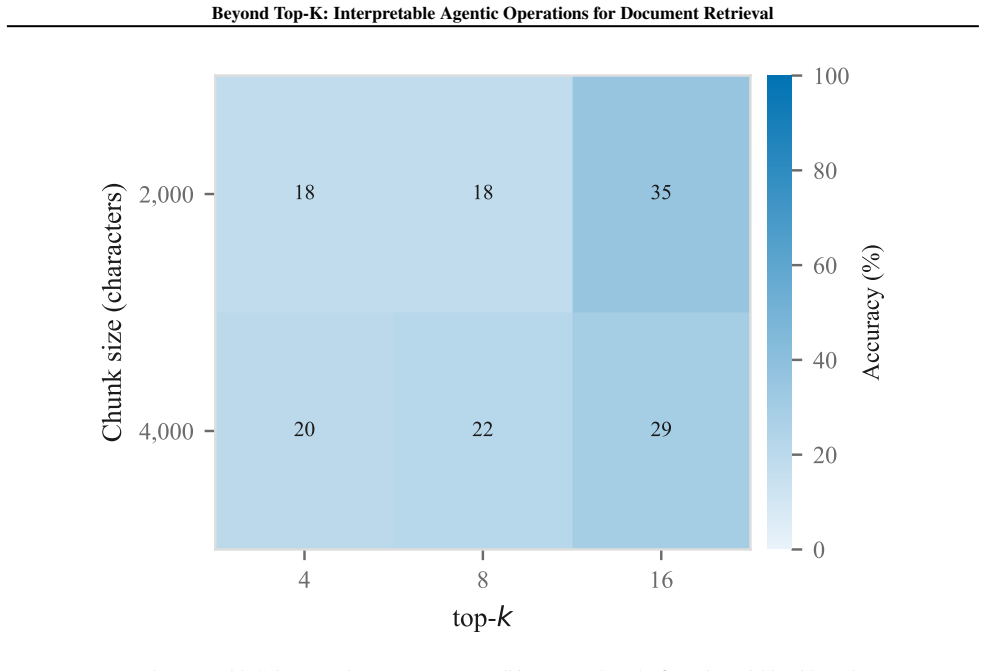
- On this document class, dense retrieval's best tuned configuration (2,000-character chunks, k=16, 35.3% accuracy) still trails READ by 23.5 points (Holm-corrected p = 0.017), and every one of the six swept dense configurations is beaten significantly.
- An agent with the same loop and budget but a top-k tool reaches 27.5% against READ's 58.8% (p = 0.012), so the gain is attributed to the span-addressed deterministic interface, not to the ability to iterate.
- Because every READ operation is a pure function of the document text, trajectories are replayable audit trails: a third party can re-execute the exact line spans and verify each figure in an answer, a property top-k similarity scores cannot offer.
- BM25's statistical parity with READ (51.0% vs 58.8%, confidence interval spanning zero) means the evidence separates embedding-based from embedding-free retrieval rather than agentic from lexical search; a practitioner with a lexical index captures most of the available gain at roughly a third of READ's cost.
- READ is the most expensive and slowest system per question ($0.058 and 31.4 s against dense's $0.023 and 12.7 s), so adopting it is a correctness-and-auditability trade rather than a cost–accuracy win.
Reading between the lines
- If the interface-attribution finding generalizes, then chunker and reranker research on structured documents is optimizing the wrong layer; the testable prediction is that a pre-registered benchmark on other statutory filings reproduces the ordering READ at or above BM25, both above dense, even if the magnitudes shrink.
- The yearless-residue mechanism predicts a boundary condition: documents that repeat fiscal-year headers per page or per table section should show a smaller chunking penalty and a correspondingly smaller advantage for span-addressed reading, a prediction a controlled corpus could test.
- Giving conversion damage its own question category implies a methodological inference: some published retrieval gaps on PDF-derived corpora may be measuring the PDF converter rather than the retriever, and re-reporting those questions separately would change how existing benchmarks are read.
- The cost asymmetry (READ at $0.058 per question against BM25 at $0.020) points to a two-tier deployment for this document class: cheap lexical search by default, with span-addressed agentic reading reserved for questions where exactness or auditability is mandatory.
Signed reviews
Editorial analysis
A structured set of objections, weighed in public.
Referee Report
Summary. The paper argues that the dominant chunk-embed-top-k retrieval design is structurally unsound for an important class of long, tabular, exactness-critical documents, and proposes READ, an MCP-based interface in which an agent searches and reads the raw document through deterministic operations: normalized lexical search, outline navigation, and bounded span reads. The authors first measure document properties on the Gujarat Finance Accounts 2024-25, Volume I: 86.8% of non-empty lines are table rows, numbers repeat 3.68-fold, and a figure's unit header is a median of 13 lines above it; they then show that a table-aware chunker, offered as a steelman, still leaves 27-30% of numeric chunks without a fiscal-year header at every chunk size. On 51 author-verified questions, READ scores 58.8% versus dense retrieval's 15.7% (p_Holm = 2 x 10^-5), versus dense's best tuned configuration of 35.3% (p_Holm = 0.017), and versus an agent with a vector-search tool instead of READ's operations at 27.5% (p_Holm = 0.012). The paper also reports that BM25 is statistically indistinguishable from READ and that READ is not the most grounded system, explicitly narrowing the claim to separating embedding-based from embedding-free retrieval. The appendices provide extensive protocol detail, a dense-configuration sweep, example trajectories, and a candid discussion of benchmark-construction limitations.
Significance. If the central empirical result holds, the paper would substantively challenge the default application of dense retrieval to structured financial documents, with practical implications for auditability and verifiability in high-stakes settings. The paper is unusually strong in its disclosure practices: it reports dense retrieval's best tuned configuration rather than its worst, includes an agentic control that separates interface from iteration, reports a minimum detectable difference, separates conversion-limited questions from retriever failures, and releases the MCP server and per-cell trajectory records for independent replay. These are genuine strengths. However, the quantitative foundation is a single 51-question benchmark written by the authors of the system under test, and the paper itself documents that the benchmark was extended non-blindly after observing where chunk-based retrieval was weak. Because the headline gaps are large but rest on this one benchmark, the external validity of the interface-attribution claim is not yet established.
major comments (3)
- [Section 8.1 and Table 8] The benchmark authorship and non-blind growth are load-bearing for every quantitative claim in the paper. Section 9 states that an initial 25-question version produced no significant differences, that two later batches were added after inspection revealed coverage defects that 'happen to fall where chunk-based retrieval is weak,' and that dense accuracy drifted 24.0% -> 16.7% -> 15.7% as questions were added. Appendix C.3 repeats that the benchmark was drafted by the authors, who also built the system under test. This does not prove the results are artifacts, but it means the central 23.5- to 43.1-point gaps, and the interface-versus-iteration attribution built on them, have not been separated from question-selection effects. I ask that the authors either add an independently constructed, pre-registered question set (ideally on a second document of the same class) or, failing that, substantially weaken the causal language in the abstract and Section 8.1 and mark the result explicitly as an exploratory finding on a self-authored benchmark.
- [Appendix B.3 and Section 4.3] The claim that 'the gain belongs to the interface, not to the loop' is underdetermined by the AgenticVec comparison. AgenticVec differs from READ in more than one property: it lacks normalized lexical search, structural navigation, and span-addressed reads simultaneously. Since BM25 (a non-agentic lexical retriever) reaches 51.0% and is statistically indistinguishable from READ, the evidence is consistent with the alternative explanation that the decisive factor is lexical matching over the converted text rather than the specific span-addressed agentic operations. The paper's own ablations reinforce this reading: READ-lit and READ-no-outline each score 66.7%, numerically above READ itself. To support the interface-level attribution, the authors should include a control in which the same agentic loop receives a lexical search tool but not the span-addressed read, or otherwise disentangle the retrieval primitive from the agentic operations. Absent that, the conclusion should be limited to what the data actually separate: embedding-free versus embedding-based retrieval.
- [Appendix B.3] The table-aware chunker has several free parameters that are fixed but not swept: the backward-search horizon (200 lines), the seed budget, the carried-line budget, and the maximum chunk-body line length. Section D sweeps chunk size and k for the dense baseline, but not these parameters. Since the paper argues the dense baseline is 'steelmanned,' a sensitivity analysis over these parameters, or at least a statement of why the chosen values are not favorable to READ, would strengthen the claim that the residue identified in Section 4.3 is truly invariant. Without it, a reader cannot rule out that some other parameterization of the steelman chunker would recover part of the year-header coverage and change the tuned dense result.
minor comments (4)
- [Table 7] In Table 7, the row labels for the two ablations are somewhat confusing: 'no-outline' and 'naive-grep' may be read as negatively framed even though their accuracies are numerically above READ. Consider renaming them to 'grep+read only' and 'literal-grep' for clarity.
- [Section 6.3] The sentence 'The first row is important' appears after Table 3 but refers to a row not explicitly numbered in the prose; consider adding a row number or an explicit reference such as 'the first data row of Table 3.'
- [Section D] In Section 6.3, the description of the numeric matcher says it normalizes 'Indian digit grouping, parenthesised and (-) negatives, and lakh/crore units, at 0.5% relative tolerance,' but the abstract and Section 4.2 mention that lakh and crore differ by a factor of 100. It would be helpful to state explicitly whether the 0.5% tolerance is applied before or after unit normalization.
- [Section 9] Appendix D reports that the 2,000/k=16 cell scored 35.3% while the same configuration in Table 7 is listed as 15.7% (the k=8 cell), and the footnote attributes a one-question difference to run-to-run nondeterminism. Since the paper otherwise uses paired statistics, it would be useful to report the variance across repeated runs of at least one configuration, so readers can gauge the stability of the reported gaps.
Circularity Check
The READ-vs-dense gap is partially constructed: the benchmark was grown non-blindly to cover weaknesses of chunk-based retrieval, with dense accuracy drifting 24.0% to 16.7% to 15.7% as batches were added.
-
fitted input called prediction
[Section 9 (Limitations), paragraph on benchmark growth; also Section C.3]
"Both defects were identified from the document rather than from any system’s results, and questions were drafted without running them first. But both happen to fall where chunk-based retrieval is weak, and we knew that when we chose to fix them. A reader should treat the n=51 result as one we sought and found, not one we stumbled into; the pre-registered version of this study would have fixed the benchmark first. We report the accuracy of dense retrieval at each stage — 24.0%, 16.7%, 15.7% — so the drift is visible rather than hidden."
The central quantitative claim—that READ beats dense retrieval by 43.1 points (23.5 against the best tuned dense configuration)—is an output of a benchmark whose composition was altered after the authors knew where chunk-based retrieval is weak. Extending the question set to cover exactly those defects is equivalent to selecting the test set conditional on the expected outcome. The dense baseline's measured accuracy fell from 24.0% to 16.7% to 15.7% as the batches were added, showing the composition change directly lowered the comparison system's score. The 'prediction' that READ's interface causes the gain is therefore partly forced by benchmark construction, not solely by the interface.
full rationale
This is an empirical comparison, not a mathematical derivation, so most classical circularity patterns (self-definitional equations, imported uniqueness theorems, ansatz-by-citation) do not apply. There is no load-bearing self-citation: the related-work references are to other research groups. The experimental design is unusually careful: a shared backbone, a top-k agentic control that isolates interface from iteration, mechanical gold validation, a tuned dense sweep, a BM25 null, and explicit reporting of cost, groundedness, and the conversion ceiling. However, the paper's own Section 9 and C.3 concede that the benchmark was authored by the implementers of the system under test and grew non-blindly: an initial 25-question version showed no significant differences, and later batches were added to fix coverage defects that the authors knew fell where chunk-based retrieval is weak. The dense accuracy drift (24.0% to 16.7% to 15.7%) demonstrates that the benchmark composition directly moved the headline comparison. This is a specific, quoted mechanism by which the input (the question set) was fitted to the expected weakness of the comparison systems, making the headline gap partially constructed. The disclosure is commendable and the controls preserve independent content, but the central numerical claim should be treated as a hypothesis generated by a non-blind benchmark rather than a fully independent measurement. Score 5 reflects substantial partial circularity, not full reduction.
Assumptions & free parameters
free parameters (5)
- chunker backward-search horizon =
200 lines
- chunker seed and carried-line budgets =
max(200, chunk chars/2); max(120, chunk chars/4)
- numeric grading tolerance =
0.5% relative
- grep context and max matches =
0-10 lines (default 2); max 25 matches
- read span cap =
400 lines per call
assumptions (6)
- domain assumption The pymupdf4llm Markdown conversion preserves enough row and column structure for the unit-inheritance and yearless-residue analyses to be meaningful.
- domain assumption A figure's unit is determined by the nearest preceding unit declaration ('(Rs. in lakh/crore)').
- domain assumption The 51 gold answers are correct, and the mechanical validation (within-one-line presence, arithmetic identities, derived-answer absence) is sufficient.
- domain assumption The gemini-2.5-pro backbone is sufficiently competent at tool use to exercise READ's operations as intended.
- ad hoc to paper The two conversion-limited questions are genuinely unanswerable from the converted text, so failures on them are not charged to any retriever.
- standard math Paired McNemar tests with Holm correction are valid for these 51 paired questions.
Cite this review
Pith. "Pith review of Beyond Top-K: Replacing Black-Box Retrieval with Interpretable Agentic Operations." pith.science (2026). https://pith.science/paper/JMSHY6UC
@misc{pith2026260806305,
  author       = {Pith},
  title        = {Pith review of: Beyond Top-K: Replacing Black-Box Retrieval with Interpretable Agentic Operations},
  year         = {2026},
  howpublished = {\url{https://pith.science/paper/JMSHY6UC}},
  note         = {Machine review of arXiv:2608.06305}
}
read the original abstract
Retrieval-augmented generation over long documents is dominated by one design: chunk the text, embed the chunks, and surface the top-k nearest neighbours of the query. We argue that for an important class of documents -- financial statements, audit reports, regulatory returns -- this design is structurally unsound, and we make the argument measurable. On a 780-page government financial report, 86.8% of content lines are table rows, thousands of near-identical figures compete in one embedding space, and a figure inherits its unit from a header a median of 13 lines above it -- so a chunk boundary routinely separates a number from whether it is in lakh or crore, an error of two orders of magnitude. A table-aware chunker built as a steelman fixes the unit problem but leaves 27-30% of numeric chunks with no fiscal-year header at every chunk size we tried. We propose READ (Reliable Embedding-free Agentic Document-search), in which an agent reads the raw document through three deterministic operations -- normalized lexical search, structural navigation, and bounded span reads -- exposed over the Model Context Protocol, so a trajectory is a replayable audit trail, not an opaque similarity score. On 51 verified questions READ answers 58.8% against dense retrieval's 15.7% (p_Holm = 2 x 10^-5) -- or 35.3% tuned, which READ still leads by 23.5 points (p_Holm = 0.017). An agent given the same loop but a top-k tool reaches only 27.5%, locating the gain in the interface rather than in iteration. We also report what the evidence does not support: BM25 is statistically indistinguishable from READ, so our result separates embedding-based from embedding-free retrieval, not agentic from lexical search.
Figures


Figures from the paper (2 more)

Reference graph
Works this paper leans on
-
[1]
Retrieval-augmented generation for knowledge-intensive NLP tasks , year =
Lewis, Patrick and Perez, Ethan and Piktus, Aleksandra and Petroni, Fabio and Karpukhin, Vladimir and Goyal, Naman and K. Retrieval-augmented generation for knowledge-intensive NLP tasks , year =. Proceedings of the 34th International Conference on Neural Information Processing Systems , articleno =
-
[3]
2024 , eprint =
Retrieval-Augmented Generation for Large Language Models: A Survey , author =. 2024 , eprint =
2024
-
[4]
and Jones, S
Robertson, Stephen and Walker, S. and Jones, S. and Hancock-Beaulieu, M. M. and Gatford, M. , title =. Overview of the Third Text REtrieval Conference (TREC-3) , year =
-
[5]
2021 , eprint =
BEIR: A Heterogenous Benchmark for Zero-shot Evaluation of Information Retrieval Models , author =. 2021 , eprint =
2021
-
[8]
2022 , eprint =
Unsupervised Dense Information Retrieval with Contrastive Learning , author =. 2022 , eprint =
2022
-
[12]
Chen, Lingjiao and Zaharia, Matei and Zou, James , journal =. How Is. 2024 , month =
2024
-
[13]
2023 , eprint =
Self-RAG: Learning to Retrieve, Generate, and Critique through Self-Reflection , author =. 2023 , eprint =
2023
-
[14]
2020 , eprint =
Learning to Retrieve Reasoning Paths over Wikipedia Graph for Question Answering , author =. 2020 , eprint =
2020
Show all 52 references
-
[15]
2023 , eprint =
Interleaving Retrieval with Chain-of-Thought Reasoning for Knowledge-Intensive Multi-Step Questions , author =. 2023 , eprint =
2023
-
[16]
2023 , eprint =
ReAct: Synergizing Reasoning and Acting in Language Models , author =. 2023 , eprint =
2023
-
[17]
Toolformer: language models can teach themselves to use tools , year =
Schick, Timo and Dwivedi-Yu, Jane and Dess. Toolformer: language models can teach themselves to use tools , year =. Proceedings of the 37th International Conference on Neural Information Processing Systems , articleno =
-
[18]
2021 , eprint =
Evaluating Large Language Models Trained on Code , author =. 2021 , eprint =
2021
-
[19]
SWE-agent: Agent-Computer Interfaces Enable Automated Software Engineering , abstract =
John Yang and Jimenez, \ Carlos E.\ and Alexander Wettig and Kilian Lieret and Shunyu Yao and Karthik Narasimhan and Ofir Press , year =. SWE-agent: Agent-Computer Interfaces Enable Automated Software Engineering , abstract =. Advances in Neural Information Processing Systems , issn =
-
[20]
2024 , eprint =
Agentless: Demystifying LLM-based Software Engineering Agents , author =. 2024 , eprint =
2024
-
[21]
2024 , howpublished =
Introducing the. 2024 , howpublished =
2024
-
[22]
2026 , eprint =
Is Grep All You Need? How Agent Harnesses Reshape Agentic Search , author =. 2026 , eprint =
2026
-
[23]
2026 , eprint =
Beyond Semantic Similarity: Rethinking Retrieval for Agentic Search via Direct Corpus Interaction , author =. 2026 , eprint =
2026
-
[24]
2026 , eprint =
Chronos: Temporal-Aware Conversational Agents with Structured Event Retrieval for Long-Term Memory , author =. 2026 , eprint =
2026
-
[25]
Grep vs Graph: Agentic Search Is Powerful, but Enterprise
Yu, Fanghua (Joshua) , year =. Grep vs Graph: Agentic Search Is Powerful, but Enterprise
-
[27]
2026 , eprint =
From Rows to Reasoning: A Retrieval-Augmented Multimodal Framework for Spreadsheet Understanding , author =. 2026 , eprint =
2026
-
[28]
2025 , eprint =
LongMemEval: Benchmarking Chat Assistants on Long-Term Interactive Memory , author =. 2025 , eprint =
2025
-
[29]
2025 , eprint =
BrowseComp-Plus: A More Fair and Transparent Evaluation Benchmark of Deep-Research Agent , author =. 2025 , eprint =
2025
-
[30]
, editor =
Yang, Zhilin and Qi, Peng and Zhang, Saizheng and Bengio, Yoshua and Cohen, William and Salakhutdinov, Ruslan and Manning, Christopher D. , editor =. Proceedings of the 2018 Conference on Empirical Methods in Natural Language Processing , month = oct #. 2018 , address =. doi:1...
2018 doi
-
[31]
2025 , howpublished =
Finance Accounts 2024--25, Volume I , author =. 2025 , howpublished =
2024
-
[32]
Introducing the Model Context Protocol
Anthropic . Introducing the Model Context Protocol . https://www.anthropic.com/news/model-context-protocol, 2024. Accessed 2026-08-03
2024
-
[33]
Learning to retrieve reasoning paths over wikipedia graph for question answering, 2020
Asai, A., Hashimoto, K., Hajishirzi, H., Socher, R., and Xiong, C. Learning to retrieve reasoning paths over wikipedia graph for question answering, 2020. URL https://arxiv.org/abs/1911.10470
2020 arXiv
-
[34]
Self-rag: Learning to retrieve, generate, and critique through self-reflection, 2023
Asai, A., Wu, Z., Wang, Y., Sil, A., and Hajishirzi, H. Self-rag: Learning to retrieve, generate, and critique through self-reflection, 2023. URL https://arxiv.org/abs/2310.11511
2023 arXiv
-
[35]
How is ChatGPT 's behavior changing over time? Harvard Data Science Review, 6 0 (2), mar 12 2024
Chen, L., Zaharia, M., and Zou, J. How is ChatGPT 's behavior changing over time? Harvard Data Science Review, 6 0 (2), mar 12 2024. https://hdsr.mitpress.mit.edu/pub/y95zitmz
2024
-
[36]
Chen, M., Tworek, J., Jun, H., Yuan, Q., de Oliveira Pinto, H. P., Kaplan, J., Edwards, H., Burda, Y., Joseph, N., Brockman, G., Ray, A., Puri, R., Krueger, G., Petrov, M., Khlaaf, H., Sastry, G., Mishkin, P., Chan, B., Gray, S., Ryder, N., Pavlov, M., Power, A., Kaiser, L., B...
2021 arXiv
-
[37]
Finance accounts 2024--25, volume i
Comptroller and Auditor General of India . Finance accounts 2024--25, volume i. Office of the Principal Accountant General (A&E), Gujarat, 2025. URL https://cag.gov.in/uploads/state_accounts_report/account-report-FA-VOL-I-2024-25-069c52aa2b34bf9-63690940.pdf
2024
-
[38]
V., Clarke, C
Cormack, G. V., Clarke, C. L. A., and Buettcher, S. Reciprocal rank fusion outperforms condorcet and individual rank learning methods. In Proceedings of the 32nd International ACM SIGIR Conference on Research and Development in Information Retrieval, SIGIR '09, pp.\ 758--759, ...
2009
-
[39]
Encoding spreadsheets for large language models
Dong, H., Zhao, J., Tian, Y., Xiong, J., Zhou, M., Lin, Y., Cambronero, J., He, Y., Han, S., and Zhang, D. Encoding spreadsheets for large language models. In Al-Onaizan, Y., Bansal, M., and Chen, Y.-N. (eds.), Proceedings of the 2024 Conference on Empirical Methods in Natural...
2024 doi
-
[40]
Splade: Sparse lexical and expansion model for first stage ranking
Formal, T., Piwowarski, B., and Clinchant, S. Splade: Sparse lexical and expansion model for first stage ranking. In Proceedings of the 44th International ACM SIGIR Conference on Research and Development in Information Retrieval, SIGIR '21, pp.\ 2288--2292, New York, NY, USA, ...
2021
-
[41]
Retrieval-augmented generation for large language models: A survey, 2024
Gao, Y., Xiong, Y., Gao, X., Jia, K., Pan, J., Bi, Y., Dai, Y., Sun, J., Wang, M., and Wang, H. Retrieval-augmented generation for large language models: A survey, 2024. URL https://arxiv.org/abs/2312.10997
2024 arXiv
-
[42]
From rows to reasoning: A retrieval-augmented multimodal framework for spreadsheet understanding, 2026
Gulati, A., Sen, S., Sarguroh, W., and Paul, K. From rows to reasoning: A retrieval-augmented multimodal framework for spreadsheet understanding, 2026. URL https://arxiv.org/abs/2601.08741
2026
-
[43]
Unsupervised dense information retrieval with contrastive learning, 2022
Izacard, G., Caron, M., Hosseini, L., Riedel, S., Bojanowski, P., Joulin, A., and Grave, E. Unsupervised dense information retrieval with contrastive learning, 2022. URL https://arxiv.org/abs/2112.09118
2022 arXiv
-
[44]
Dense passage retrieval for open-domain question answering
Karpukhin, V., Oguz, B., Min, S., Lewis, P., Wu, L., Edunov, S., Chen, D., and Yih, W.-t. Dense passage retrieval for open-domain question answering. In Webber, B., Cohn, T., He, Y., and Liu, Y. (eds.), Proceedings of the 2020 Conference on Empirical Methods in Natural Languag...
2020 doi
-
[45]
and Zaharia, M
Khattab, O. and Zaharia, M. Colbert: Efficient and effective passage search via contextualized late interaction over bert. In Proceedings of the 43rd International ACM SIGIR Conference on Research and Development in Information Retrieval, SIGIR '20, pp.\ 39--48, New York, NY, ...
2020
-
[46]
u ttler, H., Lewis, M., Yih, W.-t., Rockt \
Lewis, P., Perez, E., Piktus, A., Petroni, F., Karpukhin, V., Goyal, N., K \"u ttler, H., Lewis, M., Yih, W.-t., Rockt \"a schel, T., Riedel, S., and Kiela, D. Retrieval-augmented generation for knowledge-intensive nlp tasks. In Proceedings of the 34th International Conference...
2020
-
[47]
Beyond semantic similarity: Rethinking retrieval for agentic search via direct corpus interaction, 2026
Li, Z., Zhang, H., Wei, C., Lu, P., Nie, P., Lu, Y., Bai, Y., Feng, S., Zhu, H., Zhong, M., Zhang, Y., Xie, J., Choi, Y., Zou, J., Han, J., Chen, W., Lin, J., Jiang, D., and Zhang, Y. Beyond semantic similarity: Rethinking retrieval for agentic search via direct corpus interac...
2026 arXiv
-
[48]
F., Lin, K., Hewitt, J., Paranjape, A., Bevilacqua, M., Petroni, F., and Liang, P
Liu, N. F., Lin, K., Hewitt, J., Paranjape, A., Bevilacqua, M., Petroni, F., and Liang, P. Lost in the middle: How language models use long contexts. Transactions of the Association for Computational Linguistics, 12: 0 157--173, 2024. doi:10.1162/tacl_a_00638. URL https://acla...
2024 doi
-
[49]
M., and Gatford, M
Robertson, S., Walker, S., Jones, S., Hancock-Beaulieu, M. M., and Gatford, M. Okapi at trec-3. In Overview of the Third Text REtrieval Conference (TREC-3), pp.\ 109--126. Gaithersburg, MD: NIST, January 1995. URL https://www.microsoft.com/en-us/research/publication/okapi-at-trec-3/
1995
-
[50]
Toolformer: language models can teach themselves to use tools
Schick, T., Dwivedi-Yu, J., Dess \'i , R., Raileanu, R., Lomeli, M., Hambro, E., Zettlemoyer, L., Cancedda, N., and Scialom, T. Toolformer: language models can teach themselves to use tools. In Proceedings of the 37th International Conference on Neural Information Processing S...
2023
-
[51]
Sen, S., Kasturi, A., Lumer, E., Gulati, A., and Subbiah, V. K. Is grep all you need? how agent harnesses reshape agentic search, 2026 a . URL https://arxiv.org/abs/2605.15184
2026 arXiv
-
[52]
Sen, S., Lumer, E., Gulati, A., and Subbiah, V. K. Chronos: Temporal-aware conversational agents with structured event retrieval for long-term memory, 2026 b . URL https://arxiv.org/abs/2603.16862
2026
-
[53]
Beir: A heterogenous benchmark for zero-shot evaluation of information retrieval models, 2021
Thakur, N., Reimers, N., Rücklé, A., Srivastava, A., and Gurevych, I. Beir: A heterogenous benchmark for zero-shot evaluation of information retrieval models, 2021. URL https://arxiv.org/abs/2104.08663
2021 arXiv
-
[54]
Interleaving retrieval with chain-of-thought reasoning for knowledge-intensive multi-step questions, 2023
Trivedi, H., Balasubramanian, N., Khot, T., and Sabharwal, A. Interleaving retrieval with chain-of-thought reasoning for knowledge-intensive multi-step questions, 2023. URL https://arxiv.org/abs/2212.10509
2023 arXiv
-
[55]
Searching for best practices in retrieval-augmented generation
Wang, X., Wang, Z., Gao, X., Zhang, F., Wu, Y., Xu, Z., Shi, T., Wang, Z., Li, S., Qian, Q., Yin, R., Lv, C., Zheng, X., and Huang, X. Searching for best practices in retrieval-augmented generation. In Al-Onaizan, Y., Bansal, M., and Chen, Y.-N. (eds.), Proceedings of the 2024...
2024 doi
-
[56]
S., Deng, Y., Dunn, S., and Zhang, L
Xia, C. S., Deng, Y., Dunn, S., and Zhang, L. Agentless: Demystifying llm-based software engineering agents, 2024. URL https://arxiv.org/abs/2407.01489
2024 arXiv
-
[57]
Swe-agent: Agent-computer interfaces enable automated software engineering
Yang, J., Jimenez, C., Wettig, A., Lieret, K., Yao, S., Narasimhan, K., and Press, O. Swe-agent: Agent-computer interfaces enable automated software engineering. Advances in Neural Information Processing Systems, 37, 2024. ISSN 1049-5258
2024
-
[58]
React: Synergizing reasoning and acting in language models, 2023
Yao, S., Zhao, J., Yu, D., Du, N., Shafran, I., Narasimhan, K., and Cao, Y. React: Synergizing reasoning and acting in language models, 2023. URL https://arxiv.org/abs/2210.03629
2023 arXiv
-
[59]
Yu, F. J. Grep vs graph: Agentic search is powerful, but enterprise AI needs governed knowledge. https://medium.com/@yu-joshua/grep-vs-graph-agentic-search-is-powerful-but-enterprise-ai-needs-governed-knowledge-8de709c31451, 2025. Accessed 2026-08-03
2025
Reviewed August 15, 2026 · model on record in the stance chip above.
Discussion (0). Continue with ORCID to comment.