REVIEW 3 major objections 4 minor 10 references
Keyed Chaotic Dynamics for Privacy-Preserving Neural Inference
T0 review · 3 major / 4 minor · reviewed 2026-08-07 · deepseek-v4-flash
Pith's one-line read This paper introduces a keyed chaotic graph dynamical system that encrypts and decrypts real-valued tensors during neural inference by adding and subtracting a deterministic, key- and nonce-dependent mask.
desk verdict A clearly written chaotic tensor-masking scheme whose central 'privacy-preserving inference' claim fails at deployment: the server must hold the key and reconstruct plaintext, so the scheme is at best a lightweight obfuscation/authentication layer, not a privacy primitive against the model host. read the letter →
The pith
A machine-rendered reading of the paper's core claim, the machinery that carries it, and where it could break.
The reading
What carries the argument
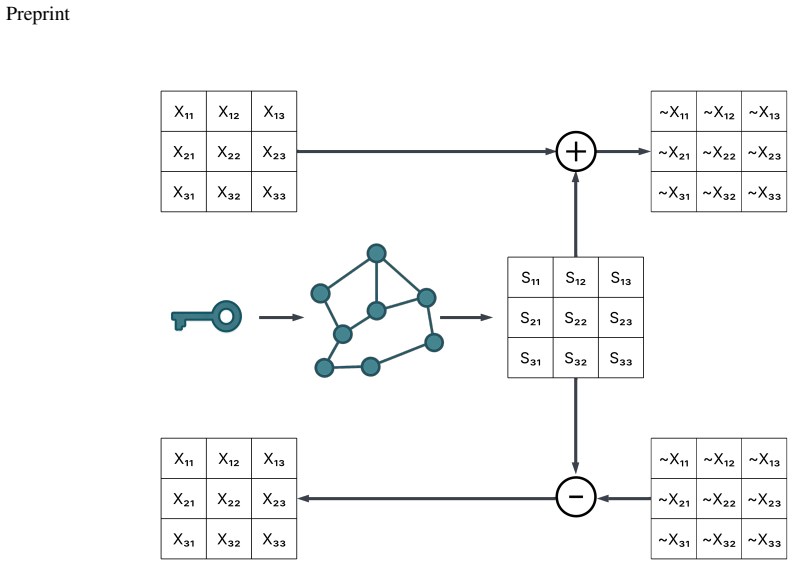
The load-bearing object is the key-conditioned chaotic graph dynamical system: a computation graph whose topology is sampled from a pseudorandom generator seeded by the subkey $k_{graph}$, whose node dynamics are chosen from a library of chaotic maps (e.g., logistic, tent, Baker's, standard, Arnold's cat) with parameters sampled from $k_{params}$, and whose initial state comes from $k_{init}$. Each node evolves under local nonlinear dynamics plus diffusive coupling through the sampled weight matrix $W$, with deterministic key-derived noise injected per timestep; after $T$ steps the node states are aggregated into the mask matrix $S$. The entire construction is keyed and nonce-seeded, so the same $k$ and $n$ reproduce the same mask, while perturbing either produces exponential divergence. This mask is what carries the entire security argument: encryption is $X+S$, decryption is $\tilde{X}-S$, and the security claim rests on the mask being practically uninvertible without the key.
What would settle it
Estimate the largest Lyapunov exponent over a sample of keys drawn from the key schedule; if the exponent is not positive for typical keys, the claim that the mask generator is chaotic fails.
Extended reading notes
Core claim
The central discovery is that a chaotic graph dynamical system fully specified by a cryptographic key can act as a generator of a deterministic tensor mask $S$, allowing encryption as element-wise addition and decryption as subtraction on real-valued data. The system is instantiated by hashing domain labels together with the master key $k$ and a public nonce $n$ with SHA-256 to obtain subkeys, which deterministically sample a graph adjacency matrix, coupling weights, node-level chaotic maps (logistic, tent, Baker, standard, or Arnold's cat), initial conditions, and per-timestep noise. Forward dynamics under diffusive coupling produce a mask; positive Lyapunov exponents are used as the diagnostic that the system is chaotic. The author claims this construction is architecture-agnostic, operates in continuous space, and is reversible by any party holding the key, thereby enabling key-authenticated inference and per-user tensor obfuscation without altering model weights or requiring finite-field cryptographic operations.
Load-bearing premise
The privacy guarantee rests on the assumption that the attacker sees the masked tensor $\tilde{X}$ but not the key or the mask-generating system, yet the described inference deployment requires the model host to regenerate the mask and subtract it, so the host unavoidably sees the plaintext $X$.
Editorial extensions
If this is right
- The masking scheme can be added to an existing neural pipeline as a pre- or post-processing layer, with no architectural changes or retraining required.
- Users holding the correct key and nonce can generate valid masked inputs, which binds model access to key possession and makes replayed or forged inputs fail to produce meaningful inference.
- Because a fresh nonce yields a fresh mask under the same key, the same tensor can be masked differently for each query, preventing mask-reuse attacks.
- The computation graph is continuous and differentiable, so the mask generation is amenable to GPU acceleration via fused kernels, keeping overhead low.
- If output masking is used, the model can return keyed encryptions of its outputs that only the client can decode, completing a key-authenticated round trip.
Reading between the lines
- A direct corollary the author does not state: because the deployment in Section 4.1 requires the model host to regenerate $S$ and compute $X = \tilde{X} - S$, the host always obtains the plaintext; hence the scheme's privacy guarantee necessarily excludes the inference server, limiting it to protecting inputs from third-party observers and from storage and transit exposure.
- The construction is structurally a symmetric stream cipher whose keystream is a chaotic trajectory; this suggests the natural next test is whether it resists known-plaintext attacks when many $(X, \tilde{X})$ pairs under the same key are available, which the paper does not yet analyze.
- Because the mask is added in continuous space, the distribution of masked inputs will differ from the training distribution; a testable extension is to fine-tune the model on masked inputs or to verify whether accuracy degrades for unmasked-trained models.
- The positive Lyapunov exponent diagnostic alone does not imply cryptographic strength; a concrete open question is whether the graph structure and coupling can be recovered from a long stream of masked tensors, a task the paper lists as future work.
Editorial analysis
A structured set of objections, weighed in public.
Referee Report
Summary. The paper proposes a tensor-level masking scheme based on keyed chaotic graph dynamical systems. A cryptographic key and nonce are hashed into subkeys that deterministically sample a graph topology, local chaotic map parameters, and initial conditions; forward simulation of the coupled dynamics produces a mask S_k that is added to an input tensor X to yield X̃ = X + S_k, and decryption subtracts the same mask. The author claims this enables privacy-preserving neural inference, input authentication, and per-user control without architectural changes or the overhead of homomorphic encryption or secure multi-party computation. The manuscript includes a threat model, a list of claimed security properties, a discussion of limitations, and a note that validation experiments are ongoing.
Significance. If the central claims held, a lightweight, differentiable, keyed masking layer for real-valued tensors would be a useful addition to the toolbox for privacy-preserving inference. The paper usefully emphasizes architecture-agnostic, continuous-space transformations and explicitly connects chaotic dynamics with keyed, nonce-conditioned deterministic masks. However, the significance is sharply limited by two facts. First, the deployment protocol in Section 4.1 requires the inference server to regenerate the key and subtract the mask, so the server always possesses the plaintext; the scheme therefore does not provide privacy against the entity running the model, which is the standard adversary in privacy-preserving inference. Second, the manuscript provides no security proof, no experiments, no error analysis, and no comparison to existing approaches; the author explicitly states in Section 7 that 'Validation experiments and empirical evaluations are ongoing.' The paper is best read as a conceptual proposal rather than a validated system.
major comments (3)
- [§4.1] The central privacy claim is contradicted by the paper's own deployment protocol. In Section 4.1, the user sends X̃ = X + S_k and 'the model internally reconstructs the true input by regenerating the same chaotic system and subtracting the mask: X = X̃ - S_k.' The inference server therefore holds the key, the mask, and the plaintext in its own memory during every query. The threat model in Section 5.1 assumes 'the attacker has access to the masked tensor X̃, but not the key,' which models an external eavesdropper, not the model host. In privacy-preserving inference, the model host is typically the adversary from whom the user's input must be protected. As written, the scheme reduces to obfuscation of data in transit or at rest, not privacy-preserving inference.
- [§5.2 and §5.3] The security claim is asserted rather than derived. Section 5.2 lists 'nonlinear unpredictability' and 'exponential sensitivity' as guarantees, and Section 5.3 states that model inversion attacks are 'computationally infeasible in practice,' but no argument, reduction, or quantitative analysis supports this. The paper never defines a security game beyond the informal threat model, and it concedes in Section 5.3 that the scheme 'does not satisfy formal definitions of indistinguishability.' A positive Lyapunov exponent (Section 3.2.3) does not by itself establish cryptographic security; without an analysis of key-recovery, inversion, or distinguishing attacks, the 'encryption' terminology is not justified.
- [§7 and §5.5] There is no empirical or experimental validation. Section 7 states that 'Validation experiments and empirical evaluations are ongoing,' and Section 5.5 defers formal analysis to future work. The manuscript contains no measurements of (i) whether downstream model accuracy is preserved when inputs are masked and unmasked, (ii) the computational overhead of mask generation and subtraction compared with plaintext inference or with HE/SMPC baselines, or (iii) the actual Lyapunov exponents or statistical properties of the generated masks for realistic tensor sizes. The claims of 'lightweight' and 'low-latency' are therefore unsupported.
minor comments (4)
- [§3.2.2] The 'deterministic noise' injected at each timestep in Algorithm 1 is never defined in the equations of Section 3.2.2 or Section 3.3; the reader cannot tell whether this noise is part of the state update or an additive perturbation to the mask, and how it interacts with the various local maps.
- [§1, §3.2.3, and §4] There are several typographical and formatting issues: 'encrpytion' appears in Section 3.2.3, the Erdős–Rényi name is rendered with an unusual combining character, and Figure 1 is described in the caption but no actual figure image is included in the manuscript text.
- [§5.1] The threat model does not state whether the adversary is assumed to have access to multiple (input, masked-input) pairs or chosen plaintexts; given that the nonce is public, a statement about the intended regime (e.g., one-time key per session, no reuse across many queries) would clarify the security boundary.
- [§2.2] No quantitative comparison with homomorphic encryption or secure multi-party computation is provided, even though the introduction and related work motivate the proposal by the overhead of these methods; a table or at least a qualitative complexity comparison would help position the contribution.
Circularity Check
No significant circularity: the reversible masking operation is definitional by design, and the paper's gaps are threat-model and evidence issues rather than circular derivations.
full rationale
No circular step is present. The encryption and decryption operations are defined as X~ = X + S_k and X = X~ - S_k (Algorithm 1, Section 3.3), which are inverses by construction. This is the intended semantics of a reversible cipher, not a case of a prediction being equivalent to an input. The mask S_k is derived from the key and nonce, independent of the input tensor, so no fitted parameter is renamed as a prediction. The paper contains no self-citations and invokes no imported uniqueness theorem; its security statements in Section 5.2 are asserted properties of chaotic sensitivity rather than results derived from fitted quantities. The deployment-layer tension between Section 4.1, where the model host regenerates and subtracts the mask and therefore holds plaintext, and Section 5.1, where the attacker is assumed not to hold the key, is a substantive threat-model and correctness problem, but it is not circularity. Similarly, the absence of validation experiments and the paper's own concession in Section 5.3 that it does not satisfy formal indistinguishability are completeness and evidence concerns, not circular reductions. The central claim does not reduce to its inputs by definition or by self-citation.
Assumptions & free parameters
free parameters (5)
- Number of timesteps T =
unspecified
- Graph sampling parameters (p, beta) =
unspecified
- Weight sampling interval =
unspecified
- Local map parameter ranges =
unspecified
- Deterministic noise injection scale =
unspecified
assumptions (4)
- domain assumption A secure key exchange protocol (e.g., ECDH) is available
- standard math SHA-256 behaves as a secure pseudorandom function
- ad hoc to paper Positive Lyapunov exponent, estimated by the two-trajectory method, implies cryptographic security
- domain assumption The inference server is trusted to hold the key and see plaintext
Cite this review
Pith. "Pith review of Keyed Chaotic Dynamics for Privacy-Preserving Neural Inference." pith.science (2026). https://pith.science/paper/JNLKFMRP
@misc{pith2026250523655,
  author       = {Pith},
  title        = {Pith review of: Keyed Chaotic Dynamics for Privacy-Preserving Neural Inference},
  year         = {2026},
  howpublished = {\url{https://pith.science/paper/JNLKFMRP}},
  note         = {Machine review of arXiv:2505.23655}
}
read the original abstract
Neural network inference typically operates on raw input data, increasing the risk of exposure during preprocessing and inference. Moreover, neural architectures lack efficient built-in mechanisms for directly authenticating input data. This work introduces a novel encryption method for ensuring the security of neural inference. By constructing key-conditioned chaotic graph dynamical systems, we enable the encryption and decryption of real-valued tensors within the neural architecture. The proposed dynamical systems are particularly suited to encryption due to their sensitivity to initial conditions and their capacity to produce complex, key-dependent nonlinear transformations from compact rules. This work establishes a paradigm for securing neural inference and opens new avenues for research on the application of graph dynamical systems in neural network security.
Figures
Reference graph
Works this paper leans on
-
[1]
Cryptonets: Applying neural networks to encrypted data with high throughput and accuracy
Ran Gilad-Bachrach, Nathan Dowlin, Kim Laine, Kristin Lauter, Michael Naehrig, and John Wernsing. Cryptonets: Applying neural networks to encrypted data with high throughput and accuracy. In Proceedings of the 33rd International Conference on Machine Learning (ICML) , pages 201–210, 2016
work page 2016
-
[2]
Secureml: A system for scalable privacy-preserving machine learning
Payman Mohassel and Yupeng Zhang. Secureml: A system for scalable privacy-preserving machine learning. In IEEE Symposium on Security and Privacy (S&P) , pages 19–38, 2017
work page 2017
-
[3]
Cryptography and Network Security: Principles and Practice
William Stallings. Cryptography and Network Security: Principles and Practice . Pearson, 7th edition, 2017
work page 2017
-
[4]
Fips pub 197: Advanced encryption standard (aes)
National Institute of Standards and Technology. Fips pub 197: Advanced encryption standard (aes). https: //nvlpubs.nist.gov/nistpubs/FIPS/NIST.FIPS.197.pdf, 2001
work page 2001
-
[5]
Fips pub 198-1: The keyed-hash message authentication code (hmac)
National Institute of Standards and Technology. Fips pub 198-1: The keyed-hash message authentication code (hmac). https://csrc.nist.gov/publications/detail/fips/198/1/final, 2008
work page 2008
-
[6]
Fips pub 180-4: Secure hash standard (shs)
National Institute of Standards and Technology. Fips pub 180-4: Secure hash standard (shs). https://nvlpubs. nist.gov/nistpubs/FIPS/NIST.FIPS.180-4.pdf, 2015
work page 2015
-
[7]
Deep learning with differential privacy
Martin Abadi, Andy Chu, Ian Goodfellow, H Brendan McMahan, Ilya Mironov, Kunal Talwar, and Li Zhang. Deep learning with differential privacy. In Proceedings of the 2016 ACM SIGSAC Conference on Computer and Communications Security (CCS), pages 308–318, 2016
work page 2016
-
[8]
Embedding watermarks into deep neural networks
Yusuke Uchida, Yuki Nagai, Shigeyuki Sakazawa, and Shin’ichi Satoh. Embedding watermarks into deep neural networks. In Proceedings of the ACM International Conference on Multimedia Retrieval (ICMR) , pages 269–277, 2017
work page 2017
Show all 10 references
-
[9]
Nonlinear dynamics and chaos: with applications to physics, biology, chemistry, and engineering
Steven H Strogatz. Nonlinear dynamics and chaos: with applications to physics, biology, chemistry, and engineering. Chapman and Hall/CRC, 2024
2024
-
[10]
Chaos in dynamical systems
Edward Ott. Chaos in dynamical systems . Cambridge university press, 2002. 10
2002
Reviewed August 7, 2026 · model on record in the stance chip above.
Discussion (0). Sign in to comment.