Characterization of Hydroxyls in Surface Oxide of Superconducting Tantalum and Their Mitigation in Quantum Circuits
Pith reviewed 2026-07-02 04:45 UTC · model grok-4.3
The pith
Hydroxyls accumulate in the tantalum suboxide layer and can be suppressed by chemical mechanical planarization to address a source of microwave loss.
A machine-rendered reading of the paper's core claim, the machinery that carries it, and where it could break.
Core claim
Hydroxyls accumulate in the Ta suboxide region above the underlying Ta; [OH] incorporation can be suppressed by replacing the native oxide with an oxide formed during chemical mechanical planarization; hydroxyls are a probable molecular origin of TLS loss channels.
What carries the argument
Secondary ion mass spectrometry depth profiling of hydroxyl concentration through the oxide, cross-checked with angle-resolved X-ray photoelectron spectroscopy for oxide stoichiometry and transmission electron microscopy for thickness.
Load-bearing premise
That the hydroxyls identified are the dominant two-level system defects causing the microwave loss, rather than other oxide species or defects.
What would settle it
Fabrication and microwave measurement of quantum circuits showing no measurable improvement in coherence time after chemical mechanical planarization suppresses the hydroxyl signal.
Figures
read the original abstract
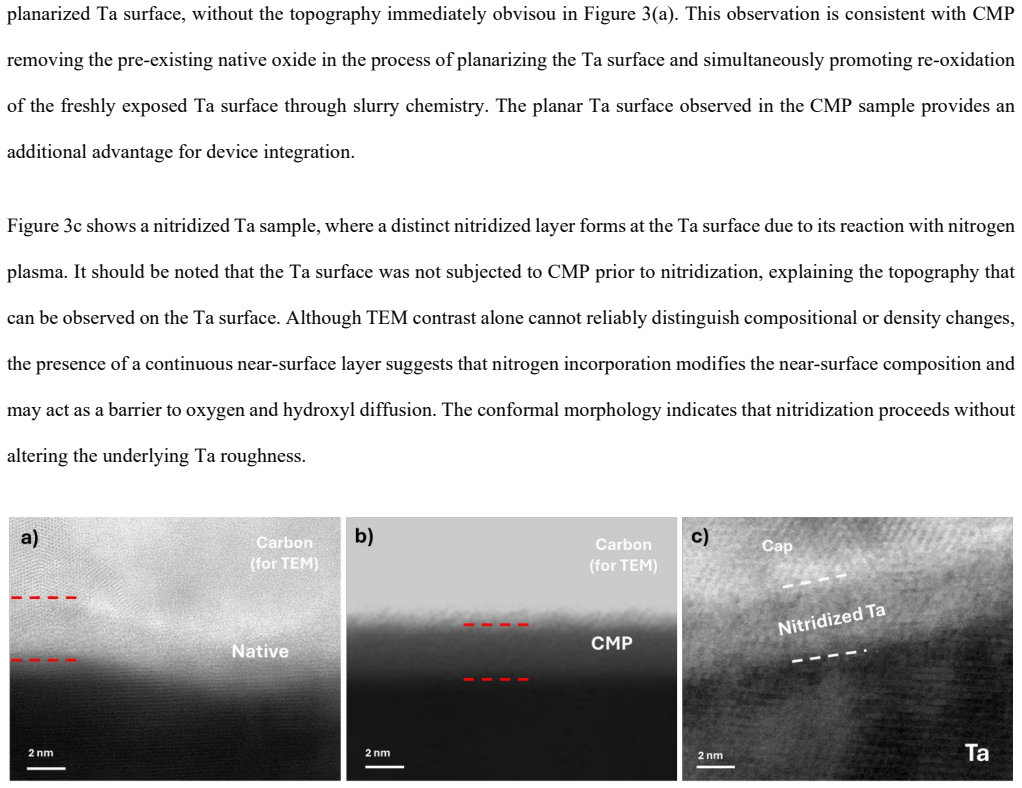
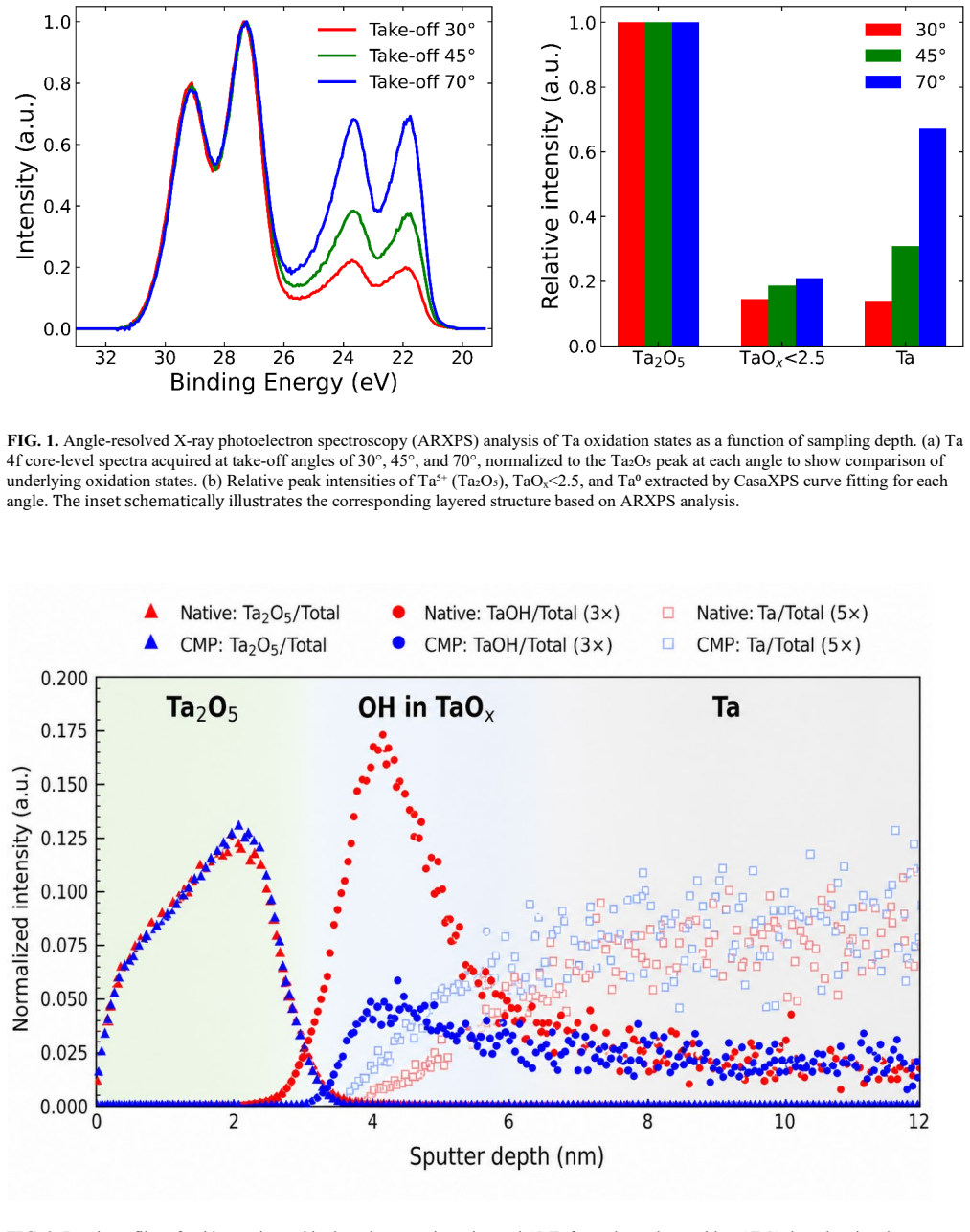
Recently, tantalum (Ta) has gained attention in superconducting quantum circuits due to the longer coherence times achieved when replacing niobium (Nb) in capacitor pads. Previous literature shows that surface oxides that form upon ambient exposure on superconducting metals such as Ta, Al, and Nb host two-level system (TLS) defects, which are a leading source of microwave loss and decoherence. While the surface oxides of Nb and Al have been extensively studied, Ta oxides remain less well understood. Using secondary ion mass spectrometry of alpha-Ta films deposited at 300 mm wafer scale, we show for the first time that hydroxyls accumulate in the Ta suboxide region above the underlying Ta. Angle-resolved X-ray photoelectron spectroscopy shows that the surface region is dominated by Ta2O5, with sub-stoichiometric TaOx present in between the Ta2O5 and underlying Ta. The thickness of the tantalum oxide is confirmed by transmission electron microscopy. We demonstrate that [OH] incorporation can be suppressed by replacing the native oxide with an oxide formed during chemical mechanical planarization of alpha-Ta films. Our findings support the hypothesis that TLS defects are non-uniform within the oxide thickness and suggest hydroxyls as a probable molecular origin of these loss channels. Furthermore, we show the feasibility of plasma nitridization as a method to decrease hydroxyl loading on alpha-Ta surfaces. The modulation of hydroxyl content through surface engineering of alpha-Ta can enable the fabrication of more robust, high-coherence superconducting quantum circuits by addressing a potential TLS source.
Editorial analysis
A structured set of objections, weighed in public.
Referee Report
Summary. The manuscript characterizes surface oxides on wafer-scale alpha-Ta films for superconducting quantum circuits. SIMS depth profiling shows hydroxyl accumulation in the suboxide region above the Ta metal; ARXPS indicates a Ta2O5-dominated surface with sub-stoichiometric TaOx beneath it, with oxide thickness confirmed by TEM. The authors demonstrate that a CMP-formed oxide suppresses [OH] incorporation relative to the native oxide and that plasma nitridization can further reduce hydroxyl loading. They conclude that these findings support hydroxyls as a probable molecular origin of TLS defects and that surface engineering of alpha-Ta can mitigate a potential loss channel.
Significance. The multi-technique characterization on industrially relevant 300 mm wafers provides concrete data on Ta oxide composition and a practical route to control hydroxyl content via CMP and nitridization. If the hypothesized link to TLS loss is later confirmed by device measurements, the results could inform surface treatments for higher-coherence Ta qubits. The work is strongest as a materials characterization study; its direct relevance to quantum-circuit performance remains prospective because no resonator Q_i, TLS density, or coherence-time data are reported.
major comments (1)
- [Abstract/Discussion] Abstract and concluding discussion: the statement that hydroxyls are a 'probable molecular origin of these loss channels' rests on the observed non-uniform [OH] distribution in SIMS profiles plus literature on Nb/Al oxides, yet the manuscript contains no microwave resonator, qubit, or TLS-spectroscopy measurements that would link reduced [OH] (via CMP or nitridization) to lower loss. This inference is central to the paper's motivation for quantum-circuit applications but is not tested by the data presented.
minor comments (1)
- [Results/SIMS section] The manuscript should explicitly define the notation [OH] on first use and state the depth resolution and calibration method used for the SIMS hydroxyl quantification.
Simulated Author's Rebuttal
We thank the referee for the constructive review of our manuscript characterizing surface oxides on wafer-scale alpha-Ta films. The major comment concerns the strength of the inference regarding hydroxyls as a probable TLS source. We respond point-by-point below.
read point-by-point responses
-
Referee: [Abstract/Discussion] Abstract and concluding discussion: the statement that hydroxyls are a 'probable molecular origin of these loss channels' rests on the observed non-uniform [OH] distribution in SIMS profiles plus literature on Nb/Al oxides, yet the manuscript contains no microwave resonator, qubit, or TLS-spectroscopy measurements that would link reduced [OH] (via CMP or nitridization) to lower loss. This inference is central to the paper's motivation for quantum-circuit applications but is not tested by the data presented.
Authors: We agree that the manuscript reports no direct microwave resonator, qubit, or TLS-spectroscopy measurements linking the observed reduction in [OH] to lower loss. The abstract and discussion frame the connection as a hypothesis: the SIMS data show non-uniform hydroxyl accumulation in the suboxide, ARXPS and TEM confirm the oxide structure, and this is placed in the context of prior Nb/Al literature where analogous defects are implicated in TLS. The work's core contribution is the materials characterization and the demonstration that CMP and plasma nitridization can suppress hydroxyl incorporation. In response to the comment, we will revise the abstract and concluding discussion to state more explicitly that the TLS link is inferential and prospective, requiring future device measurements for confirmation. This constitutes a partial revision focused on wording clarity rather than new experiments. revision: partial
Circularity Check
No circularity: purely experimental characterization with direct measurements
full rationale
The paper reports SIMS depth profiling, ARXPS, and TEM measurements on alpha-Ta films to identify hydroxyl accumulation in the suboxide region and demonstrate suppression via CMP-formed oxide or plasma nitridization. No equations, fitted parameters, derivations, or predictions are present. All claims rest on the new experimental data themselves rather than reducing to prior self-citations or self-defined quantities. Prior literature is cited only for context on Nb/Al oxides and TLS, which does not create a load-bearing circular chain within this work.
Axiom & Free-Parameter Ledger
axioms (1)
- domain assumption Standard surface-science interpretation of secondary-ion mass spectrometry and angle-resolved X-ray photoelectron spectroscopy signals correctly identifies hydroxyl incorporation and oxide stoichiometry.
Reference graph
Works this paper leans on
-
[1]
Suppressing quantum errors by scaling a surface code logical qubit,
R. Acharya, I. Aleiner, R. Allen, T. I. Andersen, M. Ansmann et al., “Suppressing quantum errors by scaling a surface code logical qubit,” Nature 614, 676–681 (2023)
2023
-
[2]
Hyperbolic lattices in circuit quantum electrodynamics,
A. J. Kollár, M. Fitzpatrick, and A. A. Houck, “Hyperbolic lattices in circuit quantum electrodynamics,” Nature 571, 45– 50 (2019)
2019
-
[3]
Probing entanglement in a 2D hard- core Bose–Hubbard lattice,
A. H. Karamlou, I. T. Rosen, S. E. Muschinske, C. N. Barrett, A. Di Paolo et al., “Probing entanglement in a 2D hard- core Bose–Hubbard lattice,” Nature 629, 561–566 (2024)
2024
-
[4]
Superconducting qubits: Current state of play,
M. Kjaergaard, M. E. Schwartz, J. Braumüller, P. Krantz, J. I.-J. Wang et al., “Superconducting qubits: Current state of play,” Annu. Rev. Condens. Matter Phys. 11, 369–395 (2020)
2020
-
[5]
Materials challenges and opportunities for quantum computing hardware,
N. P. de Leon, K. M. Itoh, D. Kim, K. K. Mehta, T. E. Northup et al., “Materials challenges and opportunities for quantum computing hardware,” Science 372, eabb2823 (2021)
2021
-
[6]
TOF -SIMS analysis of decoherence sources in superconducting qubits,
A. A. Murthy, J. Lee, C. Kopas, M. J. Reagor, A. P. McFadden et al., “TOF -SIMS analysis of decoherence sources in superconducting qubits,” Appl. Phys. Lett. 120, 044002 (2022)
2022
-
[7]
Millisecond lifetimes and coherence times in 2D transmon qubits,
M. P. Bland, F. Bahrami, J. G. C. Martinez, P. H. Prestegaard, B. M. Smitham et al., “Millisecond lifetimes and coherence times in 2D transmon qubits,” Nature 647, 343–348 (2025)
2025
-
[8]
Disentangling losses in tantalum superconducting circuits,
K. D. Crowley, R. A. McLellan, A. Dutta, N. Shumiya, A. P. M. Place et al., “Disentangling losses in tantalum superconducting circuits,” Phys. Rev. X 13, 041005 (2023)
2023
-
[9]
Systematic improvements in transmon qubit coherence enabled by niobium surface encapsulation,
M. Bal, A. A. Murthy, S. Zhu, F. Crisa, X. You et al., “Systematic improvements in transmon qubit coherence enabled by niobium surface encapsulation,” npj Quantum Inf. 10, 43 (2024)
2024
-
[10]
Investigation of the superconducting properties of Nb films covered by PECVD a-Si:H layers for superconducting qubit application,
A. Bruno, P. Mengucci, L. V. Mercaldo, and M. P. Lisitskiy, “Investigation of the superconducting properties of Nb films covered by PECVD a-Si:H layers for superconducting qubit application,” Phys. Procedia 36, 239 –244 (2012)
2012
-
[11]
Nitrogen plasma passivated niobium resonators for superconducting quantum circuits,
K. Zheng, D. Kowsari, N. J. Thobaben, X. Du, X. Song et al., “Nitrogen plasma passivated niobium resonators for superconducting quantum circuits,” Appl. Phys. Lett. 120, 102601 (2022)
2022
-
[12]
Engineering of niobium surfaces through accelerated neutral atom beam technology for quantum applications,
S. Kar, C. Weiland, C. Zhou, E. Bhatia, B. Martinick et al., “Engineering of niobium surfaces through accelerated neutral atom beam technology for quantum applications,” J. Appl. Phys. 134, 025301 (2023)
2023
-
[13]
Tailoring the physicochemical properties of Nb thin films via surface engineering methods,
J. A. Dhas, E. Bhatia, K. P. Koirala, Z. Zhu, M. Liu et al., “Tailoring the physicochemical properties of Nb thin films via surface engineering methods,” ACS Appl. Mater. Interfaces 17, 24502– 24512 (2025)
2025
-
[14]
Eliminating surface oxides of superconducting circuits with noble metal encapsulation,
R. D. Chang, N. Shumiya, R. A. McLellan, Y. Zhang, M. P. Bland et al., “Eliminating surface oxides of superconducting circuits with noble metal encapsulation,” Phys. Rev. Lett. 134, 097001 (2025). 9
2025
-
[15]
Three -dimensional superconducting resonators at T < 20 mK with photon lifetimes up to τ = 2 s,
A. Romanenko, R. Pilipenko, S. Zorzetti, D. Frolov, M. Awida et al., “Three -dimensional superconducting resonators at T < 20 mK with photon lifetimes up to τ = 2 s,” Phys. Rev. Applied 13, 034032 (2020)
2020
-
[16]
Understanding mechanism of performance improvement in nitrogen-doped niobium superconducting radio frequency cavity,
X. Fang, J.-S. Oh, M. Kramer, A. Romanenko, A. Grassellino et al., “Understanding mechanism of performance improvement in nitrogen-doped niobium superconducting radio frequency cavity,” Mater. Res. Lett. 11, 108 –116 (2023)
2023
-
[17]
Chemical mechanical planarization for Ta -based superconducting quantum devices,
E. Bhatia, S. Kar, J. Nalaskowski, T. Vo, S. Olson et al., “Chemical mechanical planarization for Ta -based superconducting quantum devices,” J. Vac. Sci. Technol. B 41, 033202 (2023)
2023
-
[18]
A step-by-step guide to perform X-ray photoelectron spectroscopy,
G. Greczynski and L. Hultman, “A step-by-step guide to perform X-ray photoelectron spectroscopy,” J. Appl. Phys. 132, 011101 (2022)
2022
-
[19]
H. J. Frost, C. Weiland, K. P. Koirala, J. A. Dhas, E. Bhatia et al., “Oxidation kinetics of superconducting niobium and α-tantalum in atmosphere at short and intermediate time scales,” arXiv:2411.10410 (2024)
-
[20]
The NIST X-ray photoelectron spectroscopy database,
J. R. Rumble, Jr., D. M. Bickham, and C. J. Powell, “The NIST X-ray photoelectron spectroscopy database,” Surf. Interface Anal. 19, 241–246 (1992)
1992
-
[21]
Hydrogen bonds in Al2O3 as dissipative two- level systems in superconducting qubits,
L. Gordon, H. Abu-Farsakh, A. Janotti, and C. G. Van de Walle, “Hydrogen bonds in Al2O3 as dissipative two- level systems in superconducting qubits,” Sci. Rep. 4, 7590 (2014)
2014
-
[22]
Ta-based damascene resonators,
D. J. Rebar, M. Liu, T. Nanayakkara, C. Zhou, J. Macy et al., “Ta-based damascene resonators,” in 2024 IEEE International Conference on Quantum Computing and Engineering (QCE) (IEEE, 2024), Vol. 2, pp. 532– 533
2024
-
[23]
Enabling 300 mm wafer -scale fabrication of superconducting quantum devices,
E. Bhatia, H. Frost, N. Pieniazek, J. Nalaskowski, J. Mucci et al., “Enabling 300 mm wafer -scale fabrication of superconducting quantum devices,” in 2024 35th Annual SEMI Advanced Semiconductor Manufacturing Conference (ASMC) (IEEE, 2024), pp. 1–6
2024
-
[24]
Chemical profiles of the oxides on tantalum in state -of- the-art superconducting circuits,
R. A. McLellan, A. Dutta, C. Zhou, Y. Jia, C. Weiland et al., “Chemical profiles of the oxides on tantalum in state -of- the-art superconducting circuits,” Adv. Sci. 10, 2300921 (2023). 10 FIG. 1. Angle-resolved X-ray photoelectron spectroscopy (ARXPS) analysis of Ta oxidation states as a function of sampling depth. (a) Ta 4f core-level spectra acquired a...
2023
discussion (0)
Sign in with ORCID, Apple, or X to comment. Anyone can read and Pith papers without signing in.