Radiation tolerance of a diamond radiation detector for space use
Pith reviewed 2026-06-29 02:10 UTC · model grok-4.3
The pith
Diamond radiation detectors maintain spectroscopic performance after proton doses equivalent to 100 years in orbit.
A machine-rendered reading of the paper's core claim, the machinery that carries it, and where it could break.
Core claim
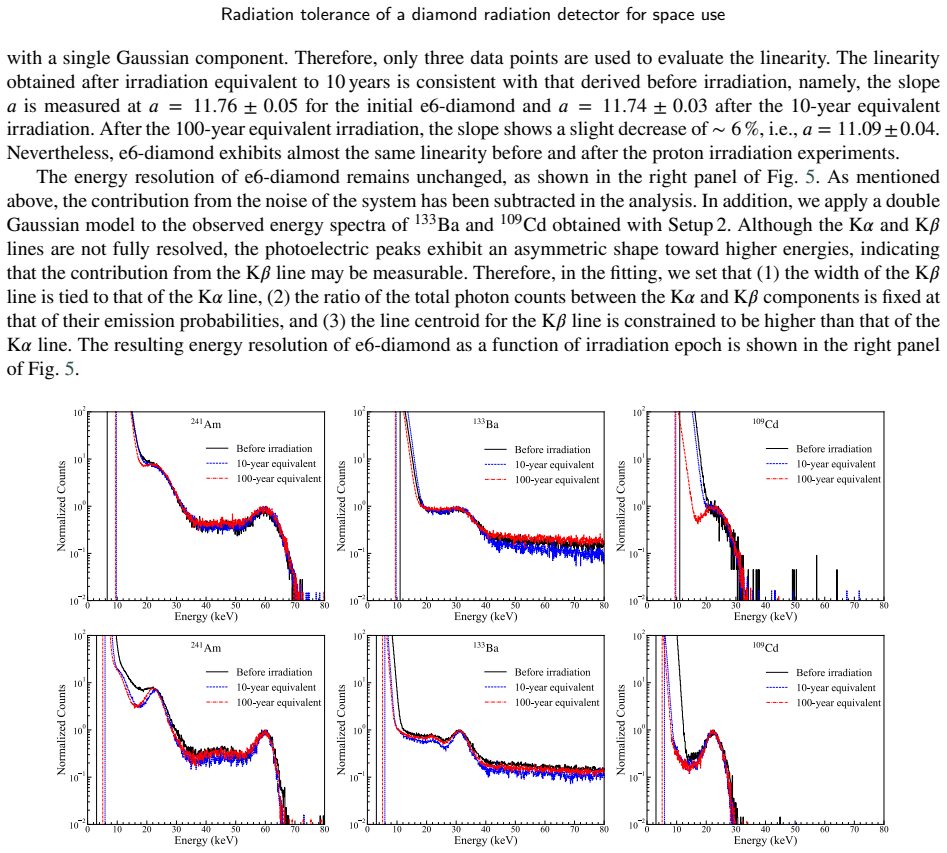
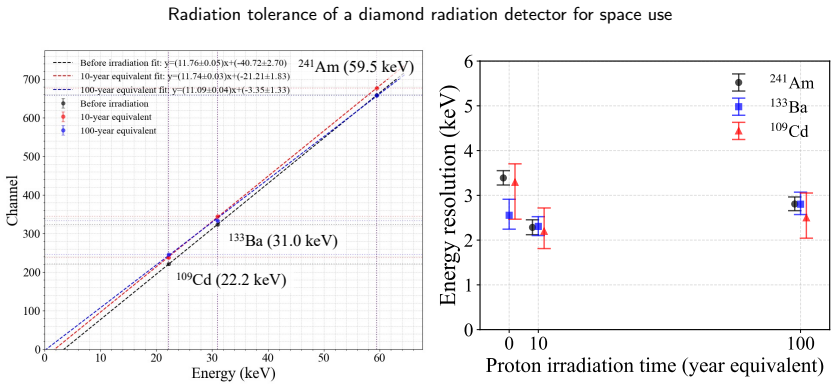
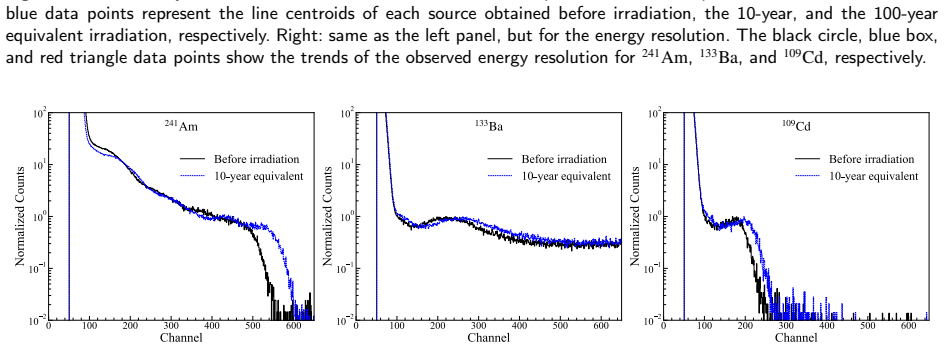
Two MPCVD diamond radiation detectors show no significant degradation in spectroscopic performance, measured via characteristic X-rays from radioisotope sources, after 100 MeV proton irradiation up to doses equivalent to at least 10 years of exposure in the target orbital environment, with one detector also showing no degradation at the 100-year equivalent dose.
What carries the argument
100 MeV proton irradiation followed by post-exposure X-ray spectroscopy as a proxy for assessing long-term radiation tolerance in space.
If this is right
- The detectors remain usable for at least 10 years of operation in the planned orbital radiation environment.
- One detector type tolerates exposure equivalent to 100 years without measurable loss in performance.
- Both detector types are suitable for detecting particles in the 10-40 keV energy range over extended periods.
- Observed differences in initial performance between the two diamond types may stem from variations in material properties.
Where Pith is reading between the lines
- The same irradiation protocol could be applied to validate diamond detectors for other high-radiation orbits or solar-system environments.
- Direct comparison of pre- and post-irradiation response to actual 10-40 keV charged particles would strengthen the proxy used here.
- If the tolerance holds, diamond detectors may enable longer mission durations than silicon-based alternatives in similar radiation fields.
Load-bearing premise
Unchanged X-ray spectroscopic performance after proton irradiation accurately reflects the detectors' ability to measure charged particles without degradation over years in the actual space radiation environment.
What would settle it
A clear worsening of energy resolution or peak visibility in X-ray spectra from the irradiated detectors relative to unirradiated controls would indicate degradation.
Figures
read the original abstract
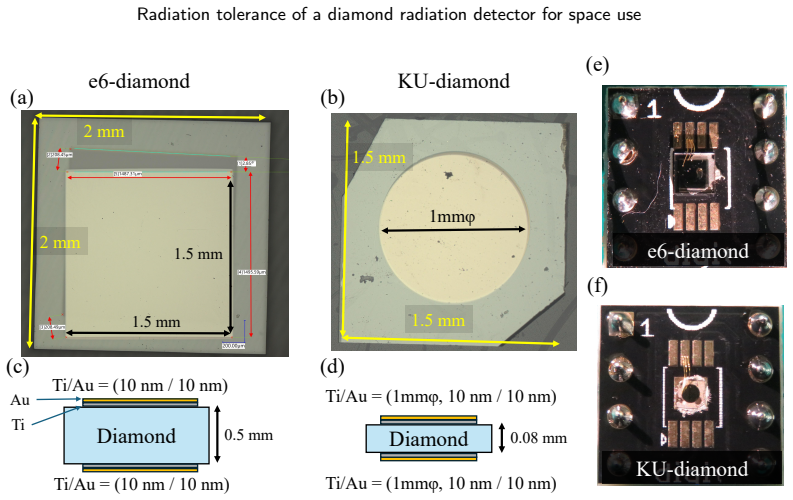
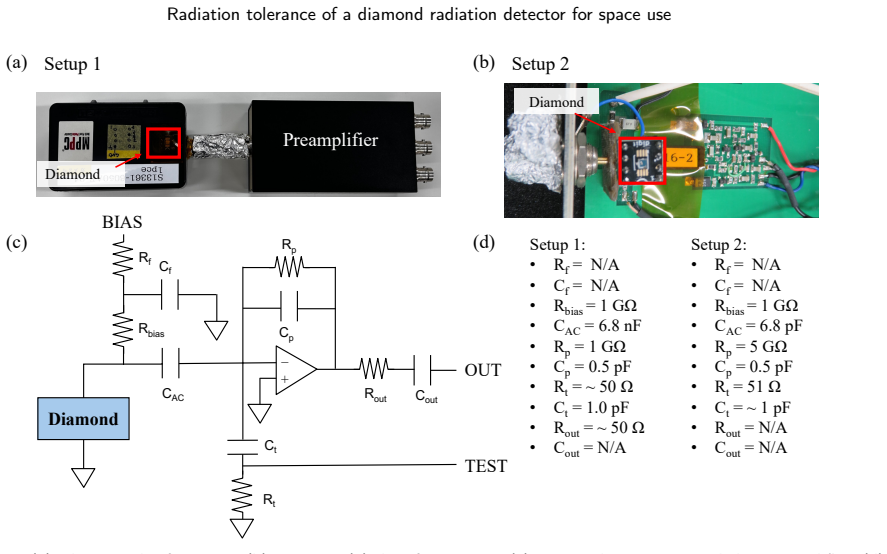
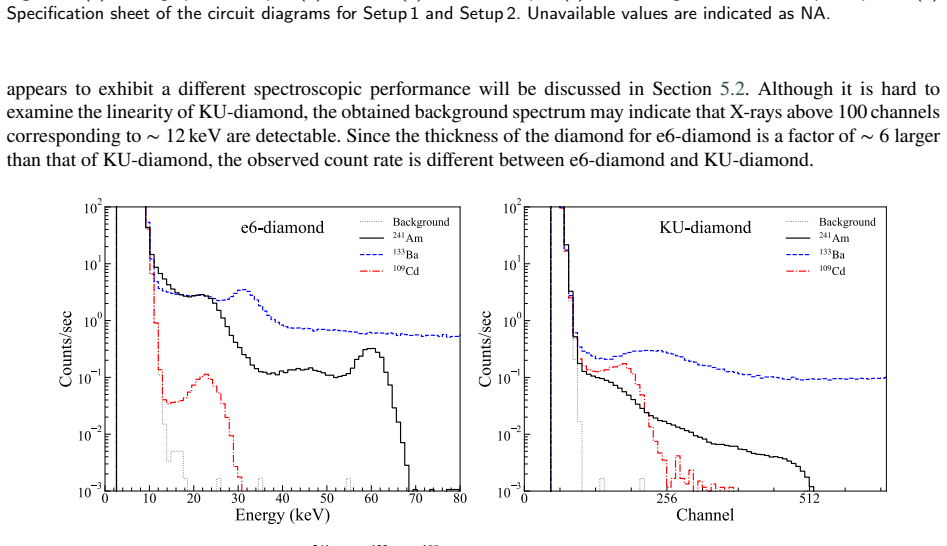
We present a study of the radiation tolerance of two types of diamond radiation detectors for space use. We plan to launch a 3U-size CubeSat, KSAT3-X, developed by Kanazawa University in 2027. The KSAT3-X mission is aimed to observe inflows and outflows of charged particles such as electrons and protons, particularly in the 10 - 40 keV energy range, in the Earth's magnetosphere. As the mission instrument, we have developed two diamond radiation detectors. The first is composed of a microwave plasma chemical vapor deposition (MPCVD) diamond fabricated by Element Six, and the second is based on a MPCVD diamond produced in-house at Kanazawa University. We irradiate both diamonds with 100 MeV protons and evaluate their spectroscopic performance as an indicator of radiation tolerance using characteristic X-rays from radioisotope sources. We find no significant degradation in their spectroscopic performance up to at least the 10-year equivalent irradiation under the orbital environments of KSAT3-X. We additionally irradiate the Element Six diamond with 100 MeV protons up to the 100-year equivalent. As a result, no significant degradation in the spectroscopic performance is observed. These results indicate that the two diamond radiation detectors have sufficiently high radiation tolerance. We also discuss possible physical origins of the observed difference in the spectroscopic performance between the two detectors.
Editorial analysis
A structured set of objections, weighed in public.
Referee Report
Summary. The manuscript reports radiation tolerance tests for two MPCVD diamond detectors (Element Six and in-house Kanazawa) intended for the KSAT3-X 3U CubeSat mission to measure 10-40 keV electrons and protons in the magnetosphere. Detectors are irradiated with 100 MeV protons to fluences equivalent to 10-year and (for Element Six) 100-year orbital exposure; spectroscopic performance is evaluated via X-ray spectra from radioisotope sources, with the central claim of no significant degradation in energy resolution or peak position.
Significance. If the results hold, they would provide direct experimental support for radiation hardness of these detectors under relevant proton fluences, strengthening the case for their use in the KSAT3-X mission and offering useful data for other space-based diamond detector applications. The choice of 100 MeV protons and long-equivalent fluences is appropriate for the orbital environment.
major comments (2)
- [Abstract] Abstract: the claim that the detectors are suitable for 10-40 keV charged-particle detection (the mission goal) is based exclusively on post-irradiation X-ray spectroscopy; no data or explicit justification is given for why unchanged X-ray performance (photoelectric absorption producing secondary electrons) serves as a valid proxy for direct ionization tracks from 10-40 keV electrons/protons, where local ionization density, charge trapping, or polarization effects could differ. This assumption is load-bearing for the mission-relevance conclusion.
- [Results] Results/Discussion: 'no significant degradation' is stated without quantitative thresholds, reported uncertainties, or statistical criteria for what constitutes significance, and without pre/post-irradiation spectra or resolution values shown for the particle-relevant energy range.
minor comments (2)
- [Methods] The calculation of orbital-equivalent fluences should be detailed with explicit reference to the radiation environment model used for KSAT3-X.
- Figure captions and axis labels for spectra should include the radioisotope sources and energies used.
Simulated Author's Rebuttal
We thank the referee for the constructive comments, which help clarify the manuscript's claims. We address each major point below with honest responses based on the existing data and will make revisions where the manuscript can be strengthened without misrepresentation.
read point-by-point responses
-
Referee: [Abstract] Abstract: the claim that the detectors are suitable for 10-40 keV charged-particle detection (the mission goal) is based exclusively on post-irradiation X-ray spectroscopy; no data or explicit justification is given for why unchanged X-ray performance (photoelectric absorption producing secondary electrons) serves as a valid proxy for direct ionization tracks from 10-40 keV electrons/protons, where local ionization density, charge trapping, or polarization effects could differ. This assumption is load-bearing for the mission-relevance conclusion.
Authors: X-ray spectroscopy is used as a standard proxy because it directly measures charge collection efficiency and energy resolution in the diamond bulk after radiation damage, which governs performance for any ionizing radiation including 10-40 keV electrons and protons. The photoelectrons produced have energies in a comparable range and generate electron-hole pairs via the same ionization process. We will add an explicit paragraph in the revised introduction and discussion justifying this choice with references to prior diamond detector literature, while acknowledging that differences in track structure (e.g., higher dE/dx for protons) represent a potential limitation not directly tested here. revision: partial
-
Referee: [Results] Results/Discussion: 'no significant degradation' is stated without quantitative thresholds, reported uncertainties, or statistical criteria for what constitutes significance, and without pre/post-irradiation spectra or resolution values shown for the particle-relevant energy range.
Authors: We agree that the phrasing lacks quantitative support. The revised manuscript will report pre- and post-irradiation FWHM values with uncertainties for the main X-ray peaks, define 'no significant degradation' explicitly as changes smaller than the combined measurement uncertainties, and include tabulated resolution data or figures covering the energy range relevant to the mission (10-40 keV equivalent via the X-ray lines used). revision: yes
Circularity Check
No circularity: purely experimental measurement campaign
full rationale
The paper reports results from proton irradiation of two diamond detectors followed by post-irradiation spectroscopic measurements with radioisotope X-ray sources. No equations, derivations, fitted parameters, predictions, or self-citations appear as load-bearing elements in the central claims. All conclusions rest directly on the measured energy spectra and resolution values before and after fluence exposure. This is a standard experimental tolerance study with no reduction of outputs to inputs by construction.
Axiom & Free-Parameter Ledger
free parameters (1)
- orbital equivalent fluence
axioms (1)
- domain assumption X-ray spectroscopic resolution after proton exposure accurately reflects radiation damage relevant to 10-40 keV electron and proton detection in orbit.
Reference graph
Works this paper leans on
-
[1]
E. G. Shelley, R. G. Johnson, and R. D. Sharp. Satellite observations of energetic heavy ions during a geomagnetic storm.Journal of GeophysicalResearch, 77(31):6104, January 1972
1972
-
[2]
A. W. Yau and M. Andre. Sources of ion outflow in the high latitude ionosphere.SpaceScience Reviews, 80(1):1–25, 1997
1997
-
[3]
Thepolarwind:Recentobservations
AndrewW.Yau,TakumiAbe,andW.K.Peterson. Thepolarwind:Recentobservations. JournalofAtmosphericandSolar-TerrestrialPhysics, 69(16):1936–1983, November 2007
1936
-
[4]
J. H. Hoffman, W. H. Dodson, C. R. Lippincott, and H. D. Hammack. Initial ion composition results from the Isis 2 satellite.Journal of GeophysicalResearch, 79(28):4246, October 1974
1974
-
[5]
Kentaro Terada, Shoichiro Yokota, Yoshifumi Saito, Naritoshi Kitamura, Kazushi Asamura, and Masaki N. Nishino. Biogenic oxygen from Earth transported to the Moon by a wind of magnetospheric ions.NatureAstronomy, 1:0026, January 2017
2017
-
[6]
Heynderickx, B
D. Heynderickx, B. Quaghebeur, J. Wera, E.J. Daly, and H.D.R. Evans. New radiation environment and effects models in esa’s space environment information system (spenvis). InProceedings of the 7th European Conference on Radiation and Its Effects on Components and Systems,2003.RADECS2003., pages 643–646, 2003
2003
-
[7]
SpaceEnvironmentInformationSystem(SPENVIS)
M.Kruglanski,N.Messios,E.deDonder,E.Gamby,S.Calders,L.Hetey,andH.Evans. SpaceEnvironmentInformationSystem(SPENVIS). In EGUGeneralAssemblyConferenceAbstracts, EGU General Assembly Conference Abstracts, page 7457, April 2009
2009
-
[8]
Heynderickx, B
D. Heynderickx, B. Quaghebeur, E. Speelman, and E. Daly.ESA’sSpaceEnvironmentInformationSystem(SPENVIS)-AWWWinterface tomodels ofthe spaceenvironmentanditseffects
-
[9]
Concept of high-z gamma-ray bursts unraveling the dark ages and extreme space-time mission—hiz- gundam
Daisuke Yonetoku, Akihiro Doi, Tatehiro Mihara, Hideo Matsuhara, Takanori Sakamoto, Kohji Tsumura, Kunihito Ioka, Makoto Arimoto, Yoshiyuki Ando, Teruaki Enoto, et al. Concept of high-z gamma-ray bursts unraveling the dark ages and extreme space-time mission—hiz- gundam. Journal of AstronomicalTelescopes,Instruments, andSystems, 11(4):044002–044002, 2025
2025
-
[10]
W. Adam, E. Berdermann, P. Bergonzo, G. Bertuccio, F. Bogani, E. Borchi, A. Brambilla, M. Bruzzi, C. Colledani, J. Conway, P. Dangelo, W. Dabrowski, P. Delpierre, A. Deneuville, W. Dulinski, B. van Eijk, A. Fallou, F. Fizzotti, F. Foulon, M. Friedl, K. K. Gan, E. Gheeraert, E. Grigoriev, G. Hallewell, S. Han, F. Hartjes, J. Hrubec, D. Husson, H. Kagan, D....
2000
-
[11]
KimiyoshiIchikawa,TsubasaMatsumoto,TakaoInokuma,SatoshiYamasaki,ChristophE.Nebel,andNorioTokuda.DiamondHomoepitaxial Growth Technology toward Wafer Fabrication, Atomically Controlled Surfaces, and Low Resistivity.Accounts of Materials Research, 5(10):1181–1193, October 2024
2024
-
[12]
Mykolajewycz, J
R. Mykolajewycz, J. Kalnajs, and A. Smakula. High-precision density determination of natural diamonds.Journal of Applied Physics, 35(6):1773–1778, 06 1964. Ando et al.: Preprint submitted to Elsevier Page 10 of 11 Radiation tolerance of a diamond radiation detector for space use
1964
-
[13]
Progressinthedevelopment of cdte and cdznte semiconductor radiation detectors for astrophysical and medical applications.Sensors, 9(5):3491–3526, 2009
StefanoDelSordo,LeonardoAbbene,EzioCaroli,AnnaMariaMancini,AndreaZappettini,andPietroUbertini. Progressinthedevelopment of cdte and cdznte semiconductor radiation detectors for astrophysical and medical applications.Sensors, 9(5):3491–3526, 2009
2009
-
[14]
S. M. Sze and Kwok K. Ng.Physicsof SemiconductorDevices. Wiley-Interscience, Hoboken, N.J., 3rd edition, 2006
2006
-
[15]
Scarsbrook
JanIsberg,JohanHammersberg,ErikJohansson,TobiasWikstrom,DanielJ.Twitchen,AndrewJ.Whitehead,StevenE.Coe,andGeoffreyA. Scarsbrook. High carrier mobility in single-crystal plasma-deposited diamond.Science, 297(5587):1670–1672, 2002
2002
-
[16]
Twitchen, and Jan Isberg
Markus Gabrysch, Saman Majdi, Daniel J. Twitchen, and Jan Isberg. Electron and hole drift velocity in chemical vapor deposition diamond. Journal ofAppliedPhysics, 109(6):063719–063719–4, March 2011
2011
-
[17]
Muhammad Jauhar Kholili, Takehiro Shimaoka, Asuka Hara, and Manobu M. Tanaka. Transient-Current Technique Characterization of DiamondDetectorandProposalofaDiamondDetectorwithChargeAmplification. PhysicaStatusSolidiAppliedResearch,221(4):2300673, February 2024
2024
-
[18]
Faiz Rahman Ishaqzai, Muhammed Deniz, Kevin Kröninger, and Jens Weingarten. Charge-Carrier Mobility in Diamond: Review, Data Compilation, and Modelling for Detector Simulations.arXive-prints, page arXiv:2601.10807, January 2026
arXiv 2026
-
[19]
physicastatussolidi(a),213(10):2629–2633, 2016
TakehiroShimaoka,JunichiH.Kaneko,YukiSato,MasakatsuTsubota,HiroakiShimmyo,AkiyoshiChayahara,HideyukiWatanabe,Hitoshi Umezawa,andYoshiakiMokuno.Fanofactorevaluationofdiamonddetectorsforalphaparticles. physicastatussolidi(a),213(10):2629–2633, 2016
2016
-
[20]
Aksenov, Rugard Dressler, Robert Eichler, Erich Griesmayer, Dominik Herrmann, Andreas Turler,andChristinaWeiss
Benjamin Kraus, Patrick Steinegger, Nikolay V. Aksenov, Rugard Dressler, Robert Eichler, Erich Griesmayer, Dominik Herrmann, Andreas Turler,andChristinaWeiss. Chargecarrierpropertiesofsingle-crystalcvddiamondupto473k. NuclearInstrumentsandMethodsinPhysics ResearchSection A: Accelerators,Spectrometers,DetectorsandAssociated Equipment, 989:164947, 2021
2021
-
[21]
Alan Owens and A. Peacock. Compound semiconductor radiation detectors.Nuclear Instruments and Methods in PhysicsResearchSection A: Accelerators, Spectrometers, Detectors and Associated Equipment, 531(1):18–37, 2004. Proceedings of the 5th International Workshop on Radiation Imaging Detectors
2004
-
[22]
Pace and A
E. Pace and A. De Sio. Diamond detectors for space applications.NuclearInstruments andMethodsinPhysicsResearchA, 514(1-3):93–99, November 2003
2003
-
[23]
Hochedez, E
J.-F. Hochedez, E. Verwichte, P. Bergonzo, B. Guizard, C. Mer, D. Tromson, M. Sacchi, P. Dhez, O. Hainaut, P. Lemaire, and J.-C. Vial. Future Diamond UV Imagers For Solar Physics.PhysicaStatusSolidiAppliedResearch, 181(1):141–149, January 2000
2000
-
[24]
Hochedez, P
J.-F. Hochedez, P. Bergonzo, M.-C. Castex, P. Dhez, O. Hainaut, M. Sacchi, J. Alvarez, H. Boyer, A. Deneuville, P. Gibart, B. Guizard, J.-P. Kleider, P. Lemaire, C. Mer, E. Monroy, E. Muñoz, P. Muret, F. Omnes, J. L. Pau, V. Ralchenko, D. Tromson, E. Verwichte, and J.-C. Vial. Diamond UV detectors for future solar physics missions.Diamondand RelatedMateri...
2001
-
[25]
Benmoussa, J.-F
A. Benmoussa, J.-F. Hochedez, W. K. Schmutz, U. Schühle, M. Nesládek, Y. Stockman, U. Kroth, M. Richter, A. Theissen, Z. Remes, K.Haenen,V.Mortet,S.Koller,J.P.Halain,R.Petersen,M.Dominique,andM.D’Olieslaeger. Solar-BlindDiamondDetectorsforLyra,the Solar VUV Radiometer on Board Proba II.Experimental Astronomy, 16(3):141–148, December 2003
2003
-
[26]
De Sio, M
A. De Sio, M. G. Donato, G. Faggio, Marco Marinelli, G. Messina, E. Milani, E. Pace, A. Paoletti, A. Pini, S. Santangelo, S. Scuderi, A. Tucciarone, and G. Verona-Rinati. Spectral response of large area CVD diamond photoconductors for space applications in the vacuum UV. DiamondandRelatedMaterials, 12(10):1819–1824, January 2003
2003
-
[27]
BenMoussa, J
A. BenMoussa, J. F. Hochedez, U. Schühle, W. Schmutz, K. Haenen, Y. Stockman, A. Soltani, F. Scholze, U. Kroth, V. Mortet, A. Theissen, C. Laubis, M. Richter, S. Koller, J.-M. Defise, and S. Koizumi. Diamond detectors for LYRA, the solar VUV radiometer on board PROBA2. Diamondand RelatedMaterials, 15(4):802–806, January 2006
2006
-
[28]
Hochedez, W
J.-F. Hochedez, W. Schmutz, Y. Stockman, U. Schühle, A. Benmoussa, S. Koller, K. Haenen, D. Berghmans, J.-M. Defise, J.-P. Halain, A.Theissen,V.Delouille,V.Slemzin,D.Gillotay,D.Fussen,M.Dominique,F.Vanhellemont,D.McMullin,M.Kretzschmar,A.Mitrofanov, B. Nicula, L. Wauters, H. Roth, E. Rozanov, I. Rüedi, C. Wehrli, A. Soltani, H. Amano, R. van der Linden, A...
2006
-
[29]
Weiner, and Gerardo Morell
Frank Mendoza, Vladimir Makarov, Brad R. Weiner, and Gerardo Morell. Solar-blind field-emission diamond ultraviolet detector.Applied PhysicsLetters, 107(20):201605, November 2015
2015
-
[30]
Developmentofsingle- crystal CVD-diamond detectors for spectroscopy and timing.PhysicaStatusSolidiAppliedResearch, 203(12):3152–3160, September 2006
M.Pomorski,E.Berdermann,A.Caragheorgheopol,M.Ciobanu,M.Ki,A.Martemiyanov,C.Nebel,andP.Moritz. Developmentofsingle- crystal CVD-diamond detectors for spectroscopy and timing.PhysicaStatusSolidiAppliedResearch, 203(12):3152–3160, September 2006
2006
-
[31]
High-performancediamondradiationdetectorsproducedbylift-offmethod
TakehiroShimaoka,JunichiH.Kaneko,MasakatsuTsubota,HiroakiShimmyo,HideyukiWatanabe,AkiyoshiChayahara,HitoshiUmezawa, andShin-ichiShikata. High-performancediamondradiationdetectorsproducedbylift-offmethod. EPL(EurophysicsLetters),113(6):62001, March 2016
2016
-
[32]
Shimaoka, S
T. Shimaoka, S. Koizumi, J. H., and Kaneko. Recent progress in diamond radiation detectors.FunctionalDiamond, 1(1):205–220, 2021
2021
-
[33]
M. J. Berger. ESTAR, PSTAR, and ASTAR: Computer programs for calculating stopping-power and range tables for electrons, protons, and helium ions, December 1992
1992
-
[34]
J. R. Janesick.Scientific charge-coupled devices. Society of Photo Optical, 2001
2001
-
[35]
Murakami, K
S.Ueda,K.Hayashida,H.Nakajima,N.Anabuki,H.Tsunemi,H.Kan,T.Kohmura,S.Ikeda,K.Kaneko,T.Watanabe,K.Mori,M.Nobukawa, H. Murakami, K. Sakata, S. Todoroki, N. Yagihashi, E. Mizuno, M. Muramatsu, H. Suzuki, and S. Takagi. Measurement of the soft X-ray response of P-channel back-illuminated CCD.NuclearInstruments andMethodsinPhysicsResearchA, 704:140–146, mar 2013
2013
-
[36]
Nobukawa, R
S.Inoue,K.Hayashida,S.Katada,H.Nakajima,R.Nagino,N.Anabuki,H.Tsunemi,T.G.Tsuru,T.Tanaka,H.Uchida,M.Nobukawa,K.K. Nobukawa, R. Washino, K. Mori, E. Isoda, M. Sakata, T. Kohmura, K. Tamasawa, S. Tanno, Y. Yoshino, T. Konno, and S. Ueda. Modeling the spectral response for the soft X-ray imager onboard the ASTRO-H satellite.Nuclear Instruments and Methods in ...
2016
discussion (0)
Sign in with ORCID, Apple, or X to comment. Anyone can read and Pith papers without signing in.