REVIEW 2 major objections 5 minor 20 references
Answer First, Reason Later: Commitment Order in Diffusion LLMs
T0 review · 2 major / 5 minor · reviewed 2026-08-08 · deepseek-v4-flash
Pith's one-line read Commitment order, not EOS beliefs, is the causal axis of reasoning failure in masked diffusion language models, and a decoding-time reachability constraint recovers chain-of-thought without retraining.
desk verdict A transparent, well-designed empirical study showing commitment order controls whether chain-of-thought helps in diffusion LLMs, with a strong practical fix and one overreaching mechanistic claim. read the letter →
The pith
A machine-rendered reading of the paper's core claim, the machinery that carries it, and where it could break.
The reading
What carries the argument
The load-bearing mechanism is frontier-gated commitment, a decoding-time constraint that limits commitment eligibility to masked positions within a window of size w ahead of the left-most masked position. The sampler still scores every position and selects by confidence, but only among eligible candidates; w=∞ reproduces unconstrained pure decoding token-for-token and w=1 enforces left-to-right order. The paper uses this single knob as a manipulated variable to show that restricting reachability alone recovers the order channel—the part of the reasoning loss that persists even when reasoning text is produced—while also measuring the accuracy–parallelism frontier, where the optimal window flips from w=1 at full refinement to unconstrained at eight tokens per step. The companion measurement tool is the pressure–commitment dissociation: EOS pressure (the fraction of masked positions whose top-1 prediction is EOS) versus EOS commitment (the fraction of positions actually finalized as EOS), which separates what the model believes from what the sampler is permitted to do.
What would settle it
If a dLLM trained with a dedicated padding token (so EOS pressure at late positions is suppressed) still collapses to answer-only outputs under unconstrained pure decoding at the same rate as LLaDA-8B, the belief account is falsified and reachability is sufficient; if the collapse disappears, the paper's claim that termination beliefs are non-causal would be contradicted.
Extended reading notes
Core claim
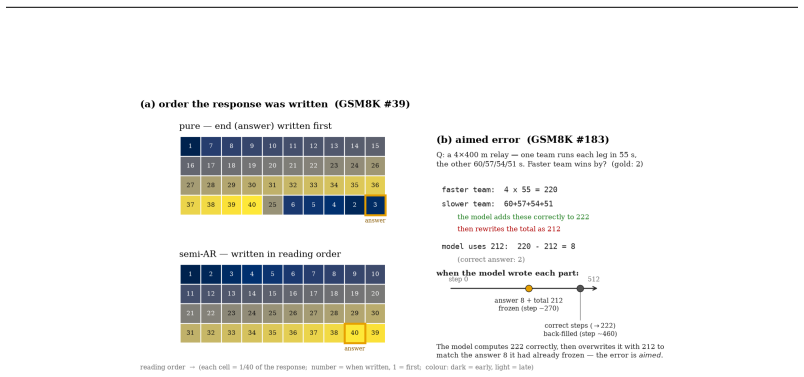
The central claim is that in masked diffusion language models, the sampler's freedom to commit any token at any step—not the model's learned termination beliefs—determines whether chain-of-thought reasoning functions. Pure decoding of LLaDA-8B-Instruct on GSM8K commits the answer at a median normalized step of 0.147–0.240 while the median reasoning token is committed near 0.505, and it produces answer-only outputs on 36.6% of problems at L=256 and 90.2% at L=512. EOS pressure, the fraction of masked positions whose top-1 prediction is EOS, is nearly identical across pure and semi-autoregressive decoders (0.782 vs 0.766), while EOS commitment differs by more than 2×, showing the model wants to terminate equally but only the unconstrained sampler can act on that want at distant positions. The paper establishes causality by manipulating commitment order alone: frontier-gated commitment, which restricts eligibility to a window ahead of the left-most masked position, lifts pure decoding from 0.528 to 0.824–0.852 without training or logit modification. The general lesson is that any-order generation is not a neutral flexibility but a commitment policy that can make the conclusion precede and then bend the derivation.
Load-bearing premise
The dissociation between EOS pressure and commitment assumes that the fraction of masked positions whose top-1 prediction is EOS is a decoder-invariant measure of termination belief, even though pure and semi-AR decoders have different masked-position sets and already-committed contexts at the same step.
Editorial extensions
If this is right
- Existing block and window samplers, previously motivated by efficiency, work because they restrict reachability; the paper shows a sliding window of 32 matches a block of 32 within 1.2 points, so the active ingredient is reachability, not block structure.
- Retraining dLLMs to remove EOS bias addresses a symptom; a decoding-time gate recovers the full order channel on GSM8K and Dream-7B, so the documented EOS-overflow remedies are not necessary for this failure.
- The optimal commitment window flips with the refinement budget: w=1 is best at full refinement and any-order freedom buys nothing, while at 8 tokens per step gating is purely harmful, implying diffusion decoding needs enough steps to exploit order.
- Operationally, a gated decoder at 4 tokens per step retains near-autoregressive accuracy at a measured 4× wall-clock speedup, giving a concrete operating point for fast ordered decoding.
- Answer-first commitment is universal under pure decoding, and 57–66% of erroneous equations are load-bearing (the erroneous value is precisely what the committed answer requires), so unfaithful reasoning is not an accident but a structural consequence of the commitment order.
Reading between the lines
- We infer that the commitment-log instrumentation used here could serve as a general diagnostic for reasoning faithfulness in diffusion models: because the log records causal order directly, it makes post-hoc rationalization observable in a way that autoregressive models can only probe indirectly; applying it to code generation or open-ended dialogue, where the paper says the order channel is untes
- We note the paper's belief-exoneration rests on the assumption that EOS pressure computed over masked positions is a fair cross-decoder measure; if masked-position sets themselves bias top-1 predictions, the dissociation would be weaker, though the gating experiment still demonstrates reachability is sufficient.
- The failure of the paper's adaptive window schedules at low NFE is explained by commit density rather than window availability, which suggests that future fixes might attack the per-step commit budget itself (e.g., by scheduling fewer commitments per step) rather than spatial eligibility.
- The measured crossover at 4–8 tokens per step may generalize to other any-order decoders such as non-autoregressive Transformers, where similar early-commitment pathologies could degrade multi-step reasoning; this is an extrapolation, not a paper claim.
Editorial analysis
A structured set of objections, weighed in public.
Referee Report
Summary. The paper studies masked diffusion language models and argues that their advertised any-order commitment freedom is the cause of poor reasoning performance. Using an instrumented decoding loop on LLaDA-8B-Instruct and Dream-7B, the authors document two failure modes under unconstrained (pure) decoding: answer-only collapse, where the model emits a bare answer followed by EOS padding on up to 90% of GSM8K problems at L=512, and answer-first commitment, where the final answer is committed early and the derivation is backfilled around it. A preregistered-style 2x2 prompt-by-decoder design on 250 paired problems shows that chain-of-thought helps only under ordered commitment (interaction +34.8 pp, 95% CI [26.8, 42.8]), with no decoder difference in the answer-only condition; the pattern replicates on Dream-7B and MATH-500. A one-knob intervention, frontier-gated commitment, restricts which masked positions are eligible and recovers most of the accuracy gap without training, while a compute sweep shows the optimal window flips from w=1 at full refinement to unconstrained at low NFE. The paper concludes that the cause is reachability, not the model's termination beliefs, and reframes windowing methods as fixes for a reasoning pathology.
Significance. If the central claim holds, this is an important and useful reframing of diffusion LLM decoding: it identifies commitment order as the causal axis for chain-of-thought effectiveness, provides a cheap decoding-time intervention, and connects several previously separate observations about EOS bias, windowed decoding, and backfilled rationalization. The paper has notable strengths: the sampler is verified token-identical to the reference implementation, the 2x2 design and the gating sweep are specified before measuring the target results, two failed predictions are reported, robustness checks include stochastic sampling and prompt paraphrase, and the headline interaction is replicated on a second model and a second dataset with a direct-column near-tie. The main weakness is the belief-versus-reachability dissociation in Section 3.3, which is used to support the abstract's causal claim but rests on a context-dependent comparison. The gating result itself is well supported, but the paper's stronger explanatory claim needs either a cleaner belief measurement or a more modest statement.
major comments (2)
- [§3.3] The load-bearing dissociation between termination beliefs and reachability is not established by the reported EOS-pressure comparison. EOS pressure is defined at step t as the fraction of still-masked positions whose top-1 prediction is EOS, but at the same step the pure and semi-AR decoders are conditioning on different committed contexts and different masked-position sets, so near-equal pressure values (0.782 vs 0.766 at L=512) do not imply near-equal termination beliefs. The text also does not state at which step or over which problem subset these values are computed, and pressure varies over the trajectory. The gating experiment in §6.1 shows that restricting reachability is sufficient to recover accuracy, but because the gate changes the context on which later predictions are conditioned, it does not by itself show that termination beliefs are irrelevant. As written, the abstract's claim that 'the cause is not the model's termination beliefs' overreaches the evidence. Please either provide a matched-context measurement of termination beliefs (for example, by measuring EOS predictions under identical contexts for both policies) or revise the claim to say that reachability is the manipulated variable and the belief question remains open.
- [§5.2] The two-channel decomposition is not cleanly identified. The collapse-channel estimate of +13.6 pp is obtained by shrinking the canvas from L=512 to L=256 and attributing the interaction difference to the reduction in collapse rate, with the assertion that this changes 'little else.' But halving L also halves the number of denoising steps, changes the EOS-pressure profile, and shifts the commitment-order statistics (t* changes from 0.240 to 0.147 in Section 4.1). The residual order channel is separately supported by the non-collapsed comparison (0.478 vs 0.794, n=316, p≈3e-20), so the central interaction stands, but the decomposition as stated is a length-dependent effect rather than a pure collapse-channel estimate. Please re-label this quantity or provide a manipulation that changes collapse without changing canvas length, steps, and pressure.
minor comments (5)
- [§3.3] The paper should report the step index, the aggregation window, and the dispersion or confidence intervals for the EOS-pressure values; the single pair 0.782 vs 0.766 is currently presented without enough detail to assess the near-identity claim.
- [Appendix B] The checkpoints are not pinned to revisions and were loaded from default branches; providing commit hashes, or an explanation of why they are unavailable, would strengthen reproducibility.
- [§6.2] The claim that wall-clock time is linear in NFE with R²=1.00 is based on four measured NFE points; please state the number of repetitions and the standard errors around the timing measurements.
- [Appendix C] The heading 'Dream-7B-7B' appears to contain a duplicated model name and should be corrected.
- [§5.1] The statement that predictions were 'fixed before the runs' would be more verifiable with a dated preregistration or an immutable log; as written it is an assertion about procedure.
Circularity Check
No material circularity: the central claims rest on logged measurements and a manipulated decoding gate, not on fitted inputs or self-citation chains.
full rationale
The paper's derivation chain is self-contained at the level of its load-bearing claims. Commitment timing, collapse rates, EOS pressure, and EOS commitment are all logged directly from the instrumented decoding loop; the 2x2 prompt-decoder interaction was fixed in advance, and its sharpest cell is an independent null result (the direct-column near-tie). The frontier-gating intervention is a single knob swept before measuring recovery, and the paper explicitly reports two failed advance predictions, which acts as a check against post-hoc fitting. The EOS-pressure dissociation is contestable as evidence about beliefs, since pressure is computed over different masked-position sets and conditioning contexts in the two decoders, but that is a measurement-validity concern rather than circularity: the paper does not define the conclusion into the measurement. The only self-citation (Jin et al. 2025) appears in the Outlook as a suggested future extension and is not load-bearing. No fitted parameter is renamed as a prediction, no uniqueness theorem is imported from the authors' prior work, and no equation reduces the output to the input by construction.
Assumptions & free parameters
assumptions (3)
- domain assumption The regex-based answer span detection maps answers to token positions accurately enough for commitment-time statistics.
- domain assumption EOS pressure over masked positions is a valid decoder-invariant proxy for termination beliefs.
- domain assumption The first 250 problems of GSM8K and MATH-500 are representative enough for paired comparisons.
Cite this review
Pith. "Pith review of Answer First, Reason Later: Commitment Order in Diffusion LLMs." pith.science (2026). https://pith.science/paper/JQGBHAFH
@misc{pith2026260805687,
  author       = {Pith},
  title        = {Pith review of: Answer First, Reason Later: Commitment Order in Diffusion LLMs},
  year         = {2026},
  howpublished = {\url{https://pith.science/paper/JQGBHAFH}},
  note         = {Machine review of arXiv:2608.05687}
}
read the original abstract
Masked diffusion language models (dLLMs) can commit tokens in any order -- a freedom marketed as their core advantage over autoregressive decoding. We show that on reasoning tasks this freedom is instead the axis of failure. Logging every commitment during decoding of LLaDA-8B on GSM8K, we find that unconstrained (pure) decoding commits the final answer at 15-24% of the trajectory while half the reasoning region is still masked, and collapses to answer-only outputs on up to 90% of problems as the canvas grows. The cause is not the model's termination beliefs -- EOS "pressure" is nearly identical across decoders -- but reachability: whether the sampler may act on those beliefs at distant positions. A 2x2 prompt-decoder design shows that chain-of-thought helps only under ordered commitment (interaction +34.8 percentage points, 95% CI [26.8, 42.8]; without reasoning text the decoders are indistinguishable), an interaction we decompose into a collapse channel and an order channel and replicate on Dream-7B and MATH-500. A single-knob intervention -- frontier-gated commitment -- causally recovers the full gap (0.528 to 0.852) while preserving up to 4x parallel decoding, along a measured frontier whose optimal window flips from w=1 at full refinement to unconstrained at 8 tokens/step. Our results reframe existing window-style samplers, previously motivated by efficiency, as the minimal fix for a reasoning pathology they were never designed to address.
Figures


Figures from the paper (2 more)


Reference graph
Works this paper leans on
-
[3]
Training verifiers to solve math word problems.arXiv preprint arXiv:2110.14168,
Karl Cobbe et al. Training verifiers to solve math word problems.arXiv preprint arXiv:2110.14168,
-
[4]
Enyi Jiang, Changming Xu, Nischay Singh, Tian Qiu, and Gagandeep Singh. Robust answers, frag- ile logic: Probing the decoupling hypothesis in LLM reasoning.arXiv preprint arXiv:2505.17406,
-
[6]
Bumjun Kim, Dongjae Jeon, Dueun Kim, Wonje Jeung, and Albert No
arXiv:2503.10167. Bumjun Kim, Dongjae Jeon, Dueun Kim, Wonje Jeung, and Albert No. Rainbow padding: Miti- gating early termination in instruction-tuned diffusion LLMs.arXiv preprint arXiv:2510.03680,
-
[7]
Measuring faithfulness in chain-of-thought reasoning.arXiv preprint arXiv:2307.13702,
Tamera Lanham et al. Measuring faithfulness in chain-of-thought reasoning.arXiv preprint arXiv:2307.13702,
- [9]
-
[10]
Zanlin Ni, Shenzhi Wang, Yang Yue, Tianyu Yu, Weilin Zhao, Yeguo Hua, Tianyi Chen, Jun Song, Cheng Yu, Bo Zheng, and Gao Huang. The flexibility trap: Rethinking the value of arbitrary order in diffusion language models.arXiv preprint arXiv:2601.15165,
-
[11]
Large language diffusion models.arXiv preprint arXiv:2502.09992,
Shen Nie, Fengqi Zhu, Zebin You, Xiaolu Zhang, Jingyang Ou, Jun Hu, Jun Zhou, Yankai Lin, Ji-Rong Wen, and Chongxuan Li. Large language diffusion models.arXiv preprint arXiv:2502.09992,
-
[12]
Drop the Act: Probe-Filtered RL for Faithful Chain-of-Thought Reasoning
Swapnil Parekh. Drop the act: Probe-filtered RL for faithful chain-of-thought reasoning.arXiv preprint arXiv:2605.11467,
Show all 20 references
-
[13]
Deferred commitment decoding for diffusion language models with confidence-aware sliding windows.arXiv preprint arXiv:2601.02076,
Yingte Shu, Yuchuan Tian, Chao Xu, Yunhe Wang, and Hanting Chen. Deferred commitment decoding for diffusion language models with confidence-aware sliding windows.arXiv preprint arXiv:2601.02076,
-
[14]
DLM-Scope: Mechanistic interpretability of diffusion language models via sparse autoencoders.arXiv preprint arXiv:2602.05859, 2026a
Xu Wang, Bingqing Jiang, Yu Wan, Baosong Yang, Lingpeng Kong, and Difan Zou. DLM-Scope: Mechanistic interpretability of diffusion language models via sparse autoencoders.arXiv preprint arXiv:2602.05859, 2026a. Yuxiang Wang, Yu Xiang, Baojian Zhou, Qifang Zhao, Keyue Jiang, Yan...
-
[16]
MMaDA: Multimodal large diffusion language models.arXiv preprint arXiv:2505.15809, 2025a
Ling Yang et al. MMaDA: Multimodal large diffusion language models.arXiv preprint arXiv:2505.15809, 2025a. Yicun Yang, Cong Wang, Shaobo Wang, Zichen Wen, Biqing Qi, Hanlin Xu, and Linfeng Zhang. Diffusion LLM with native variable generation lengths: Let [EOS] lead the way.arX...
-
[17]
Dream 7B: Diffusion large language models.arXiv preprint arXiv:2508.15487,
Jiacheng Ye, Zhihui Xie, Lin Zheng, Jiahui Gao, Zirui Wu, Xin Jiang, Zhenguo Li, and Lingpeng Kong. Dream 7B: Diffusion large language models.arXiv preprint arXiv:2508.15487,
-
[18]
Thinking out of order: When output order stops reflecting reasoning order in diffusion language models.arXiv preprint arXiv:2601.22035, 2026a
Longxuan Yu, Yu Fu, Shaorong Zhang, Hui Liu, Mukund Varma T, Greg Ver Steeg, and Yue Dong. Thinking out of order: When output order stops reflecting reasoning order in diffusion language models.arXiv preprint arXiv:2601.22035, 2026a. Longxuan Yu, Shaorong Zhang, Yu Fu, Hui Liu...
-
[19]
The answer is X
A ROBUSTNESS R1: stochastic sampling.Main tables use the official sampler atT=0. Repeating the three- decoder comparison atT=0.7with three seeds preserves every sign: pure collapse exceeds 50% and ordered decoders stay below 20% in every seed; paired decoder gaps remain positi...
2026
-
[20]
under identical seeds, re-verified after the multi-model refactor together with a 20/20 match against stored outputs from a previously completed cell—so the logging hooks and the family flag leave the LLaDA-8B sampling path unchanged.Commit-schedule accounting: gated low-NFE c...
2026
-
[2021]
Prism: Efficient test-time scaling via hierarchical search and self-verification for discrete diffusion language models.arXiv preprint arXiv:2602.01842,
Jinbin Bai, Yixuan Li, Yuchen Zhu, Yi Xin, Qingyu Shi, Aosong Feng, Xiaohong Liu, Molei Tao, Jianru Xue, Xiangtai Li, and Ming-Hsuan Yang. Prism: Efficient test-time scaling via hierarchical search and self-verification for discrete diffusion language models.arXiv preprint arX...
-
[2022]
11 Jingyi Yang, Yuxian Jiang, and Jing Shao.ρ-EOS: Training-free bidirectional variable-length control for masked diffusion LLMs.arXiv preprint arXiv:2601.22527,
-
[2024]
Chunyu Liu, Zhengyang Fan, Kaisen Yang, and Alex Lamb
MATH-500 subset origin. Chunyu Liu, Zhengyang Fan, Kaisen Yang, and Alex Lamb. V oidPadding: Let [VOID] handle padding in masked diffusion language models so that [EOS] can focus on semantic termination. arXiv preprint arXiv:2606.17999,
-
[2025]
well, keep thinking
Hyunbin Jin, Je Won Yeom, Seunghyun Bae, and Taesup Kim. “well, keep thinking”: Enhancing llm reasoning with adaptive injection decoding. InFindings of the Association for Computational Linguistics: ACL 2025,
2025
-
[2026]
Reasoning theater: Disentangling model beliefs from chain-of-thought
Siddharth Boppana, Andrew Ma, Max Loeffler, Raphael Sarfati, Eric Bigelow, Atticus Geiger, Owen Lewis, and Jack Merullo. Reasoning theater: Disentangling model beliefs from chain-of-thought. arXiv preprint arXiv:2603.05488,
Reviewed August 8, 2026 · model on record in the stance chip above.
Discussion (0). Continue with ORCID to comment.