REVIEW 2 major objections 2 minor 41 references
Spherical voxel indexing derives a conservative bound that safely prunes redundant distance checks in farthest point sampling without altering the output.
Reviewed by Pith at T0; open to challenge. T0 means a machine referee read the full paper against a public rubric. the ladder, T0–T4 →
T0 review · grok-4.3
2026-06-28 00:59 UTC pith:JQVKNPU7
load-bearing objection RadiusFPS claims exact FPS equivalence via spherical voxel pruning and a fused GPU kernel, delivering reported 2.5x speedups and lower memory on standard benchmarks, but the bound's conservativeness needs explicit checking. the 2 major comments →
RadiusFPS: Efficient Farthest Point Sampling on CPUs and GPUs via Spherical Voxel Pruning
The pith
A machine-rendered reading of the paper's core claim, the machinery that carries it, and where it could break.
Core claim
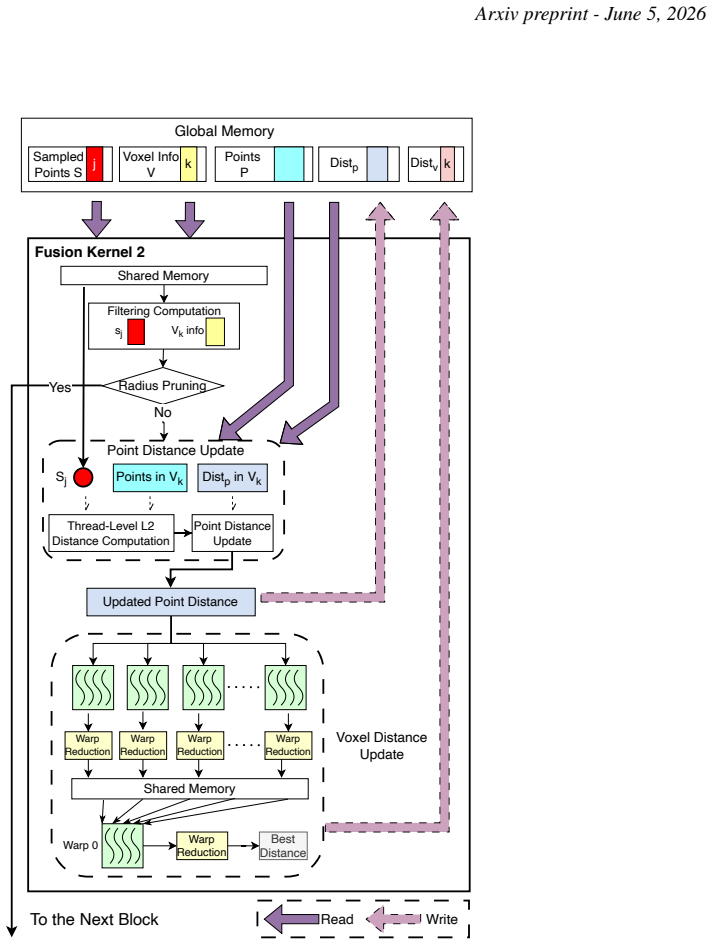
RadiusFPS indexes the point cloud with spherical voxels to obtain a conservative geometric bound that prunes redundant distance computations in each FPS iteration while preserving the exact update rule, initialization, and tie-breaking policy of standard FPS; a coordinate-wise point-skip test eliminates residual updates; the GPU variant fuses these steps into memory-coalesced kernels.
What carries the argument
Spherical voxel pruning: indexing the point cloud with spherical voxels to derive a conservative geometric bound that safely eliminates distance computations guaranteed not to contain the next farthest point.
Load-bearing premise
The spherical voxel bound is guaranteed to be conservative, so that no point that would have been chosen by the standard FPS rule is ever pruned.
What would settle it
Run both classical FPS and RadiusFPS on the same point cloud with identical initialization and tie-breaking; if any sampled point differs, the pruning bound is not conservative.
If this is right
- RadiusFPS-G reaches up to 2.5 times the speed of GPU-based FPS on the evaluated indoor and outdoor datasets.
- It matches or exceeds QuickFPS performance while using roughly half the GPU memory.
- Segmentation accuracy remains comparable to standard FPS on S3DIS, ScanNet, and SemanticKITTI.
- Pairing RadiusFPS-G with a learning-based sampler yields the fastest end-to-end inference among tested configurations.
Where Pith is reading between the lines
- The same voxel-bound technique could be applied to other iterative farthest-point or diversity-sampling loops that rely on repeated distance queries.
- Because the method preserves exact FPS output, it can serve as a drop-in replacement inside any pipeline that assumes the classical sampling distribution.
- The coordinate-wise skip test may generalize to other coordinate-aligned data structures beyond spherical voxels.
Editorial analysis
A structured set of objections, weighed in public.
Referee Report
Summary. The paper proposes RadiusFPS, a framework for accelerating classical Farthest Point Sampling (FPS) on point clouds via spherical voxel pruning that is claimed to preserve the exact FPS update rule and tie-breaking policy. It introduces CPU and GPU (RadiusFPS-G) implementations with fused kernels, reporting up to 2.5x speedup over GPU FPS, roughly half the memory of QuickFPS, and comparable segmentation accuracy on S3DIS, ScanNet, and SemanticKITTI when used in downstream pipelines, including with learning-based samplers.
Significance. If the claimed exact equivalence holds, the work would provide a practical, low-memory acceleration for a core operator in robotic perception pipelines handling high-rate LiDAR data. The explicit comparisons to QuickFPS on public benchmarks, memory measurements, and end-to-end timing with FastPoint are concrete strengths that would make the result useful for latency-constrained systems.
major comments (2)
- [Abstract] Abstract (pruning derivation paragraph): the central claim that spherical voxel indexing produces a conservative geometric bound safely pruning distance computations without discarding the true farthest point (under standard FPS update and tie-breaking) rests on an unshown geometric derivation. No explicit proof, exhaustive check, or handling of floating-point/degenerate cases is provided, making equivalence to classical FPS unverifiable and rendering the reported accuracy parity non-guaranteed.
- [§4] §4 (evaluation on S3DIS/ScanNet/SemanticKITTI): the speedup, memory, and accuracy claims are presented without error bars, multiple random seeds, or statistical tests. Given that any deviation in selected points from the unverified pruning stages would affect downstream segmentation, the absence of variability analysis undermines the reliability of the 'matches or exceeds QuickFPS' and 'comparable accuracy' statements.
minor comments (2)
- [§3] The interaction between the spherical voxel pruning stage and the coordinate-wise point-skip test is described at a high level; a small example or pseudocode showing their combined effect on a single iteration would improve clarity without altering the central claim.
- Table captions and axis labels in the runtime/memory plots should explicitly state the number of points sampled (e.g., 1024 or 4096) and whether timings include voxel construction overhead.
Simulated Author's Rebuttal
We thank the referee for the constructive feedback. We address each major comment below and will revise the manuscript to incorporate the suggested improvements.
read point-by-point responses
-
Referee: [Abstract] Abstract (pruning derivation paragraph): the central claim that spherical voxel indexing produces a conservative geometric bound safely pruning distance computations without discarding the true farthest point (under standard FPS update and tie-breaking) rests on an unshown geometric derivation. No explicit proof, exhaustive check, or handling of floating-point/degenerate cases is provided, making equivalence to classical FPS unverifiable and rendering the reported accuracy parity non-guaranteed.
Authors: We agree that an explicit formal proof is needed for verifiability. Section 3 derives the conservative spherical voxel bound, but the revised manuscript will expand this with a complete geometric proof, including analysis of floating-point precision and degenerate cases (e.g., points on voxel boundaries or ties), to rigorously establish preservation of the exact FPS update rule and tie-breaking policy. revision: yes
-
Referee: [§4] §4 (evaluation on S3DIS/ScanNet/SemanticKITTI): the speedup, memory, and accuracy claims are presented without error bars, multiple random seeds, or statistical tests. Given that any deviation in selected points from the unverified pruning stages would affect downstream segmentation, the absence of variability analysis undermines the reliability of the 'matches or exceeds QuickFPS' and 'comparable accuracy' statements.
Authors: We acknowledge the lack of error bars, multi-seed analysis, and statistical tests in the current evaluation. The revised manuscript will report accuracy metrics averaged over multiple random seeds (minimum 5) with standard deviations for all datasets and include statistical tests to support the comparable accuracy claims. revision: yes
Circularity Check
No circularity: algorithmic performance claims rest on external benchmarks and geometric pruning argument
full rationale
The paper describes a pruning-based acceleration of classical FPS that claims to preserve the original update rule via conservative spherical-voxel bounds and coordinate-wise skips. No equations reduce a reported quantity to a fitted parameter or to the method's own output by construction. No self-citations are invoked as load-bearing uniqueness theorems. Speedup, memory, and accuracy figures are measured on public datasets (S3DIS, ScanNet, SemanticKITTI) rather than being derived from internal definitions. The equivalence claim is an algorithmic assertion whose verification status is a correctness question, not a circularity reduction.
Axiom & Free-Parameter Ledger
axioms (2)
- standard math Euclidean distance is the metric used for FPS selection
- domain assumption Spherical voxel partitioning induces a conservative bound on maximum possible distance
read the original abstract
Point clouds are a primary sensory representation for robotic perception, underpinning LiDAR-based autonomous driving, simultaneous localization and mapping (SLAM), and navigation. Within these pipelines, Farthest Point Sampling (FPS) is the most well-known downsampling operator, as its uniform coverage preserves the geometric structure on which downstream perception relies. However, the large time complexity of classical FPS scales poorly with the million-point-per-second rates of modern 3D sensors, making it a dominant latency bottleneck that conflicts with the real-time and limited onboard compute budgets of robotic systems. Therefore, we propose RadiusFPS, an FPS acceleration framework based on spherical voxel pruning that preserves the standard FPS update rule under the same initialization and tie-breaking policy. By indexing the point cloud with spherical voxels, RadiusFPS derives a conservative geometric bound that prunes redundant distance computations in each iteration, complemented by a coordinate-wise point-skip test that removes residual updates. We further introduce RadiusFPS-G, a warp-level GPU implementation that fuses voxel selection, pruning, and distance update into memory-coalesced kernels, eliminating costly global-memory round-trips. On indoor (S3DIS, ScanNet) and outdoor LiDAR (SemanticKITTI) benchmarks, RadiusFPS-G attains up to 2.5x speedup over GPU-based FPS and matches or exceeds QuickFPS among the evaluated methods while using roughly half its GPU memory, with comparable segmentation accuracy. When coupled with the learning-based FastPoint sampler, the resulting pipeline achieves the fastest End-to-End inference among all evaluated configurations. These properties make high-quality FPS-style sampling practical for latency- and memory-constrained robotic vision.
Figures




Reference graph
Works this paper leans on
-
[1]
Comparative evaluation of lidar systems for transport infrastructure: case studies and perfor- mance analysis.European Journal of Remote Sensing, 57(1):2316304, 2024
Rabia Rashdi, Iv ´an Garrido, Jes ´us Balado, Pablo Del R ´ıo-Barral, Juan Luis Rodr´ıguez-Somoza, and Joaqu´ın Mart´ınez-S´anchez. Comparative evaluation of lidar systems for transport infrastructure: case studies and perfor- mance analysis.European Journal of Remote Sensing, 57(1):2316304, 2024
2024
-
[2]
Meta architecture for point cloud analysis
Haojia Lin, Xiawu Zheng, Lijiang Li, Fei Chao, Shanshan Wang, Yan Wang, Yonghong Tian, and Rongrong Ji. Meta architecture for point cloud analysis. InProceedings of the IEEE/CVF Conference on Computer Vision and Pattern Recognition, pages 17682–17691, 2023
2023
-
[3]
Pointvector: A vector representation in point cloud analysis
Xin Deng, WenYu Zhang, Qing Ding, and XinMing Zhang. Pointvector: A vector representation in point cloud analysis. InProceedings of the IEEE/CVF conference on computer vision and pattern recognition, pages 9455– 9465, 2023
2023
-
[4]
Pointnet++: Deep hierarchical feature learning on point sets in a metric space.Advances in neural information processing systems, 30, 2017
Charles Ruizhongtai Qi, Li Yi, Hao Su, and Leonidas J Guibas. Pointnet++: Deep hierarchical feature learning on point sets in a metric space.Advances in neural information processing systems, 30, 2017
2017
-
[5]
Point transformer v3: Simpler, faster, stronger
Xiaoyang Wu, Li Jiang, Peng-Shuai Wang, Zhijian Liu, Xihui Liu, Yu Qiao, Wanli Ouyang, Tong He, and Hengshuang Zhao. Point transformer v3: Simpler, faster, stronger. InCVPR, 2024
2024
-
[6]
Towards large-scale 3d representation learning with multi-dataset point prompt training
Xiaoyang Wu, Zhuotao Tian, Xin Wen, Bohao Peng, Xihui Liu, Kaicheng Yu, and Hengshuang Zhao. Towards large-scale 3d representation learning with multi-dataset point prompt training. InCVPR, 2024
2024
-
[7]
Point transformer v2: Grouped vector attention and partition-based pooling
Xiaoyang Wu, Yixing Lao, Li Jiang, Xihui Liu, and Hengshuang Zhao. Point transformer v2: Grouped vector attention and partition-based pooling. InNeurIPS, 2022
2022
-
[8]
Pointcept: A codebase for point cloud perception research.https://github.com/ Pointcept/Pointcept, 2023
Pointcept Contributors. Pointcept: A codebase for point cloud perception research.https://github.com/ Pointcept/Pointcept, 2023
2023
-
[9]
Randla-net: Efficient semantic segmentation of large-scale point clouds.Proceedings of the IEEE Conference on Computer Vision and Pattern Recognition, 2020
Qingyong Hu, Bo Yang, Linhai Xie, Stefano Rosa, Yulan Guo, Zhihua Wang, Niki Trigoni, and Andrew Markham. Randla-net: Efficient semantic segmentation of large-scale point clouds.Proceedings of the IEEE Conference on Computer Vision and Pattern Recognition, 2020
2020
-
[10]
Pointrcnn: 3d object proposal generation and detection from point cloud
Shaoshuai Shi, Xiaogang Wang, and Hongsheng Li. Pointrcnn: 3d object proposal generation and detection from point cloud. InProceedings of the IEEE/CVF conference on computer vision and pattern recognition, pages 770–779, 2019
2019
-
[11]
Not all points are equal: Learning highly efficient point-based detectors for 3d lidar point clouds
Yifan Zhang, Qingyong Hu, Guoquan Xu, Yanxin Ma, Jianwei Wan, and Yulan Guo. Not all points are equal: Learning highly efficient point-based detectors for 3d lidar point clouds. InProceedings of the IEEE Conference on Computer Vision and Pattern Recognition, 2022
2022
-
[12]
3dssd: Point-based 3d single stage object detector
Zetong Yang, Yanan Sun, Shu Liu, and Jiaya Jia. 3dssd: Point-based 3d single stage object detector. InProceed- ings of the IEEE/CVF conference on computer vision and pattern recognition, pages 11040–11048, 2020
2020
-
[13]
STD: sparse-to-dense 3d object detector for point cloud
Zetong Yang, Yanan Sun, Shu Liu, Xiaoyong Shen, and Jiaya Jia. STD: sparse-to-dense 3d object detector for point cloud. In2019 IEEE/CVF International Conference on Computer Vision, ICCV 2019, Seoul, Korea (South), October 27 - November 2, 2019, 2019
2019
-
[14]
Point- mamba: A simple state space model for point cloud analysis
Dingkang Liang, Xin Zhou, Wei Xu, Xingkui Zhu, Zhikang Zou, Xiaoqing Ye, Xiao Tan, and Xiang Bai. Point- mamba: A simple state space model for point cloud analysis. InAdvances in Neural Information Processing Systems, 2024
2024
-
[15]
Point-bert: Pre-training 3d point cloud transformers with masked point modeling
Xumin Yu, Lulu Tang, Yongming Rao, Tiejun Huang, Jie Zhou, and Jiwen Lu. Point-bert: Pre-training 3d point cloud transformers with masked point modeling. InProceedings of the IEEE Conference on Computer Vision and Pattern Recognition (CVPR), 2022
2022
-
[16]
Masked autoencoders for point cloud self-supervised learning
Yatian Pang, Wenxiao Wang, Francis EH Tay, Wei Liu, Yonghong Tian, and Li Yuan. Masked autoencoders for point cloud self-supervised learning. InComputer Vision–ECCV 2022: 17th European Conference, Tel Aviv, Israel, October 23–27, 2022, Proceedings, Part II, pages 604–621. Springer, 2022. 26 Arxiv preprint - June 5, 2026
2022
-
[17]
3dctn: 3d convolution-transformer network for point cloud classification.IEEE Transactions on Intelligent Transportation Systems, pages 1–12, 2022
Dening Lu, Qian Xie, Kyle Gao, Linlin Xu, and Jonathan Li. 3dctn: 3d convolution-transformer network for point cloud classification.IEEE Transactions on Intelligent Transportation Systems, pages 1–12, 2022
2022
-
[18]
Point-gn: A non-parametric network using gaussian positional en- coding for point cloud classification
Marzieh Mohammadi and Amir Salarpour. Point-gn: A non-parametric network using gaussian positional en- coding for point cloud classification. In2025 IEEE/CVF Winter Conference on Applications of Computer Vision (WACV), pages 3487–3496, 2025
2025
-
[19]
3d semantic parsing of large-scale indoor spaces
Iro Armeni, Ozan Sener, Amir R Zamir, Helen Jiang, Ioannis Brilakis, Martin Fischer, and Silvio Savarese. 3d semantic parsing of large-scale indoor spaces. InProceedings of the IEEE conference on computer vision and pattern recognition, pages 1534–1543, 2016
2016
-
[20]
Chang, Manolis Savva, Maciej Halber, Thomas Funkhouser, and Matthias Nießner
Angela Dai, Angel X. Chang, Manolis Savva, Maciej Halber, Thomas Funkhouser, and Matthias Nießner. Scan- net: Richly-annotated 3d reconstructions of indoor scenes. InProc. Computer Vision and Pattern Recognition (CVPR), IEEE, 2017
2017
-
[21]
An efficient accelerator for point-based and voxel-based point cloud neural networks
Xinhao Yang, Tianyu Fu, Guohao Dai, Shulin Zeng, Kai Zhong, Ke Hong, and Yu Wang. An efficient accelerator for point-based and voxel-based point cloud neural networks. In2023 60th ACM/IEEE Design Automation Conference (DAC), pages 1–6. IEEE, 2023
2023
-
[22]
A point transformer accelerator with fine-grained pipelines and distribution-aware dynamic fps
Yaoxiu Lian, Xinhao Yang, Ke Hong, Yu Wang, Guohao Dai, and Ningyi Xu. A point transformer accelerator with fine-grained pipelines and distribution-aware dynamic fps. In2023 IEEE/ACM International Conference on Computer Aided Design (ICCAD), pages 1–9. IEEE, 2023
2023
-
[23]
Meng Han, Liang Wang, Limin Xiao, Hao Zhang, Chenhao Zhang, Xiangrong Xu, and Jianfeng Zhu. Quickfps: Architecture and algorithm co-design for farthest point sampling in large-scale point clouds.IEEE Transactions on Computer-Aided Design of Integrated Circuits and Systems, 42(11):4011–4024, 2023
2023
-
[24]
Lee, and Hongil Yoon
Donghyun Lee, Dawoon Jeong, Jae W. Lee, and Hongil Yoon. Fastpoint: Accelerating 3d point cloud model inference via sample point distance prediction. InIEEE/CVF International Conference on Computer Vision (ICCV 25), 2025
2025
-
[25]
4d spatio-temporal convnets: Minkowski convolutional neural networks
Christopher Choy, JunYoung Gwak, and Silvio Savarese. 4d spatio-temporal convnets: Minkowski convolutional neural networks. InProceedings of the IEEE/CVF conference on computer vision and pattern recognition, pages 3075–3084, 2019
2019
-
[26]
Frustum pointnets for 3d object detection from rgb-d data
Charles R Qi, Wei Liu, Chenxia Wu, Hao Su, and Leonidas J Guibas. Frustum pointnets for 3d object detection from rgb-d data. InProceedings of the IEEE conference on computer vision and pattern recognition, pages 918–927, 2018
2018
-
[27]
Semantic segmentation for real point cloud scenes via bilateral aug- mentation and adaptive fusion
Shi Qiu, Saeed Anwar, and Nick Barnes. Semantic segmentation for real point cloud scenes via bilateral aug- mentation and adaptive fusion. InProceedings of the IEEE/CVF conference on computer vision and pattern recognition, pages 1757–1767, 2021
2021
-
[28]
A volumetric method for building complex models from range images
Brian Curless and Marc Levoy. A volumetric method for building complex models from range images. In Proceedings of the 23rd annual conference on Computer graphics and interactive techniques, pages 303–312, 1996
1996
-
[29]
Pointacc: Efficient point cloud accelerator
Yujun Lin, Zhekai Zhang, Haotian Tang, Hanrui Wang, and Song Han. Pointacc: Efficient point cloud accelerator. InMICRO-54: 54th Annual IEEE/ACM International Symposium on Microarchitecture, pages 449–461, 2021
2021
-
[30]
A point transformer acceler- ator with distribution-aware heuristic distance calculation.IEEE Transactions on Computer-Aided Design of Integrated Circuits and Systems, 2024
Yaoxiu Lian, Xinhao Yang, Ke Hong, Yu Wang, Ningyi Xu, and Guohao Dai. A point transformer acceler- ator with distribution-aware heuristic distance calculation.IEEE Transactions on Computer-Aided Design of Integrated Circuits and Systems, 2024
2024
-
[31]
Accelerating point cloud sampling by parallel structure deconstruction.IEEE Transactions on Parallel and Distributed Systems, 37(1):60–75, 2026
Hengzhe Chi, Jihe Wang, Jinzhe Zhang, and Danghui Wang. Accelerating point cloud sampling by parallel structure deconstruction.IEEE Transactions on Parallel and Distributed Systems, 37(1):60–75, 2026
2026
-
[32]
3D is here: Point Cloud Library (PCL)
Radu Bogdan Rusu and Steve Cousins. 3D is here: Point Cloud Library (PCL). InIEEE International Conference on Robotics and Automation (ICRA), Shanghai, China, May 9-13 2011
2011
-
[33]
Grid-gcn for fast and scalable point cloud learning
Qiangeng Xu, Xudong Sun, Cho-Ying Wu, Panqu Wang, and Ulrich Neumann. Grid-gcn for fast and scalable point cloud learning. InProceedings of the IEEE/CVF conference on computer vision and pattern recognition, pages 5661–5670, 2020
2020
-
[34]
Kpconv: Flexible and deformable convolution for point clouds
Hugues Thomas, Charles R Qi, Jean-Emmanuel Deschaud, Beatriz Marcotegui, Franc ¸ois Goulette, and Leonidas J Guibas. Kpconv: Flexible and deformable convolution for point clouds. InProceedings of the IEEE/CVF international conference on computer vision, pages 6411–6420, 2019
2019
-
[35]
Pgformer: a point cloud segmentation network for urban scenes combining grouped transformer and kpconv.IEEE Transactions on Geoscience and Remote Sensing, 2025
Jiakang Xia, Yanming Chen, Guoli Li, Yueqian Shen, Xincan Zou, Dong Chen, and Yufu Zang. Pgformer: a point cloud segmentation network for urban scenes combining grouped transformer and kpconv.IEEE Transactions on Geoscience and Remote Sensing, 2025. 27 Arxiv preprint - June 5, 2026
2025
-
[36]
Edgepc: Ef- ficient deep learning analytics for point clouds on edge devices
Ziyu Ying, Sandeepa Bhuyan, Yan Kang, Yingtian Zhang, Mahmut T Kandemir, and Chita R Das. Edgepc: Ef- ficient deep learning analytics for point clouds on edge devices. InProceedings of the 50th Annual International Symposium on Computer Architecture, pages 1–14, 2023
2023
-
[37]
An adjustable farthest point sampling method for approximately-sorted point cloud data
Jingtao Li, Jian Zhou, Yan Xiong, Xing Chen, and Chaitali Chakrabarti. An adjustable farthest point sampling method for approximately-sorted point cloud data. In2022 IEEE workshop on signal processing systems (SiPS), pages 1–6. IEEE, 2022
2022
-
[38]
Van-icp: Gpu-accelerated approximate nearest neighbor search for icp regis- tration via voxel dilation
Weimin Wang and Qiong Chang. Van-icp: Gpu-accelerated approximate nearest neighbor search for icp regis- tration via voxel dilation. InICASSP 2023-2023 IEEE International Conference on Acoustics, Speech and Signal Processing (ICASSP), pages 1–5. IEEE, 2023
2023
-
[39]
Accelerating nearest neighbor search in 3d point cloud regis- tration on gpus.ACM Transactions on Architecture and Code Optimization, 22(1):1–24, 2025
Qiong Chang, Weimin Wang, and Jun Miyazaki. Accelerating nearest neighbor search in 3d point cloud regis- tration on gpus.ACM Transactions on Architecture and Code Optimization, 22(1):1–24, 2025
2025
-
[40]
Behley, M
J. Behley, M. Garbade, A. Milioto, J. Quenzel, S. Behnke, C. Stachniss, and J. Gall. SemanticKITTI: A Dataset for Semantic Scene Understanding of LiDAR Sequences. InProc. of the IEEE/CVF International Conf. on Computer Vision (ICCV), 2019
2019
-
[41]
Guocheng Qian, Yuchen Li, Houwen Peng, Jinjie Mai, Hasan Hammoud, Mohamed Elhoseiny, and Bernard Ghanem. Pointnext: Revisiting pointnet++ with improved training and scaling strategies.arXiv:2206.04670, 2022. 28
discussion (0)
Sign in with ORCID, Apple, or X to comment. Anyone can read and Pith papers without signing in.