Full Configuration Interaction Quantum Monte Carlo for Accurate textit{Ab Initio} Nuclear Structure Calculations
Pith reviewed 2026-06-26 09:57 UTC · model grok-4.3
The pith
A stochastic sampler computes the exact nuclear wave function to obtain ground-state energies and charge radii of light nuclei at sub-percent accuracy.
A machine-rendered reading of the paper's core claim, the machinery that carries it, and where it could break.
Core claim
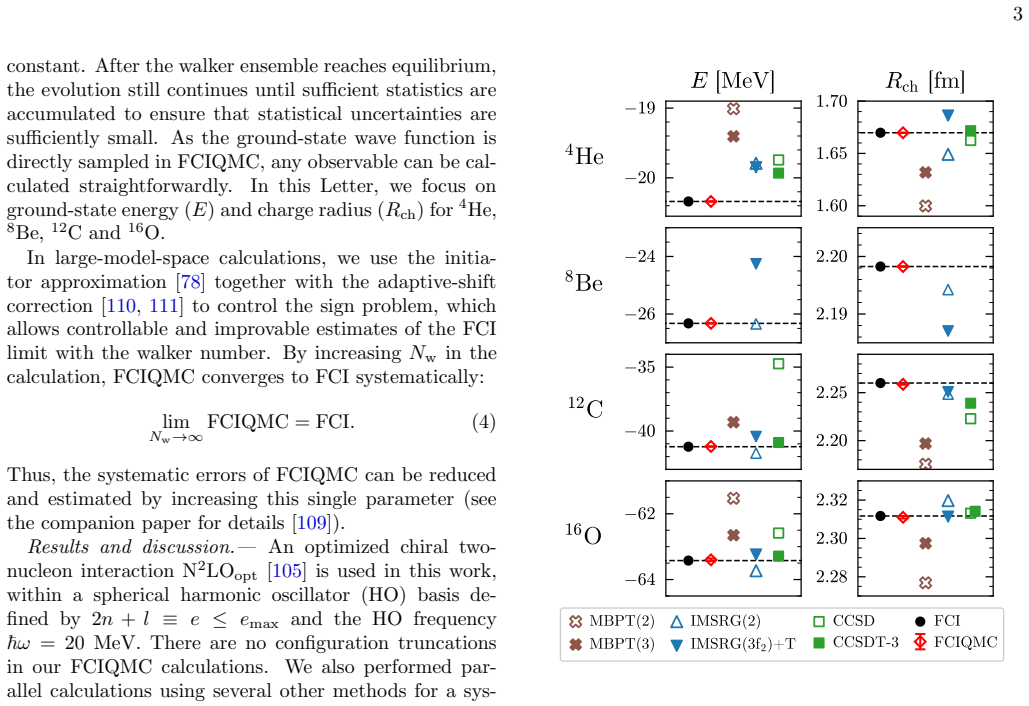
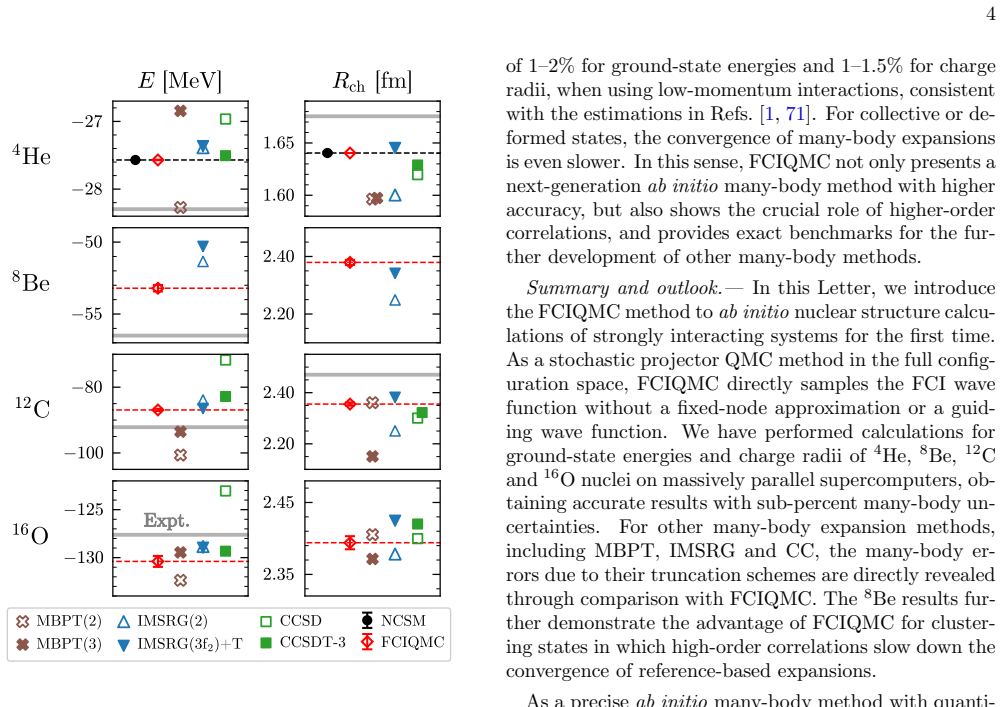
Full configuration interaction quantum Monte Carlo samples the exact wave function in the full configuration space, enabling computation of ground-state energies and charge radii for ^4He, ^8Be, ^12C and ^16O from chiral effective field theory interactions with sub-percent many-body uncertainties and establishing the method as a solver for systems beyond conventional no-core shell model reach.
What carries the argument
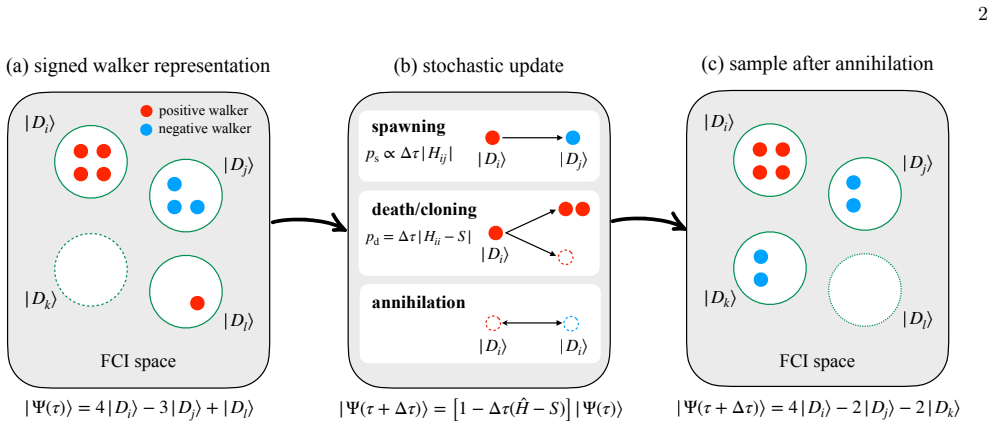
Full configuration interaction quantum Monte Carlo (FCIQMC), a stochastic procedure that directly samples the exact wave function in the full configuration space to capture high-order many-body correlations without basis truncation.
If this is right
- The method can treat nuclei larger than those reachable by the conventional no-core shell model.
- It supplies high-accuracy benchmarks for truncated many-body expansion techniques.
- It handles high-order many-body correlations in strongly interacting nuclear systems at controllable precision.
- Ground-state energies and charge radii are obtained with sub-percent many-body uncertainties for the four nuclei examined.
Where Pith is reading between the lines
- The same sampling technique could be applied to test chiral interactions at higher orders or for additional observables such as electromagnetic transitions.
- If the computational scaling remains favorable, the approach may eventually reach medium-mass nuclei where other exact methods become intractable.
- Results from this method could serve as calibration points for developing improved effective interactions or for validating hybrid quantum-classical algorithms.
Load-bearing premise
The stochastic sampling converges to the exact full-configuration-interaction wave function for the studied nuclei with controllable bias and feasible computational effort.
What would settle it
An independent exact diagonalization of the same Hamiltonian for ^4He that differs from the reported FCIQMC energy by more than the stated uncertainty.
Figures
read the original abstract
We introduce novel full configuration interaction quantum Monte Carlo (FCIQMC) as an accurate many-body solver for $\textit{ab initio}$ nuclear structure calculations. This stochastic approach directly samples the exact wave function in the full configuration space, enabling high-fidelity treatment of high-order many-body correlations in strongly interacting nuclear systems. Using interactions from chiral effective field theory, we have computed ground-state energies and charge radii of $^4$He, $^8$Be, $^{12}$C and $^{16}$O with sub-percent-level many-body uncertainties. These results establish FCIQMC as a stochastic full-configuration-space solver capable of treating systems beyond the reach of the conventional no-core shell model, and as an accurate benchmark for truncated many-body expansion methods.
Editorial analysis
A structured set of objections, weighed in public.
Referee Report
Summary. The manuscript introduces full configuration interaction quantum Monte Carlo (FCIQMC) as a stochastic many-body solver for ab initio nuclear structure. Using chiral EFT interactions, it reports ground-state energies and charge radii for ^4He, ^8Be, ^12C and ^16O with claimed sub-percent many-body uncertainties, asserting that the method samples the exact full-configuration-interaction wave function and provides benchmarks beyond the reach of the no-core shell model.
Significance. If the sub-percent accuracy claims hold with controlled biases, the work would supply valuable exact benchmarks for light nuclei and a new tool for systems where conventional NCSM is limited by basis truncation. The stochastic full-space approach could complement truncated expansions if convergence and error control are demonstrated.
major comments (2)
- [Abstract] Abstract: the central claim of 'exact' sampling of the FCI wave function with 'sub-percent-level many-body uncertainties' for ^16O rests on the assumption that initiator-approximation bias remains below 0.5 %; no initiator threshold, population-size extrapolations, or bias estimates are described, yet the Hilbert-space dimension for ^16O is orders of magnitude larger than for ^4He where the bias is smallest.
- [Abstract] Abstract: the manuscript supplies no convergence tests, error budgets, or direct comparisons with exact diagonalization or other methods that would substantiate the sub-percent uncertainty assertion for any of the reported nuclei.
Simulated Author's Rebuttal
We thank the referee for their careful review and constructive comments. We address each major comment point by point below. We agree that the abstract and current presentation lack sufficient detail on error control and will revise the manuscript accordingly.
read point-by-point responses
-
Referee: [Abstract] Abstract: the central claim of 'exact' sampling of the FCI wave function with 'sub-percent-level many-body uncertainties' for ^16O rests on the assumption that initiator-approximation bias remains below 0.5 %; no initiator threshold, population-size extrapolations, or bias estimates are described, yet the Hilbert-space dimension for ^16O is orders of magnitude larger than for ^4He where the bias is smallest.
Authors: The referee correctly identifies that the manuscript does not describe the initiator threshold, population-size extrapolations, or quantitative bias estimates. While the abstract uses the term 'exact' to indicate that FCIQMC targets the full configuration interaction space (in contrast to truncated methods), the initiator approximation introduces a controllable bias. We will revise the manuscript by adding an explicit subsection on error control, reporting the initiator parameters used, results of population extrapolations, and bias estimates for each nucleus, including ^16O, to substantiate that the bias remains below the stated uncertainty threshold. revision: yes
-
Referee: [Abstract] Abstract: the manuscript supplies no convergence tests, error budgets, or direct comparisons with exact diagonalization or other methods that would substantiate the sub-percent uncertainty assertion for any of the reported nuclei.
Authors: We agree that the manuscript as submitted does not include explicit convergence tests, a full error budget, or direct comparisons in sufficient detail. The reported sub-percent uncertainties are based on internal stochastic error estimates and initiator studies, but these are not presented with the rigor the referee requests. In the revised version we will expand the results and methods sections to include convergence data with respect to population size and initiator threshold, a tabulated error budget, and comparisons to exact diagonalization for ^4He as well as to NCSM results for the larger nuclei. revision: yes
Circularity Check
No significant circularity; derivation is self-contained
full rationale
The paper introduces FCIQMC as a stochastic method that directly samples the exact FCI wave function in the full configuration space and applies it to compute ground-state energies and charge radii for light nuclei using chiral EFT interactions. No equations, derivations, or self-citations are presented that reduce the claimed results or uncertainties to fitted parameters, self-referential definitions, or load-bearing prior results by the same authors. The central claim of controllable sub-percent many-body uncertainties rests on the convergence properties of the stochastic sampler, which is an independent methodological assertion rather than a tautology constructed from the outputs. This is the normal case of an applied computational method whose validity is assessed externally.
Axiom & Free-Parameter Ledger
axioms (1)
- domain assumption Chiral effective field theory interactions provide an accurate description of nuclear forces for the nuclei considered.
Reference graph
Works this paper leans on
-
[1]
Hergert, A Guided Tour ofab initioNuclear Many- Body Theory, Front
H. Hergert, A Guided Tour ofab initioNuclear Many- Body Theory, Front. Phys.8, 379 (2020)
2020
-
[2]
Epelbaum, H.-W
E. Epelbaum, H.-W. Hammer, and U.-G. Meißner, Modern theory of nuclear forces, Rev. Mod. Phys.81, 1773 (2009)
2009
-
[3]
Machleidt and D
R. Machleidt and D. R. Entem, Chiral effective field theory and nuclear forces, Phys. Rep.503, 1 (2011)
2011
-
[4]
Hammer, S
H.-W. Hammer, S. K¨ onig, and U. van Kolck, Nuclear ef- fective field theory: Status and perspectives, Rev. Mod. Phys.92, 025004 (2020)
2020
-
[5]
Tews,et al., Nuclear Forces for Precision Nuclear Physics: A Collection of Perspectives, Few-Body Syst
I. Tews,et al., Nuclear Forces for Precision Nuclear Physics: A Collection of Perspectives, Few-Body Syst. 63, 67 (2022)
2022
-
[6]
Pastore, R
S. Pastore, R. Schiavilla, and J. L. Goity, Electromag- netic two-body currents of one- and two-pion range, Phys. Rev. C78, 064002 (2008)
2008
-
[7]
Gazit, S
D. Gazit, S. Quaglioni, and P. Navr´ atil, Three-Nucleon Low-Energy Constants from the Consistency of Inter- actions and Currents in Chiral Effective Field Theory, Phys. Rev. Lett.103, 102502 (2009)
2009
-
[8]
Pastore, L
S. Pastore, L. Girlanda, R. Schiavilla, M. Viviani, and R. B. Wiringa, Electromagnetic currents and magnetic moments in chiral effective field theory (χEFT), Phys. Rev. C80, 034004 (2009)
2009
-
[9]
Men´ endez, D
J. Men´ endez, D. Gazit, and A. Schwenk, Chiral Two- Body Currents in Nuclei: Gamow-Teller Transitions and Neutrinoless Double-Beta Decay, Phys. Rev. Lett.107, 062501 (2011)
2011
-
[10]
Gysbers,et al., Discrepancy between experimental and theoreticalβ-decay rates resolved from first princi- ples, Nat
P. Gysbers,et al., Discrepancy between experimental and theoreticalβ-decay rates resolved from first princi- ples, Nat. Phys.15, 428 (2019)
2019
-
[11]
G. B. King,et al., Chiral effective field theory calcula- tions of weak transitions in light nuclei, Phys. Rev. C 102, 025501 (2020)
2020
-
[12]
Krebs, Nuclear currents in chiral effective field the- ory, Eur
H. Krebs, Nuclear currents in chiral effective field the- ory, Eur. Phys. J. A56, 234 (2020)
2020
-
[13]
Miyagi,et al., Impact of Two-Body Currents on Mag- netic Dipole Moments of Nuclei, Phys
T. Miyagi,et al., Impact of Two-Body Currents on Mag- netic Dipole Moments of Nuclei, Phys. Rev. Lett.132, 232503 (2024)
2024
-
[14]
Acharya,et al., Magnetic Dipole Transition in 48Ca, Phys
B. Acharya,et al., Magnetic Dipole Transition in 48Ca, Phys. Rev. Lett.132, 232504 (2024)
2024
-
[15]
Binder, J
S. Binder, J. Langhammer, A. Calci, and R. Roth,Ab initiopath to heavy nuclei, Phys. Lett. B736, 119 (2014)
2014
-
[16]
T. D. Morris,et al., Structure of the Lightest Tin Iso- topes, Phys. Rev. Lett.120, 152503 (2018)
2018
-
[17]
Arthuis, C
P. Arthuis, C. Barbieri, M. Vorabbi, and P. Finelli,Ab InitioComputation of Charge Densities for Sn and Xe Isotopes, Phys. Rev. Lett.125, 182501 (2020)
2020
-
[18]
Belley, C
A. Belley, C. G. Payne, S. R. Stroberg, T. Miyagi, and J. D. Holt,Ab InitioNeutrinoless Double-Beta Decay Matrix Elements for 48Ca, 76Ge, and 82Se, Phys. Rev. Lett.126, 042502 (2021)
2021
-
[19]
Hu,et al.,Ab initiopredictions link the neutron skin of 208Pb to nuclear forces, Nat
B. Hu,et al.,Ab initiopredictions link the neutron skin of 208Pb to nuclear forces, Nat. Phys.18, 1196 (2022)
2022
-
[20]
Miyagi, S
T. Miyagi, S. R. Stroberg, P. Navr´ atil, K. Hebeler, and J. D. Holt, Convergedab initiocalculations of heavy nuclei, Phys. Rev. C105, 014302 (2022)
2022
-
[21]
Hebeler,et al., Normal ordering of three-nucleon interactions forab initiocalculations of heavy nuclei, Phys
K. Hebeler,et al., Normal ordering of three-nucleon interactions forab initiocalculations of heavy nuclei, Phys. Rev. C107, 024310 (2023)
2023
-
[22]
Karthein,et al., Electromagnetic properties of indium isotopes illuminate the doubly magic character of 100Sn, Nat
J. Karthein,et al., Electromagnetic properties of indium isotopes illuminate the doubly magic character of 100Sn, Nat. Phys.20, 1719 (2024)
2024
-
[23]
Door,et al., Probing New Bosons and Nuclear Struc- ture with Ytterbium Isotope Shifts, Phys
M. Door,et al., Probing New Bosons and Nuclear Struc- ture with Ytterbium Isotope Shifts, Phys. Rev. Lett. 134, 063002 (2025)
2025
-
[24]
F. Bonaiti, G. Hagen, and T. Papenbrock, Structure of the doubly magic nuclei 208Pb and 266Pb from ab initio computations (2025), arXiv:2508.14217 [nucl-th]
arXiv 2025
-
[25]
Jiang,et al., Toward ab initio quantum simulations of atomic nuclei using noisy qubits, Science Bulletin71, 1598–1601 (2026)
C. Jiang,et al., Toward ab initio quantum simulations of atomic nuclei using noisy qubits, Science Bulletin71, 1598–1601 (2026)
2026
-
[26]
B. R. Barrett, P. Navr´ atil, and J. P. Vary,Ab initiono core shell model, Prog. Part. Nucl. Phys.69, 131 (2013)
2013
-
[27]
Navr´ atil, J
P. Navr´ atil, J. P. Vary, and B. R. Barrett, Properties of 12C in theAb InitioNuclear Shell Model, Phys. Rev. Lett.84, 5728 (2000)
2000
-
[28]
Maris, J
P. Maris, J. P. Vary, and A. M. Shirokov,Ab initiono- core full configuration calculations of light nuclei, Phys. Rev. C79, 014308 (2009)
2009
-
[29]
Maris, M
P. Maris, M. Sosonkina, J. P. Vary, E. Ng, and C. Yang, Scaling ofab initionuclear physics calculations on mul- ticore computer architectures, Procedia Comput. Sci.1, 97 (2010)
2010
-
[30]
K. A. Wendt, C. Forss´ en, T. Papenbrock, and D. S¨ a¨ af, Infrared length scale and extrapolations for the no-core shell model, Phys. Rev. C91, 061301 (2015)
2015
-
[31]
M. A. Caprio, P. J. Fasano, and P. Maris, Robustab initioprediction of nuclear electric quadrupole observ- ables by scaling to the charge radius, Phys. Rev. C105, L061302 (2022)
2022
-
[32]
M. A. Caprio, P. Maris, and P. J. Fasano, Robustab initiopredictions for dimensionless ratios ofE2 and ra- dius observables. I. Electric quadrupole moments and deformation, Phys. Rev. C112, 044318 (2025)
2025
-
[33]
Tichai, J
A. Tichai, J. M¨ uller, K. Vobig, and R. Roth, Natural orbitals forab initiono-core shell model calculations, Phys. Rev. C99, 034321 (2019)
2019
-
[34]
Roth and P
R. Roth and P. Navr´ atil,Ab InitioStudy of 40Ca with an Importance-Truncated No-Core Shell Model, Phys. Rev. Lett.99, 092501 (2007)
2007
-
[35]
M. K. G. Kruse, E. D. Jurgenson, P. Navr´ atil, B. R. Barrett, and W. E. Ormand, Extrapolation uncertain- ties in the importance-truncated no-core shell model, Phys. Rev. C87, 044301 (2013)
2013
-
[36]
Stumpf, J
C. Stumpf, J. Braun, and R. Roth, Importance- truncated large-scale shell model, Phys. Rev. C93, 021301 (2016)
2016
-
[37]
Dytrych, K
T. Dytrych, K. D. Sviratcheva, C. Bahri, J. P. Draayer, and J. P. Vary, Evidence for Symplectic Symmetry in Ab InitioNo-Core Shell Model Results for Light Nuclei, Phys. Rev. Lett.98, 162503 (2007)
2007
-
[38]
K. D. Launey, T. Dytrych, and J. P. Draayer, Symmetry-Guided Large-Scale Shell-Model Theory, Prog. Part. Nucl. Phys.89, 101 (2016)
2016
-
[39]
A. E. McCoy, M. A. Caprio, T. Dytrych, and P. J. Fasano, Emergent Sp(3,R) Dynamical Symmetry in the Nuclear Many-Body System from anAb InitioDescrip- tion, Phys. Rev. Lett.125, 102505 (2020)
2020
-
[40]
K. S. Becker,et al., Unexpected Rise in Nuclear Collec- tivity from Short-Range Physics, Phys. Rev. Lett.136, 022501 (2026). 6
2026
-
[41]
G. A. Negoita,et al., Deep learning: Extrapolation tool forab initionuclear theory, Phys. Rev. C99, 054308 (2019)
2019
-
[42]
Wolfgruber, M
T. Wolfgruber, M. Kn¨ oll, and R. Roth, Precise neural network predictions of energies and radii from the no- core shell model, Phys. Rev. C110, 014327 (2024)
2024
-
[43]
Kn¨ oll,et al., Benchmarking artificial neural network extrapolations of the ground-state energies and radii of Li isotopes, Phys
M. Kn¨ oll,et al., Benchmarking artificial neural network extrapolations of the ground-state energies and radii of Li isotopes, Phys. Rev. C111, 064304 (2025)
2025
-
[44]
Wolfgruber, T
T. Wolfgruber, T. Gesser, M. Kn¨ oll, P. Maris, and R. Roth, High-precisionab initioradius calculations of boron isotopes, Phys. Rev. C112, 014306 (2025)
2025
-
[45]
Roth and J
R. Roth and J. Langhammer, Pad´ e-Resummed High- Order Perturbation Theory for Nuclear Structure Cal- culations, Phys. Lett. B683, 272 (2010)
2010
-
[46]
Langhammer, R
J. Langhammer, R. Roth, and C. Stumpf, Spectra of Open-Shell Nuclei with Pad´ e-Resummed Degenerate Perturbation Theory, Phys. Rev. C86, 054315 (2012)
2012
-
[47]
B. S. Hu, F. R. Xu, Z. H. Sun, J. P. Vary, and T. Li,Ab initioNuclear Many-Body Perturbation Calculations in the Hartree-Fock Basis, Phys. Rev. C94, 014303 (2016)
2016
-
[48]
Tichai, E
A. Tichai, E. Gebrerufael, K. Vobig, and R. Roth, Open- Shell Nuclei from No-Core Shell Model with Perturba- tive Improvement, Phys. Lett. B786, 448 (2018)
2018
-
[49]
Drischler, K
C. Drischler, K. Hebeler, and A. Schwenk, Chiral Inter- actions Up to Next-To-Next-To-Next-To-Leading Order and Nuclear Saturation, Phys. Rev. Lett.122, 042501 (2019)
2019
-
[50]
J. W. Holt and N. Kaiser, Equation of State of Nu- clear and Neutron Matter at Third-Order in Perturba- tion Theory from Chiral Effective Field Theory, Phys. Rev. C95, 034326 (2017)
2017
-
[51]
Tichai, R
A. Tichai, R. Roth, and T. Duguet, Many-Body Pertur- bation Theories for Finite Nuclei, Front. Phys.8, 164 (2020)
2020
-
[52]
Tsukiyama, S
K. Tsukiyama, S. K. Bogner, and A. Schwenk, In- Medium Similarity Renormalization Group For Nuclei, Phys. Rev. Lett.106, 222502 (2011)
2011
-
[53]
Hergert, S
H. Hergert, S. K. Bogner, T. D. Morris, A. Schwenk, and K. Tsukiyama, The In-Medium Similarity Renor- malization Group: A novelab initiomethod for nuclei, Phys. Rep.621, 165 (2016)
2016
-
[54]
S. R. Stroberg,et al., Nucleus-Dependent Valence-Space Approach to Nuclear Structure, Phys. Rev. Lett.118, 032502 (2017)
2017
-
[55]
Yuan,et al., Deformed in-medium similarity renor- malization group, Phys
Q. Yuan,et al., Deformed in-medium similarity renor- malization group, Phys. Rev. C105, L061303 (2022)
2022
-
[56]
B. S. Hu, Q. Wu, Z. H. Sun, and F. R. Xu,Ab ini- tioGamow in-medium similarity renormalization group with resonance and continuum, Phys. Rev. C99, 061302 (2019)
2019
-
[57]
Zhen,et al., Non-perturbative calculations of nu- clear matter using in-medium similarity renormalization group, Phys
X. Zhen,et al., Non-perturbative calculations of nu- clear matter using in-medium similarity renormalization group, Phys. Lett. B862, 139350 (2025)
2025
-
[58]
K¨ ummel, K
H. K¨ ummel, K. H. L¨ uhrmann, and J. G. Zabolitzky, Many-fermion theory in expS- (or coupled cluster) form, Phys. Rep.36, 1 (1978)
1978
-
[59]
R. J. Bartlett and M. Musia l, Coupled-cluster theory in quantum chemistry, Rev. Mod. Phys.79, 291 (2007)
2007
-
[60]
Shavitt and R
I. Shavitt and R. J. Bartlett,Many-body Methods in Chemistry and Physics(Cambridge University Press, Cambridge UK, 2009)
2009
-
[61]
Hagen, T
G. Hagen, T. Papenbrock, M. Hjorth-Jensen, and D. J. Dean, Coupled-cluster computations of atomic nuclei, Rep. Prog. Phys.77, 096302 (2014)
2014
-
[62]
Hagen,et al., Coupled-cluster theory for three-body Hamiltonians, Phys
G. Hagen,et al., Coupled-cluster theory for three-body Hamiltonians, Phys. Rev. C76, 034302 (2007)
2007
-
[63]
G. R. Jansen, J. Engel, G. Hagen, P. Navratil, and A. Signoracci,Ab InitioCoupled-Cluster Effective In- teractions for the Shell Model: Application to Neutron- Rich Oxygen and Carbon Isotopes, Phys. Rev. Lett. 113, 142502 (2014)
2014
-
[64]
Z. H. Sun,et al., Multiscale Physics of Atomic Nuclei from First Principles, Phys. Rev. X15, 011028 (2025)
2025
-
[65]
Marino,et al., From closed shells to open shells: Coupled-cluster calculations of atomic nuclei, Phys
F. Marino,et al., From closed shells to open shells: Coupled-cluster calculations of atomic nuclei, Phys. Rev. C113, 044301 (2026)
2026
-
[66]
W. H. Dickhoff and C. Barbieri, Self-consistent Green’s function method for nuclei and nuclear matter, Prog. Part. Nucl. Phys.52, 377 (2004)
2004
-
[67]
Som` a, Self-Consistent Green’s Function Theory for Atomic Nuclei, Front
V. Som` a, Self-Consistent Green’s Function Theory for Atomic Nuclei, Front. Phys.8, 340 (2020)
2020
-
[68]
Som` a, P
V. Som` a, P. Navr´ atil, F. Raimondi, C. Barbieri, and T. Duguet, Novel chiral Hamiltonian and observables in light and medium-mass nuclei, Phys. Rev. C101, 014318 (2020)
2020
-
[69]
Svensson, A
I. Svensson, A. Tichai, K. Hebeler, and A. Schwenk, Bayesian approach for many-body uncertainties in nu- clear structure: Many-body perturbation theory for fi- nite nuclei, Phys. Rev. C113, 024303 (2026)
2026
-
[70]
Heinz, A
M. Heinz, A. Tichai, J. Hoppe, K. Hebeler, and A. Schwenk, In-medium similarity renormalization group with three-body operators, Phys. Rev. C103, 044318 (2021)
2021
-
[71]
Heinz,et al., Improved structure of calcium isotopes fromab initiocalculations, Phys
M. Heinz,et al., Improved structure of calcium isotopes fromab initiocalculations, Phys. Rev. C111, 034311 (2025)
2025
-
[72]
S. R. Stroberg, T. D. Morris, and B. C. He, In-medium similarity renormalization group with flowing 3-body operators, and approximations thereof, Phys. Rev. C 110, 044316 (2024)
2024
-
[73]
B. C. He and S. R. Stroberg, Factorized approximation to the in-medium similarity renormalization group IM- SRG(3), Phys. Rev. C110, 044317 (2024)
2024
-
[74]
Brolli, C
S. Brolli, C. Barbieri, and E. Vigezzi, Diagrammatic Monte Carlo for Finite Systems at Zero Temperature, Phys. Rev. Lett.134, 182502 (2025)
2025
-
[75]
C. Drischler, K. S. McElvain, and P. Arthuis, Many- body perturbation theory for the nuclear equation of state up to fifth order (2026), arXiv:2603.24532 [nucl- th]
arXiv 2026
-
[76]
X. Zhen, R. Z. Hu, J. C. Pei, and F. R. Xu, Stochastic many-body perturbation theory for high-order calcula- tions, Phys. Rev. C113, L051302 (2026)
2026
-
[77]
G. H. Booth, A. J. W. Thom, and A. Alavi, Fermion Monte Carlo without fixed nodes: A game of life, death, and annihilation in Slater determinant space, J. Chem. Phys.131, 054106 (2009)
2009
-
[78]
Cleland, G
D. Cleland, G. H. Booth, and A. Alavi, Communica- tions: Survival of the fittest: Accelerating convergence in full configuration-interaction quantum Monte Carlo, J. Chem. Phys.132, 041103 (2010)
2010
-
[79]
D. M. Cleland, G. H. Booth, and A. Alavi, A study of electron affinities using the initiator approach to full configuration interaction quantum Monte Carlo, J. Chem. Phys.134, 024112 (2011)
2011
-
[80]
F. R. Petruzielo, A. A. Holmes, H. J. Changlani, M. P. Nightingale, and C. J. Umrigar, Semistochastic Projec- 7 tor Monte Carlo Method, Phys. Rev. Lett.109, 230201 (2012)
2012
discussion (0)
Sign in with ORCID, Apple, or X to comment. Anyone can read and Pith papers without signing in.