REVIEW 2 major objections 5 minor 33 references
Replacing softmax with α-entmax in CLIP’s final attention layers zeros irrelevant token mass and improves dense open-vocabulary prediction, with gains largest when baseline attention is most diffuse.
Reviewed by Pith at T0; open to challenge. T0 means a machine referee read the full paper against a public rubric. the ladder, T0–T4 →
T0 review · grok-4.5
2026-07-14 15:50 UTC pith:JRB2HAAG
load-bearing objection Solid training-free demo that swapping softmax for α-entmax in CLIP’s last layers denoises dense features, with gains scaling cleanly to off-class attention mass. the 2 major comments →
Sparse Attention for Dense Open-Vocabulary Prediction in CLIP
The pith
A machine-rendered reading of the paper's core claim, the machinery that carries it, and where it could break.
Core claim
The gain from attention sparsification is proportional to how much the baseline attention spreads off the target class. Substituting α-entmax for softmax in the final visual self-attention layers of a frozen CLIP encoder zeros low-relevance dependencies and concentrates mass on relevant tokens, lifting dense open-vocabulary segmentation and fine-grained retrieval without any training or architectural change.
What carries the argument
The α-entmax transform: a data-dependent threshold that maps low attention scores exactly to zero while remaining on the probability simplex (recovering softmax as α → 1).
Load-bearing premise
The claim assumes that CLIP’s global contrastive training concentrates its localization bias almost entirely in the final one or two layers, so sparsifying only those layers is sufficient.
What would settle it
Compute, for every foreground patch, the fraction of its attention mass that lands on non-class patches (using ground-truth masks downsampled to the patch grid). If that off-class fraction shows no positive correlation with the mIoU or retrieval gain of entmax over softmax across images or classes, the central proportionality claim is false.
Editorial analysis
A structured set of objections, weighed in public.
Referee Report
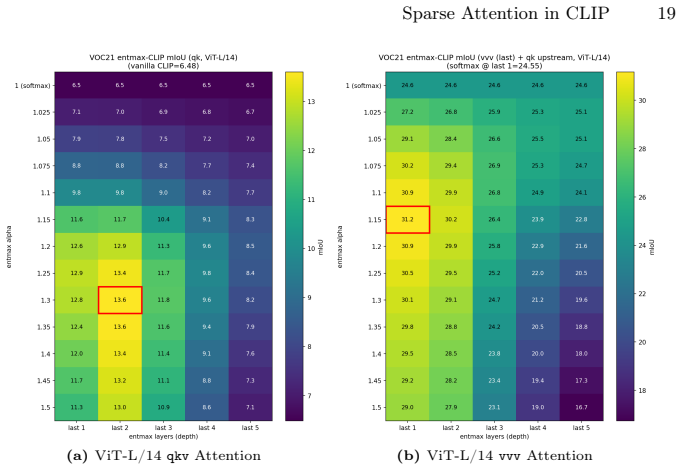
Summary. The paper studies a training-free inference-time substitution of row-wise softmax by α-entmax in the final visual self-attention layer(s) of frozen CLIP (ViT-B/16 and ViT-L/14). Entmax applies a data-dependent threshold that zeros low-relevance scores while remaining on the simplex, acting as an implicit denoiser. The central empirical claim is that the resulting gains on dense open-vocabulary tasks (semantic segmentation on Pascal VOC/Context/ADE20K and fine-grained region-text retrieval on FG-OVD) are proportional to how diffusely the baseline (softmax) attention mass spreads onto non-class tokens. The substitution is evaluated across native qkv and self-correlation score sources (qqv, kkv, vvv, ensembles), with supporting ablations on depth/α, resolution, residual/FFN pathways, random-mask and temperature controls, and qualitative attention/similarity maps.
Significance. If the proportionality claim holds, the work isolates attention density as a previously under-examined factor in CLIP's known localization bias and supplies a zero-parameter, architecture-preserving intervention that consistently improves self-correlated attention distributions for dense prediction. The multi-dataset, multi-backbone, multi-resolution design, together with the matched-support random-mask and temperature controls and the same-class mass redistribution diagnostics, makes the result immediately usable by practitioners and a clean reference point for future sparse-attention studies in vision-language models. The explicit demonstration that already-concentrated distributions (e.g., vvv on ViT-B/16) receive null or negative gains is a falsifiable strength rather than a caveat.
major comments (2)
- The proportionality claim (abstract, §1, Fig. 1) is the paper's main contribution, yet the quantitative support is limited to a single scatter of off-class mass versus ΔmIoU on Pascal VOC for one backbone/distribution pair. Tables 1–2 and 5–7 show consistent directional gains, but a systematic quantification of the same off-class mass statistic across all reported distributions, backbones and datasets would make the claim fully load-bearing rather than illustrative.
- §3.2 and Fig. 5 justify sparsifying only the final 1–2 layers by appealing to prior literature on global-objective bias. While the shallow-depth sweeps are consistent with this design choice, the paper never measures how much of the off-class mass actually originates in earlier layers; a brief diagnostic (e.g., cumulative off-class mass by layer) would confirm that the intervention is applied where the noise is concentrated.
minor comments (5)
- Several typographical errors remain: "yeilds" (§5.1), "higer" (conclusion), "finallayer" (Table 4 caption), "finallayer Transformer block" (Table 4), and inconsistent spacing around α-entmax.
- Figure 1 caption and the surrounding text in §1 refer to "the fraction of a foreground patch's attention that lands on non-class (irrelevant) patches" measured against downsampled VOC GT; the precise downsampling procedure (nearest-neighbour vs. majority vote) should be stated once for reproducibility.
- Table 3 reports FG-OVD mHME for the random-mask control but does not list the exact support size or sampling procedure used to match entmax; a one-sentence clarification would strengthen the control.
- The background-threshold sweep for VOC is mentioned (§4.1) but the selected thresholds are never reported; adding them to the appendix would aid exact reproduction.
- References [5] and [13] are cited for MaskCLIP and CLIP-Surgery, yet the precise implementation details of the "v-only" reference (Tables 5–7) are left implicit; a short note confirming that the residual and FFN are retained would remove ambiguity.
Circularity Check
No significant circularity: purely empirical substitution study whose central proportionality claim is measured against external ground-truth masks, not derived from its own inputs.
full rationale
The paper performs a training-free inference-time swap of row-wise softmax for α-entmax (a known transform from Blondel/Martins et al.) in the final visual self-attention layers of frozen CLIP, then evaluates the resulting dense features on external open-vocabulary benchmarks (Pascal VOC/Context, ADE20K mIoU; FG-OVD mHME). The load-bearing claim—that sparsification gain scales with how much baseline attention mass lands off the target class—is an empirical observation obtained by measuring off-class mass against downsampled ground-truth segmentation masks (Fig. 1) and same-class mass redistribution (Fig. 2b), then correlating those quantities with ΔmIoU/ΔmHME across distributions, backbones, resolutions and tasks (Tables 1–7). α is treated as a free hyper-parameter (default 1.2) whose effect is swept, not fitted to produce a “prediction.” Prior self-citations (e.g., β-CLIP) and literature on self-correlation attention are used only for baselines and motivation; none of them force the proportionality result by construction. There is therefore no self-definitional loop, no fitted quantity renamed as prediction, and no load-bearing uniqueness theorem imported from the authors. The derivation chain is simply “apply known sparse normalizer → measure external metrics → report observed correlation,” which is self-contained against external data.
Axiom & Free-Parameter Ledger
free parameters (2)
- α (entmax sparsity) =
1.2 (primary)
- number of final layers sparsified =
1–2
axioms (3)
- standard math α-entmax recovers softmax as α→1 and maps scores below a data-dependent threshold τ exactly to zero while remaining on the simplex.
- domain assumption CLIP’s global image-text contrastive objective concentrates localization degradation in the final self-attention layers.
- domain assumption Self-correlation score matrices (QQ, KK, VV) already provide better localization than native QK for dense CLIP tasks.
read the original abstract
Contrastive Language-Image Pre-training (CLIP) relies on softmax-based self-attention, a strictly positive distribution that assigns probability mass to every pair of tokens-even semantically irrelevant ones. While these dense softmax weights are effective for gathering broad context during pre-training, they spread attention across many low-salience tokens, producing noise that obscures the fine-grained, spatially localized cues required for dense, open-vocabulary prediction. We study an inference-time substitution of the row-wise softmax in the final visual self-attention layers with the $\alpha$-entmax transform, applied across both the standard query-key attention and self-correlation variants. Because entmax applies a data-dependent threshold that maps low scores exactly to zero, it acts as an implicit denoiser, zeroing contextually irrelevant dependencies while redistributing mass onto the most relevant tokens. We evaluate on open-vocabulary tasks-dense semantic segmentation (Pascal VOC, Pascal Context, ADE20K) and fine-grained retrieval (FG-OVD)-and find the gain from attention sparsification is proportional to how much the baseline attention spreads off the target class.
Figures




Reference graph
Works this paper leans on
-
[1]
arXiv (2023).https://doi.org/10.48550/arxiv.2311.17518
Bianchi, L., Carrara, F., Messina, N., Gennaro, C., Falchi, F.: The devil is in the fine-grained details: Evaluating open-vocabulary object detectors for fine-grained understanding. arXiv (2023).https://doi.org/10.48550/arxiv.2311.17518
-
[2]
In: Chaudhuri, K., Sugiyama, M
Blondel, M., Martins, A.F.T., Niculae, V.: Learning classifiers with fenchel-young losses: Generalized entropies, margins, and algorithms. In: Chaudhuri, K., Sugiyama, M. (eds.) Proceedings of the 22nd International Conference on Artificial Intelligence and Statistics. Proceedings of Machine Learning Research, vol. 89, pp. 606–615. PMLR (April16–18 2019),...
2019
-
[3]
In: Proceedings of the IEEE/CVF Conference on Computer Vision and Pattern Recognition (CVPR)
Bousselham, W., Petersen, F., Ferrari, V., Kuehne, H.: Grounding everything: Emerging localization properties in vision-language transformers. In: Proceedings of the IEEE/CVF Conference on Computer Vision and Pattern Recognition (CVPR). pp. 3828–3837 (June 2024)
2024
-
[4]
In: Proc
Correia, G.M., Niculae, V., Martins, A.F.: Adaptively sparse transformers. In: Proc. EMNLP-IJCNLP (to appear) (2019)
2019
-
[5]
Dong, X., Bao, J., Zheng, Y., Zhang, T., Chen, D., Yang, H., Zeng, M., Zhang, W., Yuan, L., Chen, D., Wen, F., Yu, N.: Maskclip: Masked self-distillation advances contrastive language-image pretraining (2023)
2023
-
[6]
International Journal of Computer Vision111(1), 98–136 (Jan 2015)
Everingham, M., Eslami, S.M.A., Van Gool, L., Williams, C.K.I., Winn, J., Zisser- man, A.: The pascal visual object classes challenge: A retrospective. International Journal of Computer Vision111(1), 98–136 (Jan 2015)
2015
-
[7]
Fang, Y., Wang, W., Xie, B., Sun, Q., Wu, L., Wang, X., Huang, T., Wang, X., Cao, Y.: Eva: Exploring the limits of masked visual representation learning at scale (2022)
2022
-
[8]
In: Proceedings of the Winter Conference on Applications of Computer Vision (WACV)
Hajimiri, S., Ben Ayed, I., Dolz, J.: Pay attention to your neighbours: Training-free open-vocabulary semantic segmentation. In: Proceedings of the Winter Conference on Applications of Computer Vision (WACV). pp. 5061–5071 (February 2025)
2025
-
[9]
Jia, C., Yang, Y., Xia, Y., Chen, Y.T., Parekh, Z., Pham, H., Le, Q.V., Sung, Y., Li, Z., Duerig, T.: Scaling up visual and vision-language representation learning with noisy text supervision (2021)
2021
-
[10]
In: The Thirty-eighth Annual Conference on Neural Information Processing Systems (2024), https://openreview.net/forum?id=nExI4FuKWD
Jing, D., He, X., Luo, Y., Fei, N., Yang, G., Wei, W., Zhao, H., Lu, Z.: FineCLIP: Self-distilled region-based CLIP for better fine-grained understanding. In: The Thirty-eighth Annual Conference on Neural Information Processing Systems (2024), https://openreview.net/forum?id=nExI4FuKWD
2024
-
[11]
In: European Conference on Computer Vision
Lan, M., Chen, C., Ke, Y., Wang, X., Feng, L., Zhang, W.: Clearclip: Decomposing clip representations for dense vision-language inference. In: European Conference on Computer Vision. pp. 143–160. Springer (2024)
2024
-
[12]
In: CVPR (2022)
Li, F., et al.: Grounded language-image pre-training. In: CVPR (2022)
2022
-
[13]
Li, Y., Wang, H., Duan, Y., Zhang, J., Li, X.: A closer look at the explainability of contrastive language-image pre-training (2024),https://arxiv.org/abs/2304. 05653
2024
-
[14]
Ma, Z., Hong, J., Gul, M.O., Gandhi, M., Gao, I., Krishna, R.: Crepe: Can vision- language foundation models reason compositionally? (2023),https://arxiv.org/ abs/2212.07796
Pith/arXiv arXiv 2023
-
[15]
02068 16 F
Martins, A.F.T., Astudillo, R.F.: From softmax to sparsemax: A sparse model of attention and multi-label classification (2016),https://arxiv.org/abs/1602. 02068 16 F. Zohra et al
2016
-
[16]
Martins, P.H., Marinho, Z., Martins, A.F.T.: Sparse text generation (2020),https: //arxiv.org/abs/2004.02644
Pith/arXiv arXiv 2020
-
[17]
In: Proceedings of the IEEE Conference on Computer Vision and Pattern Recognition (CVPR) (June 2014)
Mottaghi, R., Chen, X., Liu, X., Cho, N.G., Lee, S.W., Fidler, S., Urtasun, R., Yuille, A.: The role of context for object detection and semantic segmentation in the wild. In: Proceedings of the IEEE Conference on Computer Vision and Pattern Recognition (CVPR) (June 2014)
2014
-
[18]
Peters, B., Niculae, V., Martins, A.F.T.: Sparse sequence-to-sequence models (2019), https://arxiv.org/abs/1905.05702
Pith/arXiv arXiv 2019
-
[19]
Qiu, C., Wu, Y., Ke, W., Bai, X., Zhang, T.: Refining clip’s spatial awareness: A visual-centric perspective (2025),https://arxiv.org/abs/2504.02328
Pith/arXiv arXiv 2025
-
[20]
ICML (2021)
Radford, A., Kim, J.W., Hallacy, C., et al.: Learning transferable visual models from natural language supervision. ICML (2021)
2021
-
[21]
Ranasinghe, K., McKinzie, B., Ravi, S., Yang, Y., Toshev, A., Shlens, J.: Perceptual grouping in contrastive vision-language models (2023),https://arxiv.org/abs/ 2210.09996
Pith/arXiv arXiv 2023
-
[22]
Shao,T.,Tian,Z.,Zhao,H.,Su,J.:Explorethepotentialofclipfortraining-freeopen vocabulary semantic segmentation (2024),https://arxiv.org/abs/2407.08268
Pith/arXiv arXiv 2024
-
[23]
Vaswani, A., Shazeer, N., Parmar, N., Uszkoreit, J., Jones, L., Gomez, A.N., Kaiser, L., Polosukhin, I.: Attention is all you need (2023)
2023
-
[24]
Voita, E., Talbot, D., Moiseev, F., Sennrich, R., Titov, I.: Analyzing multi-head self-attention: Specialized heads do the heavy lifting, the rest can be pruned (2019), https://arxiv.org/abs/1905.09418
Pith/arXiv arXiv 2019
-
[25]
arXiv preprint arXiv:2312.01597 (2023)
Wang, F., Mei, J., Yuille, A.: Sclip: Rethinking self-attention for dense vision- language inference. arXiv preprint arXiv:2312.01597 (2023)
Pith/arXiv arXiv 2023
-
[26]
Wu, S., Zhang, W., Xu, L., Jin, S., Li, X., Liu, W., Loy, C.C.: Clipself: Vision transformer distills itself for open-vocabulary dense prediction (2024),https:// arxiv.org/abs/2310.01403
Pith/arXiv arXiv 2024
-
[27]
In: CVPR (2022)
Wu, X., et al.: Regionclip: Region-based language Image pre-training. In: CVPR (2022)
2022
-
[28]
Xie, C., Wang, B., Kong, F., Li, J., Liang, D., Zhang, G., Leng, D., Yin, Y.: Fg-clip: Fine-grained visual and textual alignment (2025),https://arxiv.org/abs/2505. 05071
2025
-
[29]
Yuksekgonul, M., Bianchi, F., Kalluri, P., Jurafsky, D., Zou, J.: When and why vision-language models behave like bags-of-words, and what to do about it? (2023), https://arxiv.org/abs/2210.01936
Pith/arXiv arXiv 2023
-
[30]
Zhai, X., Mustafa, B., Kolesnikov, A., Beyer, L.: Sigmoid loss for language image pre-training (2023),https://arxiv.org/abs/2303.15343
Pith/arXiv arXiv 2023
-
[31]
Zhou, B., Zhao, H., Puig, X., Xiao, T., Fidler, S., Barriuso, A., Torralba, A.: Semanticunderstandingofscenesthroughtheade20kdataset.Int.J.Comput.Vision 127(3), 302–321 (Mar 2019).https://doi.org/10.1007/s11263- 018- 1140- 0 , https://doi.org/10.1007/s11263-018-1140-0
doi:10.1007/s11263- 2019
-
[32]
Zhou, Y., Fritz, M., Keuper, M.: Multimax: Sparse and multi-modal attention learning (2025),https://arxiv.org/abs/2406.01189
Pith/arXiv arXiv 2025
-
[33]
Zohra, F., Zhao, C., Itani, H., Ghanem, B.:beta-CLIP: Text-conditioned contrastive learning for multi-granular vision-language alignment. arXiv (2026).https://doi. org/10.48550/arxiv.2512.12678 Sparse Attention in CLIP 17 A Extended Quantitative Analysis A.1 Resolution Scaling for Dense Segmentation on ViT-B/16 Table 7 extends the resolution sweep to dens...
discussion (0)
Sign in with ORCID, Apple, or X to comment. Anyone can read and Pith papers without signing in.