REVIEW 4 major objections 5 minor 53 references
Structure and efficiency in bacterial photosynthetic light-harvesting
T0 review · 4 major / 5 minor · reviewed 2026-08-14 · deepseek-v4-flash
Pith's one-line read This paper argues that bacterial light-harvesting achieves high efficiency without long-range quantum coherence, and that random chromophore packing suffices if nearest-neighbour spacing matches natural values.
desk verdict A genuinely useful whole-antenna model and a clever random-box design study, but the time-dependent disorder protocol is under-justified and the efficiency claims are overstated. read the letter →
The pith
A machine-rendered reading of the paper's core claim, the machinery that carries it, and where it could break.
The reading
What carries the argument
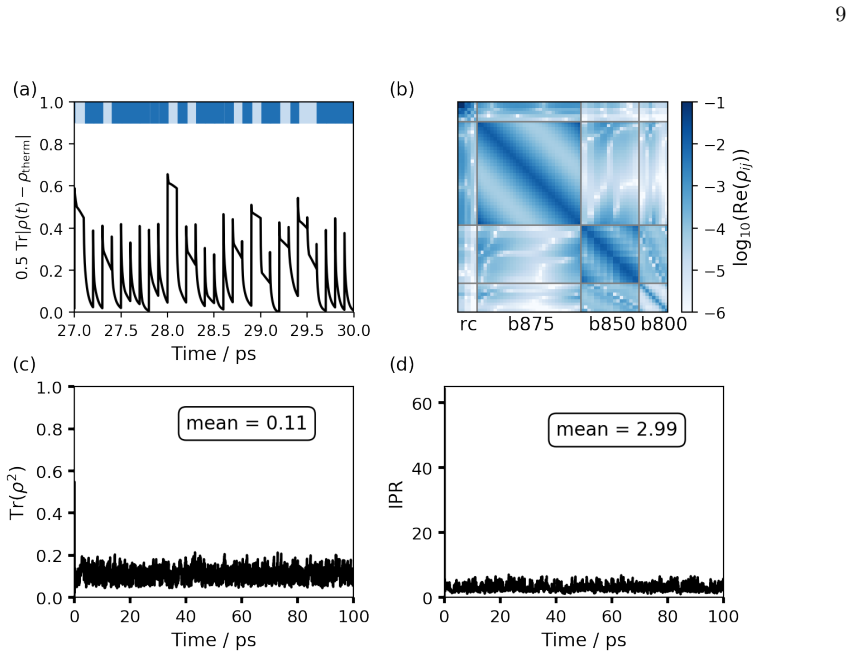
The mechanism that carries the argument is a Lindblad master equation for the one-exciton density matrix, with four dissipative pieces representing absorption and emission of sunlight, loss to the reaction-centre sink, non-radiative decay, and the vibrational bath: $\frac{d\rho(t)}{dt} = -\frac{i}{\hbar}[\hat H(t),\rho(t)] + (\mathcal{L}_{\mathrm{rad}}+\mathcal{L}_{\mathrm{bath}}+\mathcal{L}_{\mathrm{nr}}+\mathcal{L}_{\mathrm{sink}})\rho(t)$. The distinctive feature is that the Hamiltonian $\hat H(t)$ is re-randomized every 0.1 ps: site energies and dipoles are redrawn from distributions taken from density-functional/molecular-dynamics snapshots, mimicking the symmetry-breaking effect of slow vibrational modes. This time-dependent disorder, combined with a thermalizing bath term that relaxes the system to the instantaneous Boltzmann state, is what keeps the exciton state highly mixed and continuously moving; it replaces the functional role that long-lived coherence was once thought to play.
What would settle it
Vary the Hamiltonian-reset interval in the model (for example from 0.05 ps to 1 ps) and recompute the time-averaged efficiency and purity; if the efficiency changes by more than a few percent or significant coherence appears at longer intervals, the sudden-switch representation of slow vibrations is falsified as the explanation.
Extended reading notes
Core claim
The central claim is that high light-harvesting efficiency in purple bacteria does not require long-range quantum coherence, and that the detailed spatial arrangement of chromophores is not a significant determinant of that efficiency. In the model the excitonic subsystem settles into a state that is close to a mixture of the instantaneous thermal states of a randomly fluctuating Hamiltonian; the average state has an inverse participation ratio near the incoherent limit, and population is spread evenly across equivalent sites within each ring. The same efficiency emerges when chromophores are packed randomly, in three dimensions or in a slab, around a reaction centre, provided their typical nearest-neighbour separation is comparable to the natural one. What matters, the authors argue, is the density of chromophores and the balance between dephasing, decay, trapping, and thermalization, not a specific architecture.
Load-bearing premise
The conclusions rest on the assumption that slow molecular vibrations can be represented by generating a fresh random Hamiltonian every 0.1 ps; if real slow modes act differently on that timescale, the computed mixed state and efficiencies could change.
Editorial extensions
If this is right
- Artificial light-harvesting devices do not need precise control of chromophore orientation; matching near-neighbour spacing to natural values should be enough for high efficiency.
- Quantum coherence is not a prerequisite for efficient energy transport under natural illumination; the combination of thermalizing relaxation and slow vibrational disorder suffices.
- The key design variables for an antenna become chromophore concentration, dephasing rate, and the balance of decay and trapping, rather than ring symmetry or molecular orientation.
- The apparent importance of circular ring structures in nature may be a consequence of packing: rings achieve high local density while avoiding the concentration quenching that a fully disordered solution would suffer.
- Different choices for the system-bath model (global thermalizing vs. local dephasing) change the predicted efficiency by tens of percent, so quantitative predictions remain model-dependent.
Reading between the lines
- If the random-box result extends to other antenna geometries, a cheap design rule for synthetic systems is to enforce only a minimum nearest-neighbour distance while letting chromophores orient freely, which is far more scalable than current coherence-preserving designs.
- A direct validation would be to compare the sudden-switch disorder model with an explicit continuous low-frequency mode calculation on a small ring; disagreement would indicate that the 0.1 ps reset interval is doing too much work.
- The same modelling approach could be applied to other pigment-protein networks, such as cryptophyte antennas or cyanobacterial phycobilisomes, to test whether density rather than architecture predicts efficiency across organisms.
Signed reviews
Editorial analysis
A structured set of objections, weighed in public.
Referee Report
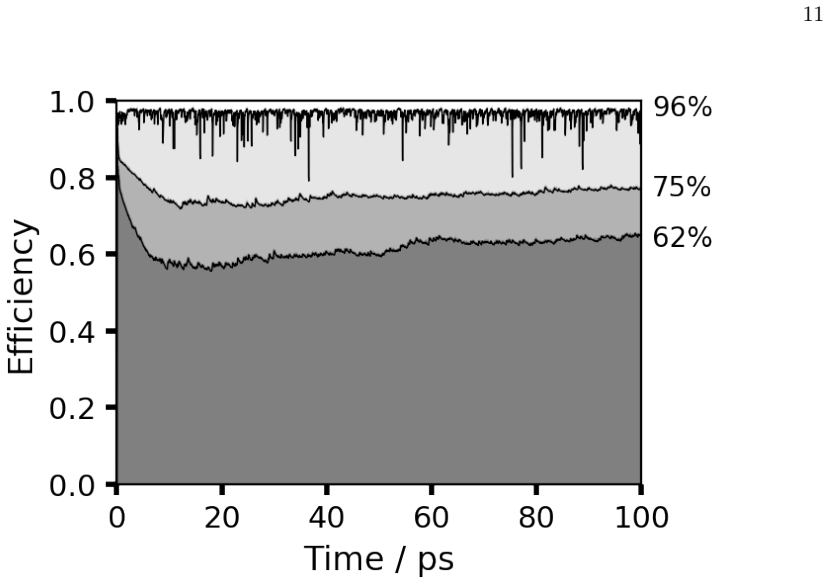
Summary. The paper presents a master-equation model of the bacterial photosynthetic antenna consisting of one LHII complex, one LHI complex, and the reaction centre (65 chromophores), including explicit weak incoherent sunlight absorption, radiative and non-radiative losses, a reaction-centre sink, and two alternative models of the vibrational bath (a local dephasing model and a global thermalizing Redfield model). Slow vibrational modes are incorporated by redrawing a random Hamiltonian every 0.1 ps, with energetic and dipole disorder taken from earlier TDDFT/MD work. The authors report a time-averaged efficiency of 96% with the global thermalizing model and 62% with the local dephasing model, and they find that the one-exciton state remains highly mixed and largely incoherent. In a second set of simulations, randomly arranged chromophores in a box around a reaction centre also give high efficiency at sufficiently high concentration, which the authors interpret as evidence that detailed structural arrangement is not important for efficiency.
Significance. If the central conclusions are correct, the paper makes a substantive contribution: it argues that high photosynthetic efficiency does not require long-range quantum coherence and that random dense packing of chromophores may be sufficient, with implications for artificial light-harvesting design. The model is unusually comprehensive in its simultaneous treatment of sunlight, loss channels, the sink, and two opposing bath descriptions, and the inclusion of TDDFT/MD disorder and a large combined LHII–LHI–RC system goes beyond typical single-complex studies. The random-box simulations provide a falsifiable, concentration-dependent prediction. However, the quantitative efficiency and the mechanistic claims about slow vibrations rest on a heuristic time-dependent-disorder protocol that is not validated or subjected to sensitivity analysis, and the abstract's efficiency claim is stronger than the two-bath-model results support. The paper is therefore promising but requires substantial revision.
major comments (4)
- [Coupling to the environment, second paragraph; Figs. 1-2; Table II] The 0.1 ps Hamiltonian-resampling protocol for slow vibrational modes is not independently validated, and no sensitivity scan over the switching interval is presented; the characteristic periods of the Renger–Marcus spectral density in Eq. (7) are 2π/ω1 ≈ 60 ps and 2π/ω2 ≈ 17 ps, an order of magnitude longer than the 0.1 ps interval, so the protocol may be closer to rapid white-noise-like fluctuations than to the slowly varying static disorder described in the text. The conclusions that the state remains permanently highly mixed, that the IPR is small, and that disorder-driven localization is mitigated all depend on this choice, and a range of switching times (e.g., 0.01–10 ps) should be tested before these claims can be considered robust.
- [Abstract; Results, Fig. 3; Eq. (8)] The abstract's statement that 'our model describes the experimentally observed high efficiency of light harvesting' is contradicted by the local dephasing model, which yields a time-averaged efficiency of 62% rather than the high experimental range; the two bath models therefore give qualitatively different efficiency predictions, and the abstract should report or at least qualify this discrepancy. Furthermore, because Γsink = 0.125 ps−1 is 125 times larger than Γnr = 0.001 ps−1, the efficiency measure in Eq. (8) is heavily influenced by the fixed rate ratio, and the paper does not isolate how much of the predicted high efficiency is a consequence of these chosen kinetic constants rather than of the antenna structure or dynamics; a sensitivity analysis over Γsink and Γnr is needed.
- [Eqs. (5)-(7); SI Fig. S2, SI Fig. S4] The global thermalizing model relies on the B777-fitted spectral density JRM being transferred to the LHII/LHI/RC system, and the only validation cited is the reproduction of an LHII relaxation time; no validation is provided for LHI or the combined antenna, and the text itself admits that the global model overestimates the RC population. Since the headline 96% efficiency comes from this model, the paper should present this value with the acknowledged bias and should quantify the uncertainty arising from the spectral-density transfer.
- [An artificial light-harvesting system; Fig. 4] The conclusion that chromophore orientation is not significant is inferred from the small variance of efficiency across 32 random configurations at high concentration, but this design varies positions and orientations simultaneously; an explicit control in which positions are fixed and only orientations are randomized is required to support the claim that orientation is irrelevant, and the paper should report effect sizes or confidence intervals rather than only standard-deviation bars.
minor comments (5)
- [Throughout] There are several typographical errors, including 'futher' in the Discussion, 'though to imply' in the artificial light-harvesting section, and 'maintian' in the Discussion; these should be corrected.
- [Coupling to the environment] The text states that the global Lindblad approach gives 'good qualitative agreement' with HEOM calculations, but no data from the HEOM comparison are shown; a figure or a more detailed statement of the comparison should be provided in the SI.
- [Results, Table II; Eq. (9)] The inverse participation ratio is defined for the full n-site system, but Table II reports IPR values for subsystems of different sizes; the normalization basis for the subsystem IPR should be stated explicitly to allow interpretation of the numbers in Table II.
- [Results, Fig. 3] The time-averaged efficiency is stated to be calculated 'from 5 ps', but the total simulation duration for the full antenna is not given; this duration should be reported for reproducibility and to allow comparison with the 10–100 ps averaging used for the random-box simulations.
- [Theory, Hamiltonian disorder] The distributions for the energetic and dipole disorder are cited to reference [12], but the functional forms and parameter values are not reproduced in the main text or the SI; providing those details would make the model reproducible.
Circularity Check
No significant circularity: inputs are external experimental rates and spectral densities, the efficiency output is not fitted, and the structure-insensitivity claim is tested by independent random-box simulations.
full rationale
The paper's derivation chain is not circular. The efficiency reported in Eq. 8 is computed from a time-dependent master equation whose rate constants (Table I) are taken from independent experimental work, not fitted to the efficiency values the paper reports. The difference between the 96% efficiency under the global thermalizing model and the 62% under local dephasing shows that the output is not forced by the sink/non-radiative rate ratio alone; transport details matter. The spectral density of Eq. 7 is fitted to B777 monomer data and then checked against LHII relaxation, which is a cross-validation against a different experimental observable, not a circular reuse of the target result. The disorder distributions are imported from the authors' earlier TDDFT/MD study (ref 12), but this is an input to the model rather than the paper's predicted claim, and the central structural conclusion is independently probed with randomly arranged chromophore boxes that do not depend on that self-citation. The mixed-state conclusion follows from the chosen Lindblad dissipators, but the paper presents it as a consequence of the model, not as a prediction independent of those dissipators. The 0.1 ps Hamiltonian-resampling protocol is a model assumption whose physical realism could be questioned, but an assumption is not circularity unless the conclusion is identical to the assumption. The paper even concedes that neither bath model can on its own reliably describe the vibrational environment; this is a stated limitation, not a circular step. No constructed identity between inputs and outputs, no fitted parameter renamed as a prediction, and no load-bearing self-citation chain were found.
Assumptions & free parameters
free parameters (6)
- Hamiltonian switching interval =
0.1 ps
- Sink rate Gamma_sink =
0.125 ps^-1
- Non-radiative decay rate Gamma_nr =
0.001 ps^-1
- Dephasing rate Gamma_deph =
11 ps^-1
- Spectral density parameters omega1, omega2 =
0.10483 and 0.364625 rad/ps
- Energetic and dipole disorder distributions
assumptions (6)
- domain assumption Each chromophore is modeled as a two-level system (ground and first excited state); only the zero- or one-exciton subspace is retained.
- domain assumption Inter-chromophore couplings are computed with the point dipole approximation, with corrections for LHI/RC from 'more detailed calculations' in SI.
- domain assumption The vibrational environment is modeled by a Markovian Lindblad master equation (local dephasing or global Redfield thermalizing), with slow modes treated separately as time-dependent disorder.
- ad hoc to paper The spectral density JRM(w) from Renger-Marcus, fitted to B777 monomer spectra, applies to the LHII/LHI antenna systems.
- domain assumption The reaction center acts as an irreversible sink with constant rate Gamma_sink = 0.125 ps^-1.
- domain assumption The initial excited state can be prepared as a completely delocalized pure state with occupation p=1e-9, and long-time averages are insensitive to it.
Cite this review
Pith. "Pith review of Structure and efficiency in bacterial photosynthetic light-harvesting." pith.science (2026). https://pith.science/paper/JREBH2XI
@misc{pith2026190808373,
  author       = {Pith},
  title        = {Pith review of: Structure and efficiency in bacterial photosynthetic light-harvesting},
  year         = {2026},
  howpublished = {\url{https://pith.science/paper/JREBH2XI}},
  note         = {Machine review of arXiv:1908.08373}
}
read the original abstract
Photosynthetic organisms use networks of chromophores to absorb sunlight and deliver the energy to reaction centres, where charge separation triggers a cascade of chemical steps to store the energy. We present a detailed model of the light-harvesting complexes in purple bacteria, including explicit interaction with sunlight; energy loss through radiative and non-radiative processes; and dephasing and thermalizing effects of coupling to a vibrational bath. An important feature of the model is that we capture the effect of slow vibrational modes by introducing time-dependent disorder. Our model describes the experimentally observed high efficiency of light harvesting, despite the absence of long-range quantum coherence. The one-exciton part of the quantum state fluctuates due to slow vibrational changes, but remains highly mixed at all times. This lack of long-range coherence suggests a relatively minor role for structure in determining the efficiency of bacterial light harvesting. To investigate this we built hypothetical models with randomly arranged chromophores, but still observed high efficiency when typical nearest-neighbour distances are comparable with those found in nature. This helps to explain the efficiency of energy transport in organisms whose chromophore networks differ widely in structure, while also suggesting new design criteria for efficient artificial light-harvesting devices.
Figures

Figures from the paper (1 more)

Reference graph
Works this paper leans on
-
[1]
E. Wientjes, H. Van Amerongen, and R. Croce, Journal of Physical Chemistry B 117, 11200 (2013)
work page 2013
-
[2]
C. P. Rijgersberg, R. Van Grondelle, and J. Amesz, Biochimica et Biophysica Acta - Bioenergetics 592, 53 (1980)
work page 1980
-
[3]
F. Fassioli, R. Dinshaw, P. C. Arpin, and G. D. Scholes, Journal of The Royal Society Interface 11, 20130901 (2013)
work page 2013
-
[4]
G. S. Engel, T. R. Calhoun, E. L. Read, T. K. Ahn, T. Manˇ cal, Y. C. Cheng, R. E. Blankenship, and G. R. Fleming, Nature 446, 782 (2007)
work page 2007
-
[5]
Lee, Y.-C
H. Lee, Y.-C. Cheng, and G. R. Fleming, Science 316, 1462 (2007)
2007
-
[6]
T. R. Calhoun and G. R. Fleming, Physica Status Solidi (B) Basic Research 248, 833 (2011)
work page 2011
-
[7]
E. Harel and G. S. Engel, Proceedings of the National Academy of Sciences 109, 706 (2012)
work page 2012
-
[8]
Panitchayangkoon, D
G. Panitchayangkoon, D. Hayes, K. A. Fransted, J. R. Caram, E. Harel, J. Wen, R. E. Blankenship, and G. S. Engel, Proceedings of the National Academy of Sciences 107, 12766 (2010)
2010
Show all 53 references
-
[9]
Str¨ umpfer, M
J. Str¨ umpfer, M. S ¸ener, and K. Schulten, Journal of Physical Chemistry Letters3, 536 (2012)
2012
-
[10]
Collini, C
E. Collini, C. Y. Wong, K. E. Wilk, P. M. Curmi, P. Brumer, and G. D. Scholes, Nature 463, 644 (2010)
2010
-
[11]
N. F. van Hulst, R. J. Cogdell, D. Brinks, R. Hildner, and J. B. Nieder, Science 340, 1448 (2013)
2013
-
[12]
Stross, M
C. Stross, M. W. Van der Kamp, T. A. A. Oliver, J. N. Harvey, N. Linden, and F. R. Manby, The Journal of Physical Chemistry B 120, 11449 (2016)
2016
-
[13]
Christensson, H
N. Christensson, H. F. Kauffmann, T. Pullerits, and T. Manˇ cal, Journal of Physical Chemistry B 116, 7449 (2012)
2012
-
[14]
H.-G. Duan, V. I. Prokhorenko, R. J. Cogdell, K. Ashraf, A. L. Stevens, M. Thorwart, and R. J. D. Miller, Proceedings of the National Academy of Sciences 114, 8493 (2017)
2017
-
[16]
Brumer and M
P. Brumer and M. Shapiro, Proceedings of the National Academy of Sciences 109, 19575 (2012)
2012
-
[17]
Kassal, J
I. Kassal, J. Yuen-Zhou, and S. Rahimi-Keshari, Journal of Physical Chemistry Letters 4, 362 (2013)
2013
-
[18]
Tiersch, S
M. Tiersch, S. Popescu, and H. J. Briegel, Philosophical Transactions of the Royal Society A: Mathe- matical, Physical and Engineering Sciences 370, 3771 (2012)
2012
-
[19]
Fassioli, A
F. Fassioli, A. Olaya-Castro, S. Scheuring, J. N. Sturgis, and N. F. Johnson, Biophysical Journal 97, 16 2464 (2009)
2009
-
[20]
Sarovar and K
M. Sarovar and K. Birgitta Whaley, New Journal of Physics 15, 013030 (2013)
2013
-
[21]
Manzano, PLoS ONE 8, 1 (2013)
D. Manzano, PLoS ONE 8, 1 (2013)
2013
-
[22]
Brumer, The Journal of Physical Chemistry Letters 9, 2946 (2018)
P. Brumer, The Journal of Physical Chemistry Letters 9, 2946 (2018)
2018
-
[23]
Manˇ cal and L
T. Manˇ cal and L. Valkunas, New Journal of Physics 12 (2010), 10.1088/1367-2630/12/6/065044
2010 doi
-
[24]
Buckhout-White, C
S. Buckhout-White, C. M. Spillmann, W. R. Algar, A. Khachatrian, J. S. Melinger, E. R. Goldman, M. G. Ancona, and I. L. Medintz, Nature Communications 5, 5615 (2014)
2014
-
[25]
E. A. Hemmig, C. Creatore, B. Wunsch, L. Hecker, P. Mair, M. A. Parker, S. Emmott, P. Tinnefeld, U. F. Keyser, and A. W. Chin, Nano Letters 16, 2369 (2016)
2016
-
[26]
Olejko and I
L. Olejko and I. Bald, RSC Adv. 7, 23924 (2017)
2017
-
[27]
An order of magnitude estimate gives p = 10−9
A simple kinetics calculation gives the steady-state probability of being in the excited state as p = kabs/(Γsink + Γnr + kspont + kstim + kabs), where kspont, kstim and kabs are, respectively, the rates of spontaneous emission, stimulated emission and absortion. An order of m...
-
[28]
R. E. Blankenship, D. M. Tiede, J. Barber, G. W. Brudvig, G. Fleming, M. Ghirardi, M. R. Gunner, W. Junge, D. M. Kramer, A. Melis, T. A. Moore, C. C. Moser, D. G. Nocera, A. J. Nozik, D. R. Ort, W. W. Parson, R. C. Prince, and R. T. Sayre, Science 332, 805 (2011)
2011
-
[29]
S. R. Greenfield, M. Seibert, Govindjee, and M. R. Wasielewski, The Journal of Physical Chemistry B 101, 2251 (2002)
2002
-
[30]
Demmig-Adams, G
B. Demmig-Adams, G. Garab, and W. Adams Iii, Advances in Photosynthesis and Respiration Includ- ing Bioenergy and Related Processes Non-Photochemical Quenching and Energy Dissipation in Plants, Algae and Cyanobacteria Non-Photochemical Quenching and Energy Dissipation in Plant...
2014
-
[31]
M. A. Palacios, F. L. De Weerd, J. A. Ihalainen, R. Van Grondelle, and H. Van Amerongen, Journal of Physical Chemistry B 106, 5782 (2002)
2002
-
[32]
K. L. Zankel, D. W. Reed, and R. K. Clayton, Proceedings of the National Academy of Sciences 61, 1243 (2006)
2006
-
[33]
Pandit, N
A. Pandit, N. Shirzad-Wasei, L. M. Wlodarczyk, H. Van Roon, E. J. Boekema, J. P. Dekker, and W. J. De Grip, Biophysical Journal 101, 2507 (2011)
2011
-
[34]
Monshouwer, M
R. Monshouwer, M. Abrahamsson, F. van Mourik, and R. van Grondelle, The Journal of Physical Chemistry B 101, 7241 (2002)
2002
-
[35]
M. a. Bopp, Y. Jia, L. Li, R. J. Cogdell, and R. M. Hochstrasser, Proceedings of the National Academy of Sciences of the United States of America 94, 10630 (1997)
1997
-
[36]
A. F. Fidler, V. P. Singh, P. D. Long, P. D. Dahlberg, and G. S. Engel, Journal of Physical Chemistry Letters 4, 1404 (2013)
2013
-
[37]
A. J. Schile and D. T. Limmer, arXiv:1905.0029v [cond-mat.stat-mech] (30 Apr 2019)
1905
-
[38]
Ostilli and C
M. Ostilli and C. Presilla, Physical Review A 95, 062112 (2017). 17
2017
-
[39]
P. P. Hofer, M. Perarnau-Llobet, L. D. M. Miranda, G. Haack, R. Silva, J. B. Brask, and N. Brunner, New Journal of Physics 19 (2017), 10.1088/1367-2630/aa964f
2017 doi
-
[40]
Caruso, A
F. Caruso, A. W. Chin, A. Datta, S. F. Huelga, and M. B. Plenio, Physical Review A - Atomic, Molecular, and Optical Physics 81, 1 (2010)
2010
-
[41]
F. M. W. C. Vaughan, N. Linden, and F. R. Manby, Journal of Chemical Physics 146 (2017), 10.1063/1.4978568
2017 doi
-
[42]
F. M. W. C. Vaughan, Exciton Energy Transfer in Photosynthetic Light Harvesting Complexes , Ph.D. thesis, University of Bristol (2017)
2017
-
[43]
May and O
V. May and O. K¨ uhn,Charge and Energy Transfer Dynamics in Molecular Systems (Wiley-VCH Verlag GmbH & Co. KGaA, Weinheim, Germany, 2011)
2011
-
[44]
Renger and R
T. Renger and R. A. Marcus, Journal of Chemical Physics 116, 9997 (2002)
2002
-
[45]
T. A. Stuart, M. Vengris, V. I. Novoderezhkin, R. J. Cogdell, C. Neil Hunter, and R. Van Grondelle, Biophysical Journal 100, 2226 (2011)
2011
-
[46]
Pullerits, M
T. Pullerits, M. Chachisvilis, M. R. Jones, C. N. Hunter, and V. Sundstr¨ om, Chemical Physics Letters 224, 355 (1994)
1994
-
[47]
Freiberg, K
A. Freiberg, K. Timpmann, S. Lin, and N. W. Woodbury, Journal of Physical Chemistry B 102, 10974 (1998)
1998
-
[48]
Meier, V
T. Meier, V. Chernyak, and S. Mukamel, The Journal of Physical Chemistry B 101, 7332 (1997)
1997
-
[49]
R. E. Blankenship, Molecular Mechanisms of Photosynthesis , 1st ed. (Blackwell Science Ltd, Oxford, UK, 2002)
2002
-
[50]
Olaya-Castro and F
A. Olaya-Castro and F. Fassioli, Procedia Chemistry 3, 176 (2011)
2011
-
[51]
K. M. Pelzer, T. Can, S. K. Gray, D. K. Morr, and G. S. Engel, Journal of Physical Chemistry B 118, 2693 (2014)
2014
-
[52]
Caruso, A
F. Caruso, A. W. Chin, A. Datta, S. F. Huelga, and M. B. Plenio, The Journal of Chemical Physics 131, 105106 (2009)
2009
-
[53]
Sisto, C
A. Sisto, C. Stross, M. van der Kamp, M. O’Connor, G. T. Johnson, E. G. Hohenstein, F. R. Manby, D. R. Glowacki, and T. J. Martinez, Phys. Chem. Chem. Phy. 19, 5 (2017)
2017
-
[54]
C. C. Jumper, S. Rafiq, S. Wang, and G. D. Scholes, Current Opinion in Chemical Biology 47, 39 (2018)
2018
Reviewed August 14, 2026 · model on record in the stance chip above.
Discussion (0). Continue with ORCID to comment.