Estimating Grammatical Gender Directions in Contextual Embeddings under Controlled and Natural Contexts
Pith reviewed 2026-06-30 06:05 UTC · model grok-4.3
The pith
Unweighted controlled contexts isolate the purest grammatical gender direction in contextual embeddings.
A machine-rendered reading of the paper's core claim, the machinery that carries it, and where it could break.
Core claim
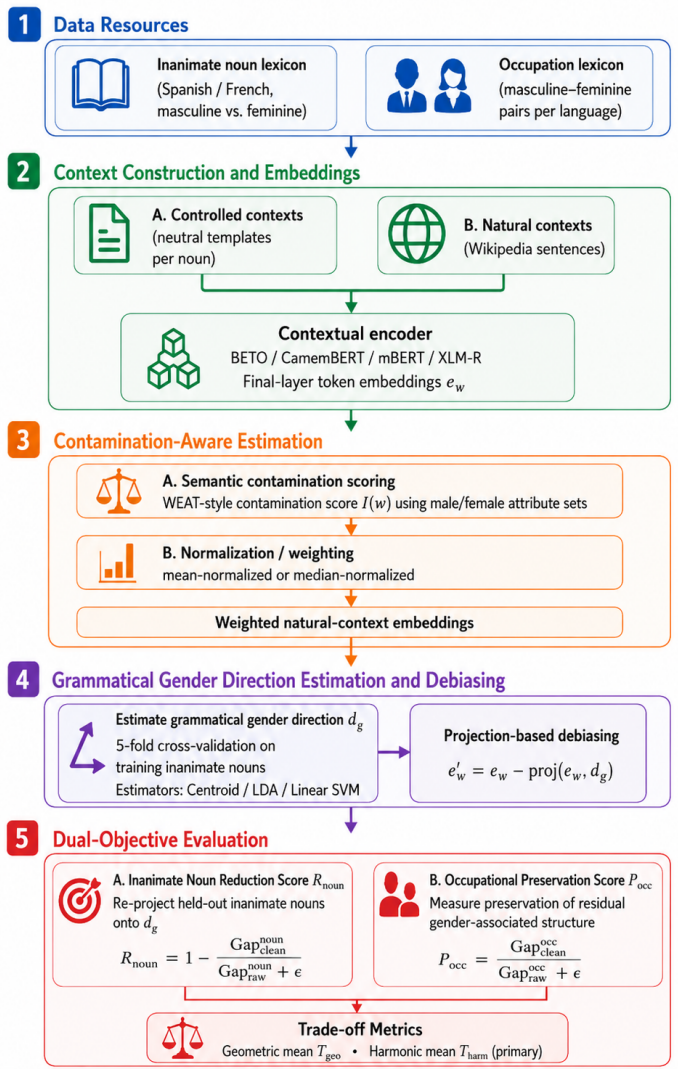
By constructing balanced datasets of inanimate nouns in both controlled templates and natural Wikipedia contexts, the authors estimate grammatical gender directions in contextual embeddings. They compare centroid, SVM, and LDA estimators under different weighting schemes and introduce dual-objective metrics that trade off leakage suppression against semantic preservation. The results establish that unweighted controlled contexts yield the purest grammatical gender direction and that the centroid estimator outperforms the discriminative baselines.
What carries the argument
The dual-objective evaluation framework that applies centroid, SVM, and LDA estimators to balanced datasets of inanimate nouns drawn from controlled templates and Wikipedia contexts.
If this is right
- Debiasing techniques can now target contextual representations instead of being limited to static word embeddings.
- Grammatical gender signals can be estimated independently of semantic gender distinctions.
- Controlled sentence templates supply cleaner signals for direction estimation than natural text does.
- A simple centroid calculation is sufficient and preferable to SVM or LDA for this estimation task.
Where Pith is reading between the lines
- The same construction of controlled contexts could be applied to other gendered languages to test whether the purity advantage holds.
- Directions obtained this way could be inserted into existing debiasing pipelines to measure downstream gains on bias reduction tasks.
- The approach might extend to disentangling other grammatical features such as number or animacy from semantic content.
Load-bearing premise
The balanced datasets of inanimate nouns successfully isolate grammatical gender without residual semantic contamination that would distort the direction estimates.
What would settle it
Finding that the gender direction estimated from controlled contexts still correlates strongly with semantic features of occupation terms would show that isolation failed.
Figures
read the original abstract
Contextual language models conflate grammatical gender and social semantic bias in gendered languages such as Spanish. Existing gender debiasing approaches only operate on static word embeddings leaving contextual representations unexplored for this two dimensional gender disentanglement. To address the this issue, we make the first attempt to disentangle grammatical gender from semantic contamination for contextual embeddings. We construct both controlled templates and natural Wikipedia contexts to build balanced datasets of inanimate nouns, and design a framework equipped with centroid, Support Vector Machine (SVM) and Linear Discriminant Analysis (LDA) gender direction estimators as well as contamination-aware weighting strategies. A set of dual-objective evaluation metrics is proposed to balance the suppression of grammatical gender leakage on inanimate nouns and the preservation of semantic gender distinctions for occupation terms. The results reveal that unweighted controlled contexts yield the purest grammatical gender direction, and the centroid estimator achieves better performance than discriminative baselines.
Editorial analysis
A structured set of objections, weighed in public.
Referee Report
Summary. The paper claims to make the first attempt at disentangling grammatical gender from semantic contamination in contextual embeddings for Spanish. It constructs balanced datasets of inanimate nouns via controlled templates and natural Wikipedia contexts, applies centroid/SVM/LDA gender direction estimators together with contamination-aware weighting, and proposes dual-objective metrics that trade off suppression of grammatical gender leakage on inanimates against preservation of semantic gender distinctions on occupation terms. The reported results are that unweighted controlled contexts produce the purest grammatical gender direction and that the centroid estimator outperforms the discriminative baselines.
Significance. If the isolation of grammatical gender holds, the work supplies a concrete framework and dual-objective evaluation protocol for contextual debiasing in gendered languages, extending prior static-embedding methods. The explicit comparison of controlled versus natural contexts and the inclusion of both centroid and discriminative estimators are constructive contributions that could be reused.
major comments (2)
- [§3 / Abstract] §3 (Dataset Construction) and Abstract: The central claim that unweighted controlled contexts yield the purest direction and that centroid outperforms SVM/LDA rests on the assumption that the balanced inanimate-noun datasets isolate grammatical gender without residual semantic contamination. No diagnostic (e.g., pre/post-weighting correlation between noun semantics and estimated directions, or an independent semantic probe) is described that would falsify this isolation; if the assumption fails, both the purity ranking and the estimator comparison become unreliable.
- [Evaluation / Abstract] Evaluation section: The dual-objective metrics are introduced to balance suppression on inanimates versus preservation on occupations, yet the abstract (and by extension the reported results) supplies no quantitative values, dataset sizes, error bars, or statistical tests. Without these numbers it is impossible to verify the claimed superiority of the centroid estimator or the ranking of context types.
minor comments (2)
- [Abstract] Abstract: 'To address the this issue' contains a typographical error.
- [Abstract / Introduction] Abstract: The claim of being the 'first attempt' should be supported by a brief literature comparison in the introduction rather than asserted only in the abstract.
Simulated Author's Rebuttal
We thank the referee for the constructive feedback. We address each major comment below, proposing revisions where the manuscript can be strengthened without misrepresenting our contributions.
read point-by-point responses
-
Referee: [§3 / Abstract] §3 (Dataset Construction) and Abstract: The central claim that unweighted controlled contexts yield the purest direction and that centroid outperforms SVM/LDA rests on the assumption that the balanced inanimate-noun datasets isolate grammatical gender without residual semantic contamination. No diagnostic (e.g., pre/post-weighting correlation between noun semantics and estimated directions, or an independent semantic probe) is described that would falsify this isolation; if the assumption fails, both the purity ranking and the estimator comparison become unreliable.
Authors: We agree that an explicit falsification diagnostic would strengthen the isolation claim. The framework relies on the established practice of using inanimate nouns (which carry no semantic gender) to isolate grammatical gender, combined with contamination-aware weighting to mitigate residual effects. We will add a pre/post-weighting correlation analysis between noun semantics and the estimated directions as a diagnostic in the revised §3. revision: yes
-
Referee: [Evaluation / Abstract] Evaluation section: The dual-objective metrics are introduced to balance suppression on inanimates versus preservation on occupations, yet the abstract (and by extension the reported results) supplies no quantitative values, dataset sizes, error bars, or statistical tests. Without these numbers it is impossible to verify the claimed superiority of the centroid estimator or the ranking of context types.
Authors: The Evaluation section reports the dual-objective metric values, dataset sizes, and comparisons, but the abstract summarizes results qualitatively. We will revise the abstract to include key quantitative values and dataset sizes. Error bars and statistical tests were not computed in the original experiments; we can add basic significance notes if feasible but cannot retroactively introduce them without new runs. revision: partial
Circularity Check
No circularity detected in derivation chain
full rationale
The paper constructs balanced datasets of inanimate nouns from controlled templates and Wikipedia contexts, then applies standard centroid, SVM, and LDA estimators along with contamination-aware weighting and dual-objective metrics. The headline results (unweighted controlled contexts being purest; centroid outperforming baselines) are presented as empirical comparisons on these constructed data. No equations, self-definitional reductions, fitted inputs renamed as predictions, or load-bearing self-citations appear in the abstract or described methods. The derivation chain relies on external ML estimators and data construction rather than reducing outputs to inputs by construction.
Axiom & Free-Parameter Ledger
Reference graph
Works this paper leans on
-
[1]
Social Bias in Multilingual Language Models: A Survey
Gamboa LCL, Feng Y, Lee MG. Social Bias in Multilingual Language Models: A Survey. In: Proceedings of the 2025 Conference on Empirical Methods in Natural Language Processing. Suzhou, June 30, 2026 13/18 China: Association for Computational Linguistics; 2025. p. 27857-80. Available from: https://aclanthology.org/2025.emnlp-main.1416/. doi:10.18653/v1/2025....
-
[2]
Man is to Computer Programmer as Woman is to Homemaker? Debiasing Word Embeddings
Bolukbasi T, Chang KW, Zou J, Saligrama V, Kalai A. Man is to Computer Programmer as Woman is to Homemaker? Debiasing Word Embeddings. arXiv preprint arXiv:160706520. 2016. Available from:https://arxiv.org/abs/1607.06520. doi:https://doi.org/10.48550/arXiv.1607.06520
work page internal anchor Pith review Pith/arXiv arXiv doi:10.48550/arxiv.1607.06520 2016
-
[3]
Measuring Bias in Contextualized Word Representations
Kurita K, Vyas N, Pareek A, Black AW, Tsvetkov Y. Measuring Bias in Contextualized Word Representations. In: Proceedings of the First Workshop on Gender Bias in Natural Language Processing; 2019. p. 166-72. Available from:https://aclanthology.org/W19-3823/. doi:https://doi.org/10.18653/v1/W19-3823
-
[4]
Semantics derived automatically from language corpora contain human-like biases
Caliskan A, Bryson JJ, Narayanan A. Semantics derived automatically from language corpora contain human-like biases. Science. 2017;356(6334):183-6. Available from: https://arxiv.org/abs/1608.07187. doi:https://doi.org/10.1126/science.aal4230
work page internal anchor Pith review Pith/arXiv arXiv doi:10.1126/science.aal4230 2017
-
[5]
Examining Gender Bias in Languages with Grammatical Gender
Zhou P, Shi W, Zhao J, Huang KH, Chen M, Cotterell R, et al. Examining Gender Bias in Languages with Grammatical Gender. In: Proceedings of the 2019 Conference on Empirical Methods in Natural Language Processing and the 9th International Joint Conference on Natural Language Processing (EMNLP-IJCNLP); 2019. p. 5276-84. Available from:https://aclanthology.o...
-
[6]
OSCaR: Orthogonal Subspace Correction and Rectification of Biases in Word Embeddings
Dev S, Li T, Phillips JM, Srikumar V. OSCaR: Orthogonal Subspace Correction and Rectification of Biases in Word Embeddings. In: Proceedings of the 2021 Conference on Empirical Methods in Natural Language Processing. Online and Punta Cana, Dominican Republic: Association for Computational Linguistics; 2021. p. 5034-50. Available from:https://aclanthology.o...
-
[7]
Bias and Fairness in Large Language Models: A Survey
Gallegos IO, Rossi RA, Barrow J, Tanjim MM, Kim S, Dernoncourt F, et al. Bias and Fairness in Large Language Models: A Survey. Computational Linguistics. 2024;50(3):649-704. Available from: https://aclanthology.org/2024.cl-3.8/. doi:10.1162/coli_a_00498
-
[8]
A Survey on Fairness in Large Language Models; 2023
Li Y, Du M, Song R, Wang X, Wang Y. A Survey on Fairness in Large Language Models; 2023. Available from:https://arxiv.org/abs/2308.10149. arXiv:2308.10149. doi:10.48550/arXiv.2308.10149
-
[9]
Multilingual Denoising Pre-training for Neural Machine Translation
Liu Y, Gu J, Goyal N, Li X, Edunov S, Ghazvininejad M, et al. Multilingual Denoising Pre-training for Neural Machine Translation. Transactions of the Association for Computational Linguistics. 2020;8:726-42. Available from:https://aclanthology.org/2020.tacl-1.47/. doi:https://doi.org/10.1162/tacl_a_00343
-
[10]
MarIA and BETO are sexist: evaluating gender bias in large language models for Spanish
Garrido-Muñoz I, Martínez-Santiago F, Montejo-Ráez A. MarIA and BETO are sexist: evaluating gender bias in large language models for Spanish. Language Resources and Evaluation. 2023;58(4):1387-417. Available from: https://link.springer.com/article/10.1007/s10579-023-09670-3. doi:https://doi.org/10.1007/s10579-023-09670-3
-
[11]
Corbett GG. Gender. Cambridge Textbooks in Linguistics. Cambridge University Press; 1991
1991
-
[12]
Identifying and Reducing Gender Bias in Word-Level Language Models
Bordia S, Bowman SR. Identifying and Reducing Gender Bias in Word-Level Language Models. In: Proceedings of the 2019 Conference of the North American Chapter of the Association for Computational Linguistics: Student Research Workshop; 2019. p. 7-15. Available from: https://aclanthology.org/N19-3002/. doi:https://doi.org/10.18653/v1/N19-3002
-
[13]
Zunino GM, Aguilar M, Stetie NA, Martínez Rebolledo C, Hinojosa JA. Dresses and ties: the effect of grammatical gender and stereotypical semantic bias in three Spanish-speaking communities. Language and Cognition. 2025;17:e35. Available from: June 30, 2026 14/18 https://www.cambridge.org/core/journals/language-and-cognition/article/dresses-and -ties-the-e...
-
[14]
Boroditsky L, Schmidt LA, Phillips W. Sex, Syntax, and Semantics. In: Language in Mind: Advances in the Study of Language and Thought; 2003. p. 61-79. Available from:https://direct.mit.edu/b ooks/edited-volume/1917/chapter-abstract/52672/Sex-Syntax-and-Semantics. doi:https://doi.org/10.7551/mitpress/4117.003.0010
-
[15]
What an Elegant Bridge: Multilingual LLMs are Biased Similarly in Different Languages
Mihaylov V, Shtedritski A. What an Elegant Bridge: Multilingual LLMs are Biased Similarly in Different Languages. In: Proceedings of the Fourth Workshop on Multilingual Representation Learning (MRL 2024); 2024. p. 22-9. Available from:https://aclanthology.org/2024.mrl-1.2/. doi:https://doi.org/10.18653/v1/2024.mrl-1.2
-
[16]
The Causal Influence of Grammatical Gender on Distributional Semantics
Stańczak K, Du K, Williams A, Augenstein I, Cottrell R. The Causal Influence of Grammatical Gender on Distributional Semantics. Transactions of the Association for Computational Linguistics. 2024;12:1672-85. Available from:https://aclanthology.org/2024.tacl-1.90/. doi:https://doi.org/10.1162/tacl_a_00723
-
[17]
Sukumaran P, Houghton C, Kazanina N. Investigating grammatical abstraction in language models using few-shot learning of novel noun gender. In: Findings of the Association for Computational Linguistics: EACL 2024. St. Julian’s, Malta: Association for Computational Linguistics; 2024. p. 747-65. Available from:https://aclanthology.org/2024.findings-eacl.50/...
-
[18]
Beyond Content: How Grammatical Gender Shapes Visual Representation in Text-to-Image Models
Saeed M, Raza S, Vayani A, Abdul-Mageed M, Emami A, Shehata S. Beyond Content: How Grammatical Gender Shapes Visual Representation in Text-to-Image Models. Findings of the Association for Computational Linguistics: EMNLP 2025. 2025. Available from: https://aclanthology.org/2025.findings-emnlp.1343/. doi:10.18653/v1/2025.findings-emnlp.1343
-
[19]
Sabbaghi SO, Caliskan A. Measuring Gender Bias in Word Embeddings of Gendered Languages Requires Disentangling Grammatical Gender Signals. In: Proceedings of the 2022 AAAI/ACM Conference on AI, Ethics, and Society; 2022. p. 518-27. Available from: https://dl.acm.org/doi/10.1145/3514094.3534176. doi:https://doi.org/10.1145/3514094.3534176
-
[21]
Man is to Computer Programmer as Woman is to Homemaker? Debiasing Word Embeddings
Bolukbasi T, Chang KW, Zou JY, Saligrama V, Kalai AT. Man is to Computer Programmer as Woman is to Homemaker? Debiasing Word Embeddings. In: Advances in Neural Information Processing Systems 29; 2016. p. 4349-57. Available from:https://proceedings.neurips.cc/paper _files/paper/2016/hash/a486cd07e4ac3d270571622f4f316ec5-Abstract.html
2016
-
[23]
On Measuring Social Biases in Sentence Encoders
May C, Wang A, Bordia S, Bowman SR, Rudinger R. On Measuring Social Biases in Sentence Encoders. In: Proceedings of the 2019 Conference of the North American Chapter of the Association for Computational Linguistics: Human Language Technologies, Volume 1 (Long and Short Papers)
2019
-
[24]
p. 622-8. Available from:https://aclanthology.org/N19-1063/. doi:https://doi.org/10.18653/v1/N19-1063. June 30, 2026 15/18
-
[25]
Gonen H, Goldberg Y. Lipstick on a Pig: Debiasing Methods Cover up Systematic Gender Biases in Word Embeddings But do not Remove Them. In: Proceedings of the 2019 Conference of the North American Chapter of the Association for Computational Linguistics: Human Language Technologies, Volume 1 (Long and Short Papers); 2019. p. 609-14. Available from: https:/...
-
[26]
Bias in Bios: A Case Study of Semantic Representation Bias in a High-Stakes Setting
De-Arteaga M, Romanov A, Wallach H, Chayes J, Borgs C, Chouldechova A, et al. Bias in Bios: A Case Study of Semantic Representation Bias in a High-Stakes Setting. arXiv preprint arXiv:190109451
-
[27]
Bias in Bios: A Case Study of Semantic Representation Bias in a High-Stakes Setting
Available from:https://arxiv.org/abs/1901.09451. doi:https://doi.org/10.48550/arXiv.1901.09451
work page internal anchor Pith review Pith/arXiv arXiv doi:10.48550/arxiv.1901.09451 1901
-
[28]
Mitigating Gender Bias in Contextual Word Embeddings
Yarrabelly N, Damodaran V, Su FG. Mitigating Gender Bias in Contextual Word Embeddings. arXiv preprint arXiv:241112074. 2024. Available from:https://arxiv.org/abs/2411.12074. doi:https://doi.org/10.48550/arXiv.2411.12074
-
[29]
Assessing Social and Intersectional Biases in Contextualized Word Representations
Tan YC, Celis LE. Assessing Social and Intersectional Biases in Contextualized Word Representations. arXiv preprint arXiv:191101485. 2019. Available from:https://arxiv.org/abs/1911.01485. doi:10.48550/arXiv.1911.01485
-
[30]
Stereotype and Skew: Quantifying Gender Bias in Pre-trained and Fine-tuned Language Models
de Vassimon Manela D, Errington D, Fisher T, van Breugel B, Minervini P. Stereotype and Skew: Quantifying Gender Bias in Pre-trained and Fine-tuned Language Models. In: Proceedings of the 16th Conference of the European Chapter of the Association for Computational Linguistics: Main Volume. Online: Association for Computational Linguistics; 2021. p. 2232-4...
-
[31]
Gonen H, Kementchedjhieva Y, Goldberg Y. How Does Grammatical Gender Affect Noun Representations in Gender-Marking Languages? In: Proceedings of the 23rd Conference on Computational Natural Language Learning (CoNLL); 2019. p. 463-71. Available from: https://aclanthology.org/K19-1043/. doi:https://doi.org/10.18653/v1/K19-1043
-
[32]
Gendered Grammar or Ingrained Bias? Exploring Gender Bias in Icelandic Language Models
Friðriksdóttir SR, Einarsson H. Gendered Grammar or Ingrained Bias? Exploring Gender Bias in Icelandic Language Models. In: Proceedings of the 2024 Joint International Conference on Computational Linguistics, Language Resources and Evaluation (LREC-COLING 2024). Torino, Italia: ELRA and ICCL; 2024. p. 7596-610. Available from: https://aclanthology.org/202...
2024
-
[33]
Elpers N, Jensen G, Holmes KJ. Does grammatical gender affect object concepts? Registered replication of Phillips and Boroditsky (2003). Journal of Memory and Language. 2022;127:104357. Available from: https://www.sciencedirect.com/science/article/abs/pii/S0749596X22000444. doi:https://doi.org/10.1016/j.jml.2022.104357
-
[34]
Leveraging Large Language Models to Measure Gender Representation Bias in Gendered Language Corpora
Derner E, de la Fuente SS, Gutiérrez Y, Moreda P, Oliver N. Leveraging Large Language Models to Measure Gender Representation Bias in Gendered Language Corpora. In: Proceedings of the 6th Workshop on Gender Bias in Natural Language Processing (GeBNLP); 2025. p. 468-83. Available from: https://aclanthology.org/2025.gebnlp-1.39/. doi:https://doi.org/10.1865...
-
[35]
EuroGEST: Investigating gender stereotypes in multilingual language models
Rowe J, Klimaszewski M, Guillou L, Vallor S, Birch A. EuroGEST: Investigating gender stereotypes in multilingual language models. In: Proceedings of the 2025 Conference on Empirical Methods in Natural Language Processing; 2025. p. 32074-96. Available from: https://aclanthology.org/2025.emnlp-main.1632/. doi:https://doi.org/10.18653/v1/2025.emnlp-main.1632
-
[36]
Spanish Pre-trained BERT Model and Evaluation Data
Cañete J, Chaperon G, Fuentes R, Ho JH, Kang H, Pérez J. Spanish Pre-trained BERT Model and Evaluation Data. arXiv preprint arXiv:230802976. 2023. Available from: https://arxiv.org/abs/2308.02976. doi:https://doi.org/10.48550/arXiv.2308.02976. June 30, 2026 16/18
-
[37]
Conneau A, Khandelwal K, Goyal N, Chaudhary V, Wenzek G, Guzmán F, et al. Unsupervised Cross-lingual Representation Learning at Scale. In: Proceedings of the 58th Annual Meeting of the Association for Computational Linguistics; 2020. p. 8440-51. Available from: https://aclanthology.org/2020.acl-main.747/. doi:https://doi.org/10.18653/v1/2020.acl-main.747
-
[38]
CamemBERT: a Tasty French Language Model
Martin L, Muller B, Ortiz Suárez PJ, Dupont Y, Romary L, de la Clergerie É, et al. CamemBERT: a Tasty French Language Model. In: Proceedings of the 58th Annual Meeting of the Association for Computational Linguistics; 2020. p. 7203-19. Available from: https://aclanthology.org/2020.acl-main.645/. doi:https://doi.org/10.18653/v1/2020.acl-main.645
-
[39]
Word embeddings are biased: But whose bias are they reflecting? AI & Society
Petreski D, Hashim IC. Word embeddings are biased: But whose bias are they reflecting? AI & Society. 2023;38:975-82. Available from:https://www.researchgate.net/publication/342995921 _Social_biases_in_word_embeddings_and_their_relation_to_human_cognition. doi:https://doi.org/10.1007/s00146-022-01443-w
-
[40]
Detecting gender bias in Arabic text through word embeddings
Mourad A, Abu Salem FK, Elbassuoni S. Detecting gender bias in Arabic text through word embeddings. PLOS ONE. 2025. Available from: https://journals.plos.org/plosone/article?id=10.1371/journal.pone.0319301. doi:https://doi.org/10.1371/journal.pone.0319301
-
[41]
Job Unfair: An Investigation of Gender and Occupational Bias in Free-Form Text Completions by LLMs
Casula C, Vecellio Salto S, Leonardelli E, Tonelli S. Job Unfair: An Investigation of Gender and Occupational Bias in Free-Form Text Completions by LLMs. In: Proceedings of the 2025 Conference on Empirical Methods in Natural Language Processing. Suzhou, China: Association for Computational Linguistics; 2025. p. 22759-77. Available from: https://aclantholo...
-
[42]
Zhao D, Li W, Shen Z, Qiu Y, Xu B, Chen H, et al. Bias Is a Subspace, Not a Coordinate: A Geometric Rethinking of Post-hoc Debiasing in Vision-Language Models. arXiv preprint arXiv:251118123. 2025. Available from:https://arxiv.org/abs/2511.18123. arXiv:2511.18123. doi:10.48550/arXiv.2511.18123
-
[43]
Grammatical Gender Associations Outweigh Topical Gender Bias in Cross-linguistic Word Embeddings
McCurdy K, Serbetci O. Grammatical Gender Associations Outweigh Topical Gender Bias in Cross-linguistic Word Embeddings. arXiv preprint arXiv:200508864. 2020. Available from: https://arxiv.org/abs/2005.08864. doi:https://doi.org/10.48550/arXiv.2005.08864
-
[44]
Discovering Low-rank Subspaces for Language-agnostic Multilingual Representations
Xie Z, Zhao H, Yu T, Li S. Discovering Low-rank Subspaces for Language-agnostic Multilingual Representations. In: Proceedings of the 2022 Conference on Empirical Methods in Natural Language Processing. Abu Dhabi, United Arab Emirates: Association for Computational Linguistics; 2022. p. 5617-33. Available from:https://aclanthology.org/2022.emnlp-main.379/....
-
[45]
Gupta S, Balia R, Angioni D, Brau F, Pintor M, Demontis A, et al. Bias Is a Subspace, Not a Coordinate: A Geometric Rethinking of Post-hoc Debiasing in Vision-Language Models. arXiv preprint arXiv:251118123. 2025. Available from:https://arxiv.org/abs/2511.18123. arXiv:2511.18123
-
[46]
Bias in language models: A survey
de Vassimon Manela D, Errington D, Fisher T, van Breugel B, Minervini P. Bias in language models: A survey. Cognitive Systems Research. 2021;70:100554. Available from: https://www.sciencedirect.com/science/article/abs/pii/S0925231221019408. doi:10.1016/j.cogsys.2021.100554
-
[47]
RobustDebias: Debiasing Language Models using Distributionally Robust Optimization
Gandhi D, Singh K, Hegde N. RobustDebias: Debiasing Language Models using Distributionally Robust Optimization. arXiv preprint arXiv:260200405. 2026. Available from: https://arxiv.org/abs/2602.00405. arXiv:2602.00405. doi:10.48550/arXiv.2602.00405. June 30, 2026 17/18
-
[48]
Universal Patterns of Grammatical Gender in Multilingual Large Language Models
Schröter A, Basirat A. Universal Patterns of Grammatical Gender in Multilingual Large Language Models. In: Proceedings of the 5th Workshop on Multilingual Representation Learning (MRL 2025). Suzhou, China: Association for Computational Linguistics; 2025. p. 34-46. Available from: https://aclanthology.org/2025.mrl-main.3/. doi:10.18653/v1/2025.mrl-main.3
-
[49]
Do Multilingual Transformers Encode Paninian Grammatical Relations? A Layer-wise Probing Study
Kumar A, Sharma D, Krishnamurthy P. Do Multilingual Transformers Encode Paninian Grammatical Relations? A Layer-wise Probing Study. In: Proceedings of the Third Workshop on Quantitative Syntax (QUASY, SyntaxFest 2025). Ljubljana, Slovenia: Association for Computational Linguistics
2025
-
[50]
p. 124-30. Available from:https://aclanthology.org/2025.quasy-1.15/. doi:10.18653/v1/2025.quasy-1.15
-
[51]
Causal Intervention and Counterfactual Reasoning for Multi-modal Fake News Detection
Chen Z, Hu L, Li W, Shao Y, Nie L. Causal Intervention and Counterfactual Reasoning for Multi-modal Fake News Detection. In: Proceedings of the 61st Annual Meeting of the Association for Computational Linguistics (Volume 1: Long Papers). Toronto, Canada: Association for Computational Linguistics; 2023. p. 627-38. Available from:https://aclanthology.org/20...
-
[52]
Ploeger E, Poelman W, de Lhoneux M, Bjerva J. What is “Typological Diversity” in NLP? In: Proceedings of the 2024 Conference on Empirical Methods in Natural Language Processing. Miami, Florida, USA: Association for Computational Linguistics; 2024. p. 5681-700. Available from: https://aclanthology.org/2024.emnlp-main.326/. doi:10.18653/v1/2024.emnlp-main.3...
discussion (0)
Sign in with ORCID, Apple, or X to comment. Anyone can read and Pith papers without signing in.