REVIEW 3 major objections 5 minor 46 references
Interfacial contributions to spin-orbit torque and magnetoresistance in ferromagnet/heavy-metal bilayers
T0 review · 3 major / 5 minor · reviewed 2026-08-14 · deepseek-v4-flash
Pith's one-line read This paper claims that in ferromagnet/heavy-metal bilayers, both damping-like spin-orbit torque and the transverse magnetoconductance usually attributed to spin-Hall magnetoresistance carry comparably large interfacial contributions that…
desk verdict Serious first-principles SOT decomposition with a solid interfacial-torque result, but the magnetoresistance benchmark is dimensionally inconsistent as printed and the order-of-magnitude claim needs a re-derivation. read the letter →
The pith
A machine-rendered reading of the paper's core claim, the machinery that carries it, and where it could break.
The reading
What carries the argument
The argument rests on three tools: a first-principles non-equilibrium Green's function calculation with Anderson disorder that treats the whole bilayer quantum-mechanically; an expansion of the torquance tensor, the tensor mapping electric field to torque, in vector spherical harmonics, an orthonormal basis that cleanly separates damping-like from field-like torque terms; and a thickness-dependence analysis that fits the damping-like torque to $\tau_0+\tau_{\rm SH}[1-\mathrm{sech}(d_N/l_{\rm sf})]$ and compares the magnetoconductance with the spin-Hall SMR formula. The vector-harmonic expansion is what lets the paper identify which torque terms are damping-like and which are field-like, and the thickness fit is what separates the bulk spin-Hall piece from the interfacial piece.
What would settle it
Compute $\Delta_{yz}g$ for Co/Pt bilayers with the spin-orbit coupling in the Pt bulk turned off while leaving the interface unchanged. The paper's interfacial mechanism predicts $\Delta_{yz}g$ remains of order $e^2/h$; if it collapses to the spin-Hall prediction, the central claim is wrong.
Extended reading notes
Core claim
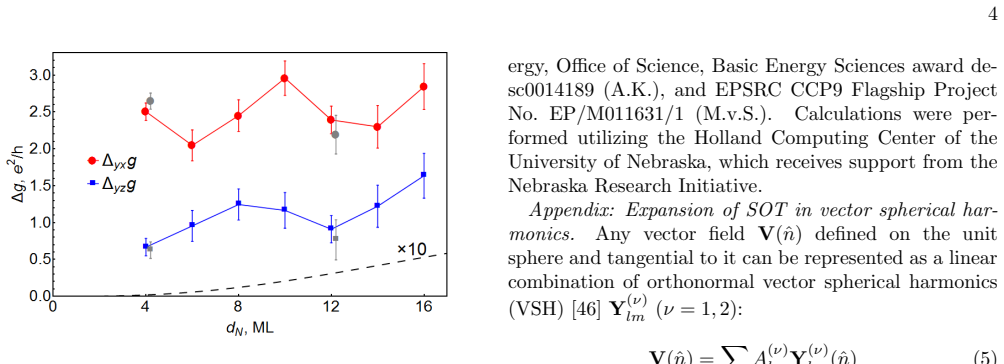
The central claim is that in Co/Pt and Co/Au bilayers, the damping-like spin-orbit torque is the sum of a bulk spin-Hall contribution that grows with heavy-metal thickness and a thickness-independent interfacial contribution of comparable size. In Co/Pt, the fitted interfacial constant is about 110 ns/m versus about 97 ns/m for the bulk spin-Hall part, and in Co/Au the interfacial part is also substantial. The paper additionally finds that the transverse magnetoconductance $\Delta_{yz}g$ in Co/Pt is of order $e^2/h$, which exceeds the spin-Hall magnetoresistance formula $\Delta_{yz}g^{\rm SH}=\theta_{\rm SH}^2\bar\rho\tanh^2(d_N/2l_{\rm sf})\tanh(d_N/l_{\rm sf})$ by more than an order of magnitude. The paper concludes that this magnetoconductance, like the damping-like torque, likely has an interfacial origin rather than a spin-Hall origin.
Load-bearing premise
The fit splits the torque into a bulk spin-Hall term with thickness dependence $1-\mathrm{sech}(d_N/l_{\rm sf})$ and a thickness-independent interfacial term; if the interfacial contribution itself changes with thickness, the split is not a physical decomposition.
Editorial extensions
If this is right
- For Co/Pt at typical disorder, the interfacial damping-like torque constant is about 110 ns/m, comparable to the bulk spin-Hall value near 97 ns/m, so neglecting the interface would overestimate the bulk spin-Hall torque.
- The spin-Hall magnetoresistance formula underpredicts the calculated $\Delta_{yz}g\sim e^2/h$ by more than an order of magnitude, so measured SMR in metallic bilayers cannot be taken as direct evidence for the spin-Hall effect.
- Since the angular functions of SMR, AMR, and interfacial anomalous magnetoresistance are linearly dependent, angular scans alone can determine only two independent parameters; separating the mechanisms requires thickness dependence or interface control.
- If the interfacial contribution is included, the effective spin-Hall angle inferred for Co/Pt rises from about $\theta_{\rm SH}\approx 0.02$ to about $0.06$, matching typical experimental values.
- The linear growth of SMR at small thicknesses, often cited in favor of spin-Hall theory, may instead indicate the thickness at which a continuous metal film forms, because the interface properties change over a few monolayers.
Reading between the lines
- If this interfacial picture is right, spin-Hall angles extracted from torque experiments on nanometer-thick bilayers are not bulk material parameters; they depend on interface quality and disorder, so comparing samples requires controlling the interface as well as the metal.
- A direct test would be to insert a single monolayer spacer at the Co/Pt interface or to vary interfacial roughness while keeping the Pt bulk unchanged; the interfacial torque and the large $\Delta_{yz}g$ should change substantially if they are truly interfacial.
- A natural computational extension is to repeat the thickness series with spin-orbit coupling scaled separately in the bulk and at the interface, mapping where the torque and magnetoresistance are generated and turning the fitted separation into a microscopic assignment.
- The same vector-spherical-harmonic expansion could be applied to other bilayer combinations, including systems with weak bulk spin-Hall effect, potentially revealing interfacial spin-orbit torque in materials previously classified as spin-Hall dominated.
Signed reviews
Editorial analysis
A structured set of objections, weighed in public.
Referee Report
Summary. The manuscript reports first-principles non-equilibrium Green's function (NEGF) calculations of spin-orbit torque (SOT) and magnetoresistance in Co/Pt and Co/Au bilayers with explicit Anderson disorder. The damping-like SOT is fitted to τ0 + τSH[1 - sech(dN/lsf)], yielding a thickness-independent interfacial part τ0 comparable to the spin-Hall part τSH. The transverse magnetoconductance Δyzg in Co/Pt is reported to be of order e²/h, exceeding the spin-Hall magnetoresistance prediction of Eq. (4) by more than an order of magnitude, which the authors attribute to an interfacial contribution. The paper also analyzes the field-like torque and the planar-Hall-like term, and proposes that the spin-Hall mechanism cannot account for the observed magnetoconductance.
Significance. If the central quantitative claim holds, the paper would provide first-principles evidence that interfacial transport processes dominate the magnetoresistance of Co/Pt bilayers, complementing similar conclusions for damping-like SOT. The methodological strengths include the use of NEGF with explicit disorder, the systematic expansion of SOT in vector spherical harmonics, and a genuine cross-observable check: θSH and lsf are fitted to SOT and then used to predict the magnetoresistance, not fitted to it. However, the dimensional inconsistency in Eq. (4) and the model dependence of the SOT decomposition currently prevent the central quantitative claim from being substantiated as written.
major comments (3)
- [Magnetoresistance, Eq. (4)] Equation (4) as printed is dimensionally inconsistent: Δyzg is defined in Eq. (3) as a reduced conductance with units of siemens, while the right-hand side θ_SH² ρ̄ tanh²(d_N/2l_sf) tanh(d_N/l_sf) has units of resistivity (Ω·m). The dashed line in Fig. 2 is additionally 'scaled by a factor of 10' without showing the unscaled curve, so the claim that the spin-Hall mechanism is too weak by more than an order of magnitude is not reproducible from the manuscript. The authors should re-derive the spin-diffusion SMR expression from the cited references, state any unit convention or missing length factor explicitly, and plot the unscaled benchmark.
- [Thickness dependence of SOT, Eq. (1)] The decomposition of the damping-like torque into τ0 + τSH[1 - sech(dN/lsf)] assumes a strictly thickness-independent interfacial contribution. The paper itself warns that this 'assumes a geometrical interface between homogeneous bulk regions and ignores thickness-dependent perturbations and finite-size effects.' Because the central claim of a comparable interfacial contribution rests on the fitted τ0, the authors should provide a sensitivity analysis, for example by allowing τ0 to have a weak thickness dependence or by fitting only data in a range where the interface is expected to be converged. Without such a test, the separation of τ0 and τSH in Table I is model-dependent.
- [Magnetoresistance, comparison with computed Δyzg] Even after fixing the units in Eq. (4), the benchmark uses the same θSH and lsf values that were obtained from the model-dependent SOT decomposition of Eq. (1). The comparison in Fig. 2 therefore inherits the assumptions of that decomposition. The manuscript should acknowledge this coupling explicitly and, if possible, show how the benchmark would change if the SOT fit parameters are varied within their uncertainty.
minor comments (5)
- [Abstract and Conclusions] The abstract and conclusions state that Δyzg is 'of the order of a conductance quantum per interfacial atom,' but the body text (Magnetoresistance section) states it is 'of the order of one conductance quantum' without a per-atom normalization. Please clarify which quantity is meant and define the normalization.
- [Fig. 2] The dashed line is described as 'scaled by a factor of 10' but the unscaled prediction is not shown. Please include the unscaled curve (or an inset) so the reader can directly compare the computed points with the theoretical benchmark.
- [Thickness dependence of SOT, first paragraph] There is a typo: 'τ0 andτSH' should have a space after 'and'.
- [Magnetoresistance, last paragraph] The notation '∆gyz/g' in the paragraph on the growth at small thicknesses is inconsistent with the earlier definition '∆µνg/g'; please unify the notation.
- [Eq. (2)] The quantity 'M/A' is used in the definition of θSH but is not explicitly defined in the main text; please define it as the total magnetic moment per unit area and specify its units.
Circularity Check
The interfacial SOT contribution is defined by the fitted form of Eq. (1) rather than independently derived, while the magnetoresistance benchmark is a genuine cross-check; circularity is partial.
-
self definitional
[Thickness dependence of SOT, Eq. (1) and the paragraph after Fig. 1]
"The damping-like SOT coefficient C (1) 1,−1 is well described by the function C (1) 1,−1 = τ0 + τSH [1 − sech(dN/lsf)] (1) with the parameters listed in Table I, where τ0 represents the thickness-independent interfacial contribution to SOT and τSH the conventional spin-Hall-generated part. Importantly, we find that τ0, which can appear due to interface scattering [8, 9], is comparable with τSH in both systems."
τ0 is not an independently computed or predicted interfacial torque; it is, by construction, the zero-thickness intercept of the chosen fitting function. Any thickness-independent residual after subtracting the assumed spin-diffusion term sech(dN/lsf) is assigned the label 'interfacial.' The paper's conclusion that damping-like SOT has an interfacial contribution comparable to the spin-Hall effect therefore restates the fit assumption rather than deriving it from first principles. The paper itself concedes that Eq. (1) 'assumes a geometrical interface between homogeneous bulk regions and ignores thickness-dependent perturbations and finite-size effects in the electronic structure of the bilayer.'
full rationale
The circularity is localized to the SOT decomposition. The magnetoresistance portion is not circular in the same sense: θ_SH, l_sf, and ρ̄ are fitted to the SOT thickness dependence and then used to form the Δyzg_SH benchmark for an independently computed magnetoconductance, which is a legitimate cross-observable test. However, Eq. (4) as printed is dimensionally inconsistent (left side is a reduced conductance while the right side retains resistivity units), and the dashed benchmark is only shown scaled by a factor of 10; these are correctness concerns rather than circularity. The self-citations to Ref. [26] (NEGF methodology and the previous statement about Co spin-orbit coupling) are not load-bearing in a circular way: the methodology is externally anchored, and the Co-SOC statement is re-verified for additional stacks in this paper. Overall, the central SOT claim reduces appreciably to the definition of τ0 in the fitting model, while the MR claim retains independent content, so the paper is partially but not wholly circular.
Assumptions & free parameters
free parameters (4)
- tau0 (thickness-independent SOT intercept) =
110.3 ns/m (Co/Pt, Vm=1.09 eV); 54.6 ns/m (Co/Au, Vm=1.09 eV)
- tauSH (spin-Hall SOT coefficient) =
96.5 ns/m (Co/Pt, Vm=1.09 eV); 108.9 ns/m (Co/Au, Vm=1.09 eV)
- lsf (spin-diffusion length) =
1.94 nm (Co/Pt, Vm=1.09 eV); 3.61 nm (Co/Au, Vm=1.09 eV)
- Vm (Anderson disorder amplitude) =
0.77 or 1.09 eV
assumptions (4)
- domain assumption Anderson disorder model captures dominant disorder scattering in these metallic bilayers.
- domain assumption Fermi-surface contribution to SOT dominates at room temperature.
- ad hoc to paper The bulk spin-Hall SOT contribution follows tauSH [1 - sech(dN/lsf)].
- domain assumption Spin-Hall SMR can be estimated from Eq. (4) with theta_SH and lsf taken from the SOT fit.
Cite this review
Pith. "Pith review of Interfacial contributions to spin-orbit torque and magnetoresistance in ferromagnet/heavy-metal bilayers." pith.science (2026). https://pith.science/paper/JRKK7LNC
@misc{pith2026190802680,
  author       = {Pith},
  title        = {Pith review of: Interfacial contributions to spin-orbit torque and magnetoresistance in ferromagnet/heavy-metal bilayers},
  year         = {2026},
  howpublished = {\url{https://pith.science/paper/JRKK7LNC}},
  note         = {Machine review of arXiv:1908.02680}
}
read the original abstract
The thickness dependence of spin-orbit torque and magnetoresistance in ferromagnet/heavy-metal bilayers is studied using the first-principles non-equilibrium Green's function formalism combined with the Anderson disorder model. A systematic expansion in orthogonal vector spherical harmonics is used for the angular dependence of the torque. The damping-like torque in Co/Pt and Co/Au bilayers can be described as a sum of the spin-Hall contribution, which increases with thickness in agreement with the spin-diffusion model, and a comparable interfacial contribution. The magnetoconductance in the plane perpendicular to the current in Co/Pt bilayers is of the order of a conductance quantum per interfacial atom, exceeding the prediction of the spin-Hall model by more than an order of magnitude. This suggests that the "spin-Hall magnetoresistance," similarly to the damping-like torque, has a large interfacial contribution unrelated to the spin-Hall effect.
Figures

Reference graph
Works this paper leans on
-
[26]
K. D. Belashchenko, A. A. Kovalev, and M. van Schilf- gaarde, Phys. Rev. Materials 3, 011401 (2019)
work page 2019
- [1]
- [2]
-
[3]
I. M. Miron, G. Gaudin, S. Auffret, B. Rodmacq, A. Schuhl, S. Pizzini, J. Vogel, and P. Gambardella, Nat. Mater. 9, 230 (2010)
work page 2010
-
[4]
L. Liu, T. Moriyama, D. C. Ralph, and R. A. Buhrman, Phys. Rev. Lett. 106, 036601 (2011)
2011
-
[5]
A. Manchon, J. Zelezn´ y, I. M. Miron, T. Jungwirth, J. Sinova, A. Thiaville, K. Garello, and P. Gambardella, arXiv:1801.09636 (2018)
arXiv 2018
-
[6]
Nakayama, M
H. Nakayama, M. Althammer, Y.-T. Chen, K. Uchida, Y. Kajiwara, D. Kikuchi, T. Ohtani, S. Gepr¨ ags, M. Opel, S. Takahashi, R. Gross, G. E. W. Bauer, S. T. B. Goennenwein, and E. Saitoh, Phys. Rev. Lett. 110, 206601 (2013)
2013
-
[7]
Y.-T. Chen, S. Takahashi, H. Nakayama, M. Althammer, S. T. B. Goennenwein, E. Saitoh, and G. E. W. Bauer, Journal of Physics: Condensed Matter 28, 103004 (2016)
work page 2016
Show all 46 references
-
[8]
V. P. Amin and M. D. Stiles, Phys. Rev. B 94, 104419 (2016)
2016
-
[9]
V. P. Amin and M. D. Stiles, Phys. Rev. B 94, 104420 (2016)
2016
-
[10]
K. D. Belashchenko, A. A. Kovalev, and M. van Schilf- gaarde, Phys. Rev. Lett. 117, 207204 (2016)
2016
-
[11]
L. Zhu, D. C. Ralph, and R. A. Buhrman, Phys. Rev. Lett. 122, 077201 (2019)
2019
-
[12]
Y.-T. Chen, S. Takahashi, H. Nakayama, M. Althammer, S. T. B. Goennenwein, E. Saitoh, and G. E. W. Bauer, Phys. Rev. B 87, 144411 (2013)
2013
-
[13]
Sinova, S
J. Sinova, S. O. Valenzuela, J. Wunderlich, C. H. Back, and T. Jungwirth, Rev. Mod. Phys. 87, 1213 (2015)
2015
-
[14]
Liu, C.-F
L. Liu, C.-F. Pai, Y. Li, H. W. Tseng, D. C. Ralph, and R. A. Buhrman, Science 336, 555 (2012)
2012
-
[15]
L. Liu, O. J. Lee, T. J. Gudmundsen, D. C. Ralph, and R. A. Buhrman, Phys. Rev. Lett. 109, 096602 (2012)
2012
-
[16]
A. G. Aronov and Y. B. Lyanda-Geller, JETP Lett. 50, 431 (1989)
1989
-
[17]
Edelstein, Solid State Commun
V. Edelstein, Solid State Commun. 73, 233 (1990)
1990
-
[18]
S. D. Ganichev, M. Trushin, and J. Schliemann, in Hand- book of spin transport and magnetism , edited by E. Y. Tsymbal and I. ˇZuti´ c (CRC, Boca Raton, FL, 2011) p. 487
2011
-
[19]
Chernyshov, M
A. Chernyshov, M. Overby, X. Liu, J. K. Furdyna, Y. Lyanda-Geller, and L. P. Rokhinson, Nat. Phys. 5, 656 (2009)
2009
-
[20]
I. M. Miron, K. Garello, G. Gaudin, P.-J. Zermatten, M. V. Costache, S. Auffret, S. Bandiera, B. Rodmacq, A. Schuhl, and P. Gambardella, Nature 476, 189 (2011)
2011
-
[21]
Manchon, H
A. Manchon, H. C. Koo, J. Nitta, S. M. Frolov, and R. A. Duine, Nat. Mater. 14, 871 (2015)
2015
-
[22]
X. Fan, H. Celik, J. Wu, C. Ni, K.-J. Lee, V. O. Lorenz, and J. Q. Xiao, Nat. Commun. 5, 3042 (2014)
2014
-
[23]
D. A. Pesin and A. H. MacDonald, Phys. Rev. B 86, 014416 (2012)
2012
-
[24]
Qaiumzadeh, R
A. Qaiumzadeh, R. ˆA. A. Duine, and M. Titov, Phys. Rev. B 92, 014402 (2015)
2015
-
[25]
I. A. Ado, O. A. Tretiakov, and M. Titov, Phys. Rev. B 95, 094401 (2017)
2017
-
[27]
J. Kim, J. Sinha, M. Hayashi, M. Yamanouchi, S. Fukami, T. Suzuki, S. Mitani, and H. Ohno, Nat. Mater. 12, 240 (2013)
2013
-
[28]
Ramaswamy, X
R. Ramaswamy, X. Qiu, T. Dutta, S. D. Pollard, and H. Yang, Appl. Phys. Lett. 108, 202406 (2016)
2016
-
[29]
Torrejon, J
J. Torrejon, J. Kim, J. Sinha, S. Mitani, M. Hayashi, M. Yamanouchi, and H. Ohno, Nat. Commun. 5, 4655 (2014)
2014
-
[30]
L. Wang, R. J. H. Wesselink, Y. Liu, Z. Yuan, K. Xia, and P. J. Kelly, Phys. Rev. Lett. 116, 196602 (2016). 6
2016
-
[31]
Freimuth, S
F. Freimuth, S. Bl¨ ugel, and Y. Mokrousov, Phys. Rev. B 90, 174423 (2014)
2014
-
[32]
Mahfouzi and N
F. Mahfouzi and N. Kioussis, Phys. Rev. B 97, 224426 (2018)
2018
-
[33]
S. V. Faleev, F. L´ eonard, D. A. Stewart, and M. van Schilfgaarde, Phys. Rev. B 71, 195422 (2005)
2005
-
[34]
B. K. Nikoli´ c, K. Dolui, M. D. Petrovi´ c, P. Plech´ aˇ c, T. Markussen, and K. Stokbro, in Handbook of Ma- terials Modeling: Applications: Current and Emerging Materials, edited by W. Andreoni and S. Yip (Springer International Publishing, Cham, 2018) pp. 1–35
2018
-
[35]
Turek, V
I. Turek, V. Drchal, J. Kudrnovsk´ y, M. ˇSob, and P. Weinberger, Electronic Structure of Disordered Alloys, Surfaces and Interfaces (Kluwer, Boston, 1997)
1997
-
[36]
Pashov, S
D. Pashov, S. Acharya, W. R. L. Lambrecht, J. Jackson, K. D. Belashchenko, A. Chantis, F. Jamet, and M. van Schilfgaarde, arXiv:1907.06021 (2019)
2019 arXiv
-
[37]
N. H. Long, P. Mavropoulos, D. S. G. Bauer, B. Zimmer- mann, Y. Mokrousov, and S. Bl¨ ugel, Phys. Rev. B 94, 180406(R) (2016)
2016
-
[38]
V. P. Amin, J. Li, M. D. Stiles, and P. M. Haney, Phys. Rev. B 99, 220405(R) (2019)
2019
-
[39]
G. Y. Guo, S. Murakami, T.-W. Chen, and N. Nagaosa, Phys. Rev. Lett. 100, 096401 (2008)
2008
-
[40]
Safranski, E
C. Safranski, E. A. Montoya, and I. N. Krivorotov, Nat. Nanotechnol. 14, 27 (2019)
2019
-
[41]
J. Kim, P. Sheng, S. Takahashi, S. Mitani, and M. Hayashi, Phys. Rev. Lett. 116, 097201 (2016)
2016
-
[42]
Kawaguchi, D
M. Kawaguchi, D. Towa, Y.-C. Lau, S. Takahashi, and M. Hayashi, Appl. Phys. Lett. 112, 202405 (2018)
2018
-
[43]
V. L. Grigoryan, W. Guo, G. E. W. Bauer, and J. Xiao, Phys. Rev. B 90, 161412(R) (2014)
2014
-
[44]
M. Bode, S. Heinze, A. Kubetzka, O. Pietzsch, X. Nie, G. Bihlmayer, S. Bl¨ ugel, and R. Wiesendanger, Phys. Rev. Lett. 89, 237205 (2002)
2002
-
[45]
Gould, C
C. Gould, C. R¨ uster, T. Jungwirth, E. Girgis, G. M. Schott, R. Giraud, K. Brunner, G. Schmidt, and L. W. Molenkamp, Phys. Rev. Lett. 93, 117203 (2004)
2004
-
[46]
V. B. Berestetskii, E. M. Lifshitz, and L. P. Pitaevskii, Quantum electrodynamics (Elsevier, Oxford, 1982)
1982
Reviewed August 14, 2026 · model on record in the stance chip above.
Discussion (0). Continue with ORCID to comment.